

What Is Direct Access Physical Therapy in Florida
You wake up in Deerfield Beach with a stiff lower back, a sharp twinge when you stand, or neck pain that makes turning toward the coffee pot uncomfortable. Your first thought may be, “I need to see my doctor before I can see a physical therapist.” In Florida, that assumption often adds an unnecessary step.
Direct access physical therapy lets you contact a licensed physical therapist directly for a musculoskeletal problem, without waiting for a physician referral to begin the conversation. That doesn't mean every pain problem belongs in a therapy clinic, or that medical evaluation is never necessary. It means a qualified therapist can assess your movement, screen for warning signs, and help determine the safest next step sooner.
When Back Pain Hits, What Comes First
Tuesday morning in Deerfield Beach: you lifted a box over the weekend, slept awkwardly, or spent hours driving. Now your lower back hurts when you stand, sit, or get out of bed. You call your primary care office and learn that the next appointment does not fit your schedule. Even after that visit, you may need another appointment with a physical therapist.
That delay matters when the problem appears connected to movement, strength, flexibility, or function. Direct access changes the first question from “Who can write my referral?” to “Can a licensed physical therapist safely evaluate this?”

The practical decision
Say your pain started after gardening and worsens when you bend, sit, or rise from a chair. At a Deerfield Beach clinic such as MedAmerica Rehab Center, you can describe those details during scheduling and ask whether a same-day evaluation is appropriate. The therapist can review your history, examine movement, check strength and mobility, and identify what increases or eases the symptoms.
That visit may lead to a therapy plan. It may also show that you need medical assessment before treatment continues. A careful therapist screens for warning signs rather than assuming every back problem belongs in physical therapy.
The same decision applies to a stiff neck after travel, shoulder pain that makes dressing difficult, knee discomfort on stairs, or recurring arthritis-related symptoms. The therapist's role includes assessing the movement problem and recognizing findings that warrant referral.
Practical rule: Direct access helps most when it shortens the route to an appropriate evaluation while preserving medical care when symptoms require it.
Earlier assessment can reduce guesswork. Complete rest, self-directed pain medication, or waiting for symptoms to settle may leave the underlying movement limitation unaddressed. A systematic review of direct access physical therapy supports direct access as a reasonable pathway for appropriate musculoskeletal complaints, with the included research reporting favorable clinical and healthcare-use findings without reported adverse effects.
Before booking, ask how Florida's rules apply, whether your insurance requires a referral for coverage, and what the clinic recommends for unusual or urgent symptoms. Same-day access can make the first decision easier, but safety determines the next one.
Understanding Direct Access Physical Therapy
You wake up with shoulder pain, cannot reach a high shelf, and wonder whether to call your doctor first. In Florida, you can often schedule an evaluation directly with a licensed physical therapist. Direct access physical therapy means you can seek an initial evaluation without first obtaining a physician's referral or prescription, subject to state law, insurance rules, and the therapist's clinical judgment.
The first appointment still includes a professional assessment. Your therapist reviews your symptoms, health history, movement, and daily limitations, then decides whether physical therapy fits your situation. If the findings suggest another medical problem, the therapist can recommend evaluation by a physician or urgent care instead of beginning routine treatment.

How the first contact works
When you contact a clinic, describe:
- Where it hurts: Include your back, neck, shoulder, hip, knee, or another area.
- How it started: Mention a lifting incident, fall, auto accident, sports activity, surgery, or gradual change.
- What you cannot do: Explain problems with walking, sleeping, reaching, working, exercising, or household tasks.
- What concerns you: Numbness, unusual weakness, fever, unexplained changes, severe symptoms, or rapid worsening require careful screening.
During the evaluation, the therapist may check posture, gait, range of motion, strength, balance, coordination, and functional movements. Treatment may involve hands-on care, targeted exercises, education, and activity changes. The visit can also end with a recommendation to contact a physician or obtain urgent medical attention.
Who tends to benefit
Direct access can suit adults with common back, neck, joint, muscle, and movement-related complaints. It may also help people with sports injuries, recovery after an orthopedic procedure, balance limitations, or recurring stiffness when the therapist determines that treatment is appropriate.
Access does not replace your primary care clinician, orthopedist, neurologist, or emergency provider. It gives you an earlier clinical checkpoint with a professional trained to assess movement and function. A responsible therapist should explain when your symptoms exceed physical therapy's scope and help identify the right medical resource.
Before booking at a Deerfield Beach clinic such as MedAmerica Rehab Center, confirm whether your plan requires a referral for payment, even if Florida law permits direct scheduling. That distinction can affect your out-of-pocket cost and the number of visits covered.
Florida Direct Access Laws and Limitations
Florida permits patients to contact a physical therapist without first seeing a physician, but that permission has boundaries. The state's direct access framework allows an initial 21-day period of treatment without physician supervision. If treatment must continue after that period, a physician must evaluate the patient and authorize further care.
The time limit creates a medical checkpoint for longer or more complicated cases. During the initial period, your therapist should track your response, document progress, and explain what will happen if your symptoms do not improve as expected.
What the time limit means in practice
Your first visit still requires a full clinical assessment. Arriving without a referral does not mean you receive a routine exercise plan automatically. The therapist should review your history, discuss your current symptoms, assess how the problem affects daily activities, and look for findings that may require medical care instead.
If your condition responds appropriately, the therapist can provide conservative treatment and outline the next steps. If you need care beyond the 21-day period, the clinic can explain how physician involvement will work. Insurance rules may also affect scheduling or payment, even when Florida law allows you to book therapy directly.
The practical decision comes down to three separate questions: legal access, clinical suitability, and coverage. You may have the legal right to schedule with a therapist, while particular symptoms still call for physician evaluation or your insurance plan requires authorization.
What the evidence says about safety and burden
A 2026 systematic review of direct access for adults with musculoskeletal disorders found fewer primary-care consultations in the reviewed studies, along with neutral-to-reduced costs in the cost analyses and no consistent signal of increased harm. For Florida patients, that supports direct access as a reasonable first route for appropriate musculoskeletal complaints. It does not replace red-flag screening or medical oversight when the situation calls for it.
The 2021 review also reported no adverse effects in the included studies. Evidence from other health systems cannot guarantee what will happen in every Florida case, so the therapist's assessment remains the deciding safety step.
Seek urgent medical attention instead of waiting for a routine therapy appointment if symptoms suggest a serious or rapidly changing condition. If you are unsure, describe the symptoms clearly when contacting a Deerfield Beach clinic such as MedAmerica Rehab Center. Staff can help determine whether a physical therapist or medical provider should see you first.
Direct Access Versus Traditional Referral Pathways
Your first appointment depends on the problem you are trying to solve. A physician-first route makes sense when you may need a medical diagnosis, medication management, imaging, surgery planning, or assessment by another specialist. A therapist-first route can be practical when pain or limited movement appears musculoskeletal and you want an evaluation focused on function.
In the traditional pathway, you schedule with a physician, complete that evaluation, and wait for any testing, referral, and therapy scheduling steps. Direct access starts with a physical therapist. You contact the clinic, describe what happened, and receive an examination of movement, strength, mobility, and function. If the findings fall outside physical therapy's scope, the therapist recommends the appropriate medical follow-up.
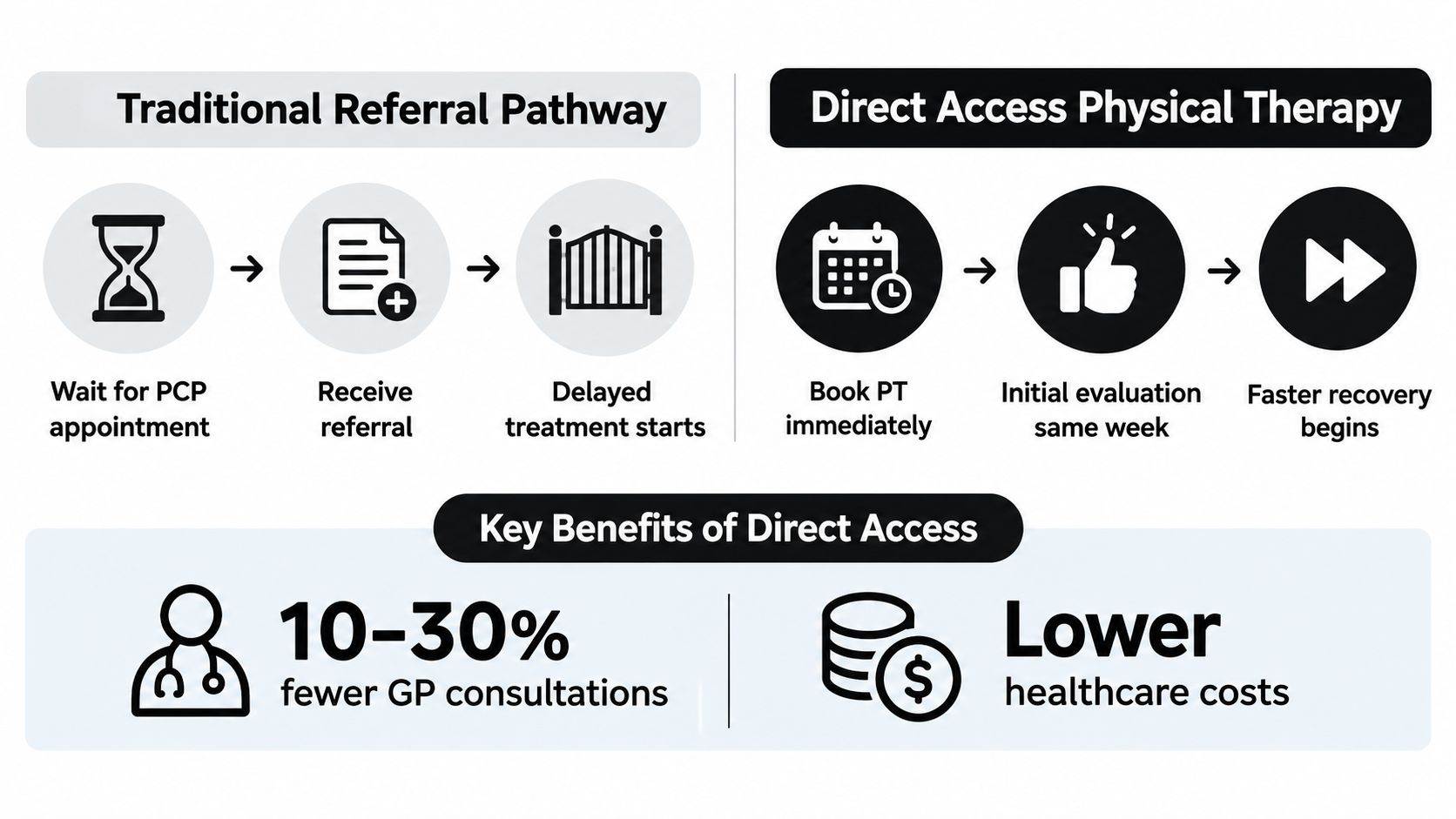
Choose the route that fits your situation
Choose direct access if:
- Your symptoms began after activity, work, exercise, or a familiar musculoskeletal strain.
- Your main concern is pain, stiffness, weakness, balance, or reduced movement.
- You want a movement-based assessment before deciding whether further medical care is needed.
- You can confirm your insurance plan's rules, or you are prepared to discuss payment expectations with the clinic.
- You want to reduce unnecessary scheduling steps and can provide a clear symptom history.
Choose physician-first care if:
- Symptoms are severe, rapidly changing, or difficult to explain.
- You may need imaging, medication, surgery planning, or care from another specialist.
- A medical condition, recent procedure, or complex health history may affect treatment.
- Your insurance or employer program requires a physician referral or authorization.
- The clinic's screening identifies a concern that needs medical evaluation before therapy.
Direct access is a screening-and-treatment pathway, not a promise that therapy is appropriate. A physical therapist must decide whether the presentation fits physical therapy and whether referral is needed. The 2026 evidence synthesis associated direct access with fewer primary-care consultations and reduced imaging in most studies. That supports a therapist-first option for suitable complaints, while leaving room for physician care when the clinical picture is more complex.
The practical choice can also involve provider roles. If you are comparing conservative care options, review the difference between a chiropractor and a physical therapist before booking.
At a Deerfield Beach clinic such as MedAmerica Rehab Center, you can describe the problem during scheduling and ask whether a therapist-first evaluation is appropriate. Bring your medication list, relevant medical history, and details about how the symptoms started. That information helps the clinic choose the safest first appointment.
You can also watch the following overview for a visual explanation of the pathway.
Insurance Coverage and Practical Benefits
A missing referral does not automatically determine whether insurance will pay. Florida law and insurance-plan administration aren't identical. Florida permits direct access within its legal limits, while a plan may still require eligibility checks, authorization, specific documentation, visit limits, in-network care, or other conditions.
The APTA report on the state of direct access describes a practical gap between legal access and payment policies. Patients may not realize they can seek physical therapy without a referral, and providers may not know how a particular insurer handles direct-access treatment. An employer, payer, or plan administrator can therefore create paperwork requirements even when Florida law allows you to start with a physical therapist.
Ask these questions before your appointment
Call the clinic or insurer and confirm:
- Is the therapist in network? Network status can change your share of the cost.
- Does the plan require authorization? Approval may be required before treatment or after the first evaluation.
- Does the plan impose a referral rule? Ask specifically about direct-access physical therapy.
- Are there exclusions? Medicare, Medicaid, workers' compensation, auto claims, and employer policies may use different administrative processes.
- What will I owe? Ask about deductibles, copayments, coinsurance, and the clinic's self-pay policy.
Write down the representative's name, the date of the call, and any reference number. That record can help if the information given by phone differs from a later explanation of benefits.
These questions separate permission to begin care from the insurer's decision about payment. A payer can request paperwork even though Florida permits an initial physical therapy evaluation without a physician referral.
Why earlier access can be useful
For a suitable complaint, direct access can shorten the wait before a therapist assesses the problem. Early care may focus on the task that is limited, such as lifting, sitting, walking, training, or sleeping. Your therapist can adjust movement instruction, activity changes, and strengthening as your symptoms and function respond, rather than leaving you with a generic handout.
MedAmerica Rehab Center is a family-owned Deerfield Beach clinic that has provided physical therapy and related rehabilitation services since 1995. Its intake process addresses insurance and scheduling details while the team treats acute and chronic conditions, sports injuries, post-surgical needs, and other movement-related problems.
Cost still belongs in the decision. If you are paying privately or comparing choices, review this guide to physical therapy cost without insurance and ask the clinic for a current explanation of charges. Coverage rules can change, so verify your benefits before assuming that every direct-access visit will be covered.
Getting Started at MedAmerica Rehab Center
You wake up in Deerfield Beach with back pain that makes sitting, walking, or lifting difficult. If you want to explore direct access physical therapy, call MedAmerica Rehab Center or submit an online request. Tell the team where it hurts, when it began, what activities are limited, and whether the problem followed an accident, surgery, work task, or sports activity.
Same-day appointments may be available when the schedule allows. During the first conversation, staff can review appointment options, collect insurance information, and discuss whether your symptoms appear appropriate for a physical therapy evaluation. Florida may allow you to begin without a physician referral, but your insurer can apply separate rules to coverage and payment.

What to bring and explain
Bring identification, insurance details, a medication list, relevant medical records, and information about previous treatment. Mention imaging, surgery, an accident, or a workers' compensation claim when you schedule. Ask the insurer whether a referral, authorization, visit limit, or specific network requirement applies, and record the representative's name or reference number if one is provided.
A clear symptom summary helps the therapist assess your situation:
- The starting point: Say whether symptoms appeared suddenly or gradually.
- The pattern: Describe what improves or worsens them, including sitting, walking, lifting, reaching, or sleeping.
- The effect on daily life: Identify the activity you most want to regain.
- Your concerns: Report numbness, weakness, balance changes, or symptoms that feel different from ordinary soreness.
Use everyday language. Explaining what you can and cannot do is more useful than trying to diagnose yourself.
What happens during the evaluation
A licensed therapist reviews your health information, examines movement and function, and discusses your goals. Treatment may include hands-on care, targeted exercises, education, balance or gait training, and other evidence-based modalities. MedAmerica also describes advanced shockwave therapy among its services, although the evaluation determines whether it fits your needs.
Before you leave, you should understand what may be contributing to the limitation, which activities or exercises to do at home, how often visits may be appropriate, and which changes require medical follow-up. If physical therapy is not the right starting point, the therapist should explain why and recommend the next step.
Choosing a clinic involves more than finding the earliest appointment. This guide on how to choose a physical therapist covers licensing, communication, relevant experience, insurance processes, and whether treatment can adapt to your goals.
MedAmerica also describes a mobile physical therapy option for patients who have difficulty traveling. Ask whether in-home treatment, exercise, and functional training suit your needs, and confirm how insurance or private payment would apply.
If pain or limited movement is disrupting your routine, contact the clinic with a clear symptom summary. Confirm Florida and insurance requirements, then let a licensed professional help determine the safest starting point.
MedAmerica Rehab Center offers direct-access evaluations, same-day availability when scheduling permits, and individualized care for pain, mobility, sports, accident, and post-surgical concerns in Deerfield Beach. Visit MedAmerica Rehab Center to request an appointment.
MedAmerica Rehab · Deerfield Beach
Talk to a clinician about your pain
Physical therapy, chiropractic, acupuncture and shockwave therapy under one roof, since 1995. Same-day appointments are available.
Mon–Thu 8:00 AM – 6:30 PM · Fri 8:00 AM – 3:00 PM