

How to Find a Good Chiropractor Near You
You're probably doing what many do. You wake up with back pain, your neck won't turn comfortably, or an old car accident injury starts acting up again, and you search for a chiropractor near Deerfield Beach. Then the same problem hits: every clinic says it treats everything, every website looks polished, and the reviews don't tell you what you need to know.
A good chiropractor isn't just someone nearby with a license and a few glowing comments. A good chiropractor is someone who can tell you what's wrong, explain why a treatment fits your case, measure whether it's helping, and change course when it's not. That's the part many patients miss when they're trying to figure out how to find a good chiropractor.
The profession itself has been around since September 18, 1895, when D.D. Palmer delivered the first documented chiropractic adjustment in Davenport, Iowa. Over time, chiropractic became a regulated profession, with Kansas becoming the first U.S. state to specifically recognize and license chiropractic in 1913, Louisiana the last in 1974, and unified licensure standards advancing in 1933 through the organization that later became the Federation of Chiropractic Licensing Boards, as outlined in the World Federation of Chiropractic history overview. That history matters for one simple reason: modern chiropractic should be judged by current licensure, training, screening, and clinical decision-making, not by tradition alone.
What a Good Chiropractor Fit Really Looks Like
A Deerfield Beach patient with low back pain after long hours sitting at work usually doesn't need the same plan as a golfer with shoulder and neck stiffness, or someone dealing with post-accident whiplash. Yet many people search as if the job is to find the closest clinic with an open appointment.
That's where bad matches start.

Fit matters more than distance
A good fit feels organized from the start. The clinician asks what changed, what movements hurt, what has already been tried, and what you need to get back to. For one person, that may be sleeping through the night without neck pain. For another, it may be driving without sciatica or returning to pickleball after a flare.
That's very different from walking into a clinic and being told everyone gets the same adjustment plan.
When patients are sorting through options, I often tell them to think in terms of function, not just pain. Pain matters, but function tells you whether care is moving your life forward. If you also want practical home strategies, simple products and self-care ideas in this back and neck pain relief guide can help you ask better questions about what should happen between visits.
Practical rule: The right chiropractor should be able to connect your symptoms to a clear activity goal, then explain how progress will be checked.
What a strong clinical fit includes
A good chiropractor fit usually includes these basics:
- A diagnosis-driven plan that links treatment to your actual problem, not just a body region.
- Measurable goals such as improved turning, easier walking, less pain with sitting, or better tolerance for work tasks.
- A short reassessment window so you're not stuck repeating the same care indefinitely.
- Coordination when needed with physical therapy, primary care, imaging, or post-accident documentation.
- Clear expectations about what care can help and what it probably won't.
For readers comparing local options, MedAmerica's chiropractic health and wellness approach is one example of how a clinic can present services around whole-body function rather than only adjustments.
What success actually looks like
The best visits usually don't feel mysterious. You should leave understanding what the clinician found, what the first phase of care is meant to do, and what signs would mean the plan needs to change.
A good chiropractor fit doesn't mean hearing what you want to hear. It means getting a plan specific enough to test.
That's especially important in Deerfield Beach, where patients often need overlapping care needs addressed at once: desk-related neck pain, post-surgical stiffness, sports overuse, or auto accident injuries that benefit from coordinated rehab rather than a stand-alone adjustment schedule.
Where to Start Your Search Without Wasting Time
Wasting time happens in one of two ways. Either nobody is asked and search results are relied on alone, or everyone is asked and a pile of names is gathered that can't be sorted through.
A better approach is to build a shortlist fast, then vet only the clinics that match your situation.
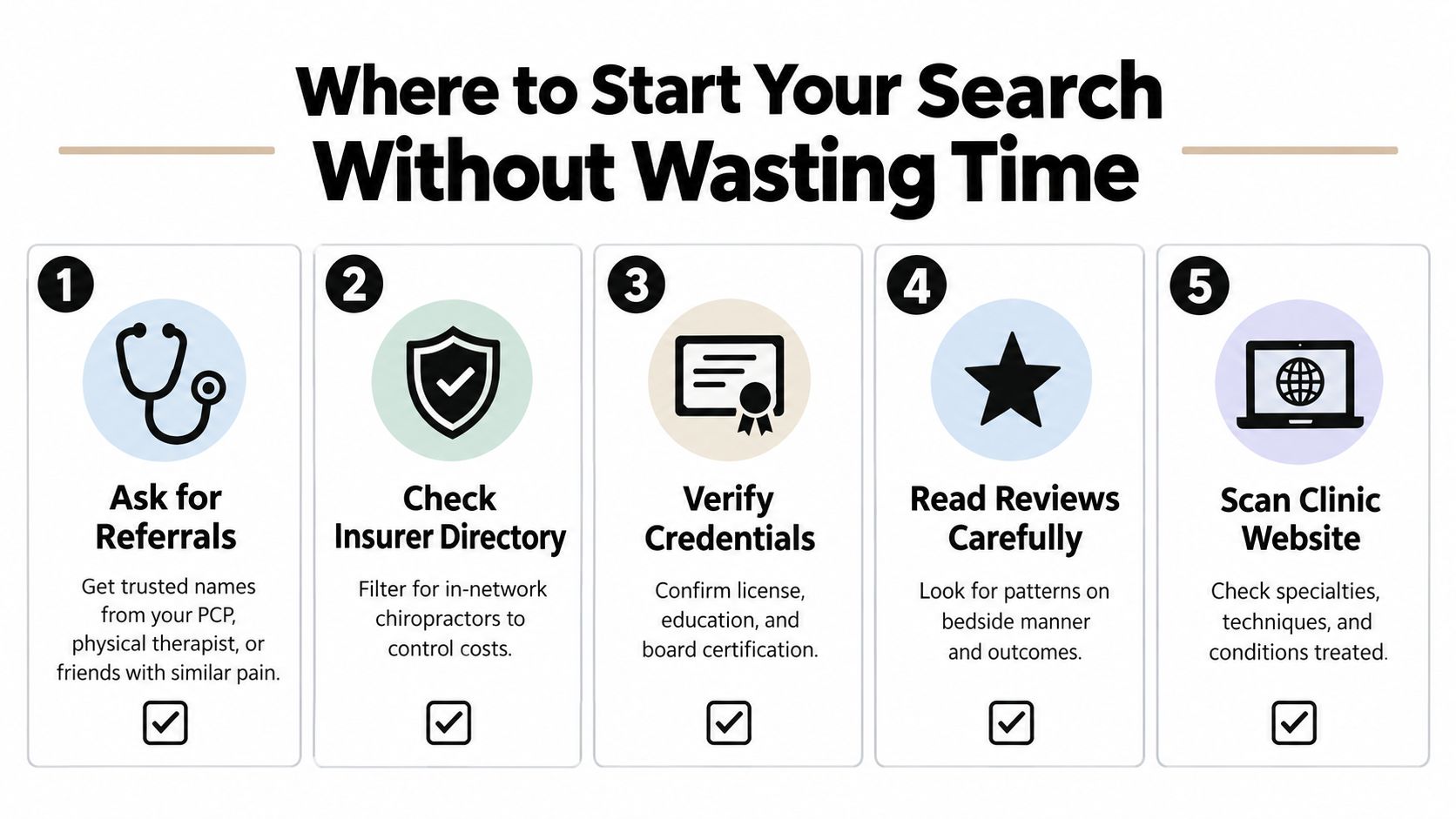
Start with people who know your case
If you already have a provider involved in your care, ask there first. The referral itself isn't the final answer, but it usually gives you a cleaner starting point than random online searching.
Useful referral sources include:
- Your primary care clinician if you've already been evaluated and want a conservative next step.
- Your physical therapist if you need manual care blended with exercise and movement retraining.
- Your orthopedic office if your symptoms involve prior surgery or imaging findings that matter.
- Your attorney after an auto injury if documentation, scheduling consistency, and case coordination are part of the picture.
- A friend with a similar problem, not just any friend who “likes their chiropractor.”
If you want a parallel framework for choosing another front-line provider, these primary care doctor search tips are useful because the same principle applies: start with fit, logistics, and communication, not branding.
Build a shortlist in one sitting
Keep this part simple. You do not need a spreadsheet with twenty names.
Use this sequence:
- Pull your insurer directory first if in-network access matters to you.
- Add referred names from clinicians or trusted local contacts.
- Limit the list to a handful of offices that treat your type of complaint.
- Call or check online scheduling for same-day or near-term availability if you're in pain now.
- Note what each clinic emphasizes. Rehab? Sports injuries? Auto accidents? Seniors? Post-surgical support?
That last step matters more than many people realize. A clinic that's organized around wellness memberships may not be the right fit for someone with new sciatica, a workers' compensation claim, or a neck injury after a collision.
Read reviews for patterns, not stars
A five-star average doesn't tell you much by itself. Reviews are useful when they repeatedly mention the same operational and clinical themes.
Read reviews looking for patterns such as:
- Communication. Do patients say the doctor explained the problem clearly?
- Thoroughness. Do they mention an exam, movement testing, or follow-up checks?
- Front desk reliability. Scheduling problems can become a real issue if you need coordinated care.
- Population fit. Are there comments from athletes, seniors, or post-accident patients if that's your category?
- Pressure or lack of pressure. Reviews often reveal whether patients felt pushed into prepaid care.
If every review talks about being “friendly” but none mention assessment, explanations, or progress, keep looking.
Deerfield Beach shortcuts that actually help
Busy adults, retirees, and injured drivers all need different shortcuts.
For local searching, these questions save time:
- Can they see new patients quickly?
- Do they handle insurance verification before the first visit?
- Can they coordinate with physical therapy if rehab is needed?
- Do they have experience with auto accident or workers' compensation cases?
- Will they tell you what to bring, including imaging or prior records?
Those answers won't tell you everything. But they'll eliminate a lot of clinics that look good online and work poorly in real life.
How to Verify Credentials Specialties and Screening Quality
Once you have a short list, the next step is verification. Many patients stop too early. They see “licensed chiropractor,” feel reassured, and assume the rest will sort itself out.
Licensure matters. It just isn't enough.
What licensure tells you and what it doesn't
Because chiropractic evolved from a single documented adjustment in 1895 into a regulated profession with state licensing and later unified licensure standards, current board status is a practical baseline, not a bonus. The history is useful because it sets a modern expectation: verify that the doctor is licensed now, trained formally, and accountable to current professional standards, not established in the community.
That check answers one question. It does not answer whether the provider is a good match for your condition.
A chiropractor may be fully licensed and still be a poor fit for post-surgical recovery, older adults with balance concerns, or a patient who needs active rehab more than repeated passive treatment.
Match the specialty to the problem
Patients can save themselves weeks of frustration. Ask what kinds of cases the clinic handles routinely.
Examples of a better match:
- Sports or active adult complaints often benefit from a clinician who looks at movement patterns, training load, and return-to-activity planning.
- Auto accident injuries often require documentation, reassessment, and coordination with other providers.
- Workers' compensation cases need consistency and attention to work function.
- Post-surgical or medically complex cases demand caution, communication, and comfort with co-management.
- Low back pain with rehab needs often goes better when chiropractic care and exercise planning are integrated rather than separated.
If you're trying to sort out whether chiropractic care, rehab exercise, or both make sense for back pain, this comparison of physical therapy vs chiropractor for back pain is worth reading before you book.
Screening quality is the real separator
This is the part patients rarely ask about and should.
Independent guidance warns against choosing a chiropractor who makes broad cure claims or skips risk screening. It also flags the need to screen for concerns such as osteoporosis, neurologic symptoms, recent surgery or infection, pregnancy, or unstable medical or mental status, and to avoid treatment if the clinician can't clearly explain contraindications and obtain informed consent, according to the ASH clinical guidance on manipulation screening and contraindications.
A strong screening visit usually includes questions about:
- Current symptoms including numbness, weakness, dizziness, and radiating pain
- Medication use, especially if it affects bone health, bleeding risk, or balance
- History of falls or fractures
- Prior imaging and surgeries
- Age-related risk factors
- Mechanism of injury, especially after trauma
Look for objective follow-up
A recent review noted that practice standards still vary, informed consent is inconsistent, and adverse-event reporting is poor. It argued that outcome tracking and re-evaluation are stronger quality signals than marketing claims alone, as summarized in this review on chiropractic safety, standards, and follow-up quality.
That lines up with what works in clinic every day. A provider who documents your baseline function, tests movement, sets goals, and rechecks progress gives you something real to judge. A provider who only says “you're out of alignment” leaves you with no way to know whether care is helping.
The most useful quality signal isn't the slogan on the homepage. It's whether the clinic measures function, rechecks it, and changes the plan when progress stalls.
Questions to Ask Before You Book and During Your Consultation
A phone call and a first visit should do more than secure a time slot. They should tell you how the clinic thinks.
The strongest chiropractors don't get defensive when you ask direct questions. They answer them clearly.
Questions worth asking on the phone
Before you book, ask a few practical questions:
- Do you treat my kind of problem often? Be specific. Low back pain, whiplash, sciatica, post-surgical stiffness, headaches, balance issues.
- What does the first visit include? You want history, exam, and a plan discussion, not an automatic treatment conveyor belt.
- Do you coordinate with physical therapy or other providers if needed?
- How do you handle auto accident or workers' compensation paperwork if that applies?
- How quickly can I be re-evaluated if symptoms change?
Short, direct answers are usually a good sign. Evasive answers usually stay evasive after you arrive.
Questions to ask in the consultation
Clinical guidelines for low back pain support spinal manipulation as an option best used alongside active care such as exercise, education, and self-management, not as a stand-alone fix. They also support a diagnosis-driven plan, measurable goals, and a short reassessment window, with the plan changing or the case being co-managed if symptoms don't improve, as noted in this guideline review on low back pain care and spinal manipulation.
Use that standard in the room.
Ask questions like:
- What do you think is driving my symptoms?
- Why is manipulation appropriate for my case, if you recommend it?
- What else will I need besides adjustments?
- What goals should improve first?
- When will you reassess whether this is working?
- If it doesn't help enough, what changes next?
What Good Answers Sound Like at Consultation
| Question to Ask | Strong Answer Signals | Weak Answer Signals |
|---|---|---|
| What do you think is causing this? | Gives a working diagnosis tied to history and exam findings | Says everything is due to the same generic spinal problem |
| Why is this treatment appropriate? | Explains why manipulation, exercise, or other care fits your condition | Says everyone needs the same treatment |
| What else should be part of care? | Includes exercise, education, activity modification, or co-management when needed | Offers adjustment-only care with no self-management plan |
| How will we know if it's working? | Sets functional goals and a reassessment point | Gives no measurable markers beyond “you'll feel it” |
| What if I don't improve? | Will modify, refer, or co-manage | Implies you just need more visits indefinitely |
| What are the risks and alternatives? | Explains benefits, common soreness, safety screening, and alternatives in plain language | Minimizes discussion or skips informed consent |
Safety questions matter, especially for neck pain and older adults
A prospective national survey of cervical spine manipulation reported no serious adverse events in the survey sample and estimated the risk of a serious adverse event at roughly 1 per 10,000 treatment consultations immediately after treatment, about 2 per 10,000 within 7 days, and about 6 per 100,000 cervical spine manipulations, according to the PubMed summary of the cervical manipulation safety survey.
That doesn't mean safety questions are optional. It means a good chiropractor treats screening seriously because risk is rare, not nonexistent.
Ask:
- How do you screen for neck treatment risks?
- Do you modify care for older adults or people with osteoporosis?
- What side effects are common after treatment?
- What symptoms would mean I should contact you right away?
Good informed consent is calm, specific, and easy to understand. If the explanation sounds rushed or dismissive, that's your answer.
Red Flags That Mean You Should Keep Looking
A lot of “how to find a good chiropractor” advice stays polite. It tells you to check reviews, make sure the office is clean, and trust your instincts. Fine. But some problems are serious enough that you shouldn't try to talk yourself past them.
If you see these, keep looking.
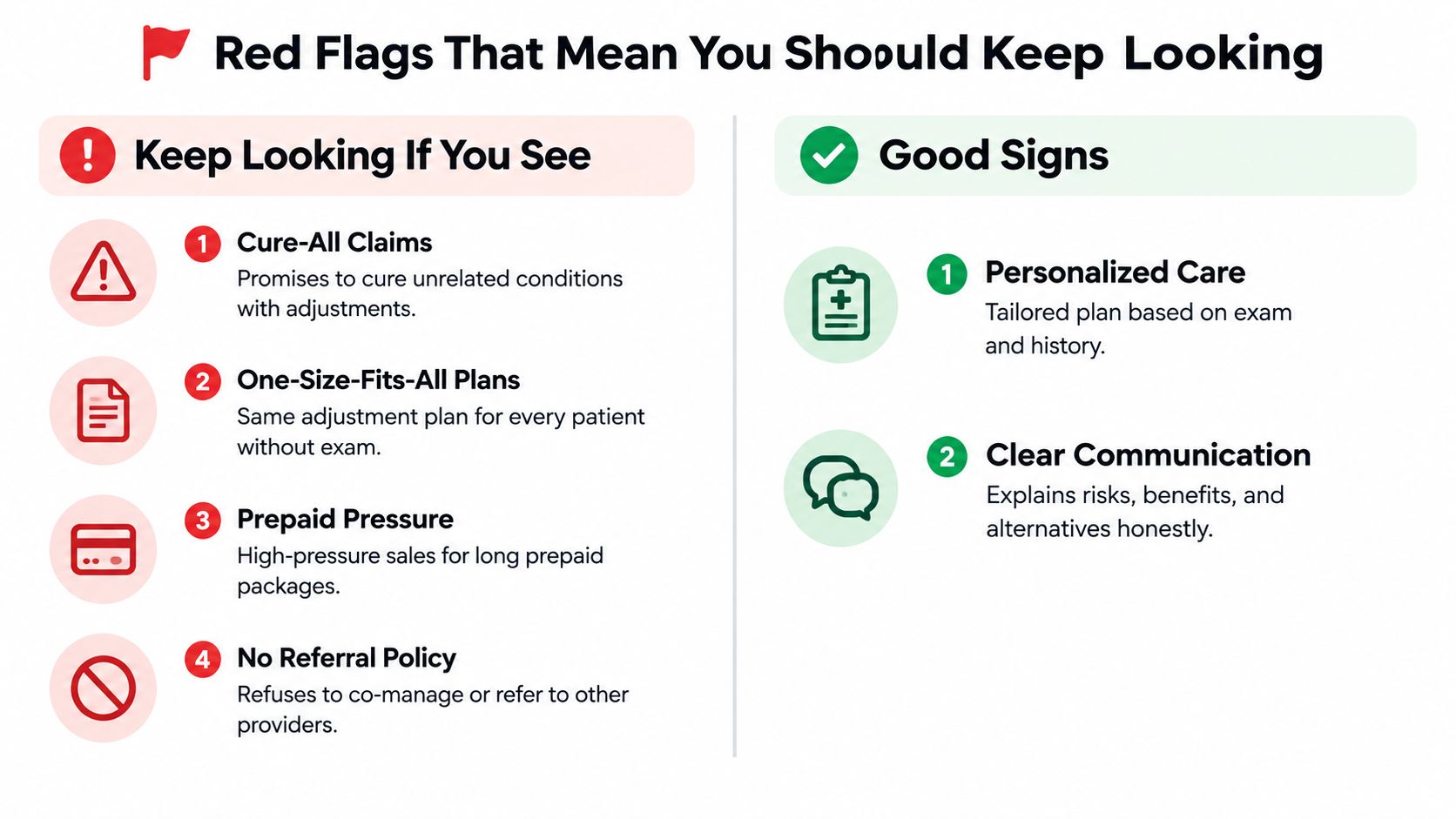
The big red flags
Start with the obvious ones.
- Cure-all claims. If a clinic suggests spinal adjustments will fix a wide range of unrelated conditions without a clear diagnosis, that's not careful care.
- One-size-fits-all plans. Good clinicians individualize. They don't put every patient on the same schedule.
- High-pressure prepaid packages. A treatment plan should follow your exam findings and response, not a sales script.
- No clear referral threshold. If a provider never co-manages, never refers, and never revises the plan, that's a problem.
Those signs often show up together.
The quieter red flags patients miss
These are less dramatic and often more important.
One is poor screening. A provider who doesn't ask about fracture risk, numbness, weakness, surgery, infection, pregnancy, or recent trauma is telling you something about how they practice.
Another is poor consent. Mild short-lived soreness or stiffness after treatment is common, while serious adverse events are rare but not zero. A responsible clinician should be able to say both plainly. If everything is presented as effortless and risk-free, the conversation isn't honest enough.
There's also the issue of context. Evidence on safety keeps reinforcing that “safe for whom” is the better question. A later review involving older adults summarized 25 studies and more than 400 reported adverse events, found serious complications were rare, and identified no life-threatening events in the clinical studies reviewed. The same source also notes that screening for trauma, connective tissue disease, and vascular disorders is critical, and mentions a 2026 observational study in Medicare Part B beneficiaries with new-onset neck pain that associated chiropractic care with lower adverse event rates than primary medical care, highlighting how much patient selection and treatment context matter, as discussed in this review of adverse events and context in chiropractic care.
A short do-not-ignore checklist
Leave or get a second opinion if the clinic:
- Won't explain contraindications
- Doesn't document baseline function
- Keeps repeating care despite no meaningful change
- Dismisses neurologic symptoms
- Refuses to coordinate with your other providers
- Turns every visit into a sales conversation
If the plan never changes, the clinician may not be following your case closely enough.
That matters in Deerfield Beach accident care especially. A patient recovering after a crash may need chiropractic care, physical therapy, imaging review, and communication across providers. A clinic that insists on being the only answer is often the wrong one.
Costs Insurance and What to Expect at Your First Visit in Deerfield Beach
By the time you're comparing clinics, practical details matter. Cost, insurance, scheduling, and first-visit structure affect whether care is realistic for you, not just whether it sounds good.
That's especially true if you expect to need more than one type of treatment.
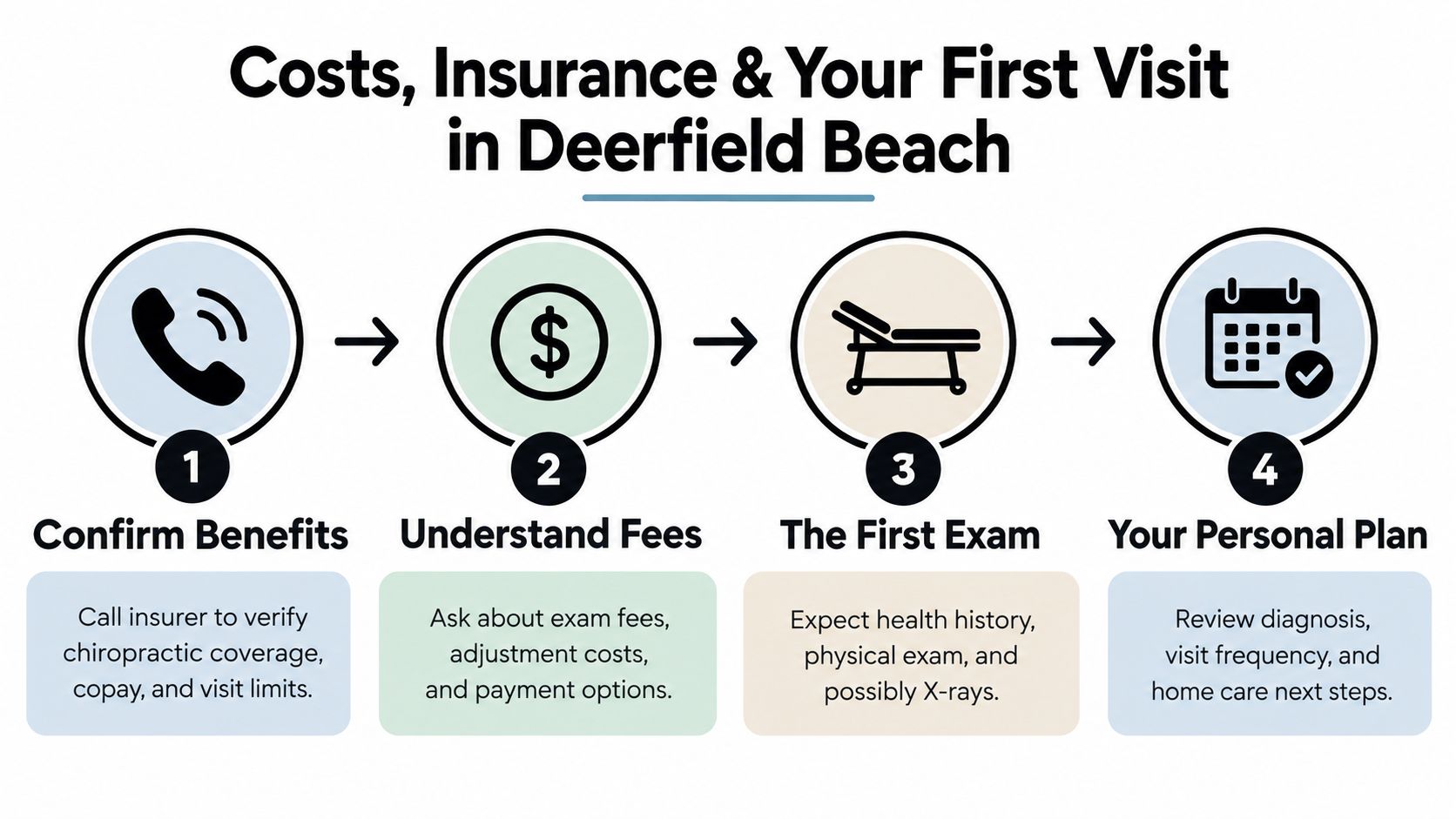
What to confirm before the visit
Ask the office to verify your benefits before you arrive. You want to know whether chiropractic care is covered, whether visit limits apply, and whether your case falls under regular health insurance, auto insurance, or workers' compensation.
Also ask about:
- What the first visit includes
- Whether imaging or outside records should be brought
- How follow-up frequency is decided
- Whether home exercises or self-care instructions are given
- What happens if you need services beyond chiropractic treatment
Clear answers here usually signal an organized clinic.
What a thorough first visit should look like
A useful first visit should include health history, a focused physical exam, movement assessment, baseline function, and a practical explanation of the first phase of care. If you're dealing with a car accident claim, work injury, or prior surgery, the clinician should also account for that in the plan.
You should leave with:
- A working diagnosis or clinical impression
- An explanation of what treatment is for
- A short-term plan
- A home plan
- A sense of how progress will be tracked
If you want a more detailed preview, this guide on what to expect at a first chiropractic visit can help you prepare.
Why coordinated care often works better
In real practice, many patients do better when chiropractic care is part of a broader rehab plan. Someone with low back pain may need adjustment plus strengthening. Someone after an accident may need manual care, mobility work, and documentation support. A senior with balance issues may need fall-prevention training as much as symptom relief.
That's why coordinated care matters so much locally. In Deerfield Beach, one practical option is MedAmerica Rehab Center, which offers chiropractic care along with physical therapy, acupuncture, and shockwave therapy, and also supports auto accident, workers' compensation, and post-surgical cases. For the right patient, that kind of setup can make follow-through easier because the treatment plan doesn't stop at the adjustment table.
The best first visit doesn't just answer whether you should get treated. It answers whether this clinic can manage your case well over time.
If you're looking for care in Deerfield Beach, MedAmerica Rehab Center offers chiropractic care along with physical therapy, acupuncture, and other rehab services that can be coordinated when your case needs more than one tool. If you want help sorting out whether a chiropractor is the right fit for your back pain, neck pain, accident injury, or recovery plan, schedule a visit and come prepared with your questions, records, and goals.
MedAmerica Rehab · Deerfield Beach
Talk to a clinician about your pain
Physical therapy, chiropractic, acupuncture and shockwave therapy under one roof, since 1995. Same-day appointments are available.
Mon–Thu 8:00 AM – 6:30 PM · Fri 8:00 AM – 3:00 PM