

Finding the Best Neck Pain Relief Device for You in 2026
You wake up, turn your head toward the alarm, and something grabs. Or maybe it isn't dramatic at all. It's the same low-grade ache you've been carrying for weeks after long hours at a desk, in the car, or looking down at your phone. That's usually the moment people start searching for the best neck pain relief device and get buried in lists of pillows, massagers, braces, traction units, and gadgets that all promise relief.
The frustrating part is that many of those devices can help. They just don't help the same kind of neck pain.
A heated massager may feel great for tight upper traps and stiffness from posture. It won't do much for pain that shoots into the shoulder or arm. A traction device may be useful for the right nerve-related problem, but it can be the wrong starting point for someone whose main issue is muscular guarding and stress tension. That mismatch is where people waste money, lose time, and sometimes make themselves sorer.
When patients ask me what works best, I don't start with the device. I start with the pain pattern. What does it feel like? Where does it travel? What makes it better or worse? Once you sort that out, the device category gets much easier to choose.
The Search for Lasting Neck Pain Relief
Individuals looking for a neck pain device aren't shopping for technology. They're trying to get through ordinary life without bracing for every turn of the head.
It might be the parent who can't check a blind spot comfortably while driving. It might be the office worker who feels a knot building by noon every day. It might be someone recovering from an old flare-up who keeps buying “supportive” products and still wakes up stiff. Different stories, same question. What will actually help?
The answer usually isn't “buy the most expensive thing” or “buy whatever has the best reviews.” It's choosing a tool that matches the problem in front of you. Neck pain from muscle overload behaves differently from neck pain caused by irritation or compression of a nerve. Those two patterns can overlap, but they don't respond best to the same device.
A good device should make your symptoms more understandable, not more confusing. If you use something and your pain pattern becomes sharper, more spread out, or more intense, that device probably isn't the right fit.
That's why retail roundups often miss the mark. They compare product features but skip the part patients need. What kind of pain am I dealing with, and which device category makes sense for that pain?
The useful way to think about neck devices is simple:
- Some devices decompress. They try to reduce pressure on discs or nerve roots.
- Some devices calm symptoms. They relax muscle, soothe soreness, or change pain signaling.
- Some devices support alignment. They help you rest, sleep, or avoid irritating positions.
If you know which lane your symptoms belong in, you're much more likely to get relief and much less likely to end up with a drawer full of disappointing purchases.
Decoding Your Neck Pain Before You Choose
The most helpful split is between muscular pain and nerve-related pain. They can happen together, but one usually stands out as the main driver.

When it's mainly muscular
Muscular neck pain behaves like a tight rope that's been under load too long. The tissue feels overworked, shortened, guarded, or tender. People usually describe it as:
- A dull ache
- Stiffness when turning
- Tension at the base of the skull or across the shoulders
- Knots or sore bands in the upper back and neck
- Pain that improves with warmth, movement, or massage
This pattern is common with posture strain, stress tension, sleep position problems, and overuse. It often feels local. Even if it spreads a bit into the shoulder blade area, it usually doesn't have the sharp, electric quality of nerve pain.
When it's more likely nerve-related
Nerve-related pain feels more like a pinched wire than a tight rope. The issue isn't just muscle tension. Something may be irritating a nerve root, often from disc involvement, narrowing around the nerve, or inflammation. Symptoms tend to sound like this:
- Sharp or burning pain that starts in the neck and travels
- Tingling or numbness into the shoulder, arm, or hand
- Pain with certain neck positions, especially extension or rotation
- Weakness or clumsiness, such as grip changes
If that pattern sounds familiar, it helps to learn the broader signs of degenerative disc problems in the neck because disc changes and narrowing around the nerve can produce symptoms that aren't just “a sore neck.”
Quick self-check: If pressure, kneading, and heat feel relieving, muscle is probably a major part of the problem. If certain neck positions trigger pain down the arm, think beyond muscle.
Why this matters before you buy
A lot of disappointment comes from using a symptom-soothing device for a mechanical problem, or a mechanical device for an irritable pain condition that needs gentler care first. If your pain is mostly muscular, a massager, heat, or supportive pillow may be a very reasonable starting point. If your pain radiates, tingles, or behaves like compression, the device decision changes.
That's the difference between shopping randomly and choosing on purpose.
Mechanical Relief Devices for Decompression
For nerve-related neck pain, cervical traction is the device category that deserves the most serious attention. It isn't a cure-all, but it's one of the more established tools in clinical care for the right patient.
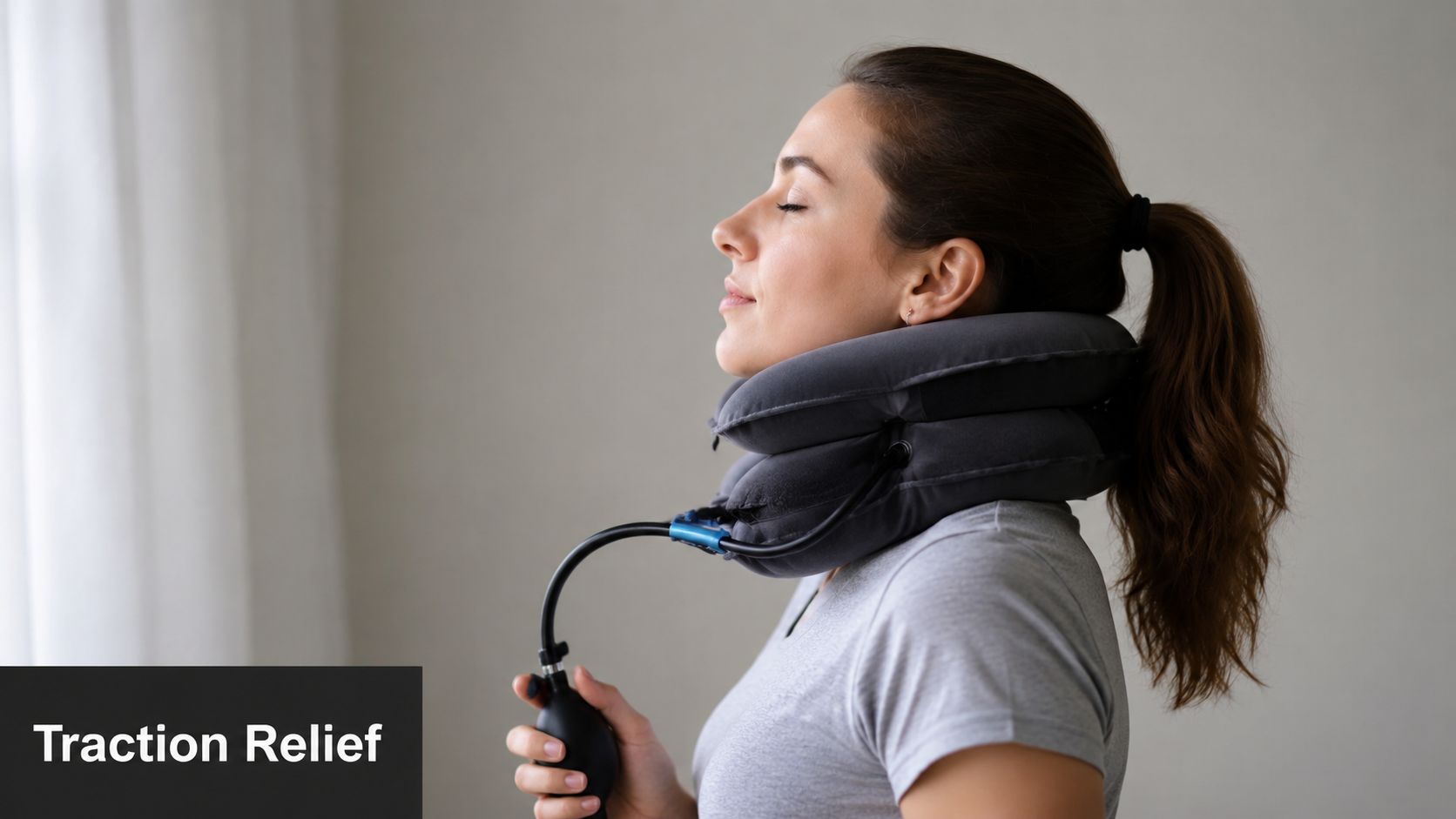
A 2017 survey found that 76.6% of physical therapists use cervical traction, and 93.1% said they would use it for a patient showing signs of nerve root compression. That same survey reported that manual traction was the most common mode at 92.3%, followed by mechanical traction tables at 88.3%, which shows how integral traction is to rehab settings, especially for selected cases rather than every neck complaint (clinical traction use in practice).
How traction works
Traction applies a controlled pulling force to the cervical spine. The goal is to create a little more space around irritated joints, discs, and nerve openings. In plain terms, it tries to unload structures that may be compressed.
Clinical references describe traction as a biomechanical intervention that can increase intervertebral and foraminal space and reduce compression on nerve roots and discs. Sessions are commonly short, around 10 to 15 minutes, and some patients report improvement after 2 to 3 sessions when they're good candidates for it (how neck traction works and how it's used).
That doesn't mean “more pull is better.” Force control matters. Too much can trigger muscle guarding or aggravate symptoms. Too little may not change the pressure enough to help.
Which traction devices make sense at home
Home traction usually falls into a few buckets:
Inflatable air collar styles
These are simple and portable. They're easy to try, but some people find they change posture more than they create a clean traction force.Over-the-door pulley systems
These can provide stronger decompression, but setup matters a lot. They're not my favorite for every patient because positioning can be awkward.Pneumatic or reclining traction devices
These often allow better body support and more controlled use. They tend to feel calmer and more consistent than upright options.
Here's a short demonstration format many patients find helpful before trying a traction setup at home:
Who usually benefits most
Traction makes the most sense when symptoms suggest radiculopathy, disc irritation, or pain that eases with gentle manual distraction. It is far less compelling as a generic answer for every stiff neck.
A reasonable traction candidate often says things like:
- “The pain runs into my arm.”
- “Certain head positions trigger tingling.”
- “When my neck feels gently unloaded, it eases.”
The real trade-offs
The upside is precision. When traction matches the condition, it can target the mechanical side of the problem better than a massage gun or heating pad ever will.
The downside is that it's easy to misuse. The wrong angle, too much force, poor setup, or using it for the wrong pain type can leave you feeling worse. This is one reason systematic reviews remain inconclusive overall even while traction remains widely used in practice. It appears most useful for selected patients, not as a universal neck pain solution, as noted in the earlier clinical data.
If a traction device causes spreading pain, dizziness, stronger tingling, or a headache that feels new, stop using it and get assessed before trying again.
For patients with clear nerve-type symptoms, traction is often the category closest to a true treatment device rather than just a comfort device. That distinction matters.
Symptom Management with Heat Stimulation and Massage
Not every neck problem needs decompression. A lot of neck pain is dominated by guarding, stiffness, trigger points, and soreness from sustained posture. In those cases, symptom-soothing devices are often the better first move.
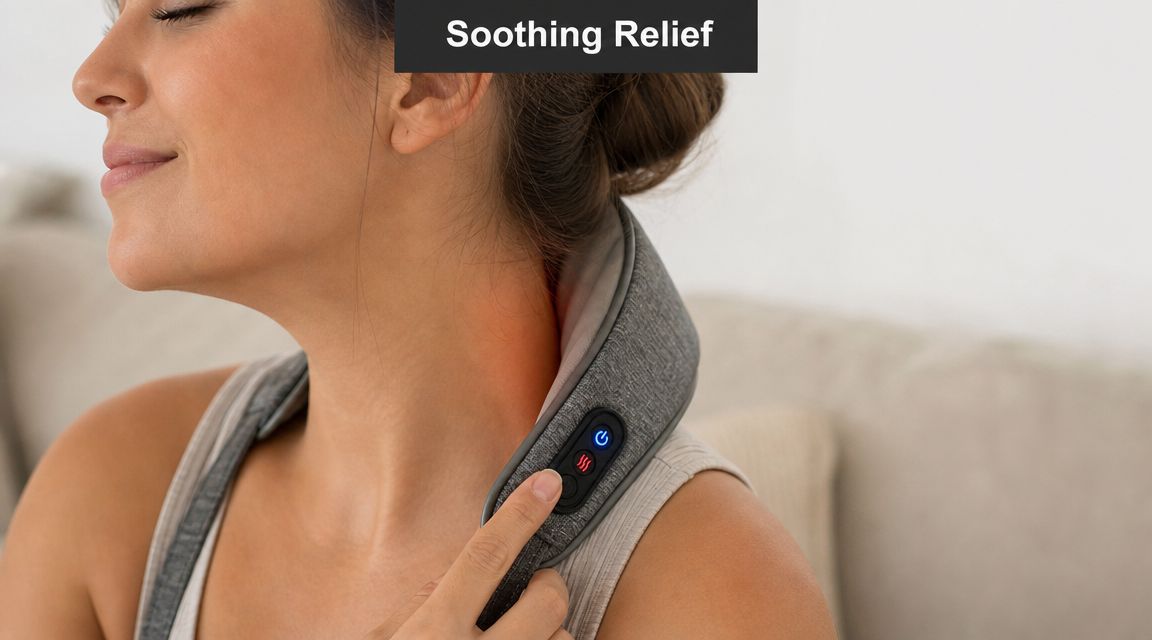
Heat for stiffness and guarded muscle
Heat doesn't fix a compressed nerve, but it can make a tight neck easier to move. Patients with muscular pain often respond well to warm wraps, electric heating pads, and heated neck massagers because warmth helps calm protective muscle tone.
If you want a practical overview of how therapists use heat as part of care, this guide to physical therapy heat packs and when they help is a useful starting point.
What I like heat for:
- Morning stiffness
- Desk-related tightness
- Pain that improves as the day goes on
- Muscle guarding after an awkward sleep position
Electronic massage for knots and tension
Massagers work best when your neck feels overloaded rather than unstable. Shiatsu-style kneading devices, percussion massagers used carefully around the shoulder girdle, and wraparound neck massagers can all help reduce the “stuck” feeling that comes with tension.
The best use case is simple. You press on a tender spot, and it feels like a sore muscle. Gentle movement helps. Heat helps. A massage tool often helps too.
What doesn't work well is hammering directly over the front of the neck or aggressively chasing symptoms that are traveling into the arm. That's where people confuse irritation with tightness.
TENS and EMS for pain modulation
Electrical stimulation devices sit in a slightly different category. They don't stretch tissue and they don't knead muscle. They work more on how pain is perceived or how muscle is recruited. Some people find them very helpful during flare-ups, especially when pain is sharp or the surrounding muscles won't settle down.
A useful development is the rise of multi-modal devices. According to product and review data, devices that combine therapies such as traction, heat, and electrical stimulation are popular because the mechanisms complement each other. Traction targets mechanical decompression, heat reduces muscle tension, and EMS can modulate pain signaling, especially across conditions like muscle spasm and cervical spondylosis (multi-modal neck therapy design considerations).
Practical rule: If your pain feels better from warmth, motion, and pressure, start with a symptom-soothing device before jumping to a more aggressive mechanical tool.
What these devices do well, and what they don't
Here's the honest comparison.
| Device category | Best at | Usually not enough for |
|---|---|---|
| Heated pads | Stiffness, muscle guarding, general soreness | Strong radiating nerve pain |
| Electronic massagers | Trigger points, upper trap tension, stress-related tightness | Structural compression problems |
| TENS or EMS units | Acute pain modulation, flare management | Correcting posture or unloading a nerve |
If you're sitting all day, the device will work better if your setup stops feeding the problem. Small workstation changes can boost comfort and productivity and make heat or massage more effective because you're no longer asking your neck to fight the same bad position for hours.
For muscular pain, these devices are often the most practical and easiest place to start. Just remember what they are. They are symptom managers, not structural fixers.
Support and Alignment Devices for Daily Use
Some neck devices don't really “treat” pain. They reduce aggravation. That's still useful.
Pillows that keep the neck neutral
A good cervical pillow or contoured pillow can make a big difference if your symptoms are worst in the morning. The job of the pillow isn't to push your head into a rigid position. It's to keep your neck closer to neutral so the tissues aren't twisted or bent all night.
Side sleepers usually need enough height to fill the space between the shoulder and the head. Back sleepers usually do better when the pillow supports the natural curve of the neck without shoving the head too far forward.
If sleep posture is clearly part of your problem, it helps to find the right pillow for better sleep using shape and sleeping position rather than shopping by brand alone.
Soft collars and braces
Soft cervical collars can reduce motion and give irritated tissues a short rest. That can feel good during an acute flare, especially after strain or when every movement feels provocative. But that benefit has limits.
A review found that up to 76% of patients report reduced pain with short-term use of a soft cervical collar, but there is no evidence of long-term benefit, which is why collars are better seen as temporary support rather than a corrective solution (what the evidence says about soft collar relief).
That matches what we see clinically. Used briefly, a collar may calm things down. Worn too long, it can encourage stiffness and reduce how much the neck muscles do for themselves.
The best way to use passive support
Think of support devices as situational tools:
- Pillow at night when sleep position is the aggravator
- Short-term soft collar use during a painful flare if motion is highly irritating
- Posture support sparingly as a reminder, not an all-day crutch
Passive support works best when it protects you from repeated irritation while active recovery performs the core work.
How to Choose the Right Neck Pain Device for You
Choosing the best neck pain relief device comes down to matching symptom pattern, goal, and tolerance. Start with the simplest question. Are you trying to unload something mechanical, calm angry muscle, or support better alignment?
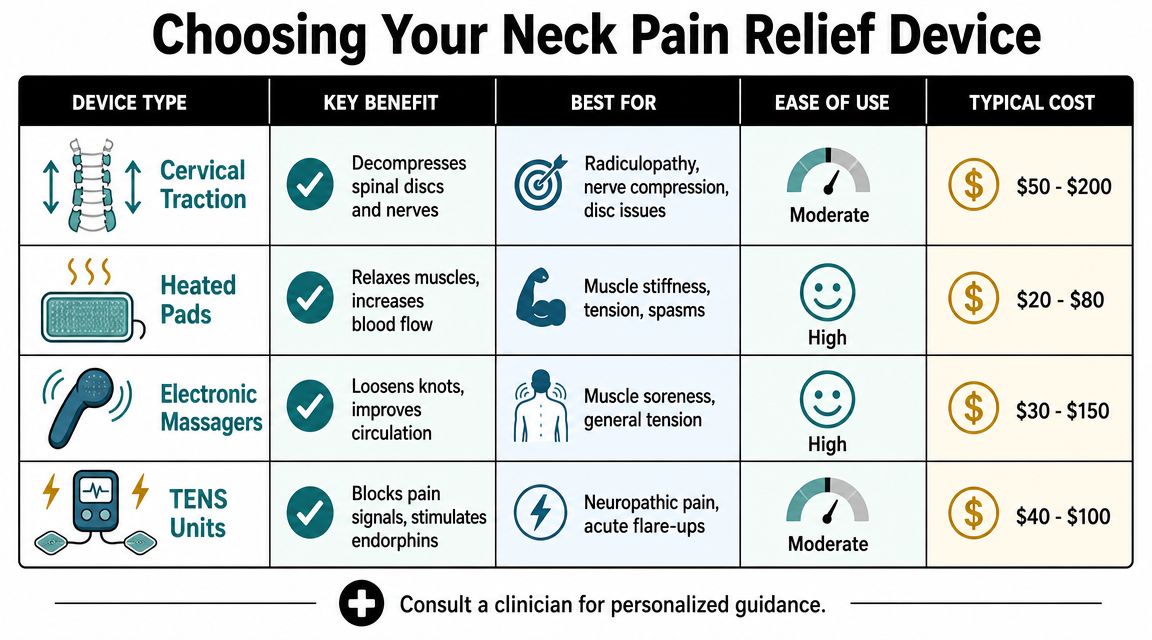
Neck Pain Relief Device Comparison
| Device Type | Best For | How It Works | Pros | Cons |
|---|---|---|---|---|
| Cervical traction | Nerve-related symptoms, disc irritation, pain relieved by unloading | Applies controlled distraction to reduce pressure around discs and nerve roots | More targeted for mechanical nerve issues | Requires careful setup and may aggravate the wrong patient |
| Heated pads | General stiffness, muscular guarding, morning tightness | Warms tissue and helps muscle relax | Easy to use, calming, low effort | Doesn't correct compression problems |
| Electronic massagers | Trigger points, upper trap tension, stress-related soreness | Uses kneading, vibration, or percussion to ease muscle tension | Fast symptom relief, good for local tightness | Can irritate sensitive areas if overused |
| TENS or EMS units | Pain flare-ups, mixed pain with muscle guarding | Modulates pain signals and may help muscle recruitment | Portable and useful for symptom control | Doesn't address alignment or decompression |
| Cervical pillows | Sleep-related stiffness, poor overnight positioning | Supports a more neutral neck posture | Helpful for prevention and sleep comfort | More supportive than therapeutic |
| Soft collars | Short-term acute irritation with painful motion | Limits movement and provides temporary support | Can reduce symptoms during flares | Not a long-term fix |
A simple if-then guide
If your pain is dull, tight, and better with rubbing or warmth, begin with heat or a neck massager.
If your symptoms are sharp, burning, or travel into the shoulder or arm, traction may be more relevant than massage. That's also the point where professional guidance becomes more important.
If your neck is worst when you wake up, look hard at your pillow and sleeping position before buying an active treatment device.
If your pain keeps coming back after computer work, don't just treat the neck. Fix the workstation. Better desk setup can boost comfort and productivity and reduce how often you need the device in the first place.
My practical order of operations
I usually think about device choice like this:
- Start low-risk if symptoms are mostly muscular. Heat, gentle massage, and sleep support are reasonable entry points.
- Use traction more selectively when symptoms suggest nerve involvement.
- Treat posture triggers seriously so the device isn't fighting the same daily aggravation.
- Get examined if symptoms are spreading, recurring, or not matching the device response you expected.
That last point matters. MedAmerica Rehab Center also offers a practical guide to neck pain devices and hands-on evaluation when a device category seems right in theory but the symptoms still aren't clear in real life.
When Devices Are Not Enough Get Professional Care
Some neck pain is appropriate for self-management. Some isn't.
If you have numbness, tingling that persists, loss of strength, pain that spreads farther down the arm, dizziness, severe headache, or symptoms after a significant injury, don't keep experimenting with gadgets and hoping one finally works. Those patterns deserve an exam.
The same goes for pain that keeps returning, wakes you at night, or improves only temporarily no matter what device you try. A home tool can help symptoms, but it can't examine reflexes, test strength, check joint mechanics, or tell you whether the main issue is disc-related, muscular, postural, or something else entirely.
Sometimes patients benefit from reading broader perspectives on addressing your sore neck because it reinforces an important point. Soreness can be simple, but persistent neck pain often needs a plan, not just a product.
If that's where you are, it helps to understand how physical therapy helps with back and neck pain beyond symptom relief alone. A proper treatment plan can combine manual therapy, exercise, posture correction, and condition-specific guidance in a way no single device can.
Sometimes the most useful thing a device does is reveal that the pain is more complex than it first seemed.
The goal isn't to avoid devices. It's to use them in the right role. They can be excellent supports. They just shouldn't be asked to replace diagnosis.
If your neck pain keeps coming back, radiates into the arm, or isn't improving with home devices, MedAmerica Rehab Center can help you sort out the cause and choose the right next step. The clinic provides physical therapy, chiropractic care, acupuncture, and individualized treatment plans for neck pain, disc-related symptoms, postural strain, and injury recovery, so your care can match the problem instead of relying on trial and error.
MedAmerica Rehab · Deerfield Beach
Talk to a clinician about your pain
Physical therapy, chiropractic, acupuncture and shockwave therapy under one roof, since 1995. Same-day appointments are available.
Mon–Thu 8:00 AM – 6:30 PM · Fri 8:00 AM – 3:00 PM