
Effective Arthritis Pain Relief For Feet
If your feet hurt the moment you get out of bed, and then hurt again after a day of walking, standing, or commuting, you're not imagining it. Foot arthritis often creates a frustrating pattern. You loosen up a little, start moving, then pay for it later.
That's why generic advice like “just rest” usually falls apart in real life. Individuals still need to get to work, shop for groceries, take care of family, or move through the day. Good arthritis pain relief for feet has to work in the middle of real routines, not only in ideal conditions.
Why Your Feet Hurt Understanding Arthritis Pain
Arthritis in the feet means the joints aren't moving smoothly anymore. Cartilage that normally helps joints glide and absorb force becomes damaged or worn, and the tissues around the joint get irritated. The result is pain, stiffness, swelling, and a foot that stops tolerating normal load the way it used to.
In the clinic, people usually describe it in practical terms. Their first steps in the morning feel stiff. Certain shoes suddenly become intolerable. Standing in line, walking through a parking lot, or pushing off through the big toe becomes the part of the day they start planning around.
The main types don't all behave the same way
This is the first thing to get right. The cause matters. Cleveland Clinic notes that treatment depends on the cause of the arthritis, and that distinction is especially important between osteoarthritis and inflammatory forms such as rheumatoid arthritis, which may require immune-targeting treatment rather than only local pain relief and support strategies (Cleveland Clinic on foot and ankle arthritis).
- Osteoarthritis tends to be the wear-and-tear form. The joint gradually gets less tolerant of compression and motion.
- Rheumatoid arthritis is different. It's systemic, not just local. The immune system drives inflammation, so the plan often goes beyond shoe changes and pain medication.
- Post-injury arthritis can show up after an old fracture, sprain, or joint injury, even when the original injury seemed to heal.
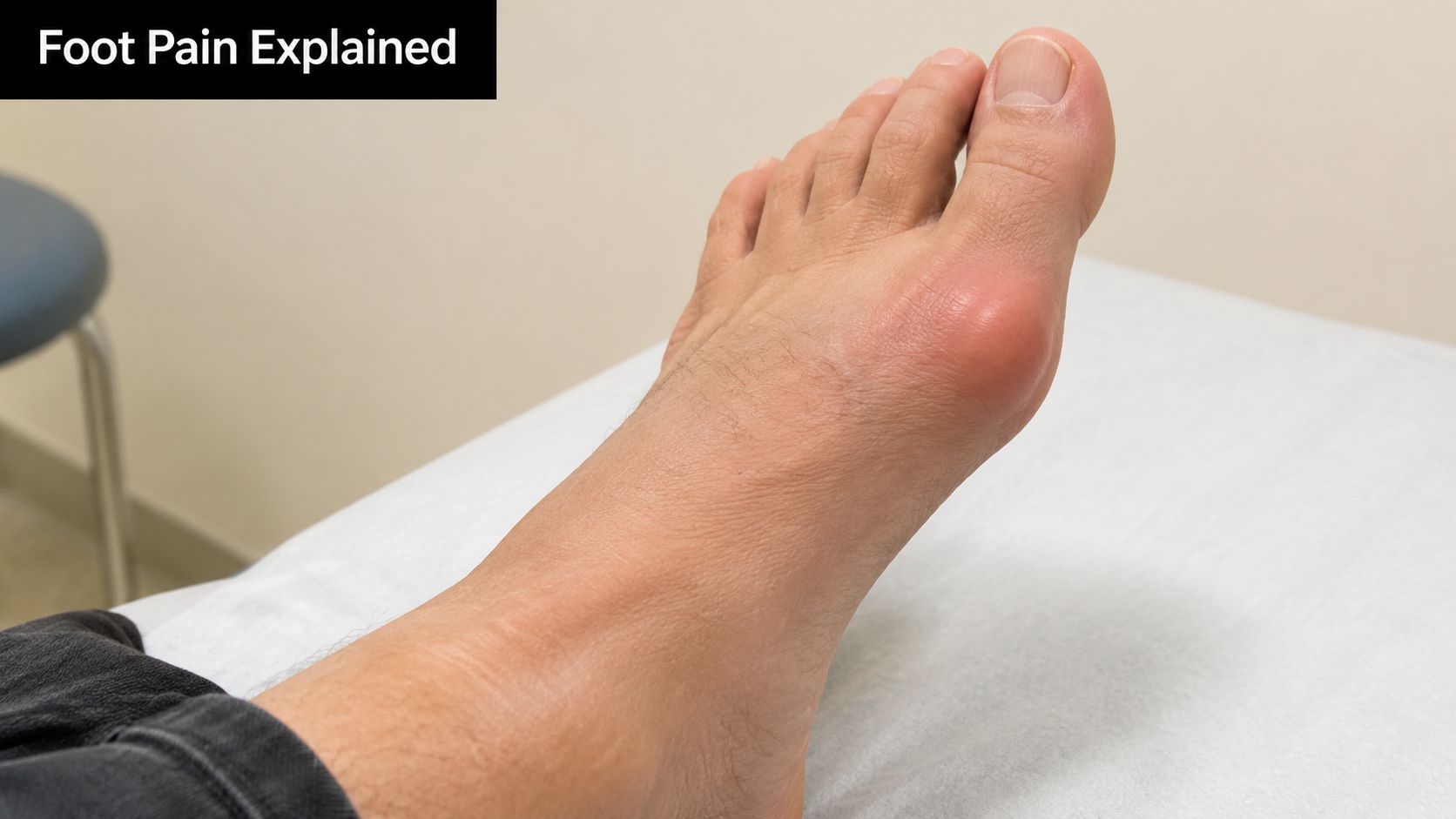
Common patterns people notice
A painful arthritic foot rarely acts the same all day. Symptoms often change with load, surface, and shoe choice.
| Symptom pattern | What it often feels like in daily life |
|---|---|
| Morning stiffness | The first few steps feel tight, awkward, or sharp |
| Pain with activity | Walking farther, standing longer, or climbing stairs brings symptoms on |
| Swelling | Shoes feel tighter by the end of the day |
| Reduced motion | Bending the big toe, ankle, or midfoot feels restricted |
| Pressure sensitivity | Certain shoes or laces aggravate the painful area |
Pain that eases when load drops and returns when load rises is a strong clue that joint mechanics are part of the problem.
Why foot arthritis disrupts so much
Your feet don't get many breaks. Every step asks them to absorb force, adapt to uneven ground, and push your body forward. When one arthritic joint loses motion or becomes inflamed, the rest of the foot often compensates. Then the ankle, knee, hip, or low back starts doing extra work.
That's why understanding the diagnosis matters so much. If you know whether you're dealing with wear-and-tear arthritis, inflammatory disease, or an old-injury pattern, your treatment choices become a lot clearer.
Immediate Steps for Arthritis Pain Relief at Home
When pain spikes, your job isn't to “push through.” It's to calm the joint down without letting the whole day unravel. The fastest home plan is usually simple: reduce irritation, lower swelling if it's present, and stop feeding the flare.
What to do during a flare
Start with a short-term reset:
- Reduce walking volume for the day. Don't stop all movement, but cut unnecessary trips, stairs, and errands.
- Use cold when the joint feels hot, puffy, or throbbing. If you want a practical guide on timing and application, this overview of cold pack therapy in physical therapy is useful.
- Raise the foot when possible. Even ten to fifteen minutes with the foot supported can help after a long standing period.
- Switch shoes immediately. A flare is not the day for flat sandals, old sneakers, or anything narrow through the toe box.
- Use compression carefully if swelling is mild and the wrap doesn't increase pressure over the painful joint.
Heat has a role too, but not for every moment. Use it when the foot feels stiff and tight rather than hot and swollen. A warm shower, warm towel, or brief heating session can make the first steps of the day easier. Cold is usually better after activity or during an obvious flare.
The medication that often helps most
For many people, over-the-counter NSAIDs are the most practical starting point because they target both pain and inflammation. A major review found moderate improvements in osteoarthritis outcomes, including effect sizes of 0.51 for pain and 0.51 for function, with a number needed to treat of 4 for clinically significant pain relief, and oral NSAIDs outperformed paracetamol for pain relief in direct comparisons (NIH review of arthritis medicines).
That doesn't mean more is better. It means they can be useful when taken as directed and when they're appropriate for you. If you have a history of stomach, kidney, bleeding, or medication-interaction concerns, ask your physician or pharmacist before using them.
Practical rule: If your foot is swollen and angry, calm inflammation first. Stretching aggressively into a hot flare usually backfires.
What helps, but shouldn't replace the basics
Some people also like sensory approaches that make the feet feel less tense after daily activities. If that sounds familiar, you might discover this wellness ritual as an adjunct for comfort. Just keep the order straight. Relief rituals are optional. Load reduction, shoe changes, cold or heat used correctly, and appropriate anti-inflammatory care come first.
A good home response should leave the foot less reactive within the day, not more aggravated by bedtime.
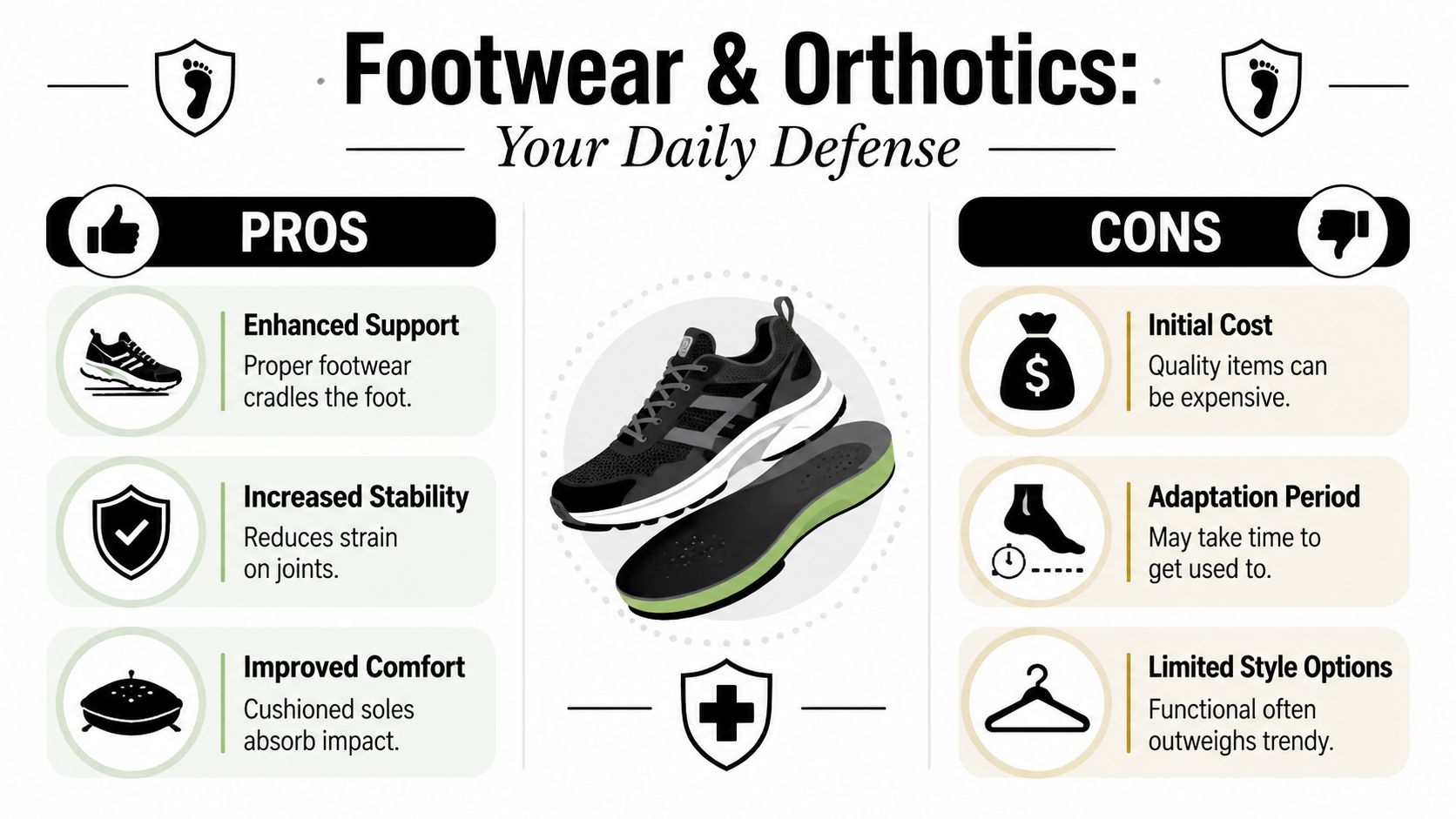
Your Daily Defense Choosing the Right Footwear and Orthotics
If you only focus on pain relief and ignore what's loading the joint all day, you'll keep chasing the same flare. Footwear is treatment. Not fashion, not an accessory, not an afterthought.
A layered approach works best. Control inflammation, then reduce mechanical stress with supportive footwear and orthotics that improve alignment and redistribute pressure. Relying on medication alone without that mechanical support is a common mistake, as described in this guidance on arthritic foot pain treatment.
What a good shoe does
A good shoe reduces the amount of stress that lands on the painful joint with every step. It doesn't need to be expensive. It needs to be structurally helpful.
Look for these features:
- Wide toe box so the forefoot and toes aren't compressed.
- Firm heel counter so the rearfoot doesn't wobble excessively.
- Stable midsole rather than a floppy sole that twists easily.
- Good arch support if your foot benefits from better load distribution.
- Rocker-style sole when pushing off the forefoot or big toe hurts.
Now compare that with what usually fails:
| Better choice | Usually aggravating |
|---|---|
| Supportive walking shoe | Thin flat shoe with no structure |
| Roomy toe box | Narrow fashion shoe |
| Stable sole | Worn-out sneaker that bends in the middle |
| Cushioned and controlled | Hard sandal or unsupportive slide |
Orthotics are pressure tools
Orthotics don't “fix” arthritis, but they can make the foot more livable. Their main job is to shift load away from the irritated area and support a cleaner movement pattern.
- Over-the-counter inserts can help when you need general arch support, cushioning, or mild control.
- Custom orthotics make more sense when your foot shape, deformity, or pain pattern is more specific.
- Carbon or stiff inserts may help when bending through the forefoot is the main trigger.
- Temporary braces can be useful during flares or longer standing days.
The right choice depends on which joint is involved and what movement aggravates it.
The real-world rule for people who stay active
Don't wait until pain climbs before changing shoes. Plan your day around load.
If you have a commute, a warehouse shift, errands, or a long event, wear your most supportive pair from the start. Bring backup footwear if one pair tends to lose comfort after several hours. If you limp when fatigue sets in, it's worth learning how gait training in physical therapy can improve how force moves through the foot and leg.
The wrong shoe can undo a good exercise program by noon.
Patients often want a medication that solves everything. Usually, the bigger win is this: reduce the mechanical insult that keeps provoking the joint.
Gentle Movement for Lasting Relief Stretches and Exercises
Rest helps during a flare. Long-term relief usually needs movement. Arthritic feet stiffen when they stop moving well, and they often hurt more when nearby muscles become weak, guarded, or poorly coordinated.
The goal isn't to force range of motion into a painful joint. It's to improve how the foot, ankle, and lower leg share load so the irritated area doesn't do all the work.
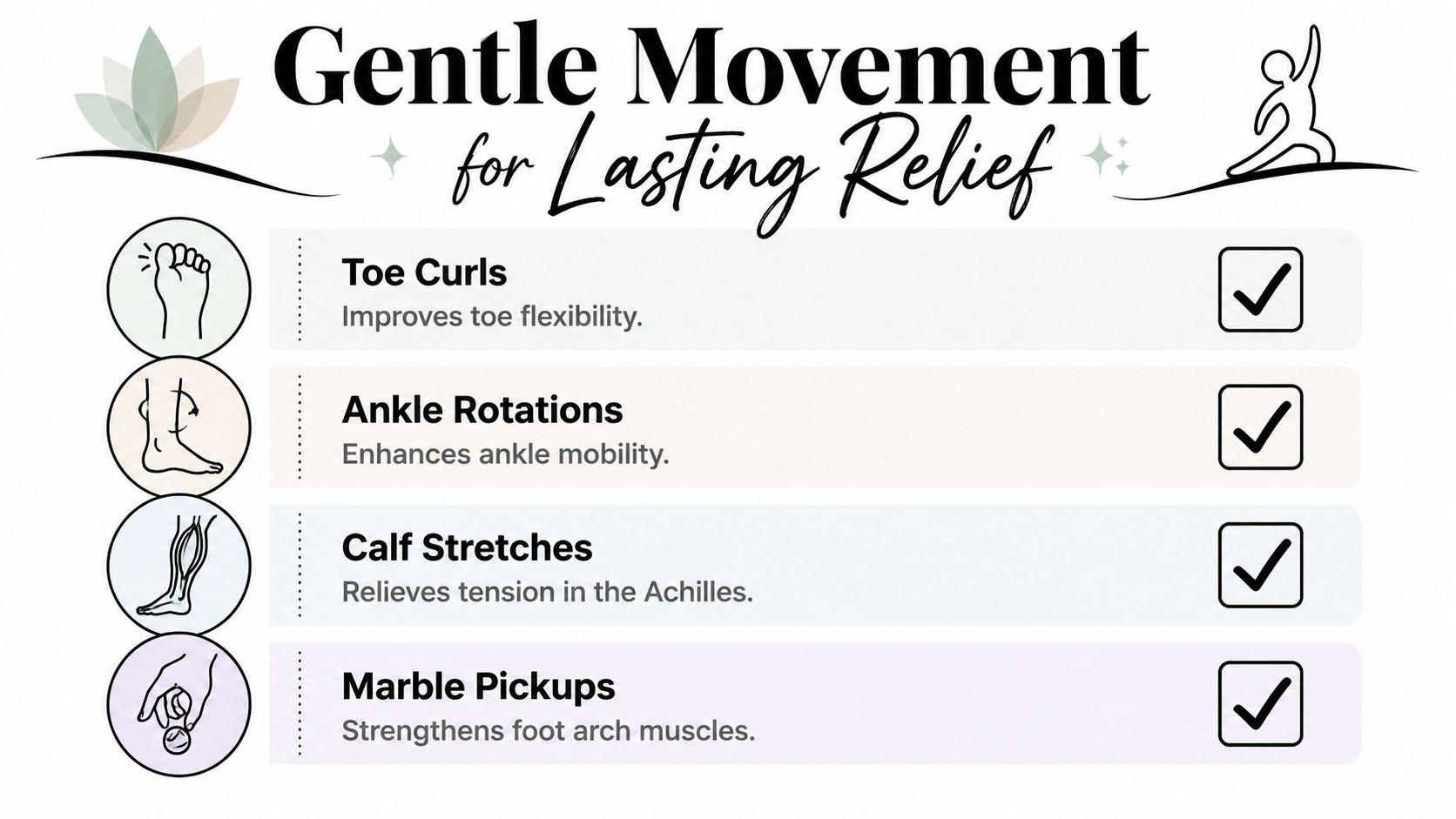
Start with mobility you can tolerate
Use slow, controlled motion. Mild discomfort is acceptable. Sharp pain, swelling that worsens, or limping afterward means you did too much.
Ankle rotations
Sit down and slowly circle the ankle in both directions. This helps reduce stiffness around the joint and improves awareness of motion.Calf stretch
Stand facing a wall, place the painful side behind you, and keep the heel down while leaning forward. Tight calves can increase stress through the foot and alter gait.Toe curls with a towel
Place a towel on the floor and use your toes to bunch it toward you. This wakes up the small muscles that support the foot.Marble pickups or small object lifts
Pick up small objects with your toes and place them into a cup. This builds fine control and intrinsic foot strength.
Here's a simple visual guide for form and pacing:
Build support, not irritation
Once simple mobility feels easier, add low-level strengthening and balance work.
- Supported heel raises with hands on a counter. Move through a comfortable range only.
- Weight shifts side to side while standing in supportive shoes.
- Single-leg balance with fingertip support if your symptoms and balance allow it.
- Short walking intervals instead of one long walk that pushes the joint too far.
Many people get stuck. They either do too little because they're afraid of pain, or they jump into too much activity on a good day. Both patterns feed the cycle.
Load management while walking and standing
Yale Medicine and NYU Langone emphasize that a major goal in foot and ankle arthritis care is to evenly distribute mechanical load across the foot, often with orthotics, braces, and gait modification. That matters most for people who still need to be active during a flare, because continued activity becomes more manageable when stress shifts away from the most painful area (Yale Medicine on arthritis treatments).
That translates into daily decisions like these:
- Break long walks into shorter bouts instead of one continuous push.
- Use the smoother route even if it's slightly longer. Uneven ground increases joint stress.
- Stand with one foot on a small footrest or shift position often if you're stuck in place.
- Turn your whole body instead of twisting through the foot when changing direction.
- Use a temporary brace or insert on high-demand days instead of waiting for pain to spike.
Keep activity below the point where your gait changes. Once you start limping, the foot is no longer handling the load well.
What exercise should feel like
A good session leaves the foot warmer, looser, and more confident. A bad session leaves it swollen, protective, and harder to walk on later that day.
That's why I usually tell patients to judge exercise by the next several hours, not just the minute they finish. If symptoms steadily ramp up afterward, reduce the range, the repetitions, or the total time on your feet.
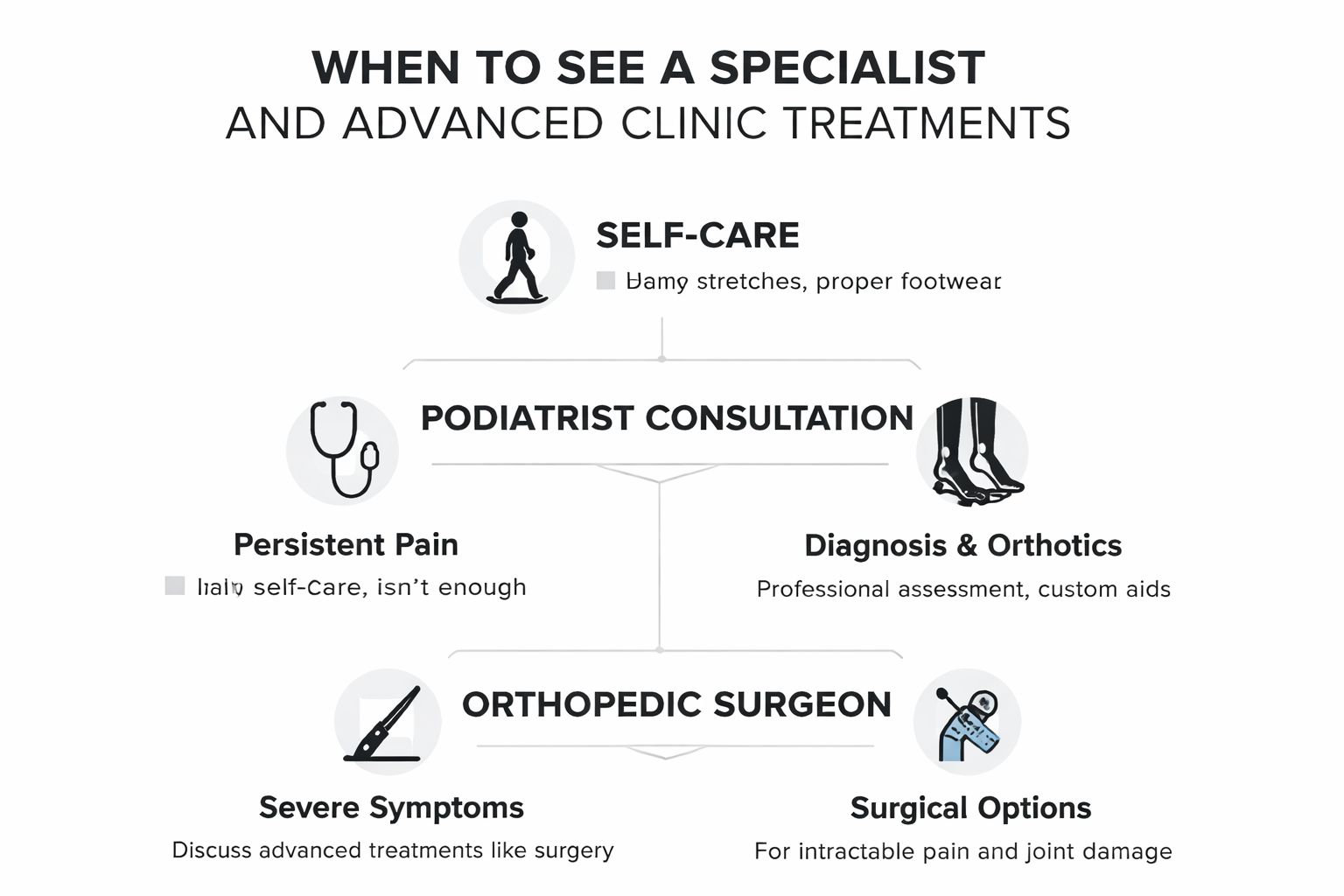
When to See a Specialist and Advanced Clinic Treatments
Home care has limits. If pain keeps returning, walking gets more restricted, or the joint feels unstable, a specialist evaluation saves time and frustration. That's especially true when you're no longer sure whether the problem is arthritis alone, an altered gait, tendon overload, or a more inflammatory pattern.
Signs you shouldn't keep managing on your own
Use these as practical checkpoints:
- Pain interrupts sleep or wakes you when the foot isn't even loaded.
- Walking tolerance keeps shrinking despite better shoes and activity changes.
- Swelling or stiffness stays persistent rather than settling after lighter days.
- You've started limping regularly or changing how you climb stairs.
- Home strategies help briefly but symptoms rebound fast.
What advanced treatment usually looks like
When symptoms don't respond well enough to self-care, injections are a common next step. They can reduce inflammation and ease pain, but they're a “double-edged sword” and are often limited to about two or three per year in a given joint. The better strategy is to pair the injection with follow-up rehab so the temporary relief turns into improved movement and reduced mechanical stress, as outlined in this discussion of foot arthritis injections and follow-up care.
That rehab piece matters. Once pain drops, a therapist can work on joint mobility, calf flexibility, intrinsic foot strength, balance, and walking mechanics. Without that step, many people return to the same aggravating pattern.
A broader arthritis rehab plan may also include options like physical therapy for arthritis, which focuses on reducing stiffness, improving function, and restoring safer movement patterns. In a multidisciplinary setting such as MedAmerica Rehab Center, care may also include chiropractic assessment for lower-extremity mechanics, acupuncture for pain modulation, or shockwave therapy when chronic tissue irritation overlaps with the arthritic picture.
Matching the treatment to the problem
Not every painful foot needs the same approach.
| Problem pattern | What often helps next |
|---|---|
| Stiff, overloaded joint | Targeted physical therapy, shoe changes, orthotics |
| Localized inflammatory flare | Medical evaluation, possible injection, temporary unloading |
| Ongoing gait compensation | Gait retraining, strengthening, balance work |
| Advanced structural limitation | Orthopedic or podiatric consultation for procedural options |
For people trying to sort through broader options for chronic pain relief, it helps to think in layers. First, calm the irritated area. Second, restore motion and strength where the body has become guarded. Third, correct the daily load pattern that keeps recreating the problem.
Temporary pain relief without a change in mechanics often gives you a quieter foot, not a stronger one.
If the joint has constant pain, severe deformity, or major functional loss, a surgical consultation may become part of the conversation. But many people do well when they get the right diagnosis and a load-based rehab plan before things progress that far.
Your Path Forward A Sample Foot Arthritis Action Plan
A good plan is simple enough to repeat. If your routine is too complicated, you won't keep doing it when life gets busy.
A practical weekly rhythm
Here's a sample approach you can adapt:
Monday
Wear your most supportive shoes all day. Do a short morning mobility routine with ankle rotations and a calf stretch.Tuesday
Take a low-impact walk in shorter intervals instead of one long outing. Use cold afterward if the foot feels swollen or hot.Wednesday
Do strengthening work such as towel scrunches, toe control drills, and supported balance.Thursday
Make it a load-management day. Reduce unnecessary standing, switch to your best shoes early, and avoid uneven walking surfaces.Friday
Repeat mobility and strengthening, but keep the volume modest if you've had a demanding week on your feet.Weekend
Plan activity in blocks. If you're shopping, commuting, or attending events, build in sitting breaks and don't wait for pain to force them.
How to judge whether the plan is working
Look for these signs:
- Morning steps feel easier
- You can stand or walk with less limping
- Swelling settles faster after activity
- Shoe tolerance improves
- You recover better from busy days
If you're not seeing meaningful improvement after a stretch of consistent self-care, or if your walking is getting worse, that's the point to get a professional assessment. A better diagnosis, a more precise orthotic strategy, or supervised therapy can change the trajectory.
The best arthritis pain relief for feet usually doesn't come from one dramatic fix. It comes from stacking the right actions. Calm the flare. Reduce load. Support the foot. Keep it moving. Get help when the pattern stops responding.
If foot arthritis is limiting your walking, standing, or daily routine, MedAmerica Rehab Center can help you build a practical treatment plan that fits real life. Their team provides patient-centered physical therapy and related rehab services for arthritis, gait problems, and foot and ankle pain, with individualized care aimed at reducing pain, restoring mobility, and helping you stay active safely.
MedAmerica Rehab · Deerfield Beach
Talk to a clinician about your pain
Physical therapy, chiropractic, acupuncture and shockwave therapy under one roof, since 1995. Same-day appointments are available.
Mon–Thu 8:00 AM – 6:30 PM · Fri 8:00 AM – 3:00 PM