
Balance Board with Ball: What It Is and How to Use Safely
A balance board with a ball is a platform resting on a rounded or ball-like base that forces the user to keep it level. It challenges balance, but making an exercise less stable doesn't automatically make it better for building leg strength.
You may be looking at a board beside your exercise mat, wondering whether to step on, hold a counter, or leave it alone until your next physical therapy appointment. The right choice starts with identifying the equipment, deciding what you want to improve, and choosing a starting position you can control.
What a Balance Board With Ball Actually Is
Standing on this equipment feels more like standing in a small rowing boat than on your kitchen floor. Your weight shifts, the surface responds, and you have to adjust without letting the movement carry you away.
A recognizable milestone was the BOSU Balance Trainer, introduced in 1999 by David Weck, with BOSU originally meaning “both sides utilized,” according to the company's history. By 2024, the company reported that more than 1.4 million households owned a BOSU product.
Common Balance Board With Ball Designs
| Design | How it becomes unstable | Main training focus |
|---|---|---|
| Wobble board with rounded base | Tilts and rocks front to back and side to side | Ankle, knee, and trunk control |
| Dome-on-platform trainer (BOSU-style) | Combines a rigid platform with an inflated dome; the chosen side changes the challenge | Weight shifting and posture |
| Multi-ball board (four-ball design) | Balls beneath the platform deform and shift under changing pressure | Dynamic control and reaching |
These designs aren't interchangeable. A rounded-base wobble board pivots around its base, while an inflated dome changes shape under your weight. A multi-ball platform distributes movement across several support points rather than pivoting around a single central contact.
For a beginner using a wobble board, the initial stance is generally both feet on the platform with sturdy hand support. On a dome trainer, begin with a supported stance in the manufacturer-approved orientation, not an inverted position copied from an advanced workout. On a multi-ball board, use a supported, evenly weighted stance before attempting reaching.
Buying rule: Identify the device by its construction, not just the words on the product page.
The phrase balance board with ball covers products with different platform sizes, base shapes, inflation requirements, and movement limits. Check the maximum load and instructions before applying advice intended for another design. Your health and balance history also determine whether standing on it is the appropriate first step.
Choosing a Board and Comparing Prices
Choose the design for your intended task and body weight before comparing prices. A board for controlled weight shifting isn't necessarily the best choice for someone seeking a portable seated exercise surface.
Listed Prices for Sample Ball-Based Boards
The following listings illustrate the price and specification differences, not a ranking of rehabilitation suitability.
| Product | Listed price (2026) | Maximum load | Design notes |
|---|---|---|---|
| SferaBoard balance board with ball, beginner or pro version | $156 | Confirm with manufacturer | Ball-based board |
| SferaBoard bestseller combo, on the same product listing | $174 | Confirm with manufacturer | Combo package |
| Play Wildchild Wooden Maze Balance Board | $134.10, regular $149.00 | 350 lb | 24 × 13.5 × 3.5 in |
| TOGU Balanza Ballstep Balance Board | $359.95 | 330 lb | Four-ball design |
A higher price doesn't establish greater safety or effectiveness. You may be paying for different geometry, construction, or accessories.
Before buying, check:
- Load capacity: Choose a manufacturer-rated capacity above your body weight. SferaBoard's maximum load needs confirmation.
- Usable space: Account for the platform, your stance, hand support, and an unobstructed step-off area.
- Required position: Make sure the surface accommodates your feet and the supported stance you need.
If you're comparing smaller inflatable equipment, this explanation of an inflatable balance disc can help distinguish that option from a rigid board. For a separate water-sport purchase, PADL's guide to the easiest paddle board for beginners addresses beginner equipment selection, but paddle-board stability isn't a clinical progression standard.
Confirm current prices and specifications before ordering.
How the Ball Makes Your Balance Work Harder
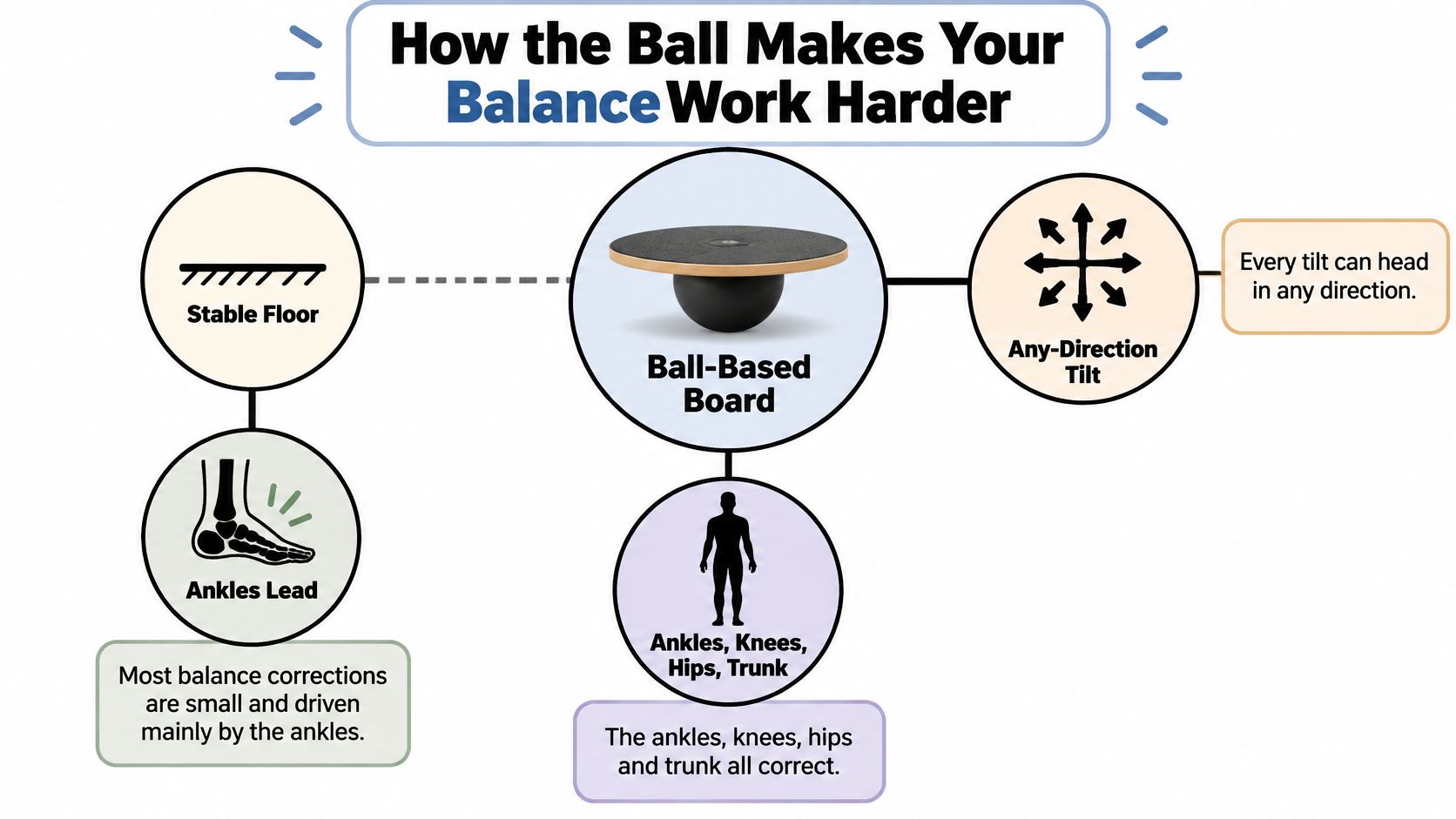
On a stable floor, small balance corrections often come mainly from the ankles. On an unstable board, the direction and size of the movement change, so your knees, hips, and trunk also help keep your body over its support.
Think of carrying a tray of drinks on a moving bus. Stiffening one joint isn't enough; you need coordinated adjustments throughout your body.
The diagram illustrates that shared stabilization task.
Better control can mean less effort
In a four-week wobble-board intervention in healthy adults, unstable-surface standing time approximately tripled while lower-leg muscle activation decreased by 29–59%, according to the study abstract indexed by Medscape.
That combination is important. Staying balanced longer while using less muscle activation suggests that participants learned a more efficient strategy, rather than contracting harder.
The goal isn't to produce the biggest wobble. It's to manage the movement with smaller, more controlled corrections.
Progress by changing the task
Begin with both feet supported on the board, hands on a sturdy counter, and brief efforts. Keep your eyes forward and your knees comfortably soft.
Then progress deliberately:
- Reduce reliance on your hands: Lighten your grip without losing alignment.
- Adjust your stance: Narrow it only when you can control the current position.
- Introduce single-leg work: Reserve this for users who can manage the added demand safely.
- Add reaching: Move toward an easy target without chasing the board or twisting abruptly.
A movement demonstration can help you understand the task, but it isn't an individualized exercise prescription.
Runners exploring how to prevent ankle sprains while running should distinguish general conditioning advice from rehabilitation for an unstable ankle. The findings above concern wobble-board training specifically, not identical outcomes from every commercial ball-and-board design.
What the Research Shows About Balance Gains
Wobble-board training doesn't guarantee better everyday balance or fewer falls. Improving at an equipment-specific task and reducing real-world fall risk are different outcomes.
A 2021 systematic review of wobble-board training in older adults reported the following results across the included studies.
What the 2021 Review Measured
| Measure | Reported result | How to read it |
|---|---|---|
| Berg Balance Scale or similar functional test | Weighted average improvement of 4.4% | Small average gain across studies reporting comparable outcomes |
| Timed up-and-go test | Improvement of 6.3% | Modest gain on a common mobility test |
| Effect sizes across studies | 0.09 to 0.96 | Results ranged from small to relatively substantial |
| Time to measurable change | About three weeks | Improvements could appear with sufficiently long sessions and simple exercises |
| Evidence base | 6 studies, 129 participants | Small evidence base with conflicting overall findings |
The functional-test result is encouraging but modest. It doesn't mean every participant improved, and it doesn't translate directly into a matching reduction in falls.
The spread of effect sizes also matters. Participants, exercises, training exposure, and assessment methods differed, so the review did not identify a uniform benefit that applies to everyone who buys a board.
What counts as meaningful improvement
A useful outcome should connect to your actual difficulty. Someone recovering from an ankle injury may need better control during a direction change, while someone concerned about falls may need safer turning, transfers, or walking.
Improved board performance can be part of that picture, but it isn't the whole picture. A therapist should also consider whether you move more confidently and safely during the activities that brought you to treatment.
Exercise selection and dosage matter more than equipment ownership. Simple tasks practiced consistently may be more useful than occasional attempts at difficult tricks. However, the review doesn't provide a universal home prescription, and its early improvement window shouldn't be treated as a deadline.
The evidence supports using the board as one component of supervised balance and gait training. It doesn't establish the device as a stand-alone way to reduce fall risk or replace assessment of vision, sensation, strength, medications, and walking ability.
Matching the Board to Your Training Goal
Instability doesn't automatically increase lower-limb muscle activity. A difficult-looking exercise can demand considerable coordination without providing the loading you need for maximal leg strength.
A systematic review and meta-analysis covering 86 studies and 1,783 participants found increased activity in several core muscles on unstable surfaces, but lower-limb activity wasn't consistently higher than during equivalent stable-surface exercises.
The review also discusses device-specific differences. Highly unstable Swiss-ball conditions increased activation across tested muscles, while moderately unstable BOSU and Dyna Disc conditions often didn't significantly increase activation in trained participants.
Match the setup to the adaptation
- Rapid postural control: Choose a task that requires small corrections without repeated loss of position. Reduce hand support or increase instability only after you can maintain control for the planned interval.
- Core endurance: Use manageable instability, steady breathing, and a trunk position you can sustain. Extend the hold before making the surface dramatically less predictable.
- Maximal leg strength: Prioritize stable resistance exercises that allow appropriate loading. Progress resistance and movement quality rather than trying to lift heavier weights on a wobbling platform.
For example, someone preparing for dance may need both strength and balance practice, but those needs don't have to be trained in the same exercise. Resources such as Danza Academy of Social Dance conditioning can help frame broader conditioning questions without making a balance board the centerpiece of every session.
Practical distinction: Train strength where you can produce controlled force. Train balance where you can safely manage changing support.
Muscle activation is also not the same outcome as a long-term strength gain. Select the equipment for the adaptation you want, and simplify the task when fatigue starts changing your alignment or breathing.
Who Should Check With a Clinician First
Older adults with falls, people with painful arthritis, patients recovering from surgery or injury, and anyone with foot numbness need more than a generic exercise list. Recurrent ankle instability also deserves an assessment before unsupported wobble-board practice.
A review of balance and fall-prevention programs in older adults reported balance-training gains ranging from 16% to 42% across interventions; one wobble-board protocol improved one-leg standing by a mean 42.1%, while its control group declined by about 23%.
Those findings show potential value, not universal safety. A program that helped selected participants under particular conditions may be inappropriate for someone with reduced sensation, painful joints, or surgical restrictions.
Starting Point by Personal Situation
| Situation | Safer starting point | Get clearance first |
|---|---|---|
| Older adult with a history of falls | Seated work or supported standing with a sturdy counter | Yes, screen with a clinician |
| Recent surgery | Only movements approved by the surgeon or therapist | Yes |
| Arthritis in hip, knee, or ankle | Brief holds, comfortable range, and a two-legged stance | Yes if pain or swelling persists |
| Numbness or neuropathy in the feet | Supported work on a clear, flat surface; board use only after assessment | Yes |
| Recurrent ankle instability | Structured, supervised wobble training | Yes |
| Healthy adult with no symptoms | Two-legged stance with hand support and brief intervals | Usually no, but stop if symptoms appear |
More instability can mean more risk, not more benefit. Wobble boards and dome-style trainers demand more control than a stable floor, and someone who struggles with ordinary standing may need floor-based practice first.
A seated starting point doesn't mean sitting on a standing-only board. It may mean therapist-directed foot movements while seated in a stable chair, using only equipment approved for that task.
A balance assessment should clarify why you're unsteady and what assistance you need. Our explanation of physical therapy for balance issues describes how assessment and exercise selection fit together.
Tell the clinician about recent falls, changes in sensation, swelling, and any activity restrictions. Don't assume that permission to walk or resume general exercise automatically includes permission to use an unstable platform.
Safety Checklist and Signs to Stop
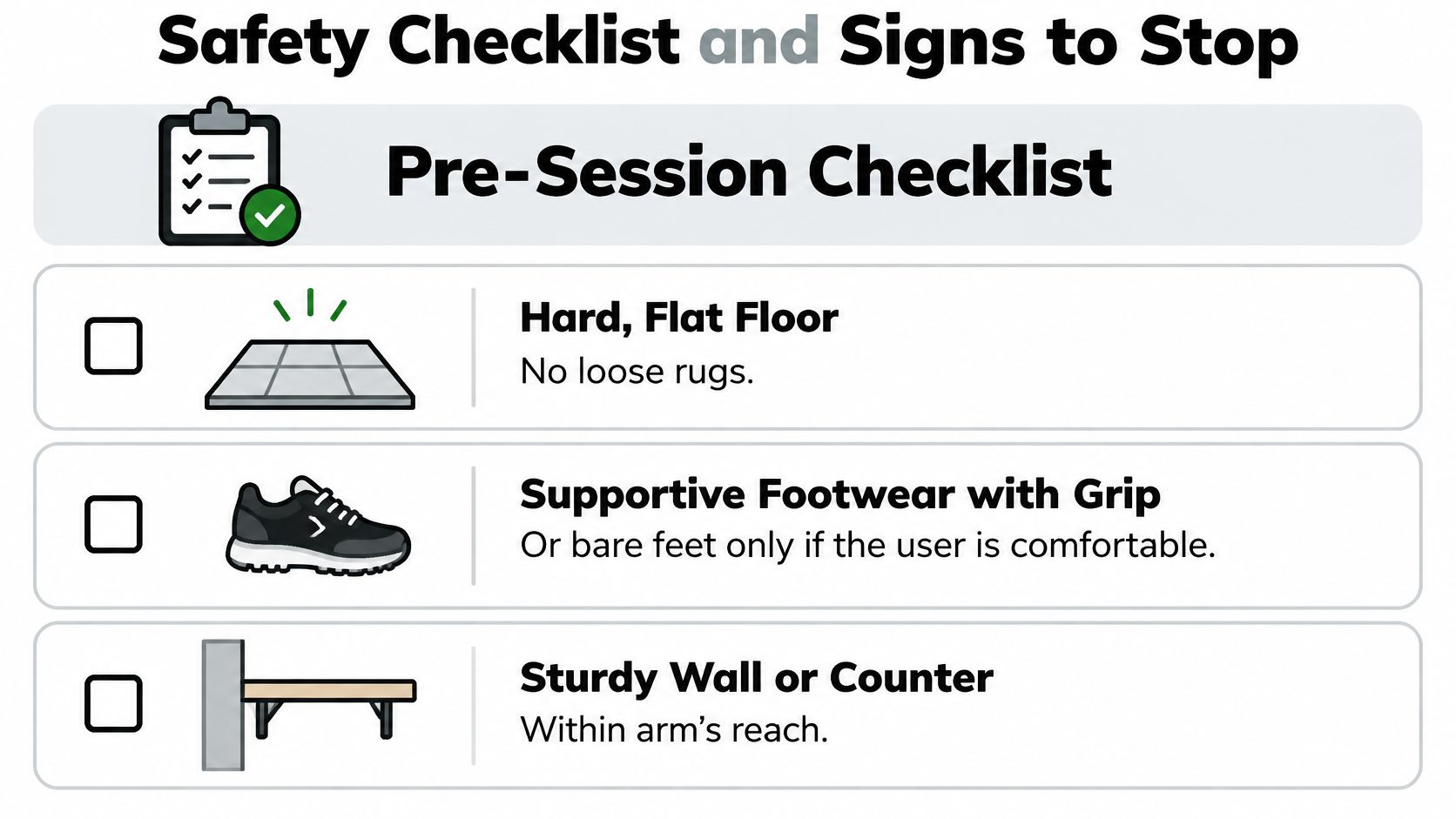
Prepare the environment before stepping onto the board:
- Firm, flat floor: Remove loose rugs and follow the manufacturer's surface requirements.
- Secure footing: Wear supportive footwear with grip. Use bare feet only if appropriate for the device and your health.
- Sturdy support: Place a fixed counter or suitable wall within easy reach. Don't rely on a rolling chair.
- Clear surroundings: Leave enough unobstructed space to step off without striking furniture.
- Nearby help: Have another person present during early attempts if you're uncertain about mounting or dismounting.
- Equipment inspection: Check maximum load, assembly, inflation instructions, and signs of damage.
Use this visual reminder when setting up your exercise space.
Keep the session controlled
Start with brief efforts and rest before your legs become shaky. Hold the support while stepping on and off, and don't try to rescue a failed repetition by making a sudden twist.
Your trunk should remain reasonably aligned, your feet controlled, and your breathing comfortable. If your knees collapse inward or you repeatedly grab the counter, return to a more supported task.
Stop signs
- Sharp or joint pain: Stop rather than testing whether another repetition will loosen it up.
- Dizziness or lightheadedness: Get safely off the board and sit down.
- Numbness or tingling: End the exercise and seek advice if symptoms are new, persistent, or recurring.
- Uncontrolled loss of balance: A forced step-off, near-fall, or fall means the task needs reassessment.
- Chest pain or unusual shortness of breath: Stop and seek medical attention. Severe or persistent symptoms warrant emergency help.
Don't train through pain or exhaustion to complete a planned interval. The useful endpoint is the last controlled effort, not the moment you can no longer stay on.
Confirm Your Starting Level Before Your First Session
Use a simple decision process rather than testing your limits immediately.
- Apply the screening rule. Arrange assessment before board use if you have falls, recent surgery, foot numbness, recurrent ankle instability, or unresolved joint symptoms.
- Choose a supported starting position. Use a manufacturer-approved setup that lets you mount and dismount without improvising.
- Record what happens. Note practice duration, hand support, symptoms, and whether you maintained a steady position.
- Progress only with repeatable control. Change a single task feature rather than removing support and adding reaching together.
- Measure what matters. Ask how progress will be assessed beyond staying on the board. A mobility measure such as the timed up-and-go test may be relevant when walking and transfers are the concern.
Bring your notes and the board's model information to an assessment. A clinician can help decide whether the device matches your needs or whether another exercise is a better starting point.
The board is a training tool, not a substitute for medical assessment.
At MedAmerica Rehab Center, we treat balance disorders, gait and mobility issues, sports injuries, and pre- and post-surgical rehabilitation, including care focused on fall prevention. Visit MedAmerica Rehab Center to ask about assessing your balance and choosing an appropriate starting point before using a ball-based board.
MedAmerica Rehab · Deerfield Beach
Talk to a clinician about your pain
Physical therapy, chiropractic, acupuncture and shockwave therapy under one roof, since 1995. Same-day appointments are available.
Mon–Thu 8:00 AM – 6:30 PM · Fri 8:00 AM – 3:00 PM