
Physical Therapy for Balance Issues: Restore Stability
You reach for the stair rail before your foot lands on the next step. Outdoors, uneven pavement makes you slow down, and a quick turn of your head leaves you briefly unsteady. Maybe you haven't fallen, but you've started changing how you move. That hesitation matters. Balance problems can affect independence long before they cause an obvious injury, and physical therapy for balance issues can identify the reason you feel unstable instead of treating every patient with the same exercise sheet.
Why Balance Fails and What That Means for You
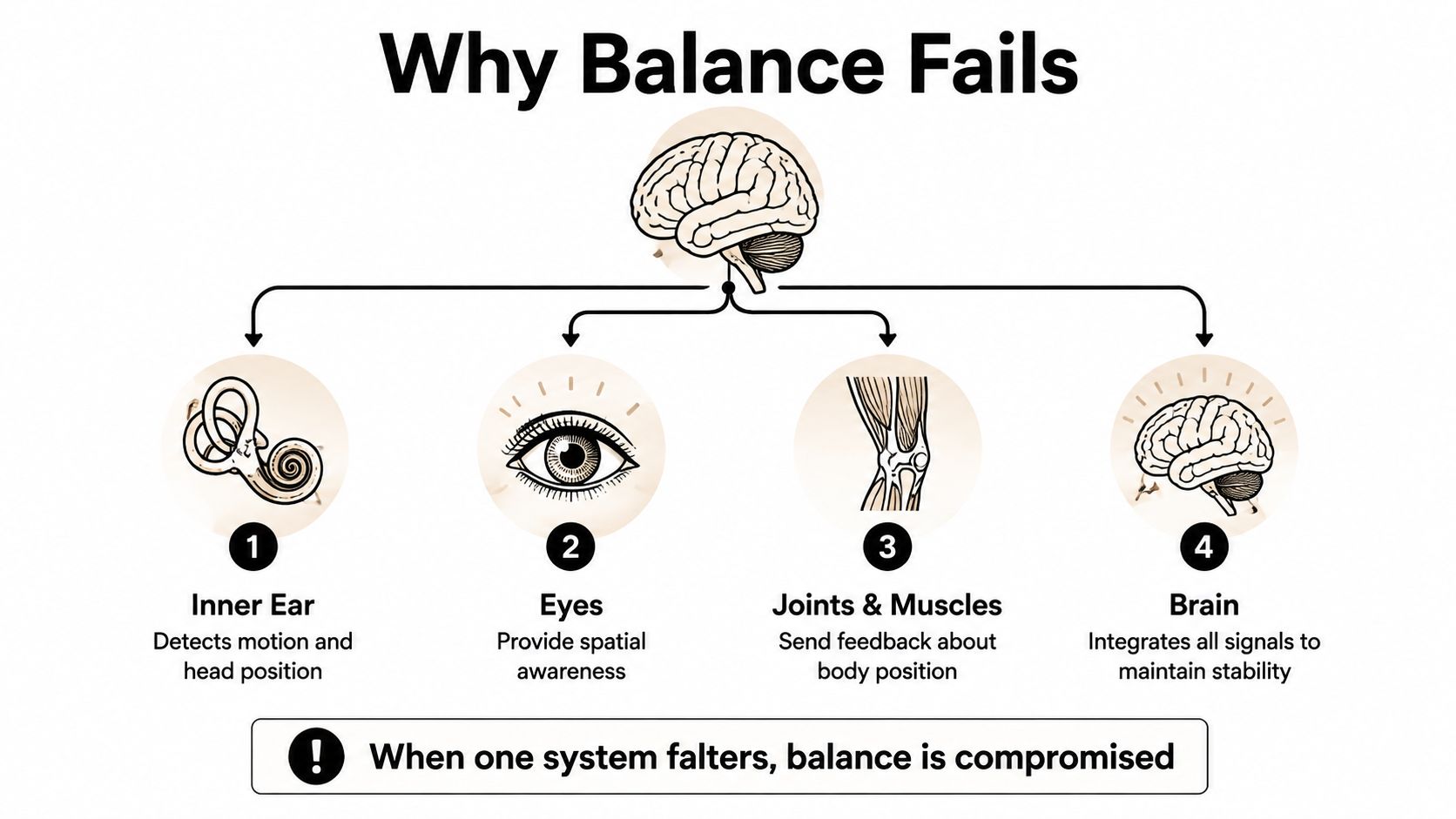
Balance depends on several systems sharing information. Your eyes estimate where you are in the environment, your inner ear detects head movement and position, and your joints and muscles report how your body is arranged. The brain processes those signals and coordinates a response that keeps you upright.
Think of the system as a three-legged stool with a control center. If one leg becomes unreliable, the other legs may compensate for a while. Someone with an inner-ear problem may depend heavily on vision. Someone with reduced sensation in the feet may watch the ground more closely. Those strategies can help temporarily, but they often fail in darkness, on uneven ground, or when attention is divided.
The signal may be sensory, muscular, or neurological
A person with vestibular dysfunction may describe spinning, rocking, motion sensitivity, or difficulty stabilizing vision while walking. A person recovering from a stroke or living with Parkinson's disease may have trouble organizing posture and stepping responses. Someone with arthritis, weakness, pain, or reduced flexibility may understand where the body is, but lack the strength or range of motion to respond quickly.
These categories can overlap. A painful knee may shorten a person's stride, which reduces practice with weight shifting. Reduced activity can then weaken the legs and make ordinary movements feel more demanding. The important point is that balance isn't just a strength problem. It also involves sensory integration, postural control, coordination, and the ability to take a corrective step.
Why the cause changes the treatment
A static exercise may be reasonable for one patient and poorly matched for another. Someone with dizziness may need gaze-stabilization or other vestibular exercises. Someone whose difficulty appears during turning may need gait and stepping practice. Someone who loses balance when reaching may need controlled shifts of the center of mass, not just seated strengthening.
Clinical perspective: Feeling unsteady is a symptom, not a diagnosis. The safest plan starts by finding out which balance system is struggling and when the problem appears.
Balance changes after a concussion, stroke, peripheral neuropathy, inner-ear disorder, injury, or gradual loss of conditioning deserve attention. Don't assume that avoiding stairs, walking slowly, or holding furniture is a harmless adjustment. Those habits may reduce immediate exposure to challenge while allowing confidence and physical capacity to decline.
How Physical Therapists Assess Balance Problems
A balance evaluation begins with your story. The therapist will ask when the unsteadiness started, whether you feel dizziness or light-headedness, what movements trigger symptoms, and whether you've fallen or nearly fallen. Questions about medications, vision, hearing, pain, previous injuries, neurological conditions, and daily activities help connect the symptom to a setting.
The therapist also wants details that can be easy to overlook. Do you feel unsafe when turning in the kitchen, stepping off a curb, getting out of bed, or walking in a crowded store? Do symptoms worsen when you move your head, close your eyes, or carry something? These examples reveal whether the problem involves sensory input, movement planning, strength, or environmental demands.
What the hands-on examination looks for
The physical therapist watches you stand, sit, turn, reach, and walk. They may examine step length, foot clearance, trunk position, speed changes, symmetry, and how you recover when your center of mass moves away from its usual position. Strength and flexibility testing can show whether a painful or restricted joint limits a corrective response.
A clinician may also compare performance with eyes open and closed, firm and softer surfaces, narrow and wider foot positions, or simple and divided attention. These changes aren't meant to make you feel judged. They help identify which information your body relies on and where that strategy breaks down.
The assessment commonly considers three overlapping sources:
- Vestibular factors: Dizziness, motion sensitivity, or difficulty keeping vision steady during head movement can point toward the inner-ear and gaze-control systems.
- Neurological factors: A stroke, Parkinson's disease, concussion, or another neurological condition may affect postural reactions, coordination, or the timing of a step.
- Musculoskeletal factors: Pain, weakness, stiffness, and limited ankle, hip, or spinal movement can reduce the physical options available when balance is challenged.
For older adults and anyone concerned about falling, a structured fall-risk assessment for elderly patients can add useful detail beyond a casual conversation.
Why testing matters
A patient may say, “My legs are weak,” while the more limiting issue is delayed stepping. Another may describe “vertigo,” while the examination points to difficulty using visual and vestibular information together. Precise testing prevents a generic prescription from replacing a targeted plan.
The evaluation should also identify safety boundaries. A therapist can decide whether a patient needs close guarding, an assistive device, environmental changes, medical referral, or a gradual reduction in hand support. That judgment is difficult to reproduce with unsupervised internet exercises.
Evidence-Based Treatments for Restoring Stability
Effective treatment should resemble the situations that make you unstable, while remaining safe enough to repeat and progress. The 2025 APTA and Academy of Geriatric Physical Therapy guideline strongly recommends multidirectional limb and whole-body movements, changes in the base of support, and reduced upper-limb support for lowering fall risk and fall rate in older adults. The guideline also strongly recommends volitional step training and gait-adaptability training, while advising against resistance training alone for fall prevention. Read the guideline and its recommendations.
Progressive balance training
Progression is the central idea. A therapist may begin with a wide stance and firm support, then gradually narrow the base of support, add reaching, introduce head turns, vary the surface, or reduce hand contact. The challenge should be meaningful, but not reckless.
Multidirectional practice matters because daily life rarely asks you to move only forward. You may need to step sideways around a chair, turn while carrying a plate, or recover after catching your toe. Training these weight shifts helps the body practice the decisions and corrective steps that real environments demand.
Resistance work still has a place. Stronger hips, legs, and trunk can improve the ability to control movement, rise from a chair, and take a step. But strengthening by itself doesn't teach the sensory processing and rapid postural responses required after an unexpected disturbance.
Vestibular rehabilitation
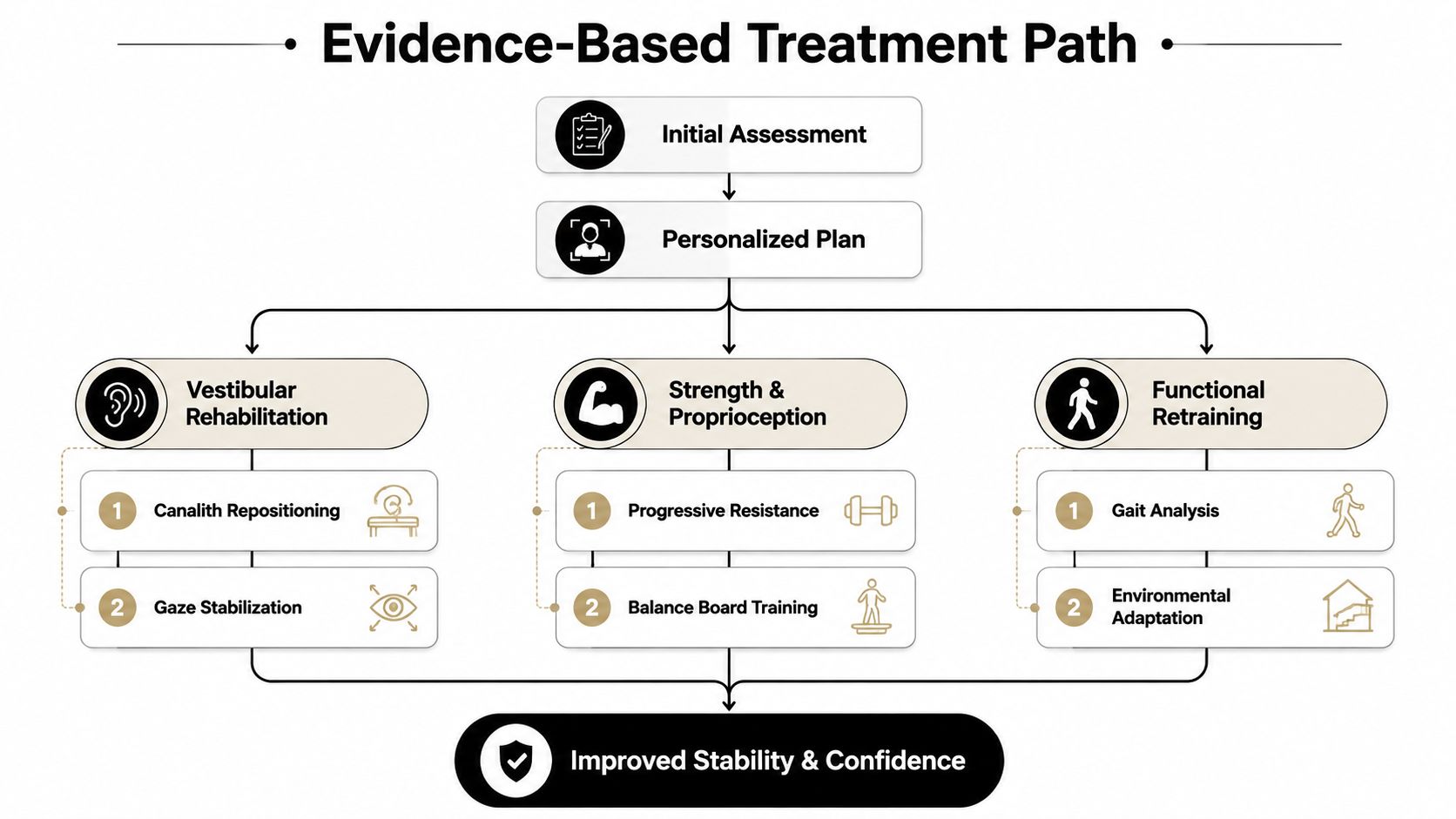
When imbalance is linked to dizziness or vestibular hypofunction, targeted vestibular rehabilitation may be more appropriate than generic mobility work. Exercises can address gaze stabilization, head movement tolerance, sensory reweighting, and postural responses. In stroke, a 2023 systematic review and meta-analysis reported an overall standardized mean difference of 0.59 for balance improvement, with a standardized mean difference of 0.56 among patients within six months of stroke, with moderate certainty of evidence. Review the vestibular rehabilitation evidence.
Evidence in Parkinson's disease is promising but less secure. A 2024 meta-analysis reported a postural balance mean difference of 5.35, with a 95% confidence interval from 2.39 to 8.31, while rating the evidence quality very low. That distinction matters. A therapist should use the finding to inform individualized care, not promise the same result to every patient.
Perturbation and functional retraining
Perturbation-based training introduces carefully controlled disturbances so the patient practices recovery. The therapist might create a small, expected shift or use a task that requires a quick step, always adjusting the setup to protect the patient. A 2026 systematic review found perturbation-based balance training reduced overall fall rates by 23% and injurious falls by 24%. See the review of balance outcomes and fall reduction.
The practical lesson is straightforward: standing still on command is useful, but it's only part of balance. Treatment should also include walking, turning, stepping over obstacles, changing speed, reaching, and managing attention. For readers who want a broader overview of exercises and progression, this guide to improving balance in older adults offers additional context.
A geriatric evaluation can also help organize medical, functional, and environmental factors that influence safety. The geriatric assessment approach from Orange Neurosciences is a useful resource for understanding why fall prevention often requires more than exercise alone.
A demonstration can make the difference between understanding a movement and performing it safely.
The Critical Role of Timing in Balance Rehabilitation
Waiting can change the problem. After dizziness begins, many people reduce head movement, walk cautiously, avoid busy places, and stop activities that once challenged their balance. Those choices may feel protective, but they can also limit exposure to the movements the nervous system needs to relearn.
Early evaluation helps separate conditions that need medical attention from impairments that respond to rehabilitation. It also gives the therapist a chance to address compensations before they become deeply practiced. A person who always turns the entire body instead of moving the head may avoid symptoms in the short term while becoming less adaptable in daily life.
Why early vestibular care matters
A large JAMA Otolaryngology study found that receiving physical therapy within three months of presentation for dizziness was associated with an 86% reduction in the odds of falling by twelve months. Read the JAMA Otolaryngology study on timing and falls. The finding describes an association, not a guarantee, and it doesn't mean every dizzy patient needs the same intervention. It does support prompt assessment when dizziness affects walking, turning, transfers, or confidence.
Vestibular rehabilitation may address gaze control and the brain's use of competing sensory signals. Strength and mobility work give the patient a stable physical platform. Stepping and perturbation practice then teach the body how to respond when the platform shifts unexpectedly.
Combining the right challenges
These elements work together, but they shouldn't be thrown into a random circuit. A patient with prominent dizziness may begin with controlled head movements and visual fixation. A patient with delayed stepping may need supported weight shifts and direction changes. A patient with pain may require joint-focused treatment before faster balance tasks are safe.
The progression should follow the patient's response. A therapist may increase movement complexity, reduce hand support, add a cognitive task, or change the environment only after the current level is controlled. If symptoms flare sharply or the patient loses safe technique, the clinician can scale the task back rather than turning rehabilitation into a test of endurance.
Timing matters because avoidance can become its own limitation. Prompt assessment gives you a safer way to practice the movements you're currently avoiding.
Seek medical care promptly for sudden severe dizziness, new neurological symptoms, fainting, chest pain, severe headache, or a sudden inability to walk. Physical therapy is valuable, but it isn't a substitute for urgent evaluation when symptoms may signal a medical emergency.
What to Expect During Physical Therapy for Balance
A generic home routine and a clinician-guided program can look similar at first. Both might include standing, stepping, reaching, or walking. The difference is that a therapist selects the starting level, watches the quality of movement, adjusts the challenge, and connects each task to the patient's actual difficulty.
A home activity may tell you to stand near a counter. A therapist decides whether you should use both hands, one hand, or no hand support, whether your feet should be close together, and whether adding head turns is appropriate. That progression protects safety while preventing the exercise from becoming so easy that it stops producing useful practice.
A typical visit
The first appointment generally combines history-taking, movement observation, strength and flexibility checks, walking assessment, and balance testing. You'll discuss falls, near-falls, dizziness, pain, medications, home hazards, and the activities you want to resume. The therapist then uses those findings to build a plan around your impairments and goals.
Later sessions may include hands-on treatment when pain, stiffness, or mobility restrictions interfere with movement. They may also include targeted exercise, gait retraining, vestibular drills, stepping practice, and education about safe setup at home. You should understand why each activity is included and what signs mean that you need to stop or modify it.
For a fuller patient-oriented description, review what a typical physical therapy session looks like.
Clinic guidance compared with do-it-yourself practice
| Generic home activity | Clinician-guided rehabilitation |
|---|---|
| Uses a fixed difficulty | Adjusts the challenge to your symptoms and control |
| May focus on standing still | Can include stepping, turning, gait adaptability, and recovery |
| Offers limited feedback | Provides immediate correction and safety monitoring |
| Often treats balance as one problem | Matches treatment to vestibular, neurological, or musculoskeletal findings |
Home practice still matters. Short, consistent practice helps reinforce the skills developed in treatment, but it should follow the therapist's instructions. Don't add foam surfaces, eyes-closed tasks, rapid turns, or dual-task demands on your own because they look more advanced. Difficulty only helps when you can perform the movement safely and with useful technique.
MedAmerica Rehab Center's physical therapy intake includes assessment of balance, strength, endurance, and flexibility, and its rehabilitation care may include targeted exercise, manual therapy, stretching, hot or cold packs, and electrical stimulation when clinically appropriate. The right combination depends on the evaluation, not on a standard package.
Taking the Next Step Toward Safer, Confident Movement
You don't need to wait for a fall before asking for help. Start by writing down when the problem occurs, what brings it on, whether you experience spinning or light-headedness, and which activities you've stopped doing. Bring a medication list, relevant medical records, and comfortable shoes that reflect what you normally wear.
At the first visit, ask practical questions:
- What appears to be limiting my balance? Ask whether the main issue seems vestibular, neurological, musculoskeletal, or mixed.
- Which movements should I practice at home? Clarify the setup, hand support, repetitions, and warning signs.
- How will progress be measured? A useful plan should track meaningful activities, not just whether an exercise feels difficult.
- What should I avoid for now? Safety instructions are part of treatment, especially if you've fallen or feel dizzy.
People in Deerfield Beach and nearby communities can look for a clinic that offers individualized physical therapy, balance and gait training, and fall-prevention support. Same-day availability and insurance-friendly processes may make it easier to begin, but the clinical match matters most. A broader home-safety and health review can complement rehabilitation, and this guide on how to prevent falls with health checks offers another perspective.
Improvement rarely follows a single dramatic moment. It often appears as a steadier turn, less reliance on the countertop, a safer walk across uneven ground, or renewed willingness to leave the house. The timeline depends on the cause, symptom severity, medical history, and consistency with the prescribed plan, so your therapist should set expectations after the evaluation rather than promise a universal schedule.
MedAmerica Rehab Center provides individualized physical therapy, balance and gait training, and fall-prevention care for patients working to move more safely and confidently. Visit MedAmerica Rehab Center to request a consultation and discuss the right starting point for your balance concerns.
MedAmerica Rehab · Deerfield Beach
Talk to a clinician about your pain
Physical therapy, chiropractic, acupuncture and shockwave therapy under one roof, since 1995. Same-day appointments are available.
Mon–Thu 8:00 AM – 6:30 PM · Fri 8:00 AM – 3:00 PM