
Acupuncture for Knee Pain Meniscus Explained
You twisted getting out of the car, or turned on the stairs, and now the inside of your knee aches every time you bend it. It doesn't lock, exactly. It just hurts, swells a little by evening, and makes you think twice before a squat or a longer walk.
That's the moment many people ask about acupuncture for knee pain meniscus problems. Not because they expect magic. They want the ache calmer, they want to keep moving, and they don't want every conversation to jump straight to surgery.
I understand that hope. The honest answer is narrower, and more useful, than most sales pages make it sound.
What Acupuncture Can Do for Meniscus Pain
Here's the verdict in plain words. Acupuncture may ease ache and stiffness for a limited time, especially when a worn meniscus shares the knee with osteoarthritis. It does not repair meniscal tissue, move a flipped fragment back into place, or replace an exam when the joint is blocked.
That distinction matters more than point selection. A 2025 narrative review on acupuncture for knee osteoarthritis reports that acupuncture may improve knee osteoarthritis pain and function for up to 4.5 months after treatment, but that finding can't be assumed to mean a torn meniscus healed. The same review notes occupational guidance is cautious, allowing acupuncture only for selected osteoarthritis patients as an adjunct to conditioning and weight loss, with evidence insufficient for acute and subacute knee pain.
When acupuncture fits a meniscus knee
| Knee situation | What acupuncture may do | What it cannot do | Better next step |
|---|---|---|---|
| Ache on stairs, squats, or walks, no locking | Short-term pain relief as an adjunct | Repair the meniscus | Strengthening plus a limited acupuncture course |
| Degenerative meniscus with osteoarthritis | Small pain and function gains seen in OA trials | Reverse cartilage or meniscus damage | Conditioning, weight management, acupuncture as an adjunct |
| Locked knee or cannot fully straighten | Little role while motion is blocked | Remove displaced tissue | Orthopedic assessment |
| Giving way, recurrent swelling, or cannot bear weight | Not a first treatment | Stabilize or diagnose the joint | Medical exam and imaging if indicated |
| Pain calmer but thigh still weak | May improve tolerance for exercise | Replace strengthening | Graded physical therapy as the main plan |
Read the first row as the fairest test. If you have stair, squat, or walking ache, full straightening, and no true locking, a short trial beside progressive strengthening is reasonable. You're testing whether lower pain lets you load the leg better, not whether needles rebuild the pad inside the joint.
The second row is who most trials studied. A degenerative meniscus with osteoarthritis is a worn, sensitive knee, not just a torn structure. Expect a small short-term change if it helps, and judge it by walking and stairs.
Rows three and four change the order of care. A locked knee, a knee that won't fully straighten, giving way, swelling that keeps returning, or inability to bear weight after a twist needs medical or orthopedic assessment first. Needles can't clear displaced tissue or tell you whether a ligament, fracture, or unstable tear is present.
The last row catches a common trap. Pain settles, so visits continue, but the thigh stays weak and the knee still feels unsure on turns. At that point graded exercise is the treatment, and acupuncture is only useful if it helps you do that work.
If you're comparing needling approaches, Dry needling insights for healthcare practitioners can help you separate muscle-focused dry needling from broader acupuncture care. For a clinical overview of how needles fit into pain care, see our page on acupuncture for pain relief.
Mark the row that matches your last two weeks, not the row you hope you're in. That row sets the next step.
How Needling Eases Pain Without Mending the Tear
The meniscus is a shock-absorbing pad between thigh bone and shin bone. When it's torn or worn, pain can come from an irritated joint lining, inflammation around the joint, sensitive tissues nearby, or a fragment that physically blocks motion. Those are different problems, and they don't respond the same way.
This visual sums up the core idea before we get into mechanism.
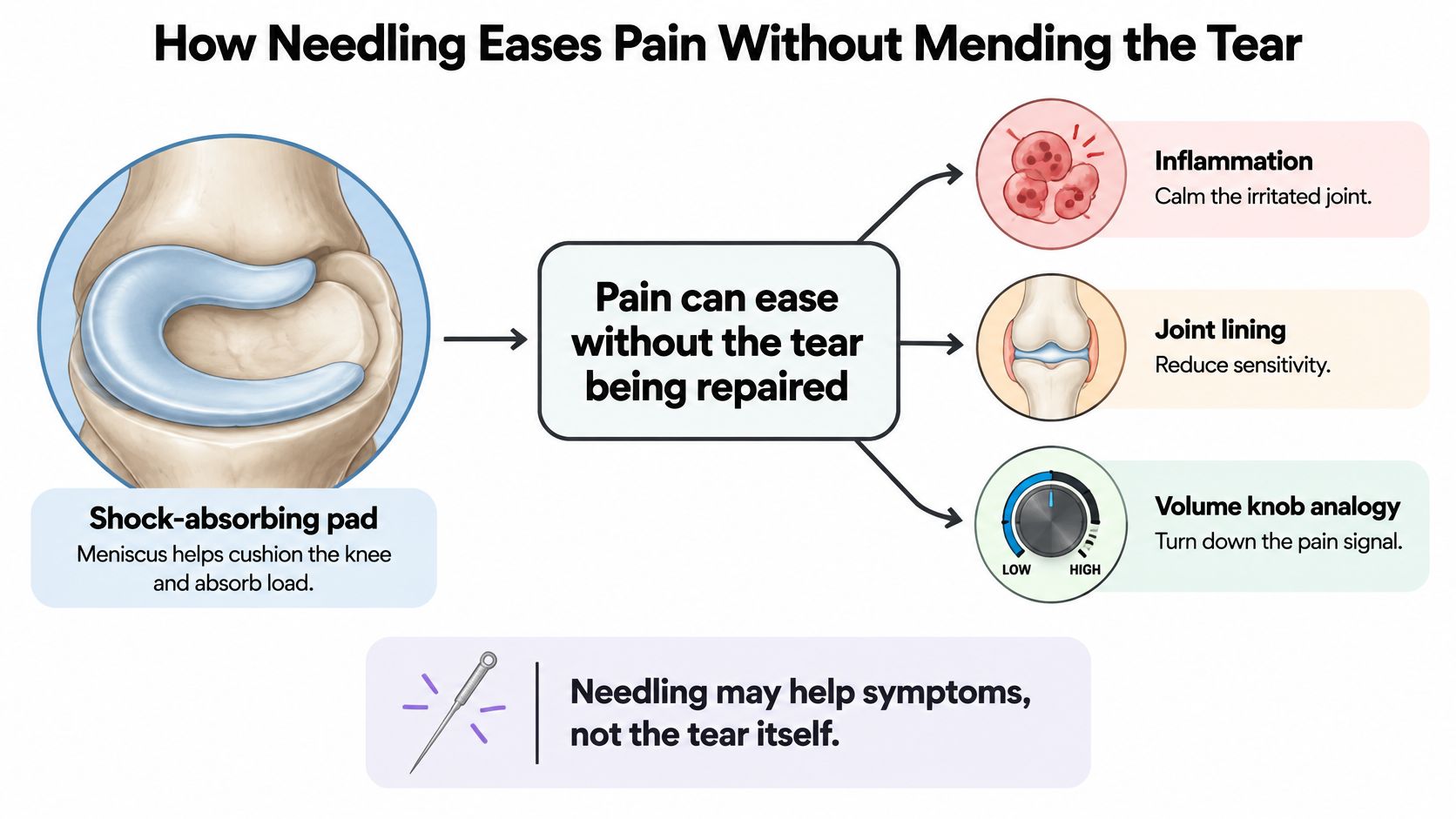
Think of pain as a volume knob. Needles don't sew the pad. They may turn the alarm down for a while by influencing pain sensors around the knee and the way the spinal cord and brain process that signal. When the volume drops, the quadriceps often switch on more willingly, walking feels less guarded, and rehab exercises become tolerable.
A 2024 systematic review in BMJ Evidence-Based Medicine put it in clinical terms, noting reduced pain can improve quadriceps activation, walking tolerance, and participation in rehabilitation. That's symptom modulation, not tissue repair. The review also found acupuncture reduced pain versus sham across its trials, but rated certainty for that estimate as very low, so I wouldn't sell it as a guaranteed effect.
The ice pack test
Ice on a sprained ankle can let you walk to therapy with less pain. Nobody claims the ice reattached a ligament. Acupuncture for a meniscus knee belongs in that same honest category when it works. It may calm sensitivity enough that you can strengthen, cycle, or walk with better form.
There's also a proposed anti-inflammatory angle involving signaling molecules such as IL-1β, IL-6, and TNF-α. Treat that as a possible part of symptom change in an arthritic knee, not proof that torn meniscal tissue has knitted back together.
Contrast two knees. A calm, achy degenerative knee that stiffens after sitting may respond to a quieter pain system. A knee that catches, locks, and won't straighten has a mechanical doorstop. Turning down the volume doesn't remove the doorstop.
This short video is a useful pause point if you're weighing symptom relief against structural problems.
Persistent locking, recurrent swelling, inability to fully extend, or worsening instability still needs a medical look. If you're mapping what recovery usually involves beside symptom care, our guide to the meniscus tear recovery timeline lays out the rehab side.
Acupuncture belongs beside exam-guided exercise and load changes. It doesn't replace them.
How Strong the Knee Pain Evidence Is
A person with a meniscus tear may also have knee osteoarthritis. That overlap matters: most acupuncture research measures osteoarthritis pain, not healing of a confirmed meniscal tear. Any benefit should be judged as symptom relief, not repair.
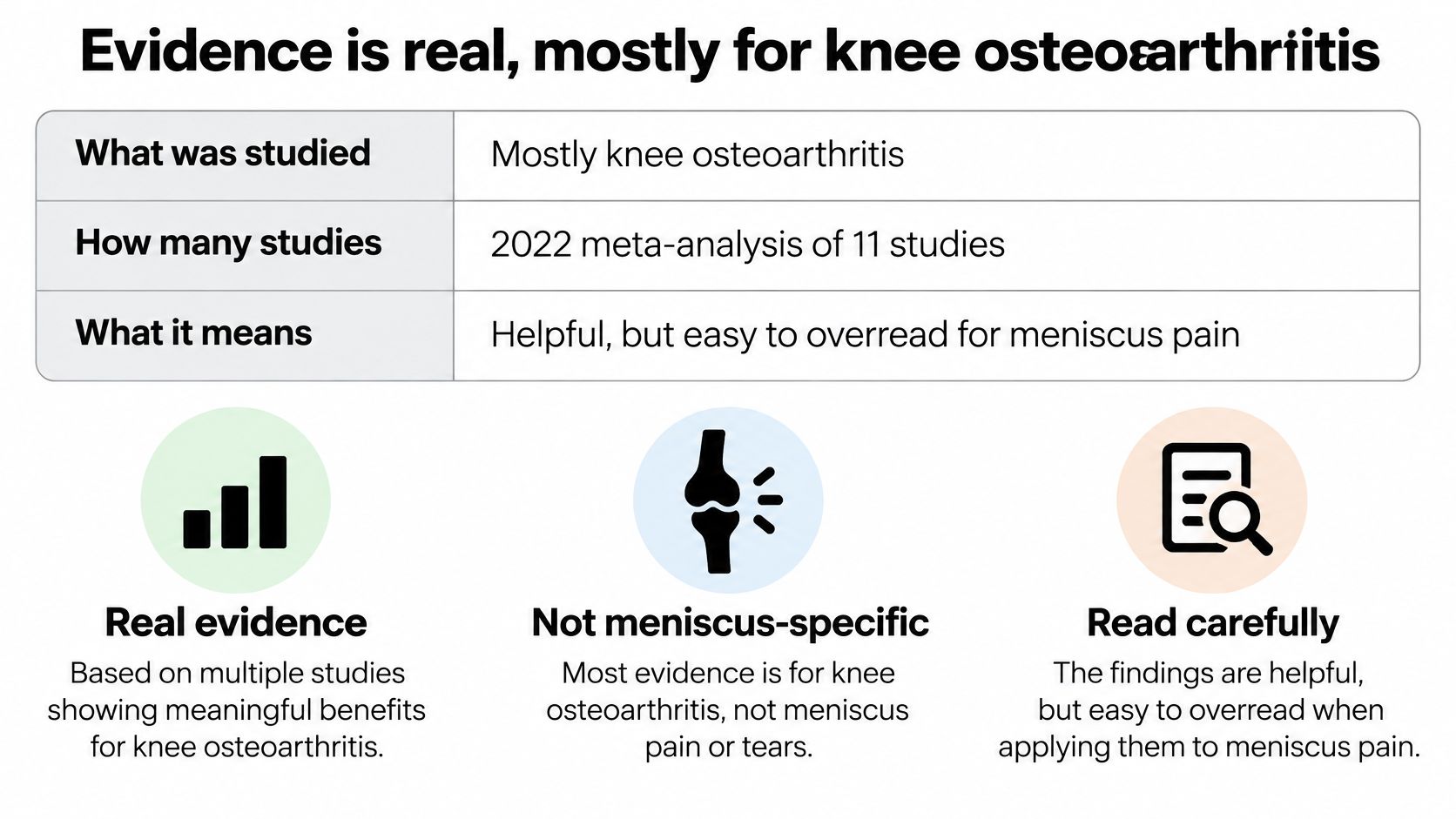
Acupuncture trial results readers should weigh
| Review | Who was studied | Pain result | Clinically important | Meniscus meaning |
|---|---|---|---|---|
| 2022 meta-analysis, 11 trials | 2,484 knee OA patients; 2,387 in the pain pool | SMD -0.12 (95% CI -0.20 to -0.04); I² 0% | Small but statistically significant | Indirect; OA, not confirmed tears |
| 2022 Cochrane versus sham | 3,498 people; 12 of 16 trials knee only | About 0.9 points on a 20-point scale; 4.59% absolute | No; below the 1.3-point pain bar | Short-term symptom hint only |
| 2022 Cochrane versus waiting list | Same review | About 14.5 points on a 100-point pain scale | Larger than the sham gap | Still not meniscus-repair evidence |
| 2024 review, 80 trials | 9,933 participants | SMD -0.74 versus sham (95% CI -1.08 to -0.39) | Uncertain; certainty rated very low | Symptom modulation, not structural healing |
The smaller, steadier result comes from a 2022 systematic review and meta-analysis of knee osteoarthritis trials. It included 11 randomized controlled trials involving 2,484 patients, with 2,387 participants contributing pain data. The pooled pain difference was a standardized mean difference of -0.12 (95% CI -0.20 to -0.04), with I² = 0%. Function data came from 2,408 participants. The average pain shift was small, although results pointed in the same direction.
A standardized mean difference, or SMD, combines studies that use different pain scales. It does not predict how many points your knee pain will change.
Sham-controlled results help show how much of the effect may come from needling itself. The 2022 Cochrane review on acupuncture for osteoarthritis included 16 randomized trials involving 3,498 people, of which 12 trials enrolled only people with knee osteoarthritis. Compared with sham, pain improved by about 0.9 points on a 20-point scale, a 4.59% absolute and 10.32% relative improvement. Function improved by about 2.7 points on a 68-point scale.
Both differences fell below the review's thresholds for clinical importance: 1.3 points for pain and 3.57 points for function. In other words, the average advantage over sham was statistically detectable but modest. Results looked larger against a waiting list, where expectations and attention may also affect symptoms.
For a meniscus decision, the practical question is whether pain relief helps you use the knee better. Plant-based joint care with AloeCure is separate from these trial findings. None of the results establishes that acupuncture repairs a confirmed tear; use symptom change and knee function to judge whether it is helping.
How Many Sessions and What Counts as Better
If your knee feels better after a session but you still limp on stairs, the treatment has not yet changed the problem that matters most. There is no proven acupuncture dose for meniscus pain, so agree on a short trial and judge it by function.
A multicenter trial protocol indexed on PubMed plans 24 sessions over 8 weeks, followed by a 16-week follow-up. It defines a responder as someone with at least a 2-point reduction in pain. Other 2025 protocols are testing myofascial trigger-point acupuncture and opposing needling combined with electroacupuncture. These are study plans, not proven treatment schedules.
Use a simple baseline to make changes easier to spot.
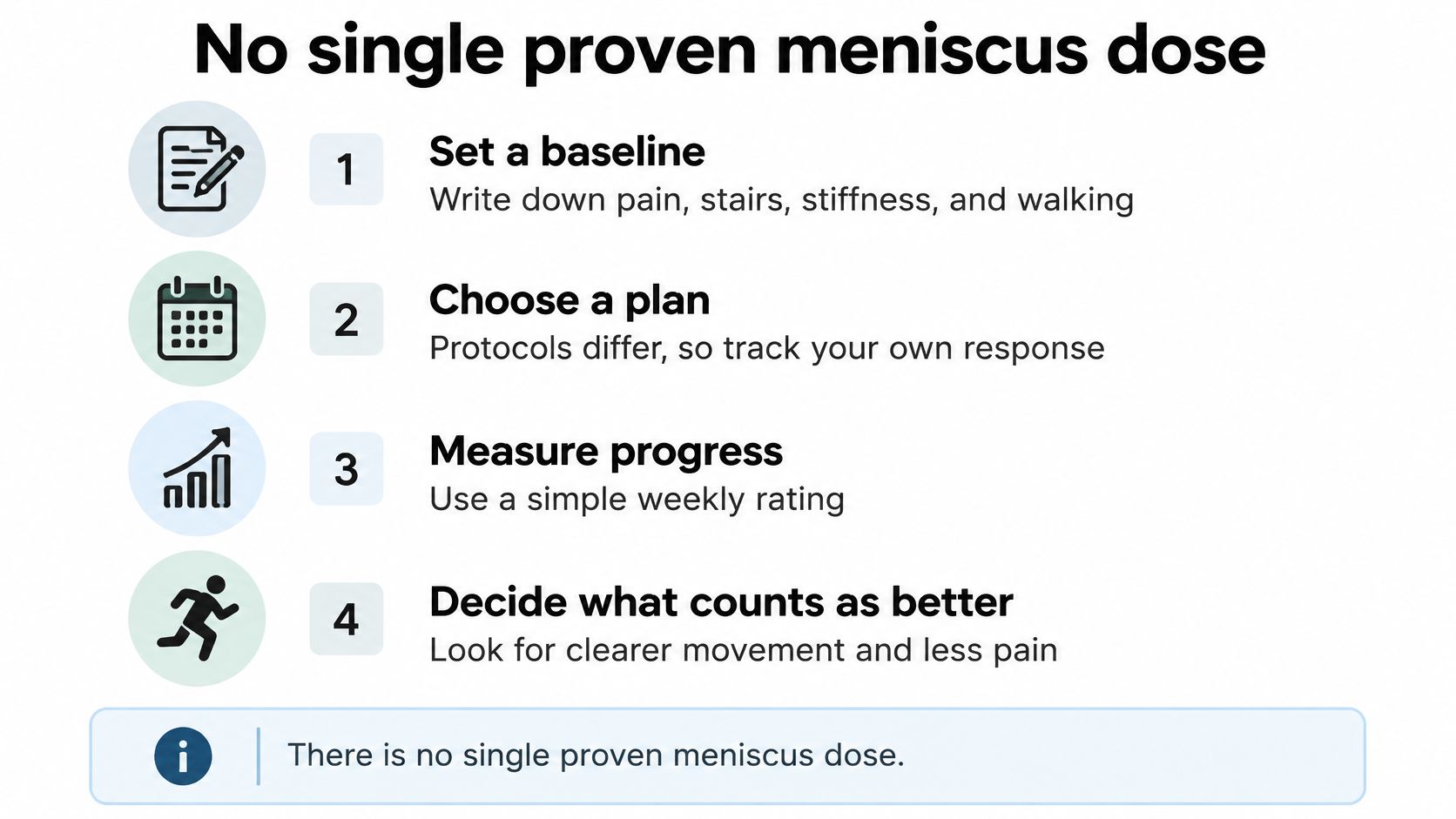
A clinical-practice guideline summarizing knee osteoarthritis trials covered 77 randomized trials involving 9,422 patients. Of these, 45 studies used manual acupuncture and 32 used electroacupuncture, often measuring pain, stiffness, and function with WOMAC scores. That range of methods shows why trial protocols cannot set a reliable dose for an individual meniscus injury.
Set your baseline before the first needle
- Rate two tasks: Score your pain from 0 to 10 on stairs and during a comfortable-depth squat.
- Time your walk: Note how long you can walk comfortably before pain changes your stride.
- Check motion: Record how far the knee bends and whether it straightens as fully as the other side.
- Compare swelling: In the evening, compare both knees and note puffiness above the kneecap.
- Choose one daily task: Track getting out of a car, standing from a low chair, or stepping off a curb.
Agree on a limited course, then reassess. A 2-point pain drop can serve as a tracking signal, but pair it with a meaningful task change: walking farther without a limp, taking stairs more comfortably, or squatting to a chair with less guarding. A better hour on the treatment table alone is weak evidence of progress.
Stop rule: If pain falls slightly but walking, knee motion, swelling, and strength do not improve, do not keep adding visits in the hope that acupuncture is repairing the tear.
Acupuncture may be an add-on for pain relief, but it does not replace graded activity and strengthening. If locking, giving way, or swelling worsens during the trial, stop and have the knee reassessed.
Safety Rules Before You Book Needles
Drop this belief first. Natural doesn't mean curative, and a calm session doesn't rule out a mechanical block. Safety here is a gate you pass before treatment, not a scare list after it.
Who should pause and ask first
- Bleeding risk: Tell the practitioner about blood thinners, a bleeding disorder, or very thin, fragile skin. Bruising can happen even with sound technique.
- Hot or infected knee: Skip needling through infected skin, an open wound, or a hot, swollen knee until a clinician clears it. That presentation can signal infection or another urgent problem.
- Higher infection risk: Uncontrolled diabetes, a compromised immune system, or a nearby prosthetic joint deserves a careful risk talk first.
- Electrical stimulation concerns: Pregnancy and pacemaker questions matter more for electroacupuncture than for a simple manual session, so the method should be chosen deliberately.
Needles should be sterile and single use, placed by a licensed practitioner who has examined the knee. Don't copy points from a diagram at home, and don't assume electroacupuncture is automatically stronger care. Trials use both manual and electrical styles, which says nothing about what your knee needs.
Expect the ordinary minor stuff to be possible, including brief dizziness, a short flare, or a small bruise. Treat different symptoms as a hard stop. Chest pain, new calf swelling, fever, or a knee that locks harder afterward is a reason to seek medical care, not to wait for the next appointment.
A good first visit includes a mechanical check. The practitioner should test whether the knee locks, catches, straightens fully, and bears weight through a step or squat, not only choose points. If catching, instability, or swelling is worsening, that finding cancels the experiment.
Real Knees and Your Next Step
Rules are easier to use when you can see the knee in front of you. These three scenarios cover most of the decisions I would walk through with a patient.

Three knees, three different plans
The 58-year-old walker. She has a degenerative meniscus, known osteoarthritis, morning stiffness, and stair pain at 6 out of 10. The knee straightens fully and never locks. A fair plan is activity pacing, quadriceps and hip strengthening, and a time-limited acupuncture course to make those exercises tolerable.
Success for her isn't a vanished MRI tear. It's walking farther, taking stairs with less guarding, and finishing the day with less swelling. At MedAmerica Rehab Center, acupuncture is offered to ease pain and headaches, release tension and promote relaxation and balance in the body, so I'd frame it exactly that way for her, as symptom support inside a rehab plan.
The weekend athlete who twisted. He felt a catch, now he can't fully straighten the knee, and something seems to block the last bit of motion. That's the mechanical doorstop pattern. An orthopedic exam comes before any needle trial, because the first job is finding out what's blocking the joint.
Booking acupuncture first for him wastes the window where a clear diagnosis matters most. If imaging and examination later support conservative care, needles can be reconsidered for pain while strength and motion are rebuilt.
The calmer knee with a shrinking thigh. Her pain dropped after rest, but the knee slips a little on turns and one thigh looks smaller. Acupuncture may settle soreness, yet the missing piece is neuromuscular training and load progression with a physical therapist. For starter movements that fit that goal, see these exercises to strengthen your knees.
People in this third group sometimes research every adjunct at once, including topical and oral products. If that's you, reading about choosing CBD oil for sore knees still shouldn't move strengthening out of first place. Weakness and giving way are training and assessment problems before they're product problems.
Choose your path
- Locked, blocked, or unstable: If you can't fully straighten, can't bear weight, or the knee gives way, get medical or orthopedic assessment first.
- Achy but moving fully: Get an exam, start progressive strengthening, and run a short acupuncture trial judged by the baseline checks.
- Pain down, thigh weak: Make graded physical therapy the priority and use needles only if they clearly help you train.
Our care aims to relieve pain, restore mobility and improve quality of life without surgery or unnecessary medication, but that goal never means delaying an orthopedic referral when the joint is blocked. The team includes Arielle Leavitt (COO), Dr. William Molesky (chiropractor and acupuncturist), Stanley Gusman (physical therapist), Heather Previll (doctor of physical therapy), Dorota Paspalis and Kristen Ebersberger (physical therapy assistants), and Krissy Carrera (office assistant), so acupuncture and physical therapy can be planned together rather than as competing appointments.
Book a first visit that checks locking, swelling, gait, and one stair or squat task. Leave with a stop date, not an open-ended needle plan.
Which case matches your last month? And which single task, stairs, walking distance, or getting out of the car, should improve before you'd book more sessions?
If your knee aches on stairs but still moves fully, we can examine it, set a baseline for walking and strength, and tell you whether a limited acupuncture trial belongs beside progressive rehab. If it locks, gives way, or won't straighten, we'll say so and point you to the assessment you need first. Visit MedAmerica Rehab Center to book that first knee visit and leave with a plan that has a clear measure of success.
MedAmerica Rehab · Deerfield Beach
Talk to a clinician about your pain
Physical therapy, chiropractic, acupuncture and shockwave therapy under one roof, since 1995. Same-day appointments are available.
Mon–Thu 8:00 AM – 6:30 PM · Fri 8:00 AM – 3:00 PM