
8 Common Pickleball Injuries and How to Prevent Them
You played a hard Saturday doubles match, felt a small twinge in the calf on the last lunge, and decided it would settle before next weekend. You show up again. The first few points feel fine, then the same push-off bites harder. That is how many common pickleball injuries begin. They are not random bad luck. They come from a short list of movements you already use every game: lateral shuffles, sudden stops, overhead reaching, and a repetitive grip on the paddle.
Those movements load the same places, so the injuries cluster. A U.S. epidemiologic analysis estimated 611 pickleball-related emergency-department injuries in 2013 compared with 13,690 in 2022, and in 2022 adults aged 65–80 accounted for 61.1% of estimated injuries. The rise tracks how many people are playing, and emergency data miss aches handled at home, so this is not your personal odds. It does show where serious cases land: older recreational players, and tissues that fail under a quick stop or a fall.
Each note below stays short. You get how the injury usually starts, a clear point to see a physical therapist, and one return-to-play check that beats "it feels mostly okay."
Practical rule: I would not play through a sharp pop, a joint that will not hold your weight, or pain that is worse the next morning.
1. Ankle Sprain (Lateral Ankle Sprain)
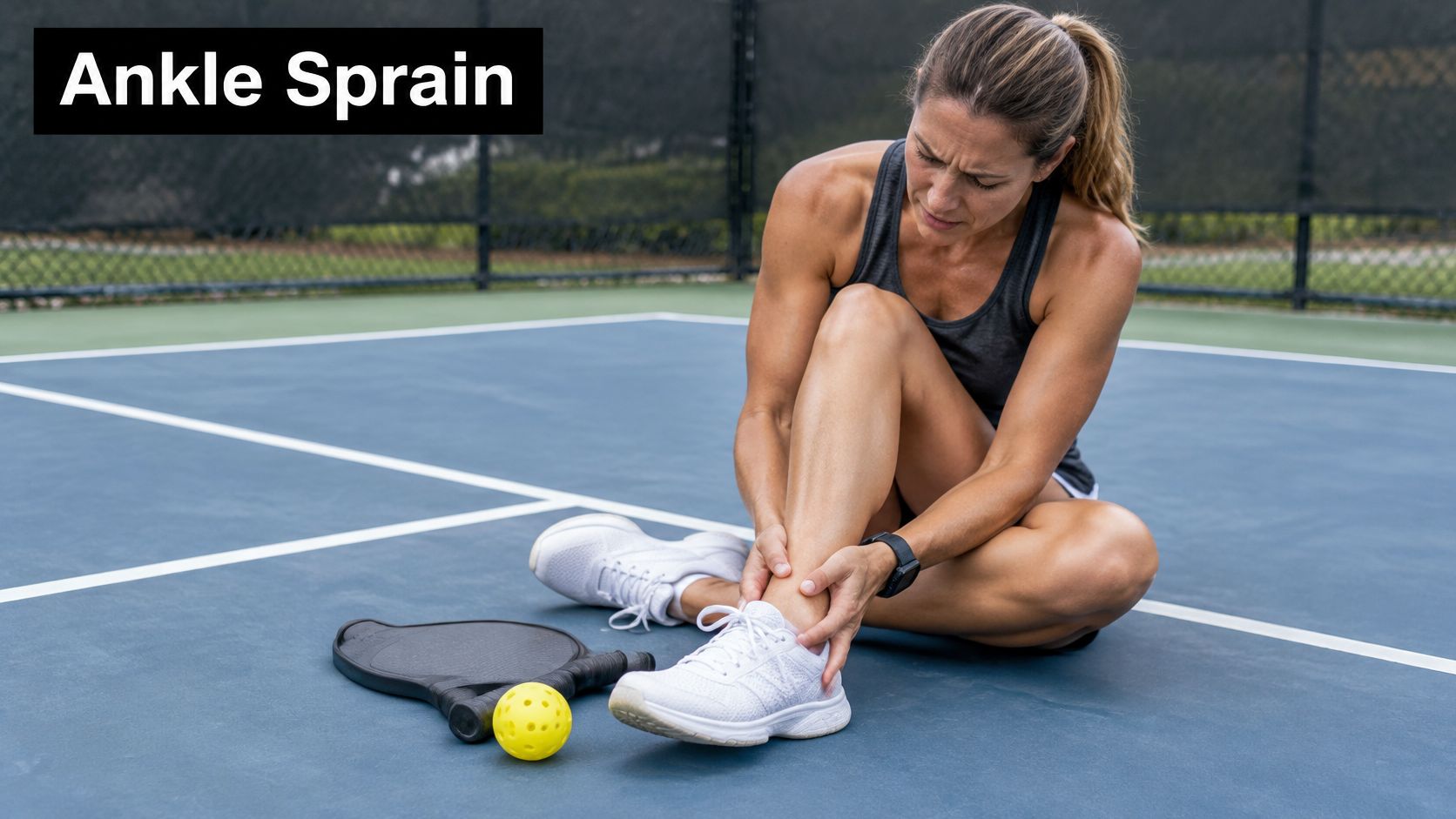
A roll usually happens in one step. You shuffle wide near the kitchen line, plant, and the outside of the ankle folds as you reach back for a lob. Ligaments on the outer ankle, most often the anterior talofibular ligament, stretch or tear. A mild sprain swells and aches. A severe one can leave the joint loose for months if you only rest it.
Adults carry more of the lower-limb load than many players expect. A 2003–2022 emergency-department analysis found that adults had a significantly greater proportion of lower-extremity injuries (59.4%) than pediatric players (36.4%) or geriatric players (39.8%). I treat a roll as a balance problem, not a one-week bruise.
See a PT when you cannot walk evenly the next day, the ankle gives way on flat ground, or swelling spreads into the foot. Once walking is comfortable, ankle sprain recovery exercises rebuild control. They are a poor idea while the joint is still unstable.
Return-to-play check: hop in place on the injured leg ten times, with no pain and no new swelling that evening.
- Court shoes: Use a shoe built for side-to-side cuts, not a running shoe.
- Warm-up: Ankle circles, calf raises, and lateral band walks before the first game.
- Balance work: Single-leg stands two or three days a week.
Say you sit out two weeks, hop clean, and still wobble on the first wide ball. That is not cleared. Cut the session and add a turning hop before full games.
2. Tennis Elbow (Lateral Epicondylitis)
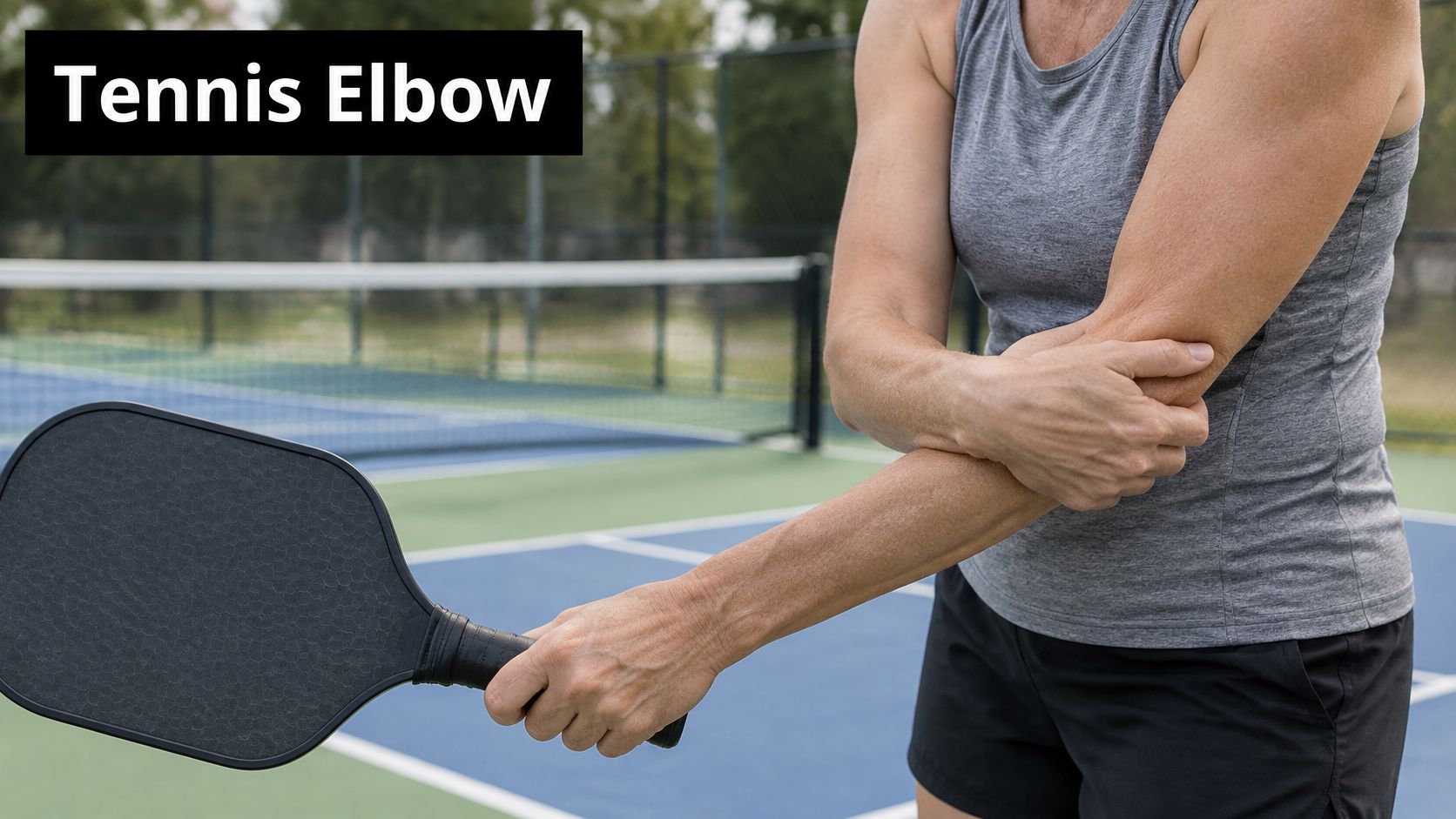
This one almost never arrives as a single bad swing. It builds from wrist extension and gripping through dinks, drives, and backhands. The tendon that usually complains is the extensor carpi radialis brevis, where it anchors on the outside of the elbow. Lighter paddles can tempt you to flick with the wrist instead of turning the trunk, and that trade-off loads the forearm more, not less.
A player who jumps to four days a week, then switches to a heavier paddle, often feels the outer elbow the next morning while lifting a coffee mug. Cutting sessions and loading the forearm slowly beats a brace alone. A tight elbow strap can quiet pain for a match and still leave the tendon weak.
A relaxed, firm grip beats a squeeze. Power should come from the legs and trunk, not a wrist snap.
Match the paddle weight and grip size to your hand. If the handle is too small, you clamp harder on every dink. Eccentric wrist extensions, lowering a light dumbbell with the palm down, three days a week, are the exercise I trust more than endless stretching.
See a PT when grip pain lasts more than two weeks, you drop the paddle, or daily tasks hurt as much as play. Return-to-play check: twenty backhands against a wall at game pace, then a pain-free coffee mug the next morning. If the mug hurts, you are not ready for a third game.
3. Shoulder Strain and Rotator Cuff Tendinopathy
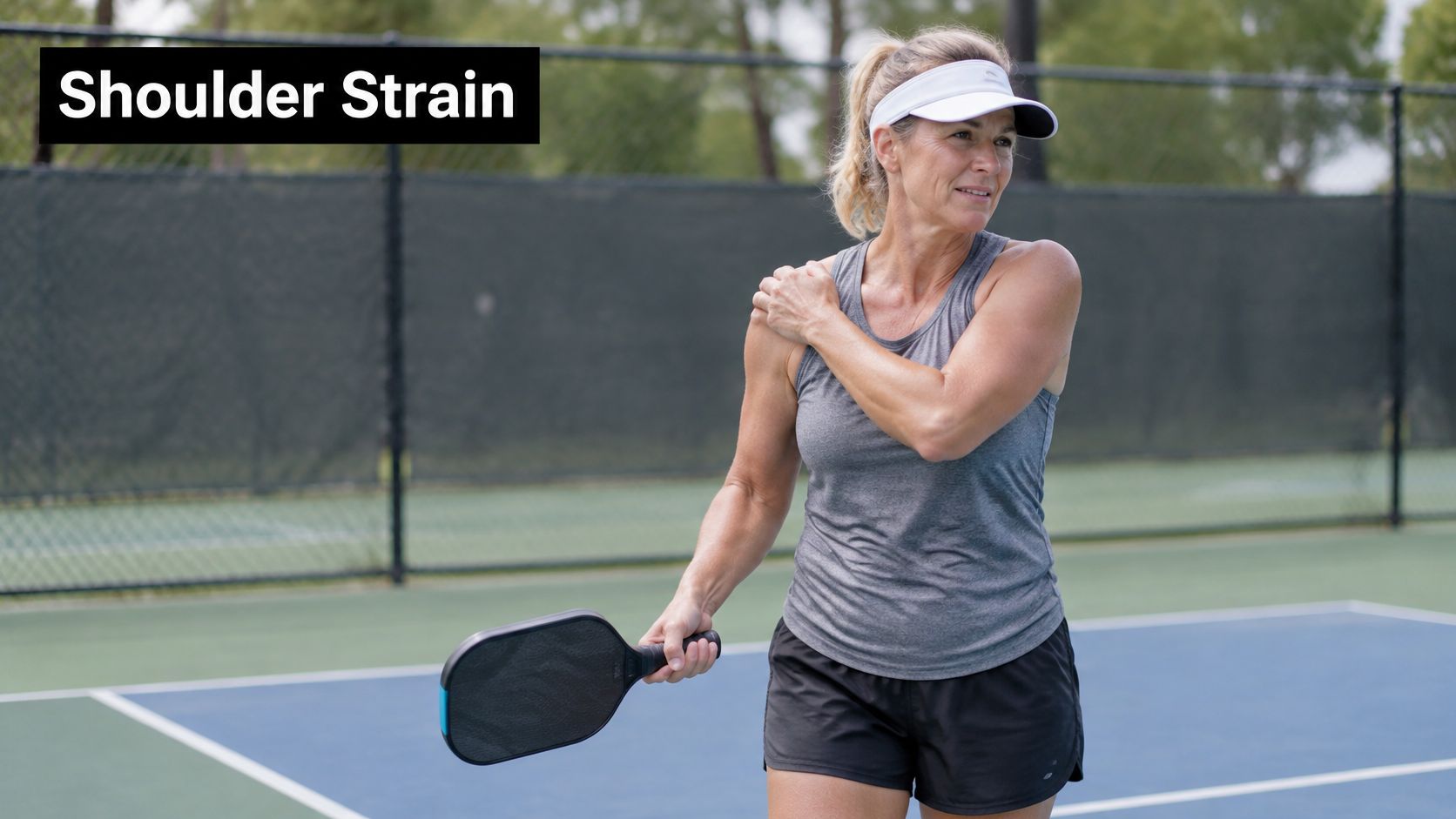
Overhead serves, smashes, and long reaches at the net ask the rotator cuff to hold the ball of the shoulder in the socket while the arm accelerates. A strain can follow one awkward swing. Tendinopathy is the slower version: a dull ache after you double your serve practice for a tournament.
The useful split is timing. Pain that shows up only on the serve and fades by morning is usually a volume problem. Pain that wakes you, or weakness when you lift the arm out to the side, needs a closer look before you add more reps. Stopping for a week and then serving fifty balls on day one is how this becomes chronic.
A six-week block of cuff and shoulder-blade work, plus a shorter service motion, is enough for many competitive players. An older player with a stiff reach often does better with band external rotations and scapular retractions than with aggressive stretching into a pinch.
See a PT when pain is sharp, it is still there the next morning, or you cannot lift the arm without hiking the shoulder. A plan for healing a rotator cuff injury without surgery fits most overuse cases. It does not fit a sudden loss of strength after a fall.
Return-to-play check: ten controlled serves at seventy percent, no next-day ache, then add volume by a few serves, not by a full bucket.
4. Achilles Tendinopathy and Achilles Rupture
The Achilles takes the push-off on every split step and sprint to a short ball. Tendinopathy is the gradual path: heel stiffness in the morning, then pain during play after you jump from one session a week to four. A rupture is the sudden path. A lunge, a pop in the calf, and you cannot rise onto your toes.
Middle-aged players coming back after a long break sit in the highest-risk window. The court feels easy. The tendon has not had months of calf raises. Heavy, slow heel raises help a grumbling tendon. They do nothing for a tendon that just snapped, and walking it off can turn a partial tear into a bigger one.
- Build slowly: Add one session, not three, when you return.
- Load the calf: Straight-knee and bent-knee heel raises each week.
- Keep the ankle moving: Gentle calf stretches after play, not a cold ballistic stretch before it.
- Stop immediately: A pop, or no push-off, means urgent orthopedic care, not another game.
See a PT when morning stiffness lasts more than a few minutes of walking, or pain climbs from the end of the match into the next day. Return-to-play check: twenty single-leg heel raises, then a week of short games with no next-morning limp. If you cannot finish the raises, you are not ready to chase lobs.
5. Low Back Pain and Muscle Strain
You rotate for a wide ball, the foot sticks, and the low back grabs. That is a strain of lumbar muscle or ligament, usually from a twist, a sudden stop, or a trunk that is not sharing the work with the hips. It is different from the stiffness you feel after a long day of dinking, which often eases once you walk.
Many players on the court already have some spinal wear. The same reach that a twenty-five-year-old shrugs off can spasm an older back for two weeks. Bending at the knees and hips for low balls, instead of hinging only through the lumbar spine, takes load off the sore spot without killing your net game.
A senior player with chronic stiffness often tolerates more games after hip mobility and trunk stability work than after more rest alone. Planks, bird dogs, and glute bridges twice a week are enough. A long static toe-touch before play is the warm-up I would drop.
See a PT when pain runs below the knee, you get numbness, strength drops in the leg, or a simple ache is still limiting you after two weeks. Return-to-play check: trunk rotations and a set of bird dogs with no spike, then one doubles game where you can lunge without holding your breath. Say the spasm hit on Saturday and walking is normal by Monday. Short games are reasonable. A three-hour open play is not.
6. Knee Injuries (Patellar Tendinopathy and Meniscus Tears)
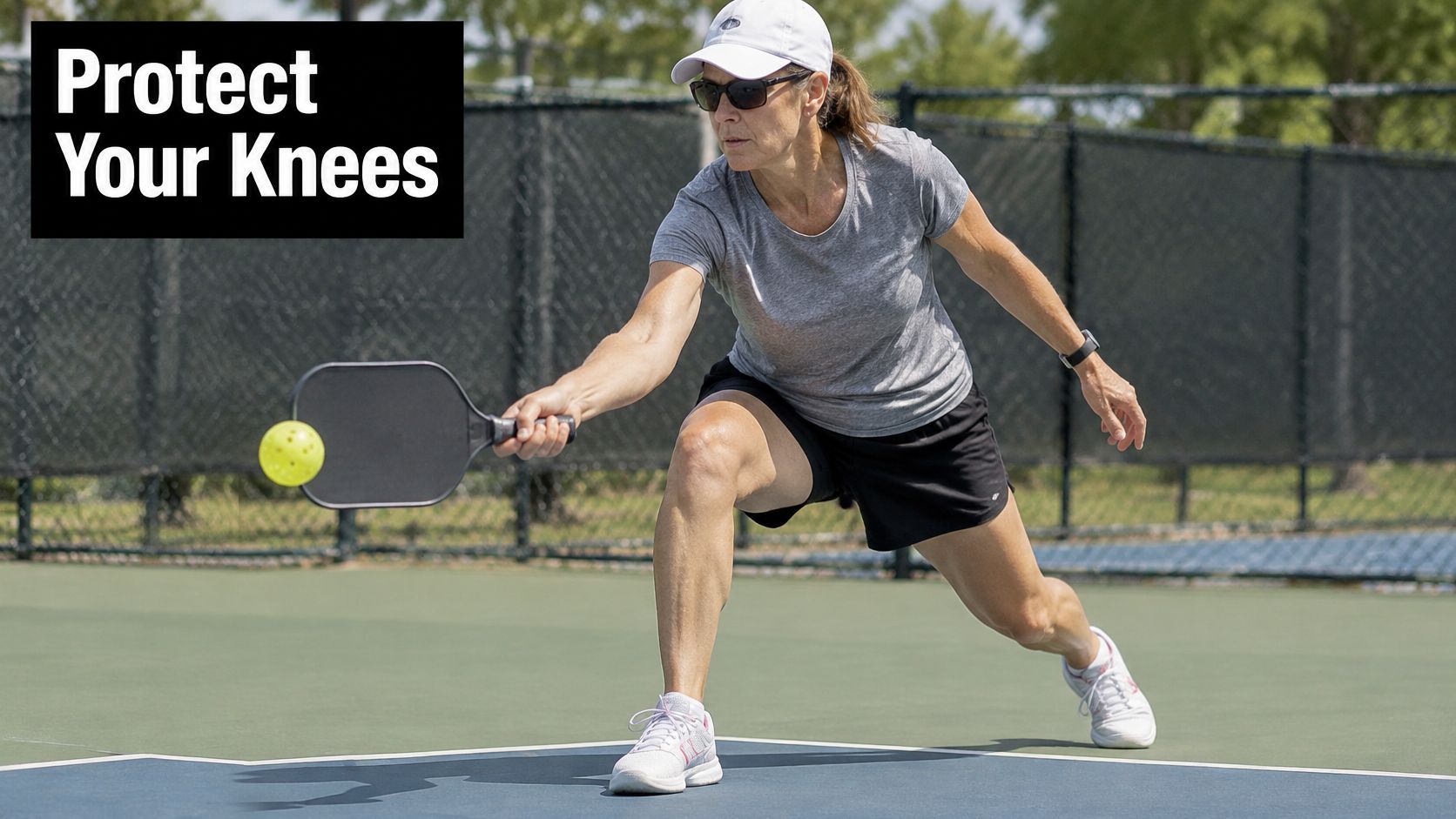
Knees fail in two familiar ways on this court. Patellar tendinopathy, jumper's knee, creeps in below the kneecap when quick starts and extra jumping drills outrun the quadriceps. A meniscus tear is more often one pivot with the foot planted: a pop, swelling over the next day, and sometimes a catch when you straighten the leg.
Soft landings help the tendon. They will not protect a meniscus if you keep twisting on a stuck shoe. Build quads and hips at least twice a week, and keep the knee tracking over the toes in a lunge. A sleeve can warm the joint. It does not replace strength, and it should not talk you into a full session on a swollen knee.
See a PT when the knee locks, buckles, or stays swollen after a few days. Imaging and an orthopedic opinion belong with a true pop and a locked knee. Many irritated menisci still settle with load management, and meniscus tear rehab without surgery is the path I start when the joint is stable.
Return-to-play check: a step-down from a low stair without the knee caving in, then a controlled lunge to each side. Pain below the cap that only shows up after new jumping drills should drop when you cut the jumps and keep the strength work. Swelling that returns the next morning means you added court time too soon.
7. Plantar Fasciitis
The first steps out of bed stab the heel, ease after you walk to the kitchen, then return after a long session on a hard court. That pattern fits the plantar fascia, the band from heel to toes, irritated by repeated starts, stops, and pivots. It is gradual overuse, not a single misstep, which is why players call it normal soreness until court time shrinks.
Worn shoes are the usual accomplice. When the midsole packs down or the heel counter folds, the arch works overtime. Replace the pair instead of adding a soft insole to a dead shoe. Supportive house shoes after play beat going barefoot on tile while the fascia is angry. A calf and arch stretch before you stand, and again before the match, costs less than a month off.
Shockwave and hands-on care can help a heel that has already become chronic. They work better beside calf strength than beside a plan to "play through it and ice later." Ice after a session is fine. It is not a loading plan.
See a PT when first-step pain is still there after two to three weeks of fewer games and better shoes, or you start limping during warm-up. Return-to-play check: a morning walk with no stab, then one short session in new court shoes. If the next morning is sharp again, you added too much. A player who swaps shoes and stretches the calves often settles in a few weeks. The player who adds daily open play usually does not.
8. Wrist Sprains and Fall-Related Fractures
Most wrist injuries are not from dinking. They start when you chase a drop, slip, and land on an outstretched hand. That force can sprain ligaments or break the distal radius. A sore wrist you can move is not the same problem as a wrist that swells, looks bent, or will not grip the paddle.
Falls dominate the serious end of common pickleball injuries. A national emergency-department analysis found that slips, trips, falls, and dives represented 64.3% of injury mechanisms, and older players had nearly three times the odds of fracture compared with younger players (OR 2.96). Sex changes the pattern too. An analysis of players aged 60 and older found women were 9.3 times more likely than men to sustain a wrist fracture. A wrist fracture in that group is a reason to screen balance and bone health, not only to brace the arm.
This short clip shows a safer way to get up and reset after a loss of balance, instead of sticking the hand out.
- Court check: Clear water, balls, and bags before the first serve.
- Legs first: Single-leg balance and hip strength cut the chance you need your hands at all.
- After a fall: Persistent wrist pain or swelling gets an exam before the next match.
See a PT when a sprain is still weak after the swelling drops, or after a fracture is cleared for motion. Hand therapy follows immobilization. It should not replace the X-ray. Return-to-play check: a painless grip on the paddle, a push-up on the wall, and no swelling after a short hitting session. Say you fell on a drop shot and the wrist is puffy that night. Sitting out is the right call. Playing left-handed "just for fun" is how the other wrist joins the story.
How the 8 Most Common Pickleball Injuries Compare
| Item | Typical Onset | Main Risk Factor | Core Treatment Focus |
|---|---|---|---|
| Ankle Sprain (Lateral Ankle Sprain) | Sudden, after rolling or landing on the ankle | Previous ankle sprain | Early RICE, then rehabilitation for strength, mobility, and balance |
| Tennis Elbow (Lateral Epicondylitis) | Gradual, worsening with repeated play | Repetitive wrist use or tight paddle grip | Modify activity and progressively strengthen forearm tendons |
| Shoulder Strain and Rotator Cuff Tendinopathy | Gradual overuse or sudden strain | Repetitive overhead motion | Modify overhead activity and strengthen the rotator cuff and shoulder stabilizers |
| Achilles Tendinopathy and Achilles Rupture | Gradual tendon pain or sudden rupture | Rapid increase in activity after inactivity | Progressive tendon loading; urgent medical evaluation for suspected rupture |
| Low Back Pain and Muscle Strain | After repeated bending, twisting, or sudden movement | Weak core and hip muscles | Gentle movement, core stabilization, and improved movement mechanics |
| Knee Injuries (Patellar Tendinopathy and Meniscus Tears) | Gradual tendon pain or acute pain after twisting | Repetitive lunging or poor knee control | Manage loading, strengthen quadriceps and hips, and assess mechanical symptoms |
| Plantar Fasciitis | Gradual heel pain, often after rest | Unsupportive footwear or sudden increase in play | Stretch the calf and plantar fascia; use supportive footwear |
| Wrist Sprains and Fall-Related Fractures | Sudden, after a fall onto the hand | Reduced balance or bone density | Immobilize and evaluate; use rehabilitation after healing |
Playing Smarter So You Keep Playing Longer
You do not need a perfect body to stay on the court. You need a short list you follow. Warm up before every session with ankle circles, easy shuffles, and a few band external rotations. Build strength and balance twice a week, even in weeks when open play is busy. Add court time gradually after a break, a new paddle, or a jump in serve practice. Treat pain that lingers beyond a few days, or that is worse the next morning, as a signal to change the load.
A physical therapist can watch the pattern behind the pain: a late plant, a stiff hip, a grip that clamps on every dink. The plan should match your goal, whether that is two social games or a weekly ladder. Rest alone does not teach the ankle, the cuff, or the calf to tolerate the next stop.
What to book before a small ache becomes a layoff
MedAmerica Rehab Center in Deerfield Beach, Florida, is a family-owned clinic offering physical therapy for sports injuries, with hands-on therapy and targeted exercise, and same-day appointments when you need to be seen before the weekend. We also work on balance, gait, and fall prevention, which matters if your last injury started with a slip rather than a swing. If you are traveling or comparing options for court athletes, sports rehabilitation in Los Cabos is another setting that focuses on getting active adults back to play.
Use this week as the test. One strength session, one balance session, and a warm-up you do not skip in the parking lot. If the calf twinge, the outer elbow, or the stiff back is already talking, get it assessed before Saturday becomes a month off.
MedAmerica Rehab Center treats pickleball-related sports injuries with physical therapy, hands-on care, and exercise plans built around how you move on the court. If an ankle, elbow, shoulder, or wrist is limiting your games, schedule an evaluation and get a clear return-to-play plan. Visit MedAmerica Rehab Center to book a visit in Deerfield Beach.
MedAmerica Rehab · Deerfield Beach
Talk to a clinician about your pain
Physical therapy, chiropractic, acupuncture and shockwave therapy under one roof, since 1995. Same-day appointments are available.
Mon–Thu 8:00 AM – 6:30 PM · Fri 8:00 AM – 3:00 PM