

Chiropractic Care for Sciatica Nerve Pain Relief
You're halfway through a drive in Deerfield Beach when a sharp line of pain travels from your low back into your buttock and down your leg. You shift in the seat, try standing, then wonder whether stretching, an adjustment, physical therapy, or a medical visit would help. That uncertainty is common because sciatica describes a symptom pattern, not one single diagnosis.
Chiropractic care for sciatica nerve pain can help some people move more comfortably, but it shouldn't be presented as a universal “nerve release” or a replacement for neurological screening. The safest plan connects hands-on treatment to exercise, tracks practical improvements such as walking and sitting tolerance, and changes direction when symptoms suggest a disc problem, spinal narrowing, or worsening nerve function. This approach also makes local care easier to evaluate, much like the practical guidance in RecensioAI's local SEO insights, which emphasizes clear, location-specific information when people are choosing a nearby service.
When Sciatica Pain Takes Over Daily Life
A sciatica flare can turn ordinary movements into decisions. You may brace before getting out of a chair, avoid bending to put on shoes, or shorten your walk because your calf starts burning. Driving can be especially frustrating. The seated position may increase symptoms, while getting out of the car sends a sudden jolt down the leg.
The pain might feel sharp, hot, aching, or electric. Tingling or numbness can reach the foot, and some people notice weakness when climbing stairs or lifting the front of the foot. The exact pattern matters because it gives a clinician clues about which nerve root may be irritated and whether the problem is stable or changing.
The practical goal isn't to keep adjusting the same area forever. It's to make movement safer and more comfortable, then build the strength and confidence to keep that progress.
A careful visit starts with questions and examination, not assumptions. A clinician may review how the pain began, what positions change it, and whether you have numbness or weakness. The assessment can include walking, strength, reflexes, sensation, and nerve-tension testing. Those findings help determine whether conservative care is reasonable and whether another professional should be involved.
A hands-on technique may reduce pain enough for you to walk, exercise, or tolerate daily activities. It can't guarantee that a disc-related problem, spinal narrowing, or another source of nerve irritation has disappeared. Research focused specifically on sciatica remains uncertain, so the responsible message is balanced: chiropractic treatment may suit selected patients as part of an individualized plan, while medical assessment, exercise-based rehabilitation, or surgery may be appropriate when clinical findings require them.
MedAmerica Rehab Center has provided physical therapy, chiropractic care, acupuncture, and related rehabilitation services in Deerfield Beach since 1995. Same-day access can be useful when leg pain is interfering with work, sleep, driving, or basic movement, but convenience should support careful screening rather than rush it.
How Sciatica Happens and Why Leg Pain Spreads
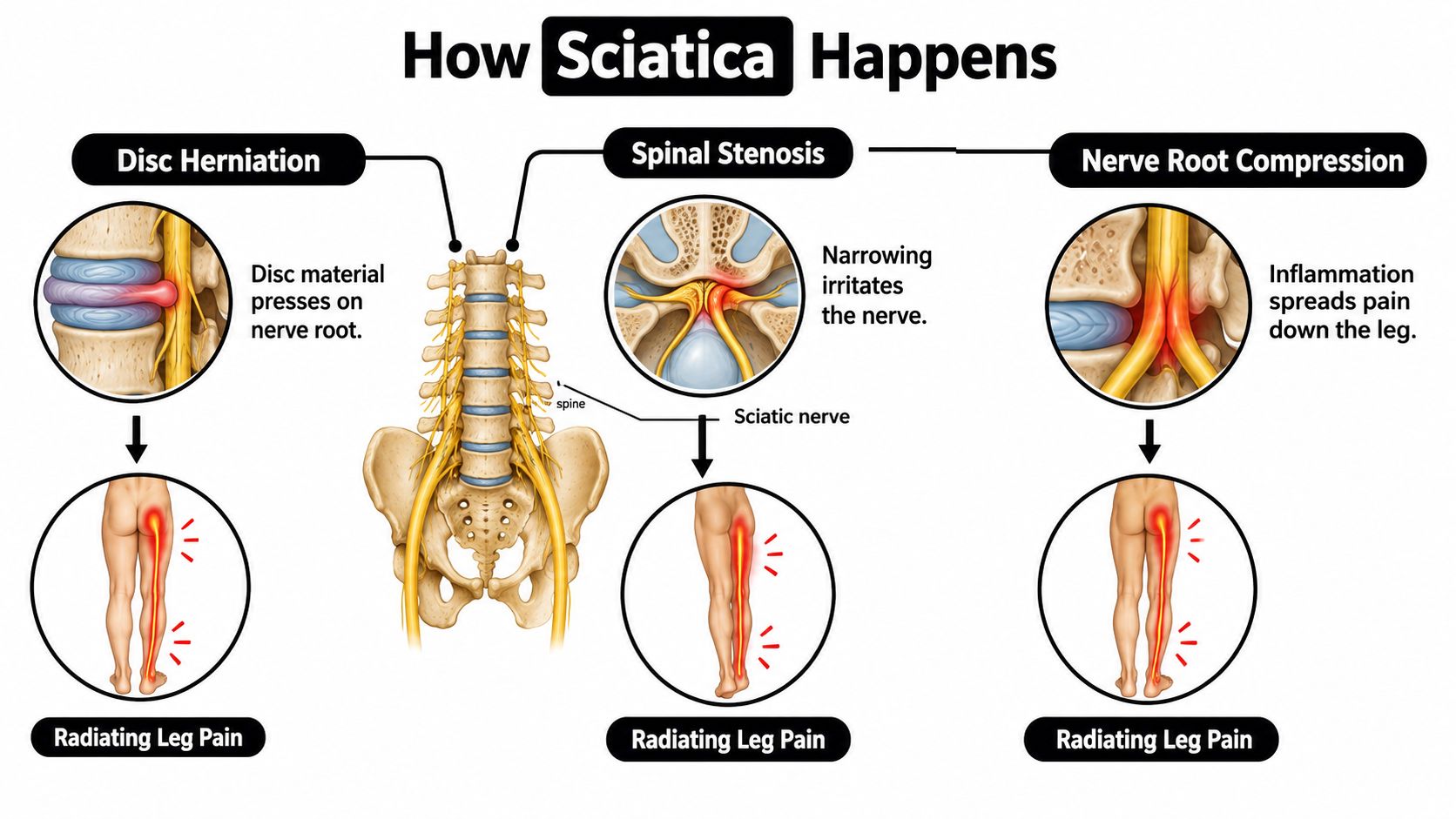
Sciatica usually begins when a nerve root in the lower spine becomes irritated or compressed. The irritation may involve disc material, narrowing around the nerve, or inflammatory chemical signals. Because the affected nerve carries information along a pathway into the buttock and leg, symptoms can travel well beyond the low back.
Think of a garden hose. If you press on one section, water flow can change beyond the point of pressure. A nerve is more complex than a hose, but the comparison helps: direct pressure can disturb nerve function, while inflammation can make the nerve more sensitive even when compression isn't the only issue.
Disc-related symptoms
A disc can irritate a nearby nerve root after its material moves outward. People often describe a sudden onset after bending, lifting, or twisting, although symptoms can also build gradually. The pattern may include back or buttock pain followed by burning, tingling, numbness, or weakness along part of the leg.
The important question isn't whether a disc appears on imaging. The examination must show whether the imaging finding matches your symptoms and neurological signs. Many structural findings don't explain pain by themselves, so a clinician should interpret scans alongside your history and physical examination.
Symptoms linked to spinal narrowing
Spinal stenosis means the spaces available for nerves have become narrower. Some people notice more discomfort with standing or walking and relief when sitting or leaning forward. Others have a mixed pattern, so posture alone can't establish the cause.
This distinction affects treatment choices. A movement that feels helpful for disc-related irritation may not be the best fit for someone whose symptoms consistently worsen with spinal extension and prolonged standing. Your response to movement provides useful information, but it shouldn't replace an examination.
A useful way to describe your symptoms is to record:
- Location: Note whether pain reaches the thigh, calf, foot, or toes.
- Quality: Describe burning, aching, electric pain, tingling, or numbness.
- Triggers: Track sitting, walking, coughing, bending, lifting, and standing.
- Function: Record changes in walking distance, sitting tolerance, stair use, and sleep.
- Neurology: Report weakness, altered sensation, changes in balance, or a new limp.
A practical low back pain running guide can also help active adults think about training loads and movement patterns, although running advice shouldn't be used to diagnose radiating nerve symptoms. The clearest next step is an assessment that connects your symptom map to strength, reflexes, gait, and neural-tension findings.
What Chiropractic Visits for Sciatica Actually Include
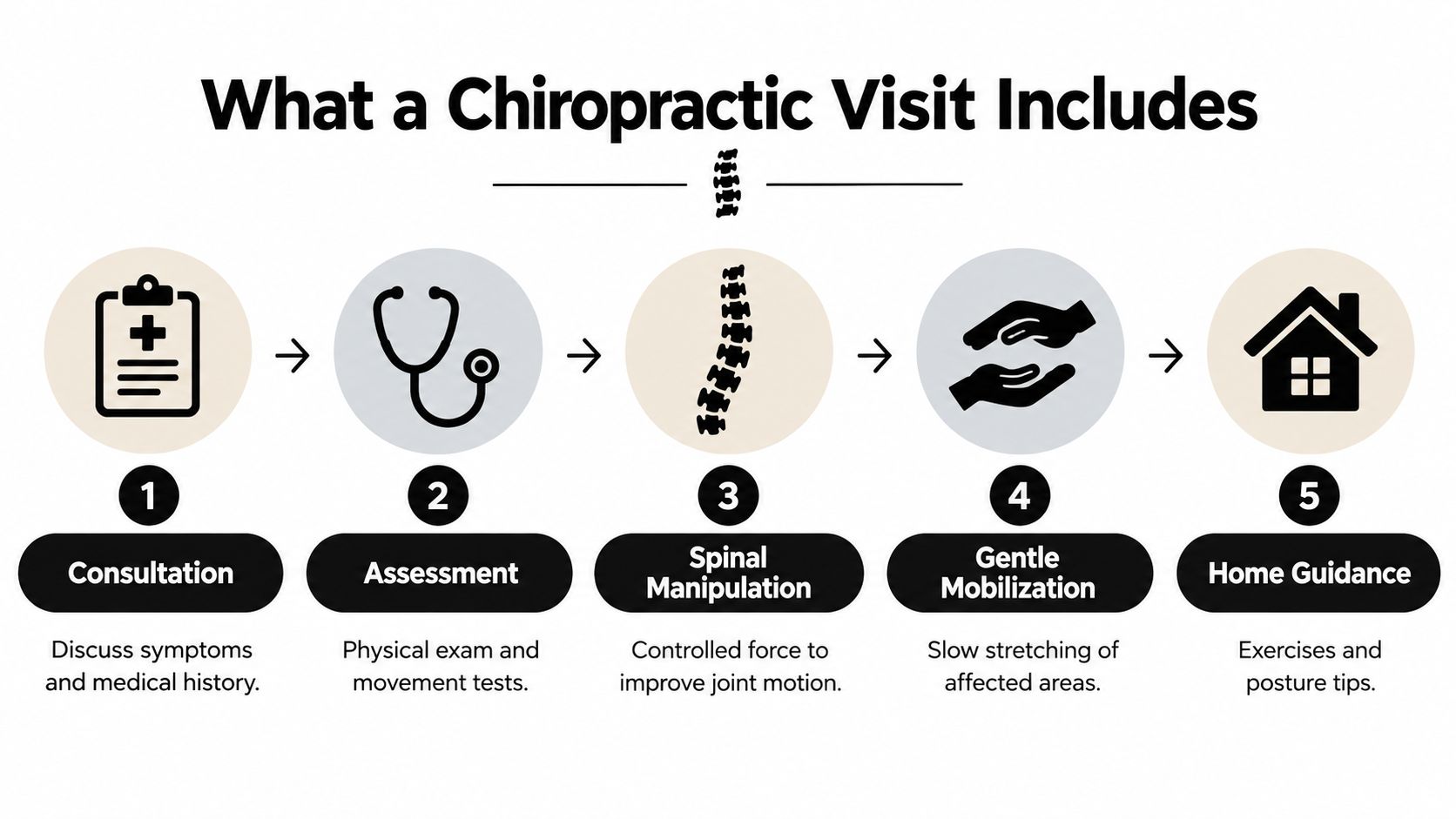
A first visit should feel more like a clinical evaluation than a quick routine adjustment. You'll usually discuss when the pain started, how it behaves during sitting or walking, what makes it worse, and whether numbness or weakness is present. The clinician may then assess spinal and hip movement, gait, strength, reflexes, sensation, and nerve tension.
The treatment choice should follow those findings. Some people may tolerate a controlled spinal manipulation. Others may be better suited to gentler mobilization, soft-tissue work, or a period of medical assessment before manual treatment.
Hands-on options and their purpose
Spinal manipulation uses a controlled, targeted force to influence joint motion. It may be appropriate when the examination supports a mechanical contribution and there are no contraindications. It shouldn't be described as permanently putting a nerve back into place.
Mobilization uses slower, gentler movement through a joint's available range. It can be useful when a person is highly sensitive, apprehensive about manipulation, or better suited to gradual loading.
Flexion-distraction techniques guide the spine through carefully controlled movement, often with the aim of improving tolerance to motion. The technique must be selected according to the suspected source of symptoms and the person's neurological status.
Soft-tissue treatment may address guarding or muscle tenderness around the low back, hip, or buttock. It can make movement feel easier, but it shouldn't be used to imply that every case comes from a tight muscle.
Heat, activity coaching, and graded movement may support the session. The clinician might recommend changing how you sit, taking brief walking breaks, or practicing a specific movement that reduces symptoms. Those suggestions work best when they connect to a clear functional target.
Hands-on care should open a door to movement. Exercise and daily activity help you keep walking through it.
A useful visit ends with a plan you understand. Ask what the clinician believes is irritating the nerve, why a technique was chosen, what response is expected, and when progress will be reassessed. You can also review what to expect at a first chiropractic visit before scheduling.
This video provides a visual introduction to the general flow of care:
Stop or modify treatment if leg symptoms intensify, weakness progresses, or new neurological changes appear. A plan that ignores those changes isn't a movement plan. It's a reason to reassess the diagnosis and referral pathway.
Benefits You Can Realistically Expect From Care
The most credible benefit of chiropractic treatment is often improved tolerance for movement, not a promise that one adjustment permanently removes nerve compression. You might sit longer before symptoms rise, walk with less guarding, put on shoes more easily, or perform an exercise that previously felt threatening. Those changes matter because they show whether treatment is helping you resume useful activity.
Evidence for sciatica specifically remains limited and uncertain. A 2024 systematic review examined 16 randomized controlled trials involving 1,385 participants and reported generally low or very low certainty. The review's average risk-of-bias score was 5.9 on a 0 to 10 scale, which means the findings need cautious interpretation. The review's full findings should not be turned into a guarantee for every patient.
For leg pain, spinal manipulative therapy appeared more effective than conventional physical therapy at four weeks, with a reported mean difference of −1.78 points, but the confidence interval was wide, from −0.44 to 3.11, limiting confidence in that estimate. For back pain at four weeks, the reported mean difference was −2.04 points, with a 95% confidence interval from −5.15 to 1.07, so the review didn't show a clear advantage.

What broader low-back-pain research adds
Research involving chronic low-back pain is broader than research involving sciatica alone. A 2019 systematic review and meta-analysis included 47 randomized controlled trials and 9,211 participants. Compared with other recommended therapies, spinal manipulation produced similar short-term pain relief, with a mean difference of −3.17 points and a 95% confidence interval from −7.85 to 1.51. Functional improvement was small but statistically better, with a standardized mean difference of −0.25, and a 95% confidence interval from −0.41 to −0.09. These results come from the BMJ review, and they shouldn't be presented as sciatica-specific proof.
A 2017 meta-analysis of 26 randomized trials found modest average benefits up to six weeks. Fifteen trials involving 1,699 patients reported pooled pain improvement of −9.95 points on a 100-millimeter visual-analog scale, while 12 trials involving 1,381 patients found a functional effect size of −0.39. The useful interpretation is modest improvement for some people, not a guaranteed cure.
Track function alongside pain. If walking, sitting, sleep, strength, and daily tasks are gradually improving, the plan may be helping. If symptoms remain unchanged, spread farther down the leg, or neurological findings worsen, the right response is reassessment, not endless visits. A plain-language explanation of adjustment mechanics is available in how chiropractic adjustment works.
Combining Chiropractic With Physical Therapy and Exercise
Hands-on treatment can make movement more comfortable, but it doesn't automatically rebuild trunk strength, hip control, aerobic capacity, or confidence with lifting. That's why clinical guidance places manual therapy inside an exercise-based package. NICE recommends considering manual therapy, including manipulation, mobilization, or soft-tissue techniques, only alongside exercise, with psychological therapy when clinically appropriate. The NICE recommendations also support linking treatment to measurable functional progress.
Exercise selection should match the person, not just the label “sciatica.” A clinician may consider directional-preference movements, progressive trunk and hip strengthening, aerobic conditioning, neural-mobility work, or graded exposure to sitting, walking, and lifting. The starting point should be tolerable. The load can increase as symptoms and neurological findings allow.
| Situation | Best next step | What progress looks like |
|---|---|---|
| Stable symptoms with mild functional limits and no worsening weakness | Consider chiropractic care with a clear home movement plan | Easier transfers, improved walking or sitting tolerance, and no increase in distal symptoms |
| Symptoms improve temporarily after hands-on treatment but return during daily activity | Add physical therapy and targeted exercise | Gains last longer between visits, with better strength, control, and confidence |
| Pain limits walking, lifting, work, or sleep | Use coordinated rehabilitation and consider medical input | More daily activity with less guarding and a defined reassessment point |
| Symptoms include progressive weakness, spreading numbness, or deteriorating neurological signs | Seek prompt medical evaluation rather than routine adjustment | Diagnosis and referral decisions become clearer before further manual care |
| A person wants to return to running, gym training, or recreational activity | Combine symptom-guided care with graded sport or activity exposure | A gradual return to selected movements without a recurring leg-pain flare |
A simple progression checklist
Start by choosing one function that matters. It might be walking to the beach, sitting through a commute, climbing stairs, or lifting a light household item. Measure how the activity feels before treatment, then review it with the clinician rather than relying only on a pain score.
Next, build capacity in layers:
- Movement access: Use a suitable hands-on technique or mobility exercise to reduce guarding.
- Strength support: Train the trunk, hips, and legs within a tolerable range.
- Conditioning: Add walking or another appropriate aerobic activity.
- Confidence: Reintroduce feared movements gradually instead of avoiding them indefinitely.
- Reassessment: Change the plan when function stalls or neurological signs change.
MedAmerica Rehab Center presents chiropractic and physical therapy as complementary options, with hands-on treatment, targeted exercise, and selected modalities organized around an individual's goals. That integrated model is also discussed in the benefits of chiropractic and physical therapy.
Safety Screening Contraindications and Red Flags to Know
A common assumption is that every pinched nerve needs the same adjustment. That isn't safe reasoning. Sciatica can involve disc irritation, spinal narrowing, inflammation, or another condition that needs medical assessment. The technique, force, and timing should follow the examination.
Guidance for disc-related symptoms is not perfectly consistent. A 2025 systematic review found that recommendations for spinal manipulation in lumbar disc herniation varied across six reviewed guidelines: four recommended it, one recommended against it, and one gave only a weak recommendation. The finding supports individualized decision-making, not a universal yes or no.
Before treatment, discuss trauma, connective-tissue disease, vascular disorders, significant medical history, current medications, and any recent change in strength or sensation. A clinician should document relevant neurological findings, including gait, myotomal strength, reflexes, sensation, and neural tension. The VA/DoD guidance supports spinal mobilization or manipulation for chronic low-back pain but reports insufficient evidence for or against it in acute low-back pain, so evidence for general back pain shouldn't automatically be treated as proof for every acute sciatica case. The VA/DoD provider summary explains that distinction.
Seek prompt medical evaluation for:
- New or progressive weakness: Especially if walking, climbing stairs, or lifting the foot becomes harder.
- Bladder or bowel changes: Loss of control or new difficulty requires urgent attention.
- Saddle-area numbness: Numbness around the groin, inner thighs, or buttocks should not wait for a routine appointment.
- Major trauma: Pain after a significant fall or collision needs appropriate assessment.
- Fever or systemic illness: These symptoms can signal a problem outside routine mechanical back pain.
- Worsening neurological signs: Stop routine care and seek guidance if numbness or weakness is spreading.
Serious adverse events are described as rare in recent evidence summaries, while temporary soreness is more common, but inconsistent reporting limits certainty. Safety depends on screening, diagnosis, technique, communication, and a clear plan for what happens if symptoms worsen.
Your Next Step Toward Lasting Sciatica Relief
Chiropractic care for sciatica nerve pain makes the most sense when it helps you move and supports an active rehabilitation plan. Book an evaluation when symptoms are stable but interfering with walking, sitting, sleep, work, or recreation. Ask for a neurological screen, an explanation of the suspected cause, a home exercise plan, and a specific point at which progress will be reviewed.
Add physical therapy when relief from hands-on care doesn't last, strength and movement confidence are limited, or daily activities remain difficult. Seek medical evaluation promptly for progressive weakness, saddle numbness, bladder or bowel changes, major trauma, fever, or other signs of worsening illness.
For Deerfield Beach residents, a multidisciplinary clinic can make coordination easier. MedAmerica Rehab Center offers chiropractic care, physical therapy, acupuncture, and shockwave therapy, with treatment plans designed around pain, mobility, and functional goals. If you're comparing local providers, practical guidance on local SEO for chiropractors can also help explain why clear service information and accessible scheduling matter when you're trying to choose care.
At a first visit, expect questions, movement testing, neurological screening, and a discussion of options. The right plan should leave you knowing what to do today, what improvement to watch for, and when to seek a different level of care.
MedAmerica Rehab Center provides individualized chiropractic care, physical therapy, and active rehabilitation for sciatica and other mobility-limiting conditions in Deerfield Beach. Visit MedAmerica Rehab Center to request an evaluation and take the next step toward moving with greater comfort and confidence.
MedAmerica Rehab · Deerfield Beach
Talk to a clinician about your pain
Physical therapy, chiropractic, acupuncture and shockwave therapy under one roof, since 1995. Same-day appointments are available.
Mon–Thu 8:00 AM – 6:30 PM · Fri 8:00 AM – 3:00 PM