

Sciatica Nerve Pain Relief: A Complete Guide for 2026
Approximately three-quarters of people with sciatica improve within 3 months with conservative care, while about one-third improve within 2 weeks. That timeline offers real hope, but worsening weakness, expanding numbness, or bowel and bladder changes require prompt medical evaluation.
You may have woken up thinking you slept awkwardly. Then you stood beside the bed and felt an electric jolt travel from your lower back or buttock into your thigh, calf, or foot. Sitting, walking, and getting dressed suddenly became decisions rather than automatic movements.
Sciatica nerve pain relief usually comes from calming the irritated nerve while gradually restoring the movements and strength that daily life demands. It isn't about finding one magical stretch or forcing your spine into a “perfect” position. It's about matching treatment to your symptoms, monitoring your response, and knowing when self-care has reached its limit.
Understanding Sciatica and Why It Hurts
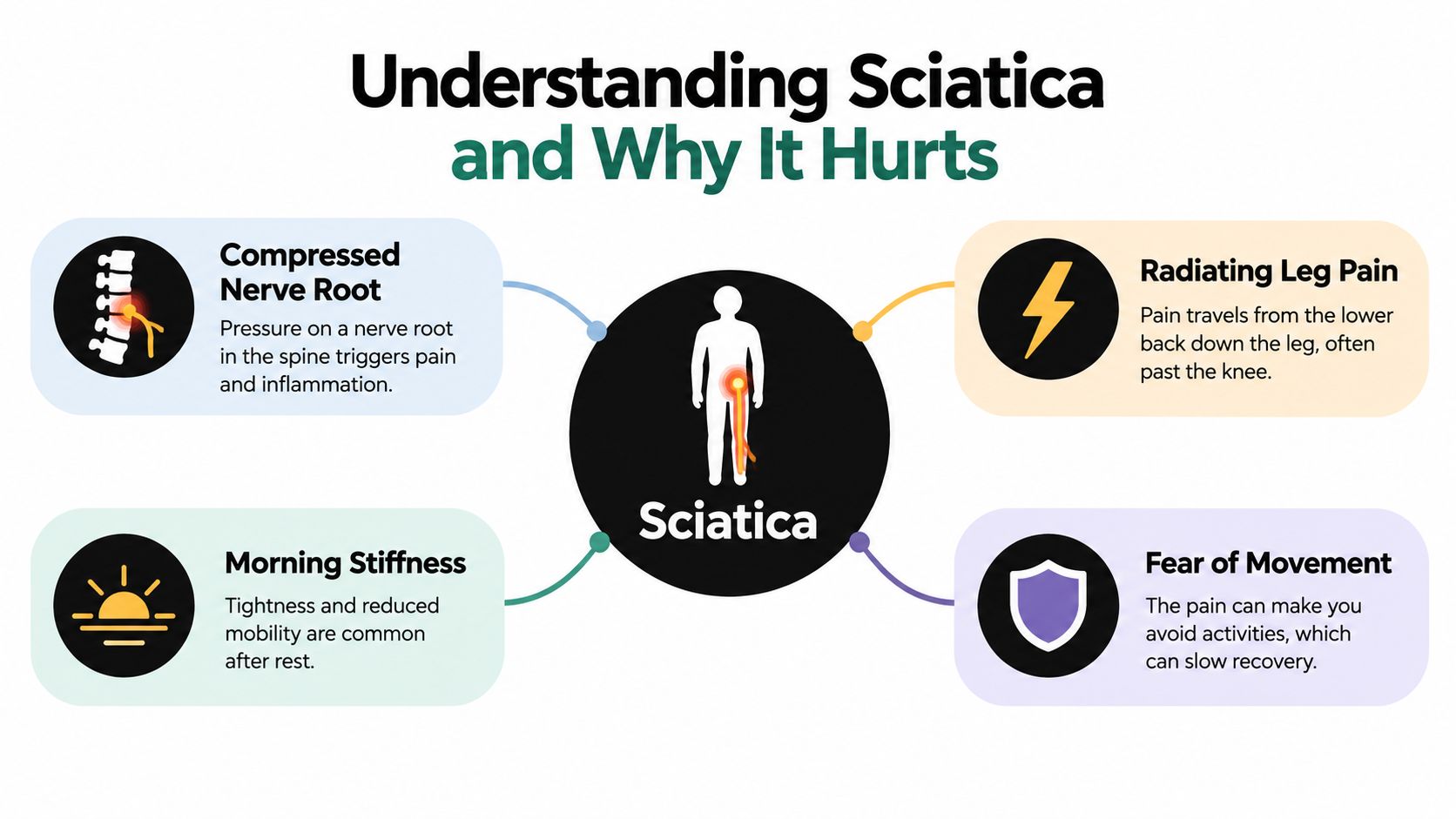
Sciatica often announces itself in a very specific way. You bend to put on a sock, stand up from a chair, or take a few steps after getting out of bed, and pain shoots from the low back or buttock into the thigh, calf, or foot. That pattern usually points to irritation of a lumbar nerve root, not ordinary muscle soreness.
The sciatic nerve is formed from nerve roots that exit the lower spine, travel through the pelvis and buttock, and continue down the leg. When one of those roots becomes irritated or compressed, symptoms can feel sharp, burning, tingling, numb, or weak. In clinic, this is one of the biggest reasons people misread the problem. The pain may be strongest in the leg even when the source is higher up.
Sciatica is common, but the numbers vary because studies do not all define it the same way. One major review reported a lifetime incidence of approximately 13% to 40%, while prevalence estimates in other research ranged from 1.6% to 43%. This clinical review explains the changing estimates and medical history of sciatica
A nerve under pressure
A nerve root works like a cable that needs both space and the ability to slide. A disc issue, narrowing around the spinal canal, or irritation from nearby tissues can crowd that space or increase the nerve's sensitivity. That is why pain can travel well below the back, sometimes all the way to the foot.
Common contributors include herniated discs, spinal stenosis, and irritation around the deep hip muscles, sometimes labeled piriformis-related pain. The hidden timeline matters here. Two people can both say “I have sciatica,” yet one improves quickly with position changes and walking, while another needs a longer period of graded loading, symptom control, and hands-on care because the irritated structure and movement pattern are different.
Practical rule: Pain that travels farther down the leg, new sensory changes, or reduced strength deserves more attention than an ache that stays in the back.
Many episodes do improve with conservative care, which is why early treatment usually starts with symptom-calming strategies and progressive movement rather than a rush to invasive options. Clinical reviews report that approximately one-third of patients improve within 2 weeks and about three-quarters improve within 3 months with conservative care. The review on sciatica recovery and treatment outcomes
Before choosing exercises, it helps to know which structure is irritated. Our guide to what causes sciatica nerve pain walks through the most common sources. That matters because good care is not just pain relief. It is reducing nerve irritation while correcting the movement habits and loading patterns that keep provoking it.
The Science Behind Sciatica Nerve Pain Relief
Effective care has two jobs. First, it reduces the nerve's irritability enough for you to sleep, walk, and participate in treatment. Second, it rebuilds capacity so the same movements no longer provoke symptoms as easily.
Match the approach to the symptom pattern
Some people feel better lying on their stomach or standing, while others prefer sitting slightly forward or bringing the knees toward the chest. These responses can suggest an extension or flexion preference, but they aren't diagnoses by themselves. A physical therapist should assess how repeated movements change leg symptoms, strength, mobility, and function.
Structured exercise is the most important active foundation. A WHO evidence review found that structured exercise for chronic primary low-back pain reduced pain compared with no intervention, with a standardized mean difference of -0.33, and reduced functional limitations, with an SMD of -0.31. The evidence review on structured exercise supports meaningful but generally modest gains, which become more useful when the program fits the patient and is performed consistently.
Manual therapy, chiropractic treatment, and massage may reduce guarding and make movement easier. Acupuncture can help some patients manage pain sensitivity and participate in rehabilitation, while shockwave therapy may be considered for selected soft-tissue or tendon-related contributors. These methods shouldn't replace neurological assessment or progressive exercise. For more detail on how acupuncture may fit into care, see acupuncture for sciatica pain.
| Treatment | Evidence level | Best for | Duration of relief |
|---|---|---|---|
| Therapeutic exercise | Moderate support for pain and function improvement | Building strength, tolerance, and movement confidence | Depends on continued progression |
| Manual or chiropractic care | Useful as an adjunct for selected movement restrictions | Short-term symptom reduction and improved mobility | Often variable and needs active follow-through |
| Acupuncture | May support pain management for suitable patients | Improving comfort while restoring activity | Individual and often used alongside rehabilitation |
| Shockwave therapy | Treatment fit depends on the involved tissues and diagnosis | Selected soft-tissue contributors rather than every nerve problem | Variable, requiring clinical assessment |
| Injection therapy | May provide faster, temporary relief in some cases | Creating a window for rehabilitation when pain limits participation | Can be time-limited |
| Medication | Requires careful risk assessment | Short-term symptom control when appropriate | Limited by side effects and contraindications |
The best plan is rarely the longest list of treatments. It's the sequence that calms symptoms without allowing passive care to become the entire recovery strategy.
Positioning and Movement Strategies for Immediate Relief
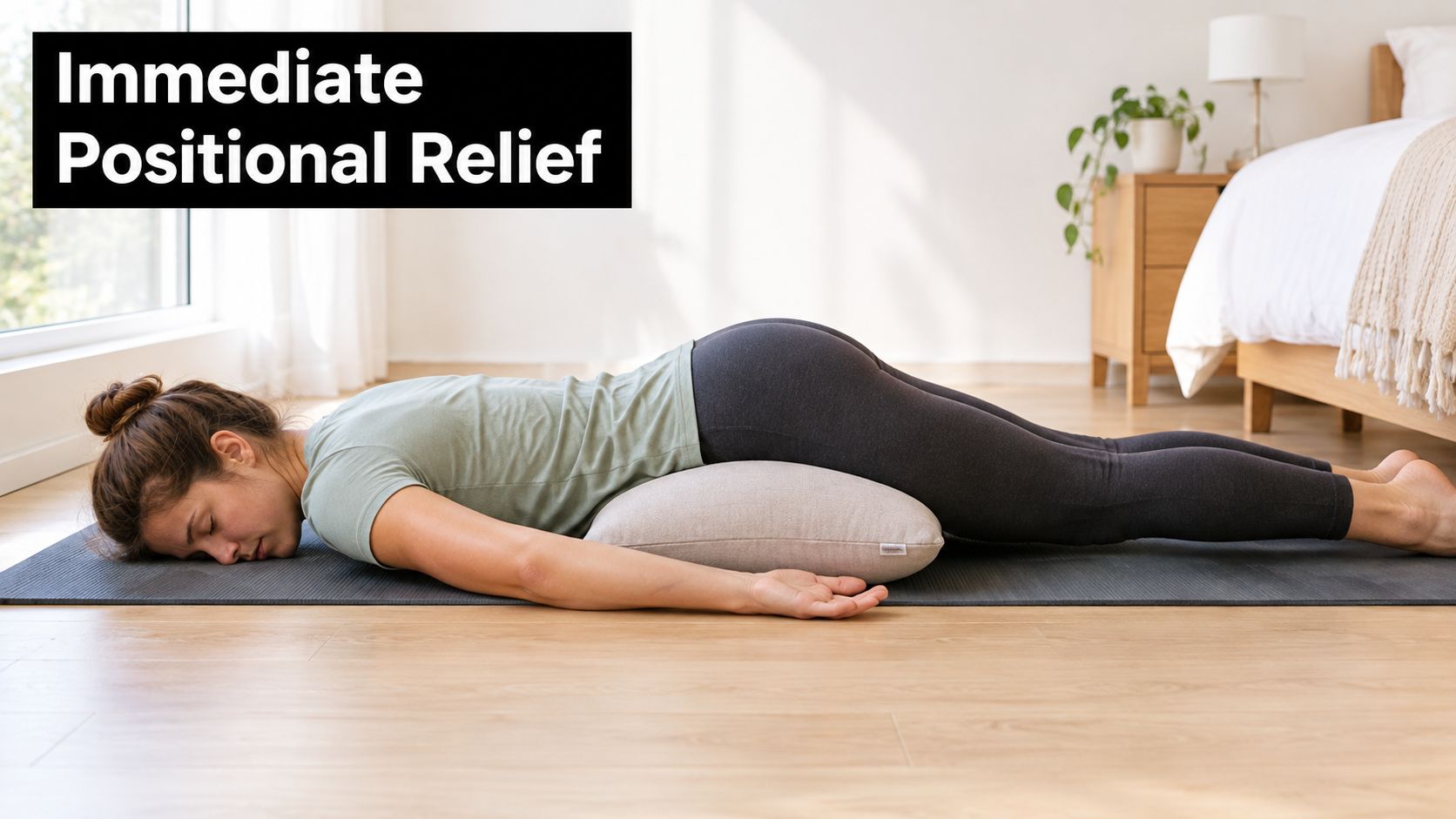
During a flare, the goal isn't to stretch aggressively. Find a position that reduces leg symptoms, stay there briefly, then change position before stiffness builds.
If lying face down feels better, try prone lying with a pillow under the hips. If that eases the leg pain, you can test gentle support through the forearms without forcing the lower back. If lying face down increases leg symptoms, stop and try lying on your back with the legs supported on a chair or pillows. Side-lying with a pillow between the knees can also reduce twisting through the pelvis.
Use your response as feedback
An extension-biased position, such as supported prone lying, may suit someone whose symptoms worsen with prolonged sitting and improve with standing. A flexion-biased position, such as supported sitting or knees bent, may suit someone who feels better leaning forward. Neither direction is universally correct. The useful direction is the one that reduces or centralizes leg symptoms without increasing numbness or weakness.
Try these practical adjustments:
- Getting out of bed: Roll onto your side, lower your legs, and push up with your arms rather than twisting suddenly.
- Sitting: Use a firm chair, keep both feet supported, and stand for brief movement breaks instead of remaining fixed in one posture.
- Sleeping: Choose the position that keeps symptoms quieter overnight. A resource on zero gravity sleep for renters may help you compare supported sleep arrangements without committing to a new bed.
- Walking: Use short, comfortable walks and turn back before symptoms begin spreading farther down the leg.
Sharp or escalating radiating pain is a signal to modify the position, not to push through. Gentle movement is usually more helpful than prolonged bed rest, but your response should guide the dose.
Exercise Programs and Progressive Loading for Recovery
A good recovery plan does more than calm a flare. It rebuilds tolerance for walking, bending, lifting, and staying in one position long enough to get through a normal day. In practice, the people who do best usually stop chasing a single perfect exercise and start loading tissues at a level their symptoms can handle.
Build capacity in stages
Start with the phase that settles the leg. That usually means short, tolerable walks, regular position changes, and repeating the movement direction that reduces or centralizes symptoms. If a drill consistently drives pain farther down the leg, it is too much for that stage. Early on, consistency matters more than effort.
Then add low-load control work for the trunk and hips. That can include abdominal bracing, supported bridges, sit-to-stand practice, and controlled hip movement. Nerve glides can help some patients, but only when they feel like gentle motion. They should not feel like a hard stretch or trigger sharp electrical pain.
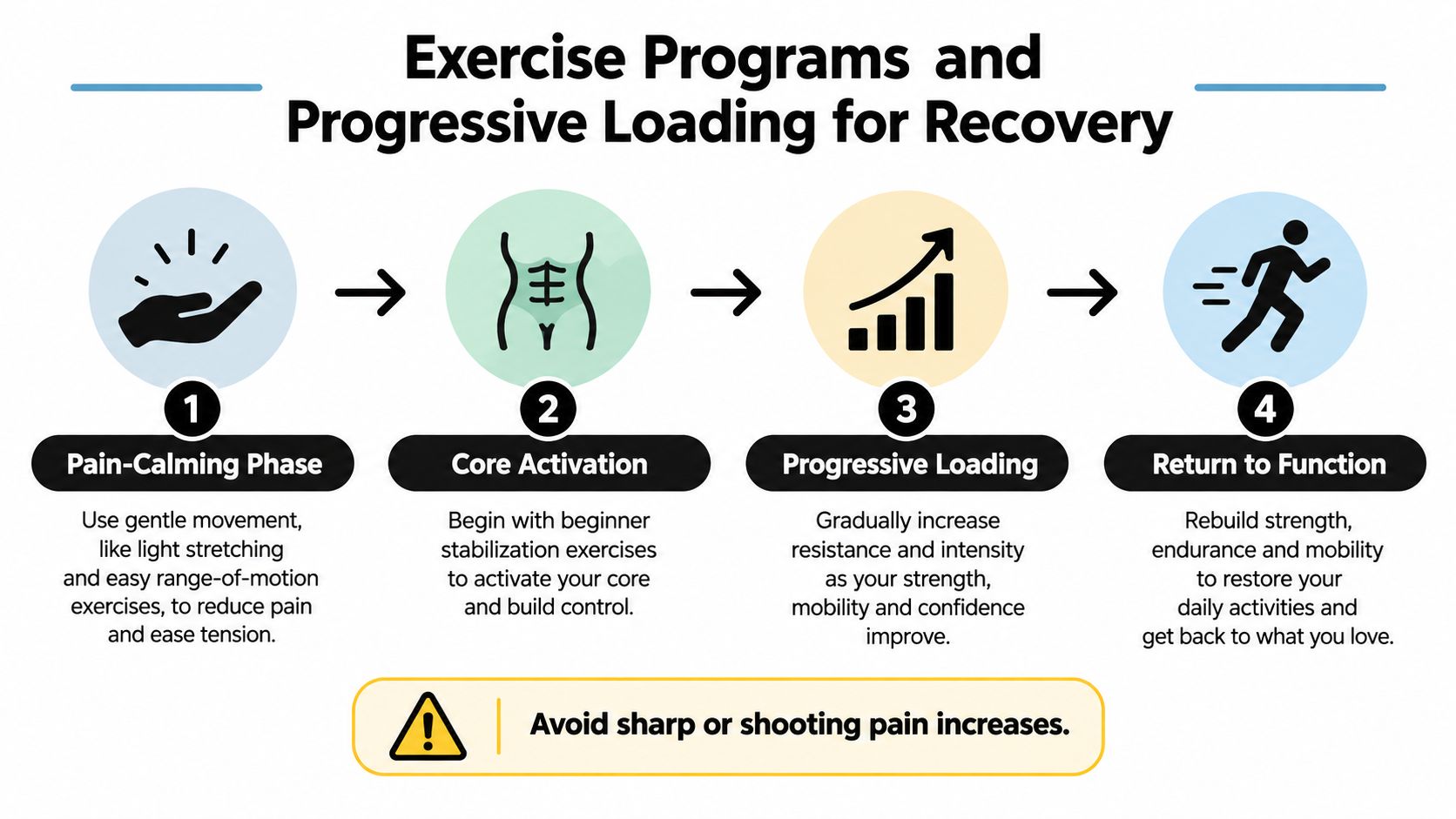
As tolerance improves, increase one training variable at a time. Lengthen the walk. Add resistance to a hip exercise. Increase repetitions. Introduce a more demanding hinge or lifting pattern. Changing duration, load, speed, and complexity all at once is where many setbacks happen.
Progression checkpoint: Advance when your current exercises are repeatable, symptoms settle after activity, and daily function is improving. Hold or reduce the dose when pain spreads farther down the leg, weakness increases, or recovery takes progressively longer.
A practical progression may look like this:
- Beginner: Short walks, supported positions, gentle trunk activation, and carefully selected mobility work.
- Intermediate: Longer walking, bridges, squats to a chair, hip strengthening, and controlled resistance.
- Advanced: Loaded hinges, step-ups, work-specific lifting, faster walking, or sport drills when neurological symptoms have settled.
Progress through these stages at the pace your symptoms allow. The overall recovery window discussed earlier is an average, not a deadline. I tell patients to track walking tolerance, sleep, leg symptoms, strength, and the daily tasks that are getting easier, because those markers show the hidden timeline better than pain alone. The beginner and intermediate stages above map well to the guide to exercises for lower back pain, which shows how to scale each movement.
When to Seek Professional Help and Urgent Warning Signs
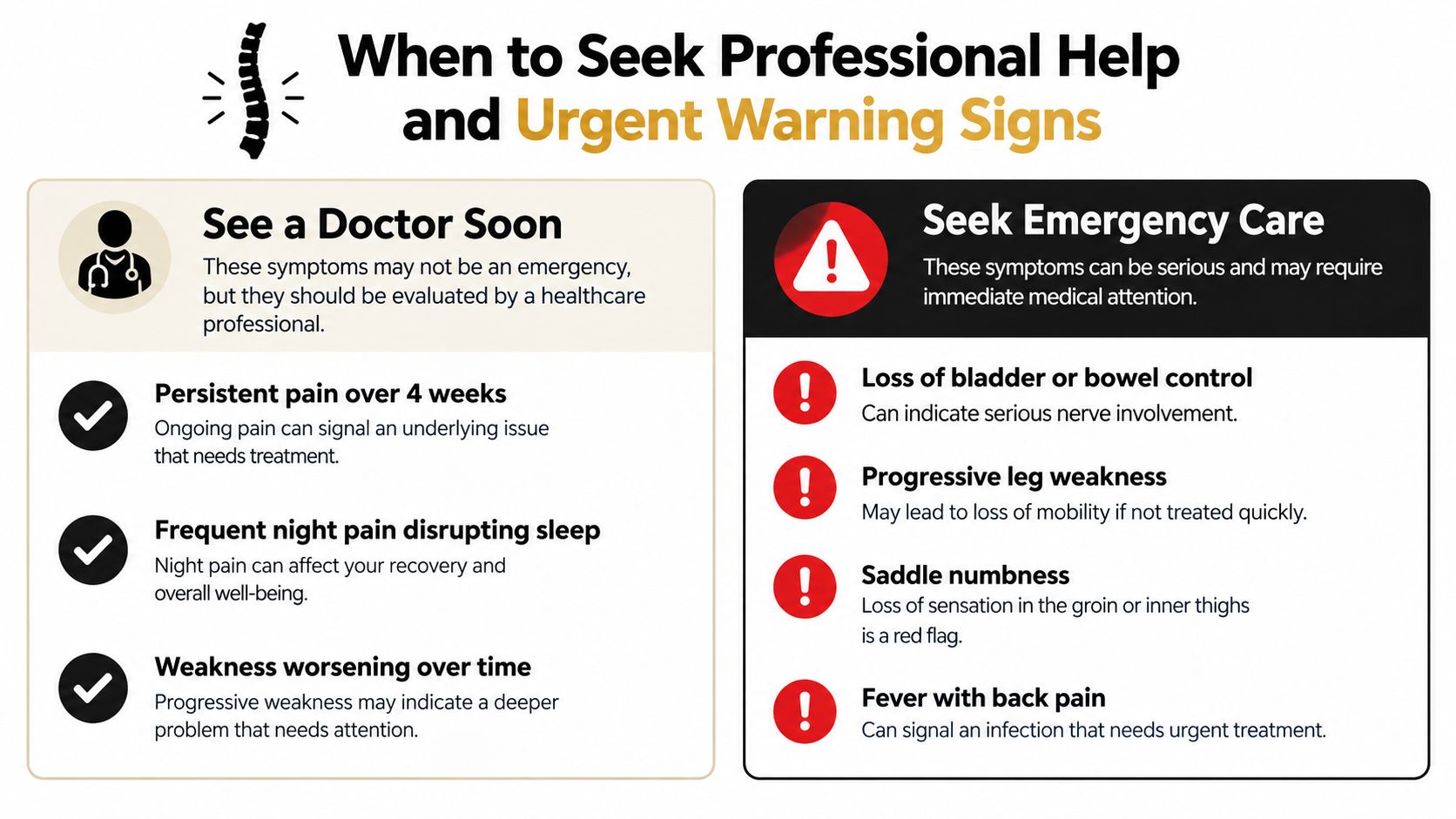
Not every flare requires emergency care, but certain symptoms change the decision. Progressive leg weakness, new bowel or bladder dysfunction, saddle numbness, or rapidly worsening neurological symptoms require urgent medical evaluation. Fever with back pain, significant trauma, or severe unremitting pain also warrants prompt assessment.
Use the timeline intelligently
A gradual reduction in pain, improved walking, and better sleep suggest that conservative care is working even if symptoms haven't disappeared. Persistent pain, recurring flares, worsening numbness, or difficulty restoring normal activities should prompt a clinical reassessment rather than endless self-treatment.
Imaging isn't automatically the first step. NICE advises against routine imaging in nonspecialist sciatica care when the result wouldn't change initial management. Imaging becomes more appropriate when progressive neurological deficits, suspected serious pathology, or possible invasive treatment makes the anatomical finding clinically important. The NICE recommendations for low-back pain and sciatica support assessment-led decisions.
Surgery also isn't the default response to radiating pain. Early surgery may provide faster relief for selected patients, while longer-term outcomes can be similar to prolonged conservative care. The decision depends on neurological findings, symptom persistence, functional loss, and the cause identified through evaluation.
MedAmerica Rehab Center Approach to Sciatica Treatment
A multidisciplinary plan can be useful when sciatica affects more than pain. Patients may also be guarding during movement, avoiding activity, losing hip or trunk strength, sleeping poorly, or compensating in ways that keep daily tasks difficult. Treating only the painful area may miss those contributors.
MedAmerica Rehab Center offers physical therapy, chiropractic care, acupuncture, and shockwave therapy for sciatica and related lower-back conditions. The clinic's approach is to assess the patient's presentation and build an individualized plan rather than apply the same sequence to everyone.
What care may look like
The first visit should clarify how symptoms began, where they travel, what positions change them, and whether numbness or weakness is present. A clinician may examine gait, spinal and hip movement, strength, reflexes, sensation, and functional tasks. That information helps determine whether the presentation is appropriate for conservative rehabilitation or needs medical referral.
Treatment may then combine hands-on techniques with active work:
- Symptom modulation: Manual therapy, chiropractic techniques, acupuncture, or other appropriate modalities may make movement more comfortable.
- Movement retraining: The therapist identifies positions and loading patterns that provoke symptoms, then practices safer alternatives.
- Progressive exercise: Trunk, hip, and leg capacity develops through tolerable strengthening and aerobic activity.
- Functional restoration: Exercises become more specific to walking, work duties, lifting, recreation, or sport.
The clinic has served the Deerfield Beach community since 1995, according to its publisher information, and provides care for acute and chronic conditions, including sciatica, back pain, sports injuries, auto-accident injuries, and workers' compensation rehabilitation. Its services also include pre- and post-surgical recovery, balance and gait training, and fall-prevention programs.
A combined approach still needs clear boundaries. Acupuncture, manual care, or shockwave therapy may help a person participate in exercise, but no passive modality should be presented as a guaranteed cure. Persistent weakness, worsening numbness, or urgent warning signs should lead to appropriate medical evaluation rather than repeated treatment sessions without reassessment.
Putting It All Together, Your Sciatica Recovery Roadmap
Use this sequence as a practical guide:
- Calm the flare: Choose the position that reduces leg symptoms, use short walks, and avoid prolonged fixed postures.
- Check the pattern: Note whether pain is centralizing, spreading, or changing with movement.
- Start active care: Add tolerable trunk, hip, and walking exercises rather than relying on rest alone.
- Progress gradually: Increase one demand at a time and track sleep, walking, strength, and daily function.
- Get assessed: Seek professional help when symptoms persist, function declines, or weakness or numbness progresses.
- Act urgently: Get immediate medical attention for bowel or bladder changes, saddle numbness, or progressive weakness.
Conservative care works for many people because it gives an irritated nerve time to settle while restoring the movement capacity that protects recovery. An individualized plan is safer and more useful than chasing a single treatment, whether that treatment is stretching, medication, injections, or passive therapy.
Frequently Asked Questions About Sciatica Relief
How long does conservative care take?
Some patients improve quickly, while others need a longer progression. The important signs are reduced leg symptoms, better sleep, increasing walking tolerance, and improved strength. Symptoms that worsen rather than gradually settle deserve reassessment.
Do I need an injection?
Not necessarily. Injections may provide a temporary reduction in pain for selected patients, but they should create an opportunity to move and rehabilitate, not replace active recovery. Recent evidence also suggests that injection benefits can be time-limited, so the choice should reflect your diagnosis, goals, and neurological findings.
Should I avoid exercise?
Avoid movements that sharply increase radiating pain, numbness, or weakness, but don't assume complete rest is the answer. Begin with tolerable activity and progress as your symptoms allow.
Are medications always appropriate?
No. NICE advises against gabapentinoids, other antiepileptics, oral corticosteroids, and benzodiazepines for sciatica because overall benefits are lacking and harms exist. NSAIDs also require consideration of contraindications, dose, duration, and potential gastrointestinal, hepatic, cardiovascular, or renal risks. Discuss medication choices with a qualified clinician.
When is surgery considered?
Surgery may be discussed when neurological deficits progress, serious compression is suspected, or symptoms remain disabling despite appropriate conservative care. It isn't automatically required because an MRI shows a disc abnormality.
How can I reduce recurrence?
Keep building strength, walking tolerance, lifting skill, and movement confidence after pain improves. A clinician can help you identify the specific work, sport, posture, or loading habits that need adjustment.
MedAmerica Rehab Center provides individualized physical therapy, chiropractic care, acupuncture, and shockwave therapy for people seeking practical sciatica nerve pain relief in Deerfield Beach. Visit MedAmerica Rehab Center to arrange an evaluation, discuss your symptoms, and receive a recovery plan based on your movement, neurological findings, and functional goals.
MedAmerica Rehab · Deerfield Beach
Talk to a clinician about your pain
Physical therapy, chiropractic, acupuncture and shockwave therapy under one roof, since 1995. Same-day appointments are available.
Mon–Thu 8:00 AM – 6:30 PM · Fri 8:00 AM – 3:00 PM