

Sciatica Pain Relief Near Me: A Local Guide
You're reaching for a coffee mug in your Deerfield Beach kitchen when a sharp jolt travels from your lower back through your buttock and down your leg. You tell yourself it's a pulled muscle, take a few cautious steps, and hope a beach walk or time in the pool will settle it. Then sitting, sleeping, or getting out of the car becomes difficult.
That pattern deserves more than a quick guess. Sciatica is common, with authoritative clinical summaries reporting a lifetime incidence of 10% to 40% and an annual incidence of 1% to 5%. Reviews commonly place adult prevalence around 5% to 10%, although definitions and study populations differ (NCBI clinical summary). Finding sciatica pain relief near me should mean finding a clinician who can identify the source, screen for danger signs, and match treatment to how your symptoms behave.
What Sciatica Feels Like and Why It Happens

The sciatic nerve begins from nerve roots in the lower spine, passes through the buttock, and travels down the back of the leg toward the foot. When one of those roots becomes irritated or compressed, the resulting symptoms may follow that pathway instead of staying in the low back.
People describe sciatica as shooting, burning, electric, aching, or throbbing. The pain may move from the low back into the buttock, thigh, calf, or foot. Tingling and numbness can accompany it, and some people notice weakness when lifting the foot, climbing stairs, or standing from a chair.
The pattern matters more than the pain score
Most ordinary cases affect one side, but symptoms on both sides can occur and deserve careful screening. Pain intensity alone doesn't tell us whether the problem comes from a disc, a narrowed space around the nerve, or a painful structure in the hip and buttock.
A movement-based assessment looks at what changes the symptoms. Does sitting worsen the leg pain? Does walking or standing trigger it? Does bending forward make the numbness travel farther down the leg? A clinician may also check strength, reflexes, sensation, walking, and nerve-tension responses.
Practical rule: Pain that travels farther down the leg, increasing numbness, or new weakness matters more than whether the pain feels like a “seven” or an “eight.”
In a local rehab setting, patients often wait because they expect the symptoms to disappear on their own. Some improve with sensible activity and conservative care, but delay can make ordinary movements feel threatening and can leave people guarding the spine, hips, and leg. A prompt evaluation gives you a safer starting point than experimenting with stretches, massage, or equipment without knowing what is being irritated.
The Common Causes Behind Sciatic Nerve Pain
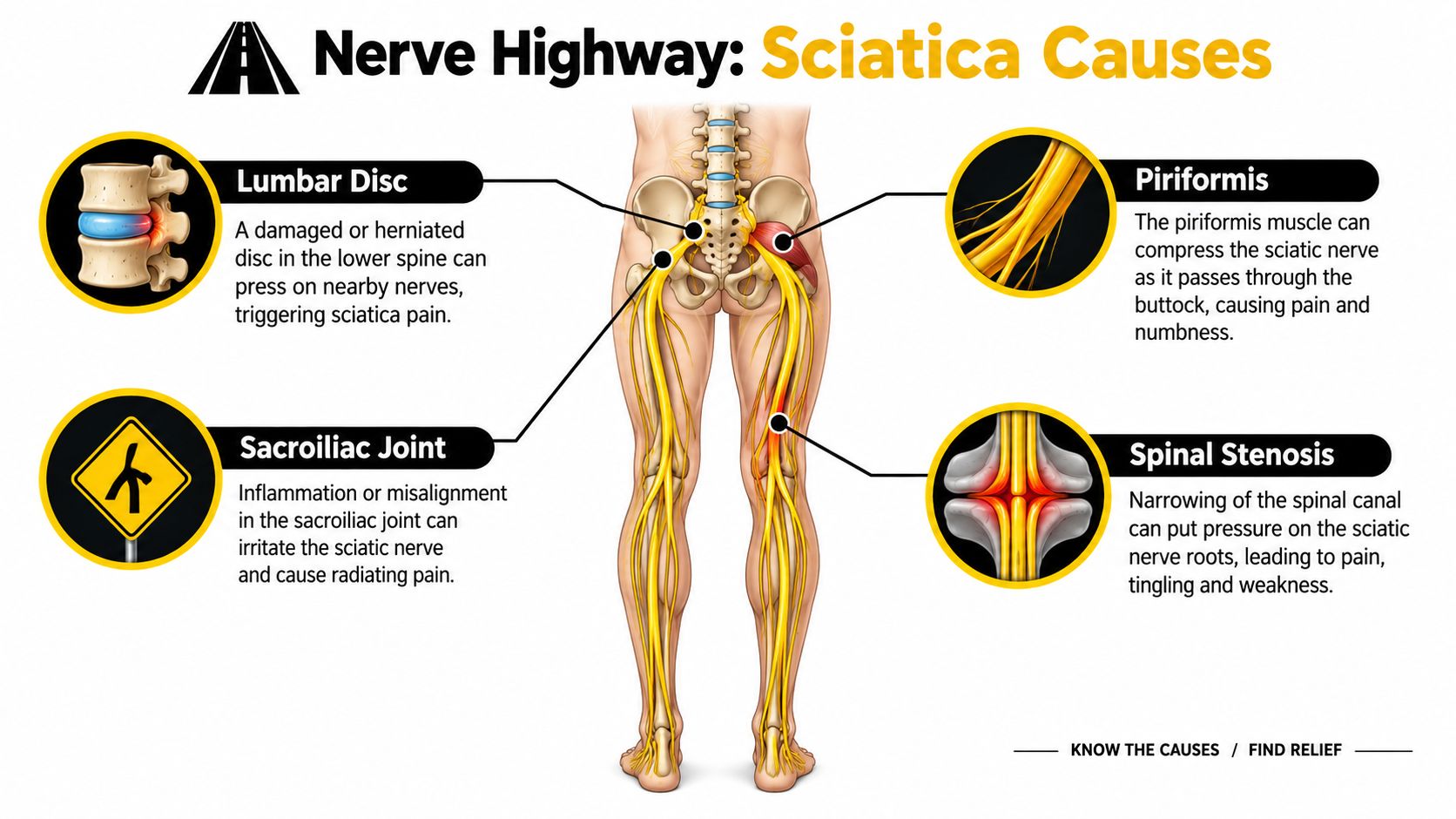
Think of the sciatic nerve as a highway leaving the lower spine and running through the buttock into the leg. Several checkpoints can narrow, irritate, or overload the route. The symptom map can suggest the checkpoint, but it can't confirm it by itself.
Common checkpoints along the nerve highway
Lumbar disc herniation is a frequent cause. The inner material of a spinal disc can push outward and irritate a nearby nerve root, sometimes after lifting and sometimes after prolonged sitting or repeated bending.
Lumbar spinal stenosis involves reduced space around the spinal canal or the exiting nerve. People with this pattern often notice leg discomfort, heaviness, or numbness with standing and walking, though each presentation is different.
Piriformis-related irritation occurs when the deep gluteal muscles become tight or sensitive around the nerve. It can resemble a disc problem, which is why a clinician shouldn't label every buttock-to-leg complaint as a herniated disc.
Other contributors include sacroiliac joint dysfunction, spondylolisthesis, and pressure associated with pregnancy. Sleep position and mattress support may also influence morning stiffness and how readily you move after getting out of bed. For practical guidance on bedroom setup and morning back discomfort, the Willis Furniture & Mattress sleep tips offer useful context, but sleep advice can't replace a neurological assessment.
Why diagnosis requires movement testing
A careful examination may include:
- Strength testing: Checking hip, knee, ankle, and toe movement for signs of nerve involvement.
- Reflex and sensation checks: Comparing sides to identify changes that pain descriptions can miss.
- Movement analysis: Observing walking, bending, sitting, and transitional movements.
- Nerve-tension testing: Using tests such as the straight-leg raise or slump test when appropriate.
The same symptom can arise from different mechanical patterns. Treatment should follow the findings, not the popularity of a modality.
Comparing Conservative Treatments That Actually Help
Conservative care is usually the starting point for sciatica. Clinical guidance emphasizes staying active, continuing daily activities where possible, and avoiding prolonged bed rest. Referral or escalation becomes more important when symptoms fail to improve after about 6 to 8 weeks, or when red-flag neurological changes appear (clinical guidance review).
The evidence isn't equally strong for every treatment. A recent network meta-analysis reported short-term signals for several non-surgical approaches but rated the overall evidence very low confidence, so a responsible clinic should explain uncertainty rather than promise a guaranteed fix (2025 network meta-analysis).
| Treatment | Best For | Evidence Strength | Typical Sessions | Ideal Patient |
|---|---|---|---|---|
| Physical therapy | Restoring movement, strength, and tolerance for daily activity | Variable, with exercise-based care commonly emphasized | Set by response and goals | Patients ready to participate in active rehabilitation |
| Chiropractic care | Joint mobility and short-term symptom modulation | Variable and pattern-dependent | Set after examination | Patients who may benefit from mobilization combined with exercise |
| Acupuncture | Pain modulation during a sensitive flare | Uncertain for specific sciatica causes | Set by response | Patients seeking a low-load option alongside assessment |
| Shockwave therapy | Selected soft-tissue presentations, such as stubborn piriformis-related pain | Limited or condition-specific | Set by tissue response and diagnosis | Patients with an appropriate soft-tissue finding, not unexplained nerve weakness |
Physical therapy usually provides the broadest foundation because it can combine education, graded loading, manual techniques, mobility work, and strengthening. The realistic goal isn't to make pain disappear on the treatment table. It's to improve walking, sitting, sleep, lifting, and confidence with movement.
Chiropractic treatment may help when restricted joint motion contributes to the presentation, particularly when adjustments or mobilization are paired with a home exercise plan. Acupuncture can help some people tolerate a flare while they begin moving again. Shockwave treatment may be considered when examination points toward a treatable soft-tissue problem, but it shouldn't be used as a substitute for neurological screening.
The guide to relieving sciatica pain quickly can help you compare immediate comfort measures with a longer-term rehabilitation plan. In practice, combined care often makes more sense than relying on one passive treatment, because pain relief and restored capacity are related but different goals.
Misconceptions That Keep People Stuck in Pain
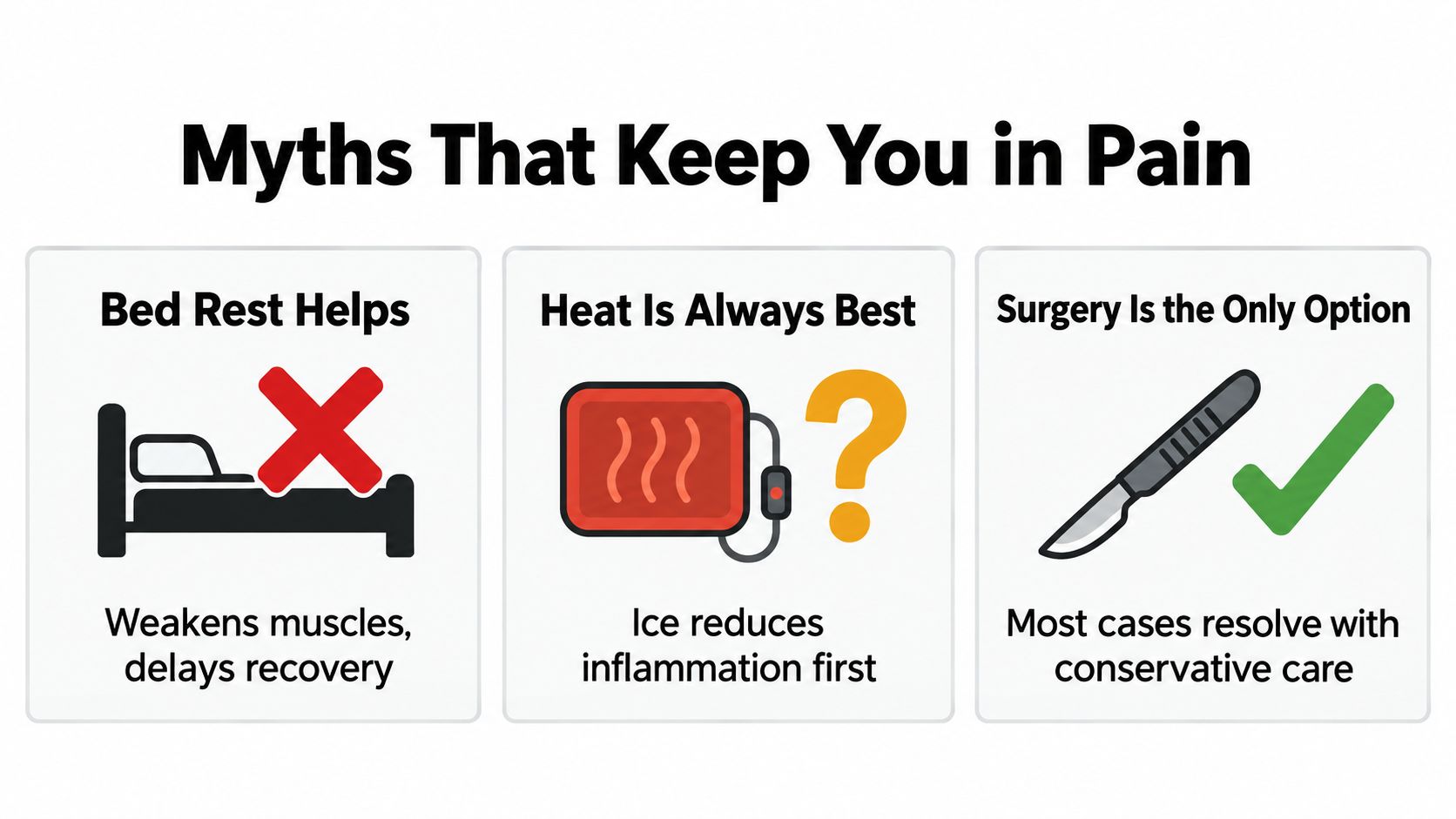
The most persistent mistake is treating sciatica like an injury that needs complete immobilization. A short period of rest may feel soothing, but prolonged inactivity can increase stiffness, reduce conditioning, and make the first return to movement harder. Clinical guidance favors remaining active and avoiding bed rest as the main strategy (conservative-care guidance).
Three beliefs worth challenging
“I need to stay in bed until the nerve settles.” Gentle, graded movement is usually more useful than spending days on the couch. That might mean changing positions regularly, taking brief walks, and avoiding only the movements that clearly intensify leg symptoms.
“A disc problem means I need surgery first.” Surgery has an important role, but it isn't the default for every radiating leg-pain complaint. Specialist referral is generally considered when symptoms don't improve after about 6 to 8 weeks, or sooner when significant neurological deficits or other red flags appear (clinical guidance review).
“No pain, no gain applies to nerve pain.” Sharp, spreading leg pain isn't a useful target for aggressive stretching or heavy strengthening. A better plan adjusts the load so symptoms remain manageable while walking, hip movement, trunk control, and strength gradually improve.
Ask yourself three questions: Am I avoiding nearly all movement? Am I assuming imaging or surgery is automatically next? Am I repeatedly provoking the exact leg symptoms I want to calm? Your answers can point toward the kind of assessment you need.
Red Flags and Triage for Sciatica
Searching for sciatica pain relief near me need timely outpatient assessment, not panic. Some symptoms, however, require urgent medical evaluation because they may signal serious nerve compression or another condition that shouldn't wait for a routine rehab appointment.
Go to urgent evaluation when warning signs appear
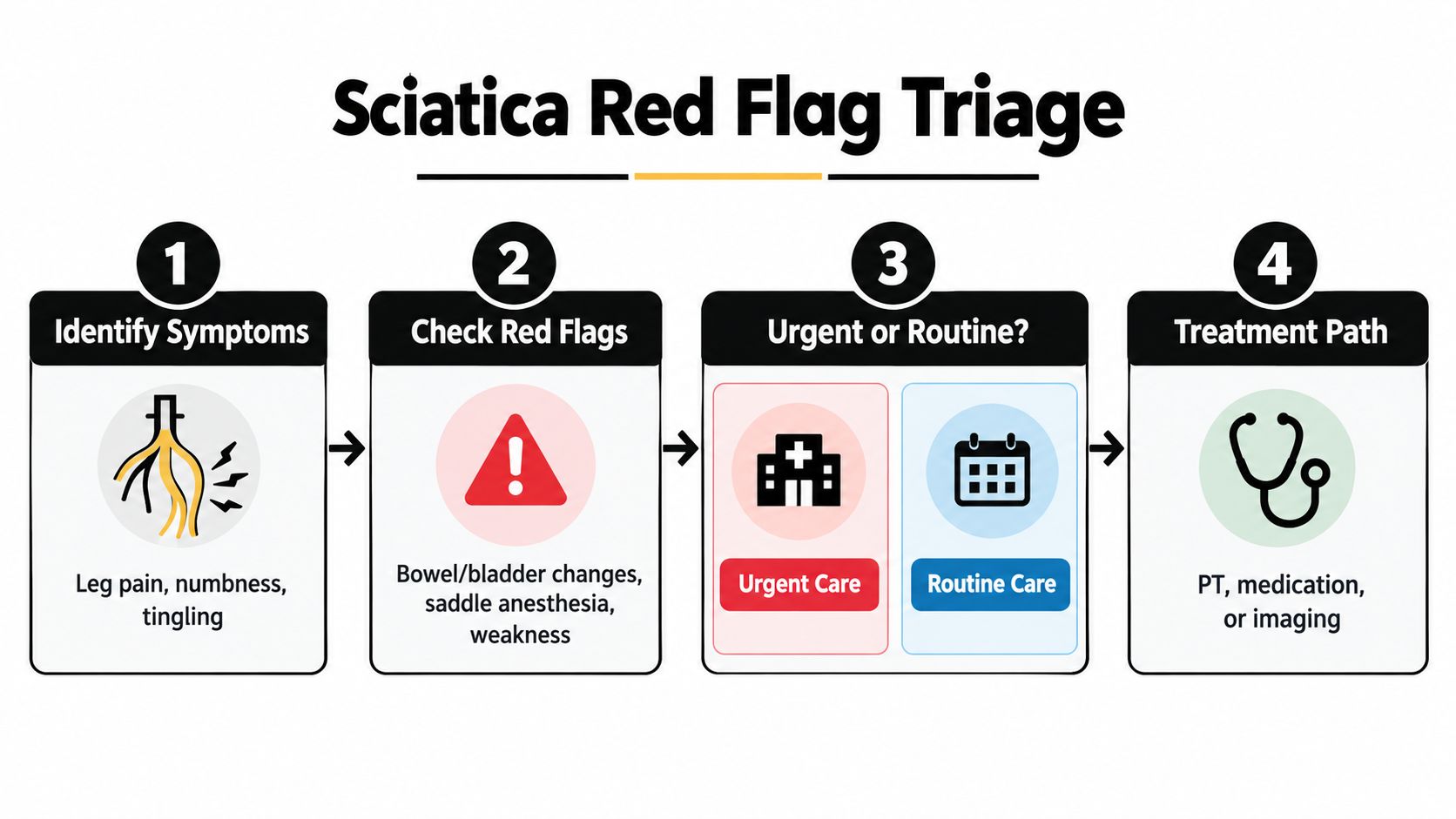
Seek immediate medical care for new bowel or bladder changes, saddle numbness, rapidly worsening weakness, severe paresis, or bilateral leg weakness. Fever, unexplained weight loss, significant recent trauma, or severe pain that doesn't ease with position changes also warrants prompt escalation. These warning signs are highlighted in recent guidance on sciatica triage (red-flag guidance).
A practical routing plan looks like this:
- Red flag present: Choose the nearest emergency department or urgent medical service rather than waiting for a rehab evaluation.
- No red flag, mild or moderate symptoms: Arrange an outpatient movement-based assessment and keep activity gentle.
- Persistent or worsening symptoms: Request same-week clinical review, particularly if numbness or weakness is developing.
- Walking or sleep significantly affected: Ask for priority assessment so the clinician can decide whether medical referral or imaging is appropriate.
Imaging isn't automatically necessary at the first visit. A clinician should decide based on the examination, progression, neurological findings, and response to initial care.
Bring a simple symptom log to your appointment:
- Location: Back, buttock, thigh, calf, foot, or more than one area.
- Quality: Burning, tingling, numbness, aching, or electric pain.
- Triggers: Sitting, walking, bending, driving, coughing, or sleeping.
- Function: What you can't do comfortably today.
- Neurological changes: Any new weakness, foot slapping, balance change, or altered bladder or bowel control.
For a broader recovery timeline and guidance on what persistence can mean, review how long sciatica pain can last, then use your own symptom pattern to decide how quickly to arrange care.
Choosing the Right Local Clinic for Sciatica
A map search gives you addresses, not clinical quality. The right question isn't, “Which clinic is closest?” It's, “Which team will test the nerve, observe how I move, and change the plan if I'm not progressing?”
A practical clinic checklist
| Evaluation Criterion | What to Look For | Red Flag to Avoid |
|---|---|---|
| Credentials | Licensed clinicians with relevant orthopedic or rehabilitation training | Unclear qualifications |
| Assessment depth | Neurological screen, nerve-tension tests, and movement analysis | A brief pain conversation with no physical testing |
| Treatment range | Manual therapy paired with active exercise | Passive treatment only |
| Evidence transparency | Willingness to explain benefits and uncertainty | Guaranteed results |
| Progress tracking | Functional goals and regular reassessment | No measurable outcome |
| Cost clarity | Written pricing and insurance verification | Vague financial answers |
| Access | Same-day or same-week options when appropriate | Long delays despite worsening symptoms |
| Location | A manageable drive that won't aggravate symptoms | A distant clinic that makes attendance difficult |
| Reviews | Specific comments about sciatica and rehabilitation | Reviews with no detail about care |
| Escalation plan | Clear physician or imaging referral process | No pathway when symptoms worsen |
At a first visit, expect questions about onset, aggravating activities, sleep, work, walking, and prior treatment. The clinician should observe gait and lumbar movement, examine strength and sensation, and explain why particular exercises or hands-on techniques fit your presentation.
At MedAmerica Rehab Center, the published service model includes physical therapy, chiropractic care, acupuncture, and shockwave therapy, with individualized treatment planning and same-day appointment availability. A first visit can include a longer evaluation, movement and gait assessment, hands-on care, targeted exercises, and a home program when those services fit the findings. You can review the clinic's sciatica physical therapy near me service before calling.
Be cautious with high-volume clinics that move every patient through the same sequence of heat, stimulation, and brief treatment without reassessing movement or neurological status. The same caution applies to online locators. For example, someone comparing local healthcare searches may find a Mounjaro clinic locator for 2026, but a medication locator isn't a substitute for choosing a rehabilitation provider with appropriate examination skills.
Your Next Steps and Common Questions
A useful first month starts with information, not a random treatment package.
A simple 30-day plan
Week one: Book a local assessment and record when symptoms worsen, where they travel, and which activities remain comfortable. Don't chase pain relief by repeatedly testing the movement that aggravates the leg.
Week two: Begin the treatment plan that matches the examination. That may include active exercise, manual therapy, education, acupuncture, chiropractic care, or another option selected for a specific finding.
Week three: Reassess function. Can you walk farther, sit more comfortably, sleep with fewer interruptions, or move with less guarding? Pain matters, but function often shows progress more clearly.
Week four: Decide whether to continue, modify the plan, or seek medical escalation. If symptoms are worsening or weakness is emerging, don't wait for the calendar to reach the end of the month.
Questions people ask before booking
How strong is the evidence for shockwave or acupuncture? Confidence varies by diagnosis and outcome. The available evidence for many non-surgical options remains low or very low confidence, so your provider should explain what the treatment is intended to change and how progress will be judged (2025 network meta-analysis).
What will treatment cost in Deerfield Beach? Out-of-pocket costs depend on the service, insurance benefits, deductible, referral requirements, and whether a medical provider orders additional care. Ask for a benefits check and written estimate before beginning.
When should relief begin? Some people feel a change in irritability early, while nerve-related symptoms may take longer to settle. Epidural steroid injections illustrate the trade-off: one randomized trial found a short-term benefit at 3 weeks, but no benefit from 6 to 52 weeks and no reduction in surgery rates, making injections a temporary tool rather than a complete solution (randomized trial).
Do I need imaging first? Not always. The examination and symptom progression should guide whether imaging or physician referral is appropriate.
What if symptoms return? Revisit the movement pattern, work demands, sleep, and home program rather than repeating the same passive treatment automatically. If a flare includes new weakness, bowel or bladder changes, or saddle numbness, seek urgent care.
If persistent symptoms affect work and daily life, legal and medical questions can overlap. A resource discussing winning disability for sciatica may help explain documentation issues, but it isn't a substitute for clinical evaluation or legal advice.
MedAmerica Rehab Center offers movement-based evaluations, physical therapy, chiropractic care, acupuncture, and selected shockwave treatment for people seeking sciatica pain relief near me in Deerfield Beach. Visit MedAmerica Rehab Center to review the services and request an appointment that matches your symptoms and urgency.
MedAmerica Rehab · Deerfield Beach
Talk to a clinician about your pain
Physical therapy, chiropractic, acupuncture and shockwave therapy under one roof, since 1995. Same-day appointments are available.
Mon–Thu 8:00 AM – 6:30 PM · Fri 8:00 AM – 3:00 PM