
What Is Remote Therapeutic Monitoring and How It Works
You finish a physical therapy visit, understand your exercises, and promise yourself you'll keep up with them at home. Then the next day gets busy, your knee feels stiff, or you're unsure whether you're performing the movement correctly. Remote therapeutic monitoring, or RTM, extends the therapy relationship between visits by helping a clinician collect treatment-related information, review it, and communicate with you while your plan is underway.
The patient experience can feel simple: use a connected device or app, complete assigned activities, answer questions, and speak with the care team when needed. Behind that simplicity, the clinic must follow Medicare rules for treatment plans, monitoring data, interactive communication, time tracking, and documentation. Understanding both sides helps patients ask better questions and helps clinics build a service that supports recovery rather than merely adding another billing process.
A Day in the Life of an RTM Patient
Maria is recovering from a total knee replacement. She lives in Deerfield Beach and has already learned the basics of her home program during an in-person visit. Before leaving the clinic, her physical therapist gives her a small sensor and pairs it with a tablet app. The setup is part of her active rehabilitation plan, not a separate fitness challenge.
At home, Maria completes her prescribed knee movements and walks around her house as instructed. The sensor records her knee range-of-motion repetitions and walking bouts, while the app gives her reminders and a place to report how the knee feels. She isn't expected to interpret every reading herself. Her therapist receives the information on a clinic dashboard and reviews it as part of ongoing care.
The next morning, the therapist sees that Maria completed her exercises but struggled to reach the movement target. During the next conversation, the therapist asks about swelling, pain, and confidence while walking. The home program may then be adjusted, perhaps by changing the exercise dose, reviewing technique, or adding a safer progression.
The patient sees a daily routine. The clinician sees evidence that can guide the next treatment decision.
Maria's experience is one example of how mobile physical therapy can connect therapy with the patient's real environment. RTM doesn't replace hands-on assessment when an examination is needed. Instead, it helps the therapist understand what happens after the patient leaves the treatment room.
The device, app, dashboard, clinical review, and live communication all serve a purpose. The rest of the process explains how those pieces fit CMS requirements, billing codes, and responsible clinic operations.
What Remote Therapeutic Monitoring Actually Is
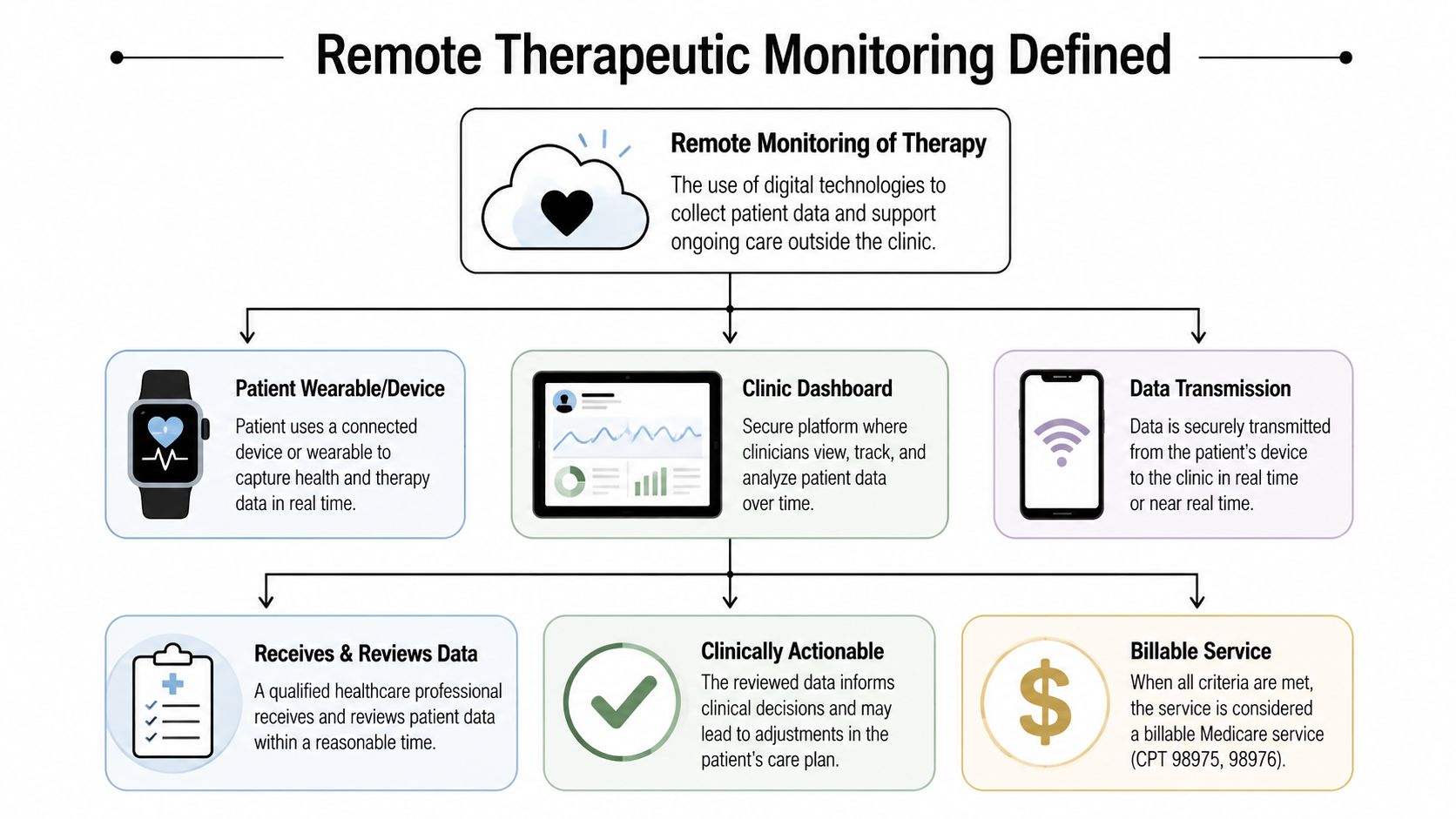
Remote therapeutic monitoring is a clinical service that tracks information related to a patient's therapy plan outside the clinic. The information can include therapy adherence, therapy response, and musculoskeletal or respiratory status. Unlike a general wellness app, RTM connects the data to an established treatment plan and requires clinical review and patient interaction.
The basic flow looks like this:
- A clinician establishes a treatment plan.
- The patient receives a suitable device or digital tool.
- The device or app captures therapy-related information.
- The clinic receives and reviews the data.
- The care team communicates with the patient and uses the information to manage treatment.
- The clinic documents the work and submits appropriate claims when requirements are met.
Why the Medicare milestone matters
RTM became a formal Medicare-billable service in the 2022 Medicare Physician Fee Schedule, when CMS and the American Medical Association established a dedicated CPT code family effective January 1, 2022. The initial published Medicare payment levels included $19.38 for code 98975, $55.72 for codes 98976 and 98977, $50.18 for code 98980, and $40.84 for code 98981. These amounts came from the 2022 Medicare Physician Fee Schedule summary.
That change gave clinics a defined financial pathway for monitoring therapy adherence, response, and musculoskeletal care. It also clarified that RTM isn't just a technology label. It's a structured service that links patient-generated information with clinician action.
Patients and staff may also encounter broader telehealth training requirements. For clinicians who need foundational education, how to get a telemedicine certificate can be a useful educational resource. Certification alone doesn't determine RTM eligibility, but appropriate training can support safer remote communication and workflow design.
RTM vs RPM The Differences That Matter
RTM and remote patient monitoring, or RPM, both use technology to support care outside a facility. They aren't interchangeable, though. RPM primarily focuses on physiologic measurements, while RTM focuses on therapy-related information and treatment response.
A blood pressure reading, body weight measurement, glucose value, or oxygen-related reading may fit an RPM workflow when collected under the applicable requirements. A home exercise response, therapy adherence pattern, or musculoskeletal function measure is more closely aligned with RTM.
RTM vs RPM at a glance
| Dimension | RTM | RPM |
|---|---|---|
| Main purpose | Monitors therapy adherence, therapy response, and musculoskeletal or respiratory treatment information | Monitors physiologic information |
| Typical examples | Exercise completion, pain response, movement performance, respiratory therapy response | Blood pressure, weight, glucose, or other physiologic readings |
| Clinical connection | Must follow an established treatment plan and support active treatment management | Supports remote review of physiologic status under RPM rules |
| Provider considerations | Created a reimbursement pathway for therapy-focused services and eligible qualified professionals | Traditionally associated with physicians and certain other qualified practitioners |
| Data emphasis | Non-physiologic, treatment-related information | Physiologic measurements |
| Patient interaction | Treatment-management codes require interactive communication with the patient or caregiver | RPM has its own communication and management requirements |
| Coding family | RTM CPT family, including musculoskeletal and respiratory supply and management codes | RPM CPT family |
The distinction matters because the same patient could use more than one type of technology, but a clinic can't assume that every connected reading belongs under the same service. The diagnosis, treatment purpose, device, provider role, and documentation must align.
For a physical therapist, RTM can fit naturally inside an active rehabilitation episode. The therapist isn't merely checking whether a patient owns a smartwatch. The therapist is using treatment-related information to decide whether the home program needs reinforcement, progression, or modification.
Decision rule: Ask what the clinician is monitoring and why. If the central question is “How is the patient responding to therapy?”, RTM may be the better conceptual fit. If it's “What is the patient's physiologic reading?”, RPM may be relevant.
The CPT Codes That Power RTM Billing
RTM billing becomes easier to understand when you separate device access and data transmission from treatment management time. The first category concerns how many days the clinic receives qualifying information during a 30-day period. The second concerns clinician work, including review, analysis, treatment decisions, and required interactive communication.
CMS currently recognizes supply codes for respiratory and musculoskeletal monitoring that cover 2 to 15 monitoring days in a 30-day period, along with treatment-management code 98979, which requires at least one real-time interactive communication and is billed in 10-minute increments. The current structure is listed in CMS's 2026 therapy code list.
The code families in plain English
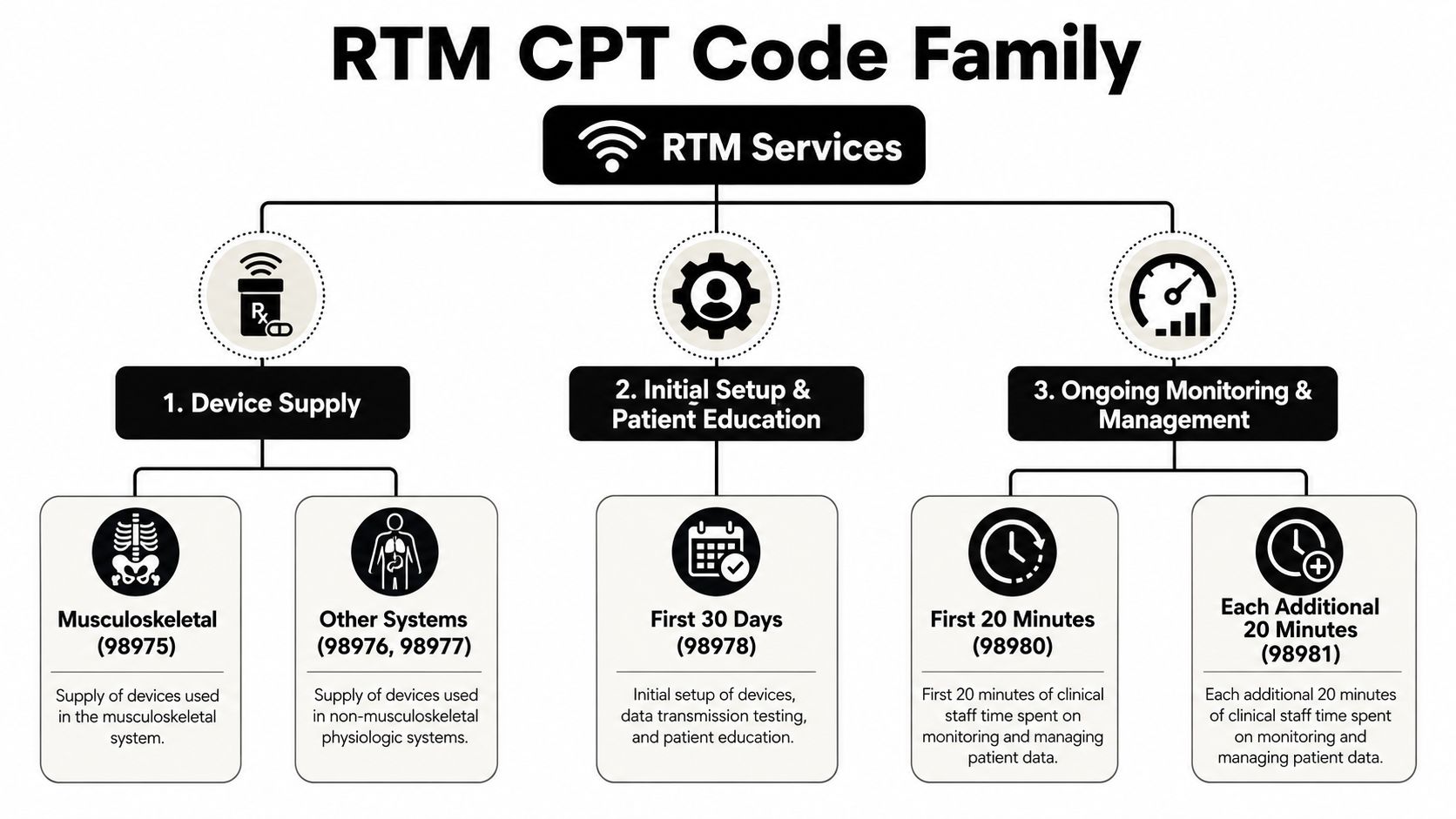
98975 covers initial setup and patient education. In practice, that can include pairing a sensor, teaching the patient how to use the app, explaining what information is captured, and confirming that the patient understands the plan.
98984 and 98985 address supply and data access for monitoring during 2 to 15 days in a 30-day period. The applicable code depends on the monitored system and code-year requirements. A patient with a short, focused rehabilitation need might generate information during this shorter window.
98976 and 98977 cover respiratory and musculoskeletal device supply categories under the applicable code structure. A low-back rehabilitation program may use the musculoskeletal pathway, while a respiratory rehabilitation plan may use the respiratory category.
98979 covers treatment management in 10-minute increments and requires at least one real-time interactive communication during the calendar month. 98980 covers the first 20 minutes under its requirements, and 98981 covers each additional 20 minutes. The therapist must track actual clinical work rather than estimate time from the number of dashboard alerts.
The 2024 clarification
CMS clarified in its 2024 final-rule discussion that the 16-day data requirement applied to RPM, not to RTM treatment-management codes 98980 and 98981. CMS also confirmed that RTM is furnished after a treatment plan has been established. The 2024 Medicare RPM and RTM rule summary explains these operational points.
For clinics, the mental model is straightforward: establish the plan, onboard the patient, collect valid treatment-related data, perform documented clinical management, and complete the required interactive communication. The Clarity 53-minute rule resource addresses a different billing context, but it can help staff think carefully about time-based documentation rather than relying on vague estimates.
Clinical Use Cases in Physical Therapy and Rehab
RTM fits best when a patient's recovery depends on what happens between appointments. The device or app should answer a clinical question, not merely produce a stream of readings.
Post-surgical recovery
After knee or shoulder surgery, a therapist may monitor exercise completion, movement performance, reported symptoms, and progress toward functional tasks. If the data shows that a patient is avoiding a movement or struggling with a progression, the therapist can contact the patient, review technique, and modify the home plan.
For a patient recovering from a knee replacement, the target may be controlled bending, safe walking, and confidence with transfers. For a shoulder patient, the focus may shift toward prescribed mobility work and gradual strengthening. RTM gives the therapist information from the home setting, where the patient performs most of the recovery work.
Spine and persistent pain programs
A low-back or neck pain program may track adherence to mobility exercises, response after activity, and changes in symptoms during daily tasks. A therapist can use that pattern to distinguish between a patient who needs a simpler routine and one who's ready for progression.
For sciatica self-management, the clinician might look for whether certain movements consistently worsen symptoms or whether the patient is avoiding activity because of fear. The resulting conversation can focus on pacing, positioning, and safe movement rather than just reminding the patient to exercise.
Balance, arthritis, and active rehabilitation
An older adult working on balance may use RTM to support a structured home routine and report confidence during transfers or walking. An arthritis patient may need a sustainable exercise pattern that respects fluctuating symptoms. An athlete may need monitoring of rehabilitation drills, return-to-training tolerance, and response after practice.
The strongest workflow turns data into a decision. A care platform connected to an RTM device was associated with significantly lower all-cause healthcare utilization after discharge at days 30, 60, and 90 in patients receiving outpatient parenteral antimicrobial therapy, as reported in a 2026 peer-reviewed study. That population isn't a direct substitute for a musculoskeletal therapy population, but the technical lesson is relevant: a device matters most when the platform helps clinicians act on the information.
RTM shouldn't become passive surveillance. The therapist must connect each review to a patient goal, such as walking safely, completing a home program, reducing symptom flare-ups, or returning to sport.
Implementation Considerations for Clinics
A clinic doesn't launch RTM by handing patients an app and waiting for data. The service needs an owner, a patient-selection process, a communication plan, and documentation standards that fit the existing episode of care.
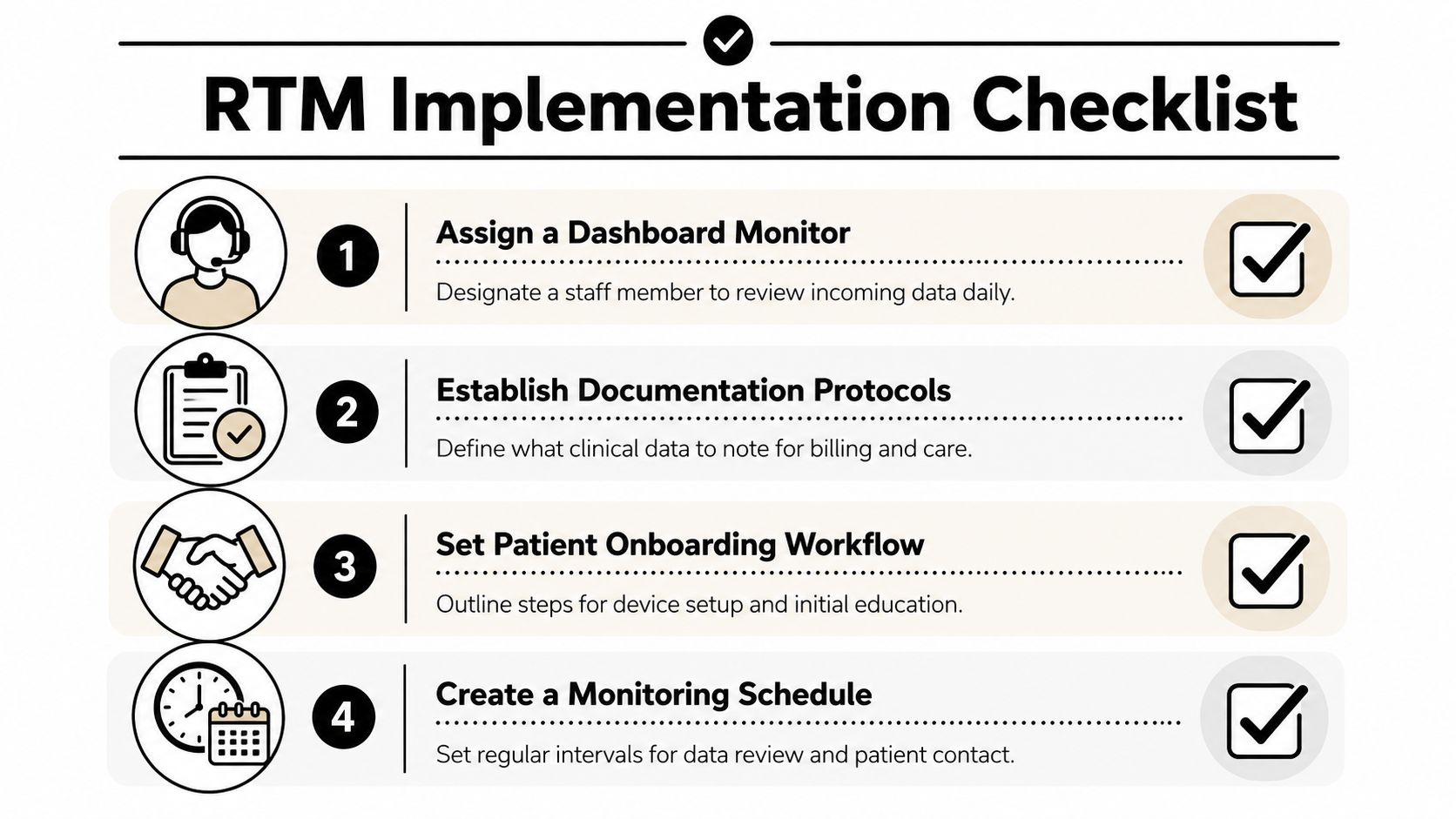
Build the workflow around four decisions
Assign dashboard responsibility. Decide which qualified clinician or trained team member reviews incoming information and how concerns reach the treating therapist. “Everyone checks it” usually means nobody owns it.
Define the patient start point. CMS confirmed that RTM is furnished after a treatment plan has been established. The clinic should document the diagnosis, goals, prescribed activities, device education, and reason remote monitoring supports the plan.
Create a live-contact protocol. Treatment-management codes require interactive communication. The clinic should define how staff schedule, conduct, and record patient conversations, including the purpose of the discussion and any resulting change in care.
Track time and data days separately. A dashboard review doesn't automatically equal billable treatment-management time. Staff should record qualifying monitoring days and clinical management time in separate fields.
Prevent predictable failures
Device pairing can fail. Patients may stop using the app, misunderstand an exercise, or lack reliable internet access. A short onboarding test, written instructions, and a named support contact can prevent small technical problems from becoming missing data.
Documentation must also show clinical meaning. “Reviewed dashboard” is weaker than noting what changed, why it changed, and how the patient responded. Billing staff should reconcile claims with the treatment record before submission.
Multidisciplinary practices need clear boundaries. Physical therapy, chiropractic, and acupuncture teams may share a patient, but the clinic must identify who owns the RTM plan and avoid duplicating time or services. For patients who need care at home, private in-home physical therapy can be considered alongside remote support when clinically appropriate.
Why RTM Is About Outcomes More Than Reimbursement
RTM adoption has moved faster than the evidence proving that it improves pain, function, or adherence across every rehabilitation population. A large U.S. utilization study reported that RTM services increased from 59,040 services and $2.66 million in 2022 to 279,464 services and $13.26 million in 2023, but those figures demonstrate adoption and spending, not better patient outcomes. The findings and evidence gap are discussed in this 2025 chronic pain monitoring review.
That distinction should change how clinics evaluate a program. Revenue can show whether the workflow is financially sustainable. It can't show whether patients move better, understand their exercises, experience less pain, or avoid unnecessary escalation of care.
Measure what the patient feels and does
A responsible RTM program can track:
- Adherence: Did the patient complete the prescribed activities?
- Function: Can the patient walk, reach, lift, transfer, or return to a valued activity?
- Symptoms: Are pain, stiffness, breathlessness, or fatigue changing?
- Confidence: Does the patient feel safer and more capable at home?
- Clinical response: Did the therapist change the plan based on the information?
The policy movement toward shorter monitoring and management thresholds may make RTM more practical for patients who need focused support rather than extended monitoring. It also makes comparison harder, because two patients may receive different levels of contact and generate different amounts of information.
A billable interaction isn't automatically a valuable interaction. Its value comes from helping the patient make a better recovery decision.
Clinics handling connected health data should also plan for privacy, access controls, and reliable documentation. Organizations seeking specialized healthtech compliance expertise may use that support to examine the technology and governance side of implementation. Patient-reported outcomes and functional measures should remain visible in the record, not buried beneath device activity. A clinic can use tools such as an outcome measure library to keep recovery evaluation connected to patient goals.
What This Means for MedAmerica Rehab Center Patients
For a patient in Deerfield Beach, RTM may add a useful layer to care that already includes hands-on assessment, targeted exercise, shockwave therapy, chiropractic treatment, acupuncture, balance training, or gait work. The technology doesn't replace the therapist's examination. It helps the care team see how the plan performs in the patient's home, at work, or during ordinary daily movement.
The approach may be relevant to several local patient groups:
- Orthopedic surgery patients can ask whether a paired device would help track a knee, shoulder, or other recovery plan.
- Auto accident and workers' compensation patients can ask how home exercise adherence and symptom response will be reviewed.
- Adults with back pain, neck pain, sciatica, or arthritis can discuss whether remote feedback would make a home program easier to follow.
- Seniors working on balance can ask how the clinic will support safe practice and respond to signs of difficulty.
- Athletes and active adults can ask whether monitoring can guide a gradual return to training.
Questions to ask before starting
Start with the treatment plan. Ask your therapist whether your current diagnosis and goals make RTM clinically appropriate, what information the device will collect, and how that information will change your care.
Then clarify the practical details:
- Coverage: Ask whether your insurance recognizes the service and whether you may have cost-sharing.
- Daily routine: Find out how often you'll use the device or app and what happens if you miss a day.
- Communication: Ask when you'll speak with the care team and what counts as the required interactive contact.
- Privacy and support: Confirm how your information is protected and whom to contact if the device stops working.
- Success measures: Agree on the functional change you're trying to achieve, not just the amount of data collected.
Used carefully, RTM can connect clinic expertise with the work patients do between visits. It should support the larger goal of helping people feel better, move better, and return to the activities they value with less reliance on unnecessary medication or surgery.
If you're considering remote therapeutic monitoring or need help with an active rehabilitation plan, visit MedAmerica Rehab Center to discuss your goals with the Deerfield Beach care team. The clinic offers physical therapy, chiropractic care, acupuncture, shockwave therapy, balance training, and individualized support for surgical, accident, workers' compensation, pain, and sports recovery.
MedAmerica Rehab · Deerfield Beach
Talk to a clinician about your pain
Physical therapy, chiropractic, acupuncture and shockwave therapy under one roof, since 1995. Same-day appointments are available.
Mon–Thu 8:00 AM – 6:30 PM · Fri 8:00 AM – 3:00 PM