
Acupuncture Points for Headache: 2026 Relief Guide
You're halfway through the day, your temples are tightening, and the first thought is usually the same, “What can I do right now that won't just wear off in an hour?” That's where acupuncture points for headache get interesting. The best treatment isn't a random list of spots, it's a pattern-based approach that matches the pain in your head, neck, or face to the points most likely to calm it.
A good acupuncturist isn't just chasing pain. The work is more like finding the leak behind the ceiling stain, then turning off the source instead of mopping the floor again and again. That's why point selection matters so much, and why the same few points keep showing up in the clinical literature on headache care, especially for tension-type patterns and neck-driven pain. For patients who want a deeper look at broader headache evaluation, root-cause migraine treatment offers a useful overview of how clinicians think about persistent headache patterns.
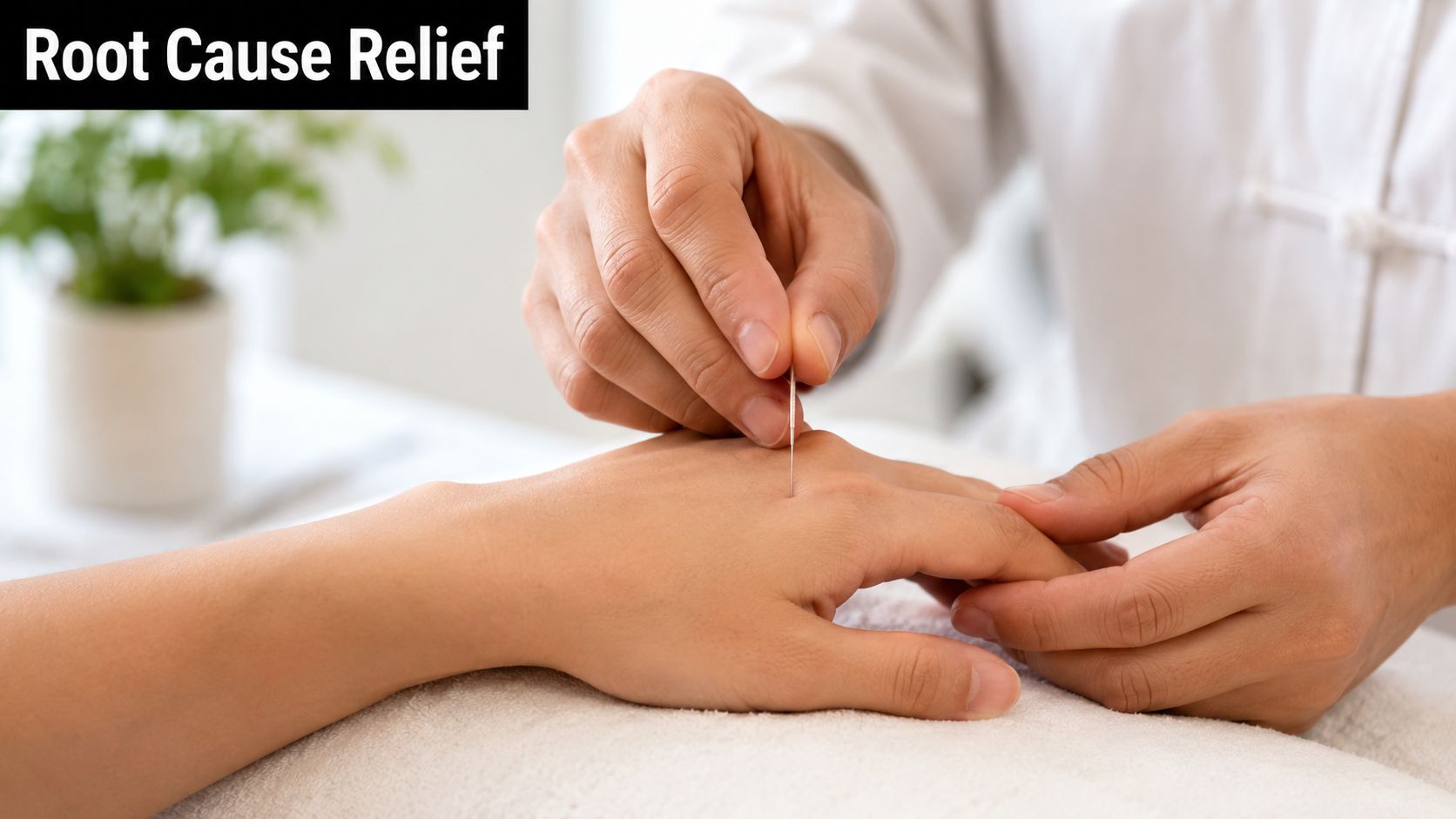
For readers comparing conservative care options, acupuncture for pain relief helps frame how needle-based treatment is used alongside other hands-on therapies.
How Acupuncture Actually Addresses Headache Pain
A patient usually comes in saying the same thing, the pain keeps coming back in the same place, and the usual quick fixes don't change the pattern. Acupuncture treats that differently from a pain reliever. Instead of only muting the sensation, it aims at the things that keep the headache cycling, especially muscle tension, nerve irritation, and the stress response that keeps the body braced.
Why point selection is never random
That's why a practitioner looks at where the headache lives, what the neck is doing, and whether the pain behaves like tension, migraine, sinus pressure, or something driven by the cervical spine. In headache care, the point prescription follows anatomy and symptom pattern, not tradition alone. The treatment room conversation often sounds less like “Where does it hurt?” and more like “Where does it start, where does it spread, and what makes it worse?”
Practical rule: if a headache keeps returning in the same pattern, the point strategy should change with the pattern, not repeat the same generic list forever.
Needle treatment also differs from simple self-care because the clinician can combine local points with distal regulatory points in a way that fits the whole case. That's one reason acupuncture is often discussed as part of a broader plan rather than a stand-alone trick. It pairs well with evaluation for posture, neck mechanics, and migraine triggers, which is the kind of thinking also reflected in multidisciplinary headache care such as physical therapy for headaches.
The clinical logic behind the approach
The logic is straightforward. A tight upper neck can refer pain into the back of the head. A strained temple pattern can behave differently from a forehead-heavy tension headache. A hand point may help regulate the pain system, while a neck point may address the structure feeding it.
That's why acupuncture for headache is best understood as pattern correction, not just symptom suppression. It doesn't promise instant shutdown of every headache, and it isn't supposed to. It's meant to interrupt the cycle that keeps the pain returning, which is a much more durable target than temporary numbing.
The Most Studied Acupuncture Points for Headache Relief
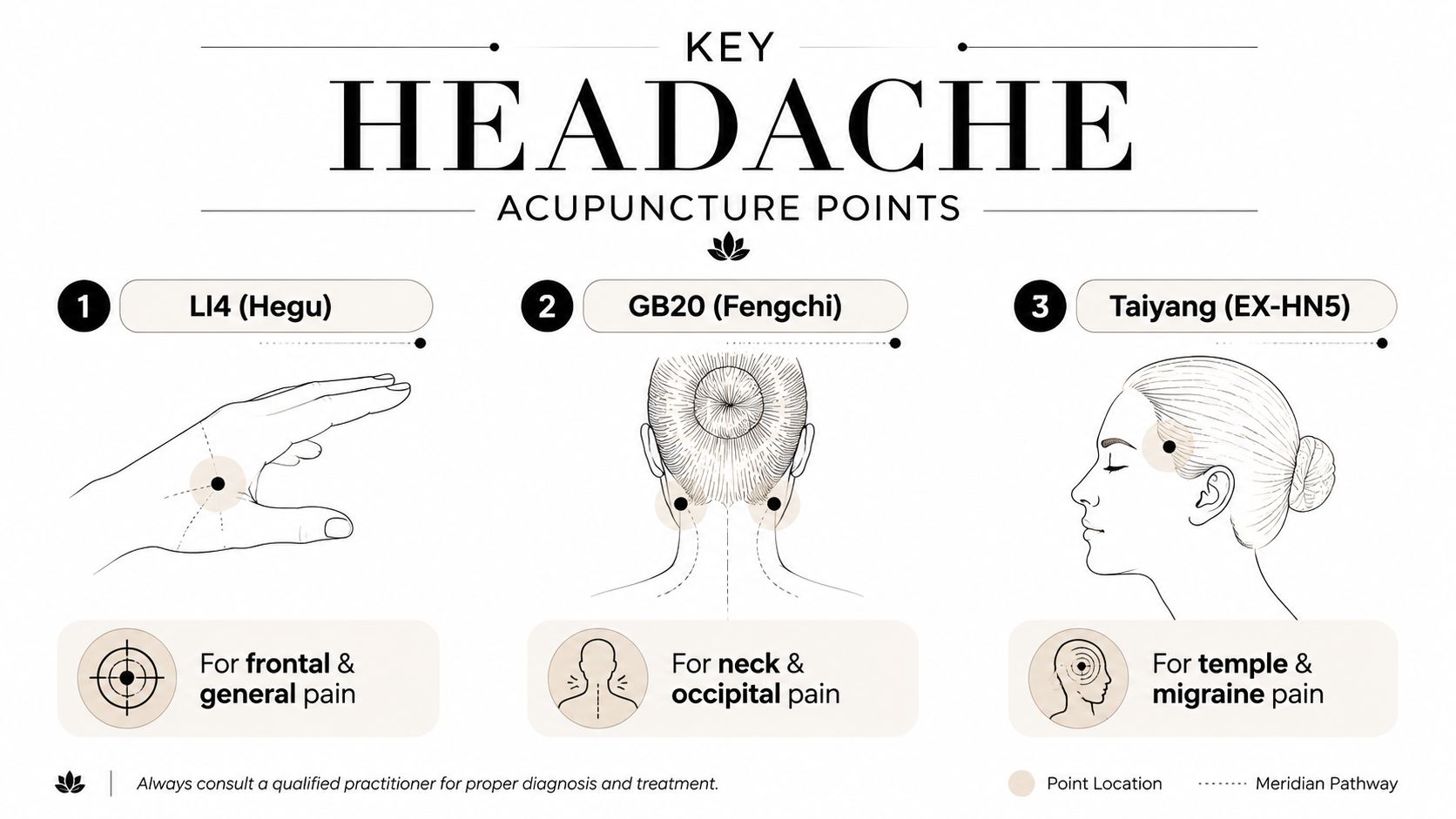
Headache treatment in clinic rarely starts with an obscure point. The research keeps coming back to a short list of points that show up again and again because they are practical, repeatable, and fit the way headache patterns are presented. In a 2021 literature review of acupuncture points used for tension-type headache, Fengchi (GB20) was the most frequently selected point, appearing in 100 of the included uses and accounting for 73.0% of point selections. Baihui (GV20) followed at 54.0%, Taiyang (EX-HN5) at 49.6%, Hegu (LI4) at 35.8%, and Taichong (LR3) at 34.3% (review of point selection in tension-type headache). That pattern matters because it shows a core strategy around the head, neck, and hand, not a random collection of points.
What each of the main points does in practice
GB20, Fengchi sits under the skull at the base of the neck. In practice, it is one of the first points I consider when a headache feels tied to tight neck muscles or rises from the occipital area.
GV20, Baihui sits on the top of the head. It often appears when the headache feels diffuse, heavy, or like pressure spread across the crown.
EX-HN5, Taiyang is located at the temple. It is commonly used when pain is temporal, one-sided, or centered around the side of the head.
LI4, Hegu is a hand point with broad regulatory use. It is often selected when the pain is more generalized or when the head and face are both involved.
LR3, Taichong is a foot point that comes up because headache treatment often needs a distal regulatory effect, not just local pressure around the skull.
The evidence base supports that kind of combination. A meta-analysis of randomized controlled trials found that people receiving acupuncture for tension-type headache averaged fewer headache days during treatment than those in the sham-acupuncture group, and the same pattern held at long-term follow-up (meta-analysis of randomized controlled trials). The same evidence base also reported a higher responder rate and a reduction in headache frequency, although the certainty for frequency was rated very low because of heterogeneity.
That is the practical takeaway. The better headache protocols do not try to do everything. They keep returning to a small cluster of points that has enough clinical and research support to justify using it first, then adjusting based on the headache pattern and what the person feels in the room. Acupuncture also fits best when it is part of a broader headache plan, including assessment of neck mechanics and posture, the same kind of thinking used in physical therapy for headaches.
Matching Acupuncture Points to Your Headache Type
The wrong approach is to treat every headache as if it comes from the same source. A headache fixed in the back of the skull usually calls for a different point strategy than pain that settles in the temples or spreads across the forehead.
Use the pain map, not the generic list
Posterior headaches often point toward the upper neck and occiput, so BL10, GB20, and GB12 are commonly used. Lateral headaches tend to call for LI18, SI16, and TE16, because the pain follows the side of the head and jaw line. Frontal headaches often bring GB14 into the picture, while temporalis pain may involve GB3 through GB7. Cervicogenic or occipital neuralgia patterns may need cervical Jiaji points and Governor Vessel points rather than the hand points people see in consumer lists (clinical review on headache-type point selection).
A practical rule helps here. If the headache starts in the neck and then climbs into the head, the point set should usually respect the neck first.
That is why one-size-fits-all advice falls short. A person with temple pain and a person with a stiff neck and occipital ache do not need the same point strategy, even if both call it a headache. In clinic, the first questions are about location, direction of spread, and the tissues that seem involved, because those answers narrow the point prescription quickly.
| Headache Type | Common Points | Location Focus |
|---|---|---|
| Posterior headache | BL10, GB20, GB12 | Back of head, upper neck, occiput |
| Lateral headache | LI18, SI16, TE16 | Side of head, jaw line, temporal margin |
| Frontal headache | GB14 | Forehead, brow, frontal pressure |
| Temporalis pain | GB3 through GB7 | Temple and side-head pain |
| Cervicogenic or occipital neuralgia pattern | Cervical Jiaji points, Governor Vessel points | Neck-driven pain, posterior axial headache |
A detailed assessment matters even more when headaches overlap with neck dysfunction. That is where treatment planning shifts from list-based care to diagnosis-based care. In many cases, a cervical workup and shared management approach, such as physical therapy for headaches, belongs in the conversation when the neck is part of the pattern. If self-care is part of the plan, keep it to the safer, simpler methods described in our peppermint oil wellness guide, since point selection and needling are not the same as home remedies.
Safe Self-Acupressure Techniques You Can Do at Home
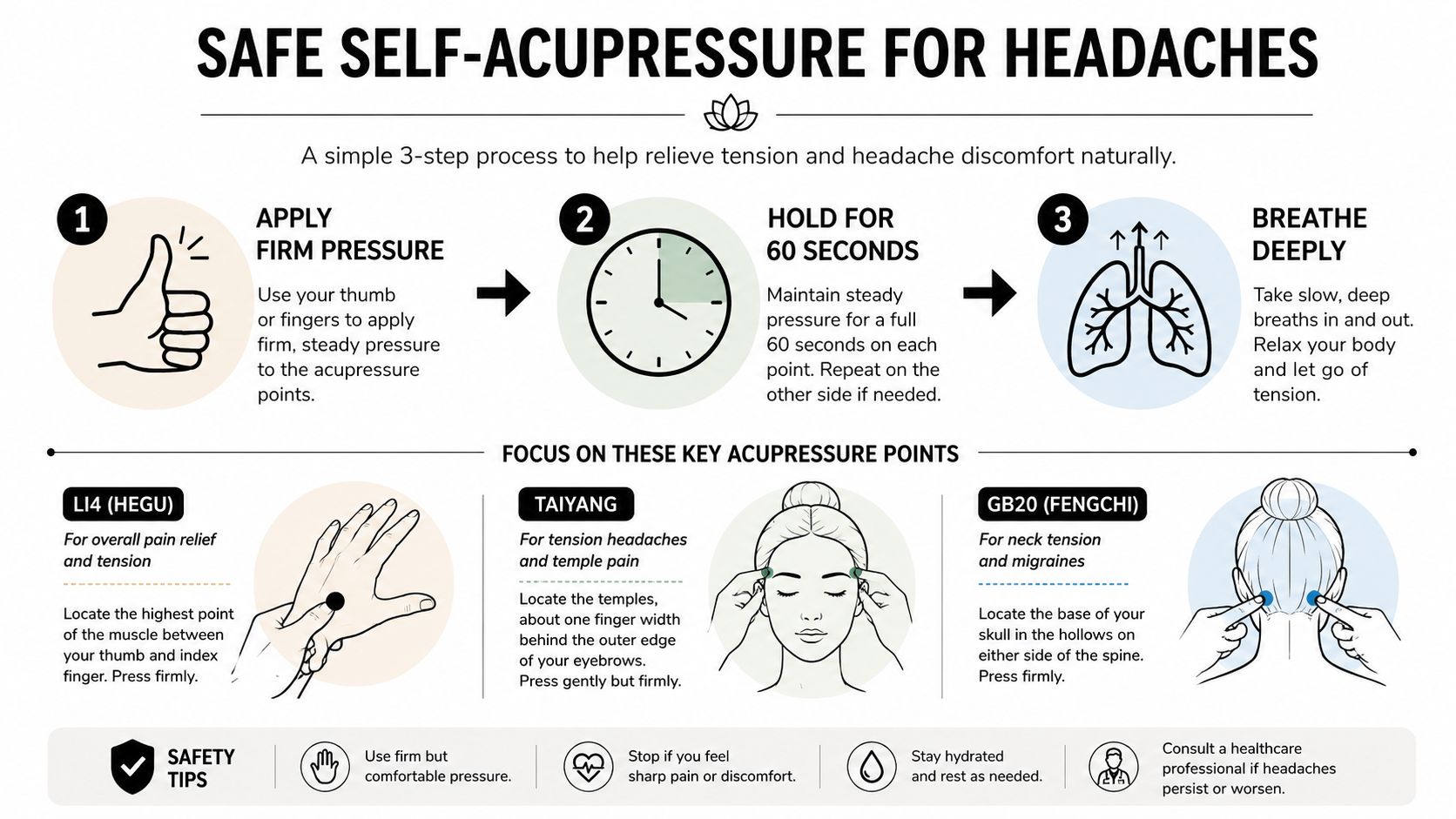
Self-care should stay simple, safe, and honest about its limits. Acupressure uses finger pressure, not needles, so it's the version people can try at home when the headache is mild, the pattern is familiar, and they're not dealing with warning signs that need medical evaluation. It can be a useful bridge for tension headaches or the early stage of a migraine pattern, but it won't replace a full treatment plan when the pain is chronic or complex.
Three points that are realistic to reach
LI4, Hegu. Find the fleshy web between the thumb and index finger. Press into the most tender spot with the thumb of the opposite hand, then hold firm, steady pressure for about a minute while breathing slowly. This is a strong point, so it should feel like pressure, not pain.
Taiyang. This sits in the soft depression at the temple, just behind the outer edge of the eyebrow line. Use two fingertips and make small circular pressure there for about a minute, then switch sides. Keep the touch gentle, especially if the area feels pulsing or irritated.
GB20, Fengchi. Place your fingers at the base of the skull, just outside the thick neck muscles. Press inward and slightly upward toward the skull for a slow hold, then release and repeat. This point is often useful when the head pain seems linked to neck tightness.
A simple at-home routine
- Apply firm pressure. Don't jab at the point. Sink in gradually.
- Hold for about a minute. If the area feels too tender, shorten the hold.
- Breathe slowly. Slow breathing keeps the body from bracing harder against the headache.
The goal isn't to “push through” pain. It's to soften the system enough that the headache doesn't keep escalating. If the headache worsens, moves in an unusual way, or comes with neurological symptoms, self-acupressure stops being the right tool.
For people who like pairing pressure-point care with other home strategies, our peppermint oil wellness guide can be a helpful companion resource, especially for understanding how topical comfort measures fit into a broader routine.
What the Evidence Shows About Acupuncture for Headaches
A common assumption is that acupuncture for headache is either purely traditional or purely placebo. The research doesn't support that oversimplification. In controlled trials for tension-type headache, acupuncture has been compared directly with sham acupuncture, and the outcomes are measured in headache days per month, responder rates, and standardized effect sizes, not just patient impressions (meta-analysis and systematic review).
What the numbers actually show
During treatment, the acupuncture group averaged 8.95 headache days per month versus 10.5 in the sham group, and at long-term follow-up the averages were 8.21 versus 9.54 (same trial synthesis). Another systematic review found a responder rate RR of 1.30 and SMD = -0.85 for headache frequency, while also noting that the certainty for frequency was very low because the studies were heterogeneous (same evidence base).
That's the honest middle ground. There's measurable clinical signal, but the evidence isn't perfectly uniform, and not every protocol works the same way for every person. A good clinician should talk plainly about that instead of promising a cure.
Acupuncture and acupressure are not the same treatment
Consumer content often blends them together. Acupressure is finger pressure, which can be reasonable for home use. Acupuncture uses needles, usually in a multi-point protocol selected for the patient's headache type and neck or facial pattern.
The distinction is also important for safety and contraindications. Headaches tied to neck dysfunction, aura, neuralgia, or other complex patterns may need clinician-delivered evaluation, not a self-treatment habit. For readers who want a clinical overview of how acupuncture fits into more specific headache patterns, The Axelrad Clinic's headache acupuncture guide is a useful reference point.
When to Seek Professional Acupuncture Treatment
If a headache keeps returning in the same place, keeps waking you up, or starts behaving differently from your usual pattern, that's a sign to get evaluated instead of just self-treating. The same goes for headaches that seem to start in the neck, shoot into the back of the head, or come with symptoms that suggest migraine with aura or occipital neuralgia. Those patterns usually need clinician-delivered care, not just pressure on a few accessible points.

What a professional visit changes
A licensed clinician can distinguish whether the pain is mostly local, neck-driven, or mixed with another musculoskeletal problem. That matters because the point strategy changes with the pattern, and the treatment plan can be adjusted across visits instead of repeated blindly. If dry needling is part of the broader conversation, it's worth understanding how it differs from acupuncture, which is addressed in what is dry needling in physical therapy.
Professional treatment is also where multiple tools can work together. Acupuncture may be paired with manual therapy, posture work, or exercise-based rehab when the headache has a mechanical driver. That's often the logical next step when home acupressure helps a little but doesn't break the cycle.
If you're in Deerfield Beach or nearby and headaches keep interfering with work, driving, sleep, or exercise, MedAmerica Rehab Center can evaluate the pattern and build a plan around it. The clinic's multidisciplinary approach makes it easier to connect headache care with neck, shoulder, or postural treatment instead of chasing symptoms one at a time.
If your headaches keep coming back, don't keep guessing at the same pressure points and hoping for a different result. Visit MedAmerica Rehab Center to get a focused evaluation and a treatment plan that matches your headache pattern, not just the label on it.
MedAmerica Rehab · Deerfield Beach
Talk to a clinician about your pain
Physical therapy, chiropractic, acupuncture and shockwave therapy under one roof, since 1995. Same-day appointments are available.
Mon–Thu 8:00 AM – 6:30 PM · Fri 8:00 AM – 3:00 PM