

Bed Tray Plastic Guide: Safer Recovery at Home in 2026
A few days after surgery, a flare in your hands, or a stretch of dizziness can make an ordinary meal feel awkward. The cup slides, the plate sits too far away, and you end up twisting in bed just to reach a spoon, a pill bottle, or the TV remote. That is where a plastic bed tray becomes more than a convenience item. Used well, it can reduce reaching, limit sudden shifts in balance, and keep recovery tasks within easy reach. Used poorly, it can tip, slide, or create a small hazard right where someone is most vulnerable.
The right question is not whether the tray looks nice at breakfast. It is whether it helps a recovering person stay safer, cleaner, and more independent at the bedside. For people recovering at home, that often means choosing a tray with stability, easy cleaning, and a shape that matches the person's strength and mobility. It also means knowing when a tray is the wrong tool and a more secure over-bed setup makes more sense, especially for people with fall risk or limited upper-body control. If you're already thinking about fall prevention at home, this guide fits with the same practical mindset as preventing falls at home.
Why a Plastic Bed Tray Matters in Recovery
A recovering patient rarely needs a fancy setup. They need a safe way to eat, read, take medication, or keep essentials close without overreaching. In that moment, a plastic bed tray is useful because it creates a stable work surface without asking the patient to balance a plate on blankets, pillows, or their lap alone. The value is simple, it removes small but meaningful movements that can turn into a spill or a near-fall.
For households dealing with post-op fatigue, arthritis flares, or age-related weakness, that reduction in effort matters. Plastic bed trays are common in homes, hospitals, and assisted-living settings because the category itself is established and still growing, with the global bed tray market estimated at USD 820.50 million in 2024 and projected to reach USD 1,423.75 million by 2032 (Future Market Report). That growth doesn't prove a single product is right for everyone, but it does show the tray is a practical, mainstream recovery aid rather than a novelty.
Practical rule: if the person has to twist, lean, or steady a dish with one hand just to finish a meal, the setup is working against recovery.
Who benefits most
A plastic tray tends to make sense for someone who can sit up in bed and manage light items independently. It also helps when meals are frequent, cleaning needs are high, or the room setup is tight and a full table won't fit easily. The tray is less about luxury and more about controlling the little movements that create strain.
Families often underestimate the way bedside tasks stack up. Medication, tissues, glasses, a phone, and a water cup all compete for space, and each extra reach changes the person's posture. A well-placed tray keeps those items clustered together so the patient isn't repeatedly reaching across the body or turning toward the bed rail.
For a person with a clear fall risk, the tray also acts as a boundary. It helps define what belongs within easy reach and what should stay outside the bed zone. That kind of setup can support safer routines, especially when the person is tired, medicated, or not moving with full confidence.
What a Plastic Bed Tray Actually Is
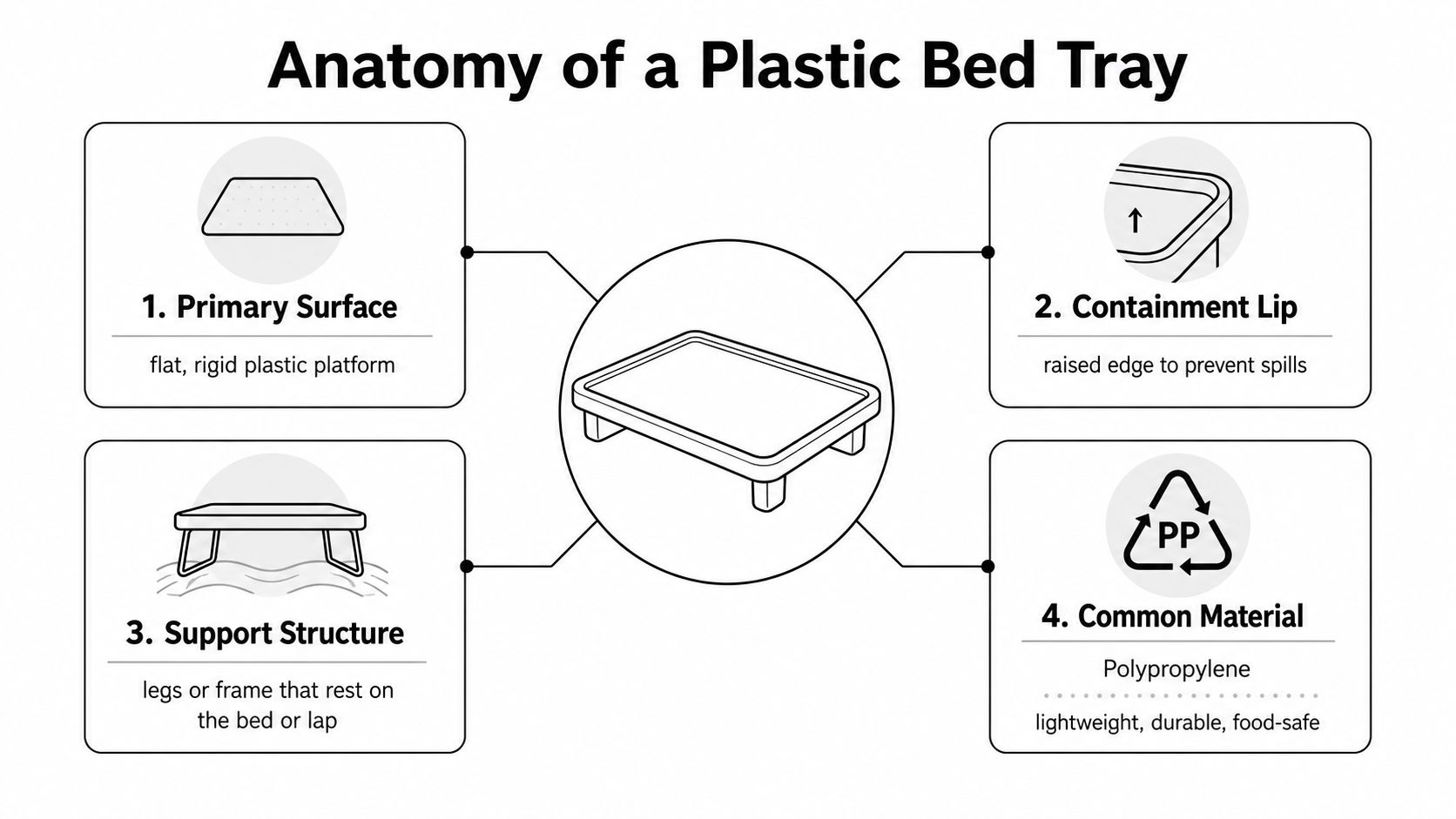
A plastic bed tray is a flat, rigid surface designed to span a lap or rest on a bed frame so someone can eat, write, or hold personal items without juggling them on soft bedding. In simple terms, it is a portable bedside work surface. In clinical use, the best versions prioritize easy sanitation, light weight, and enough structure to keep a plate or cup from shifting too easily.
The material matters. Plastic surfaces are usually nonporous, so they don't absorb spills the way unfinished wood can, and they're easier to wipe down after meals or medication use (FAB ENT). That's why plastic is often the default in patient-care and home-care settings, not just a budget pick. It's chosen because it behaves predictably when food, liquids, or cleaning solutions are part of the routine.
Common build choices
You'll see a few patterns again and again. Some trays use foldable legs that rest on the mattress or bed frame. Others use a removable base or a molded underside that hugs the lap more closely. The top may be flat, contoured, or slightly angled, and many trays include a raised edge to help keep items from sliding off.
The important point is that the tray's structure should match the patient's task. A tray meant for a light snack and a phone can be simpler than one expected to hold medication, a hardcover book, and a drink. Plastic is common because it can be molded into practical shapes without adding much weight, which helps people who need to lift, reposition, or store it often.
The tray should feel like a helper, not another object the patient has to manage.
Why plastic behaves differently
Plastic responds well to repeated cleaning and daily handling. It also tends to be lighter than wood or metal trays designed for similar bedside use. That matters in real homes, because a caregiver may need to carry it from room to room, clean it quickly after a meal, or store it beside the bed without creating clutter.
The material choice is partly about hygiene and partly about predictability. A tray that stays easy to clean and easy to lift is more likely to get used consistently, and consistency matters more than appearance in recovery spaces.
Safety Features That Matter for Patients
A tray can look sturdy and still be wrong for a patient who has tremor, weak grip, shoulder pain, or delayed reaction time. The four features that matter most are weight capacity, non-slip surface, raised lip height, and anti-tip design. Those features don't sound glamorous, but they decide whether the tray helps or becomes a nuisance.
The available guidance on bed trays recommends checking capacity, non-slip surfaces, lip height, and anti-tip design, but it doesn't give hard testing thresholds for medical recovery use (Alibaba buying guide). That means the buyer has to think clinically. Start with the patient's real movements, not just the product photo. If the person's hand shakes when lifting a spoon or their shoulder pain makes them move slowly, the tray needs to resist both sliding and tipping.
What each feature does
Weight capacity matters because even a light meal can become awkward when a heavy mug, a laptop, or a medication organizer gets added. Non-slip surfaces help when a patient's hands are wet, weak, or unsteady. Raised lips keep small items from drifting toward the edge, and anti-tip design helps the tray stay planted when weight lands off-center.
If the tray has wide-set legs or a broad base, it usually feels more secure. If it sits too high or rocks when one corner is loaded, it's not the right choice for someone with poor balance or low trunk control.
| Patient Profile | Key Feature | Why It Matters |
|---|---|---|
| Post-op patient with limited reach | Stable base | Reduces the need to brace the tray with the body |
| Person with hand tremor | Non-slip surface | Helps keep cups and utensils from sliding |
| Senior with arthritis | Raised lip | Makes dropped items less likely |
| Patient with weak core control | Anti-tip design | Lowers the chance of sudden load shifts |
A simple bedside check
Before regular use, place the tray on the intended surface and gently load it the way it will be used. If one side dips, if the tray shifts on blankets, or if a cup feels like it sits too close to the edge, the setup needs to change. For some people, that means moving from a tray to a more rigid table.
The same reasoning applies when families compare bedside accessories more broadly, including supports like a seat for a walker. The best choice is the one that reduces strain without introducing instability.
Cleaning and Hygiene Best Practices
Plastic earns its place at the bedside because it's easier to clean than porous materials. After a meal, a tray should be wiped promptly so food residue doesn't dry into seams or corners. After shared use, or after any illness, it needs a fuller disinfecting routine. The goal is not perfection, it is repeatable cleanliness that protects both patient and caregiver.
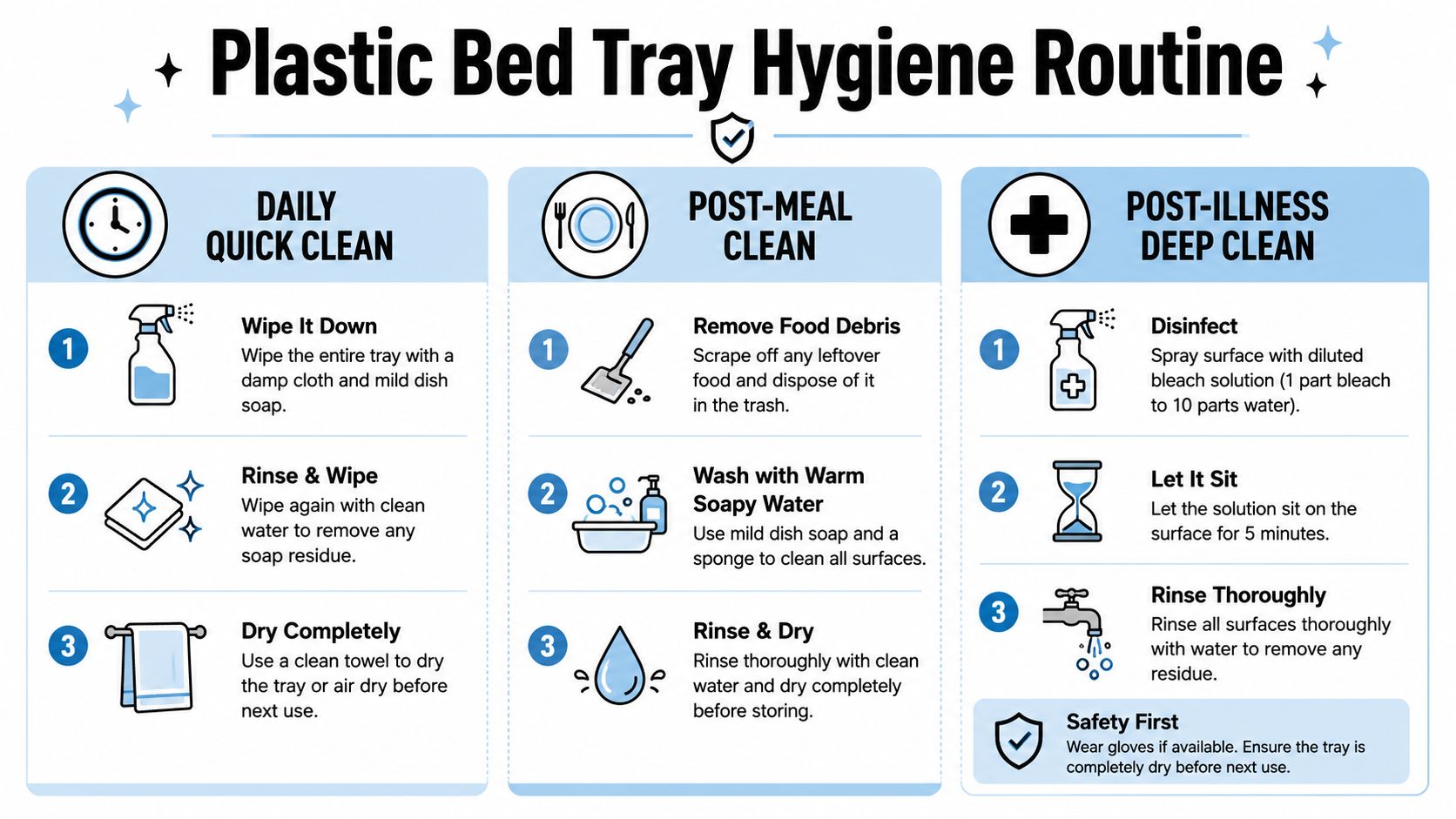
A practical routine starts with basic soap-and-water cleaning to remove visible debris. After that, use a disinfectant that's compatible with common plastics. Diluted bleach, isopropyl alcohol, and quaternary ammonium wipes are commonly used on hard, nonporous surfaces, but harsh use can cloud or damage some plastics over time. Always check the tray's finish before using stronger chemistry on it. Cracks, scratches, and warped edges should be treated as warning signs because they can trap residue and make wiping less reliable.
A practical cleaning rhythm
- Daily quick clean: Wipe the tray after the last use of the day, then let it dry fully before storing.
- Post-meal clean: Remove crumbs and liquid first, then wash the surface so residue doesn't build up around the lip.
- Post-illness deep clean: Disinfect the entire tray, including corners and underside edges, then inspect for cracks or cloudy spots.
If multiple caregivers use the same tray, consistency matters even more. One person should not assume the next person will “probably wipe it down later.” That handoff is where hygiene routines fall apart.
Good cleaning is less about the strongest product and more about doing the same sequence every time.
For trays used with dentures, medication organizers, or bedside snacks, residue often hides along the raised edge. A soft cloth or disposable wipe is usually better than scrubbing with anything that can scratch the surface. Scratches create more places for grime to sit, and once that starts, the tray gets harder to keep clean.
Comparing Plastic Trays, Wood, and Overbed Tables
A wooden tray can be fine for occasional use by a healthy adult who mainly wants a stable surface for reading or a light snack. It may look nicer in a bedroom, and some families prefer the feel of it. But wood is less forgiving when spills happen, and in a recovery setting that matters more than style.
Plastic is usually the better default for post-op care, arthritis, or anyone who expects regular cleaning. The broader plastic trays market was valued at USD 43.64 billion in 2025 and is projected to reach USD 78.53 billion by 2034, with a 6.83% CAGR, which helps explain why plastic tray designs remain widely manufactured and familiar across household and care settings (Fortune Business Insights). That scale isn't the reason to buy one, but it does help explain why replacement parts, standard shapes, and easy-to-find designs are so common.
An overbed table is the safer choice when the patient needs more support, has longer recovery demands, or can't tolerate a tray on the lap at all. It's also the better option when a hospital bed, IV setup, or frequent repositioning makes lap-based use awkward. If the person keeps sliding the tray, struggling to reach it, or bracing against it to stay balanced, the tray has already stopped being the right tool.
For households thinking through adjacent safety purchases, a resource like shop air sanitation products from EcoQuest Purifiers can be helpful if you're also trying to keep a recovery space cleaner and easier to manage.
| Option | Hygiene | Stability | Portability | Storage | Cost |
|---|---|---|---|---|---|
| Plastic tray | Non-porous, easy to disinfect | Good when the base is wide and flat | Easy to carry | Usually stores easily | Often practical |
| Wood tray | Can be attractive, but porous finishes need more care | Varies by build | Usually manageable | Needs some space | Often moderate |
| Overbed table | Typically easy to wipe down | Strongest choice for many patients | Less portable | Takes more room | Usually the most involved setup |
A short video can also help families see how bedside surfaces differ in real use.
Rehab-Specific Recommendations for Real Patients
For post-surgical recovery, the tray should sit close enough that the patient doesn't have to lean forward from the ribs. Keep the main items, plate, utensils, phone, water, and medication, in the center third of the surface, not at the far edge. That reduces the chance of a sudden reach, which is especially important if pain medicine makes the person drowsy or slower to react. If the patient can't sit upright without effort, the tray shouldn't be the main setup.
For arthritis in the hands or shoulders, tray height and loading matter as much as the tray itself. Heavy items should be placed nearest the body, lighter items farther away. The patient shouldn't have to pinch a thin edge, twist the wrist, or lift the shoulder repeatedly just to access a napkin or pill box. The tray should support easier motions, not repeat the motions that already hurt.
For chronic back or neck pain, the best tray is the one that limits forward flexion and side bending. Keep reading material, remote controls, and medication within one arm's length so the patient doesn't crane the neck to hunt for them. If the tray encourages slouching or causes the patient to hunch to reach the center, it's too low, too deep, or too unstable.
The same logic applies to fall-risk older adults. A tray should not become a surface to lean on while shifting in bed. It should stay as a passive support, not a brace. That distinction matters more than people think. A tray that moves when weight is applied can invite a small loss of balance, and that's exactly what many families are trying to avoid.
A useful parallel comes up in SouthRay's expert tub selection, where the right equipment depends on mobility, stability, and how much support the user needs. Bedside gear should be chosen the same way, by function first, not by appearance.
If the person develops dizziness, shortness of breath, worsening pain, or repeated near-falls while using the tray, the setup should stop and be reassessed. That's especially important after surgery or after a balance setback. If needed, families can compare the bedside plan with private in-home physical therapy to get a safer, more personalized setup.
If the tray makes the person reach farther than they would without it, the tray is working against recovery.
A Practical Decision Framework and Safety Checklist
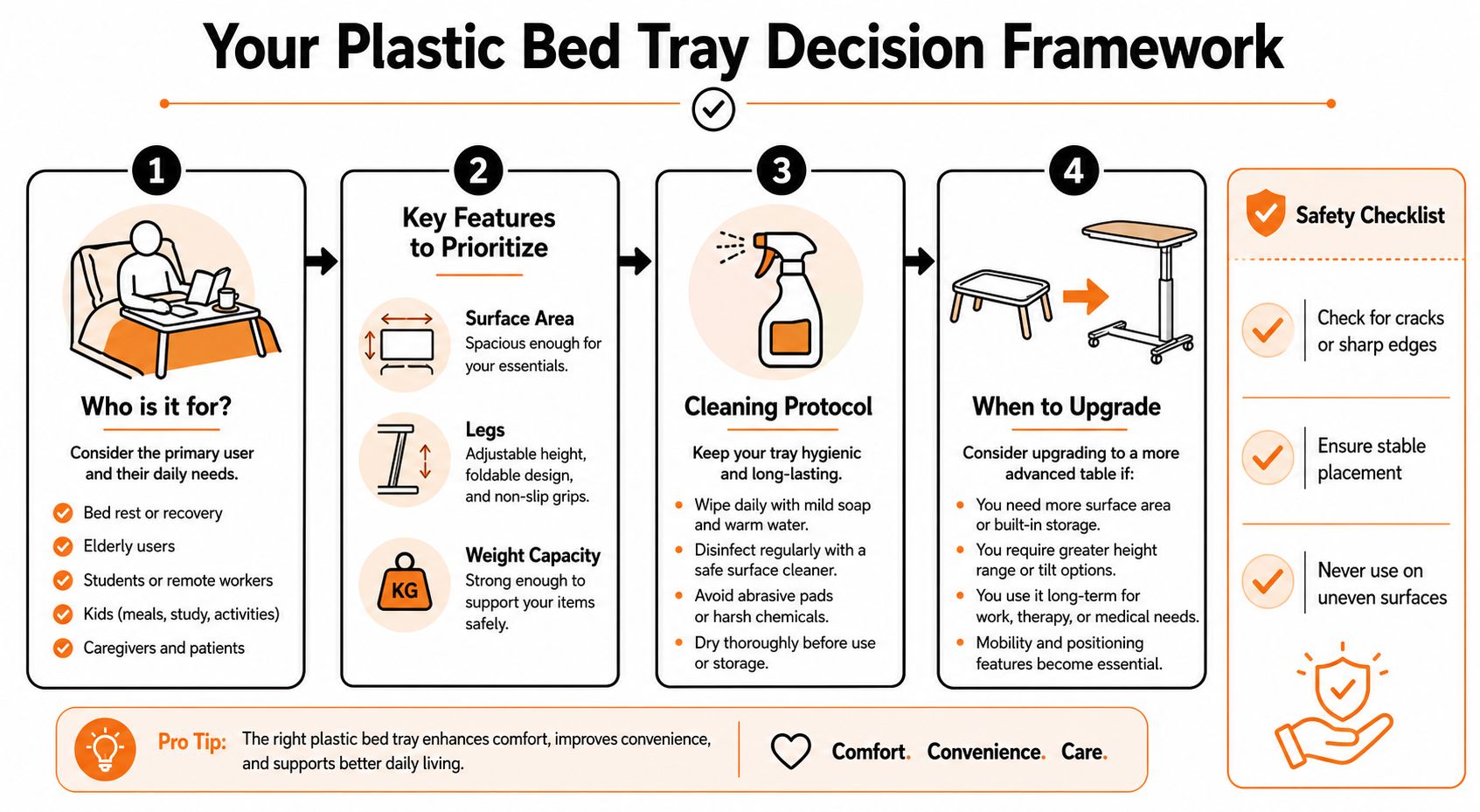
Choose a plastic bed tray when the person needs a light, easy-to-clean surface for meals or essentials, and when they can sit up without leaning on the tray for support. Upgrade to an overbed table when the person needs more stability, more clearance, or less dependence on lap placement. In every case, match the tray to the person's movement pattern, not just the room's available space.
Quick bedside checklist
- Check for cracks or sharp edges.
- Ensure stable placement.
- Never use on uneven surfaces.
If the tray passes those basics, use it with the same routine every time. If it fails any one of them, replace it or switch to a safer setup. For many families, the best next step is a rehab conversation, because a therapist can look at the person's posture, reach, and transfer habits together instead of guessing from the product label.
If you're deciding between a tray, an overbed table, or a more complete home recovery setup, MedAmerica Rehab Center can help you think through what fits your body and your space. Visit MedAmerica Rehab Center to learn more about practical therapy support for recovery, pain relief, and safer daily movement at home.
MedAmerica Rehab · Deerfield Beach
Talk to a clinician about your pain
Physical therapy, chiropractic, acupuncture and shockwave therapy under one roof, since 1995. Same-day appointments are available.
Mon–Thu 8:00 AM – 6:30 PM · Fri 8:00 AM – 3:00 PM