
Pillow Roll for Bed: A Therapist’s Guide to Pain Relief
You're exhausted, your neck or low back still won't settle down, and bedtime has turned into a guessing game. One pillow feels too flat, another pushes your head forward, and the position that looked comfortable at 10 p.m. feels wrong by midnight. A pillow roll for bed can solve that specific problem because it fills the gap regular pillows miss, then helps your body stay in a position that doesn't fight gravity all night.
This idea isn't new, either. The earliest known pillows date to about 7,000 BCE in Mesopotamia, where they were made of stone to support the head, and the soft modern pillow only became common during the Industrial Revolution as mass production made support more accessible as described in this historical overview. If you already compare sleep setup tips, the guide on sleeping positions for neck and back relief pairs well with this approach, and this neck pain sleep guide offers a useful companion perspective too.
The Simple Key to a More Restful Night
A lot of people don't need a fancier mattress first. They need one small support in the right place. A pillow roll for bed works because it changes pressure, spacing, and alignment without forcing your body into a dramatic position.
Why this simple shape matters
A regular pillow spreads support over a broad surface. A roll is more targeted, so it can sit under a neck curve, behind a lower back arch, or between the knees without bunching up. That's the practical difference between “I tried a pillow” and “I finally stopped twisting all night.”
A standard pillow should provide about 4 to 6 inches of cushion to support the head and neck, and the same basic idea is used in a more focused way with a roll as noted in this overview of bed pillow function. In clinic terms, the goal is simple, reduce strain by supporting the body where there's empty space instead of letting that space collapse.
Practical rule: if a position feels good for 30 seconds but causes you to tense up, it usually isn't truly supportive.
People often tell themselves they “just need to get used to it.” That's not always true. If a setup keeps your neck tipped up, your lower back arched, or your knees twisted, your body will keep reminding you it's unhappy. A better support can feel almost boring, and that's usually the point.
Finding Your Ideal Pillow Roll
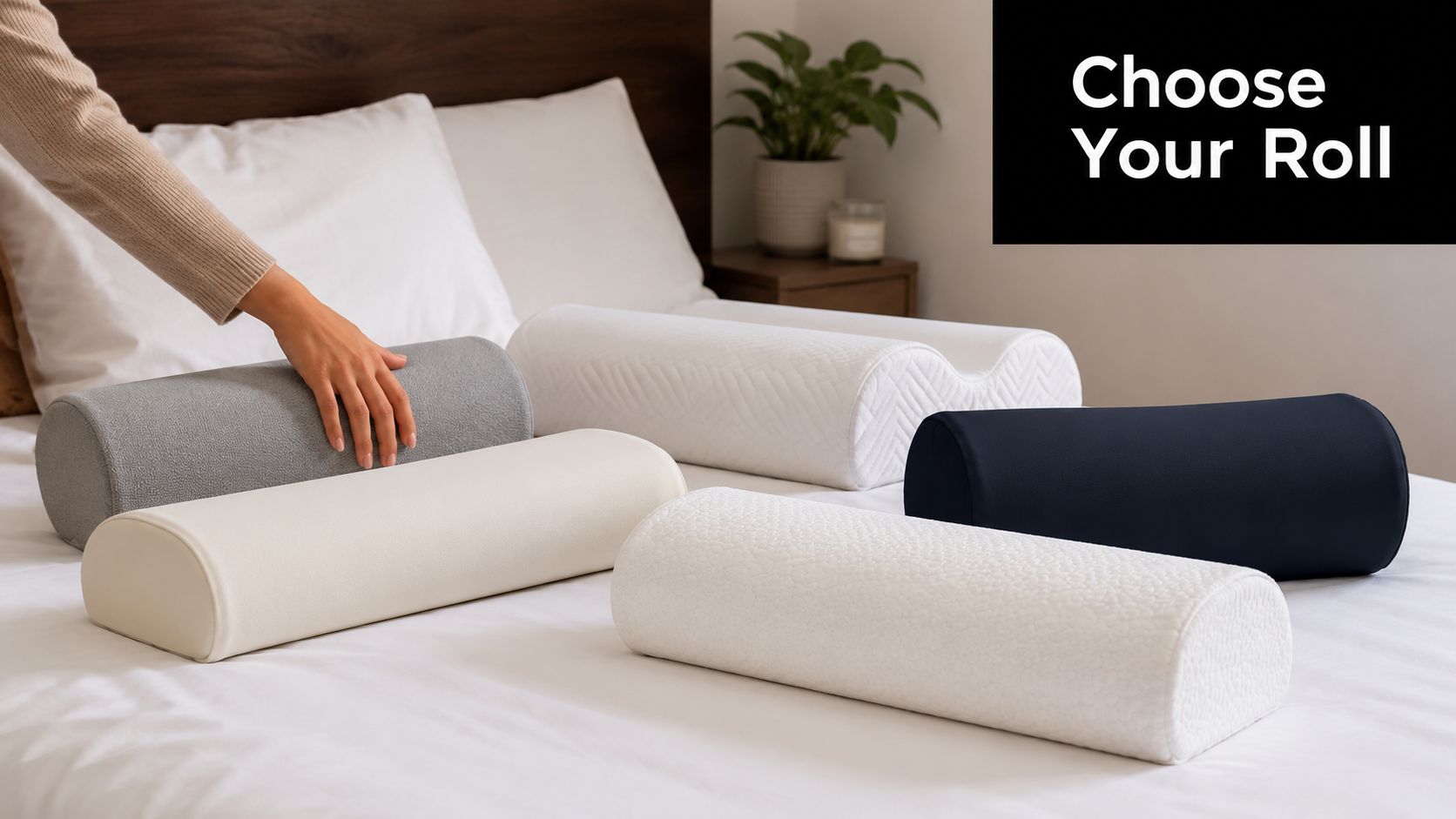
Choosing the right pillow roll for bed starts with shape, not marketing. Some rolls are full-round bolsters, which give a more pronounced lift. Others are half-moon or flattened on one side, which can feel steadier and less intrusive if you don't want a large bump under your body.
Match the shape to the problem
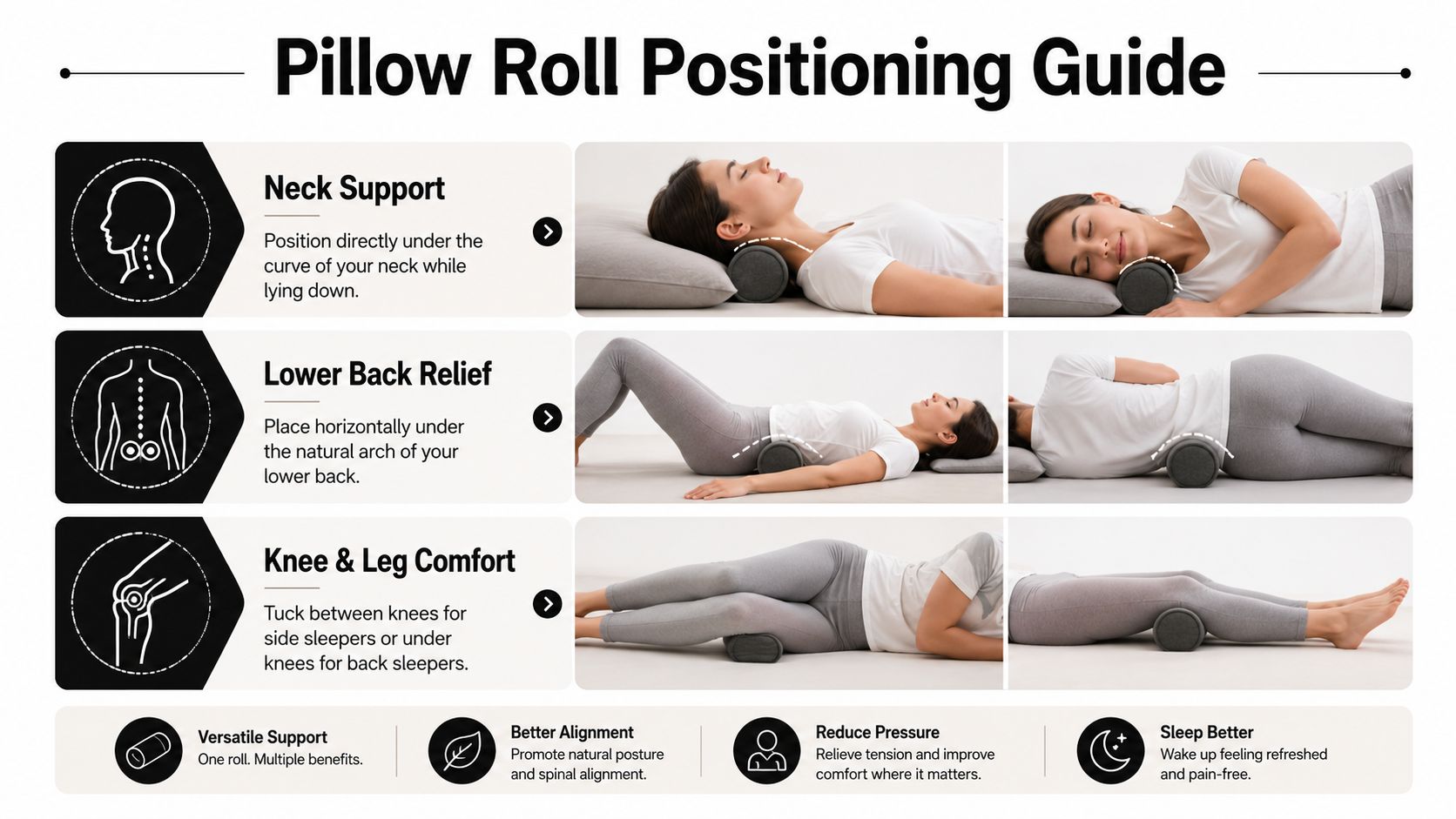
A side sleeper with a stiff lower back usually needs a different setup than someone with cervical neck strain. For side sleeping, the roll often works best between the knees because it stops the top leg from dropping forward and twisting the pelvis. For back sleeping, it often fits under the knees so the hips and low back can relax.
Material changes the experience a lot. Memory foam tends to contour more closely, which many people like for neck support. High-density foam usually feels firmer and more stable, while fiberfill can feel softer but may compress more quickly. If you want a position that stays consistent through the night, firmness matters as much as softness.
Think in terms of your sleep pattern
A cervical roll is commonly around 10 to 12 cm in diameter, while a knee bolster is often 15 to 18 cm according to neutral-source guidance on roll pillows. That size difference matters because your neck and knees need different kinds of space-filling support. Too small, and the roll does nothing. Too large, and it can shove you out of alignment.
If you're using it for neck tension, choose a shape that fits the natural curve without pushing the chin up. If you're using it for sciatica or low-back irritation, focus on keeping the pelvis level rather than chasing a big stretch. A good roll should make you feel more settled, not more “corrected.”
Make the choice based on comfort tests
Try these quick checks before buying:
- For side sleepers: place the roll between the knees and see whether your top hip feels less heavy.
- For back sleepers: put it under the knees and notice whether the low back softens into the bed.
- For neck support: lie down and check whether your jaw stays relaxed instead of drifting upward.
If the answer is no to all three, the size or firmness is off. That's a product mismatch, not a personal failure.
Mastering Pillow Roll Positioning for Targeted Relief
The useful part of a pillow roll for bed is not just owning it, it's placing it where your body needs help. The right position should create a sense of ease within a few breaths. If you have to keep adjusting, the roll is probably too thick, too thin, or in the wrong spot.
Lumbar support for lower back relief
For low back comfort, place the roll so it supports the natural arch rather than flattening it. Some people do well with a small roll just above the beltline, especially when lying on the back for a short rest. The goal is to keep the lumbar area from feeling suspended in midair.
If you're using it under the knees, slide it until the knees are slightly bent and the thighs can relax. That small bend reduces the pull on the low back and can make the pelvis feel less strained. The support should feel like a release, not a stretch.
Between the knees for side sleepers
When you sleep on your side, the top leg often drops forward. That twist pulls the pelvis and can wake up the low back or outer hip. Place the roll between the knees, and keep it high enough that the knees, thighs, and ankles stay lined up comfortably.
The right placement usually feels like the top leg no longer has to hover or search for balance. If you feel pressure at the knees themselves, the roll may be too firm or too narrow. If you feel a twist in the hips, move it slightly higher.
A useful check: your pelvis should feel quieter, not forced.
Cervical support for neck strain
For the neck, the roll should sit directly under the curve that needs filling, not under the skull and not shoved too far into the shoulders. The neck should feel supported, but the chin shouldn't tip up. A neutral neck is the target, not a stretched one.
That distinction matters because a roll can help one person and irritate another. If you wake with less stiffness and no pinching at the base of the skull, the placement is probably close. If your neck feels compressed, the roll is too high or too aggressive.
For people dealing with recurring low-back discomfort, this lower back pain resource can help you compare positions and figure out whether your symptoms are more about alignment or something deeper.
The three best signs you've got it right are simple:
- Breathing feels easier because you're not bracing.
- Pressure feels even instead of concentrated in one spot.
- You stop fidgeting after a few minutes.
How to Create a No-Cost DIY Pillow Roll
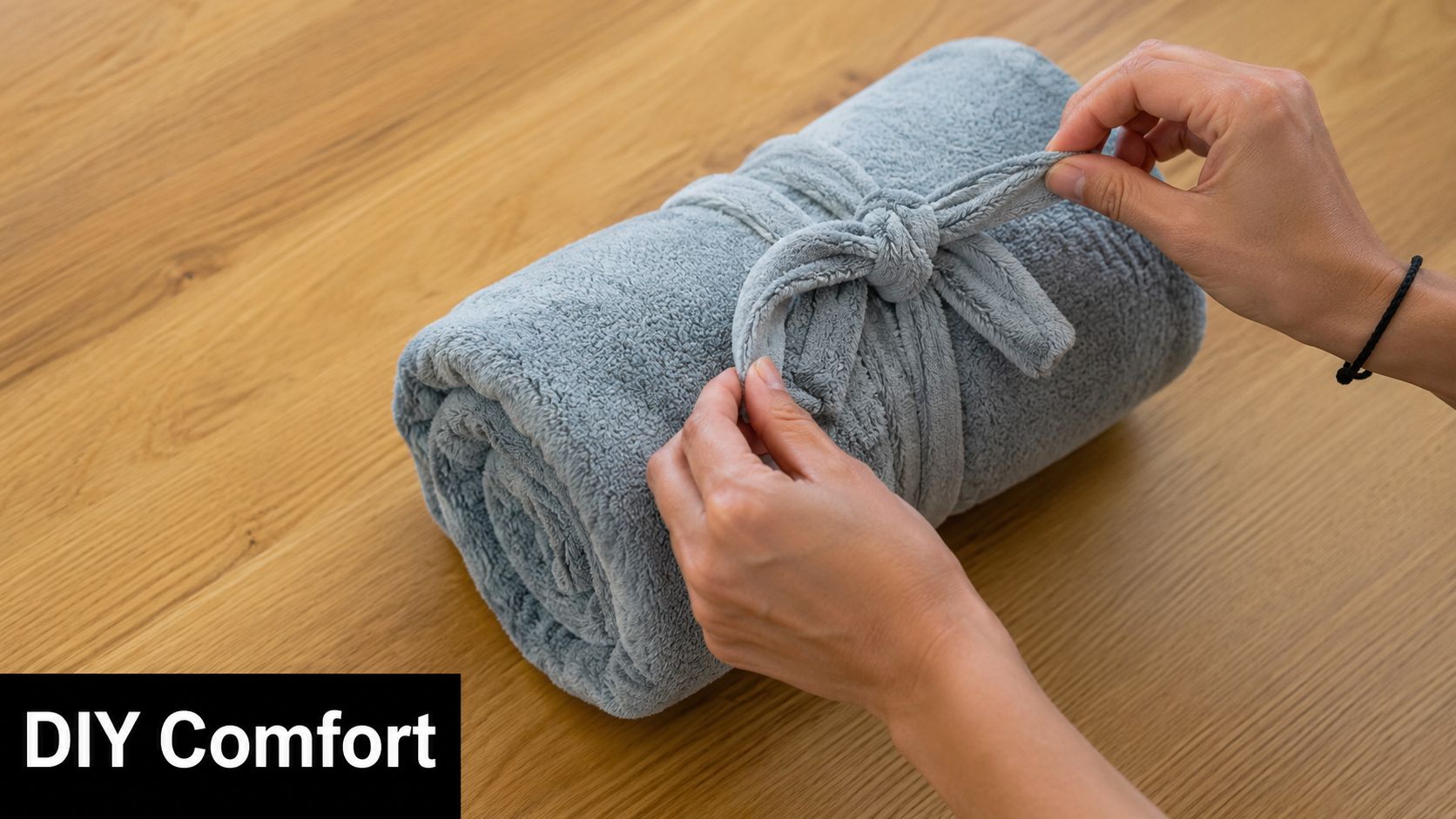
You don't need to buy a specialty product tonight to test the idea. A bath towel or small blanket can mimic the shape of a roll well enough to tell you whether your body likes the support. That makes this a low-risk way to experiment before you spend money.
Make it firm enough to stay put
Start by folding the towel lengthwise so the roll isn't flimsy. Then roll it tightly from one end to the other until it feels dense in your hands. If you want a thicker roll, use a blanket folded into a long strip before rolling.
The main job is stability. A loose roll collapses, slides, and disappears once your weight settles on it. A firmer one keeps its shape longer and gives you a more honest test of whether the position is helping.
Keep it from unraveling overnight
Use a simple tie, elastic band, or even the tucked edge of the blanket to hold the roll together. If it keeps opening up, it's too loose for sleep testing. A roll that stays compact also makes it easier to place the same way on both sides of the bed.
Try it in one position first, not all of them at once. Test under the knees if your low back feels tight on your back, or between the knees if you sleep on your side. If the DIY version helps, you'll know the concept is useful before you decide on a commercial roll.
Use the DIY version as a diagnostic tool
The point isn't perfection. It's information. A towel roll can tell you whether your discomfort comes from a lack of support, a bad angle, or a need for a different size.
If the DIY version feels helpful, you've learned something valuable about your body and your sleep setup. If it feels awkward, that also matters, because it tells you not to force the strategy.
Proper Care for Your Support Pillow
A good pillow roll for bed should stay supportive, not flatten into a limp tube. If it comes with a removable cover, wash that cover regularly so sweat and skin oils don't build up. If the core is foam, follow the manufacturer's care instructions and avoid soaking it unless the material is designed for that.
Protect the shape that does the work
Store the roll flat or in the position it was designed to hold. Don't compress it under heavy items in a closet. Foam and fiberfill both lose usefulness when they're squashed repeatedly outside of sleep use.
If the roll has started to feel uneven, lumpy, or permanently collapsed, it's no longer doing the job you bought it for. Support is only useful when it's predictable.
Simple replacement cue: when you have to keep “fixing” the roll every night, the roll is probably past its best shape.
A clean, intact roll isn't about luxury. It's about keeping the support consistent so your body can relax into it.
When a Pillow Roll Is Not Enough
A roll can help with positioning, but it can't solve every pain pattern. If you use one and your neck feels more extended, your back pain gets sharper, or you wake up more uncomfortable than before, that's a sign to stop and reassess. The wrong support can create more strain than relief.

Red flags that matter
Watch for any of these:
- Numbness or tingling in the arms, hands, legs, or feet.
- Skin pressure that leaves persistent marks or soreness.
- Neck hyperextension, meaning your head feels tipped too far back.
- Pain that worsens even when the roll seems placed correctly.
Clinical positioning guidance emphasizes avoiding neck hyperextension and using supports to protect sensitive areas. If a roll causes increased extension, numbness, or skin pressure, it may be the wrong tool, and professional evaluation is important, especially for older adults or post-surgical patients as shown in clinical positioning guidance.
Know when self-adjustment stops being enough
A pillow roll is best viewed as a comfort and alignment tool, not a cure. If mobility is limited, if you're recovering from surgery, or if pain keeps interrupting sleep despite careful positioning, the issue may need a more detailed plan. That's where individualized assessment matters.
If you need extra support for your home exercises and positioning work, the foam roller resource can be a helpful complement, but it still shouldn't replace medical guidance when symptoms are persistent or worsening.
The right response to a bad night isn't always “try harder tomorrow.” Sometimes it's “this needs a closer look.” A skilled clinician can check whether the problem is alignment, muscle guarding, nerve irritation, or something else entirely, and that distinction changes the plan.
If you're waking up stiff, twisting for comfort, or wondering whether a pillow roll for bed would help, start with a simple trial tonight, then pay attention to what your body tells you in the morning. If the discomfort keeps coming back, reach out to MedAmerica Rehab Center for a practical evaluation and a positioning plan that fits your pain pattern, your sleep habits, and your recovery goals.
MedAmerica Rehab · Deerfield Beach
Talk to a clinician about your pain
Physical therapy, chiropractic, acupuncture and shockwave therapy under one roof, since 1995. Same-day appointments are available.
Mon–Thu 8:00 AM – 6:30 PM · Fri 8:00 AM – 3:00 PM