

How to Recover from Surgery Faster: Expert Guide 2026
Surgery puts people in a strange position. You're told to prepare, show up, and then recover, but the part in the middle often feels unclear. Most patients know the date of the procedure, the time to arrive, and the basics of fasting. Far fewer know what to do in the days before surgery, the first night after it, or the point when normal soreness starts turning into a warning sign.
That uncertainty matters. If you want to know how to recover from surgery faster, the answer isn't one trick or one supplement. It's a timeline. What you do before surgery affects what happens right after surgery. What happens right after surgery shapes your strength, pain, mobility, and confidence over the next several weeks.
From a physical therapist's perspective, the patients who do best usually aren't the ones who “rest harder.” They're the ones who prepare, follow a plan, move at the right time, eat to heal, and ask for help early when something feels off. Recovery works better when it's active, not passive.
Your Proactive Path to a Smoother Surgical Recovery
If your surgery is coming up, you may already be thinking ahead to questions like: How much pain will I have? How long will I need help at home? When will I walk normally again? When can I drive, sleep comfortably, or get back to work?
Those are the right questions. But I'd add one more. What can you start doing now so recovery goes more smoothly later?
A lot of people treat recovery like it starts in the recovery room. In practice, it starts earlier. Your stress level, sleep habits, movement tolerance, home setup, and nutrition all influence how your body handles the procedure and how quickly you regain function afterward. Patients who understand that usually feel less helpless because they have something concrete to work on.
Practical rule: Don't wait to “see how you feel after surgery” before making a plan. The best recovery plans start before the incision.
Stress deserves special attention here. Surgery is a physical event, but it's also a nervous system event. If you're tense, sleeping poorly, and running on worry, it's harder to follow instructions, regulate pain, and stay consistent with movement. If stress has been building, this overview of mastering stress management gives helpful context on how the body responds under prolonged strain.
What recovery ownership looks like
Recovery ownership doesn't mean doing everything yourself. It means knowing your role.
- Before surgery: Build your physical reserve, organize your environment, and understand your restrictions.
- Right after surgery: Protect the surgical area, control pain thoughtfully, and start safe movement as directed.
- During rehab: Progress steadily, not aggressively. Healing tissues need challenge, but they also need timing.
That's where a structured plan helps. Clinics that use individualized treatment plans can match exercise, pacing, and hands-on care to the actual procedure you had, your age, your starting fitness, and your home demands.
The three phases that matter most
Think of your recovery in three connected phases:
| Phase | Focus | Common mistake |
|---|---|---|
| Prehab | Prepare your body before surgery | Doing nothing until the procedure date |
| Post-op protection | Manage pain, breathing, swelling, and early movement | Either staying too still or doing too much |
| Rehab progression | Rebuild mobility, strength, and confidence | Advancing activity faster than tissue healing allows |
This timeline makes the process easier to understand and easier to follow.
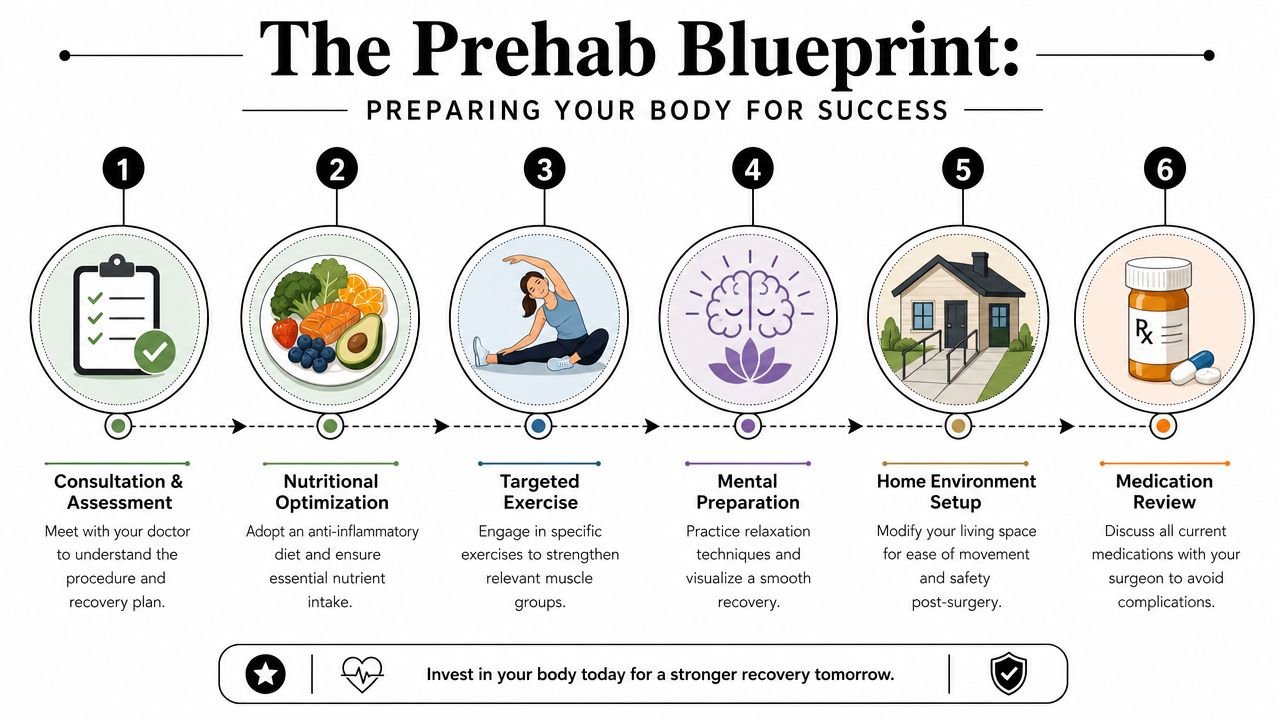
The Prehab Blueprint Preparing Your Body for Success
Two patients can have the same procedure on the same day and heal at very different speeds. One reason is what happened in the month before surgery. Strength, sleep, blood sugar control, smoking status, bowel regularity, protein intake, and confidence with basic movement all shape what your body has available once healing begins.
That is the core value of prehab. It links the pre-op period, the first days after surgery, and formal rehab into one timeline. What you do now changes how well you tolerate pain, how soon you can move safely, and how steadily you rebuild function later.
Build reserve before surgery
Regular physical activity before surgery is linked with fewer postoperative complications, and one review found lower risk among patients reporting very high preoperative activity levels of more than 1,000 minutes per week, as summarized by BMC Anesthesiology's review on preoperative physical activity and postoperative outcomes.
The goal is not to cram in hard workouts. The goal is to improve capacity without flaring pain or fatigue. In clinic, that usually means three lanes of preparation:
- Aerobic work: walking, cycling, or another low-impact option to improve endurance
- Strength work: targeted exercises for the muscles that will support the surgical area
- Movement practice: bed mobility, sit-to-stand transfers, stairs, and any daily task likely to feel awkward after surgery
Patients who start here often feel less rattled afterward because the movements are already familiar.
Nutrition shapes tissue healing and energy
Healing tissue needs protein, fluids, calories, vitamins, and minerals. It also needs a digestive system that can tolerate the stress of surgery, pain medicine, and reduced activity. This is one of the most missed links in recovery.
As noted in Dr. M. Macdonald's overview of lifestyle factors that affect surgical results, improving nutrition in the two to four weeks before surgery can support muscle mass and physiologic reserve, and carbohydrate drinks may be allowed close to anesthesia in some surgical pathways. That part must always follow your surgeon's instructions.
Gut health matters here too. Constipation, poor appetite, reflux, bloating, and low fiber intake can all become bigger problems after surgery, especially if opioids are prescribed. Patients do better when they go in with a plan. That usually means enough protein, steady hydration, regular meals, fiber from foods they already tolerate well, and a bowel routine discussed ahead of time if constipation is common.
A practical prehab plate often includes:
- Protein at each meal: eggs, Greek yogurt, fish, chicken, tofu, beans, cottage cheese, or lentils
- Fiber from familiar foods: fruit, vegetables, oats, beans, or whole grains if they sit well
- Fluids through the day: not just coffee, and not all at once late at night
- Simple consistency: eating regularly beats overcorrecting with supplements a few days before surgery
Train for the first week, not just the operation
The smartest prehab plans prepare you for life right after surgery.
Practice getting in and out of bed. Rehearse standing from the chair you use at home. Clear walking paths. Check whether your bathroom setup will be safe when you are sore, groggy, or using an assistive device. If stairs are part of your day, practice them before surgery while you are stronger and thinking clearly.
I also want patients to know what “enough” looks like. Mild muscle soreness from exercise is fine. Joint swelling, sharp pain, or next-day exhaustion means the dose was too high.
What to focus on in the final weeks
- Strengthen the support system around the surgical area. Hip strength helps after knee surgery. Upper back control matters before many shoulder procedures.
- Practice the movements recovery will ask from you. Transfers, short walks, and stair technique reduce uncertainty after surgery.
- Address smoking and blood sugar early. Tissue healing and infection risk are affected long before the day of surgery.
- Protect sleep. Poor sleep raises pain sensitivity and drains energy. This article on the importance of sleep is a useful reminder that restoration is part of preparation.
- Use a short, safe mobility routine. A focused plan works better than random internet exercises. These stretches you can add to your strength training routine to reduce recovery time fit well into many pre-op programs.
Common prehab mistakes
Some patients wait for motivation and lose useful time. Others push too hard because they are anxious and want to “get ahead.” Neither approach helps much.
The patterns that slow recovery are predictable:
- Doing too much too fast: pain spikes and fatigue reduce consistency
- Ignoring food quality until the last minute: healing needs fuel before the incision is made
- Overlooking gut issues: constipation and poor appetite are easier to address before surgery than after
- Skipping home setup: clutter, low seating, and loose rugs create avoidable problems
- Treating prehab and rehab as separate projects: they are one continuous process with different goals at each stage
If you only make a few changes before surgery, make the ones that carry into the weeks after. Build a little strength. Walk most days. Eat enough protein. Support your gut. Sleep on purpose. Those basics give post-op recovery much better ground to stand on.
The First 72 Hours Navigating the Initial Post-Op Phase
The first three days after surgery can feel like a blur. Time gets chopped into medication windows, naps, bathroom trips, dressing checks, and small attempts to get comfortable. Patients often think this phase is about enduring pain and waiting for the body to catch up.
It's more active than that.

Modern Enhanced Recovery After Surgery, or ERAS, protocols are associated with a statistically significant reduction in hospital length of stay by a mean difference of 2.83 days across randomized trials, along with decreased complication rates without increased readmissions, according to JAMA Network Open's review of ERAS protocols. The useful part for patients is what those protocols emphasize: early movement, early nutrition, and pain control that doesn't rely only on opioids.
Day 0 and Day 1
Your first job is to stay ahead of the predictable basics.
- Take pain medication as instructed: It's easier to keep pain manageable than to chase severe pain later.
- Do your breathing work: Deep breathing and coughing, if cleared, help keep the lungs open.
- Start gentle movement when allowed: Ankle pumps, changing position in bed, sitting up, and short assisted walks all matter.
- Sip fluids and progress diet as directed: Nausea changes the plan, but many patients do better when they don't wait too long to resume oral intake.
This early movement isn't about exercise. It's about circulation, lung function, and telling the body that it's still safe to move.
Day 2 and Day 3
By now, many people expect to feel “better,” then get discouraged when they still feel sore, swollen, or tired. That's normal. These days are usually about repeating a few high-value actions.
| Task | Why it matters | What to watch |
|---|---|---|
| Short walks | Helps circulation and reduces stiffness | Stop if symptoms escalate sharply |
| Position changes | Reduces pressure and discomfort | Use support pillows as needed |
| Breathing exercises | Supports lung expansion | Don't skip because you feel tired |
| Wound awareness | Helps catch concerns early | Follow surgeon instructions exactly |
| Food and fluids | Supports energy and healing | Prioritize tolerance over perfect meals |
If you can't do much, do the basics well. Breathe deeply. Move a little. Eat a little. Repeat.
A visual walkthrough can also help make the early phase feel less intimidating:
Pain control without the usual traps
Pain management works best when patients respect both sides of the issue. Under-treating pain can keep you from breathing, sleeping, and moving. Over-relying on sedating medication can leave you groggy, constipated, and less mobile.
What usually works better:
- Use your prescribed schedule correctly
- Change positions before stiffness builds
- Walk short distances instead of waiting until you're very stiff
- Use ice or elevation if your surgeon recommends them
- Ask questions early if side effects are becoming the main problem
What usually doesn't work is staying motionless all day because movement hurts a little. A small amount of soreness with guided movement is often expected. A major spike in pain or loss of function is different and needs follow-up.
Your Week-by-Week Recovery Roadmap From Weeks 1 to 6
A common recovery moment happens around day 10. The incision may look better, pain may be a little more predictable, and family members may assume you are nearly back to normal. Your body is usually telling a different story. The next month is where good planning, started before surgery, pays off.
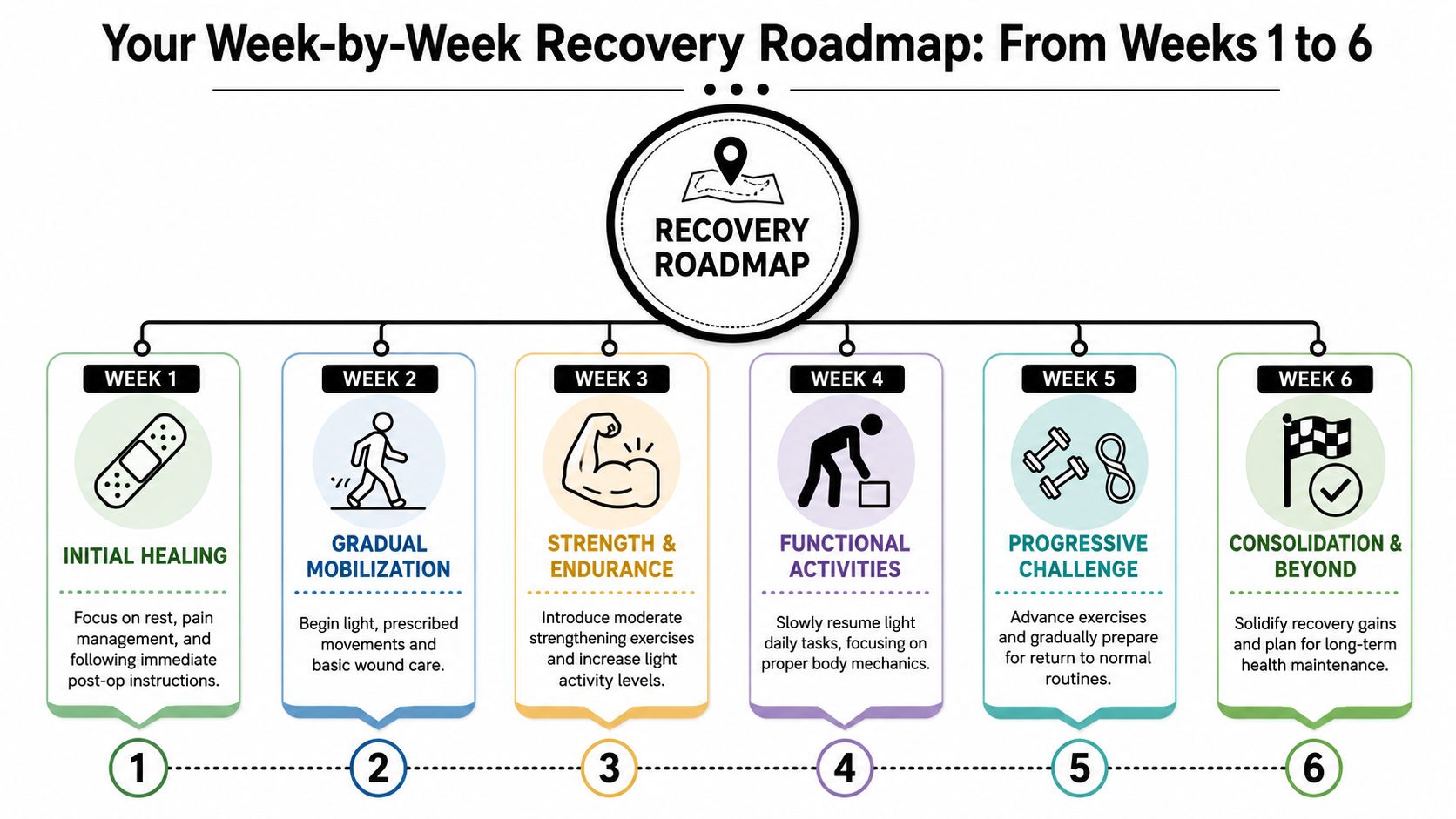
Patients who prepared well before surgery often recognize this phase sooner. They know swelling, fatigue, bowel disruption, stiffness, and uneven sleep can all slow progress, even when the procedure itself went well. Recovery moves faster when prehab, post-op care, and rehab are treated as one timeline instead of separate events.
Weeks 1 and 2
Weeks 1 and 2 are about protecting healing tissue while rebuilding basic function. Swelling is still active. Energy can drop quickly. Appetite may be inconsistent. A strong day can be followed by a rough one.
Track progress by what you can do with less effort. Standing up, getting to the bathroom, preparing a simple meal, or walking a little farther without a symptom spike are better signs than pain alone. Pain matters, but function shows whether your system is adapting.
During this phase, I want patients focused on a short list:
- brief, frequent walks
- safe transfers and position changes
- incision protection and monitoring
- regular protein intake
- hydration and bowel regularity
If the incision looks concerning or drainage changes, follow your surgeon's instructions and get help early. In some cases, added support from a clinician trained in post-surgical wound care and monitoring can help patients stay on track.
Weeks 3 and 4
Weeks 3 and 4 often fool people. Pain may settle enough that daily life feels possible again, but tissue tolerance, coordination, and strength usually have not caught up yet. This is the point where structured rehab starts to matter more.
Exercises become more specific. Range of motion work should match the surgery and respect healing limits. Strength work should match real tasks, such as climbing stairs, reaching, carrying light items, or getting in and out of a car. Gait, balance, posture, and movement quality deserve more attention now because compensations can become habits.
Skin closure is only one part of healing. The primary goal is getting normal movement back without forcing it.
Gut health also deserves attention here because it affects appetite, bowel function, comfort, and nutrient absorption. Antibiotics can disrupt the gut microbiome, and a 2024 review in Nature Reviews Microbiology explains how that disruption can influence immune function and recovery after medical treatment, including surgery-related care: gut microbiota, antibiotics, and host health. The practical takeaway is simple. Ongoing bloating, constipation, diarrhea, poor appetite, or nausea can slow rehab because patients eat less, move less, and recover less predictably.
A useful approach during this phase often includes:
- Simple meals you tolerate well: Soup, oatmeal, yogurt, eggs, rice, fruit, or other easy options are often enough at first.
- Protein at regular intervals: Aim for foods your stomach handles comfortably rather than chasing a perfect meal plan.
- Steady fluids through the day: Small amounts more often usually work better than trying to catch up at night.
- Follow-up if digestion stays off: Medication side effects, dehydration, and constipation are treatable problems.
Weeks 5 and 6
By weeks 5 and 6, the focus shifts toward function under load. Pain may be lower, but endurance, coordination, and confidence often lag behind. That gap is why many setbacks happen on a good day.
| Week | Main focus | Common challenge |
|---|---|---|
| Week 5 | Increase strength and controlled activity | Doing too much because symptoms are quieter |
| Week 6 | Resume more normal daily tasks | Confusing healing with full conditioning |
Exercises often look more like life now. Repeated sit-to-stands, longer walks, step work, light carrying, reaching, bending, and task-specific drills begin to replace simpler early exercises. The right pace depends on the procedure, the tissue involved, and how well the earlier phases were handled.
This is also where prehab shows up clearly. Patients who built strength, practiced breathing, improved mobility, and cleaned up sleep and nutrition before surgery usually tolerate this stage better. They still need patience, but they tend to regain useful function with fewer detours.
Pacing, sleep, and consistency
Recovery between weeks 1 and 6 rarely follows a straight line. A tired day after a more active day is common. Mild soreness after progressing an exercise can be appropriate. A sharp pain increase, new swelling, or a sudden drop in function deserves a call to your surgeon or rehab team.
A few habits keep this stretch productive:
- Keep a regular sleep schedule
- Progress one variable at a time, such as distance, resistance, or repetitions
- Use soreness as feedback
- Skip “catch-up” exercise after a lower-energy day
- Respect digestive issues early, because poor intake can drag down healing
Consistency drives this stage. Patients recover best when they do the right amount, week after week, and let each phase prepare the next one.
Advanced Healing Strategies and When to Use Them
Sometimes recovery follows the expected path and still stalls. Pain lingers longer than it should. Scar tissue starts limiting motion. Strength is returning, but movement still feels guarded. That's when advanced strategies can be useful.
The key is to use them as part of a plan, not as a replacement for the basics.
When hands-on treatment adds value
Manual therapy can help when tissue mobility, joint motion, muscle guarding, or movement fear are slowing progress. It isn't magic, and it shouldn't be painful theater. Used well, it can make exercise more effective by helping you move with less restriction.
That might include soft tissue work around tight surrounding structures, scar mobilization once appropriate, or guided joint movement to improve mechanics. The benefit is often less about the treatment itself and more about what it enables right after.
Where acupuncture and shockwave fit
Some patients deal with persistent pain sensitivity or stubborn soft-tissue irritation during recovery. In those cases, complementary tools may help support the main rehab plan.
- Acupuncture: Can be useful when pain, muscle tension, or nervous system irritability is getting in the way of sleep and movement.
- Shockwave therapy: May be considered for certain stubborn tissue problems when healing needs a more targeted stimulus.
- Progressive exercise: Still remains the center of the plan because lasting function comes from what your body can do, not just what is done to it.
A clinic such as MedAmerica Rehab Center's post-surgical wound care and recovery support may be one option when a patient needs coordinated physical therapy, wound-focused attention, and progression back into movement under supervision.
How to decide if you need more than standard rehab
Ask a few practical questions:
- Has progress stopped for more than a brief stretch? Plateaus happen, but long plateaus deserve review.
- Is pain the limiter, or is stiffness the limiter? Those problems aren't treated the same way.
- Does the scar or surrounding tissue feel bound down? That can change how the whole region moves.
- Are you avoiding normal movement because it feels unsafe? Fear can become its own barrier.
The right advanced treatment should make the rehab plan clearer, not more complicated.
What doesn't help is collecting therapies without a reason. If a modality isn't tied to a specific problem, it usually becomes a distraction. The best add-ons solve a defined issue and make it easier to return to walking, lifting, reaching, climbing, or whatever daily tasks matter to you.
Staying on Track Recognizing Red Flags and Partnering for Success
A good recovery plan includes confidence, but it also includes caution. Not every increase in soreness is a problem. On the other hand, some symptoms shouldn't be watched for another few days. They should be reported.
Red flags that need medical attention
Call your surgeon or medical team promptly if you notice:
- Increasing redness, drainage, or warmth around the incision
- Pain that escalates sharply instead of improving gradually
- Fever or feeling suddenly unwell
- New swelling that appears quickly or feels markedly different
- Shortness of breath, chest symptoms, or sudden calf concerns
- Loss of function that is new or worsening
- Medication side effects you can't manage safely at home
If you've been prescribed blood thinners after surgery, practical details matter too. For patients using injections, this FindMyScript's guide to Lovenox shots is a helpful plain-language resource on side effects and what to monitor.
Recovery works best as a partnership
Most patients don't need more willpower. They need clear guidance. They need to know what's normal this week, what should improve next week, and what signs mean the plan should change.
That's where a physical therapist becomes more than an exercise coach. A good therapist helps you pace activity, correct movement habits that irritate healing tissue, progress strength safely, and spot problems before they become setbacks. That support matters whether you're recovering from orthopedic surgery, dealing with post-op stiffness, or trying to regain confidence with walking and daily tasks.
The strongest recoveries usually come from teamwork between the surgeon, the rehab team, the patient, and the family members helping at home. When everyone understands the plan, recovery feels less confusing and a lot more manageable.
If you're preparing for surgery or trying to recover more efficiently after it, MedAmerica Rehab Center provides physical therapy and post-surgical support in Deerfield Beach with plans customized to the procedure, your current function, and the daily activities you want to return to.
MedAmerica Rehab · Deerfield Beach
Talk to a clinician about your pain
Physical therapy, chiropractic, acupuncture and shockwave therapy under one roof, since 1995. Same-day appointments are available.
Mon–Thu 8:00 AM – 6:30 PM · Fri 8:00 AM – 3:00 PM