

Achieve Faster Healing with Expert PT Wound Care
A wound that won’t heal changes the rhythm of a whole day. A simple shower becomes complicated. Getting dressed takes planning. Walking across the house can hurt. Family members start checking the bandage, looking for signs that things are better, then feel discouraged when the area still looks angry, wet, or slow to close.
That frustration is common after surgery, after an injury, or when someone is already dealing with swelling, diabetes-related skin problems, poor mobility, or long periods in bed or a chair. Many people think wound care means keeping it covered and waiting. In practice, healing often improves only when someone identifies what’s blocking progress and treats that problem directly.
The Challenge of a Wound That Will Not Heal
A wound usually doesn’t stall for one reason. A post-surgical incision might be stressed by swelling. A pressure sore might keep reopening because the area never gets enough relief. A lower-leg wound might stay irritated because fluid keeps pooling in the tissue. Patients often tell us the hardest part isn’t only the wound itself. It’s the uncertainty. They want to know why it’s not closing, whether movement will make it worse, and what they can do to help.
That concern is justified. In 2014, about 14.5% of all Medicare beneficiaries, roughly 8.2 million people, had at least one type of wound, with annual spending estimated between $28.1 billion and $96.8 billion, according to APTA’s summary of CMS chronic wound findings. Outpatient care made up a major share of that burden, which tells you something important. These wounds aren’t managed only in hospitals. They’re often treated over time in clinics, where progress depends on repeated skilled decisions.
Why wounds stall
When a wound lingers, the surface is only part of the story. Common barriers include:
- Too much pressure: The tissue keeps getting compressed, especially over heels, hips, tailbone, or anywhere a patient sits or lies for long periods.
- Swelling and fluid buildup: Edema stretches tissue and limits the environment the body needs to repair itself.
- Poor movement: If walking, turning, or transfers are difficult, the body loses one of its best tools for circulation and pressure relief.
- Inconsistent home care: Even a good clinic plan can get undermined if dressing changes, offloading, or skin protection aren’t followed regularly.
If you want a plain-language overview of the key reasons for slow wound healing, that resource is useful for families trying to understand why “just giving it more time” often doesn’t work.
Practical rule: A wound that’s not changing needs a new plan, not just more patience.
Why physical therapy matters here
Physical therapists look at a wound differently than someone who only focuses on the dressing. We look at load, motion, swelling, skin stress, posture, transfers, walking, and whether the patient can follow the plan at home. That matters because a wound rarely heals well if the person can’t move safely, can’t reduce pressure, or feels too discouraged to stay consistent.
Pt wound care becomes more than maintenance. It becomes active problem-solving.
What Exactly Is Physical Therapy Wound Care
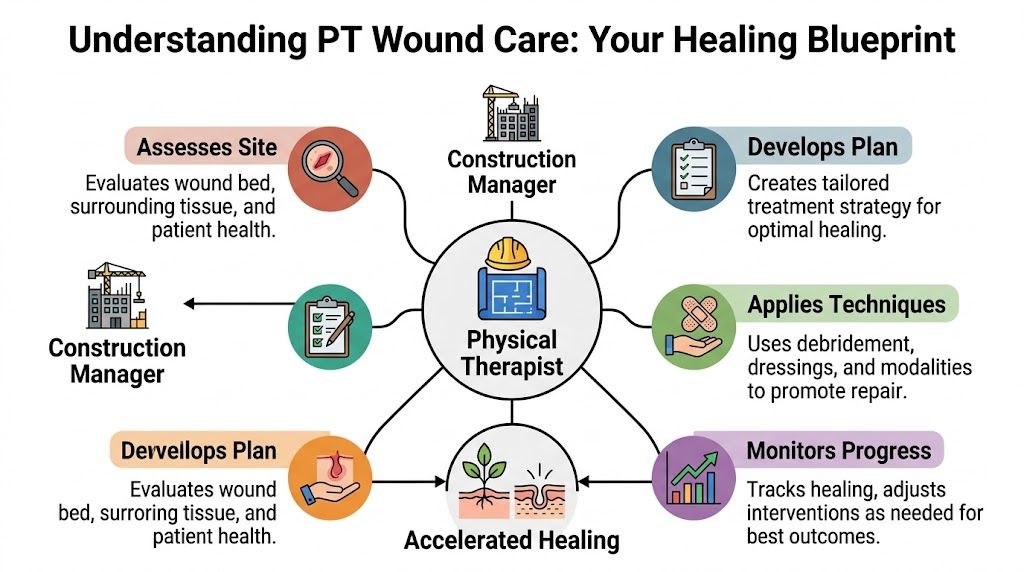
Physical therapy wound care is the combination of wound-specific treatment and movement-based clinical reasoning. The easiest way to think about it is this: a physical therapist acts like a construction manager for the body’s repair site. We don’t just look at the opening in the skin. We look at what’s slowing the rebuild, what keeps damaging the area, and what has to change for healing to continue.
That can include the wound bed itself, but it also includes swelling control, positioning, offloading, transfer mechanics, walking tolerance, circulation through safe movement, and the patient’s ability to carry out the plan day after day.
The PT role goes beyond bandages
A wound dressing can protect tissue. It can’t fix a transfer that drags skin across the bed. It can’t reduce leg edema by itself. It can’t teach someone how to unload a heel, reposition in a wheelchair, or move from bed to bathroom without putting fresh stress on a surgical site.
That broader role matters because chronic wounds affect about 6.5 million people in the U.S., and 66.8% of patients in specialized outpatient wound centers achieved healing by their final visit in findings summarized on PubMed. Specialized care works because it’s coordinated and practical. It doesn’t treat the wound as an isolated spot on the body.
What a PT is trying to change
In pt wound care, the main targets usually include:
- Tissue environment: Removing barriers to healthy tissue development and helping the wound bed support closure.
- Mechanical stress: Reducing pressure, friction, and shear that keep reopening or worsening tissue damage.
- Fluid balance: Managing swelling and exudate so the skin around the wound doesn’t stay overstretched or macerated.
- Function: Making it easier to walk, transfer, reposition, or stand without harming the healing area.
- Recurrence risk: Solving the reason the wound happened in the first place, not only closing it temporarily.
Families often do better when they understand what daily care should look like outside the clinic. A practical guide to home wound care can help patients support the clinical plan between visits.
Why function is part of healing
A wound that closes but leaves someone unable to move well isn’t a complete win. If the patient can’t get out of bed safely, can’t tolerate sitting, or can’t shift weight often enough, the wound may come back or a new one may form. Physical therapy keeps the treatment connected to real life. We ask whether the patient can manage stairs, toilet transfers, car transfers, shoes, sleep positions, and the sitting demands of daily routines.
That’s also why first visits matter. Patients do better when they know how the evaluation works, what to bring, and what the therapist will look at. If you want a clear overview of what to expect at your first appointment, that preparation usually makes the whole process less stressful.
Good wound care doesn’t stop at skin level. It has to make the person safer and more capable in the positions they live in all day.
How a Physical Therapist Assesses Your Wound
The first wound evaluation is methodical. Patients sometimes expect a quick look and a new bandage. A proper assessment is more detailed than that. The therapist needs to know what the wound is doing, what the surrounding tissue is doing, and what your body is doing around it.
What gets measured
A therapist starts with objective details. That means the wound’s length, width, depth, and any tunneling or undermining. Tissue type matters too. Healthy granulation tissue looks different from slough or eschar, and each one changes the plan. The surrounding skin gets checked for irritation, moisture damage, discoloration, callus, heat, and signs that the area is being stressed by pressure or friction.
Drainage also matters. Not just whether it’s present, but how much, what it looks like, and whether it matches the current stage of healing. Pain gets discussed in practical terms. Is it worse with dressing changes, walking, standing, or lying in one position? That helps determine whether the main problem is tissue sensitivity, pressure, swelling, or something that needs medical review.
The body around the wound matters
A wound is never assessed in isolation. The therapist looks at:
- Swelling patterns: Is fluid pooling in the foot, ankle, calf, or around the wound edges?
- Pressure points: Are the heel, tailbone, hips, or seating surfaces causing repeated load?
- Mobility limits: Can the patient turn, stand, or shift weight without help?
- Equipment issues: Is the walker the right height? Is the wheelchair setup causing prolonged pressure in one spot?
- Home routine: Does the current routine support healing, or does it keep stressing the same tissue?
For pressure injuries, these mechanics are central. Strict repositioning every 1 to 2 hours and heel elevation can reduce incidence by up to 50% in high-risk groups, according to Physiopedia’s wound care basics review. That’s why therapists ask so many questions about bed mobility, chair time, and sleep position. Those details are not side issues. They are treatment issues.
Different wounds need different goals
| Wound Type | Common Causes | Primary PT Goal |
|---|---|---|
| Pressure injury | Prolonged pressure, shear, limited mobility, poor repositioning | Offload pressure, protect skin, improve repositioning and seated or bed mobility |
| Surgical wound | Post-operative tissue stress, swelling, limited movement, wound dehiscence risk | Control edema, protect the incision, restore safe movement without pulling on healing tissue |
| Diabetic or neuropathic foot wound | Repetitive pressure, poor sensation, footwear issues, delayed detection | Offload the area, improve gait safety, protect skin during walking and transfers |
| Venous-type lower leg wound | Fluid buildup, chronic swelling, poor calf muscle pump activity | Manage edema, support circulation through movement, improve walking tolerance |
| Traumatic wound | Accident-related tissue damage, soft tissue disruption, contamination risk | Protect healing tissue, regain function, reduce swelling and stiffness around the injured area |
Assessment also includes behavior and mindset
This part gets overlooked. Some patients are frightened to move because they think any movement will tear the wound open. Others keep walking on an offloaded foot because they’re trying to stay independent. Some are exhausted, discouraged, or embarrassed by odor or drainage. A therapist has to catch that early.
If the plan doesn’t fit the patient’s real day, the plan won’t hold.
The best assessment doesn’t just document a wound. It identifies what’s keeping that wound from fitting into normal life safely.
Common Interventions and Modalities in PT Wound Care
Treatment depends on the wound type, the tissue condition, the amount of swelling, and how the patient moves through the day. Good pt wound care is rarely one single tool. It’s usually a combination of hands-on treatment, protective strategies, and mobility changes that make healing possible between visits.
Wound bed preparation
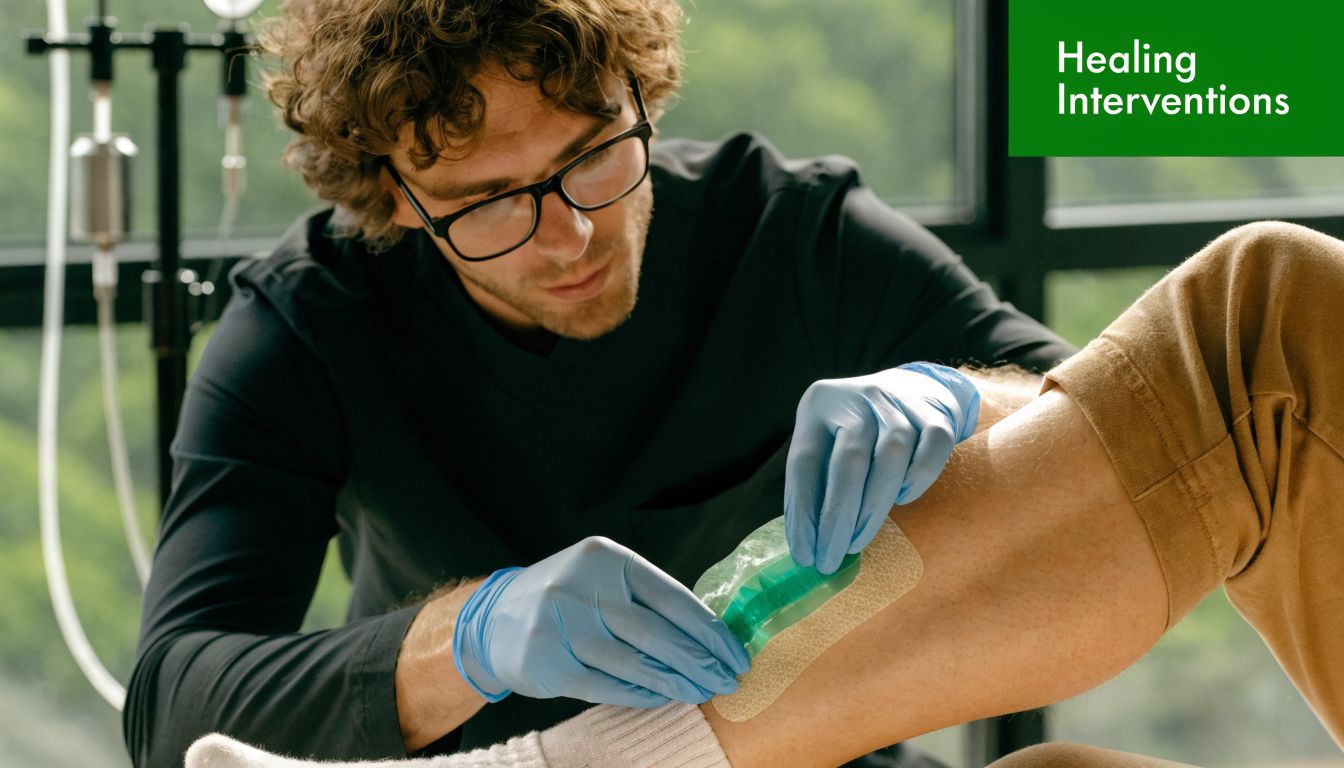
Sometimes the first job is to clean up the environment so healing tissue can do its work. That may include selective debridement when appropriate, moisture management, and choosing dressings that protect the wound without trapping the wrong kind of moisture. Too dry is a problem. Too wet is also a problem. The therapist is trying to create a wound bed that supports repair rather than stagnation.
This is also where surrounding skin care matters. If the edges stay soggy, fragile, or irritated by drainage, closure slows down. If the edges are protected and the dressing matches the wound’s needs, the tissue usually behaves better.
Compression, offloading, and pressure relief
Many wounds don’t improve until the tissue is mechanically protected. For lower-leg wounds with edema, compression strategies may be part of the plan when medically appropriate. For heel, foot, or seated pressure problems, offloading is often non-negotiable. That may mean heel relief, footwear modification, a turning schedule, transfer changes, or seating adjustments.
What doesn’t work is treating the wound in the clinic and then sending the patient back to the exact same pressure pattern all day.
A lot of patients also ask about simple symptom relief during recovery. When swelling or pain from nearby orthopedic issues complicates movement, knowing when cold therapy is useful can help. This overview of ice pack physical therapy basics is a helpful companion for understanding when cooling supports comfort and when it doesn’t address the underlying wound problem.
Modalities that support healing
Some wounds need more than cleaning and protection. Physical therapists may use biophysical agents and advanced wound technologies when the wound profile supports them.
One of the most recognized examples is Negative Pressure Wound Therapy, often called NPWT. It uses controlled suction through a specialized dressing system to help manage fluid and stimulate tissue formation. In the wound care literature summarized in this Maryland wound management presentation, NPWT reduced wound area by a median of 65.7% versus 44.4% in controls, and the therapy typically applies 125 mmHg of sub-atmospheric pressure. For the right wound, that can be a powerful option in outpatient rehab.
Clinical judgment matters: Advanced tools help when the wound and patient are selected well. They don’t replace pressure relief, edema control, or adherence.
Other modalities may be used to support the healing response, especially when the wound is compromised and the treatment plan calls for additional stimulation. The key point is that modalities are not magic. They work best when the wound bed is managed well, pressure is controlled, and the patient can follow through at home.
Here’s a short video that gives added context on wound management approaches clinicians may use in practice:
Mobility is a treatment tool
Therapists also prescribe movement with purpose. That may include bed mobility training, gait training, transfer practice, ankle pumping, calf activation, or changing how a patient stands up from a chair. Those choices are not separate from wound care. They often determine whether blood flow improves, swelling decreases, and pressure shifts enough for tissue to recover.
Patients usually do best when they understand the trade-off. Rest can protect a wound, but too much immobility can worsen pressure, stiffness, weakness, and circulation. More activity can help, but the wrong activity can overload the area. The therapist’s job is to find the safe middle.
Recognizing Red Flags When to Seek Urgent Care
Most wounds heal gradually, not dramatically. Slow change can still be normal. A sudden negative change is different. Patients and families need to know when a wound has moved beyond routine monitoring and needs prompt medical attention.
Signs that should not wait
Contact your physician or seek urgent evaluation if you notice:
- Spreading redness: Redness moving outward from the wound instead of staying localized.
- Rapid increase in pain: Pain that becomes sharply worse, especially if the wound had been stable.
- Foul odor: A strong unpleasant smell that persists after cleaning and dressing changes.
- Heavy or changed drainage: A sudden increase in drainage, or drainage that looks concerning to you compared with prior days.
- Fever or feeling unwell: Chills, fever, unusual fatigue, or a general sense that the patient is getting sick.
- New warmth and swelling around the site: Especially if the surrounding tissue looks tighter, shinier, or more inflamed.
- Darkening tissue or a sudden change in color: Tissue that looks newly dusky, blackened, or clearly worse.
- A wound that opens suddenly: Especially after surgery or after a recent period of improvement.
When to be more cautious
Some patients need an even lower threshold for getting help. That includes people who have poor sensation, limited ability to inspect the wound, major mobility restrictions, or difficulty explaining what they’re feeling. If the patient can’t reliably detect a problem early, caregivers need to act faster.
If you’re debating whether a wound change is serious, call. Waiting is usually the riskier choice.
What not to do
Don’t try to solve a possible infection by changing the dressing more often and hoping it settles down. Don’t keep putting pressure through a worsening foot or heel wound just because walking is still possible. And don’t assume an odor, sudden drainage, or spreading redness is “part of healing.”
Prompt medical review protects tissue and can prevent a much larger setback.
Your Healing Journey at MedAmerica Rehab Center
People usually arrive for wound-focused therapy after weeks of frustration. They’ve tried to be careful. They’ve followed instructions as best they can. But the wound is still limiting sleep, mobility, work, exercise, or basic confidence. By the time they seek help, many are carrying another burden too. They’re worn down.
That emotional piece matters. Chronic wounds don’t just affect skin. They can isolate people. They make some patients afraid to leave home because of drainage, odor, visible dressings, or fear of falling. Others become hesitant to move because they’re scared of making things worse.
The first visit feels more manageable when someone listens
A good wound rehab experience starts with a calm first conversation. Patients need room to explain what’s been happening, what has changed, and what they’re worried about. Then the clinical work begins: wound assessment, surrounding tissue review, mobility screening, pressure analysis, and a realistic treatment plan.
What often helps most is that the plan is tied to daily life. If a patient can’t tolerate lying on one side, that has to be addressed. If getting in and out of the car is causing friction at the wound site, that matters. If they’re panicking every time they see drainage on the dressing, education becomes part of treatment.
Healing is physical and psychological
The psychosocial side is not optional. Studies summarized in this PMC review on physical therapy and wound management note 20% to 50% higher rates of depression associated with chronic wounds. That fits what clinicians see. Patients lose momentum when they feel stuck, embarrassed, or convinced nothing will help.
Physical therapists are in a strong position to address that because we spend time with patients in function, not only in procedures. We see what they avoid, where they lose confidence, and when anxiety is stopping adherence. Sometimes the best intervention in a session is not another modality. It’s breaking the plan into manageable steps the patient believes they can do.
That may include:
- Simplifying the home routine: Fewer moving parts, clearer instructions, and better caregiver coordination.
- Reducing fear of movement: Showing what is safe, what isn’t, and how to move without damaging the wound.
- Restoring social confidence: Helping the patient tolerate sitting, walking, or leaving the house again.
- Rebuilding routine: Linking dressing protection, offloading, and exercise to normal daily activities.
Recovery often improves when the whole body is considered
Some patients heal better when lower-impact movement is available because land-based activity is painful, guarded, or difficult. In those cases, it can help to understand how physical therapy in a pool supports movement for certain orthopedic and mobility challenges that may exist alongside wound recovery.
Healing gets more consistent when the patient stops feeling like the wound is running their life.
The strongest plans support both tissue repair and morale. Patients who understand the plan, trust the process, and feel capable of carrying it out usually stay engaged longer. That consistency is often what moves a wound from stalled to progressing.
Frequently Asked Questions About PT Wound Care
Does wound care therapy hurt
Sometimes parts of treatment are uncomfortable, but the goal isn’t to make the wound “hurt into healing.” A skilled therapist works to protect viable tissue, reduce unnecessary irritation, and choose techniques that match the condition of the wound. Patients should always speak up about pain during treatment. Pain is information, and it often changes the plan.
How long will it take for my wound to heal
There isn’t one timeline that fits every wound. Healing depends on the wound type, tissue quality, pressure levels, swelling, circulation, medical history, and how consistently the home plan is followed. Two wounds that look similar at first glance can behave very differently because the underlying causes are different.
A better question is whether the wound is moving in the right direction. The therapist looks for signs such as healthier tissue, improved drainage control, better surrounding skin, less pressure stress, and more functional mobility.
What can I do at home to support healing
The home plan often matters as much as what happens in the clinic. The basics usually include:
- Protect pressure points: Follow positioning and offloading instructions exactly, especially for heels, feet, and seated surfaces.
- Stick to dressing guidance: Change dressings only as instructed. More frequent changes aren’t automatically better.
- Move the way your therapist recommends: Safe movement can help circulation and swelling, but the wrong movement can overload the wound.
- Watch the surrounding skin: New irritation, soggy skin, rubbing, or heat around the area should be reported.
- Keep the routine realistic: If a plan is too complicated to follow, tell your therapist so it can be simplified.
Will I still be able to walk or exercise
Often yes, but with restrictions. Some wounds benefit from more movement. Others need strict offloading at first. Walking may be encouraged, modified, or limited depending on where the wound is and what’s causing it to stall. Exercise is usually adjusted, not abandoned. The key is choosing movement that supports healing instead of fighting it.
Is pt wound care only for severe wounds
No. Therapy can help with chronic wounds, pressure injuries, post-surgical wounds, traumatic wounds, and wounds complicated by swelling, weakness, or mobility loss. Earlier intervention can be useful because it may prevent a manageable problem from becoming a much larger one.
Is wheelchair positioning really that important
Yes. For non-ambulatory or limited-mobility patients, seated posture can either protect healing or subtly undo it. A patient may get excellent bedside care and still keep overloading tissue for hours in a poorly supported chair. Cushioning, alignment, pressure shifts, and time spent sitting all matter.
Is wound care covered by insurance
Coverage depends on your plan, the medical necessity of treatment, your diagnosis, and the services being provided. The practical step is to ask the clinic to verify benefits and explain what’s covered before treatment begins. That removes guesswork and helps families plan.
What if I’m feeling discouraged
That’s common, and it should be discussed openly. Wound healing can be slow enough that people start to disengage. When motivation drops, the plan often gets less consistent. Tell your therapist if you’re overwhelmed, afraid of movement, tired of dressing changes, or avoiding activity. Those are treatment issues, not personal failures.
How do I know if the plan is working
Look for steady trends rather than dramatic overnight changes. A working plan often leads to a cleaner wound bed, healthier tissue appearance, better tolerance for movement, less stress on the area, and more confidence with daily activities. If those signs are absent, the plan may need to be revised.
If you or a family member is dealing with a wound that isn’t healing the way it should, MedAmerica Rehab Center can help you take the next step with practical, patient-centered care. Their Deerfield Beach team offers same-day appointments, individualized treatment, and a multidisciplinary approach built to reduce pain, restore mobility, and support healing in real life.
MedAmerica Rehab · Deerfield Beach
Talk to a clinician about your pain
Physical therapy, chiropractic, acupuncture and shockwave therapy under one roof, since 1995. Same-day appointments are available.
Mon–Thu 8:00 AM – 6:30 PM · Fri 8:00 AM – 3:00 PM