
NewStep Exercise Machine: A Complete Rehab Guide
If your back hurts every time you try to “get moving again,” you're not alone. A lot of people start rehab in that exact place, worried that a walk, bike, or gym machine will flare up pain instead of helping it. The NewStep exercise machine has become a trusted option in that in-between stage, when you're past pure rest but not ready for more demanding exercise.
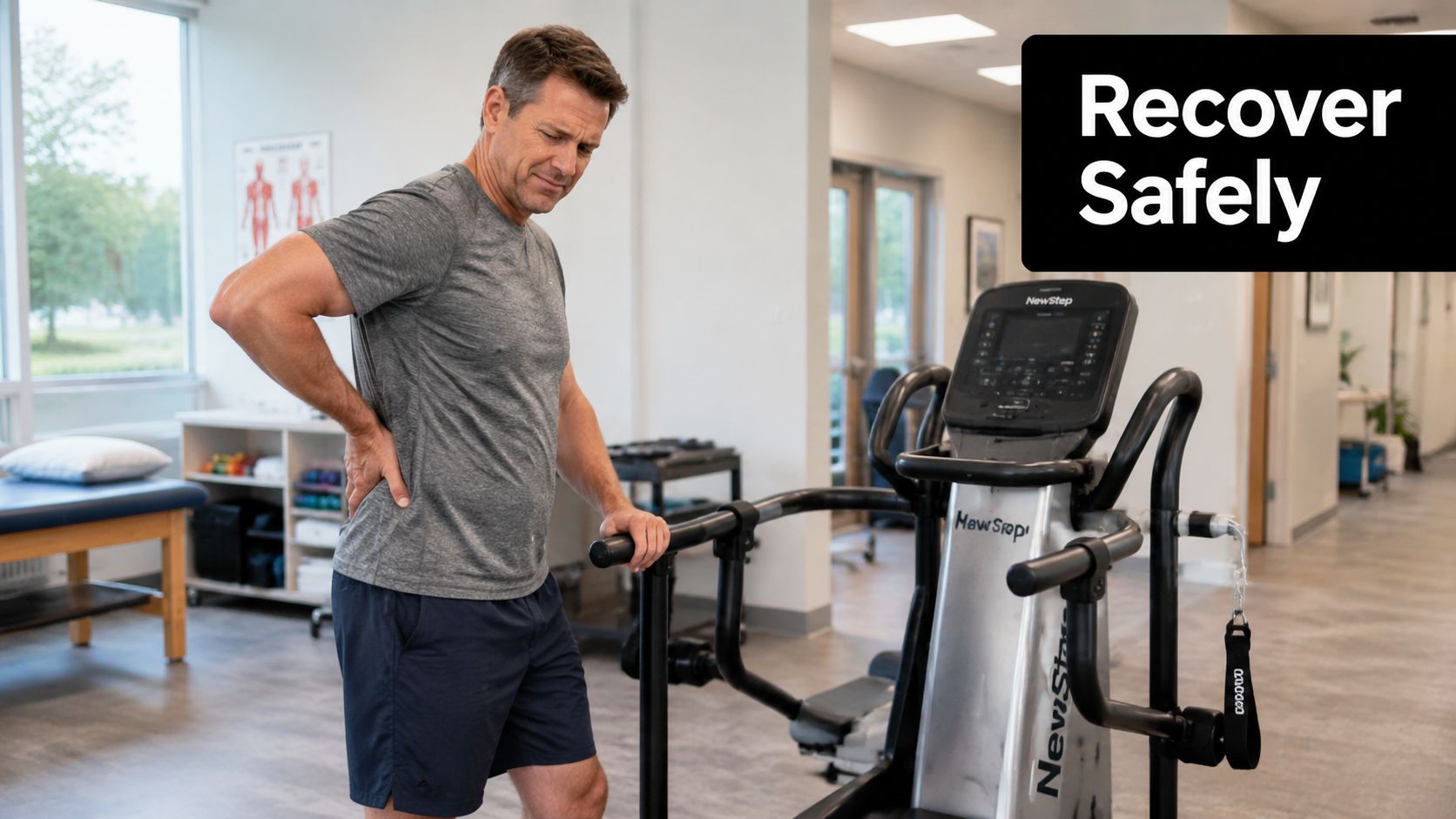
People usually find the NewStep when they need movement that feels safer than standing cardio. That's why it shows up so often in rehab settings, especially for back pain, arthritis, post-surgical stiffness, and balance-limited patients. If you've also been wondering how gait training fits into recovery, this physical therapy guide to gait training helps show where controlled movement belongs in a broader plan.
Why the NewStep Exercise Machine Matters for Recovery
The first time many patients see a NewStep exercise machine, they don't think “workout.” They think “this looks possible.” That reaction matters in rehab, because pain changes how people move, and fear of pain changes it even more. A seated cross-trainer gives you a way to re-enter exercise without asking your joints, spine, or balance system to do everything at once.
The machine's history helps explain why clinicians trust it. NuStep traces the product back to a late-1980s design effort led by biomedical engineer Dick Sarns, who saw a gap in accessible cardiac-rehabilitation equipment. NuStep says the original recumbent cross trainer launched in the 1990s, and the line later evolved through the TRS3000 in 1997, the TRS4000 in 2000, and the T4r in 2013. By May 2020, NuStep's Japanese distributor reported cumulative domestic sales of 8,076 units in Japan, which shows how far the concept moved from a niche rehab idea into real clinical use (NuStep history).
Who tends to benefit most
In practice, the NewStep tends to make the most sense for people who need low-impact, supported movement. That includes patients with back or neck pain, sciatica, arthritis, post-op stiffness, weakness after illness or surgery, and older adults who feel unsure on standing machines.
Practical rule: If standing cardio makes you brace, guard, or lose confidence, a seated cross-trainer is often a better starting point than pushing through a machine that feels unstable.
The key advantage isn't that the NewStep is “easy.” It's that it lets you work while protecting the parts of the body that are already irritated. That's a very different goal from gym fitness, and it's why the machine belongs in rehab conversations at all.
How the NewStep Exercise Machine Works
Think of the NewStep exercise machine as seated cross-training with a clear clinical bias toward control. You sit in a supported position, place your hands and feet on the moving components, and use a reciprocal pattern so the arms and legs work together. The result feels closer to an elliptical than a bike, but without the standing demand or impact loading that can bother painful joints.
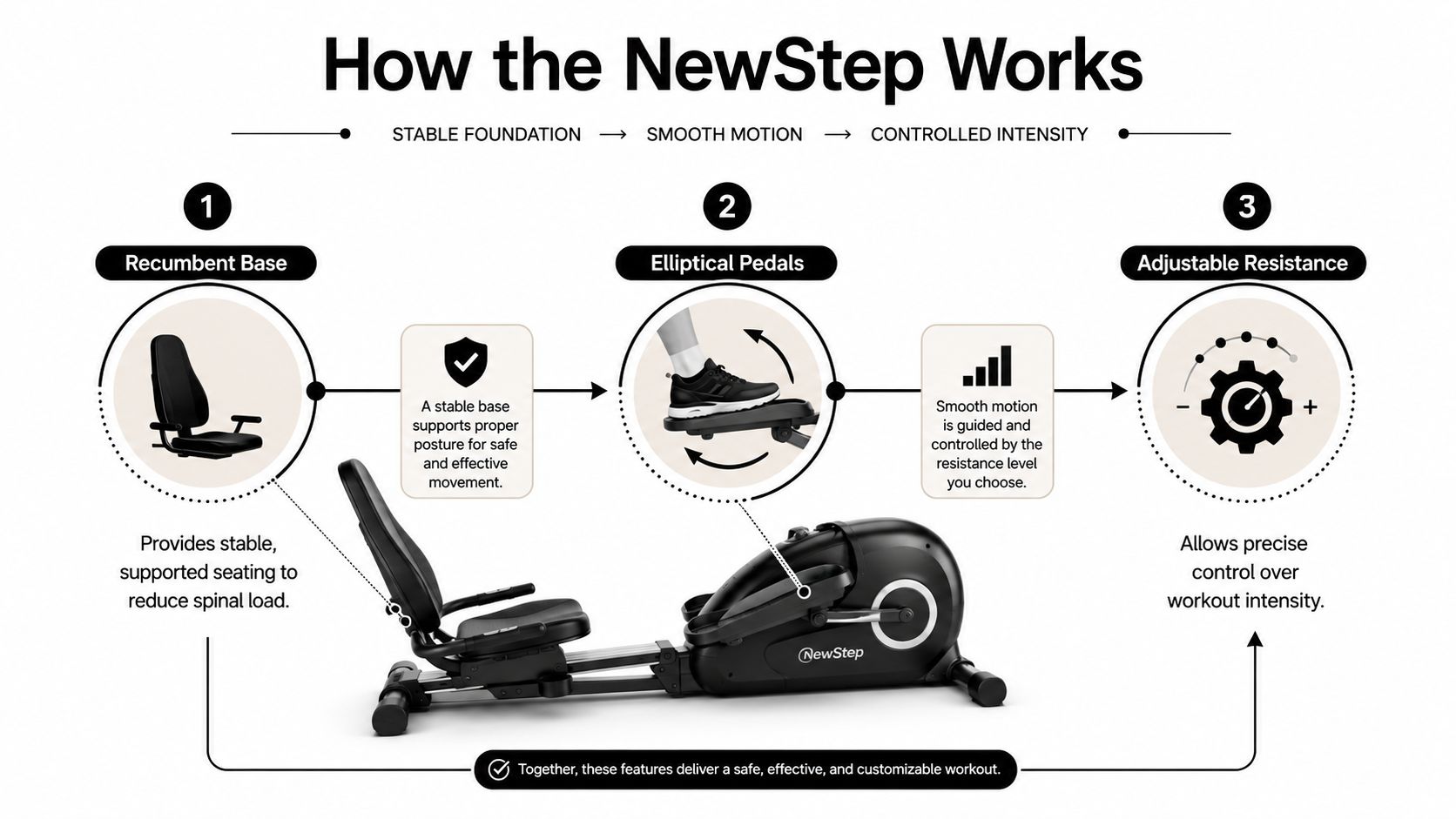
NuStep's current models show the design philosophy clearly. The T6 Pro supports users from 75 lb to 500 lb, fits heights from 4'6" to 6'7", and carries a 10-year frame warranty. The T4r lists 10 resistance levels from 5 to 800 watts and weighs 95 kg (NuStep T6 Pro specifications). That range matters because rehab rarely fits one body type or one phase of recovery.
Why the mechanics feel different
The machine uses a smooth eddy-current resistance system, which gives clinicians a way to increase or decrease load without abrupt changes. The T4r/T4 platform also provides 0 to 800 watts of power output, up to 8.5 inches (22 cm) of stepping range, 10 workload levels, and stepping speeds from 5 to 210 steps per minute (T4 specifications manual). Those details matter because they let the therapist match the machine to the patient instead of forcing the patient to adapt to the machine.
The best rehab tools don't just let people exercise. They let clinicians dose exercise.
That's the key advantage here. The NewStep doesn't ask for balance, impact tolerance, or athletic coordination first. It gives you a stable, adjustable way to move major muscle groups while keeping the effort smooth and predictable.
Rehabilitation Benefits for Common Pain Conditions
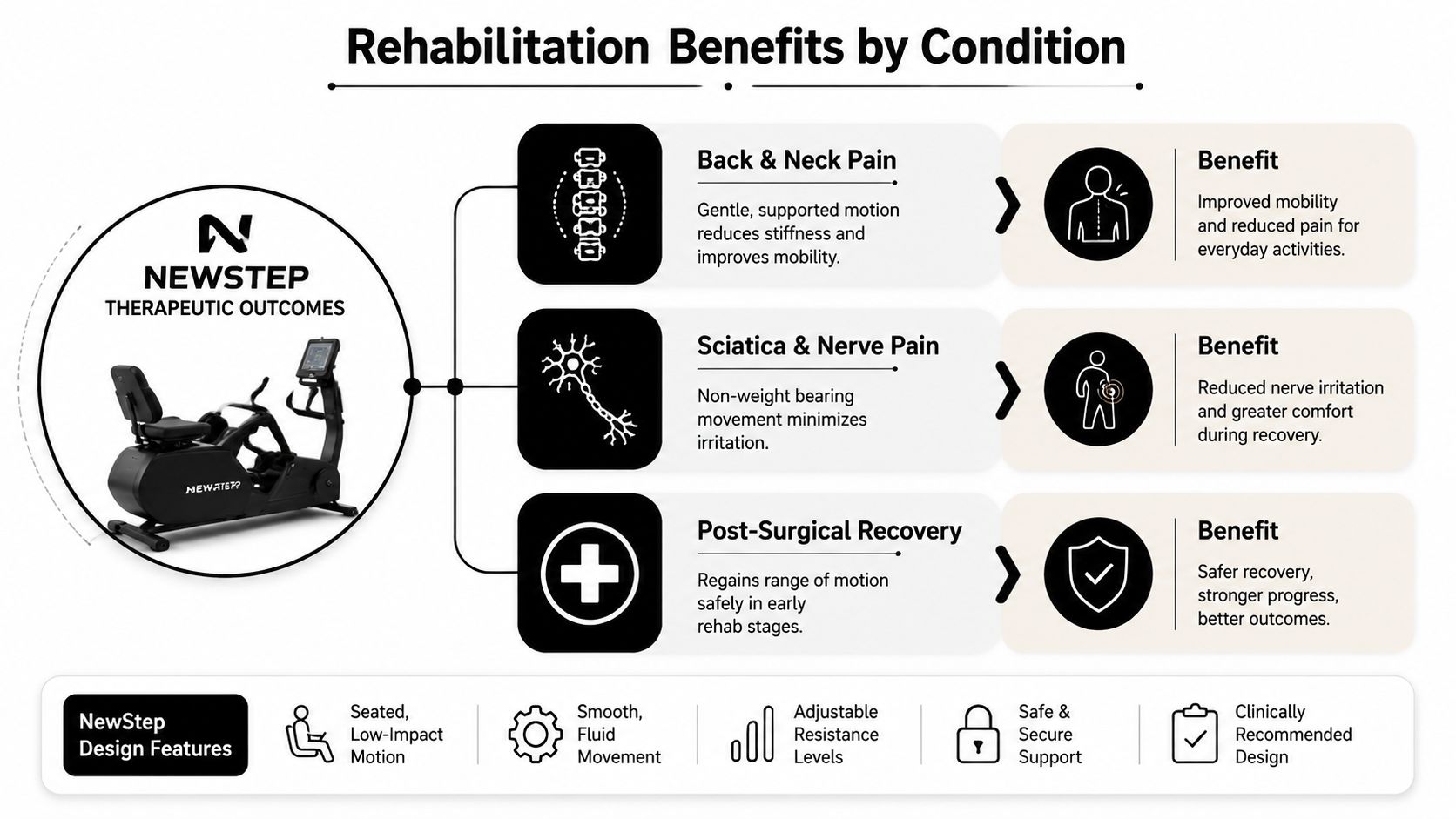
The NewStep earns its reputation when pain makes normal exercise options feel like the wrong fit. The seated position reduces the balance burden, and the reciprocal arm-and-leg motion lets patients move without needing to stand, twist, or absorb impact. That combination can be especially useful when the problem isn't just weakness, but the way pain changes confidence and movement patterns.
Back pain, neck pain, and stiffness
For back and neck pain, the main benefit is supported motion. Sitting removes the need to stabilize your body against gravity in the same way standing machines do, which can make it easier to move without tensing up. The arms and legs also share the workload, so the spine isn't carrying every demand alone.
Sciatica and radiating nerve pain
People with sciatica usually need movement that's gentle enough not to provoke symptoms, but active enough to keep them from stiffening up. The NewStep's smooth, reciprocal pattern can support that middle ground. It's not a cure for nerve pain, but it can be a reasonable option when symptom-sensitive movement is the goal.
Arthritis and joint irritation
Arthritis usually responds best to exercise that respects the joint while still encouraging motion. The NewStep's low-impact design helps here because it avoids the pounding and jarring that can come with standing cardio. Resistance can be increased gradually, so the machine can stay useful even after the initial flare settles.
Post-surgical recovery and mobility loss
Early rehab often needs something that is controlled, not aggressive. NuStep's seated exercise materials describe the machine as a bridge between rest and more advanced movement, and that idea fits post-op recovery well, as long as the surgeon's restrictions are followed (NuStep seated exercise guidance). The point is to reintroduce movement with less strain, not to prove fitness.
NewStep Compared to Other Rehab Exercise Machines
Patients often ask whether the NewStep is really better than a recumbent bike or elliptical. The honest answer is that it depends on the problem you're trying to solve. If you're comparing machines for pain recovery, the best choice is the one you can tolerate consistently, with the least aggravation and the clearest way to progress.
| Feature | NewStep | Recumbent Bike | Elliptical |
|---|---|---|---|
| Body position | Seated and supported | Seated and supported | Standing |
| Joint stress | Very low, with reciprocal motion | Low, mostly lower body | Low impact, but more demanding on balance |
| Balance requirement | Minimal | Minimal | Higher |
| Arm and leg engagement | Linked upper and lower body | Mostly legs, arms usually passive | Often full-body, but standing |
| Load control | Precise and smooth | Usually easy to adjust | Adjustable, but harder to tolerate for painful patients |
A recumbent bike can be a strong choice when leg-only conditioning is the goal. The downside is that it doesn't always recruit the upper body in the same integrated way. An elliptical can provide full-body work, but it asks for standing tolerance and coordination that many pain patients don't have yet. That's why the NewStep often lands in the middle, it gives a fuller movement pattern than a bike while staying much easier to tolerate than an elliptical.
There's also a practical gap that matters. Publicly available NuStep materials focus on operating the machine and general workout ideas, but they don't provide comparative outcome data, so the decision is less about brand loyalty and more about symptom fit. If you want a broader look at how clinicians think about assistive exercise tools, this over-the-door pulley exerciser resource helps frame the same logic in a different setting.
Clinical takeaway: When pain, weakness, or balance limits make standing cardio feel like a gamble, the NewStep is often the safer first choice.
How MedAmerica Integrates the NewStep into Treatment Plans
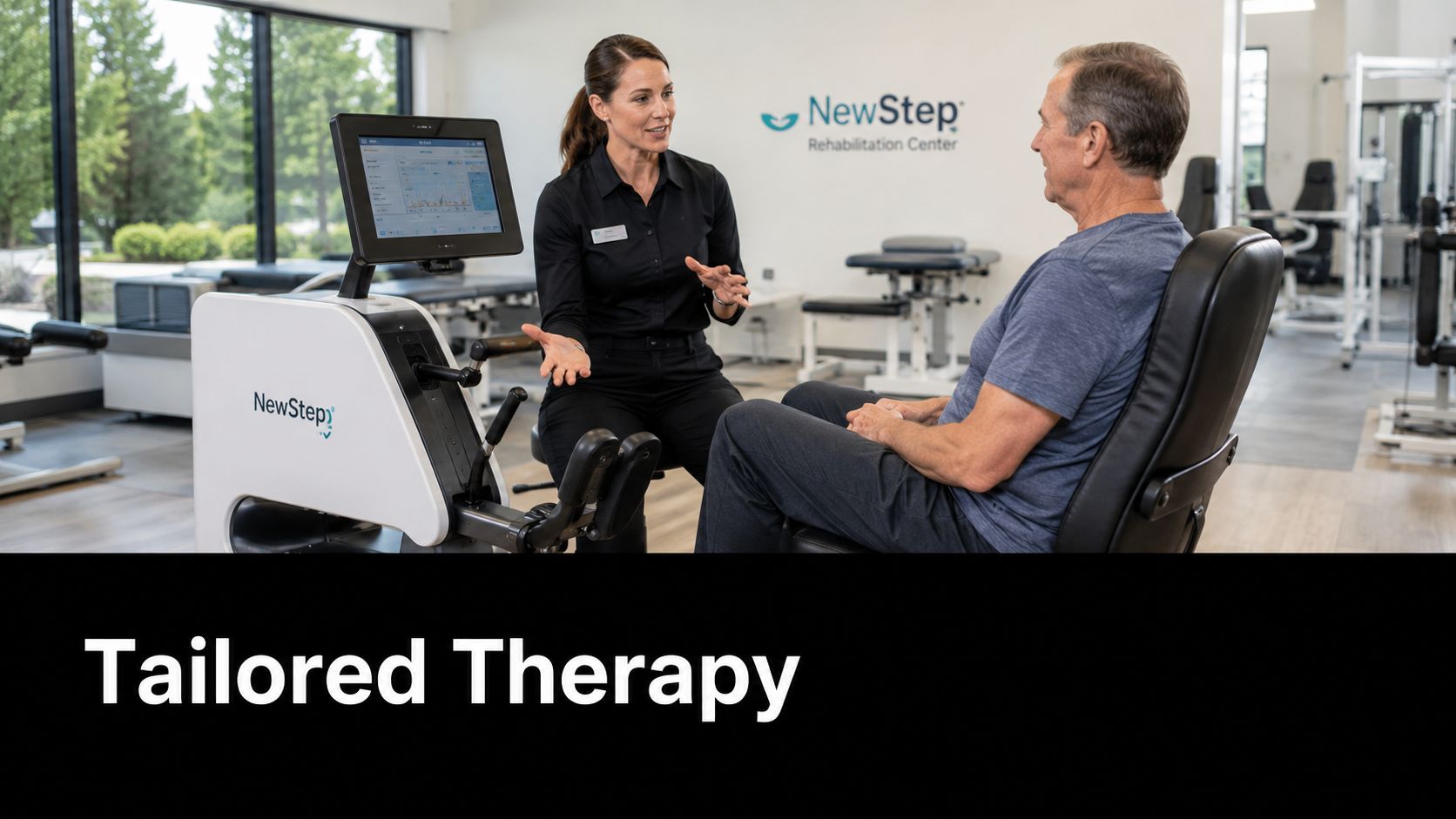
At MedAmerica, the NewStep fits into a broader plan, not a standalone routine. That matters because patients rarely need one thing only. They may need hands-on work for stiffness, targeted exercise for strength, and a supported machine for safe conditioning, all in the same episode of care.
A typical first session usually starts with a movement check, symptom review, and a conversation about what flares pain and what helps it settle. From there, the therapist can choose resistance, stepping speed, and duration based on how the patient responds that day, not just on a diagnosis label. For a deeper look at that philosophy, see this individualized treatment plans overview.
The NewStep is especially useful because it can be scaled without changing the whole exercise environment. A patient might start with very light movement, then progress to more demanding work as tolerance improves. That progression can happen alongside stretching, mobility drills, or manual therapy, which is often how patients get the best results in real clinics.
The video below shows how seated exercise fits into an early rehab framework.
In clinic, progress is usually tracked by what changes in the body and in daily life. Patients often notice less guarding, better stamina, or easier movement after repeated sessions, but the pace depends on the condition and the starting point. A machine like the NewStep works best when it's treated as a bridge to more functional activity, not the final destination.
Safety Considerations and When to Avoid the NewStep
The NewStep is helpful, but it's not the right choice for every situation. Acute injuries, unstable medical issues, and certain post-surgical restrictions can make even seated exercise inappropriate until a clinician clears the patient. That's why setup and supervision matter, especially early on.
The most common mistake is starting too hard. Patients sometimes assume that because the machine is seated, they can push resistance quickly or pedal through discomfort. That's a bad habit in rehab. Pain that keeps climbing during a session, symptoms that linger afterward, dizziness, chest discomfort, or a sense that the body is guarding more than usual are all reasons to stop and reassess.
What safe use usually looks like
- Start low and stay smooth: Early sessions should feel controlled, not forced.
- Match resistance to symptoms: More load isn't better if it changes your mechanics.
- Respect surgical limits: Healing tissues don't care that the machine feels gentle.
- Don't chase fatigue too early: Rehab exercise should build tolerance, not create a flare that wipes out the next day.
Proper positioning also matters. The seat, pedal distance, and reach need to fit the patient so the shoulders aren't hunched and the knees aren't jammed into a range that feels irritating. That kind of adjustment is easy to overlook, but it often determines whether the session feels therapeutic or annoying.
The broader rule is simple. If exercise increases function without causing a lasting symptom spike, it's probably in the right zone. If it turns into a pain test, the machine is being used the wrong way.
Frequently Asked Questions About the NewStep
How long are NewStep sessions?
It depends on the condition, the patient's tolerance, and the rehab goal. Early sessions are often shorter and more controlled, then lengthen as movement becomes easier. The right dose is the one the body can recover from well.
Is the NewStep good for seniors with limited mobility?
Yes, it often is, because the seated position reduces balance demands and the motion stays smooth. That said, a therapist still needs to judge whether transfers, reaching, and current symptoms make it a good fit that day.
How quickly will I notice results?
That varies widely. Some people feel less stiffness or more confidence fairly early, while others need several sessions before movement feels noticeably easier. The machine helps most when it's used consistently inside a broader rehab plan.
Can I use it if I have arthritis or back pain?
Often yes, if the motion is well tolerated and the resistance stays appropriate. The seated, low-impact design is one reason the NewStep is used so often for pain-sensitive patients, but the exact dosage still needs to be individualized.
What should I wear?
Wear comfortable clothing and shoes that stay secure on your feet. Loose clothing is fine if it doesn't interfere with pedal or handle contact, and it's smart to avoid anything that restricts movement at the hips or shoulders.
Does insurance cover NewStep therapy sessions?
Coverage depends on the plan, the diagnosis, and how the treatment is billed. Patients should ask the clinic directly before starting if coverage is a concern, because benefit rules can vary a lot.
Should I choose the NewStep over a bike or elliptical?
If standing makes pain worse or balance feels unreliable, the NewStep often makes more sense. If you tolerate other machines well, your therapist may still prefer a bike or another option based on your specific goals.
If you're trying to move again without guessing what your body can handle, MedAmerica Rehab Center can help you match the right equipment to the right stage of recovery. Their team builds individualized rehab plans for pain, post-surgical recovery, balance, and mobility goals, then adjusts treatment as your tolerance changes. Visit MedAmerica Rehab Center to learn how their clinicians use tools like the NewStep to support safer, more confident recovery.
MedAmerica Rehab · Deerfield Beach
Talk to a clinician about your pain
Physical therapy, chiropractic, acupuncture and shockwave therapy under one roof, since 1995. Same-day appointments are available.
Mon–Thu 8:00 AM – 6:30 PM · Fri 8:00 AM – 3:00 PM