
Effective Bursitis Pain Relief: Your Guide to Comfort
You know the pain pattern already. A sore shoulder wakes you when you roll over, a hip hurts the moment you stand after sitting, or an elbow flares every time you lean on it. Bursitis can make ordinary movements feel sharp and stubborn, but the encouraging part is that non-surgical care is usually the first and most effective path.
A systematic review of bursitis treatments found that conservative care can achieve cure rates exceeding 90%, which is why rest, movement changes, exercise, and targeted treatment are the standard starting point for alleviating bursitis (systematic review). In practice, a planned approach is generally more effective than guesswork for better outcomes. The key is knowing when to calm the irritation, when to move, and when to bring in a clinician who can narrow down the cause.
Understanding Your Bursitis Pain
Bursitis starts with a small structure that has a big job. A bursa is a fluid-filled sac that helps nearby tissues glide smoothly over each other around a joint. When that sac becomes irritated, ordinary movement can start to feel sharp, nagging, or hard to ignore.
Why the pain feels so limiting
The discomfort usually shows up in joints that repeat the same motion again and again, such as the shoulder, hip, elbow, or heel. The pain can stay in one spot, but it often comes with stiffness, tenderness, and the feeling that the joint is resisting you. That mix is one reason bursitis is easy to confuse with other problems.
A useful clinical benchmark helps set expectations. A systematic review found that conservative interventions, used alone or in combination, can achieve cure rates exceeding 90% (systematic review). That does not mean every flare settles right away. It does mean your odds are usually good when you follow a structured plan instead of forcing the joint or shutting it down completely.
Practical rule: Pain relief should calm irritation without stopping normal life. The goal is controlled recovery, not total inactivity.
What that means for recovery
The first step is to stop treating every aching joint the same way. Bursitis often improves when you reduce the movement that triggered it, keep the joint from stiffening, and avoid the cycle of flare, rest, flare again. Resting too long can leave the area stiff and sensitive, while returning to full activity too soon can keep the bursa irritated.
That is why a good bursitis plan starts with understanding, not just symptom relief. Once you know what the bursa is doing, the rest of the plan makes sense. You are not trying to push through an inflamed sac, and you are not trying to baby it forever either. You are trying to bring it back to a normal level of tolerance so daily tasks, exercise, and work stop provoking the same pain pattern.
Your First 48 Hours for Immediate Pain Control
The first two days are about reducing irritation without letting the joint seize up. Think relative rest, not total rest. If shoulder bursitis is flaring, skip overhead lifting and heavy reaching, but still use the arm for light daily tasks that don't spike pain. If hip bursitis is angry, avoid long walks or side-lying positions that compress the area, but keep easy standing and short, comfortable movement in the day.

Ice can help settle the early inflammatory phase, especially when the joint feels warm, irritated, or swollen. Use a wrapped ice pack for short sessions, then give the skin time to recover before reapplying. If cold exposure makes the area more uncomfortable or the skin becomes very sensitive, back off and use a gentler approach.
For practical setup tips, this guide to ice pack physical therapy shows how to use cold safely and consistently without overdoing it.
What to do and what to avoid
- Protect the painful position: Don't sleep or sit in the exact posture that compresses the bursa.
- Keep normal movement light: Walk, reach, or bend within a comfortable range so the joint doesn't lock up.
- Use anti-inflammatories carefully: Over-the-counter NSAIDs can help some people, but they aren't appropriate for everyone, so check with a healthcare professional if you have stomach, kidney, blood pressure, or medication concerns.
- Stop testing the pain: Repeatedly “checking” whether it still hurts usually irritates the tissue more than it helps.
A short daily routine usually beats dramatic swings between total rest and sudden effort. If pain is improving, that's a sign to keep the activity level calm and steady, not to jump back into full workouts. The bursa usually responds better to consistency than to heroics.
Restoring Motion with Gentle Exercises
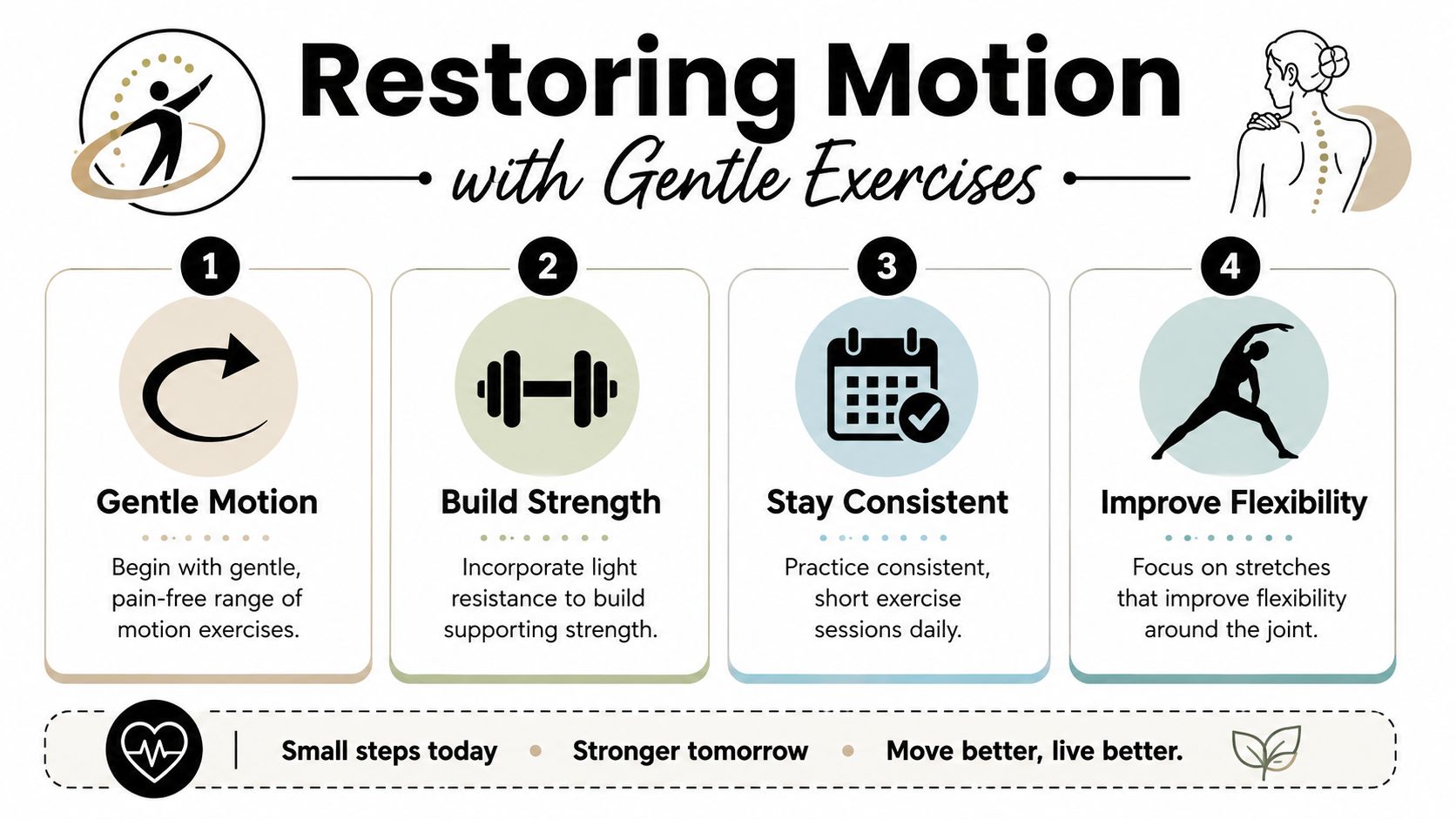
The moment pain calms a little, movement has to come back. That doesn't mean stretching hard or training through a flare. It means using pain-free range of motion to keep the joint from stiffening and the surrounding muscles from shutting down.
Start with the joint, not the ego
For shoulder bursitis, try pendulum swings. Lean forward with the non-painful arm supported on a table, let the sore arm hang relaxed, and make small circles for 30 to 60 seconds. Keep the motion loose, not forced. If the shoulder tenses up, the circle is too big.
For hip-related irritation, glute bridges are often a smart starting point if they stay pain-free. Lie on your back with knees bent, tighten your buttocks gently, and lift the hips only as high as you can without pinching the outside of the hip. Move slowly, then lower with control.
For elbow bursitis, simple elbow bends and straightening can keep the joint moving without loading the sore spot. The motion should feel easy. If leaning on the elbow worsens things, avoid compression rather than trying to stretch through it.
Move in the range that feels boring. Boredom is good here. It usually means the tissue isn't being provoked.
A simple daily pattern
- Pendulum swings: Keep the shoulder loose and relaxed.
- Bridge holds: Build support around the hip without pinching the joint.
- Gentle elbow motion: Reduce stiffness without pressing directly on the bursa.
- Short, frequent sessions: A few calm minutes several times a day usually work better than one long, aggressive session.
The short video below can help you visualize the pace and smoothness you want. Use it as a reminder that controlled movement matters more than intensity.
If you want a more detailed motion routine, this range of motion ROM exercises resource gives a useful framework for starting gently and progressing gradually.
When to Seek Professional Clinic Treatments
Home care often helps early on, but there is a point where clinic treatment makes more sense. If the pain keeps returning, your motion keeps narrowing, or the joint will not tolerate normal daily activity, a clinician can help sort out whether the bursa is the main source of pain or part of a larger movement problem.
What professional care adds
A licensed therapist can spot movement patterns that are easy to miss at home. Manual therapy may help ease protective tightness around the joint, and a personalized exercise plan can address the weakness or movement habits that keep irritating the bursa. In some cases, shockwave therapy or acupuncture may be part of a broader pain management plan when the tissue needs a different stimulus than exercise alone can provide.
One option in a multidisciplinary setting is MedAmerica Rehab Center, where patients can receive physical therapy, chiropractic care, acupuncture, and shockwave therapy as part of a coordinated approach. The value is not the label. It is matching treatment to the pattern driving the pain.

Why precision matters with injections
When a bursitis case needs injection care, technique matters. In a pilot study of refractory ischial bursitis, fluoroscopically guided injections produced a mean pain improvement of 86.25% ± 11.09%, compared with 55.00% ± 13.23% for landmark-based injections, and every fluoroscopy-guided patient reported at least 75% relief (study). That is a clear reminder that the way a procedure is delivered can change the result, not just the procedure itself.
Guidance matters in other injection settings too. For trochanteric bursa injections, ultrasound guidance improved 6-month pain scores versus landmark injection, but the benefit came with about 43% higher annual cost per patient and no clear short-term advantage, so the authors recommended it mainly for extreme obesity or prior injection failure. Professional care matters, but so does choosing the right level of care for the problem in front of you (outcomes study).
If your provider recommends an iontophoresis patch as part of inflammation control, this dexamethasone iontophoresis patch resource explains one of the noninvasive options sometimes used in rehab settings.
Recognizing Red Flags and Important Symptoms
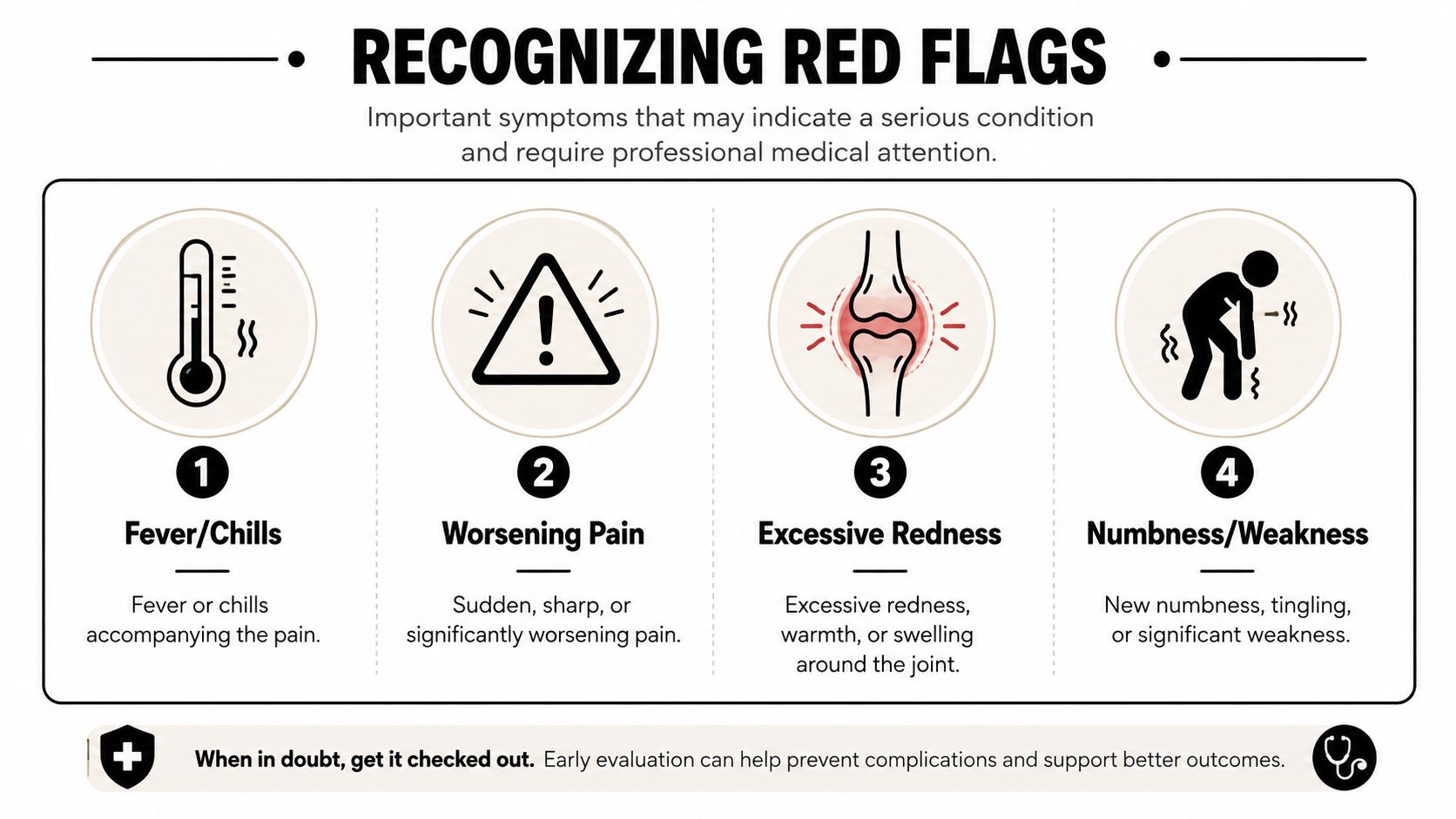
A painful bursa can look like several other problems, including arthritis and tendinitis. If the pain is not following the pattern you expected, do not write it off as simple inflammation. It deserves a closer look.
Red flags that need prompt medical attention
- Fever or chills: These symptoms can point to something more serious than a simple flare.
- Rapidly worsening pain: Sudden escalation, especially if it feels out of proportion, deserves evaluation.
- Marked redness or warmth: Skin changes around the joint can signal a different process.
- New numbness, tingling, or weakness: These symptoms suggest the pain may not be coming from the bursa alone.
Yellow flags that mean it's time to get checked
Persistent pain that does not improve with rest, ice, and over-the-counter anti-inflammatories should prompt a medical evaluation rather than more self-treatment. Pain that keeps coming back after activity is another reason to get assessed, because the underlying issue may be biomechanics, tendon irritation, or joint disease rather than the bursa itself (Mayo Clinic).
A practical rule helps here. If the pain is calming down and staying predictable, keep following the plan. If it is escalating, changing, or staying stubborn despite good self-care, a clinician should sort out the next step. That matters because early guidance can keep a short-term flare from becoming a cycle of overresting, then returning to activity too soon.
People trying to reduce flare-ups also need to watch the load they put on the joint outside treatment sessions. Recovery is not only about pain control, it is also about avoiding the same stress pattern that irritated the bursa in the first place. If meal planning is part of your broader recovery routine, the anti inflammatory foods list can give you practical options without turning food into a quick fix.
Your Recovery Timeline and Staying Pain-Free
Recovery is usually a process, not a single fix. The early goal is to settle irritation. The middle goal is to restore motion and strength. The long-term goal is to keep the same tissue from getting overloaded again.
That means the habits that protect you matter as much as the pain-relief tools. Warm up before activity, especially if the joint has been quiet for a while. Adjust desk height, chair position, sleeping positions, or lifting mechanics so the irritated area isn't getting hit the same way every day. Keep surrounding muscles strong enough to share the load instead of forcing the bursa to absorb it.
Food won't fix bursitis by itself, but an anti-inflammatory eating pattern can support the bigger recovery picture. If you want practical meal ideas, the anti inflammatory foods list is a useful starting point for building healthier options into your routine.
The biggest mistake I see is either resting too long or returning too soon. Both can keep the cycle going. The safer route is steady progress, careful load management, and professional guidance when symptoms aren't settling the way they should.
If your bursitis pain keeps interrupting sleep, work, or exercise, MedAmerica Rehab Center can help you build a plan that matches your pain level, movement limits, and recovery goals. Their team offers physical therapy, chiropractic care, acupuncture, and shockwave therapy in a coordinated setting, which can be a practical next step when home care isn't enough. Visit MedAmerica Rehab Center to get started with a team that can help you move with less pain and more confidence.
MedAmerica Rehab · Deerfield Beach
Talk to a clinician about your pain
Physical therapy, chiropractic, acupuncture and shockwave therapy under one roof, since 1995. Same-day appointments are available.
Mon–Thu 8:00 AM – 6:30 PM · Fri 8:00 AM – 3:00 PM