

Physical Therapy Without Referral: Your Florida Guide
You wake up with a stiff neck, a sharp pull in your low back, or the same knee pain that's been nagging you every time you stand up from the couch. You know you need help. What stops patients isn't the decision to get care. It's the hassle of getting to care.
A lot of Deerfield Beach patients still assume they have to call a doctor first, wait for an appointment, ask for a referral, then schedule physical therapy after that. For many muscle, joint, and movement problems, that extra step isn't always necessary. Physical therapy without referral is real, legal in Florida, and often the most practical first move when pain starts limiting your day.
At our clinic, we spend a lot of time helping people sort out the same questions. Can I start PT right away? Will insurance cover it? When should I see a physician first? The answers are usually simpler than people expect, but the details matter.
The Faster Path to Feeling Better
A common local scenario goes like this. Someone tweaks their back lifting groceries, sleeps wrong on their shoulder, or notices sciatica flaring after a long commute on I-95. They want treatment now, not after a chain of phone calls and calendar delays.
Direct access changes the experience. It means you can contact a physical therapist first for an evaluation instead of treating PT like the final stop in a long referral process. For many orthopedic and musculoskeletal problems, that's a better fit for how people seek care.
What surprises most patients is how few people know this option exists. Direct access remains underused, with utilization estimated at about 6% in privately insured populations, even though it's legally available. That same review also noted that underuse continued even when financial incentives were offered, which points to a major awareness gap among patients and families in the published research on PT access patterns.
Most people don't delay PT because they want to. They delay it because they think the system requires it.
When someone starts care sooner, the first visit can focus on what is happening. Is this a mobility problem, a strain, a nerve irritation, a balance issue, or something that needs medical referral? That kind of screening helps people move from guessing to a clear plan.
If you've never been to PT directly, it also helps to know what the visit feels like in practical terms. Our breakdown of what a typical physical therapy session looks like can make that first step feel a lot less uncertain.
What Is Direct Access Physical Therapy
Direct access physical therapy is the ability to see a licensed physical therapist without getting a physician referral first. The easiest way to think about it is this: if you have a toothache, you go to a dentist. You don't book a separate appointment just to get permission to see the professional who treats the problem. For many movement-related complaints, physical therapy works the same way.
That doesn't make PT a shortcut or a loophole. It's an established care model built around the fact that physical therapists are trained to evaluate movement, pain, function, and safety. When the issue fits conservative care, treatment can begin. When it doesn't, the therapist refers the patient to the right medical provider.
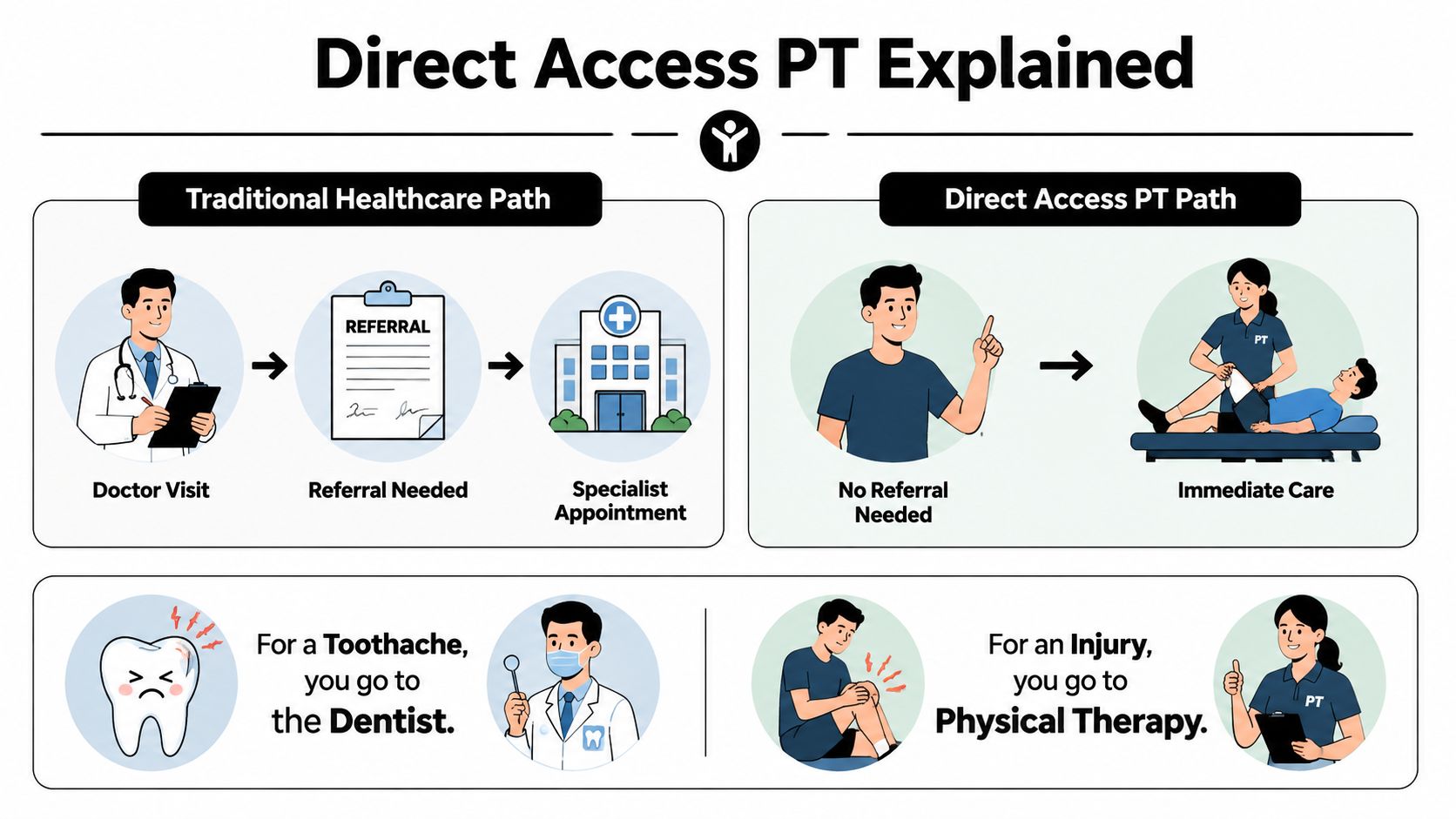
Why this model is now standard
As of July 1, 2025, all 50 U.S. states and the District of Columbia allow patients to access physical therapist services without requiring a physician referral, according to this direct access update summarizing the APTA milestone. That matters because it confirms direct access is no longer a fringe option. It's part of modern outpatient care nationwide.
In practice, that means a patient with back pain, neck stiffness, shoulder irritation, balance concerns, or a flare of arthritis symptoms can often start with PT instead of waiting for a gatekeeping step that may not add value.
Here's the cleaner comparison:
| Path | What usually happens |
|---|---|
| Traditional route | Doctor visit, referral, then PT scheduling |
| Direct access route | PT evaluation first, then treatment or medical referral based on findings |
The second path isn't always the right one for every patient, but it often makes more sense for straightforward musculoskeletal complaints.
What a PT actually does at the first visit
A direct access evaluation is not a rushed exercise session. It starts with history, symptom behavior, movement testing, and screening for anything outside PT scope. We're asking questions like:
- What brings on the pain and what calms it down?
- Is the problem mechanical and tied to movement, posture, lifting, walking, or sleeping position?
- Are there warning signs that point away from routine orthopedic care?
- Can treatment start safely today or does the patient need physician involvement first?
Some clinics also use digital intake and patient communication tools to simplify that process. If you're curious how AI is being used in clinic operations and patient education, you can learn about DocsBot for physical therapy as one example of that trend.
Direct Access Physical Therapy Rules in Florida
Florida allows direct access, but there are rules patients should understand before they assume they can continue indefinitely without any physician involvement. The legal right to start PT and the practical rules for continuing PT are not always the same thing.
For Deerfield Beach residents, the key point is simple. You can often begin physical therapy without referral, but Florida places a time-based limitation on treatment for conditions that haven't already been assessed by a physician.

The Florida rule in plain English
Florida permits direct access physical therapy with certain limitations. Therapists can treat patients for 30 days for a condition that was not previously assessed by a physician. If treatment is required beyond 30 days, a physician must review and sign the plan of care, as explained in this Florida direct access overview.
That means you don't need to panic about getting a referral before your first call. It also means your PT clinic should be thinking ahead if your condition is likely to need longer follow-up.
Practical rule: In Florida, starting PT without a referral is often easy. Continuing longer-term care may require physician sign-off depending on the situation.
What this means for common Deerfield Beach cases
For many short-term issues, the Florida rule isn't a major obstacle. A mild back strain, neck spasm, or overuse shoulder irritation may improve well within that initial treatment window. In those cases, direct access works exactly the way patients hope it will. Faster evaluation, faster treatment, fewer delays.
For more persistent problems, planning matters more. Examples include:
- Chronic arthritis flares that need a longer strengthening plan
- Sciatica symptoms that improve slowly and need progression over time
- Balance and gait issues where steady follow-up is part of the process
- Post-accident pain when symptoms shift over several weeks
In those situations, a clinic should help coordinate the physician review if continued treatment is appropriate. Patients shouldn't be left to discover that detail on their own after care has already started.
Law and payment are not the same
Confusion often arises during this process. State law determines your legal right to begin treatment, while your insurance policy dictates the terms of coverage and payment. A patient might have the legal standing to consult a physical therapist in Florida but still face specific administrative hurdles established by their healthcare provider.
That's why good front-desk screening matters just as much as good clinical screening. The local issue isn't just, “Can I come in?” It's also, “What does my plan require if I do?”
Navigating Insurance and Payments Without a Referral
The insurance question is usually the main concern. Patients don't ask, “Is direct access legal?” nearly as often as they ask, “Will I get stuck with the bill?”
That concern is fair. A significant knowledge gap exists around insurance coverage for direct access. While legally permissible, specific insurance providers may still require prescriptions or prior authorization despite state law, which is why benefit verification matters before treatment starts, as noted in this direct access insurance discussion.

The biggest mistake patients make
The mistake is assuming that if Florida allows PT without referral, every insurance plan will process the claim the same way. They won't.
Some plans are straightforward. Some require prior authorization. Some may ask for a prescription even when the law doesn't. Some workers' compensation and auto-related claims have their own process entirely. That's why “legal access” and “covered access” should always be treated as separate questions.
A practical way to think about common plan types looks like this:
| Insurance type | What to expect |
|---|---|
| PPO plans | Often more flexible, but may still have referral or authorization rules depending on the carrier |
| HMO plans | More likely to route care through a primary doctor or network approval process |
| Medicare Part B | May allow outpatient PT access, but medical necessity and plan details still matter |
| Workers' comp or auto claims | Often follow claim-specific rules, adjuster approvals, or attorney-guided documentation |
This is why our staff checks benefits before a patient assumes anything. We also encourage patients to ask for specifics, not vague reassurance.
Questions to ask your insurance company
When you call your insurer, don't ask only, “Do you cover physical therapy?” That question is too broad. Ask these instead:
- Do I need a physician referral or prescription for outpatient physical therapy under my specific plan?
- Do I need prior authorization before the first visit?
- Is direct access physical therapy covered if I schedule the evaluation myself?
- Is my clinic in network under my plan?
- What will I owe at the visit? Ask about copay, coinsurance, deductible, and whether those amounts change without a referral.
- Are there limits on treatment visits or treatment dates?
- For injury claims, is this processed through health insurance, auto insurance, or workers' compensation?
Write down the representative's name, the date, and the reference number for the call if they provide one.
Patients dealing with job-related injuries also need to understand claim timing and approvals. Our guide on how long workers' comp takes helps explain why benefit verification and documentation can affect access to care.
What if you don't have insurance
If you're uninsured or using a high-deductible plan, direct access may still be the more practical route because it can remove the need for a separate physician visit before starting therapy. That doesn't automatically mean it will be cheaper in every case, but it often simplifies the path and reduces extra scheduling.
For readers trying to understand broader options for medical treatment without insurance in Martin County, that resource gives a useful overview of how uninsured patients often approach healthcare costs and care access more generally.
This short video also helps explain the referral question from a patient perspective:
What works and what doesn't
What works is verifying benefits before the first visit, asking plan-specific questions, and letting the clinic review your coverage if they offer that service.
What doesn't work is assuming the person you spoke with last year gave you an answer that still applies today, or assuming all PT visits are handled the same way across every policy.
Your Guide to Getting PT Without a Referral
Once you know direct access exists, the next step is acting on it the right way. The smoothest starts usually happen when patients do a small amount of preparation before booking.
Step one, choose a clinic that understands direct access
Not every clinic handles direct access with the same level of clarity. Ask whether the office routinely evaluates patients who come in without referral. Ask whether they verify insurance benefits before the first appointment. Ask what happens if your case needs physician review later.
If you're comparing providers, our guide on how to choose a physical therapist can help you sort through the practical differences between clinics.
A good phone call should leave you with answers, not more confusion.
Step two, have the right information ready
Before your first visit, gather the basics so the evaluation can focus on your condition instead of missing paperwork.
Bring or prepare:
- Insurance details if you plan to use coverage
- A list of medications if relevant to your symptoms or balance
- Past imaging or medical notes if you already have them
- A short timeline of when the problem started, what makes it worse, and what you've already tried
- Claim information if your problem is tied to an auto accident or workers' compensation case
Some patients overprepare and bring a stack of records that don't affect the current problem. Some bring nothing and then can't remember when the symptoms began. A simple one-page summary is often enough.
Step three, know when a physician visit should come first
Direct access is useful, but it isn't the right entry point for every symptom. Physical therapists are trained to recognize red flags, and that screening is a core safety feature of direct access care. Patients should still see a physician first for suspected fractures, sudden severe pain without a clear cause, or neurological symptoms, based on this red flag guidance for self-referral situations.
Use this rule of thumb:
| Symptom pattern | Best first step |
|---|---|
| Pain tied to movement or activity | PT evaluation may be appropriate |
| Suspected fracture after trauma | Physician or urgent care first |
| Sudden severe pain with no clear reason | Medical evaluation first |
| Numbness, weakness, or neurological changes | Physician first, then PT as appropriate |
If a problem looks routine but doesn't behave like a routine strain, a good PT won't force treatment. They'll redirect you.
Step four, expect screening, not just exercises
Patients sometimes think a first direct access appointment will be a quick stretch session. It shouldn't be. A proper visit includes listening, testing, movement assessment, and a decision about whether PT is the right first-line care.
That's especially important for older adults with balance issues, active adults with sports injuries, and anyone whose symptoms don't fit a clear pattern.
One local option to consider
In Deerfield Beach, MedAmerica Rehab Center is one option for patients seeking evaluation for musculoskeletal and mobility problems without first obtaining a physician referral, depending on the clinical situation and insurance requirements.
Benefits and Potential Risks of Self-Referring
Self-referring to PT makes sense when the problem is likely musculoskeletal and the clinic handles screening well. The biggest benefit is speed. The second is avoiding unnecessary friction in the healthcare process.
The financial side also matters. Patients utilizing direct access to physical therapy experience reduced healthcare costs, including an 18% reduction in injection-related costs and a 54% reduction in surgical intervention costs, with no evidence of increased patient harm, according to this review of direct access cost and safety findings.
Where the benefits show up in real life
These gains don't happen by magic. They happen because early care can interrupt the cycle of pain, guarding, reduced movement, and escalating treatment. A patient who starts with guided movement, hands-on care, and a focused home plan may avoid drifting into a longer, more expensive path.
Benefits patients often notice first include:
- Faster clinical direction instead of waiting to find out what the next step should be
- Fewer extra appointments when a physician visit isn't needed just to access PT
- Earlier symptom control for strains, stiffness, joint pain, and mobility loss
- Better functional confidence because the patient understands what to do and what to avoid
The risk patients worry about most
The common fear is simple. What if the therapist misses something serious?
That concern is reasonable. It's also exactly why direct access PT depends on screening, not just treatment. Modern PT practice is built around identifying signs that don't fit a routine musculoskeletal pattern and referring those patients for medical evaluation.
The safest version of direct access is not “PT instead of medicine.” It's “PT first when appropriate, medicine first when necessary.”
What doesn't work is self-diagnosing from the internet and assuming every back or neck problem is just a tight muscle. What does work is being evaluated by a licensed professional who can separate a typical movement problem from something that needs physician input.
Get Direct Access Physical Therapy in Deerfield Beach
For Deerfield Beach patients, physical therapy without referral can remove a major barrier between pain and treatment. But the process is easiest when the clinic understands both sides of the equation. The clinical side and the insurance side.
Our team works with local patients who don't want to spend extra time bouncing between offices just to start care for back pain, neck pain, sciatica, arthritis flare-ups, balance issues, or post-injury mobility problems. We help clarify whether direct access fits the situation, whether Florida's timing rules may affect follow-up care, and what questions need to be answered before the first visit.
What patients usually want most is a clear answer to three things:
- Can I be seen without a referral?
- Will my insurance process this correctly?
- If I do need physician involvement later, who handles that step?
Those are the right questions. They're also questions that should be addressed before treatment starts, not after a surprise bill or scheduling delay.
If you're in Deerfield Beach or a nearby community, the next practical move is simple. Call the office, explain what's going on, and ask for benefit verification and scheduling guidance based on your plan and your symptoms.
If you're ready to find out whether you can start care now, contact MedAmerica Rehab Center. Our team can help you understand whether your condition is appropriate for direct access, check the insurance details that matter, and make the process of starting physical therapy feel much simpler.
MedAmerica Rehab · Deerfield Beach
Talk to a clinician about your pain
Physical therapy, chiropractic, acupuncture and shockwave therapy under one roof, since 1995. Same-day appointments are available.
Mon–Thu 8:00 AM – 6:30 PM · Fri 8:00 AM – 3:00 PM