

Deerfield Beach: Iontophoresis Physical Therapy Pain Relief
You wake up, put your feet on the floor, and that first step sends a sharp reminder through your heel. Or maybe it’s your elbow. You reach for a coffee mug, twist a doorknob, or lift a grocery bag, and the same spot flares up again. You’ve tried rest, ice, and over-the-counter pills. The pain keeps coming back.
That’s where iontophoresis physical therapy often enters the conversation.
For many people, the appeal is simple. Instead of sending medicine through your whole body, iontophoresis aims treatment at one irritated area. It’s often used when pain is stubborn, localized, and tied to inflammation in a tendon, ligament, or nearby soft tissue. If you’re in Deerfield Beach and looking for a treatment that feels less intimidating than an injection but more targeted than a pill, this is one of the options your physical therapist may discuss.
A Targeted Solution for Stubborn Pain
A lot of patients who ask about iontophoresis aren’t dealing with vague, all-over discomfort. They can point to the exact spot. The outside of the elbow. The front of the shoulder. The bottom of the heel. The pain is specific, repeatable, and annoying enough to affect daily life.
That pattern matters.
When pain is localized, a targeted treatment can make more sense than a general one. Oral anti-inflammatory medicine travels everywhere. A topical cream sits on the skin and may not reach deeper irritated tissue very well. Iontophoresis physical therapy is different because it’s built around local delivery.
When the pain keeps hanging on
Think about a few common situations:
- The office worker with elbow pain: typing is fine at first, but gripping a bag or pouring from a heavy pitcher hurts.
- The walker with heel pain: the first few morning steps are rough, then the pain eases a little, then returns later.
- The active adult with shoulder irritation: reaching overhead feels pinchy, especially after yard work or exercise.
These are the kinds of problems that often lead someone into a PT clinic asking, “Why won’t this calm down?”
Pain that stays in one small area often needs a treatment plan that’s just as precise.
That doesn’t mean iontophoresis is a magic fix. It’s usually one part of care, not the whole plan. Your therapist still looks at movement patterns, strength, flexibility, swelling, and the activities that keep feeding the irritation. But when inflammation is a major driver, iontophoresis can be a useful tool.
Why patients like this option
People are often drawn to it for three reasons:
- It’s non-invasive. No needle is used.
- It’s localized. The treatment is aimed at the painful tissue.
- It fits inside a broader rehab plan. You can combine it with exercise, hands-on care, and activity changes.
If you’ve been told to “just give it time,” but time hasn’t solved much, this kind of targeted approach can feel like a more practical next step.
How Iontophoresis Delivers Medicine Without Needles
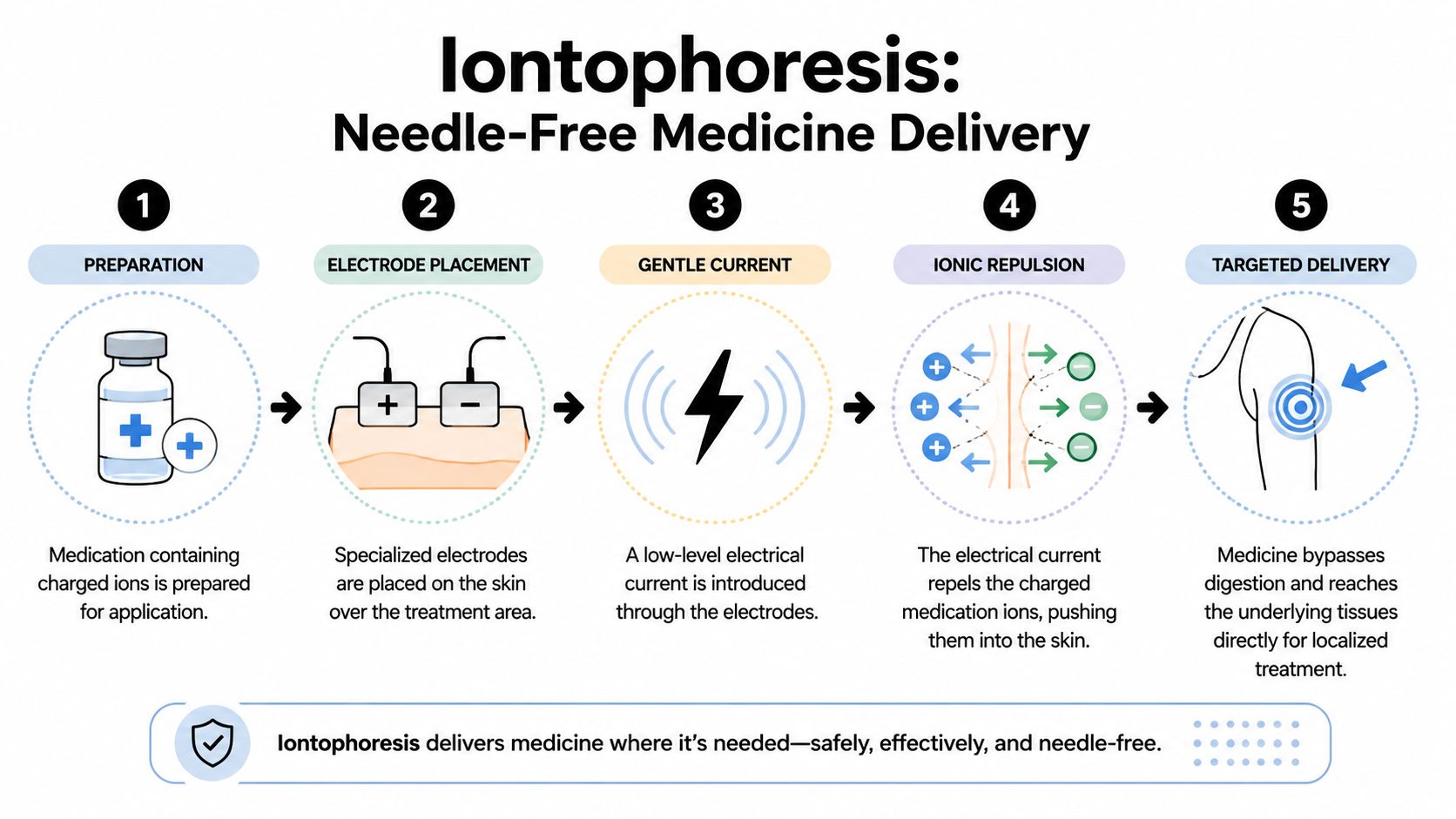
The easiest way to understand iontophoresis is to think of it as a tiny delivery system. Instead of swallowing medicine and hoping enough reaches the sore area, the therapist places medicated electrodes on the skin and uses a gentle direct current to move the medication into the tissue below.
The simple version of the science
Charged particles repel each other. That’s the basic idea.
If a medication carries a negative charge, your therapist places it under the negative electrode so the current pushes it away from that electrode and into the skin. One common example is dexamethasone. During setup, the medication has to match the correct electrode so the treatment works as intended.
That sounds technical, but in practice it’s very organized. The therapist chooses the medication, matches it to the right electrode, places a second electrode nearby, and controls the dose.
What the machine is actually doing
According to this explanation of how iontophoresis works, iontophoresis uses a direct current from 1.0 to 4.0 mA over 20 to 40 minutes to achieve a total charge of 40 to 80 mA-min. That same source notes the process can produce up to 100-fold greater drug penetration than applying a cream, with peak tissue concentrations reached in 10 to 15 minutes.
Those numbers help explain why iontophoresis physical therapy gets attention. The goal isn’t to flood the body with medication. It’s to help more of it reach the exact area being treated.
Why this feels different from a cream or pill
A cream is passive. You rub it on and wait.
A pill is broad. Your digestive system and bloodstream handle it before any amount reaches the sore tissue.
Iontophoresis is more like a guided push. It uses current to encourage the medication through the skin barrier instead of asking the body to do all the transport work on its own. If you want to see how this is often used with dexamethasone, this page on iontophoresis patch treatment with dexamethasone gives a practical example.
Practical rule: The current is meant to be gentle. You should feel a mild sensation, not sharp pain.
The part patients usually worry about
People hear “electrical current” and picture something intense. That’s not what this is. The current is low, controlled, and used for delivery, not to jolt the body. Most patients describe it as tingling, prickling, or mild warmth.
Here’s the main takeaway: iontophoresis physical therapy is a way to move medication through the skin in a focused, needle-free way. Once that clicks, the treatment starts to feel much less mysterious.
Common Conditions Treated with Iontophoresis
Some aches are easy to point to with one finger. Those are often the situations where iontophoresis makes the most sense.
The treatment is usually a better fit for localized inflammatory pain, especially around tendons, ligaments, and other small soft-tissue areas close to the skin. If pain feels widespread, shifting, or hard to locate, your therapist may choose a different plan.
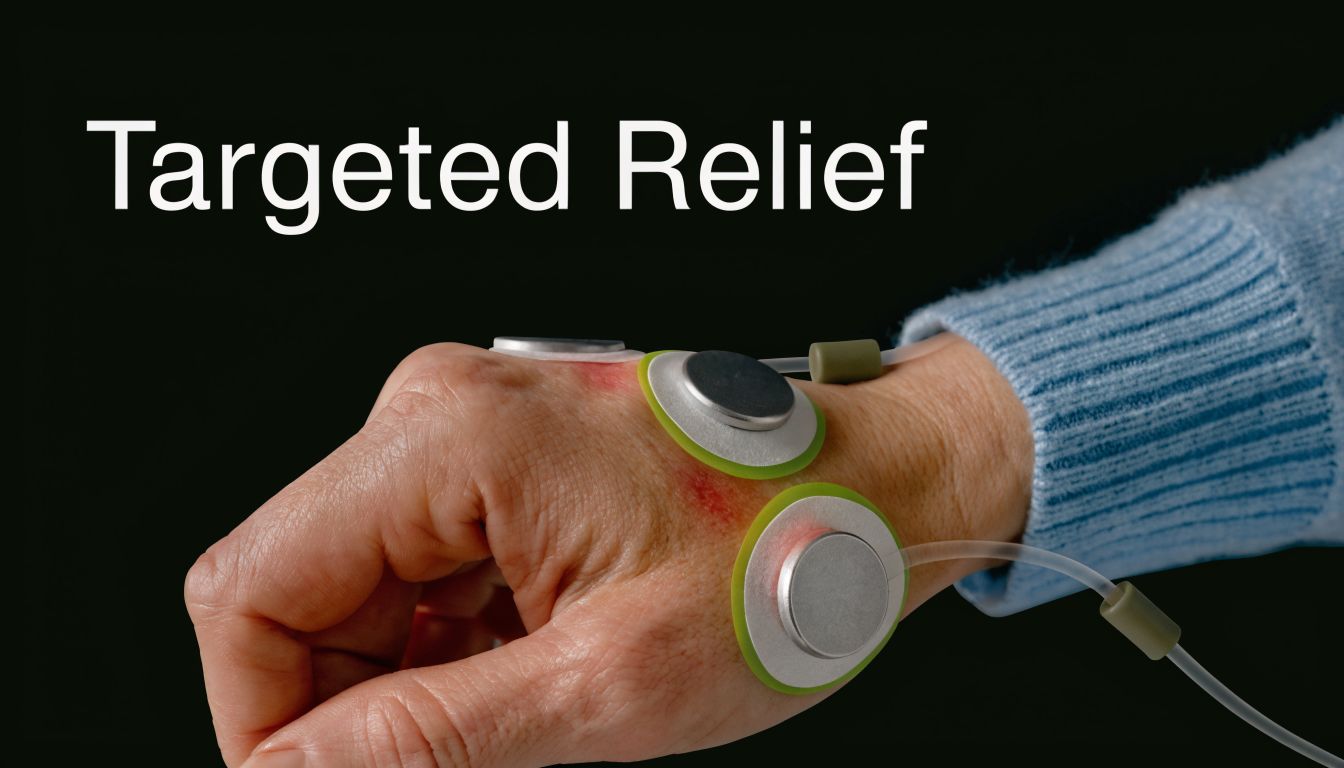
Elbow, shoulder, and wrist pain
A common example is lateral epicondylitis, better known as tennis elbow. You do not need to play tennis to get it. Repeated gripping, lifting, typing, tool use, and gym exercises can all irritate the tendon where it attaches near the elbow.
That matters because iontophoresis works best when the sore tissue is clear and specific. If elbow pain is what brought you in, this guide to tennis elbow pain relief options can help you understand the bigger picture.
Therapists may also use iontophoresis for some cases of shoulder tendon irritation, including pain around the acromioclavicular region, and for irritated tissues around the wrist. The pattern is similar. One irritated structure, pain with a repeat motion, and tenderness in a spot you can find during an exam.
Foot and ankle problems
Heel pain is another frequent reason patients ask about this treatment. With plantar fasciitis, each step can keep poking at the same sore area, almost like bending a bruise over and over. A targeted approach can be helpful when that pain stays stubborn even after rest, stretching, or shoe changes.
It can also be used for selected ankle sprains or irritated tissues near the foot and ankle when local swelling and tenderness continue after the first phase of healing.
Why these problems are often a good match
These conditions tend to share a few features:
- The pain is pinpointed. You can usually show your therapist the exact area.
- Movement repeats the irritation. Gripping, reaching, pushing, or walking brings it on.
- The tissue is sensitive and inflamed. Calming that area can make exercise and hands-on treatment easier to tolerate.
Local delivery helps because the goal is focused treatment, not whole-body medication effects. In clinic, that often makes iontophoresis one useful tool inside a broader plan that may also include exercise, activity changes, and manual therapy.
Patients also ask practical questions about visits and billing once they hear a treatment may be added to a session. If you want a simple breakdown of timed therapy billing, Happy Billing's 8 minute rule guide gives helpful background for understanding how rehab services are commonly counted.
What research and clinical use suggest
Research on superficial inflammatory conditions has reported pain relief in many patients, and physical therapists have used iontophoresis for decades in cases like lateral epicondylitis and other localized soft-tissue irritation. The response still varies from person to person, which is why the exam matters so much.
A good rule of thumb is simple. If your pain is specific, reproducible with movement, and centered in one irritated area, iontophoresis may be worth discussing with your therapist.
What to Expect During Your Iontophoresis Session
Most first-time patients want the same answer before anything else. What’s this going to feel like?
Usually, much simpler than they expect.
The first few minutes
You’ll be seated or lying comfortably so the treatment area is easy to reach. The therapist checks your skin, confirms the medication order if one is being used, and cleans the area. Clean skin matters because it helps the electrodes sit well and reduces the chance of irritation.
During setup, the medication has to match the right electrode. For example, negatively charged dexamethasone is placed under the cathode, and the dose is carefully controlled, often at 10 to 20 mA-min per session, with skin prep used to support safety and effectiveness, as described in this clinical setup overview for iontophoresis.
What you’ll feel once it starts
The machine is turned on gradually. Patients commonly feel one of these sensations:
- A mild tingling
- Light prickling
- A faint warm or buzzing feeling
It shouldn’t feel aggressive. If it does, you tell your therapist right away and the settings are adjusted. This is not the kind of treatment where you’re supposed to “push through” discomfort.
“Tell us what you feel in real time. A small adjustment often makes the session much more comfortable.”
What happens during the rest of the visit
Once the treatment is running, you usually just relax. Some people chat. Some scroll on their phone. Some sit still and let the time pass.
If you’re curious what the equipment and process look like in action, this short demonstration helps make it familiar before your first appointment:
Insurance and timing questions patients ask
People also want to know how this fits into a therapy visit. In many clinics, iontophoresis is part of a larger session that may also include exercise, manual therapy, or movement training. Billing can depend on timed treatment rules and how services are grouped in the visit. If you’ve ever wondered how timed physical therapy codes are commonly handled, Happy Billing's 8 minute rule guide gives a helpful patient-friendly overview.
After the session, your skin may look slightly pink where the electrode sat. That often fades. Your therapist will check the area, review how you responded, and decide whether iontophoresis should remain part of your plan at the next visit.
Understanding the Evidence and Realistic Outcomes
You start treatment because you want a clear answer to a simple question. Is this likely to help, and how will we know?
The honest answer is that iontophoresis can be useful for the right problem, especially when pain is coming from a small, irritated area near the surface, but it is not a guaranteed fix for every tendon, ligament, or soft tissue issue. It has been used in physical therapy for decades, and that long history matters because it gives therapists real clinical experience to pair with research and your exam findings.
What “evidence-based” means for a patient
Evidence-based care is not a promise of perfect results. It means your therapist is choosing a treatment based on research, clinical experience, and your specific symptoms, then checking whether your body responds the way it should.
That last part is what patients often miss.
A treatment can make sense on paper and still be the wrong fit for you. In the same way, a treatment with modest research support can still be helpful if it calms pain enough for you to move better and do the exercise part of rehab more effectively.
What improvement usually looks like
Progress is usually gradual and practical. You are not looking for a dramatic moment where everything suddenly feels normal.
Instead, your therapist will look for changes you can notice in daily life:
- Less pain with one clear activity, such as gripping a pan, climbing stairs, or reaching overhead
- Less lingering irritation after activity, so the sore spot settles down faster
- Better tolerance for exercise, which makes it easier to build strength and restore movement
- More confidence using the area, because each movement feels less guarded
That is often how iontophoresis helps. It lowers the volume on irritation so the rest of your rehab can do its job.
Why results can vary
This treatment is very targeted. That is a strength, but it also means results depend on matching the treatment to the condition.
If your pain comes from a small, inflamed area near the skin, iontophoresis may be a reasonable option. If the problem is deeper, more widespread, or driven by joint mechanics, weakness, or repeated overload, the medicine may not change enough on its own. In those cases, the bigger win usually comes from exercise, activity changes, hands-on care, or a mix of treatments.
That is why good therapists do not judge success by whether you felt a sensation under the patch. They judge it by function.
Short-term relief matters, but it is not the whole goal
Some patients feel improvement fairly quickly. Others notice only a small change at first. Reviews of iontophoresis have described benefits that can be more noticeable in the short term than months later, and there is still some uncertainty about the ideal treatment frequency and how long results last for different conditions, as discussed in this overview of iontophoresis evidence gaps.
For a patient at our Deerfield Beach clinic, that means we set checkpoints early. After a few visits, we should be able to answer practical questions. Is pain dropping? Are exercises easier? Is the area less reactive after normal daily use?
If the answer is yes, iontophoresis may stay in your plan for a short stretch. If the answer is no, your therapist should adjust the plan instead of repeating the same treatment out of habit.
A realistic way to think about success
Iontophoresis is best viewed as one tool, not the whole plan. A helpful comparison is using ice on a sprained ankle before you start walking drills. The ice may calm things down, but the recovery still depends on restoring movement, strength, and confidence.
That is the standard you should expect. Clear reasoning, measurable checkpoints, and a treatment plan that stays focused on lasting function rather than quick symptom relief alone.
Safety, Risks, and Treatment Alternatives
A treatment can sound appealing and still not be right for everyone. That’s especially true with iontophoresis physical therapy, because the best results depend on both the condition and the patient.
Who should avoid it
Patient selection matters more than many people realize. According to this overview of contraindications and patient screening, iontophoresis should be avoided by people with pacemakers, active infections, or compromised skin.
That screening step is important for several groups:
- Post-surgical patients whose skin is still healing
- Older adults with multiple medical conditions
- Anyone with a rash, cut, or irritated skin at the treatment site
If your skin can’t tolerate the electrode well, or if an implanted device raises safety concerns, your therapist should choose another approach.
Common side effects patients notice
Most side effects are local rather than whole-body. The most common concern is skin irritation where the electrode sits. Some patients notice redness, mild tenderness, or temporary sensitivity after the session.
Tell your therapist if you have very sensitive skin, allergies to adhesives, or a history of reacting to topical medications. That’s the kind of detail that helps shape a safer plan.
How it compares with other options
Here’s a simple way to compare common approaches:
| Treatment option | What patients often like | What patients often worry about |
|---|---|---|
| Iontophoresis | Needle-free, targeted, local treatment | Skin irritation, not right for every patient |
| Corticosteroid injection | Direct treatment at the painful area | Involves a needle, can feel more invasive |
| Oral anti-inflammatory medication | Easy to take, familiar option | Affects the whole body rather than one small area |
That table doesn’t crown one option as “best.” It just shows the trade-offs.
How therapists make the choice
A therapist typically looks at four decision points:
- Where is the pain? Local pain is a better fit than diffuse pain.
- What’s irritating it? Inflammatory tendon or soft-tissue problems tend to fit better.
- Can your skin tolerate the treatment? If not, another method may be smarter.
- What are your medical considerations? Implanted devices, active infection, and skin condition can change the answer.
The safest treatment is the one that matches both your diagnosis and your medical history.
A thoughtful PT won’t force iontophoresis into the plan. They’ll use it when it makes sense, skip it when it doesn’t, and explain why.
Start Your Recovery in Deerfield Beach
If you’re dealing with stubborn heel pain, elbow pain, shoulder irritation, or another localized inflammatory problem, the hardest part is often deciding whether to keep waiting or finally get it assessed. Many wait longer than necessary, assuming the pain will settle on its own.
Sometimes it does. Sometimes it doesn’t.
What a first clinic visit usually looks like
A strong first visit should feel organized and calm. You shouldn’t be rushed into a machine without a proper evaluation. The therapist should ask where the pain is, what movements trigger it, how long it has been there, and what treatments you’ve already tried.
If iontophoresis is being considered, they should also review skin condition, medical history, and whether the problem is the kind of localized inflammation that tends to respond to this approach. That kind of screening protects you from wasting time on the wrong treatment.
Questions to ask before you book
It helps to come in with a few practical questions ready:
- Does my condition sound like a match for iontophoresis?
- Will this be combined with exercise and hands-on treatment?
- How will we know if it’s working?
- What should I expect with scheduling and insurance verification?
Those questions usually lead to a better conversation than asking, “Do you offer it?”

Navigating appointments and insurance without the stress
Most patients want logistics to be easy. That means clear scheduling, simple paperwork, and straightforward insurance communication. A clinic that handles these steps well makes it easier to focus on recovery instead of paperwork.
If you’re searching locally, this page for physical therapy in Deerfield Beach is a useful starting point for understanding what services are available nearby and how to begin care.
The right clinic experience should feel welcoming from the first phone call. You should know where to go, what to bring, what your first visit includes, and who can answer benefit questions before treatment starts.
Getting help for persistent pain shouldn’t feel confusing. It should feel like someone has a plan.
When a painful spot keeps limiting your day, clarity matters. A proper evaluation can tell you whether iontophoresis belongs in your plan, whether another treatment would be safer, or whether your symptoms point to a different issue entirely.
If you’re ready to get clear answers and start a personalized treatment plan, MedAmerica Rehab Center offers patient-centered care in Deerfield Beach with same-day appointments, insurance-friendly support, and experienced providers who can evaluate whether iontophoresis physical therapy is right for your condition.
MedAmerica Rehab · Deerfield Beach
Talk to a clinician about your pain
Physical therapy, chiropractic, acupuncture and shockwave therapy under one roof, since 1995. Same-day appointments are available.
Mon–Thu 8:00 AM – 6:30 PM · Fri 8:00 AM – 3:00 PM