
Vestibular System and Concussion: A Recovery Guide
That dizzy, off-balance feeling after a concussion often shows up in ordinary moments. You turn your head in a parking lot and the world seems to lag. You walk through a grocery store aisle and the visual motion feels overwhelming. You look down at your phone, start scrolling, and nausea creeps in within seconds.
Individuals often find the experience unsettling because the impact may have seemed minor. However, the symptoms do not feel minor at all. They can affect work, driving, exercise, reading, sleep, and confidence.
In clinic, I see one problem repeatedly. Patients think dizziness after a concussion should fade with rest alone, so they wait, avoid movement, and hope their body will sort it out. Sometimes it does. Often, it doesn't. When the vestibular system and concussion are linked, the issue is usually a real disruption in how the inner ear, eyes, brain, and neck are working together.
Introduction Why a Minor Hit Can Cause Major Dizziness
A concussion can disturb systems that are delicate, fast, and highly coordinated. The vestibular system is one of them. It helps you stay upright, keep your vision steady, and know where your body is in space without having to think about it.
When that system is disrupted, the symptoms can feel strangely disconnected from the original injury. You may not have much head pain, but you can't tolerate a busy restaurant. You may look normal to everyone else, yet turning in bed or walking into a bright store makes you feel unsteady.
That experience is common, not unusual. Research summarized in this concussion review from CUNY Academic Works notes that vestibular dysfunction is highly prevalent following concussions, with studies showing rates exceeding 80%. The same review reports that children and adolescents with vestibular symptoms often require three times longer to return to school and four times longer to return to play than those without those symptoms.
Practical rule: If dizziness, motion sensitivity, or visual instability lingers after a concussion, don't assume it's something you just have to push through.
Why symptoms can feel so disruptive
The vestibular system doesn't work alone. It coordinates with your eyes, your neck, and the parts of the brain that interpret movement and position. A problem in any part of that chain can create symptoms that seem out of proportion to the original impact.
Common day-to-day triggers include:
- Busy visual settings: grocery stores, traffic, crowds, patterned floors
- Screen use: scrolling, video calls, switching between tabs
- Head movement: quick turns, bending, looking up
- Dual-task activity: walking while talking, reading while moving
- Position changes: getting out of bed, leaning forward, rolling over
The hopeful part
These symptoms are treatable. The key is identifying what's impaired instead of giving generic advice like “just rest” or “wait it out.” A targeted plan works better than guesswork. That plan often includes vestibular rehab, and for some patients, it also needs cervical spine treatment because the neck can keep dizziness going even after the brain begins to settle.
Your Inner Compass Understanding the Vestibular System
The vestibular system is your body's internal navigation tool. Think of it as a built-in gyroscope and motion sensor housed in the inner ear, constantly updating the brain about head position, movement, and balance.

You don't notice it when it's working well. You just stand, walk, turn, drive, and read street signs while moving. That smooth experience depends on rapid, accurate communication between the inner ear and the brain.
What the system actually does
The vestibular system has two major jobs.
First, it helps control balance and spatial orientation. Tiny structures in the inner ear detect head motion and changes in position. They send signals that help you know whether you're upright, turning, accelerating, or tilting.
Second, it helps stabilize vision during movement. When you turn your head, your eyes must move in a coordinated way so the world doesn't blur or bounce. That automatic process is why you can keep your eyes on a target while walking.
Why that matters in real life
If your vestibular system is working normally, you can:
- Walk without drifting: your body makes constant small corrections
- Turn your head and keep reading: your gaze stays stable
- Move in dim light: you don't rely entirely on vision to stay balanced
- Handle uneven surfaces: your brain integrates foot, neck, eye, and ear input quickly
Your balance doesn't come from one body part. The brain compares signals from the inner ear, eyes, muscles, joints, and neck, then decides what's trustworthy.
A simple way to picture it
Think of the brain as a control center receiving live updates from three places:
| Input system | What it tells the brain | Example |
|---|---|---|
| Vestibular system | Head movement and orientation | “Your head just turned left” |
| Visual system | What the eyes see | “The room is still” |
| Body and neck sensors | Joint position and muscle feedback | “Your body is upright and stepping forward” |
When those signals match, movement feels easy and automatic. When they don't, you can feel dizzy, foggy, nauseated, or unstable. That mismatch is where concussion-related vestibular problems begin.
How a Concussion Scrambles Your Brains GPS
A concussion doesn't have to involve a dramatic blow to cause major symptoms. The force of the injury can disrupt how the brain processes movement, eye control, and orientation. The hardware may still be there, but the communication gets noisy.
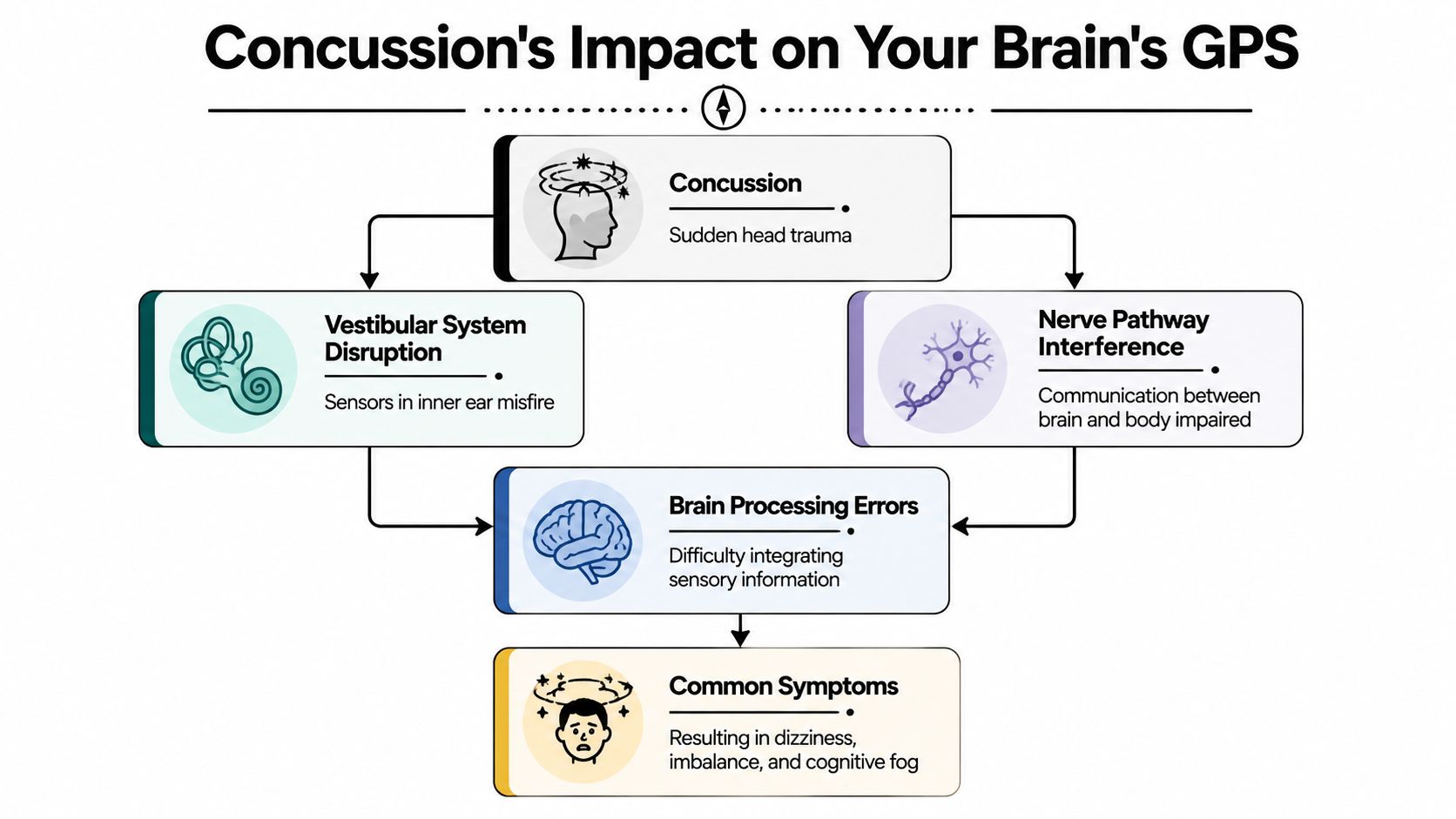
I often explain it this way to patients. After a concussion, your system can act like a GPS that still has power but keeps giving delayed or conflicting directions. Your eyes report one thing, your inner ear reports another, and your brain struggles to reconcile the difference quickly enough.
The sensory mismatch behind dizziness
Here's the classic problem. You turn your head while walking. Your vestibular system should detect that turn and coordinate your eye movement instantly so your visual world stays stable. After a concussion, that reflex may be inaccurate or delayed.
The result is a mismatch:
- The eyes say: the environment should stay clear
- The vestibular system says: movement is happening, but the signal is off
- The brain experiences: blur, lag, nausea, disorientation, or motion sensitivity
That's why patients describe symptoms in ways that sound unusual but are medically consistent. They say the floor feels soft, the room bounces when they walk, or scrolling on a phone makes them feel sick.
Why symptoms don't always show up immediately
Some people feel dizzy right away. Others notice it more once they return to normal tasks. A quiet dark room doesn't challenge the system much. A school hallway, gym, office, or supermarket does.
Symptoms often appear during:
- Visual load: reading, scrolling, driving in traffic
- Head movement: checking blind spots, bending, looking up
- Complex environments: noise, light, crowds, patterned spaces
- Fatigue: the brain has fewer resources to compensate when tired
When patients say, “I'm fine until I move,” that usually points away from laziness or anxiety and toward a movement-processing problem that needs targeted rehab.
Why rest alone often falls short
Rest matters early, but extended inactivity can create another problem. The brain needs the right amount of graded input to recalibrate. If someone avoids all symptom-provoking movement for too long, the system may become more sensitive, not less.
That doesn't mean pushing through severe symptoms. It means using precise, manageable exposure. The right exercise dose helps the brain relearn. The wrong dose, or no dose at all, keeps the system stuck.
Reading the Signs Symptoms and Tests for Vestibular Issues
Vestibular symptoms after concussion don't always look like dramatic spinning vertigo. More often, people report a cluster of subtle but disruptive problems that are hard to describe unless someone asks the right questions.
Common complaints include:
- Dizziness: lightheaded, off-balance, floating, or “not right”
- Visual instability: words move, screens feel harsh, the room seems to bounce
- Motion sensitivity: symptoms worsen in cars, stores, crowds, or while scrolling
- Balance trouble: drifting when walking, hesitation on stairs, unsteady turns
- Nausea and fogginess: especially during reading, multitasking, or busy environments
What we listen for in the clinic
The exact trigger matters. “I get dizzy” is a starting point, not the whole story. Better detail helps shape a more accurate treatment plan.
Useful ways to describe symptoms include:
- What brings it on: head turns, reading, screens, lying down, walking in crowds
- How long it lasts: seconds, minutes, or lingering all day
- What it feels like: spinning, swaying, bobbing, blur, pressure, nausea
- What helps: stillness, closing eyes, reducing light, slowing movement
If headaches are part of the picture, patients often also need a strategy for neck tension, visual overload, and activity pacing. MedAmerica also outlines related considerations in its guide to treatment for post-concussion headaches.
Why objective testing matters
A good exam does more than confirm that you feel dizzy. It identifies which part of the system is failing. That's important because post-concussion dizziness isn't one diagnosis. It can involve gaze stability, visual tracking, balance, neck input, positional vertigo, or several at once.
One useful tool is the Visio-Vestibular Exam, or VVE. According to CHOP's overview of visio-vestibular markers after concussion, specific VVE deficits such as failure in vestibular-ocular reflex suppression or errors in smooth pursuit can predict a prolonged recovery over 28 days with 75-90% sensitivity.
What a focused assessment may include
A clinician may test:
| Test area | What it checks | Why it matters |
|---|---|---|
| Smooth pursuit | How well the eyes track a moving target | Poor tracking can drive reading and screen symptoms |
| Saccades | Quick eye jumps between targets | Deficits can affect focus and visual efficiency |
| VOR testing | Eye stability during head movement | Problems often cause blur and motion intolerance |
| Balance and gait | Postural control while standing and walking | Identifies instability and fall risk |
| Cervical screening | Neck mobility, tenderness, and symptom reproduction | Helps identify cervicogenic dizziness |
A rushed exam misses patterns. A targeted exam gives you something better than reassurance. It gives you a map.
Retraining Your Balance Evidence-Based Vestibular Rehab
Vestibular rehabilitation doesn't rely on passive treatment alone. It uses structured exercise to retrain how the brain interprets motion, steadies vision, and controls balance.
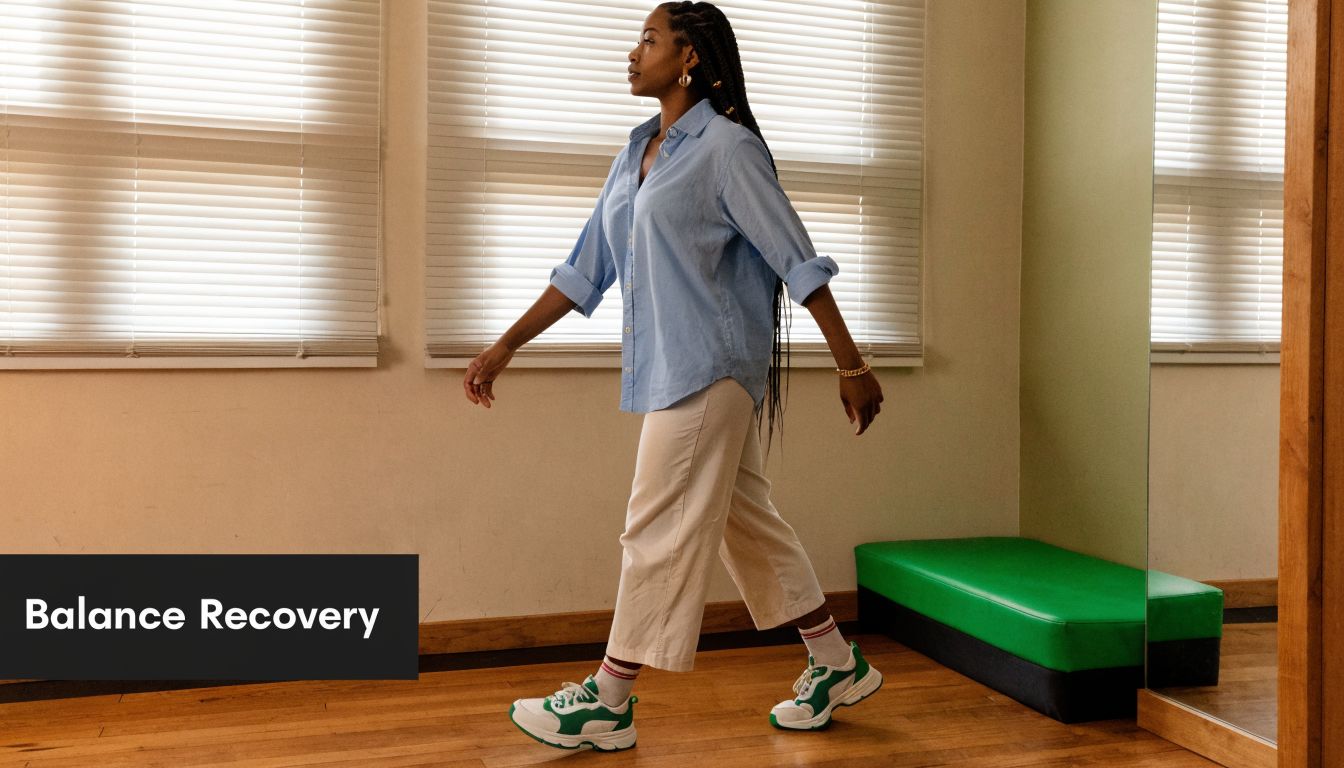
Effective treatment plans are specific. A patient with gaze instability needs different interventions than someone whose dizziness is mostly positional or driven by neck movement. Generic balance drills are insufficient when the underlying problem is visual-vestibular mismatch.
What the evidence supports
Vestibular rehab has strong support in concussion care. A systematic review discussed in this article in the National Library of Medicine found that vestibular rehabilitation can make athletes 10.27 times more likely to be medically cleared to return to sport by 8 weeks post-injury, while also shortening recovery and reducing symptom severity.
That doesn't mean every patient should do the same handout of eye exercises. It means the right program, started at the right time and progressed carefully, can change the trajectory of recovery.
The goal isn't to avoid all symptoms forever. The goal is to expose the system to enough challenge that it adapts without overwhelming it.
The three main parts of VRT
Most vestibular rehab plans draw from three buckets.
Gaze stabilization
These exercises retrain your ability to keep vision steady while the head moves. A common example is fixing your eyes on a target while turning your head side to side. If that movement provokes symptoms in a controlled way, it can help the brain recalibrate over time.
Habituation
Some patients become overly sensitive to specific motions or visual environments. Habituation uses repeated, tolerable exposure to those triggers so the brain stops overreacting. This is useful for people who get dizzy with bending, rolling, looking up, or walking into busy spaces.
Balance and gait training
This work improves how you use vestibular, visual, and body-position input together. Exercises may involve stance changes, head turns while walking, uneven surfaces, or dual-task drills. For older adults, these principles overlap with broader balance training strategies for seniors, especially when concussion has made an already fragile balance system more sensitive.
Here's what that may look like in practice.
| Therapy Type | Goal | Example Exercise |
|---|---|---|
| Gaze stabilization | Keep vision clear during head movement | Fix eyes on a letter while turning head left and right |
| Habituation | Reduce motion-triggered symptoms | Repeated sit-to-supine or bending drills at a tolerable level |
| Balance training | Improve steadiness and confidence | Standing on a compliant surface with head turns |
| Gait progression | Restore safe, efficient walking | Walking while scanning side to side |
| Visual-vestibular integration | Coordinate eye and head systems | Target switching with controlled head movement |
A brief demonstration helps make the process less abstract:
What doesn't work as well
Several approaches tend to slow progress:
- Doing nothing for too long: extended avoidance can maintain sensitivity
- Overdoing it: aggressive home exercises can flare symptoms and reduce compliance
- Treating only one system: eye exercises alone won't fix balance if the neck or gait pattern is part of the problem
- Using internet exercises blindly: the wrong drill can aggravate the wrong problem
The most effective rehab feels specific, measured, and progressive. Patients usually do best when they understand why they're doing each exercise, what level of symptoms is acceptable, and how the plan will be advanced.
Your Recovery Journey Timelines and When to Seek Help
Recovery after concussion rarely moves in a straight line. Many patients experience better days and rougher days, especially when they increase screen time, return to work, or resume exercise. That fluctuation doesn't automatically mean something is wrong. It usually means the nervous system is still building tolerance.
What matters is the trend over time. You should be moving toward better tolerance for reading, walking, head movement, and daily activity, even if progress comes in uneven steps. If symptoms stall, spike repeatedly, or remain hard to predict, that's a sign to reassess the plan rather than only resting longer.
Signs you shouldn't ignore
Some symptoms are not routine vestibular complaints and need urgent medical evaluation.
- Worsening severe headache: especially if it feels different or escalates quickly
- Repeated vomiting: not just nausea, but recurrent vomiting
- New weakness or numbness: especially on one side of the body
- Slurred speech or confusion that worsens: difficulty answering basic questions or staying alert
- Seizure activity or loss of consciousness
- Sudden vision loss or major change in coordination
If symptoms are escalating instead of fluctuating, don't wait for a therapy appointment. Go to urgent care or the emergency room.
A realistic mindset
Patients often get discouraged when they can tolerate a walk on Monday and feel worse after a busy workday on Tuesday. That's common. The better question is whether the overall pattern is improving and whether your treatment matches the actual drivers of your symptoms.
If the exam is accurate and the exercise dose is right, patients regain ground steadily. Patience helps, but passive waiting is not the same thing as guided recovery.
Start Healing Today at MedAmerica Rehab Center
Persistent post-concussion dizziness often has more than one driver. The vestibular system may be impaired, but the neck can also be feeding the brain poor movement information. That's one reason some patients improve only partially with isolated vestibular drills.
A more complete approach looks at both systems. As discussed in this overview of vestibular dysfunction after concussion, many persistent dizziness issues after a concussion stem from the neck, sometimes called cervicogenic dizziness, and a multidisciplinary approach that combines vestibular rehab with chiropractic cervical care can address the full scope of the injury.

Why integrated care matters
If a concussion happened in a car accident, a fall, or a sports collision, the neck often absorbs force too. Stiffness, joint irritation, guarded movement, and altered neck proprioception can all contribute to dizziness, headaches, and visual discomfort.
That's why some patients need a plan that combines:
- Vestibular rehabilitation: gaze stability, habituation, balance, gait progression
- Cervical spine care: mobility work, manual therapy, posture correction, symptom-guided movement
- Functional progression: return to driving, work tasks, exercise, and daily routine
For clinics coordinating multidisciplinary care, clean documentation also matters. For readers interested in how healthcare teams are streamlining clinical note capture, Vatis Tech's 2026 healthcare guide offers a useful look at medical speech-to-text workflows.
What patients can expect locally
At MedAmerica's neuro physical therapy program, concussion-related dizziness care may include vestibular assessment, gait and balance work, and coordination with cervical treatment when the neck is part of the presentation. That matters for adults recovering from auto accidents, active adults trying to return to training, and seniors whose balance confidence dropped after a head injury.
The right first visit should answer practical questions quickly. What movements trigger symptoms? Is gaze stability impaired? Is the neck reproducing dizziness or headache? What level of activity is safe right now? Clear answers reduce fear and make the next steps easier to follow.
If you've been told to just wait, but dizziness still shows up when you turn your head, enter a store, or use a screen, it's time for a more targeted assessment.
If post-concussion dizziness, imbalance, or motion sensitivity is disrupting your life, schedule an evaluation with MedAmerica Rehab Center. A focused exam can identify whether the problem is vestibular, cervical, or both, then build a practical recovery plan around the way your symptoms behave.
MedAmerica Rehab · Deerfield Beach
Talk to a clinician about your pain
Physical therapy, chiropractic, acupuncture and shockwave therapy under one roof, since 1995. Same-day appointments are available.
Mon–Thu 8:00 AM – 6:30 PM · Fri 8:00 AM – 3:00 PM