
Acupuncture for Heel Pain: A Practical Patient Guide
You swing your feet out of bed, stand up, and immediately shift your weight away from a sharp spot under your heel. By the time you reach the kitchen, you're walking carefully, wondering whether another stretch, different shoes, or acupuncture might finally make mornings easier.
The First Step Out of Bed Tells the Story
That first painful step can become the event you organize your day around. You leave shoes beside the bed, hesitate before getting up from your desk, and start calculating whether a trip to the store is worth the discomfort.
Plantar fasciitis is a likely consideration when heel pain follows this pattern, but it shouldn't become a diagnosis made from a search result. Persistent or unusual symptoms deserve an examination, especially when the location, timing, or character of the pain doesn't fit the expected picture.
Start with a decision, not a treatment package
The useful question isn't whether acupuncture works. It's whether it could help you accomplish something specific, such as walking through your workplace more comfortably or completing the exercises your clinician has prescribed.
Think of an ordinary morning rather than a dramatic recovery story. If treatment makes the first trip to the bathroom easier but you still can't tolerate necessary standing, you've gained something, but you haven't yet solved the problem that brought you in.
Practical rule: Decide what you want treatment to help you do before deciding how many appointments to book.
A sensible consultation should leave you able to answer these questions:
- What's being treated? Ask what examination findings support plantar fasciitis rather than another cause of heel pain.
- What counts as progress? Choose activities that matter in your actual day.
- What happens if treatment doesn't help? Agree on a review point and an alternative plan before committing to ongoing visits.
You don't need a sales pitch about needles. You need a working diagnosis, realistic expectations, and a clinician willing to change direction when the results don't justify continuing.
What Is Hurting Under the Heel
Press your thumb into the center of the heel pad, then slide it toward the inner edge where the arch begins. Those two spots hurt for different reasons, and they respond to different treatment plans.
The plantar fascia is a thick band of connective tissue extending from the heel toward the toes. Beneath the heel bone, the fat pad provides cushioning. These structures share the same small area, which is why pointing to the bottom of your heel doesn't identify the painful tissue by itself.
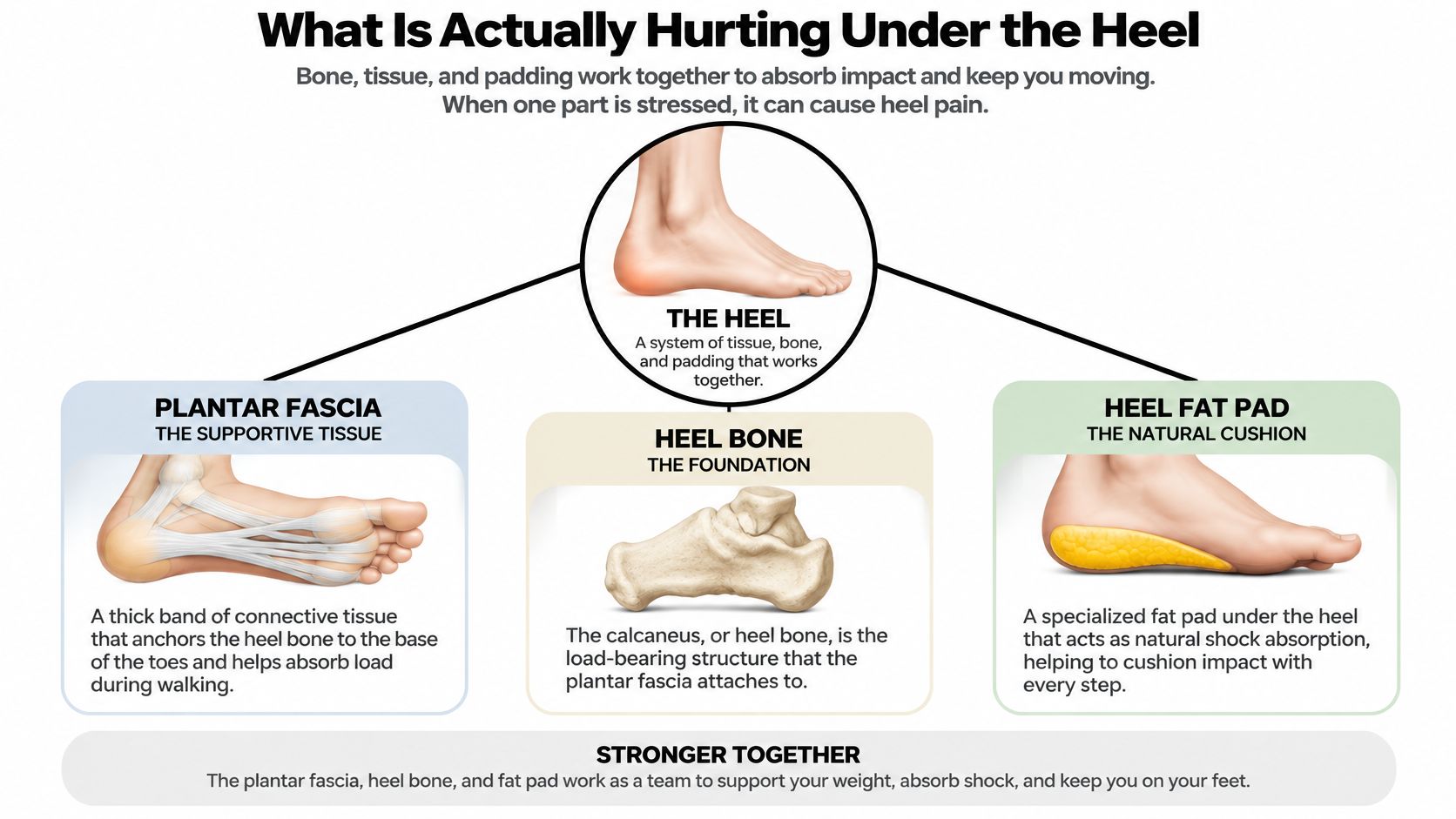
A useful examination considers where pressure reproduces your symptoms and how your foot behaves during movement. Tell your clinician whether discomfort sits underneath the heel, toward its inner edge, through the arch, or behind the heel. Don't assume that every tender spot needs a needle.
Look beyond a simple inflammation story
For treatment planning, load and tolerance tell you more than assuming the fascia is merely inflamed. A clinician should ask about changes in standing, walking, running, footwear, and exercise, then assess calf mobility and strength rather than guessing which factor matters.
The same principle applies to acupuncture mechanisms. Changes in nerve signaling, local circulation, and protective muscle tension are proposed explanations, not proof that needling repairs the fascia. The defensible clinical aim is to change the pain experience enough to support useful movement. A stuck door hinge makes the limits of that aim plain. Making the hinge move more comfortably says nothing about whether the door is aligned or whether its supports can handle repeated use, and a quieter heel is not evidence that the underlying load problem has been corrected.
Two resources can sharpen the conversation. A focused foot and ankle pain assessment should connect your symptoms with examination findings, and NexiHerb LLC's discussion of how lifestyle supports joints offers general context worth reading, though it is neither a heel-pain diagnosis nor a needling prescription. When you leave the consultation, you should be able to name what the clinician thinks is sensitive, what may be contributing, and which parts of the plan address each problem.
What the Evidence Actually Says
Acupuncture for heel pain has a more credible role in short-term symptom management than as a stand-alone cure. That distinction matters when you're weighing repeated appointments against cost, travel, and time away from work.
A systematic review of acupuncture for plantar fasciitis found measurable pain reductions generally emerging during weeks 4–8; it also described a randomized trial using contralateral PC7 or LI4 needling five times weekly for 2 weeks, with assessment at 1 month and approximately 40% pain reduction from baseline in the acupuncture group.
Read the comparison, not just the headline
That result needs careful interpretation. A reduction from baseline describes change within a treatment group, not the amount of benefit attributable to acupuncture beyond a comparator. The trial reported greater improvement in morning pain, overall pain, and pressure-pain threshold, but that doesn't establish that every patient should expect the same response.
A review summary addressing duration of benefit found no further significant pain reduction beyond the short-term window and judged evidence for long-term effectiveness insufficient because the studies differed in their methods. That uncertainty doesn't mean relief must disappear when appointments stop. It means a clinic can't responsibly promise durable recovery from the available findings.
| A clinic's claim | A more useful interpretation |
|---|---|
| Acupuncture reduces heel pain | Ask compared with what, and for which outcome. |
| A particular point fixes plantar fasciitis | Point selection and treatment methods aren't settled. |
| Relief proves the tissue has healed | Symptom change doesn't establish tissue recovery. |
| Continued visits will keep improving results | Ongoing treatment needs its own justification. |
Broader reviews of extremity musculoskeletal conditions have described small effects with limited clinical significance overall. Plantar-fasciitis findings shouldn't be generalized into a claim that acupuncture reliably solves every foot problem.
A discussion of acupuncture for pain relief should therefore include uncertainty alongside potential benefits. Ask the provider to distinguish research findings, proposed mechanisms, and their clinical recommendation. Those are related, but they aren't interchangeable.
A Realistic Treatment Protocol
One patient prepaid for a full package of sessions before anyone had recorded her baseline. Six weeks later, nobody could say whether her heel had improved, only that she "felt looser" walking out of each appointment. A real protocol exists to prevent exactly that. It has a start line, a fixed review, and a stopping rule.
You can borrow the skeleton directly from published research. The BMJ Open trial protocol and its evidence discussion describes repeated 30-minute sessions, 12 sessions over 4 weeks, sometimes scheduled three times weekly, with a responder defined as at least 50% improvement in worst first-step morning pain. That trial reported a 12-week adjusted first-step-pain difference of −12.5 points versus placebo, a 95% confidence interval of −21.6 to −3.4, and no serious adverse events. Treat those figures as a schedule worth copying. They describe a study design, not your prognosis.
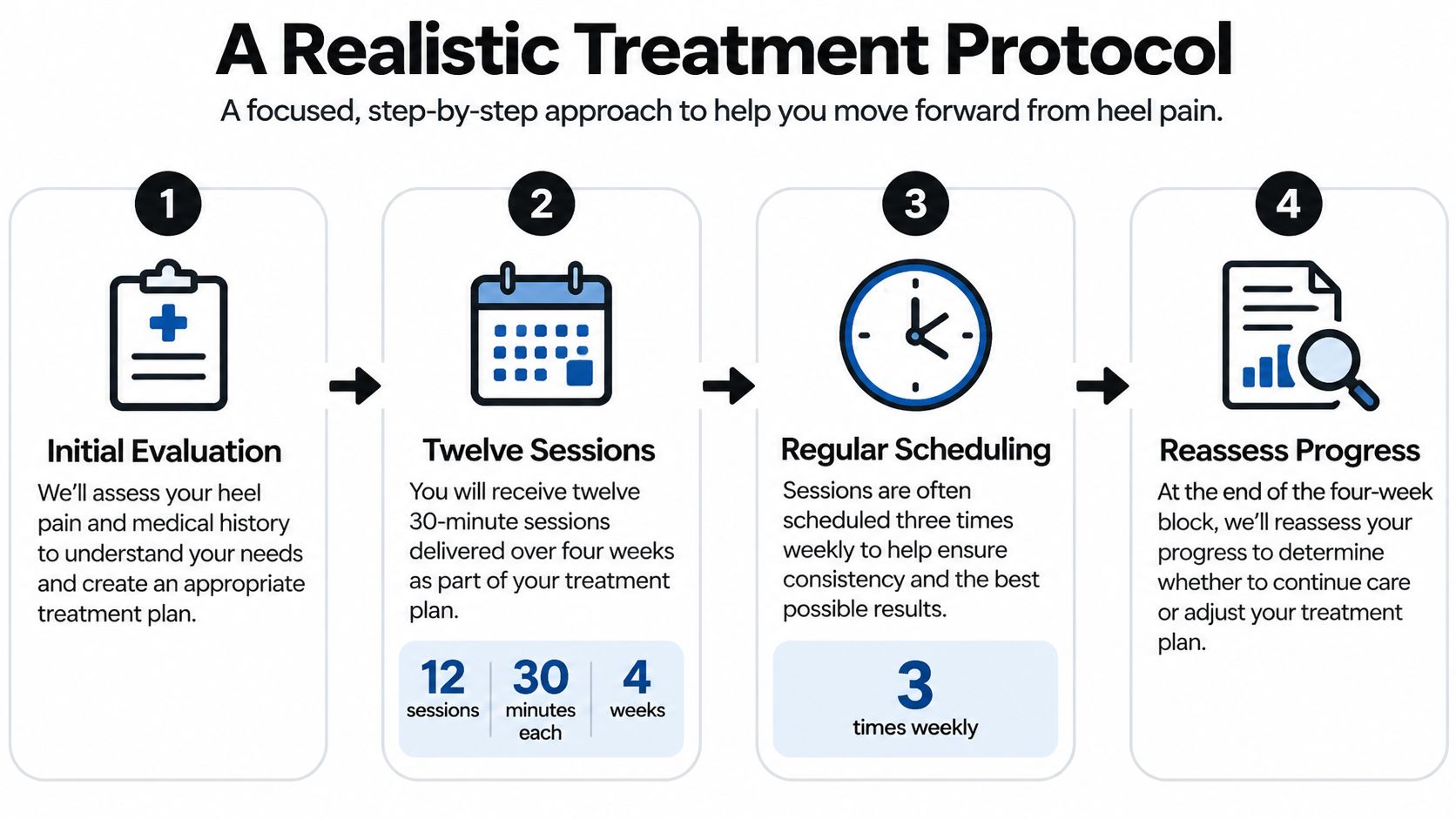
A workable timeline looks like this:
- Before session one. Record a baseline: your first-step morning pain rating, a familiar walking route, and the activities you are currently avoiding.
- Weeks one through four. Run the treatment block as planned. Do not judge it session by session, because feeling better for an afternoon is the expected short-term effect, not evidence of progress.
- The four-week checkpoint. Retest the same morning step and the same route. Comparing a quiet afternoon now against a bad morning last month tells you nothing.
- The decision. Continue, modify, or stop based on the pattern, not on whether the last visit felt good.
The checkpoint is the part most patients are never offered.
A simple diary makes that review honest. Log your morning-step rating, whether you finished a familiar walk, and whether standing to cook or getting through a workday felt easier. Note unusually demanding days too, so a flare after extra standing is not mistaken for treatment failure and a lazy Sunday is not mistaken for recovery. For an example of how exercise instructions can be recorded, the Strive Workout Log mobility guide shows a workable format. It is not a plantar-fasciitis prescription, so use only movements selected for your assessment.
If four weeks pass with no change in function and relief that lasts only until you leave the clinic, the honest question is whether those results justify the appointment burden. Temporary relief after each visit is a reason to reassess the plan. It is not, on its own, a reason to keep booking.
What Happens During a Session
A first appointment runs longer than follow-ups because the practitioner needs your history before a single needle comes out. Expect questions about when the pain started, what provokes it, which treatments you have already tried, and what you have stopped doing because of the heel. The examination follows the same logic, and you should be able to ask why they are palpating the calf or lower leg rather than only the sore spot.
If a practitioner reaches for needles before asking a single question, treat that as a warning sign.
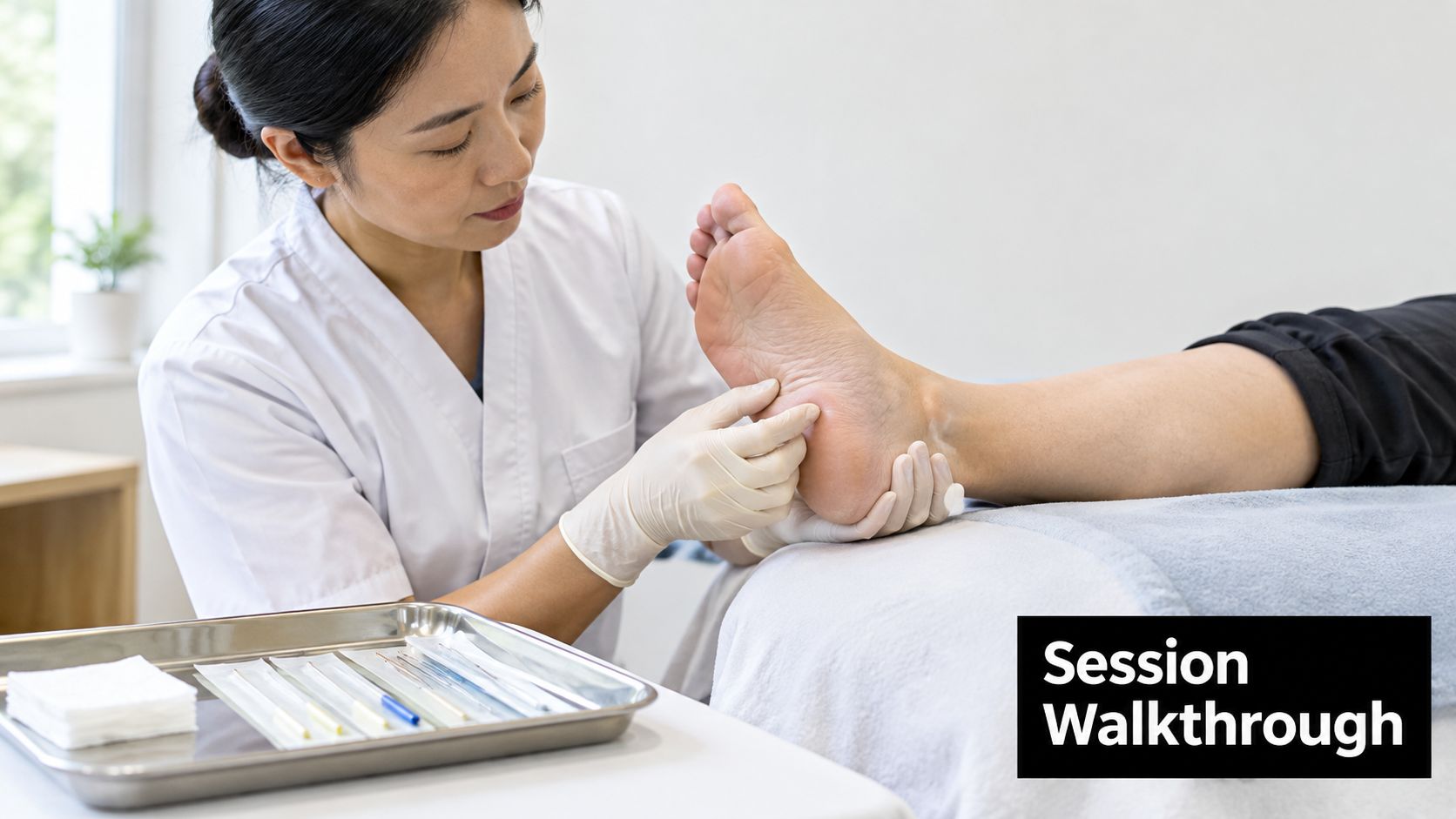
The needling itself is quieter than first-time patients expect. Once points are chosen, you typically rest with the needles in place while the practitioner checks in periodically. Before they begin, ask which sensations they are aiming for, confirm the needles are sterile and single-use, and agree on how you will signal if you want an adjustment or want treatment stopped.
What needling should and should not feel like
A dull ache, heaviness, warmth, or tingling around a needle is a normal response, sometimes called de qi. Sharp, escalating, or distressing electrical pain is not something you must endure to get a better result. Tell the practitioner immediately rather than waiting for the session to end.
Practical preparation stays simple: wear clothing that gives comfortable access to the lower leg, arrive normally hydrated, and ask whether your medical history changes anything about the session. There is no elaborate pre-appointment routine to invent.
This video can serve as a starting point for questions about the treatment process.
The visit should end with a symptom check covering what you felt during treatment and how you feel now. Leave with a documented plan: what was done, which activity is appropriate over the coming days, whom to contact about unexpected symptoms, and what gets reviewed at the next appointment. A comfortable afternoon is not permission to test the heel with unusually demanding activity. Follow the agreed loading plan, and report persistent soreness or worsening symptoms rather than assuming they are normal.
How Acupuncture Fits With Physical Therapy
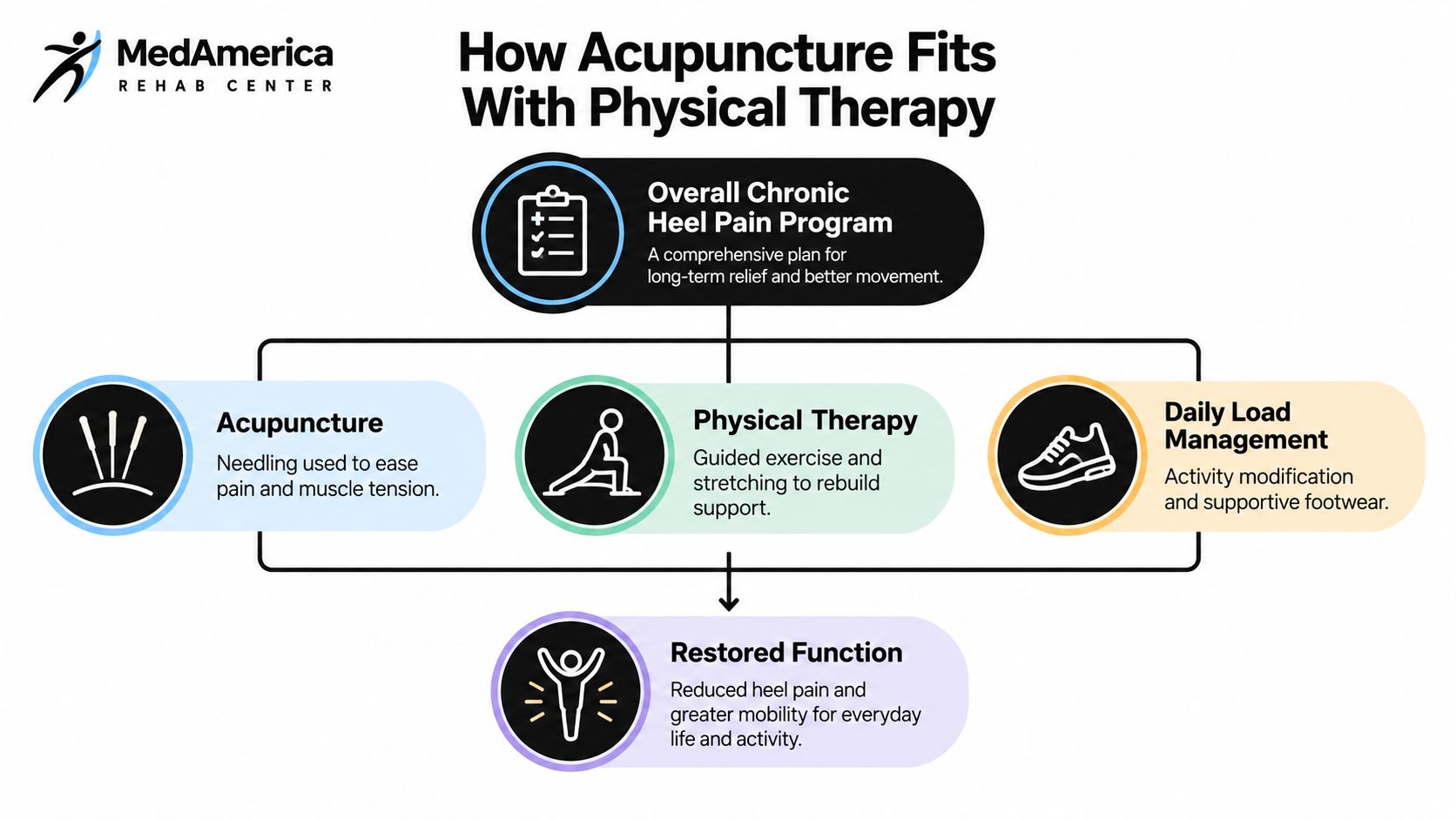
The best reason to include acupuncture is that it may make rehabilitation more manageable. Its value is much harder to defend if appointments repeatedly interrupt exercise or replace the work needed to improve everyday function.
The roles should remain distinct. Acupuncture targets symptoms; rehabilitation addresses movement, strength, and the demands you place on the foot. That doesn't make either approach universally necessary, and it doesn't mean exercise must be painful to be useful.
This diagram shows how needling belongs within a broader program rather than above it.
Match each intervention to a job
A practical rehabilitation plan should specify what you'll change between appointments. Load management, calf and plantar-fascia stretching, footwear modification, and progressive strengthening belong in that discussion, as described in the evidence reviewed earlier.
| Component | What to clarify with your clinician |
|---|---|
| Activity modification | Which necessary activities stay, which optional demands change, and how progression will work. |
| Stretching | Which movement you need, how to perform it, and what response is acceptable. |
| Footwear or orthotic changes | What problem the change is intended to address before you buy anything. |
| Strengthening | Which deficits were found and how exercises will become more demanding. |
| Acupuncture | Whether symptom relief is helping you participate in the rest of the plan. |
For example, if a prescribed exercise aggravates your heel, the response shouldn't automatically be more needling. The therapist should first reconsider the exercise dose, technique, and suitability.
Pain relief is useful when it helps you do something you couldn't comfortably do before. It isn't a substitute for a progression plan.
Understanding what a typical physical therapy session looks like can help you distinguish guided rehabilitation from a sequence of passive treatments. If several practitioners are involved, ask who coordinates the plan.
The same standard applies when chiropractic care or shockwave therapy is proposed. Ask what each service adds, how its results will be judged, and whether you're receiving complementary care or overlapping treatments without a clear purpose.
Safety, Red Flags, and Common Misconceptions
Choose a licensed practitioner and insist on sterile single-use needles. Also expect a medical-history review before treatment. A provider shouldn't assume that a local heel complaint makes the rest of your health irrelevant.
Disclose bleeding disorders, anticoagulant use, pregnancy, compromised immunity, diabetes that isn't well controlled, and any skin infection near a proposed needle site. These are reasons for individualized screening, not a blanket instruction to stop medication or assume treatment is automatically prohibited.
Know when to redirect the appointment
If you have a pacemaker or another implanted electrical device, ask for specific medical clearance before considering electroacupuncture. Tell the clinician about altered sensation as well, since your ability to report what you feel matters during treatment.
Don't make an acupuncture appointment your only response to concerning symptoms:
- Pain after trauma: A fall or injury warrants assessment before assuming plantar fasciitis.
- Systemic or marked local changes: Fever, severe swelling, or a hot, visibly changing foot should prompt medical evaluation.
- An unusual pattern: Night pain, numbness, or steadily worsening symptoms deserve a different level of scrutiny.
Persistent or atypical heel pain may require evaluation for stress fracture, nerve entrapment, inflammatory disease, or Achilles pathology, as noted in the earlier clinical review. Needling shouldn't delay that workup.
Challenge the assumptions that prolong unhelpful care
Acupuncture alone cures plantar fasciitis. That goes beyond the evidence. Ask what the plan addresses besides pain.
More needles mean better treatment. Needle count isn't a meaningful outcome. A tolerable, well-reasoned treatment is preferable to unnecessary intensity.
Pain relief proves healing. Feeling better matters, but readiness for greater activity needs to be judged separately.
The safety finding described earlier is reassuring within that study's limits, not a guarantee of zero risk. A trustworthy practitioner explains uncertainty, welcomes questions, and doesn't blame you when an intervention fails to help.
Putting It All Together at MedAmerica
The most useful decision isn't whether you believe in acupuncture. It's whether a monitored trial makes sense for your diagnosis, priorities, and ability to attend treatment without neglecting the rest of rehabilitation.
Use the reassessment framework above to avoid drifting into care without a purpose. Continue when the benefits are meaningful, modify the plan when progress is incomplete, and reconsider the diagnosis or intervention when the expected changes don't appear.
Arrive with the details that change decisions
Bring your usual walking shoes, a medication list, and a clear description of your daily demands. Explain whether you need to stand through a work shift, walk for transportation, care for family, or return to sport. Those details help a clinician recommend a plan you can follow.
Before leaving the evaluation, ask for practical answers:
- Working diagnosis: What findings support it, and does anything require further medical assessment?
- Home priorities: What should you do between appointments, and what should you temporarily modify?
- Treatment purpose: Why is each proposed service included?
- Decision point: What improvement would justify continuing, and what would trigger a change?
For readers in Deerfield Beach and nearby communities, ask about same-day evaluation availability rather than waiting for the next severe flare. An initial visit should clarify your history, examine the painful area, establish functional goals, and explain the proposed next steps.
You don't have to commit to every available treatment. You need a clinician who can explain why a particular option fits, acknowledge its limits, and help you move toward a routine that no longer revolves around your heel.
MedAmerica Rehab Center offers patient-centered physical therapy, chiropractic care, acupuncture, and shockwave therapy through a family-owned clinic in Deerfield Beach. Visit MedAmerica Rehab Center to ask about a same-day heel-pain evaluation and an individualized plan with clear goals and a scheduled progress review.
MedAmerica Rehab · Deerfield Beach
Talk to a clinician about your pain
Physical therapy, chiropractic, acupuncture and shockwave therapy under one roof, since 1995. Same-day appointments are available.
Mon–Thu 8:00 AM – 6:30 PM · Fri 8:00 AM – 3:00 PM