
Swimming Knee Injury Rehabilitation Plan
You finish a breaststroke set and notice the familiar ache along the inside of your knee. It may settle while you're moving, then return when you climb the pool ladder, walk downstairs, or try to push the pace again. The temptation is to either ignore it until training breaks down or stop swimming completely. Neither response addresses the mechanical reason the knee is irritated.
Swimming knee injury rehabilitation works best when it matches the diagnosis, the stroke creating the load, and the performance level you're trying to regain. Pain control is only the first checkpoint. A swimmer also needs enough hip control, knee capacity, range of motion, and stroke tolerance to handle progressively harder work without a delayed flare-up.
Why Swimmer Knee Happens and What It Means
Knee pain in swimmers is rarely a random accident. It usually reflects a mismatch between the forces created by a stroke and the tissues' current ability to tolerate them. That mismatch becomes especially clear in breaststroke, where the legs fold, rotate outward, and then drive backward through a whip-like action.
The medial knee absorbs much of the stress when the kick combines outward knee motion with rapid rotation and forceful extension. A swimmer may also widen the knees too much, rush the recovery phase, or increase breaststroke volume before the hips and trunk can control the movement. The result is repeated irritation rather than one obvious traumatic event.
The medical literature has recognized this pattern for decades. A review reported that up to 75% of breaststrokers experience medial knee pain, while an epidemiology review found that 34% of the 35 members of the 1972 Canadian Olympic swimming team had knee problems serious enough to require orthopedic consultation (medical review of swimming-related knee injuries). These figures don't mean every painful knee has the same diagnosis. They show that breaststroke knee symptoms are a recurring training-load problem, not an unusual fluke.
The kick matters more than the label
“Swimmer's knee” is a useful description, but it isn't a complete diagnosis. Medial knee pain might reflect irritation around the joint, tendon overload, poor hip control, reduced ankle mobility, or another condition that needs examination. The location of pain helps guide the assessment, but it doesn't tell you which tissue is responsible by itself.
The breaststroke kick also exposes a common rehabilitation mistake. A swimmer can rest long enough for symptoms to quiet down, then return to the same kick mechanics and the same workload. The pain returns because the cause remained unchanged.
Practical rule: If the same stroke and training pattern reliably bring the pain back, rest has reduced symptoms without restoring capacity.
Modern rehabilitation therefore looks beyond the painful spot. It may include stroke modification, hip and pelvic strengthening, quadriceps conditioning, mobility work, and a gradual increase in swimming volume. The emphasis is on changing the load, improving how the swimmer produces it, and testing the knee under increasingly realistic demands.
A breaststroke specialist may need a different pathway from a swimmer recovering after an ACL injury or an adult managing osteoarthritis. Those conditions can share stiffness and weakness, but they don't share identical loading rules or return criteria. The right plan starts by identifying what the knee must eventually do, then building toward that demand rather than following a generic “knee rehab” routine.
Assessing Your Baseline and Modifying Training Volume
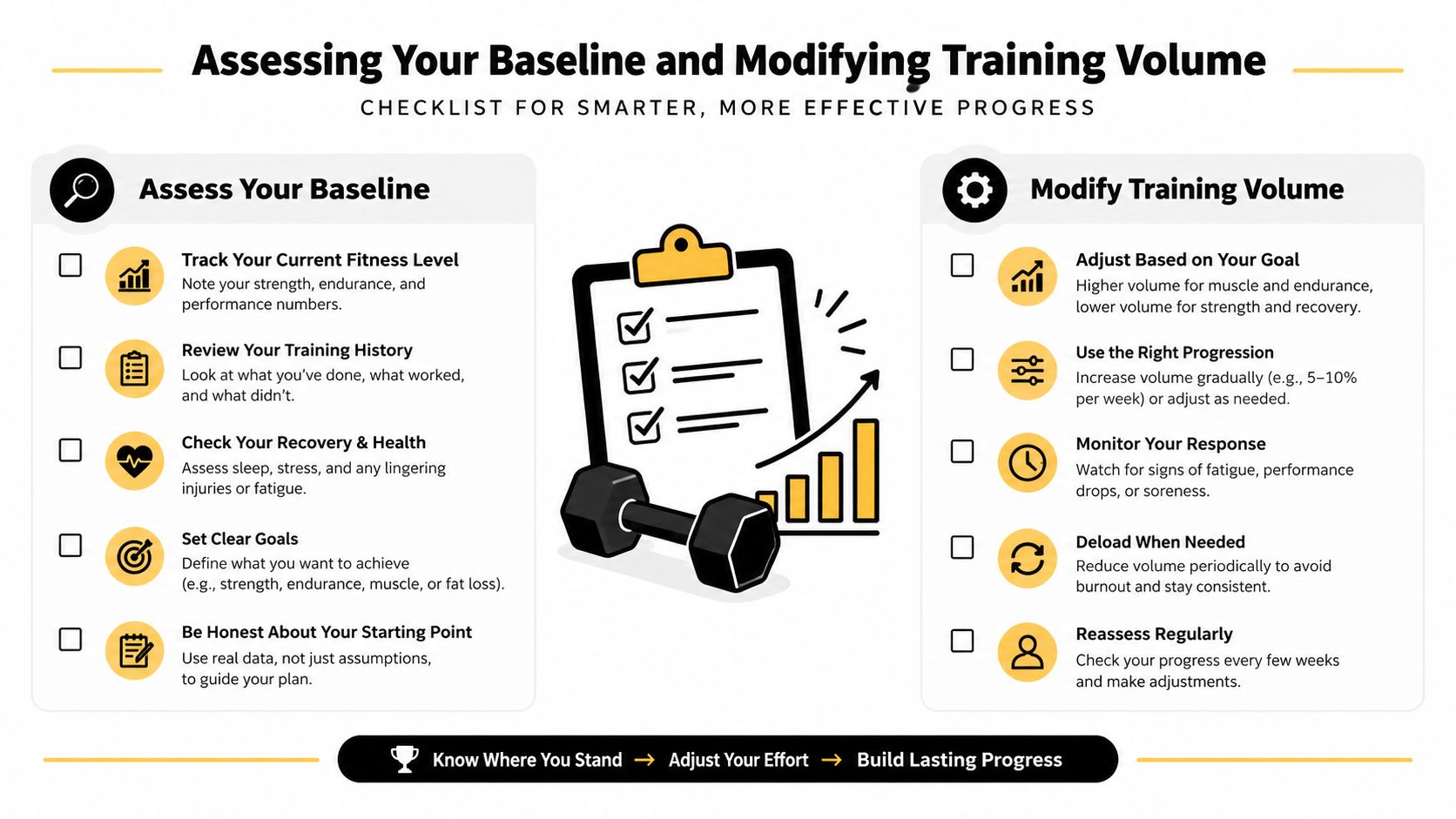
Before adding exercises, establish how irritable the knee is today. A useful baseline includes your resting symptoms, walking tolerance, stair response, knee range of motion, and the movements that reproduce pain. Notice whether discomfort is a dull muscle ache after dryland work or a sharper, localized joint symptom that appears with twisting, kicking, or loading.
Don't use one isolated swim to judge recovery. Look at the pattern during the session, later that day, and the following morning. A knee that feels acceptable in the water but becomes swollen or noticeably stiffer afterward hasn't tolerated that workload well.
Build a training decision, not a blanket restriction
Use your baseline to remove the most provocative elements first. For a breaststroker, that may mean reducing breaststroke lengths and eliminating hard whip-kick sets while retaining an easier stroke that doesn't reproduce symptoms. A freestyle swimmer with a knee problem may tolerate upper-body conditioning and controlled swimming but struggle with forceful wall push-offs or prolonged kicking.
A practical modification sequence looks like this:
- Keep what is quiet. Preserve activities that don't increase symptoms during the session or produce a clear reaction afterward.
- Reduce the trigger. Change stroke selection, kicking intensity, rest intervals, or total work before removing all pool conditioning.
- Remove aggravating equipment. Paddles can increase overall effort, while a pull buoy may alter leg position or encourage forceful wall push-offs. Test each item separately rather than assuming it's harmless.
- Recheck the response. If symptoms build during the workout or remain worse into the next day, the dose was too high.
This isn't permission to push through escalating pain. It's a way to maintain cardiovascular work while reducing the specific movement that's exceeding the knee's current capacity. You may be able to swim with a narrower technical focus, use gentle upper-body work, or replace hard kicking with an exercise that keeps the knee below its irritation threshold.
Don't ask only, “Can I swim?” Ask, “Which stroke, effort, kick, and volume can I recover from?”
Pain that steadily worsens, visible swelling, locking, giving way, or an inability to bear weight warrants professional assessment rather than continued self-testing. A baseline should guide exercise decisions, not replace a diagnosis.
Land-Based Activation and Hip Strengthening
The knee often receives the blame for movement faults that begin higher up. If the hip drops, rotates poorly, or loses control as the leg moves outward, the knee may absorb more of the rotational demand during the breaststroke kick. Dryland rehabilitation should restore that control before asking the knee to tolerate fast, repeated propulsion.
Start with low-effort activation. The purpose isn't to exhaust the glutes. It's to help you feel the pelvis remain stable while the hip muscles produce force.
Phase one builds control
Begin with a bridge, keeping the ribs relaxed and the pelvis level as you lift. If the hamstrings cramp, reduce the height and slow the movement. Add side-lying hip abduction with the top leg slightly behind the body, or use a resistance band around the thighs for controlled outward pressure without allowing the knees to collapse inward.
A dead bug or modified bird-dog can add trunk control. The swimmer should move the limbs while keeping the pelvis quiet, because a stable trunk gives the hip a better base from which to manage rotation. A side plank from the knees is another useful option when a full side plank is too demanding.
Phase two adds single-leg demand
Once basic activation is controlled, progress to supported split squats, low step-downs, and single-leg bridges. Use a wall, rail, or countertop for balance. The knee should track in line with the foot, and the pelvis shouldn't twist to escape the load.
A side lunge can be valuable because it introduces the lateral movement that swimmers often avoid in straight-line training. Keep the step short at first, sit the hips back, and return by pushing through the whole foot. If you're unsure how restricted hip motion is affecting your squat or kick position, this guide to improving hip mobility offers useful movement context.

Phase three prepares the swimmer for force
Progression means improving control, range, resistance, and eventually speed. It doesn't automatically mean lifting heavily. You might increase the depth of a split squat, add a slower lowering phase, use a stronger band, or perform a controlled lateral step while maintaining alignment.
The best exercise is the one you can perform without increasing knee symptoms and with enough quality to repeat consistently. Avoid turning rehabilitation into a random collection of exhausting leg exercises. A tired hip may provide less control, which can recreate the very mechanics you're trying to change.
Include quadriceps strengthening as well. Wall sits, controlled squats, and step-ups can build the knee's capacity for loading, while hip work helps distribute force more effectively. Keep the exercise selection connected to the eventual swim demand, then test that demand gradually in the pool.
The Real Role of Aquatic Therapy in Recovery
Water can make movement easier, but easy movement isn't the same as sport readiness. Buoyancy reduces the effective load on the body and can allow a swimmer to practice balance, range of motion, and controlled strengthening with less joint irritation. That makes aquatic therapy useful when land exercises are uncomfortable or when an adult has broader joint limitations.
A 2026 systematic review found that aquatic rehabilitation improves symptoms and function in knee dysfunction, with the strongest effects reported for knee osteoarthritis and adults under 60. The same review found that programs lasting at least 8 weeks were most beneficial for balance, proprioception, and strength, while quality-of-life improvements were less consistent (2026 systematic review of aquatic rehabilitation).
That evidence supports a bridge, not a shortcut. Water-based exercise may help you move with less pain and regain confidence, but the pool environment can hide weaknesses that appear during a hard breaststroke set, a forceful wall push, or a rapid change in pace.
Match the tool to the problem
Aquatic therapy can be a strong option for:
- Early movement: Gentle range-of-motion work and walking in water can reduce fear around loading.
- Balance practice: Water provides support while you challenge proprioception and leg control.
- General conditioning: You can maintain activity when land-based impact or deep knee loading is poorly tolerated.
- Joint-related symptoms: Adults managing osteoarthritis may benefit from the reduced-load environment.
It's less complete as a standalone plan for a competitive swimmer who needs explosive, repeated rotation. That athlete still needs land-based strength, stroke analysis, and progressive exposure to the exact movements that provoke symptoms.
Feeling better in the pool tells you that the knee likes that environment. It doesn't prove the knee is ready for race-pace loading.
Use the water deliberately. Practice controlled knee flexion, lateral weight shifts, marching, and supported strengthening, then transfer the gains to dryland exercises and swimming drills. For readers who want accessible outdoor movement while recovering, planning accessible Florida paddling can provide ideas for adapting water-based activity to individual ability, though paddling shouldn't be treated as a substitute for a swim-specific return plan.
A physical therapy program in a pool can help match water depth, resistance, and exercise selection to your symptoms. The clinician should still measure what happens outside the water, because a successful aquatic session is only one part of the return-to-performance picture.
Graded Exposure and Return-to-Swim Criteria
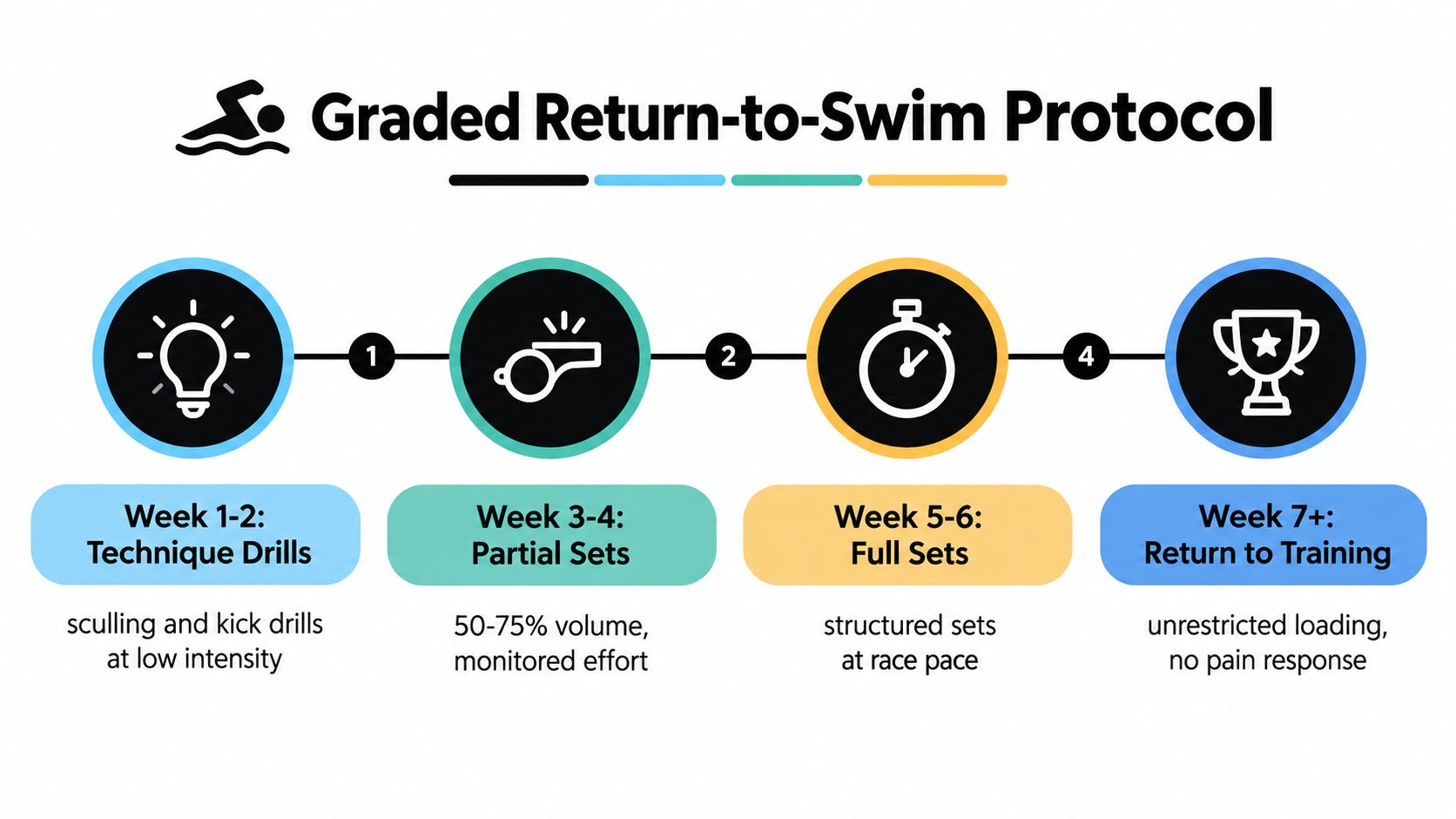
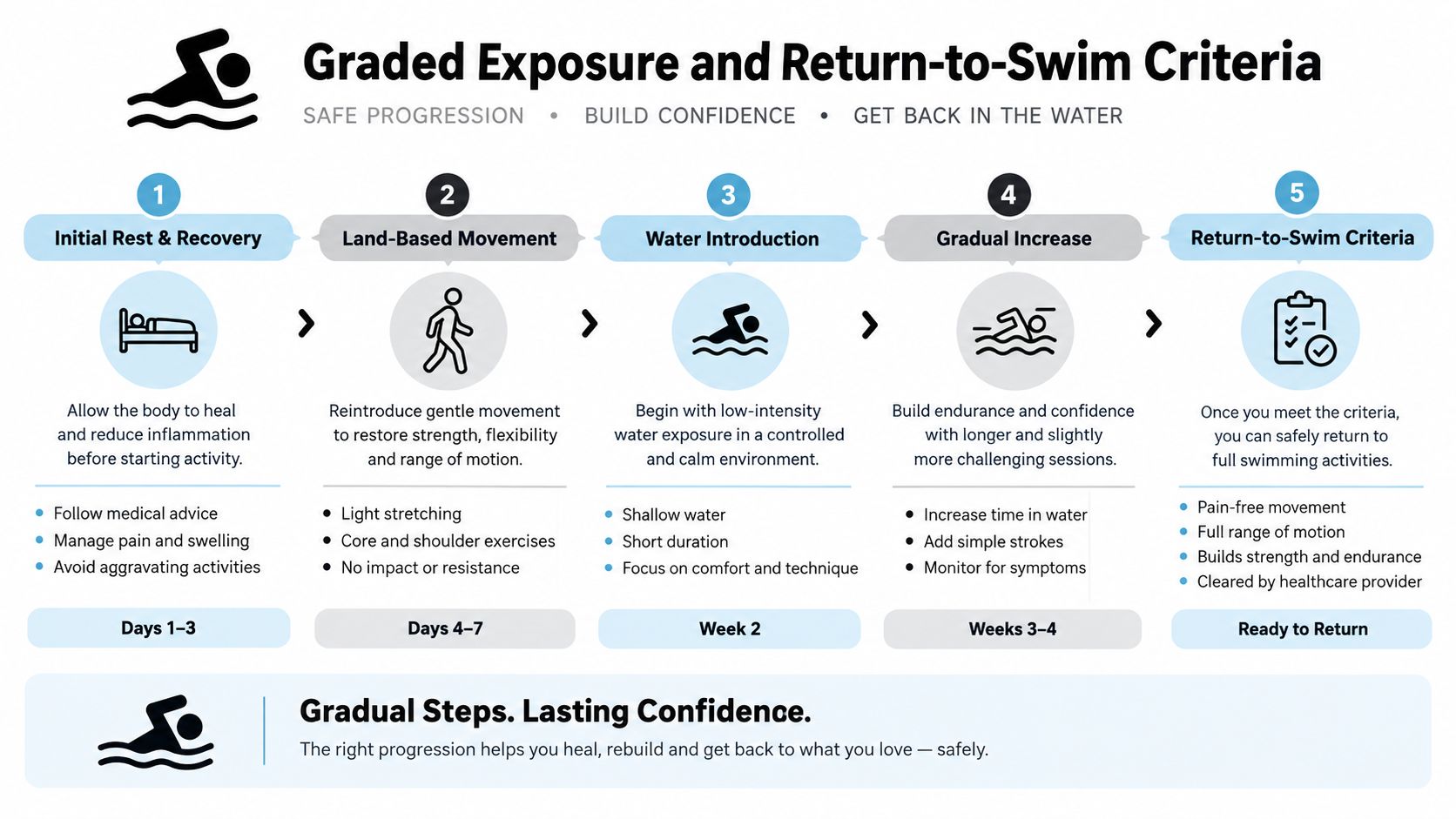
Return to swimming should be treated as exposure to a rising workload, not as a single clearance event. Begin with the least provocative version of your stroke and progress only when the knee handles the current demand without a meaningful delayed response.
The first stage may include easy swimming, technique drills, and controlled body position work. Keep breaststroke kick out if it reproduces symptoms. Use freestyle or backstroke only if those strokes remain comfortable, and remember that wall push-offs and kick intensity can still load the knee even when the stroke itself feels easier.
Use four checkpoints before advancing
You're ready to increase the challenge when:
- Range of motion is comfortable. You can bend and straighten the knee without a painful block.
- Strength is comparable to the task. The involved leg can perform controlled squats, step-downs, and single-leg work without collapsing or provoking symptoms.
- Kick mechanics are consistent. The knees don't flare excessively, the pelvis stays controlled, and the kick doesn't become rushed as fatigue appears.
- The next day is acceptable. Symptoms don't build during the following 24 hours after the session.
A 2026 return-to-swim framework recommends graded exposure and symptom monitoring over the next 24 hours, with modification when pain builds during hard sets, paddles, butterfly, breaststroke, or longer sessions (sports-medicine literature on swimming rehabilitation and return to sport). That approach is more useful than a universal pain threshold because swimmers, diagnoses, and training demands differ.
Progress one variable at a time. You might first increase easy volume, then introduce moderate intervals, then add faster work, and only afterward reintroduce demanding breaststroke kick. If symptoms rise during a hard set, reduce intensity or switch to a lower-irritation stroke rather than completing the planned workload at all costs.
Reintroduce breaststroke with control
Start with technique-focused breaststroke at an easy effort. Pay attention to a compact recovery, controlled knee width, and a smooth finish to the kick. Avoid immediately combining breaststroke kick with maximal pace, paddles, long repeats, or fatigue-heavy sets.
If you need additional guidance on rebuilding exercise after knee injury, MEDISTIK's recovery advice for knee injuries offers general principles for pacing and progression. It shouldn't replace an examination when symptoms persist or the diagnosis is uncertain.
Your return should also reflect your actual goal. Recreational swimming, masters training, and competitive racing demand different workloads. A swimmer who can complete an easy session without pain may still lack the strength and tolerance needed for repeated race-pace efforts. The return-to-play rehabilitation process should therefore be based on demonstrated capacity, not just the disappearance of daily symptoms.
When to Seek Professional Multidisciplinary Care
Self-management makes sense when symptoms are mild, clearly linked to training, and improving with sensible modification. It becomes less appropriate when the knee repeatedly flares, your function declines, or you can't identify which movement is causing the problem.
Seek an evaluation if you have persistent swelling, locking, instability, significant loss of motion, pain at rest, or difficulty walking. A clinician should also assess pain that doesn't respond to reduced swimming load, because recurrent symptoms can reflect more than a simple overload response.
Look beyond the knee
A thorough sports assessment examines the entire movement chain. The ankle may lack the mobility needed for a stable squat. The hip may fail to control rotation. The trunk may shift during single-leg loading, or a lower-back restriction may alter the swimmer's pelvic position. Treating only the painful medial knee can leave the original movement strategy intact.
A physical therapist may observe your squat, step-down, lunge, and single-leg control, then connect those findings to your kick technique. Treatment can combine hands-on work, targeted strengthening, balance training, mobility exercises, and a staged pool program. Heat or cold, electrical stimulation, massage, and other modalities may support comfort, but they shouldn't replace progressive loading and movement correction.
When progress stalls, a multidisciplinary clinic can coordinate those pieces rather than sending you between disconnected recommendations. At MedAmerica Rehab Center, physical therapy, chiropractic care, acupuncture, and shockwave therapy are among the services used within individualized rehabilitation plans for orthopedic and sports injuries. The important question isn't whether a modality sounds advanced. It's whether the overall plan identifies the load problem, restores capacity, and measures your response as training returns.
Professional care is most valuable when it turns recurring symptoms into a specific, testable rehabilitation plan.
A good consultation should leave you with clear answers. What diagnosis is most likely? Which strokes or exercises should change now? What signs permit progression? What response means the workload needs to be reduced? Those answers protect you from both extremes, pushing through a deteriorating knee and resting indefinitely without rebuilding performance.
MedAmerica Rehab Center provides individualized physical therapy, sports injury rehabilitation, hands-on treatment, targeted exercise, and advanced modalities for swimmers managing knee pain or returning to demanding activity. If your symptoms keep returning or your return to breaststroke has stalled, visit MedAmerica Rehab Center to arrange an evaluation and build a progression matched to your knee and training goals.
MedAmerica Rehab · Deerfield Beach
Talk to a clinician about your pain
Physical therapy, chiropractic, acupuncture and shockwave therapy under one roof, since 1995. Same-day appointments are available.
Mon–Thu 8:00 AM – 6:30 PM · Fri 8:00 AM – 3:00 PM