
Sciatica Pain Relief Brace: Your Guide to Lasting Comfort
That sharp pull from your low back into your buttock or leg can make ordinary tasks feel loaded. You stand up from the couch and hesitate. You bend to tie a shoe and feel a jolt. You sit through half a workday and start shifting constantly because one position just won't hold.
When people are in that spot, a sciatica pain relief brace often sounds like the next practical thing to try. That makes sense. A brace is easy to find, easy to wear, and it can provide support when your body feels unreliable.
The key is using it for what it does well. A brace can help calm symptoms and make movement more manageable. It doesn't remove the underlying reason the nerve is irritated. If you treat it like a bridge instead of a cure, it becomes much more useful.
The Search for Sciatica Pain Relief
A lot of patients reach this point after days or weeks of trying to “push through.” They wake up stiff, drive carefully, avoid lifting, and keep hoping the pain will settle on its own. Then one small movement, getting out of a chair, stepping out of the car, turning in the kitchen, reminds them that the problem is still there.

That search for relief usually starts with simple questions. Should I rest more? Should I stretch? Should I use heat, ice, or medication? If you're comparing options for day-to-day symptom control, FindMyScript's guide to pain relief is a useful overview of common over-the-counter choices and how they differ.
Why braces come up so often
A sciatica pain relief brace is now a widely available part of conservative care. Mainstream retail and orthopedic suppliers generally group these supports into lower-back braces and sacroiliac belts, and they market them for symptom control through compression, stability, and reduced irritation around the lumbar spine or pelvis, as described by BraceAbility's overview of sciatica brace options.
That popularity isn't the same thing as a cure.
People often buy a brace because they want enough support to get through work, walk more comfortably, or stop flaring their pain every time they bend. Those are reasonable goals. A brace can help with those short-term problems when it's matched to the right pain pattern and used at the right time.
A brace is most helpful when it gives you enough support to keep moving without repeatedly provoking the same pain.
What readers usually need, but don't get
Most brace pages stop at comfort and compression. They don't tell you the harder truth. If a brace helps, that relief should make it easier to start active treatment, not easier to postpone it.
That's the difference between temporary symptom management and lasting progress. The actual goal isn't wearing support forever. The goal is using support long enough to walk better, move better, and build the strength and mobility that your back and pelvis need.
Understanding Sciatica and the Role of a Brace
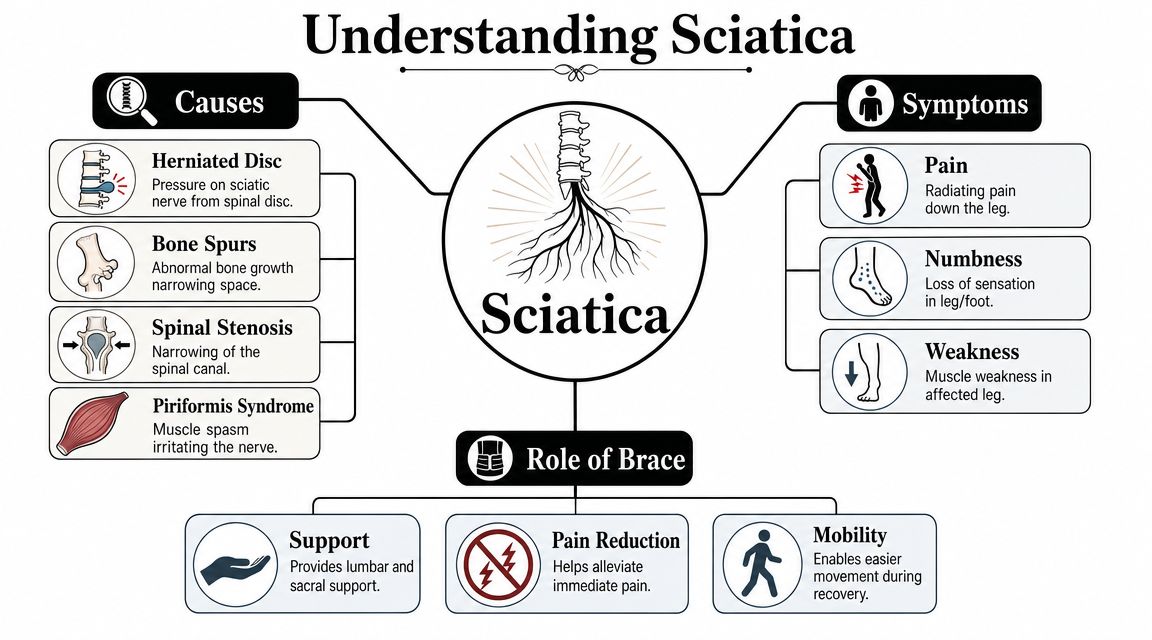
Sciatica isn't a diagnosis by itself. It's a symptom pattern. You feel pain, tingling, numbness, or weakness along the path of the sciatic nerve because something is irritating that nerve or the nerve root that feeds it.
A simple way to think about it is a kinked hose. The hose isn't the problem by itself. Something is bending it, compressing it, or creating tension on it. With sciatica, that “something” may be a disc issue, narrowing around the nerve, or irritation tied to the way the low back and pelvis are moving.
What a brace actually does
A brace doesn't go into the spine and “fix” the nerve. What it can do is change the mechanics around the problem.
Clinical guidance on lumbosacral support describes the main job clearly. A brace can reduce painful spinal motion, limit aggravating flexion and extension, and give proprioceptive feedback so you move with more control. If you want a practical overview of that low back and sciatica connection, MedAmerica's page on sciatica and back pain treatment explains how these symptoms often overlap in real patients.
The biomechanical reason some braces help
One of the more useful findings in this area came from a study of a novel sciatica brace that paired patient symptom tracking with cadaveric nerve-motion analysis. Researchers reported reduced pain on the Visual Analogue Scale immediately after bracing and again at the 7-day follow-up, along with improved patient-reported outcomes and Sciatica Bothersome Index scores. The same study found the measurable pain difference wasn't sustained at the later follow-ups, and the mechanical analysis suggested the brace worked by reducing sciatic nerve excursion, especially at the ankle, effectively “detensioning” the nerve rather than treating the spinal cause directly, as reported in the Indiana University study on sciatica bracing biomechanics.
That matters because it gives us a realistic frame. A brace may reduce the strain that reproduces symptoms. It may make walking, standing, or transitioning from sitting easier. It does not mean the underlying driver has been corrected.
Clinical takeaway: If a brace helps quickly, that's useful information. It suggests symptom reduction through support and mechanical offloading, not that the root cause is gone.
Why that distinction matters
When people understand this, they make better decisions. They stop expecting a brace to solve a disc problem, a movement control problem, or sacroiliac instability by itself. Instead, they use it to create a calmer window where exercise, mobility work, and guided rehab are possible.
Exploring the Types of Sciatica Braces
The brace market can feel messy because many products look similar online. In practice, most fall into a few functional categories. The two major established categories in common use are lower-back supports and sacroiliac belts, both of which have become standard non-surgical tools for symptom management in conservative care.
A third label you'll also see in the marketplace is decompression brace. That term usually describes a more structured lumbar support designed to unload the low back more aggressively than a simple elastic belt.
The main brace categories
A lumbar support belt wraps around the lower back and abdomen. Its job is broad support. It can help when bending, standing, lifting, or prolonged sitting aggravates the low back and sends pain down the leg.
An SI belt sits lower, around the pelvis. It compresses the sacroiliac region rather than the lumbar spine. This can be useful when pain feels linked to pelvic instability, asymmetry, or transitions like standing from sitting, rolling in bed, or standing on one leg.
A decompression-style brace is usually stiffer and more structured. It aims to offload the lumbar segments more directly. Some people tolerate these well during acute flare-ups. Others find them bulky for regular daily wear.
Comparison of Sciatica Brace Types
| Brace Type | Primary Function | Best For | Key Feature |
|---|---|---|---|
| Lumbar support belt | Limits painful low-back motion and adds abdominal support | Pain triggered by bending, lifting, sitting, or general low-back strain | Broad lumbosacral support |
| SI belt | Compresses and stabilizes the pelvis | Pain patterns that seem lower, off-center, or linked to sacroiliac irritation | Low-profile pelvic compression |
| Decompression brace | Offloads lumbar segments with more structure | Short-term support during stronger flare-ups or more motion-sensitive symptoms | Firmer frame or reinforced tension system |
The trade-offs people notice in real life
No brace type wins in every situation.
- Lumbar belts are versatile, but they can ride up if the fit is poor.
- SI belts are less bulky, but they won't do much if your pain is clearly being driven higher up in the lumbar spine.
- Decompression braces can feel more supportive, but some people stop wearing them because they're harder to fit under clothing or tolerate during a full day.
The right brace should reduce aggravation during specific activities. If it only feels tight, hot, or restrictive, it isn't doing its job well.
A practical way to think about the options
Choose by pain pattern, not by marketing language. If your symptoms worsen with trunk movement, a lumbar option usually makes more sense. If the pain feels tied to pelvic loading and asymmetry, an SI belt may fit the problem better. If you need stronger temporary support during a sharp flare, a more structured lumbar brace may be worth considering.
How to Choose the Right Sciatica Brace for You
The best sciatica pain relief brace is the one that matches the problem you're having. That's where many people go wrong. They buy the most rigid brace they can find, or the first one with good reviews, without asking what movement or position is driving the pain.
Clinical guidance is clear on one point. A lumbosacral support should be an adjunct to active treatment, not a stand-alone fix. Its role is to limit painful spinal motion and provide feedback so symptoms from issues such as disc herniation or mechanical low-back irritation are easier to manage, and outcomes are better when bracing is paired with exercise therapy focused on centralizing pain and restoring mobility, as summarized in this clinical discussion of choosing a back brace for sciatica.
Match the brace to the pain pattern
Start with the behavior of your symptoms.
- Pain with bending or sitting: A lumbar support is often the more logical place to start.
- Pain with rolling, stairs, or standing on one leg: An SI belt may fit the pattern better.
- Pain during heavier tasks or prolonged upright activity: A more structured lumbar brace may provide the extra offloading you need for short periods.
This isn't a diagnosis. It's a screening tool. If your symptoms are severe, unusual, or confusing, get evaluated rather than guessing.
Check the fit before you judge the brace
A good brace should feel supportive, not punishing.
Look for:
- Adjustability: You want to change compression based on activity and comfort.
- Breathable material: If the fabric traps heat badly, people stop wearing it.
- Secure positioning: It shouldn't drift upward when you sit or walk.
- Low enough profile for daily use: If you can't wear it under normal clothing, adherence drops.
If you're helping a parent, spouse, or another family member sort through support devices in general, this guide to durable medical equipment for caregivers is a practical starting point for understanding how support tools fit into broader care planning.
Use the brace to enable movement
This is the part that changes outcomes. If the brace reduces pain enough for you to walk, do your home exercises, or tolerate therapy, it's doing useful work. If it becomes your reason to avoid rehab, it starts working against you.
Relief is only step one. The point of support is to help you return to controlled movement, not to replace it.
Wearing a Brace Safely for Maximum Benefit
The most common mistake isn't buying the wrong brace. It's wearing a decent brace for the wrong reasons and for too long.
A lot of people worry about dependence, and that concern is reasonable. Rehabilitation guidance for back pain and sciatica favors active, movement-based care over passive support. Selective, brief brace use can improve function in the short term, but prolonged reliance can delay recovery or hide a problem that needs more direct treatment, as discussed in this review of sciatica brace use and overuse concerns.
Wear for support, remove for strengthening
That principle keeps many on track.
Use the brace when an activity predictably aggravates symptoms. Take it off when you're resting comfortably, doing prescribed exercise that doesn't require external support, or whenever it stops helping and starts feeling like a crutch.
A useful complement to that approach is understanding what active rehab looks like. MedAmerica's overview of what a typical physical therapy session looks like helps people connect short-term support with the work that restores function.
Practical do's and don'ts
- Do wear it during trigger activities. Driving, chores, standing tasks, or transitional periods during a flare are common examples.
- Do check your skin and comfort. Chafing, pinching, or numbness from the brace itself means the fit is off.
- Do loosen or remove it if breathing feels restricted. A brace should support the trunk, not make you brace against the brace.
- Don't sleep in it unless a clinician specifically tells you to.
- Don't wear it all day by default. More hours doesn't automatically mean more benefit.
- Don't use it to push through worsening nerve symptoms. Support should reduce irritation, not help you ignore it.
Signs the brace may be hurting more than helping
Pay attention if:
- Pain spreads farther down the leg
- You feel more numbness or weakness
- The brace shifts constantly and changes your posture awkwardly
- You feel less confident moving without it after relying on it for too long
Practical rule: If a brace helps you move better for a while, keep it in the plan. If it replaces movement, it's time to change the plan.
Beyond the Brace Lasting Sciatica Solutions in Deerfield Beach
You wear the brace, the edge comes off, and walking to the car feels possible again. That relief matters. It also has a job. A brace should help you move enough to start correcting the problem that is irritating the nerve, not become the whole plan.

What active care addresses that a brace can't
A brace can limit painful motion and give short-term support during a flare. It cannot restore hip mobility, improve trunk endurance, or retrain the bending, sitting, and walking patterns that keep provoking leg symptoms. In clinic, that is the difference patients feel over time. Support may calm things down for the day. Active treatment changes how the body handles load.
Longer-term sciatica care usually includes a few pieces working together:
- Targeted physical therapy: Exercises chosen for your presentation, with the goal of improving mobility, building strength and endurance, and reducing radiating pain during daily activity.
- Hands-on treatment when it fits the case: Useful for stiffness or guarding when pain is making normal movement hard to tolerate.
- Activity and position changes: Small adjustments to sitting, lifting, driving, sleep setup, and work tasks can reduce repeated nerve irritation.
- A graded return to normal activity: Walking, errands, exercise, and job demands need to be built back up in a way your symptoms can handle.
Some treatment plans also use symptom-relief tools to make exercise and movement more tolerable. One example is iontophoresis as part of physical therapy care, which may be used in some rehab settings for targeted anti-inflammatory medication delivery.
Why combined care helps some patients
Sciatica is not one-size-fits-all. One person needs help unloading an irritated lumbar nerve root. Another has severe stiffness, poor tolerance to sitting, and weakness that shows up after ten minutes on their feet. The treatment plan should match that reality.
That may include:
- Physical therapy for movement assessment, exercise progression, gait work, and strength
- Chiropractic care when joint restriction or spinal mechanics are part of the problem
- Acupuncture or other non-invasive pain-relief options when symptoms are limiting participation in rehab
- Modality-based care for selected cases where soft tissue irritation or pain sensitivity is slowing progress
MedAmerica Rehab Center offers physical therapy, chiropractic care, acupuncture, and other rehab services in Deerfield Beach. For the right patient, having those options in one setting can make care easier to coordinate and easier to follow through on.
Some readers prefer seeing movement strategies in action before starting care. This video is a good example of guided education that helps people replace fear with useful movement.
Use the brace as a bridge
The better question is not which brace will fix sciatica. The better question is what the brace lets you do today that supports recovery this week.
That mindset changes how people use support. The brace becomes a short-term aid for walking, standing, driving, or getting through early therapy sessions with less irritation. Real progress comes from restoring movement quality, strength, confidence, and tolerance for daily life. If the brace helps you start doing that, it is doing its job.
When to Seek Professional Sciatica Care
You wake up, put the brace on before your feet even hit the floor, and plan the day around how long your back and leg will tolerate standing, driving, or walking. That pattern matters. A brace that helps you function can be useful, but if you depend on it to get through ordinary tasks, it is time to get the problem assessed.
In clinic, I look at brace use as a clue. If symptoms calm down enough to let you move, that is a good start. If pain or tingling returns every time the brace comes off, or your activity keeps shrinking week by week, self-management has probably gone as far as it can.
A helpful overview of that turning point appears in this patient guide on when brace use should lead to further care.
Get urgent medical attention for red flags
Seek immediate care if you develop:
- Progressive leg weakness
- Loss of bladder or bowel control
- Numbness in the groin or saddle area
- Rapidly worsening neurological symptoms
Those symptoms need prompt medical evaluation because they can point to nerve involvement that should not wait.
Schedule a professional evaluation if symptoms aren't improving
Set up an evaluation if:
- Pain keeps returning when you remove the brace
- Radiating symptoms are getting more frequent
- Walking, sleeping, or working is still limited
- You aren't sure whether the pain is coming from the lumbar spine, SI joint, or something else
The goal is not to wear support longer. The goal is to find out what is driving the symptoms and build a plan that helps you move with less pain and less fear.
If a brace helps, use that relief wisely. Let it help you walk, change positions, and participate in treatment. Do not let it become your whole strategy.
For people in Deerfield Beach and nearby communities, a hands-on evaluation can sort out whether the main issue looks disc-related, joint-related, muscular, or nerve-driven, and whether you also need medical referral. MedAmerica Rehab Center provides physical therapy, chiropractic care, acupuncture, and other rehab services, so care can be coordinated around symptom control and active recovery.
If your back or leg pain is limiting work, sleep, walking, or daily tasks, consider scheduling an evaluation with MedAmerica Rehab Center. A clinician can determine whether a brace fits your situation, identify signs that need further medical workup, and build a personalized plan focused on active recovery rather than temporary symptom masking.
MedAmerica Rehab · Deerfield Beach
Talk to a clinician about your pain
Physical therapy, chiropractic, acupuncture and shockwave therapy under one roof, since 1995. Same-day appointments are available.
Mon–Thu 8:00 AM – 6:30 PM · Fri 8:00 AM – 3:00 PM