
Best Back Pain Relief Ointment: A 2026 PT’s Guide
Your back usually doesn't ask permission. It tightens when you stand up from the couch, grabs after yard work, or starts nagging halfway through a workday. By evening, you're in the pharmacy aisle staring at gels, rubs, creams, patches, and ointments that all promise relief.
That's where a common mistake occurs: seeking the strongest label instead of the best match.
The best back pain relief ointment depends on what's hurting. A sore, localized muscle strain responds differently than arthritic stiffness. Nerve pain that runs into the leg is a different problem entirely. An ointment can help, but only when the ingredient matches the pain pattern.
Finding Relief in a Tube a Realistic First Look
If your back pain is mild to moderate and feels local, meaning you can point to one sore area, a topical product is a reasonable first step. It's simple, targeted, and often easier on the body than jumping straight to oral medication.
That said, “best” is the wrong way to think about ointments if you don't first define the pain. A cooling rub may feel pleasant on a tight muscle but do very little for inflammatory pain. A topical anti-inflammatory may help a strain yet underperform for pain that shoots down the leg.
Early on, I tell patients to sort their symptoms into broad buckets before they buy anything:
| Pain pattern | What it often feels like | Most logical topical starting point | Main limitation |
|---|---|---|---|
| Local muscle strain | Tender, sore, worse with movement | Topical NSAID or counterirritant | Won't fix poor lifting mechanics or weakness |
| Arthritic stiffness | Achy, stiff, flares with activity or after rest | Topical NSAID | Relief is often partial and slower |
| Surface sensitivity | Irritated patch, tender to touch | Lidocaine product | May not reach deeper pain source |
| Persistent focal pain | Small area that keeps bothering you | Capsaicin | Can feel irritating at first |
| Radiating or sciatic pain | Sharp, burning, traveling into buttock or leg | Ointments are usually limited | Often needs professional assessment |
Practical rule: Start with the active ingredient, not the front of the box.
Some people also like herbal or soothing rubs as a comfort measure, especially when they want a non-drug option for general muscle aches. If you're comparing those products, Herbion Naturals Chest Rub is one example of the kind of topical balm people often consider for temporary soothing, though it still helps to match the product to the reason your back hurts.
An ointment should make movement easier, not become a substitute for figuring out why your back keeps flaring up.
How Topical Pain Relievers Actually Work
Topical products don't all do the same job. Some change what you feel at the skin, some reduce inflammation, and some quiet nerve signaling in a more direct way.
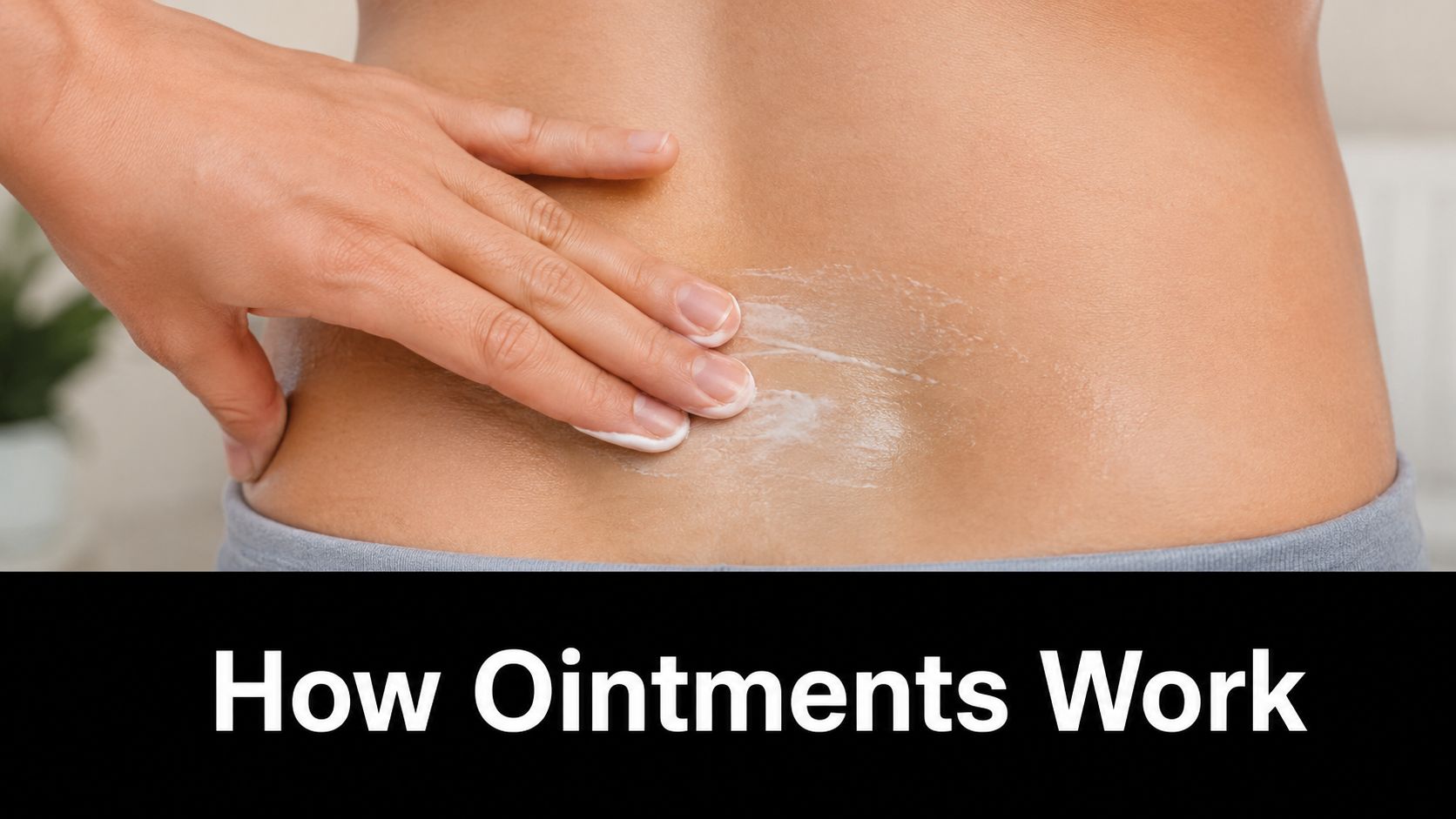
Counterirritants change the sensation
Menthol and camphor are the classic examples. They create cooling or warming sensations that compete with pain signals. Think of them as sensory distractors. They don't repair tissue, but they can make a sore area feel less dominant for a while.
These are useful when your back feels tight, achy, or overworked and you want quick symptom relief. They're less impressive when the pain is deep, inflamed, or radiating.
According to the Cochrane review on topical rubefacients, general topical analgesics can relieve pain by up to 50 percent, typically begin working within 30 minutes to 1 hour, and often provide temporary relief for 2 to 6 hours in the right setting (Cochrane evidence on topical rubefacients and related topical analgesics).
Topical NSAIDs target inflammation
This category includes diclofenac and ketoprofen. These products are more than cooling gels. They act on inflammatory pathways, which makes them more logical for a back strain, overuse flare, or arthritic area that's irritated and tender.
For the right patient, this is usually the evidence-backed category I'd consider first for localized mechanical back pain.
If you're interested in non-oral ways medications can be delivered through tissue, iontophoresis with dexamethasone is another example of a targeted rehab approach, though it's a clinical modality, not an over-the-counter ointment.
Lidocaine and capsaicin do different jobs
Lidocaine works like a local numbing agent. It's best for surface-level sensitivity or a focal painful area where dulling nerve input may help. It's usually less effective when the pain source sits deeper.
Capsaicin works differently. It reduces pain signal transmission over time rather than masking sensation. That delayed effect is why some people give up too early. It can be useful, but it asks more from the patient in terms of consistency and tolerance.
People also ask about CBD topicals. The mechanism and product quality vary widely, so expectations should stay conservative. If you want a consumer-friendly overview of that category, How CBD cream helps with pain gives a useful broad look at why some people explore it.
Relief from a topical product is real when it helps you move better. It's incomplete when it hides a problem you still need to address.
Comparing the Top Back Pain Relief Ingredients
If you want the shortest answer, it's this: for acute, localized back strain, topical NSAIDs have the strongest evidence. Other ingredient classes can still help, but their role is usually narrower, more temporary, or less reliable.
What performs best in acute strain type pain
For acute musculoskeletal back pain such as strains and sprains, diclofenac Emulgel and ketoprofen gel show the strongest performance. In one review, diclofenac Emulgel had a Number Needed to Treat of 1.8, and ketoprofen gel had an NNT of 2.5, to achieve at least 50% pain reduction within one week (NIH review of topical analgesics for acute and chronic musculoskeletal pain).
That matters clinically. A lower NNT means a treatment is more likely to help a given patient achieve meaningful relief.
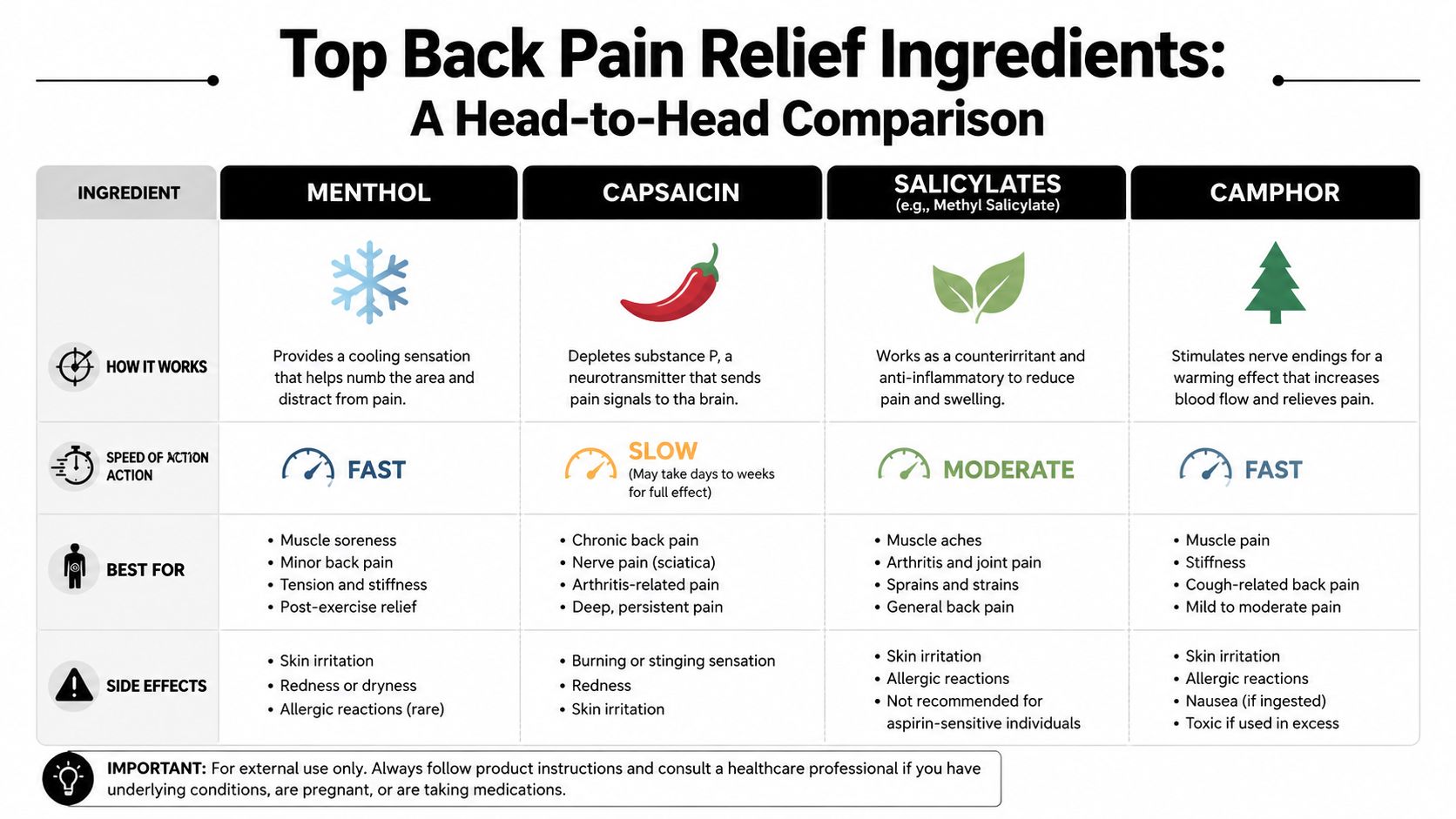
Here's the practical comparison:
| Ingredient class | Best fit | What patients usually notice | Trade-off |
|---|---|---|---|
| Topical NSAIDs | Acute strain, focal inflammatory pain | More meaningful symptom reduction when pain is local | Less impressive for diffuse or chronic pain |
| Menthol or camphor | Fast comfort for sore muscles | Immediate cooling or warming feel | Short-lived, mostly sensory |
| Lidocaine | Surface tenderness, local sensitivity | Numbing effect in a small area | Limited reach for deep back pain |
| Capsaicin | Persistent focal discomfort | Can help over time | Early burning sensation turns some people away |
| Salicylate rubs | General ache relief | Familiar heat-rub feel | Modern evidence is less convincing |
Acute versus chronic changes the answer
The same ingredient can perform very differently depending on how long the pain has been around.
For chronic osteoarthritis-related pain, topical diclofenac's NNT rises to 9.8 over 6 to 12 weeks in that same review, which shows a clear drop in effect compared with acute injuries (NIH review of topical analgesics for acute and chronic musculoskeletal pain).
That doesn't make it useless. It means you should expect partial help, not a dramatic turnaround.
Ingredients that often disappoint
Rubefacients and salicylate-based products are common on store shelves, but the evidence is uneven. The Cochrane review notes that older studies suggested benefit in acute pain, but larger, more recent studies found no effect for acute injuries or chronic conditions, and a major study of compounded topical pain creams found no statistically significant difference from placebo in average pain reduction (Cochrane evidence on topical rubefacients and related topical analgesics).
If your pain is a simple strain, look first at diclofenac or ketoprofen gels. If your pain is deep, spreading, or persistent, don't expect a different scent or stronger tingle to solve the mismatch.
Matching the Ointment to Your Type of Back Pain
The ingredient only makes sense when it matches the pain pattern. This misalignment is precisely why most trial-and-error goes wrong.

If you strained your back lifting or twisting
This is the classic “I picked something up and felt it” scenario. The pain is usually local, tender, and tied to certain movements.
That's the setting where topical NSAIDs make the most sense. Broader evidence shows that for acute conditions such as sprains or strains, topical NSAIDs can help reduce pain by at least half over about one week in roughly 1 in 2 to 1 in 5 people (Cochrane-style review of topical NSAIDs for acute and chronic musculoskeletal pain).
A menthol or camphor rub can still be useful if you mainly want a quick comfort effect. I'd think of it as a support option, not the lead player, when inflammation is part of the picture.
If your back feels stiff and arthritic
Arthritic pain often feels different. It's less about one sharp catch and more about stiffness, ache, and low-grade irritation that builds with activity or after sitting too long.
Topical NSAIDs can still help here, but the results are usually more modest and slower. You may get enough relief to move more comfortably, sleep better, or tolerate exercise, but it often won't be a complete answer for chronic degenerative pain.
The key is expectation. For arthritis, ointments are usually a tool for symptom management, not structural change.
If pain shoots into the buttock or leg
Many people often waste time on the wrong product. If your pain is burning, traveling, electric, or paired with tingling, the issue may be nerve irritation rather than a surface or local muscle problem.
The evidence-based practical takeaway is blunt here. Topical NSAIDs work best for focal, muscular, and mechanical pain, but they tend to fail when pain is deep, diffuse, radiating, or tied to nerve irritation like sciatica (guidance on matching cream type to pain pattern).
That doesn't mean an ointment can't take the edge off. It means the ointment usually won't address the underlying cause.
For a visual explanation of how back pain patterns can differ, this short video is useful:
Quick matching guide
- Local soreness after activity: Try a topical NSAID first.
- Mild muscle ache and tightness: A menthol or camphor product may be enough.
- Persistent small painful spot: Capsaicin may be worth considering if you can tolerate it.
- Surface tenderness or touch sensitivity: Lidocaine can make sense.
- Leg pain, numbness, or tingling: Don't rely on ointments alone.
Applying Ointments Safely for Maximum Benefit
A good product can still cause problems if you use it carelessly. Skin irritation is the most common issue I see, and it usually comes from overapplication, combining products, or trying to “boost” the effect with heat.
Use the label and your skin as guides
Apply topical products to clean, dry, intact skin. A thin, even layer is usually more useful than a heavy coat. More product doesn't automatically mean more relief.
After application, wash your hands well. That matters most with menthol and capsaicin. Getting either in your eyes or on sensitive skin is miserable.
A simple home checklist helps:
- Check the active ingredient: Don't buy two different brands that contain similar ingredients and layer them without realizing it.
- Watch the skin response: Mild warmth or cooling can be normal. Ongoing redness, rash, or strong burning is a reason to stop.
- Keep the area uncovered unless the label says otherwise: Tight wrapping can increase irritation.
- Be careful after bathing: Freshly shaved or recently heated skin can react more strongly.
Don't combine creams with heat or cold on the skin
This is one of the most important safety points in the whole article. Authoritative medical guidance warns that creams, heat rubs, or lotions should not be used on skin while applying hot or cold treatments because of the risk of burns or significant skin damage (WebMD guidance on topical pain relievers and safety).
That warning gets ignored all the time. People think a heating pad plus a pain rub must work better. Sometimes it just gives them an angry skin reaction.
If you want to understand how clinicians use thermal modalities more safely, this overview of physical therapy heat packs explains why timing and supervision matter.
Apply the ointment, let it absorb, and treat heat or ice as a separate tool, not a layer on top of medicated skin.
Know what success looks like
A topical product has done its job if it lowers pain enough for you to walk, bend, sleep, or do your home exercises more comfortably. That's a good result.
If you keep reapplying all day and still can't function normally, the problem probably isn't the brand you chose.
When Ointments Arent Enough for Your Back Pain
Most ointments are symptom tools. They're not diagnostic tools, and they don't correct the movement problem, joint irritation, weakness, or nerve involvement underneath.
That matters because many people stay in self-treatment mode too long. They keep rotating from cream to gel to patch, hoping the next one will finally solve a problem that isn't topical in nature.
Signs you need a real evaluation
If any of these are happening, it's time to stop relying on ointments alone:
- Pain is radiating: Especially if it travels into the buttock, thigh, or below the knee.
- You notice numbness or tingling: That shifts concern toward nerve irritation.
- Your leg feels weak or unstable: Difficulty pushing off, climbing stairs, or lifting the foot deserves attention.
- Pain keeps returning: Recurrent flare-ups often point to an untreated mechanical driver.
- Sleep, walking, or work are getting limited: Function matters more than whether a cream briefly dulls the ache.
Why the root cause matters
Topical NSAIDs can be useful for simple strains, but they often disappoint when pain is diffuse or tied to significant nerve irritation like sciatica. In practice, that's the dividing line patients need to understand. An ointment may help you feel better for a few hours while the actual problem continues unchanged.
When back pain lingers, the better question isn't “What else can I rub on it?” It's “Why does this hurt in the first place?”
That answer may involve muscle imbalance, poor lifting mechanics, joint restriction, disc irritation, or post-surgical stiffness. In some cases, patients also explore broader medical options beyond standard conservative care. If you're researching that side of treatment, this resource on regenerative options for spinal repair gives a useful overview.
For a broader overview of non-topical relief strategies, what is good for back pain relief is a solid starting point.
A cream can reduce pain. It can't retrain movement, improve spinal mobility, restore strength, or calm a persistently irritated nerve on its own.
Building Your Complete Back Pain Recovery Plan
The best back pain relief ointment has a place. It just shouldn't be asked to do everything.
For acute back pain, evidence shows that topical NSAIDs such as diclofenac Emulgel can reduce pain by at least half over roughly one week in about 1 in 2 to 1 in 5 people, while chronic conditions respond more modestly at about 1 in 5 to 1 in 10 people over 6 to 12 weeks (review of topical NSAIDs for acute and chronic musculoskeletal pain). That's useful. It's also a clear reminder that long-term back pain usually needs more than a tube.
A stronger recovery plan usually includes a few coordinated pieces:
What to keep in your plan
- Use ointments strategically: Match the ingredient to the pain type instead of buying by brand recognition.
- Keep moving: Gentle walking and guided exercise usually help more than guarding and bed rest.
- Address the mechanics: Posture, lifting habits, desk setup, and core control often drive repeat flare-ups.
- Get the right help when symptoms change: Radiating pain, weakness, and persistent recurrence deserve assessment.
Back pain improves fastest when symptom relief and root-cause treatment work together. The ointment helps you tolerate movement. The movement helps restore function. The clinical plan reduces the chance that the same pain keeps coming back.
If your back pain keeps returning, radiates into the leg, or isn't improving with smart self-care, MedAmerica Rehab Center can help you move beyond temporary relief. Their team provides patient-centered physical therapy, chiropractic care, acupuncture, and other non-surgical treatments designed to reduce pain, restore mobility, and address the reason your back hurts in the first place.
MedAmerica Rehab · Deerfield Beach
Talk to a clinician about your pain
Physical therapy, chiropractic, acupuncture and shockwave therapy under one roof, since 1995. Same-day appointments are available.
Mon–Thu 8:00 AM – 6:30 PM · Fri 8:00 AM – 3:00 PM