
FCE Explained: What Is Functional Capacity Evaluation
A Functional Capacity Evaluation, or FCE, is a standardized, objective assessment of how safely you can perform work-related tasks like lifting, carrying, pushing, pulling, standing, walking, and reaching, and many FCEs take 4 to 8 hours to complete. It's commonly used to guide return-to-work or disability decisions when the key question isn't just what injury you have, but what you can reliably do right now.
If you've been told you need an FCE, you're probably already dealing with enough uncertainty. Maybe your doctor says your healing has reached a point where work needs to be discussed. Maybe your employer wants to know whether modified duty is appropriate. Maybe a case manager, attorney, or insurance adjuster has added one more appointment to a process that already feels complicated.
That's where a lot of anxiety starts. People often hear “evaluation” and assume they're being judged, challenged, or pushed to prove something. In reality, a well-run FCE is meant to create a practical picture of your current physical capacity so that decisions about work, restrictions, and rehab are based on observed function, not guesswork.
Your Guide to the Functional Capacity Evaluation
The question behind what is functional capacity evaluation is usually more personal than technical. Patients want to know what they're walking into, whether it will hurt, and what the result could change.
An FCE is best understood as a structured way to measure how your body handles work-like activity after injury, surgery, or ongoing pain. It usually includes an interview, a physical screening, task testing, and monitoring for pain, fatigue, and consistency while you perform activities tied to real job demands.
Why this matters to you
A diagnosis tells part of the story. It may explain that you have a back injury, neck pain, arthritis, post-surgical weakness, or another condition. An FCE answers a different question. It looks at how that condition affects your ability to function in a work setting.
That distinction matters because return-to-work decisions are rarely made on imaging or symptoms alone. Employers, physicians, case managers, and insurers often need specific functional information, such as whether you can lift from floor to waist, tolerate standing, carry items safely, or repeat tasks without losing form.
Practical rule: The purpose of an FCE isn't to “catch” you. It's to document your safe ability level as clearly as possible.
What people usually want clarified
Most patients feel better once they understand a few basics:
- What the appointment includes: More than a quick strength check. The evaluator looks at movement, tolerance, effort, and task performance.
- Why it can affect work status: The results often help shape restrictions, accommodations, or next treatment steps.
- How to approach it: Honest, steady effort matters more than trying to look stronger or more limited than you are.
Once you understand those pieces, the process feels less mysterious and much more useful.
What a Functional Capacity Evaluation Truly Measures
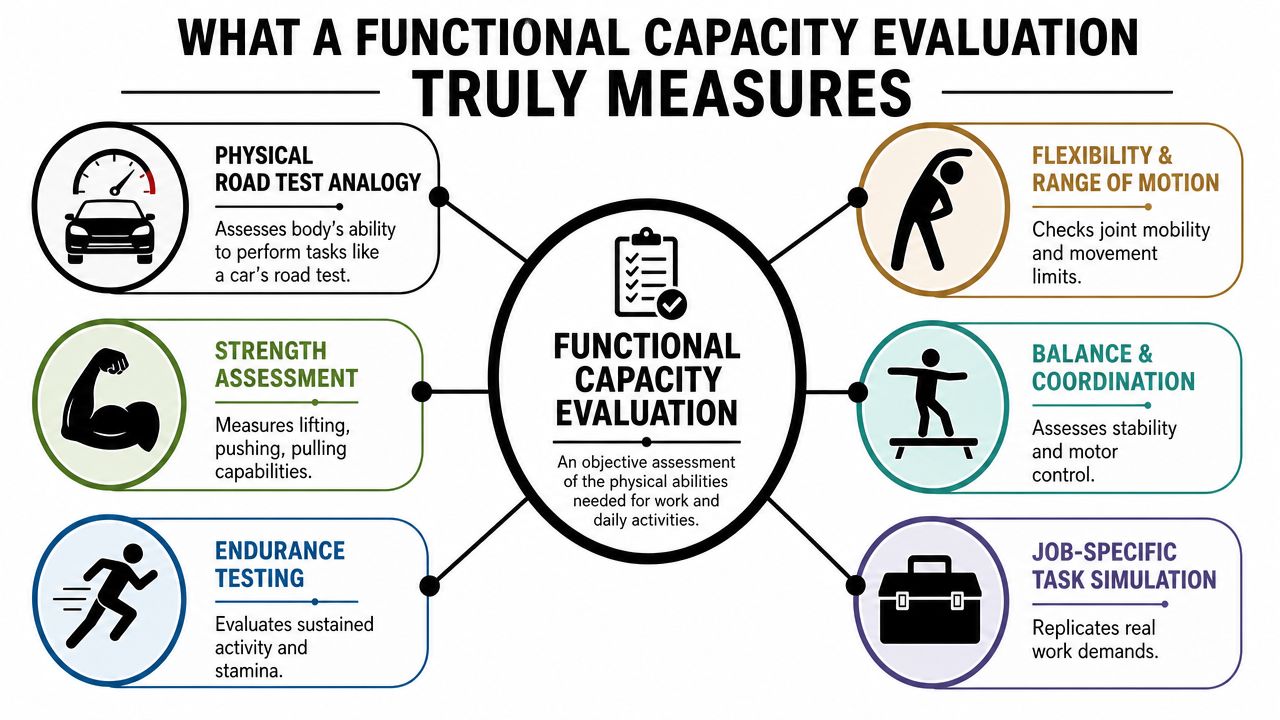
The simplest way to explain an FCE is this. It's a physical road test for your body.
A road test doesn't ask whether a car once had engine trouble. It asks whether the car can safely perform now, under specific conditions. An FCE works the same way. It doesn't primarily diagnose the injury. It measures what you can do with your current condition when asked to perform tasks that resemble work.
Function, not just diagnosis
In practice, an FCE looks at performance areas that matter on the job. That can include material handling, positional tolerance, and mobility or agility. The evaluator may observe lifting, carrying, pushing, pulling, reaching, standing, walking, bending, kneeling, or similar work-related actions, then compare your demonstrated ability to the physical demands of your job.
This is why the results are often more useful than a vague statement like “still limited.” A detailed FCE can connect symptoms to restrictions in a way employers and case managers can effectively use.
Why two FCEs might not look identical
One source of confusion is that functional capacity evaluation sounds like one specific test. It isn't. A review in PubMed Central notes that there are approximately 10 commonly used FCE systems, which means the tasks and duration can vary depending on the method used and the purpose of the exam (PubMed Central review of FCE systems).
That matters because patients sometimes compare notes and assume one person's exam should match another's. It may not. The method, the referral question, and the job being analyzed all shape the final test battery.
A useful FCE measures safe performance in context. It doesn't reduce your recovery to one lifting number.
What it often overlaps with in rehab
If you've already been working on movement quality, lifting mechanics, or task-based rehab, the exam may feel familiar. Many of the physical demands tested in an FCE connect closely to principles used in a functional strength training guide, especially the idea that strength is most meaningful when it transfers to real tasks.
That said, an FCE isn't a workout and it isn't treatment. It's an assessment. The point is to document capacity objectively, not to improve it during the session.
Why You Might Need an FCE
People are usually referred for an FCE when someone needs a clear answer to a work-capacity question that routine office visits haven't fully resolved. The reason for the referral shapes the kind of information the evaluator will emphasize.
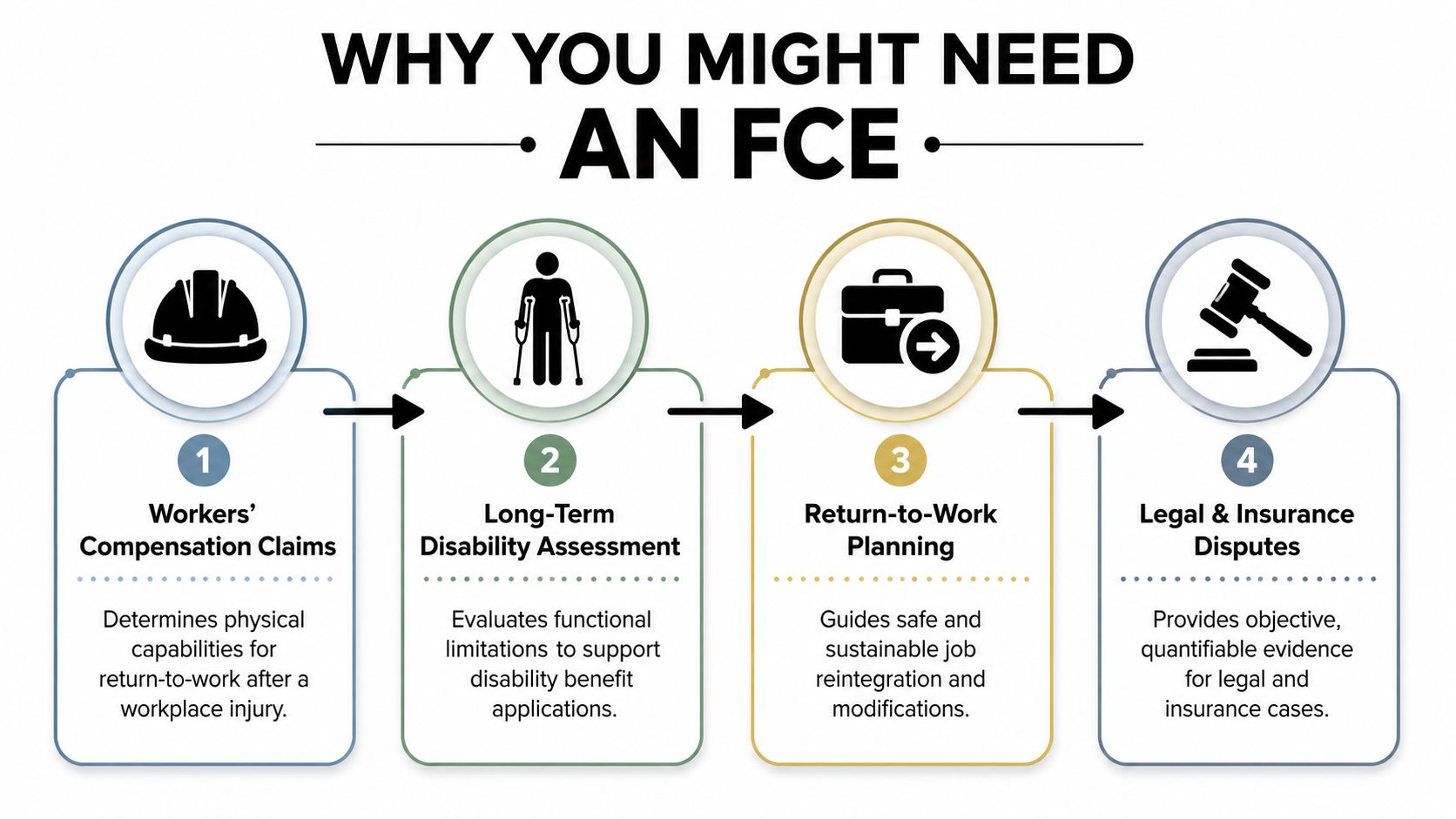
Workers' compensation cases
In workers' compensation, the central question is usually practical. Can this employee return to the job safely, and if not, what restrictions are needed?
That might mean comparing your tested ability to the demands of lifting, carrying, prolonged standing, overhead use, pushing, or repetitive bending required at work. If you're dealing with a claim and want a general legal overview of how these cases are handled, this overview of Florida workers' compensation claims can help frame the larger process. For a clinic-specific explanation of the exam itself, MedAmerica also provides a workers' compensation functional capacity exam guide.
Disability determinations
In disability settings, the question is broader. It may be less about one job and more about whether your physical limitations significantly affect your ability to perform sustained work activity.
That's where the strengths and limits of FCE evidence matter. A review highlighted in 2024 reported that several FCE tools showed good reliability, but their validity varied. The Ergo-Kit showed high inter- and intra-rater reliability but low discriminative validity, the ERGOS Work Simulator showed low to moderate concurrent validity, the WorkHab showed moderate to high reliability, and the BTE Work Simulator showed moderate predictive validity (review summary on FCE strengths and weaknesses).
In plain language, that means some systems are better at producing consistent results than they are at perfectly predicting who will succeed back in everyday life. That's why a good decision-maker treats the FCE as one important data point, not as the only one.
Return-to-work planning
Sometimes there's no dispute at all. A physician, therapist, employer, or case manager needs a clean picture of current capacity so a return-to-work plan can be built around it.
Here, the FCE helps answer questions like:
- Can full duty resume now
- Would modified duty be safer
- Which tasks should be limited for now
- Does the job need temporary accommodation
Here, the exam often provides its most immediate practical value.
Ongoing medical decision-making
An FCE may also be ordered when the next treatment step isn't obvious. If someone has improved but still reports limitations, the evaluation can clarify whether more rehab, work conditioning, work hardening, or job modification makes sense.
A physician may also use the report to support restrictions in a way that's more specific than a routine follow-up note.
A Look Inside Your FCE Appointment
The appointment usually feels more structured than people expect. It's not a single lift test, and it's not a rushed office visit. Many FCEs take 4 to 8 hours to complete, sometimes over one or two days, because the evaluator needs enough time to observe endurance, fatigue, and consistency under work-like conditions (Enlyte overview of FCE timing and purpose).
The first part of the visit
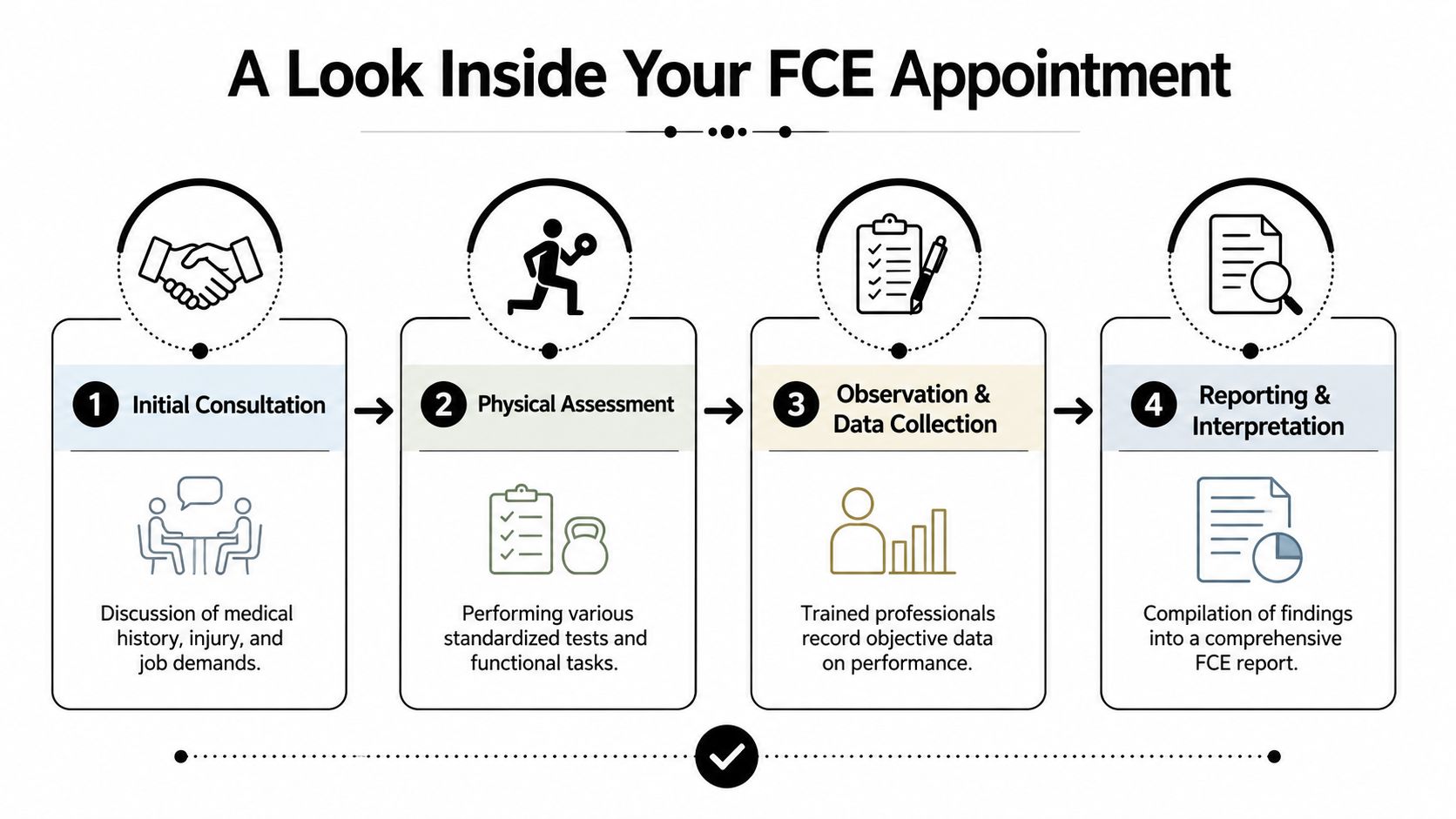
Most FCEs begin with conversation before physical testing. The evaluator reviews your medical history, current symptoms, treatment history, medications, and job demands. If your job has specific tasks such as frequent lifting, ladder climbing, pushing a cart, stocking shelves, or prolonged computer work, that information matters.
There's usually also a basic physical screening. That can include range of motion, posture, movement quality, strength observations, and symptom behavior during simple tasks.
If you've never had this type of rehab appointment before, it may help to review a general physical therapy visit overview so the clinical flow feels more familiar.
The core testing phase
The main portion of the FCE uses structured task testing. A functional capacity evaluation is a structured, performance-based test battery that measures whether a person can safely perform work-related tasks such as lifting, carrying, pushing, pulling, reaching, standing, and walking, and protocols can range from about 2 hours to 5–6 hours over 2 days (Physio-pedia description of FCE structure and duration).
That testing may include:
- Material handling: Lifting from floor to waist, waist to shoulder, carrying objects, or moving items between surfaces
- Positional tolerance: Standing, sitting, kneeling, crouching, bending, or overhead reaching for a measured period
- Mobility tasks: Walking, stair climbing, pushing, pulling, or repeated transitional movements
- Behavioral observation: How symptoms, fatigue, pacing, and movement quality change as demands increase
The evaluator is not just watching whether you complete the task. They're also looking at how you do it. Form, control, guarding, compensation, and symptom response all matter.
Later in the appointment, this short video gives a helpful visual sense of the process:
What helps most: Give consistent, honest effort and report symptoms accurately. Don't try to impress the evaluator, and don't hold back to make a point.
How to prepare without overthinking it
The best preparation is simple:
- Dress for movement: Wear comfortable clothing and supportive shoes.
- Know your job demands: If possible, bring details about your duties.
- Take routine items unless told otherwise: Use your glasses, brace, or regular supports if that reflects how you function day to day.
- Get rest if you can: Fatigue is part of testing, but showing up exhausted doesn't help.
The goal isn't to produce a heroic performance. It's to show your current safe work capacity.
Understanding Your FCE Report and Its Impact
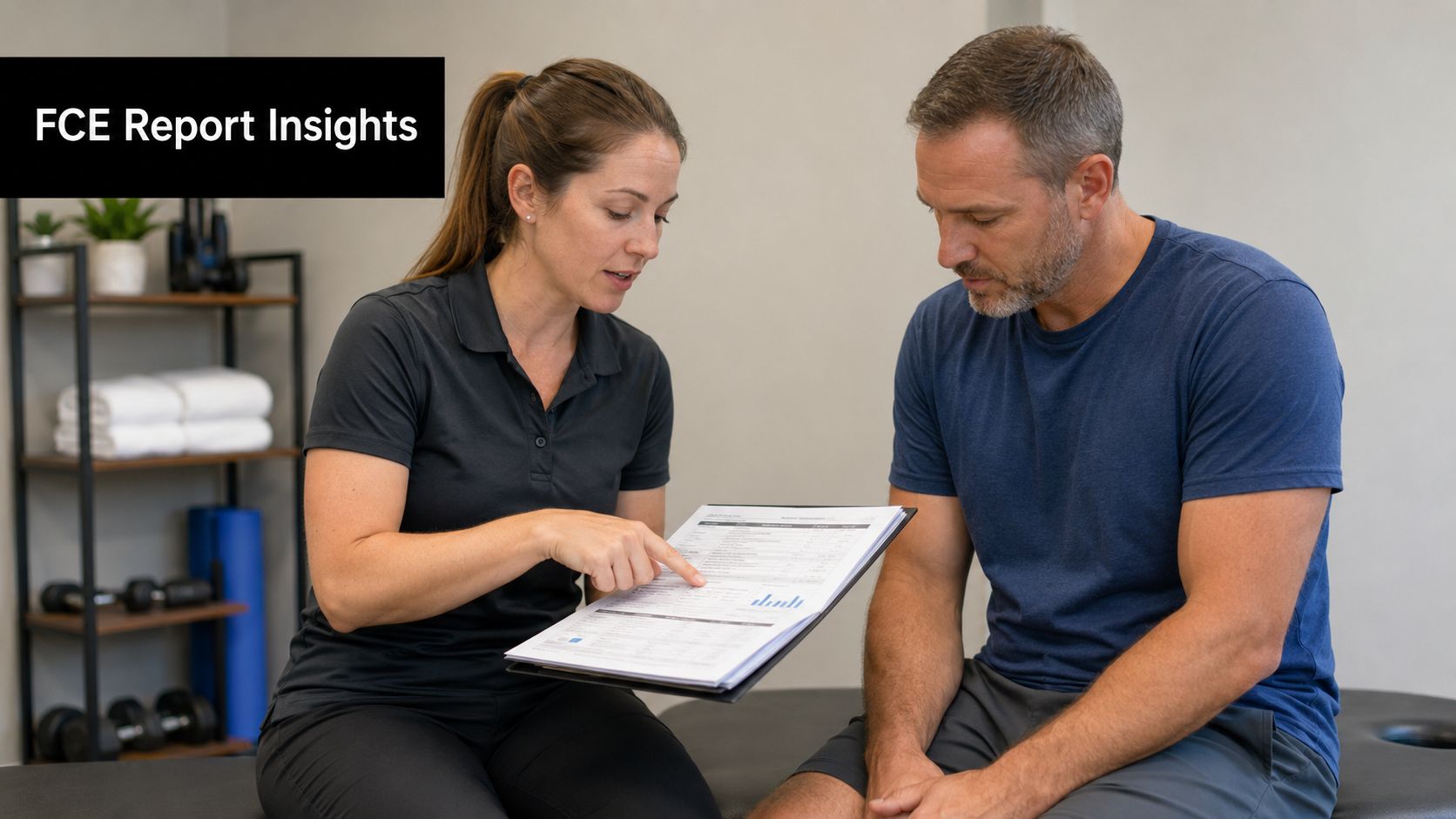
When the testing is done, the most important part is the report. That's where the raw observations become usable recommendations.
An FCE's primary value is its ability to translate diagnosis or symptoms into functional restrictions. The final report supports return-to-work decisions by documenting safe maximum capacity for tasks like material handling, positional tolerance, and mobility, which helps guide accommodations when needed (Measurabilities overview of FCE reporting and restrictions).
What you'll usually see in the report
Most reports are built around function, not just symptoms. They often describe what you demonstrated during lifting, carrying, pushing, posture tolerance, and mobility-based tasks. They may also note whether your movement stayed safe and consistent as activity progressed.
Common report language often includes:
- Safe maximum capacity: The highest level you performed safely during the exam
- Positional tolerance: How well you tolerated sitting, standing, walking, bending, or similar activity
- Consistency of effort: Whether your performance pattern remained reasonably consistent across the test
- Observed limitations: Movements or task demands that increased symptoms, reduced control, or required stopping
How this affects real decisions
A strong report turns vague concerns into concrete action. Instead of “patient still limited,” the outcome may be closer to “can perform modified duty with restricted lifting and limited prolonged standing,” or “needs additional rehab before attempting higher physical demands.”
That can influence several next steps:
| Decision area | How the FCE helps |
|---|---|
| Work status | Supports full duty, modified duty, or continued restrictions |
| Job changes | Identifies tasks that may need adjustment or accommodation |
| Rehab planning | Shows whether more conditioning is needed before work demands are realistic |
| Case communication | Gives physicians, employers, and case managers a shared functional reference point |
In some cases, the report may support a transition into a structured program such as work hardening therapy, especially when the gap between current function and job demands is clear but still trainable.
The best FCE reports don't just list what hurt. They explain what you could do safely, what changed under load, and what that means for work.
What the report does not do
Patients sometimes expect a report to settle everything. It often helps a lot, but it doesn't replace medical judgment, job analysis, or ongoing clinical follow-up. It's most useful when everyone involved reads it as practical guidance for decision-making, not as a single absolute verdict.
Your Partner for FCEs in Deerfield Beach
When someone needs an FCE, the technical side matters, but the human side matters just as much. The evaluator has to collect objective information while also understanding that the person being tested may be worried about work, pain, finances, or whether they'll be believed.
That's one reason local access matters. In Deerfield Beach, patients often do better when the clinic performing the evaluation also understands the larger rehab picture, including musculoskeletal injuries, post-surgical recovery, chronic pain patterns, and workers' compensation expectations.
A good FCE provider should be able to do three things well. First, perform a structured, fair assessment. Second, relate the findings to real job demands. Third, communicate the results in a report that physicians, employers, attorneys, and case managers can effectively use.
For local patients, MedAmerica Rehab Center is one option for FCE-related care and rehabilitation support. The clinic serves Deerfield Beach and nearby communities with physical therapy and related services, which can be useful when an evaluation needs to fit into a broader recovery plan rather than stand alone as an isolated appointment.
If you're choosing where to go, look for clarity, professionalism, and a process that respects both safety and objectivity. That combination usually leads to the most useful result.
Common Myths About Functional Capacity Evaluations
Is an FCE pass or fail
No. An FCE is an assessment of current capacity, not a school test. The aim is to identify what you can do safely right now, along with what still needs restriction, accommodation, or rehabilitation.
Do you have to push through extreme pain
No. A key limitation of FCEs is the gap between clinic-based simulation and actual job performance over a full work schedule. An FCE doesn't perfectly predict long-term job retention or symptom flare-ups, so it's best viewed as a snapshot of current safe ability, especially for conditions like chronic pain or arthritis where symptoms can vary (BTE discussion of FCE limitations and real-world carryover).
That's why “pushing through no matter what” is the wrong mindset. The exam is meant to find safe capacity, not force a breakdown.
Can someone game the test
Evaluators are trained to watch for consistency across tasks, movement patterns, pacing, pain behavior, and observed effort. That doesn't mean the process is adversarial. It means the assessment is designed to look at the whole performance picture rather than one isolated task.
Does the FCE decide your whole future
Not by itself. It can strongly influence decisions, but it works best as one part of a larger clinical and work-planning process. A thoughtful team uses it alongside your medical history, job demands, physician input, and response to treatment.
If you're nervous about the exam, that's normal. Most people feel much better once they understand that the goal is accurate measurement, not punishment.
If you need a Functional Capacity Evaluation or guidance about what your next rehab step should be, MedAmerica Rehab Center can help you understand the process, prepare appropriately, and move forward with a clear plan that fits your condition and work goals.
MedAmerica Rehab · Deerfield Beach
Talk to a clinician about your pain
Physical therapy, chiropractic, acupuncture and shockwave therapy under one roof, since 1995. Same-day appointments are available.
Mon–Thu 8:00 AM – 6:30 PM · Fri 8:00 AM – 3:00 PM