

Physical Therapy for Sports Injury: Recovery Guide 2026
You plant your foot to change direction, your ankle rolls, and the game stops before you can test whether you can walk it off. The swelling arrives quickly, but the harder questions usually follow later: Is the injury serious? When can you train again? Why does the joint still feel unreliable even after the pain settles?
Physical therapy for sports injury gives you a structured way to answer those questions. Instead of relying on rest, guesswork, or a list of stretches copied from the internet, a sports therapist examines how the injury happened, measures what has changed, and gradually rebuilds the movement, strength, control, and confidence your sport requires. The process is individual, because a recreational runner, a soccer midfielder, and a tennis player don't place the same demands on an injured body.
What Physical Therapy for a Sports Injury Really Does
Sports rehabilitation is more than reducing soreness. A therapist uses the injury history and physical examination to design a progression that helps you move safely while the affected tissue recovers. That may include managing pain and swelling, restoring joint motion, improving muscle capacity, retraining balance, and correcting movement habits that place extra stress on the injured area.
Sports injuries create substantial demand for rehabilitation. One recent review estimated that they represent 20% to 40% of musculoskeletal clinic visits globally, while acute sports injuries accounted for about 22.0% of emergency-room visits in some datasets (review of sports injuries and rehabilitation demand). Those figures help explain why physical therapy has become a central part of recovery rather than an optional add-on after an injury.
The therapist is managing stress, not avoiding it
Healing tissue needs an appropriate challenge. Too little loading can leave the joint, muscle, tendon, or ligament deconditioned. Too much loading can aggravate symptoms or interrupt recovery. Your therapist's job is to find the useful middle ground, then adjust it as your capacity changes.
That often means progressing through several layers:
- Symptom control: Reduce pain and swelling enough for you to move with better quality.
- Mobility: Restore the range needed for walking, running, lifting, jumping, or throwing.
- Capacity: Build the strength and endurance required by your sport.
- Control: Train balance, coordination, landing mechanics, and joint stability.
- Sport exposure: Reintroduce the speed, direction changes, contact, or repetition that caused concern.
The uninjured side matters, too. A therapist may compare limbs, watch how you compensate, and protect nearby joints from absorbing work they weren't designed to handle.
Modern sports physical therapy increasingly uses criteria-based rehabilitation, meaning you advance when your function and symptoms meet agreed standards rather than waiting for a date on the calendar. Readers who want a youth-specific perspective can also use this guide to youth sports rehab, particularly when growth, training demands, and communication with parents or coaches affect the plan.
Practical rule: The right exercise isn't the hardest exercise. It's the exercise that gives healing tissue a productive challenge without creating a setback.
The First Visit and What Your Therapist Is Looking For
Your first appointment should feel like an investigation, not a quick handoff to a machine. The therapist needs to understand both the injury and the athlete who wants to return to activity.
Step one is the injury story
Expect questions about the exact mechanism. Did your foot roll inward during a landing? Did your knee twist while your shoe stayed planted? Did shoulder pain build gradually with throwing? The mechanism gives the clinician clues about which structures may be involved and which movements require caution.
The conversation also covers your sport, position, training schedule, recent changes in workload, previous injuries, medications, imaging, and your main goals. “I want to get back to soccer” is useful, but “I need to sprint, cut, and tolerate a full training session” gives the therapist a more practical target.
Step two is the physical examination
The therapist may assess:
- Range of motion: How far the joint moves, and whether pain or stiffness limits it.
- Strength: How much force each muscle group can produce, often compared with the other side.
- Joint mobility: Whether a joint segment moves freely or needs hands-on assessment.
- Swelling and tenderness: Where symptoms are located and how they respond to pressure.
- Movement quality: Whether you shift weight, collapse inward, guard the area, or avoid a position.
You may then perform a single-leg balance task, squat, step-down, hop, reach, or sport-specific drill. These tests aren't designed to “catch you out.” They reveal how the body organizes movement when a simple isolated test doesn't tell the full story.
Fear is part of the examination as well. A healed structure may tolerate a movement that your nervous system still treats as dangerous. Hesitation, stiff landings, and protective movement can all guide the therapist's choice of starting exercise.
Step three is a shared plan
Before you leave, ask what the therapist believes is limiting you, what the first goals are, and how progress will be measured. A useful plan includes short-term targets, longer-term sport demands, home exercises, visit frequency, and criteria for increasing activity.
You can review the practical flow of an appointment in this overview of a typical physical therapy session. The key question isn't only, “How many visits will I need?” Ask, “What must I be able to do before I progress to the next stage?”
Manual Therapy, Targeted Exercise, and Modalities Working Together
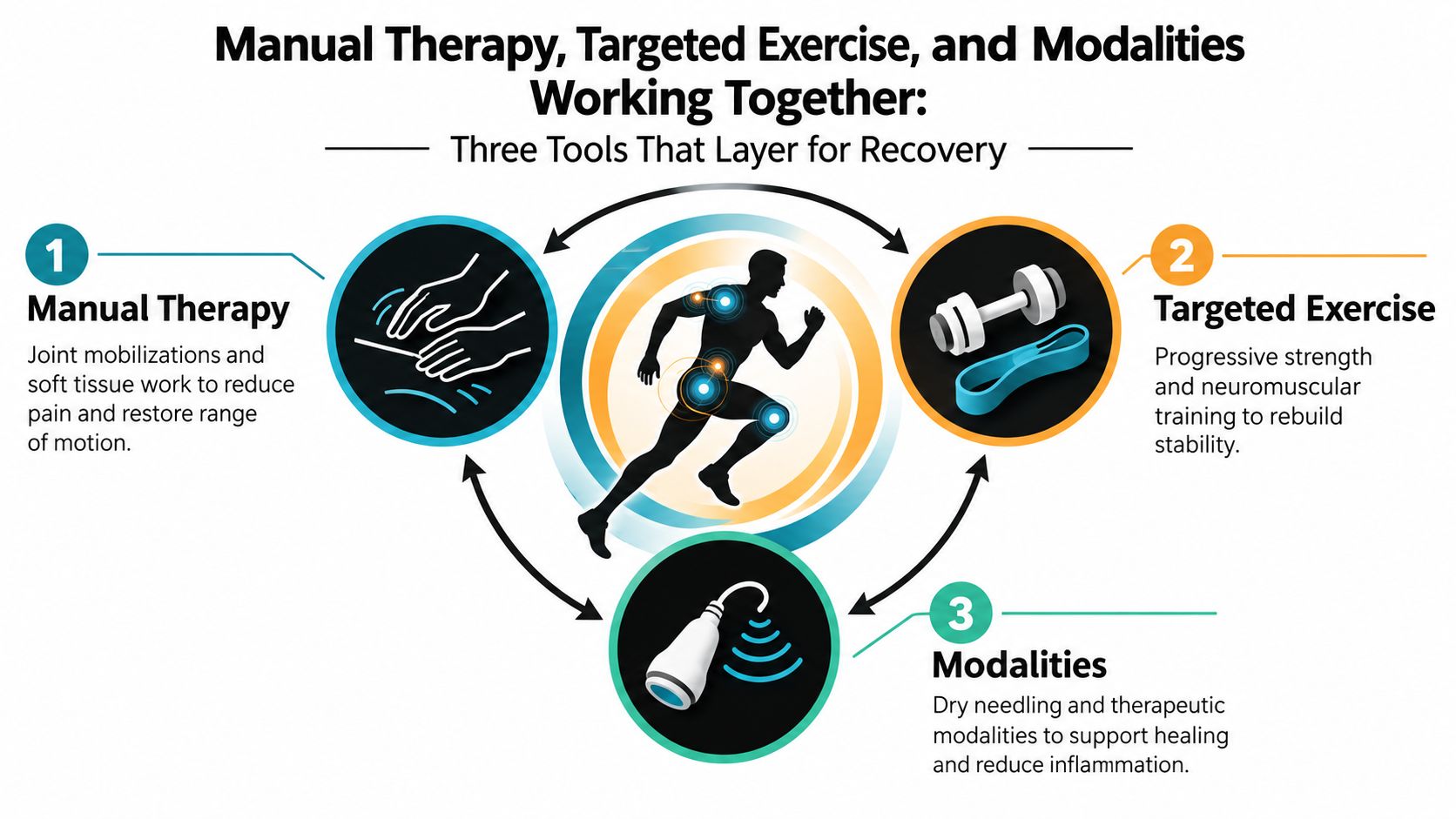
A sports rehabilitation session often combines three treatment tools, but they don't have equal jobs. Manual therapy can make movement easier. Modalities can help settle symptoms. Progressive exercise creates the long-term adaptation that lets you tolerate sport again.
Manual therapy prepares the movement window
Joint mobilization, soft-tissue techniques, and, when appropriate, dry needling may reduce pain or improve a restricted movement. For example, a stiff ankle may make a squat feel blocked, while muscle guarding around a shoulder can limit reaching or throwing mechanics. Hands-on treatment can help you access a more comfortable range so you can practice useful movement instead of repeatedly protecting the area.
That doesn't mean manual therapy “fixes” the injury by itself. Its value usually comes from what you can do afterward.
Exercise builds capacity and control
Targeted exercise may begin with active range of motion, isometric work, or low-load strengthening. It can progress toward resistance training, balance challenges, hopping, deceleration, change of direction, and sport-specific patterns.
Loading must be dosed carefully. Expert guidance recommends beginning isolated muscle loading after about 10 days of rest, starting with active range of motion and no more than 40% of one-repetition maximum, using 12 to 20 repetitions before progressing beyond 50% of one-repetition maximum after six weeks as tissue capacity consolidates (rehabilitative conditioning guidance). The same guidance describes subtle 2% load progressions early in rehabilitation, illustrating why small changes can be safer than dramatic jumps.
Modalities support the session
Ice, heat, electrical stimulation, and ultrasound may help manage pain, swelling, or muscle tension for selected patients. They shouldn't replace the active work. A simple way to understand the relationship is this: manual therapy opens the window, exercise walks you through it, and modalities reduce the background noise.
For a closer look at hands-on options, see these manual physical therapy techniques.
From Rest-Based to Criteria-Based Return to Play
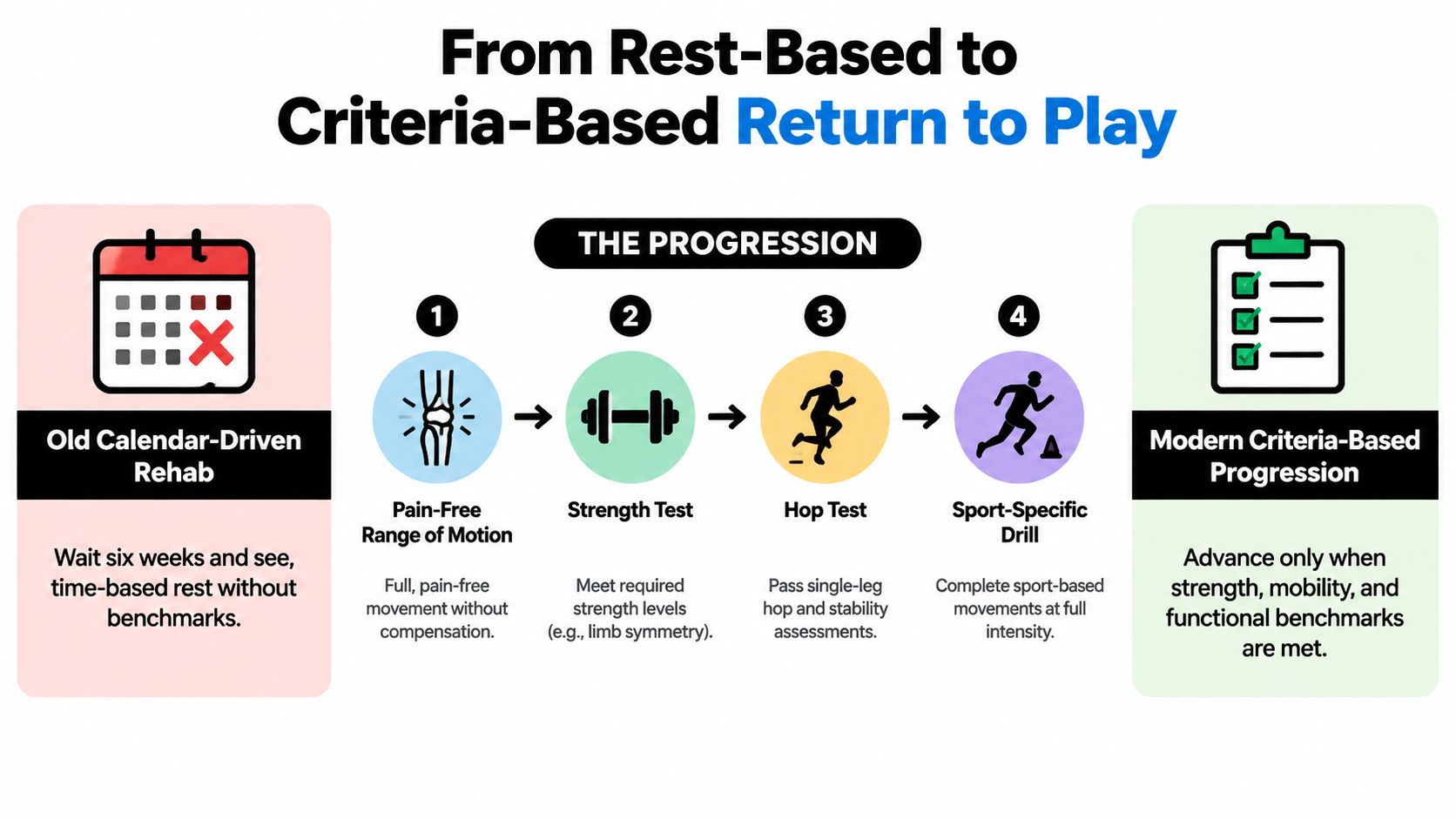
A calendar can tell you how long you've been injured. It can't tell you whether you can safely accelerate, land, cut, or tolerate your sport's workload. That limitation has pushed sports rehabilitation away from “wait and see” plans and toward criteria-based progression.
Traditional time-based rehabilitation might use a general healing window and advance an athlete because enough days have passed. That approach is easy to communicate, but it can move a strong athlete too slowly or clear a weaker athlete too early. Criteria-based care checks what your body can do.
The benchmarks behind progression
Your therapist may organize readiness around several categories:
- Tissue tolerance: The injured area handles daily activity and rehabilitation loading without an unacceptable symptom response.
- Mobility: The joint reaches the range needed for your sport and your movement strategy looks controlled.
- Strength symmetry: The involved side approaches the performance of the other side under relevant testing.
- Neuromuscular control: You can balance, decelerate, land, and change direction without obvious compensation.
- Sport demand: You tolerate drills that resemble practice, including speed, repetition, and decision-making.
- Cardiovascular readiness: Your conditioning supports participation without forcing the injured area to carry an excessive workload.
- Psychological readiness: You trust the movement enough to perform it rather than avoiding or bracing through it.
Functional tests such as the single-leg hop and limb symmetry measures often use thresholds around 90% to 95%, while ACL-related psychological readiness may be assessed with ACL-RSI scores around 70 or higher (criteria-based return-to-sport research). These aren't universal pass-fail rules for every injury. They are examples of how clinicians replace vague reassurance with observable benchmarks.
What a return decision really means
Return to play shouldn't be a single dramatic moment. It can begin with modified practice, controlled drills, limited volume, and planned recovery between sessions. Your therapist, physician, coach, and you may need to decide whether the next step is full participation, a restricted role, or more rehabilitation.
You can ask, “What is my criterion for next week?” A clear answer might involve a pain response, a strength target, a hop quality standard, or completion of a sport-specific drill. MedAmerica's return-to-play rehabilitation guidance can help you understand how that progression is organized in a clinical setting.
How Rehab Looks for Different Common Sports Injuries
The same rehabilitation principles apply across sports, but the sequence changes with the tissue and the demands placed on it. An ankle sprain, ACL reconstruction, and throwing shoulder may all require mobility, strength, control, and confidence, yet each emphasizes those qualities differently.
| Injury | Dominant impairments | Early emphasis | Late-stage milestones |
|---|---|---|---|
| Lateral ankle sprain | Swelling, restricted motion, reduced balance, ligament sensitivity | Protection, optimal loading, ankle motion, calf and foot strength | Single-leg control, hopping, cutting, and sport-specific landing |
| ACL reconstruction | Quadriceps weakness, reduced knee control, graft protection, confidence concerns | Swelling control, extension, progressive strength, controlled gait | Strength symmetry, deceleration, cutting, jumping, and practice tolerance |
| Throwing shoulder irritation | Pain with overhead motion, scapular control deficits, posterior shoulder weakness | Comfortable range, scapular mechanics, rotator cuff loading | Graduated throwing volume, velocity tolerance, recovery between throws |
A lateral ankle sprain
Early care may focus on reducing swelling while restoring useful ankle motion and loading the ligament within tolerance. Balance training matters because the ankle must respond quickly when the foot meets an uneven surface or an opponent's movement forces a change in direction.
Later, the therapist may add calf raises, resisted inversion and eversion, single-leg landing, lateral hops, and cutting drills. The goal isn't merely a pain-free walk. It is dependable control when speed and uncertainty return.
ACL reconstruction
ACL rehabilitation demands patience because graft protection and muscle recovery must coexist. Early sessions commonly prioritize knee motion, swelling management, gait, and quadriceps activation, followed by progressive strength and neuromuscular training.
Cutting sports require more than a stable-feeling knee. The athlete must control the trunk, hip, and knee during deceleration, absorb force, and repeat those actions under fatigue. A therapist may use strength comparisons, hop tasks, video feedback, and sport drills before recommending unrestricted participation.
A throwing shoulder
A throwing shoulder often needs a different emphasis. The therapist may examine scapular movement, thoracic mobility, rotator cuff capacity, and how the athlete controls the arm during acceleration and follow-through.
Throwing returns gradually. The athlete earns more volume and intensity by tolerating the current dose, recovering afterward, and maintaining mechanics. Tennis players who want additional movement ideas can review these science-backed tennis exercises, then discuss which options fit their injury stage with a clinician.
Why Confidence and Fear of Reinjury Are Part of the Plan
An athlete can have improving strength and a healed structure while still avoiding the movement that caused the injury. That response has a name, kinesiophobia, meaning fear of movement or reinjury. It can change mechanics through stiff landings, cautious cuts, shorter strides, or hesitation when the game becomes unpredictable.
Psychological readiness belongs beside strength and range-of-motion testing, not outside the clinical plan. Therapists may use self-reported tools such as the TSK-11 or ACL-RSI to understand how much fear is affecting activity. Research on sports rehabilitation emphasizes that biological recovery alone may not provide a safe, sustainable return, and highlights graded exposure, education, goal setting, and social support as relevant parts of care (review of psychological readiness in sports rehabilitation).
Confidence is built through controlled evidence
A therapist won't usually ask you to “just trust your knee” or “stop thinking about the ankle.” Instead, the plan creates repeated experiences in which you perform a feared movement safely:
- Start below the fear threshold: Use a slower speed, smaller range, or predictable surface.
- Add one demand at a time: Increase speed, height, direction, or decision-making instead of changing everything together.
- Make progress visible: Record hop quality, strength results, or successful drills so improvement isn't based only on how nervous you feel.
- Explain the purpose: Knowing what a drill prepares you for makes the exercise feel connected to your sport.
- Repeat under realistic conditions: Progress from a quiet clinic to practice-like movement and controlled fatigue.
Confidence isn't a personality trait that some athletes possess and others lack. It is a trainable response built through education, exposure, and successful movement experiences. If fear remains high even as physical benchmarks improve, tell your therapist. That information changes the plan.
Where Telehealth, Wearables, and AI Fit In Right Now
Technology can extend rehabilitation beyond the clinic, but it doesn't remove the need for clinical reasoning. Telehealth is useful for reviewing home exercises, observing basic movement, discussing symptom responses, and adjusting a program between in-person assessments. It can also make follow-up care easier when travel, work, or pain limits frequent visits.
Wearables may add information about activity and load. GPS systems, force plates, step counters, and motion sensors can help a therapist examine asymmetry, running volume, or changes in training demand. Their usefulness depends on how the data is collected and interpreted. A number without context doesn't automatically reveal whether tissue is ready for the next stage.
AI-assisted tools are appearing in exercise prescription, phone-camera movement analysis, and rehabilitation monitoring. Recent work on wearables and AI-assisted rehabilitation suggests promise for tracking asymmetry and tailoring programs, but these tools remain early-stage and need longer, real-world validation before becoming standard care (recent review of technology-enabled sports rehabilitation).
| Technology | Primary use in sports rehab | Current evidence | Main limitation |
|---|---|---|---|
| Telehealth | Exercise review, education, movement checks, progression discussions | A 2025 randomized trial in previously injured runners found telehealth gait retraining did not significantly change biomechanics or function compared with standard physical therapy, although it reduced pain more (trial findings) | Remote care can't fully replace hands-on examination or every performance test |
| Wearables | Load monitoring, asymmetry tracking, activity feedback | Promising for measurement and monitoring | Accuracy and clinical meaning vary by device and setting |
| AI-assisted tools | Form analysis, exercise suggestions, program tailoring | Early and developing | Limited long-term, real-world validation |
The balanced approach is hybrid care. Use technology to improve communication and gather useful context, while keeping examination, patient goals, and therapist judgment at the center.
Getting Started with MedAmerica's Sports Rehab Program
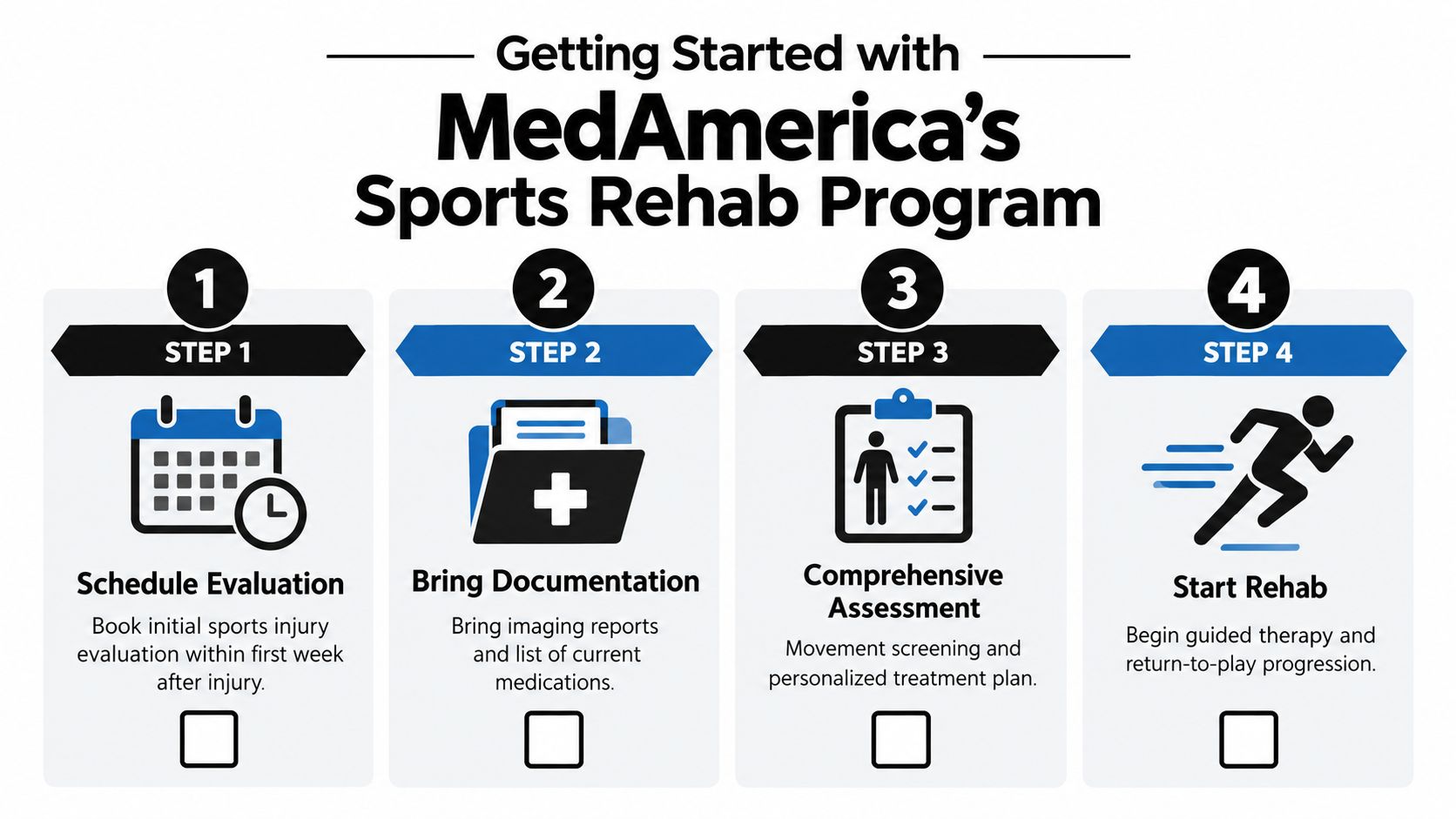
Start with an initial sports injury evaluation rather than waiting for symptoms to become your new normal. If movement is painful, schedule as soon as practical, especially when swelling, instability, weakness, or difficulty bearing weight interferes with normal activity.
Prepare for the evaluation
Bring the information that helps the therapist see the full picture:
- Medical documents: Bring imaging reports, referral paperwork if applicable, and a current medication list.
- Symptom notes: Write down when pain, swelling, weakness, or instability appears.
- Training details: Note your sport, recent workload, position, equipment, and the movements you need to regain.
- Appropriate clothing: Wear training clothes and sport-specific shoes so the therapist can observe relevant movement.
Expect the first visit to combine history, movement screening, strength testing, and an explanation of the findings. Hands-on treatment may be included, but understanding the working diagnosis and plan should come first.
Ask questions that make progress measurable
Before beginning, ask which criteria will guide progression, how often visits are expected, what you should do between appointments, and how the clinic will measure change. Also confirm insurance coverage, copay details, and whether Florida's direct-access rules allow you to book without a physician referral for your situation.
MedAmerica Rehab Center offers sports injury rehabilitation with physical therapy and related clinical services, using individualized assessment, hands-on care, targeted exercise, and supportive modalities. If you're in Deerfield Beach or nearby and want a clear plan for returning to activity, visit MedAmerica Rehab Center to schedule an evaluation and discuss your next safe step.
MedAmerica Rehab · Deerfield Beach
Talk to a clinician about your pain
Physical therapy, chiropractic, acupuncture and shockwave therapy under one roof, since 1995. Same-day appointments are available.
Mon–Thu 8:00 AM – 6:30 PM · Fri 8:00 AM – 3:00 PM