
Occupational Health Services: A Complete Patient Guide
You're at work, you tweaked something, and now the pain is still there when you bend, lift, or reach. Maybe it started as a back strain on a warehouse shift, a shoulder that's been barking through long kitchen closes, or a slip that seemed minor until the next morning. That's usually the moment people start asking the wrong question, like whether urgent care is enough, when the better question is how to keep the injury from turning into lost time, confusing paperwork, and a slow return to work.
Occupational health services are the coordinated answer to that problem. In a Deerfield Beach clinic, they're not just about treating pain after the fact, they're about documenting the injury correctly, matching care to the job, and getting the worker back safely with the right restrictions. The path is more practical than most guides make it sound, and it starts long before a final clearance note is printed.
What Most People Miss About Workplace Health Care
A lot of workers think the system begins when they walk into a clinic. In reality, it starts the moment the injury is reported, because the details recorded on day one shape everything that follows, from treatment to work restrictions to the paperwork that has to travel between the clinic, the employer, and the insurer.
The case that sounds ordinary until it isn't
A line worker in Deerfield Beach lifts a box, feels a sharp pull in the low back, and finishes the shift anyway. By Thursday, the pain is worse, the job feels impossible, and the worker is trying to decide whether this is just soreness or something worth reporting. That hesitation is common, and it's where problems begin, because waiting usually means more stiffness, a messier claim, and a harder first exam.
The right pathway is coordinated, not chaotic. A good occupational health visit doesn't just ask where it hurts, it asks what job task caused it, what movements make it worse, and what the worker can still do without making the injury worse. That's the difference between a generic visit and one that fits workplace recovery.
Practical rule: the best first visit is the one that connects symptoms to the job before the story gets diluted by delay.
This guide follows that patient journey in plain language, from the first phone call after the strain to the final clearance note. It stays grounded in what a local Deerfield Beach clinic handles, including employer forms, workers' comp documentation, and the therapy decisions that matter when time off work is on the line.
Defining Occupational Health Services
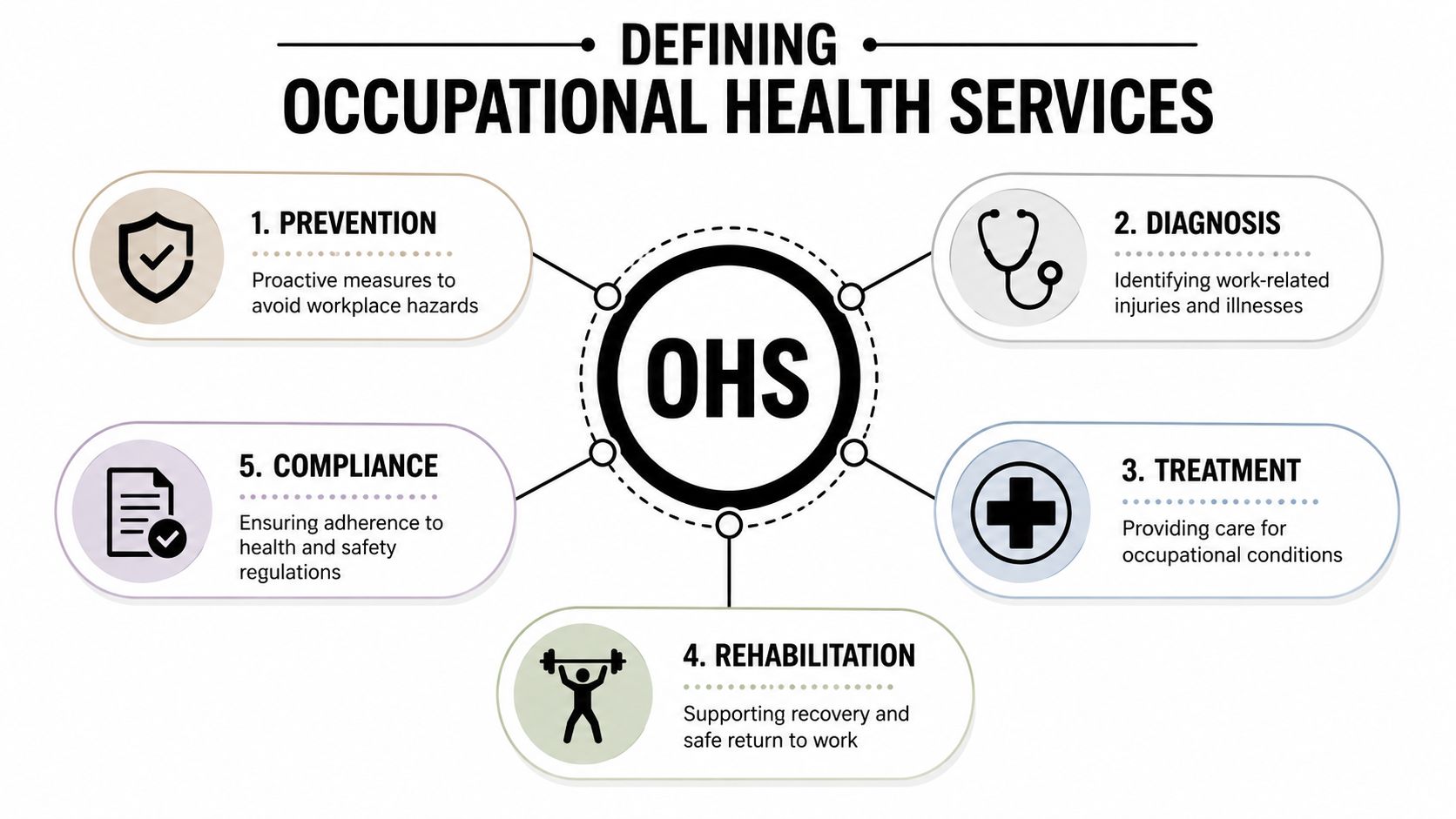
The cleanest definition is simple. Occupational health services are the clinical and preventive services that prevent, diagnose, or treat work-related injuries and illnesses and support rehabilitation, which the CDC groups into preventive, curative, rehabilitative, and consultative functions.CDC
What that looks like in a real clinic
The obvious part is treatment. A strained back, a cut finger, a shoulder flare-up, or a knee injury gets assessed and managed so the worker can function again. The less obvious part is what happens around the treatment, because a work injury usually needs more than pain relief.
A proper occupational health program may include surveillance for repetitive strain, fitness-for-duty evaluation, return-to-work planning, and health screening tied to a specific job exposure. That matters because the goal is not to say a person is “better,” but to decide whether they can safely do the actual tasks their job requires without worsening the problem.
Why it is not the same as urgent care or general rehab
Urgent care is built to get people through a medical problem quickly. General physical therapy is often built to restore movement and function. Occupational health sits between those worlds and adds the job lens, which is why it asks whether a worker can lift, twist, stand, drive, or use the same equipment they used before the injury.
That job-specific lens is what makes the service useful. Without it, a worker may get care that helps pain but does not resolve the underlying barrier to returning to work. A clinic that handles occupational cases well will also track progress, communicate with the employer when appropriate, and adjust restrictions as the worker improves.
That's also why good programs are data-driven. They don't just hand out therapy visits, they follow exposure patterns, document functional changes, and use that information to guide rehabilitation and safe return.
Core Services You Will Actually Use
Work-related care becomes easier to follow once it is broken into the services patients most often need. In a Deerfield Beach clinic, that usually means injury triage, rehabilitation, return-to-work support, drug and alcohol testing, employment physicals, and ergonomic review. The clinic's role is to match the service to the problem, then produce something the next step in the process can use, whether that is a restriction note, a surveillance result, or a clear fitness-for-duty decision.
The services that matter most
Injury evaluation and triage usually comes first. The clinician looks at what happened, what body part is involved, whether any red flags are present, and whether the worker needs imaging, therapy, or a specialist. The patient leaves with a plan, which may be simple home instructions or a more formal work restriction.
Physical therapy and chiropractic rehabilitation focus on restoring motion, lowering pain, and rebuilding tolerance for job tasks. A worker may begin with hands-on care and then move into guided exercise, mobility work, or lifting progressions. If you want a clear explanation of how work conditioning differs from work hardening, this plain-language comparison is a useful refresher.
Return-to-work conditioning is about proving the body can handle the demands of the job again. Work simulation, progressive loading, and task-specific conditioning are common parts of that process.
Drug and alcohol testing is usually tied to employer policy, post-incident rules, or pre-employment screening. The patient experience is formal, chain-of-custody based, and documentation-heavy.
Employment physicals help determine whether someone can safely do the job before they start or before they return after a break. The result is usually a clearance decision, a limitation, or a request for follow-up.
Ergonomic assessments focus on the workplace itself. A clinician or therapist observes the worker's setup, then connects the chair, keyboard, tool, bench, or lifting pattern to the body doing the work.
Injury data from the BLS shows how often these services come into play, which is one reason clinics build them into occupational programs. The numbers matter most at the kitchen table or the job site, where a missed shift, a lost paycheck, or a temporary restriction changes the rest of the week.
How the Workflow Actually Runs
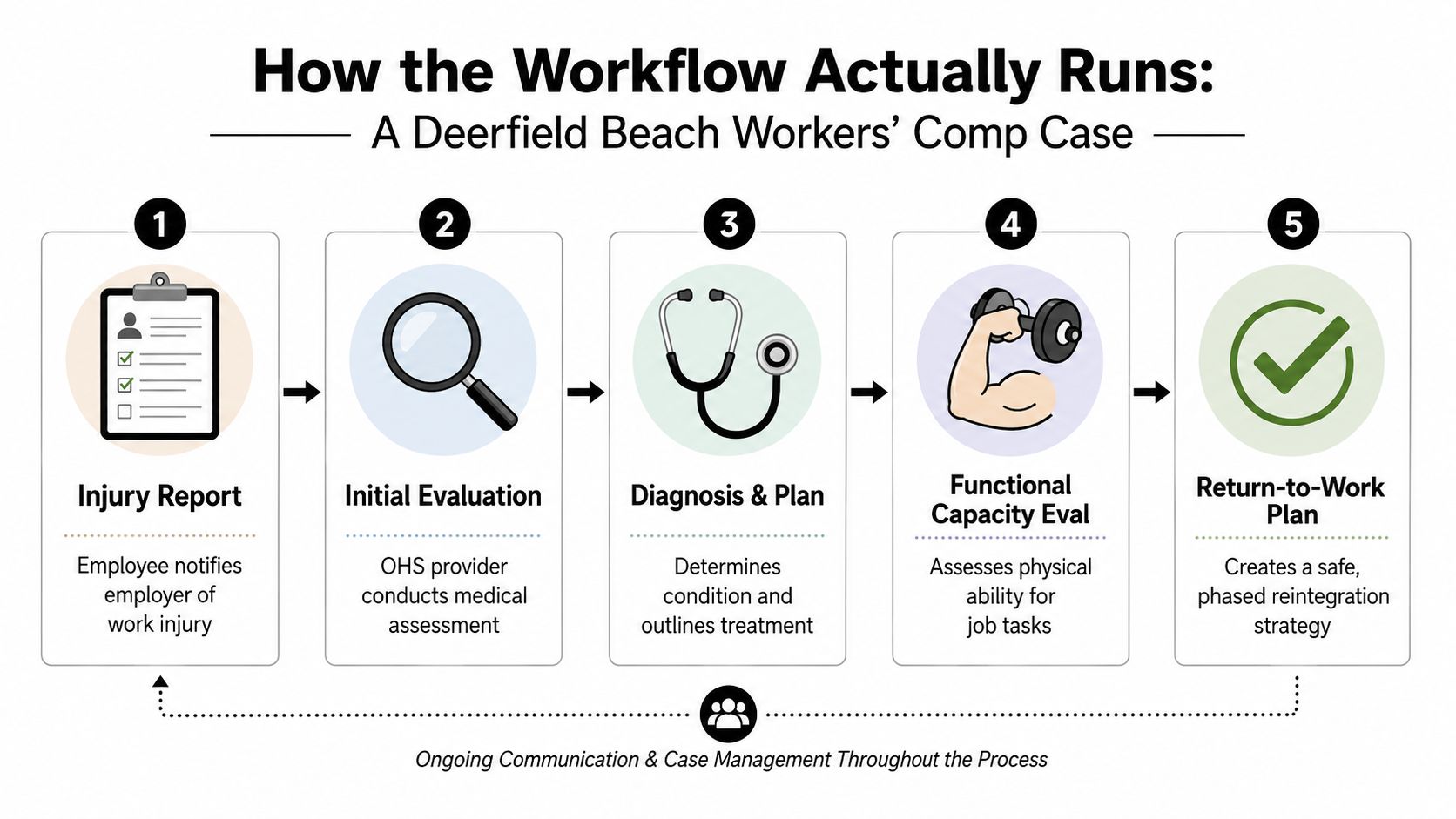
A workers' comp case moves best when each person handles the next step without delay. The worker reports the injury, the employer records it, the clinic evaluates it, and the insurer reviews the care that fits the claim. If one part slows down, the whole case starts to stall.
What usually happens first
The first call or walk-in is triage. The clinic asks what happened, where it hurts, when the injury occurred, and whether the worker is safe to wait or needs immediate care. A same-week visit matters because early assessment helps separate a simple strain from a problem that needs a different level of treatment.
The next step is the exam and the treatment plan. That may include activity modification, therapy, medication guidance if appropriate, and work restrictions that are specific enough to be useful. Vague notes help no one, because “light duty” is not the same as “no lifting over 10 pounds, no repetitive overhead reaching, and no prolonged bending.”
When recovery stalls
If the worker is improving, re-evaluation usually tightens the plan and gradually expands function. If recovery is slow, the clinic may look at whether the injury is being aggravated at work, whether the task demands are too high, or whether the worker needs more structured conditioning. A functional capacity exam becomes useful when the clinical picture and the work demands need an objective bridge.
Slow progress usually has a plain explanation, the job is still asking for more than the body can safely give.
The coordinator matters here. A clinic case manager helps move information between the provider, adjuster, and employer, because workers' comp cases tend to bog down when that communication is loose or delayed. The worker does not need to manage the whole system alone, but they do need to keep showing up, follow the plan, and report changes truthfully. For workers who want a clearer sense of where recovery needs to land before a claim settles, what is MMI in workers comp is a useful outside primer.
Benefits for Workers and Employers
The value of occupational care looks different depending on which side of the desk you sit on. For workers, the main win is having a documented path back to function instead of guessing their way through pain. For employers, the gain is a process that can reduce lost-time disruption and keep a valued employee attached to the job instead of drifting away from it.
What the worker gets
The worker gets a chart that follows the injury from first report through treatment and clearance. That matters because work restrictions, therapy notes, and follow-up visits create a record that can protect the job while the body heals.
The other benefit is pace. Delayed care tends to stretch recovery, especially for strain and sprain injuries. The BLS reported 568,150 sprains, strains, and tears among days-away-from-work cases in 2024, which is a big reason occupational programs focus on ergonomic prevention, fitness-for-duty assessment, and return-to-work support.BLS Those injuries are common, but they're not harmless just because they're common.
For workers who want to understand where healing usually has to reach before a claim settles, what is MMI in workers comp is a useful outside primer. It helps frame why “better” and “medically stable” are not always the same thing.
What the employer gets
The employer gets a defensible process for modified duty, restrictions, and clearance decisions. That protects productivity without forcing a rushed return that makes the injury worse. It also gives management a better chance to keep a trained worker on the roster rather than replacing them after a preventable setback.
The bigger point is practical. A worker who stays connected to work, even at modified duty, usually has a clearer path than someone who is out, untracked, and waiting on paperwork. Good occupational health does not erase injuries, but it does keep injuries from becoming avoidable absences.
Legal and Insurance Context in Florida
Florida workers' comp is a paperwork system as much as a medical one. The employer has to carry coverage, the injury has to be reported on time, and the clinic has to understand whether it is treating under authorization or seeing the worker while the claim is still being verified. At the front desk, that translates into claim numbers, employer contact details, and a quick check on what has been approved.
What the front desk is checking
The clinic usually wants the date of injury, employer name, adjuster information if it's available, and the body part involved. If the claim is not yet authorized, the first visit may be handled differently from a fully approved occupational visit. That is not unusual, it's just part of how the financial side of the case gets sorted.
For workers who are trying to make sense of authorization and the pace of a claim, this overview on how long workers' compensation takes can help frame the timeline without guessing.
Practical rule: if the insurer is slow, the worker should still keep the appointment path moving, because gaps in care usually cost more than the delay itself.
A second issue is whether the worker is covered by the employer's policy structure. For people checking that angle, workers comp exemption from Schneider Insurance is a useful reference on who may be outside standard coverage arrangements.
Who usually pays for what
| Service | Typical Payer | When Authorized |
|---|---|---|
| Initial injury evaluation | Employer or insurer in a covered claim | After claim verification |
| Therapy and rehabilitation | Insurer in an authorized claim | After treatment approval |
| Employment physicals | Employer or employee, depending on purpose | Before hiring or assignment |
| Drug testing | Employer | Per policy or incident rule |
| Ergonomic review | Employer | When used for prevention or job redesign |
That table is the practical version of the finance question. The exact payer depends on why the visit happened, not just what the visit involved. A good clinic makes that clear before confusion becomes a billing problem.
How to Choose the Right Local Provider
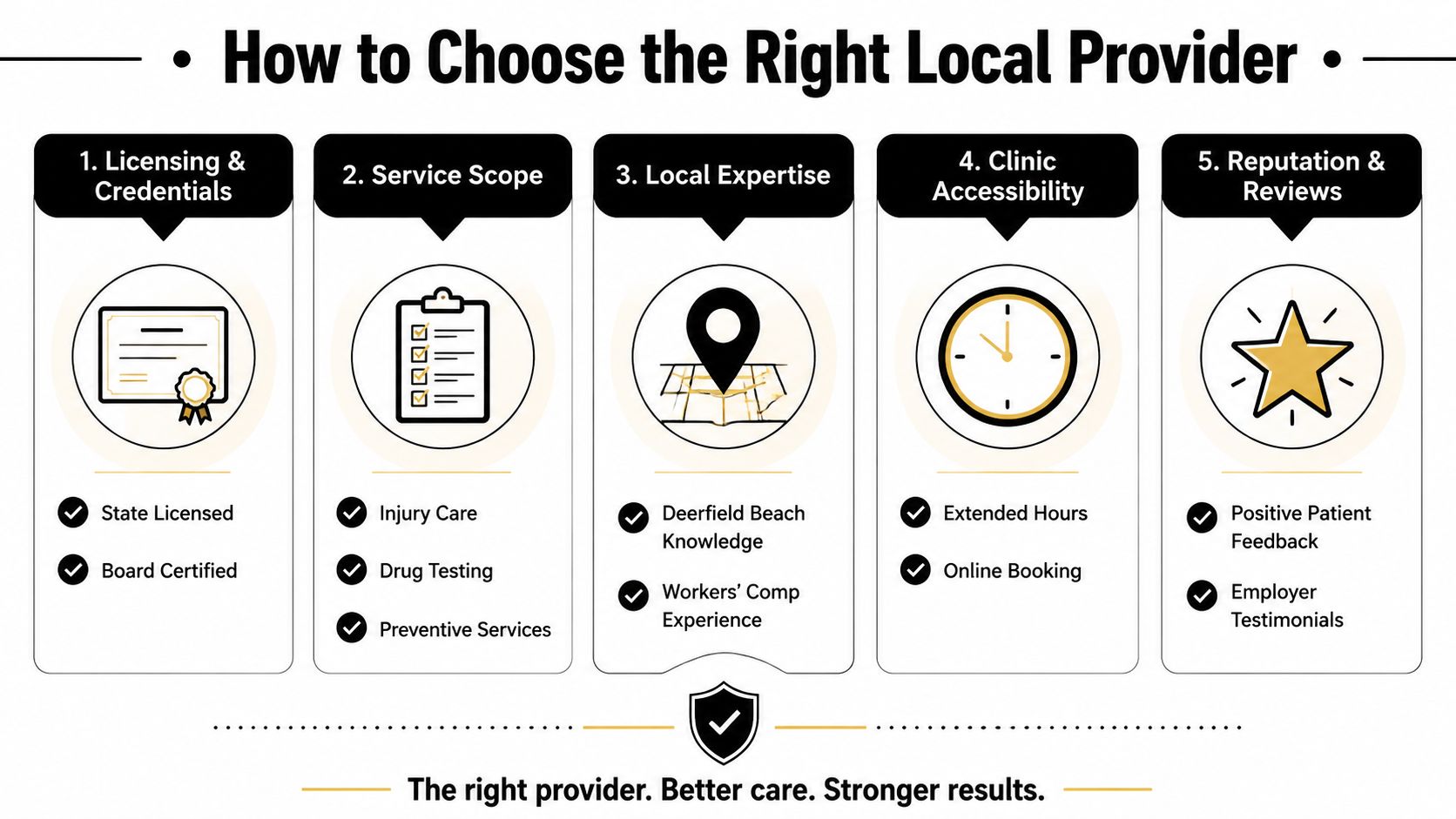
A strong occupational health provider should make your case simpler, not noisier. Look for a clinic that has the licenses, the workflow, and the communication habits to handle work injuries without making the worker chase every update.
The checklist that actually matters
Licensing and credentials come first. If a provider can't clearly explain who is treating, what their scope is, and how they handle work-related cases, keep looking.
Multidisciplinary care is a real advantage. A clinic that can coordinate therapy, chiropractic care, and occupational medicine in one place usually spends less time sending the patient across town for every step.
Workers' comp communication is nonnegotiable. You want a provider that understands adjusters, employer forms, and clear restriction language.
Ergonomic capability matters if the same task keeps causing the same injury. A clinic that can assess a workstation or job pattern has a better shot at preventing repeat flare-ups.
Return-to-work follow-through is the last filter. You want a provider who writes restrictions the employer can use, not notes that create more confusion.
Red flags are easy to spot if you pay attention. Long callback delays, no designated case manager, and vague first-visit expectations usually mean you'll be doing part of the clinic's job for them.
MedAmerica Rehab Center is one local option that fits this model, since it combines physical therapy, chiropractic care, acupuncture, and occupational therapy in a Deerfield Beach setting. For a worker, that kind of setup can reduce handoffs and keep the treatment plan moving in one place.
What to Expect at Your First Visit
A work injury visit starts with the basics, and those basics matter. Bring your photo ID, your claim number if you have it, the employer contact information, and any imaging or prior records that help explain the injury. If you were seen somewhere else first, bring those notes too, because repeating the story from scratch takes time and can blur the details that matter.
The first appointment usually begins with paperwork, then a history of the injury, then a focused exam. The clinician wants the mechanism of injury, the date, the body part, what movements aggravate it, and what you can still do at work. That history matters because a work injury is judged partly by how it behaves during normal job tasks, not just by how it feels at rest.
The checklist that matters most
A good first evaluation may include:
- Baseline measurements, such as range of motion, strength, swelling, or tenderness.
- Functional testing, if it's safe, so the clinician can see how the injury affects job-related movement.
- Initial restrictions, written clearly enough that a supervisor can understand them.
- A first treatment plan, which may start with therapy, home exercises, or follow-up visits.
The appointment is rarely a quick in-and-out stop. Coordinated cases often take longer because the clinician has to gather the story, examine the body, and document work limits in a way that supports both healing and the claim. If hands-on care is appropriate, it may begin the same day, but sometimes the first visit is mostly evaluation and planning.
Waiting to see whether the pain fades on its own is a common mistake. That delay can slow recovery and make the claim harder to document cleanly. Early therapy plus a realistic return-to-work plan usually helps more, because guided movement often beats prolonged shutdown.
Report the injury to your employer today, write down the body part, mechanism, and date, choose an authorized occupational health provider who can see you within a week, and bring your claim number to the first visit. If you want a local team that handles injury care, rehabilitation, and work-related documentation in one place, contact MedAmerica Rehab Center today to schedule your first visit and get your claim documentation started promptly.
MedAmerica Rehab · Deerfield Beach
Talk to a clinician about your pain
Physical therapy, chiropractic, acupuncture and shockwave therapy under one roof, since 1995. Same-day appointments are available.
Mon–Thu 8:00 AM – 6:30 PM · Fri 8:00 AM – 3:00 PM