

Neck Pain After Chiropractic Adjustment: What’s Normal
Mild neck pain after chiropractic adjustment is common the day after a cervical adjustment and often resolves within 24 to 48 hours. Escalating pain, a sudden severe headache, or any new neurological symptom shouldn't be monitored at home, it should be evaluated promptly.
That distinction matters more than the soreness itself. You're probably not reading this because you're curious in the abstract. You're reading it because something changed after your visit, and you want a straight answer about whether to wait, call, or seek urgent care.
Why Your Neck Hurts the Morning After an Adjustment
You left the office feeling looser. You turned your head in the parking lot and thought, finally, that worked. Then you slept, woke up, and tried to look over your shoulder in the shower or back out of the driveway, and your neck felt stiffer than it did yesterday.
That's the pattern patients describe most often. The ache isn't usually sharp. It's a dull soreness along the sides of the neck, tenderness when you press the muscles, maybe a mild headache at the base of your skull, and a tired feeling you didn't expect from a short appointment.
What That Morning Soreness Usually Feels Like
- Achy and local: The discomfort stays near the joints and muscles that were treated, rather than spreading down an arm.
- Stiff at first, looser with movement: You feel worst when you get up, then a short walk or a warm shower eases it a little.
- Tender to touch: Pressing the muscles beside your spine feels bruise like, similar to the day after unfamiliar exercise.
- A mild headache or fatigue: Both show up often enough that you shouldn't automatically read them as a problem.
None of that means you should ignore it. It means you should sort it. By the time you finish reading, you'll have two clear piles in mind. One is monitor at home, for mild symptoms that peaked early and are easing. The other is call today or seek urgent care, for symptoms that are escalating, unusual for you, or neurological in any way.
That sorting is the whole point. Blanket reassurance doesn't help if your pain is getting worse. Alarm doesn't help if what you're feeling is a routine tissue response that thousands of patients ride out every week. You need a decision rule, and you need it tied to what your neck is doing hour by hour.
Start with one question you can answer right now. Is this soreness mild, familiar in character, and no worse than it was a few hours ago? If yes, keep reading and track it. If it's severe, sudden, or paired with anything affecting your vision, speech, balance, strength, or sensation, skip ahead to the red flag table and act on that first.
What Is Actually Happening Inside the Tissues
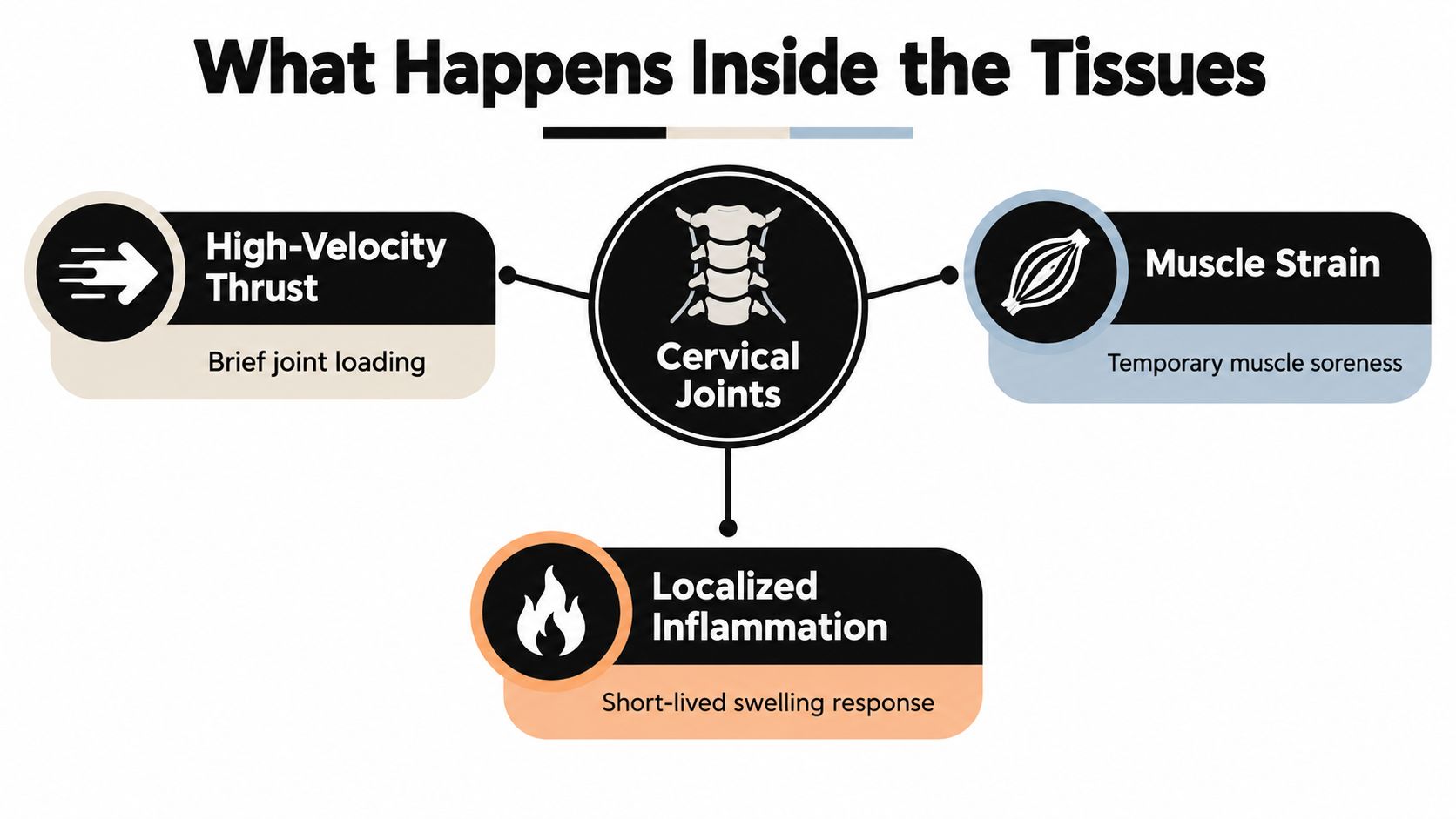
A cervical adjustment is a brief, controlled thrust that loads a joint in your neck and moves it through a small range quickly. The joint capsule, the small muscles that guard that segment, and the surrounding soft tissue all register that input at once. Your body responds the way it responds to any new mechanical load, with local muscle irritation, transient guarding, and a short lived inflammatory sensitization.
Think about a deep tissue massage on a tight shoulder. You can feel fine on the table and sore the next morning, not because tissue was damaged, but because tissue was worked harder than it's used to. A stiff cervical segment that hasn't moved well in months behaves much the same way when it's asked to move again.
The infographic below maps that sequence, from the thrust itself to the muscle and inflammatory response that follows.
Why The Reported Rates Vary So Much
In prospective studies summarized in a systematic review of adverse effects after spinal manipulation, 30 to 61 percent of patients reported some mild adverse effect, with approximately 80 percent of symptoms beginning within 24 hours, and commonly reported symptoms included increased pain, headache, fatigue, and radiating pain.
That range looks wide because studies don't count the same way. Some ask patients directly the next day, some rely on clinicians recording complaints, and some set a threshold for how much worse a symptom has to get before it counts. A stricter definition produces a lower number. A broader check in produces a higher one. The rate moves, but the pattern doesn't. Onset is usually early, symptoms are usually mild, and they usually fade.
Soreness after an adjustment is best understood as a local tissue response to new loading, not as proof that something was torn, displaced, or done wrong.
You're also more likely to notice it if you came in already flared up. A sensitized nervous system, guarded muscles, and limited motion before treatment all lower the threshold for post treatment irritability. That's why your clinician's technique choices matter, including force, frequency, and whether lower velocity mobilization or exercise fits you better on a given day. If you want the mechanics in more detail, our guide on how a chiropractic adjustment works walks through what the thrust does at the joint level.
What this means for you tonight is simple. Soreness that starts the same day or the next morning, stays localized, and doesn't progressively intensify fits the known mechanical response. Soreness that behaves differently deserves a different interpretation, which is where timing becomes your best tool.
A Practical Hour-by-Hour Recovery Timeline
Track the trend, not a single moment. A stiff neck at 7 a.m. tells you little by itself. A stiff neck at 7 a.m. that's clearly looser by noon and looser still the next morning tells you almost everything.
The First Few Hours
Right after treatment, many patients feel looser, lighter, or more aware of the area. Mild tenderness can build over the afternoon or evening as the tissue response sets in. This is the window to keep things easy, drink water, walk a little, and skip heavy lifting or an intense workout.
Don't repeatedly twist your neck to test it. That habit irritates sensitive tissue and muddies your own tracking, because you can't tell whether you're sore from the adjustment or from checking it twenty times.
The Next Morning Through 48 Hours
- Peak soreness: For those who get sore, the next morning is the high point, with stiffness easing as you move around.
- A clear direction: By the second day, range of motion should feel a bit freer and the ache a bit duller, even if it hasn't fully resolved.
- Function check: You should be able to sleep, work, drive, and do light daily tasks, perhaps with some discomfort, but without being sidelined.
Run the same two checks each morning. Turn your head left and right to a comfortable endpoint and note roughly how far you get. Then rate the ache during a normal activity like showering or making coffee. Improvement in either check is a good sign, even if soreness hasn't vanished.
The 72 Hour Mark
By around day three, routine post adjustment soreness should be clearly improving. It doesn't need to be gone. It needs a direction.
Practical rule: If your symptoms have plateaued or worsened after 48 hours, stop waiting them out and call the clinic that treated you.
That call isn't an overreaction. It's useful clinical information. Your provider may want to reduce force, switch to mobilization, treat fewer segments, add soft tissue work, or reexamine you before doing anything else. Reporting a strong reaction early lets the plan change before your next visit, instead of repeating the same input and hoping for a different result.
One exception overrides every timeline. Severe or neurological symptoms don't get a waiting period at any hour. The timeline applies only to mild, localized, nonprogressive soreness.
Normal Soreness Versus Red Flags You Should Not Ignore
Clinical guidance summarized alongside a 2025 systematic review of spinal manipulative therapy for acute neck pain identifies severe or sudden neck pain or headache, dizziness, double vision, slurred speech, difficulty swallowing, loss of coordination, fainting, or new numbness and weakness as warning signs that may indicate cervical artery or neurological involvement and warrant emergency care. That same review reported improved pain, range of motion, and disability, with no serious adverse events in the included trials.
Both halves of that sentence matter. Trials show manipulation can help acute neck pain without serious events in the studied groups. Individual patients still need symptom screening, because a trial average never examines the person in front of you.
Normal Soreness vs Red Flag Symptoms After a Cervical Adjustment
| Symptom | Usually Normal | Call the Clinic or Seek Care |
|---|---|---|
| Neck soreness | Mild, localized ache that eases over 24 to 48 hours | Severe, rapidly worsening, or unlike any pain you've had |
| Stiffness | Worst on waking, loosens with gentle movement | Locking up so you can't do basic tasks or drive safely |
| Headache | Mild, dull, similar to your usual tension headaches | Sudden and severe, or paired with vision or speech changes |
| Arm symptoms | No new arm symptoms, or brief familiar tingling that fades | New numbness, weakness, or pain spreading down the arm |
| Balance and speech | Steady walking, clear speech, normal swallowing | Dizziness, loss of coordination, slurred speech, fainting |
| Overall trend | Clearly improving by day two or three | Plateaued, escalating, or keeping you from daily function |
Why Each Warning Sign Gets Taken Seriously
Vision changes, speech difficulty, swallowing problems, loss of coordination, and new weakness point away from muscle soreness and toward the nervous system or the arteries that supply the brain. Muscles don't cause double vision. That's why those symptoms bypass the wait and see category entirely, whenever they appear.
Escalating pain matters for a different reason. A routine tissue response peaks early and recedes. Pain that builds day after day suggests ongoing irritation, a flare of the original problem, or a technique that doesn't suit you, and any of those deserves reexamination rather than another identical treatment.
One caution about timing. Neck pain itself can precede a vascular event, which means a symptom appearing after an adjustment doesn't, by itself, prove the adjustment caused it. It also doesn't clear it. Timing is a reason to evaluate carefully, not a verdict in either direction.
If you're debating whether your symptom clears the bar for a call, you've usually answered your own question. Make the call. A two minute conversation costs nothing, and a clinician who treats necks would rather hear from you today than learn next week that you sat on a worsening symptom.
Self-Care Steps You Can Start Today
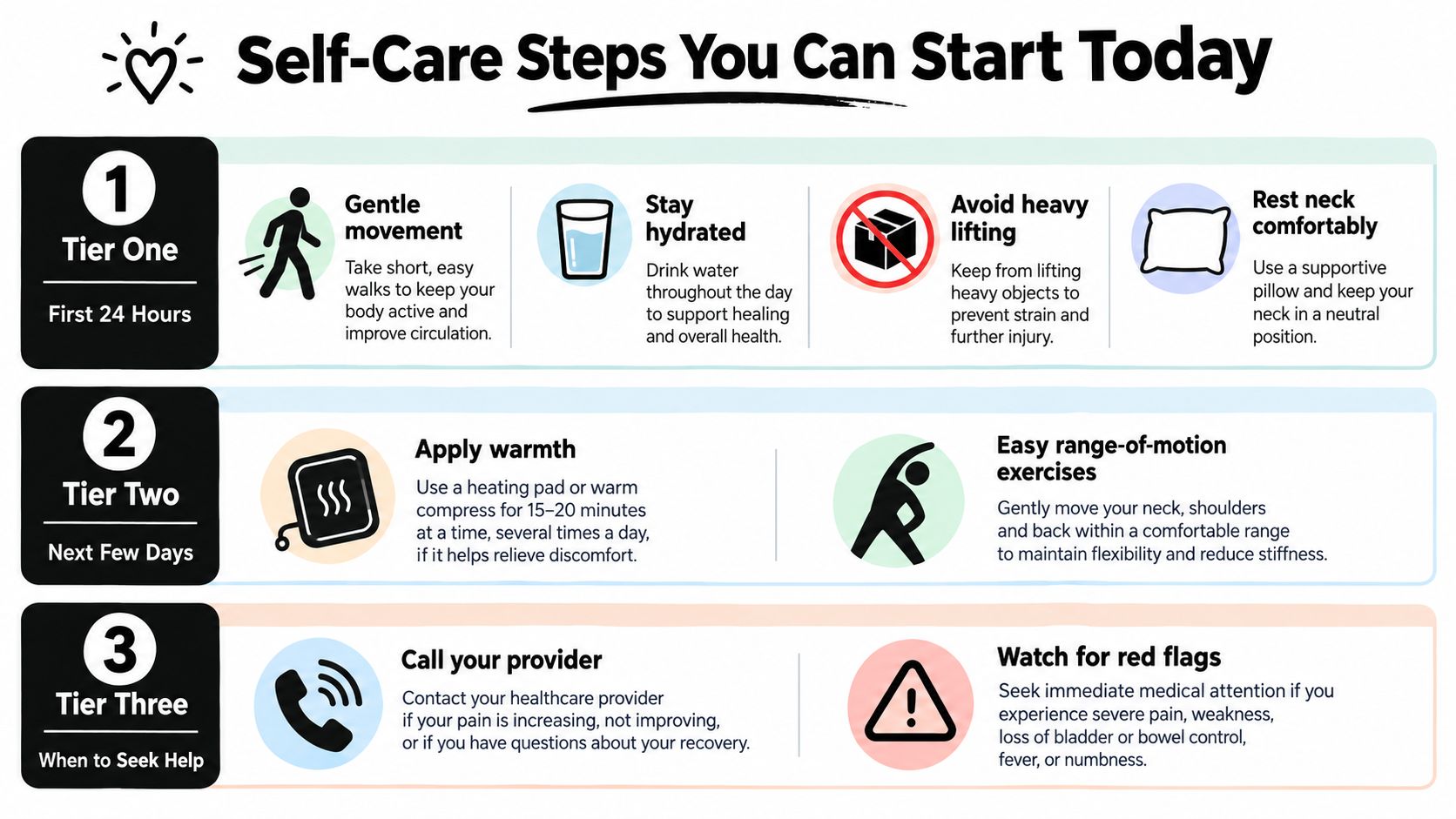
Self care works best in tiers. You start gentle, you add movement as soreness fades, and you build in a clear trigger for professional follow up so you aren't improvising on day four.
The checklist below lays out that progression, from the first day through the point where you should stop self managing.
Tier One For The First 24 Hours
- Move gently and often: Short walks and normal light activity beat lying still all day, because complete rest tends to stiffen an irritated neck further.
- Use ice or heat by response: Ice often suits a tender, freshly irritated spot, warmth often suits tight, guarded muscles, and the one that clearly helps you is the right choice.
- Protect your sleep position: Keep your head supported in a neutral position rather than propped high or twisted, and if your current setup leaves you sore most mornings, it may be time to find the right pillow for your sleeping position and build.
- Skip the heavy load: Save yard work, overhead lifting, and high intensity training for when the trend is clearly downward.
Tier Two For Days Two Through Four
Add slow, comfortable range of motion. Turn, tilt, and nod within a range that feels like a stretch, not a provocation, and stop well short of sharp pain. Break up desk time with short standing and walking intervals, because one fixed posture for hours is a reliable way to keep a sore neck sore.
The video below demonstrates gentle movement at the pace you should be aiming for during this phase.
Tier Three And What To Avoid
Resume normal exercise gradually once soreness is clearly easing, starting lighter than usual. Don't aggressively crack your own neck, don't push through sharp or radiating pain, and don't add a new aggressive stretching routine on top of irritated tissue. For a fuller home routine, see our resource on treating neck pain at home.
If you reach day three without clear improvement, tier three isn't more self care. It's a follow up appointment.
Putting the Stroke Risk in Real Perspective
Many people search this topic at midnight because they've read something frightening about neck manipulation and stroke. You deserve the actual numbers instead of either dismissal or panic.
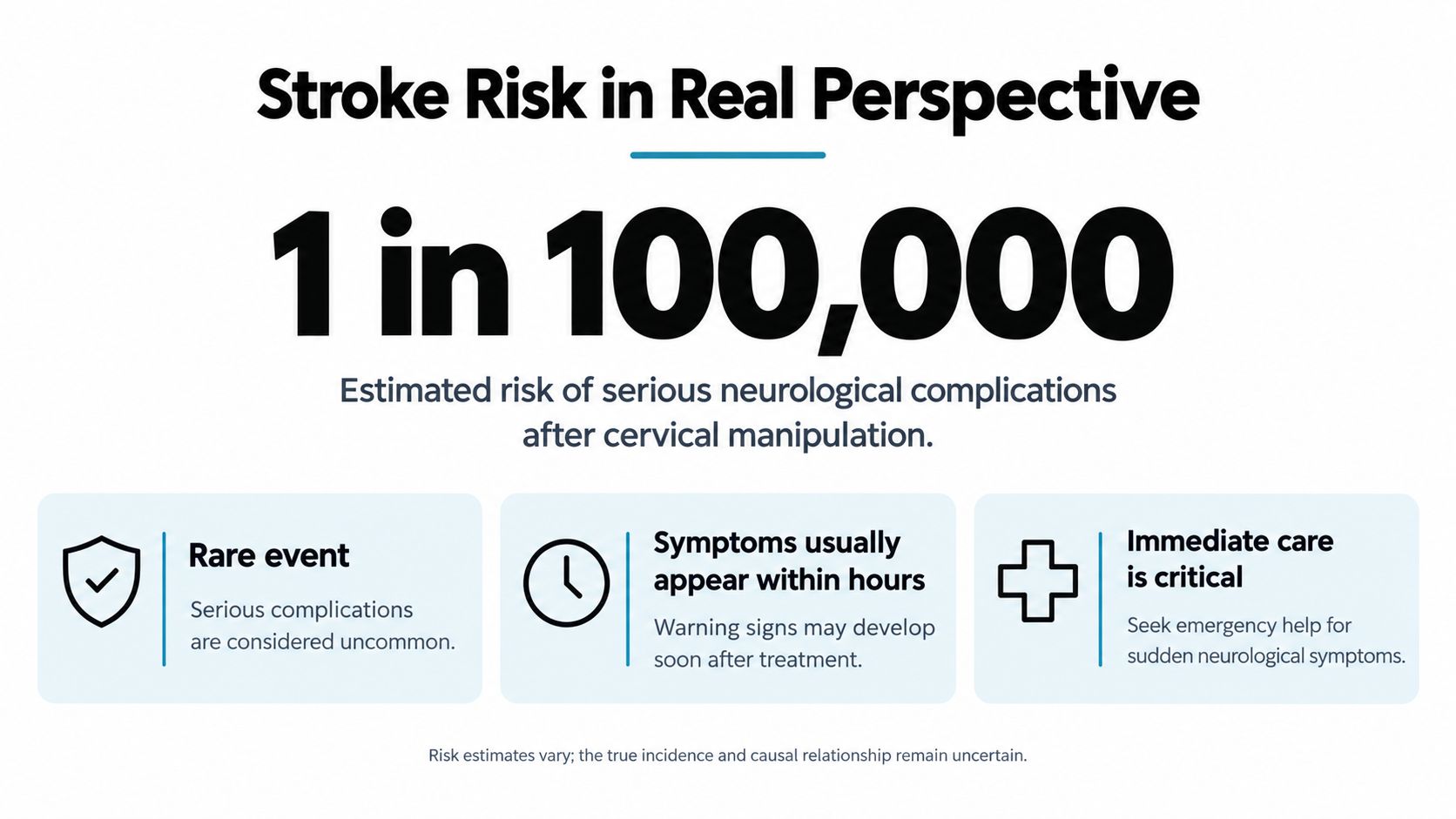
The graphic below frames how clinicians think about serious complications after cervical manipulation, as rare events that still demand fast recognition.
What The Large Scale Data Shows
An analysis of Medicare data summarized by the National Center for Complementary and Integrative Health covered more than 1.1 million adults aged 66 to 99 with neck pain and found stroke at 7 days occurred in 1.2 per 1,000 chiropractic patients versus 1.4 per 1,000 primary care patients, while at 30 days the figures were 5.1 and 2.8 per 1,000 respectively, with differences judged of doubtful clinical significance.
Read that carefully. Older adults with neck pain have strokes at a background rate whether they see a chiropractor or a primary care doctor, and in this very large dataset the rates sat in a similar range. That argues against the idea that manipulation commonly causes stroke.
Why Rare Does Not Mean Ignore It
Earlier case control research did find an association worth respecting, including dissection patients who'd had cervical manipulation shortly before their event and who reported increased head or neck pain afterward. Association in a small, selected group doesn't establish how often manipulation causes dissection, and it can't be waved away either. Both datasets point to the same practical conclusion. Serious events appear rare, and unusual symptoms still need immediate evaluation.
Ordinary post adjustment soreness is not a stroke sign. A sudden severe headache with dizziness, vision change, or weakness is not ordinary soreness.
That's the calibrated position. Don't let a rare risk talk you out of appropriate care by itself, and don't let reassuring population data talk you out of seeking help for a symptom that's scaring you. Population data describes groups. Your symptoms describe you, and they're what get examined.
How MedAmerica Rehab Center Evaluates and Manages Your Symptoms
When a patient in Deerfield Beach comes in sore after a cervical adjustment, the first job isn't treatment. It's sorting. We start with a red flag screen, asking directly about headache character, dizziness, vision, speech, swallowing, balance, and any new numbness or weakness, before anyone touches your neck.
If that screen raises concern, the visit changes course immediately toward urgent medical evaluation. If it doesn't, we move to examination.
The photo below shows the kind of hands on neck examination that anchors that assessment.

What The Examination Covers
- Your reaction history: When soreness started, where it peaked, whether it's improving, and what makes it better or worse, because that timeline separates a routine response from a flare.
- Movement and strength: Cervical range of motion, shoulder and arm strength, reflexes, and sensation, checked side to side.
- Tissue findings: Which muscles are guarded, which segments are stiff or irritable, and whether your symptoms behave like joint, muscle, or nerve involvement.
That history matters because reactions like yours are well documented. In a prospective observational study of chiropractic treatment reactions that defined a reaction as a new symptom or worsening of the original complaint by more than 30 percent within 24 hours, 31.0 percent of patients reported a reaction, with neck pain in 5.4 percent, dizziness in 4.9 percent, and headache in 4.2 percent, and these reactions were generally mild, brief, and had little effect on daily activities.
How The Plan Gets Built
Because MedAmerica Rehab Center is multidisciplinary, your plan isn't limited to repeating the adjustment that left you sore. Depending on findings, it may combine physical therapy, gentler manual therapy or mobilization, targeted exercise, postural retraining, acupuncture, or shockwave therapy, with force and frequency adjusted to how irritable your neck is that week. Our approach to physical therapy for back and neck pain shows how the exercise and manual pieces fit together.
Practical access matters when you're hurting. The clinic offers same day appointments and an insurance friendly process, and your first visit expectations are laid out clearly so you aren't guessing. If your examination points to a problem that needs orthopedic, neurological, or other specialist care, you'll be referred rather than kept in a treatment loop. A clinic that won't refer out isn't protecting you.
Your Simple Decision Rule and Next Steps
Save this version. It's the whole guide in one screen.
Monitor at home if your soreness is mild, localized to the treated area, started within the first day, lets you carry on with daily life, and is clearly easing by 24 to 48 hours. Use the tiered self care plan, run your two morning checks, and mention the reaction at your next visit so force and technique can be tuned.
Call the clinic today if soreness isn't clearly improving by day three, if it plateaus after 48 hours, if it's intense enough to cost you sleep or work, or if new arm pain, tingling, or numbness shows up. You don't need an emergency to justify that call.
Seek urgent care now if you develop a sudden severe headache or neck pain unlike anything you've felt, dizziness, double vision, slurred speech, trouble swallowing, loss of coordination, fainting, or new weakness. Don't drive yourself. Don't wait to see if it passes.
The rule in one line: Mild, local, and improving means monitor. Severe, spreading, neurological, or stuck means get evaluated.
Neck pain after chiropractic adjustment is usually a short story with a boring ending, a sore day or two, then steady improvement. Your job isn't to diagnose yourself. It's to notice the direction your symptoms are moving and act when that direction is wrong. If you're in Deerfield Beach and your neck isn't following the expected timeline, getting examined promptly beats another week of guessing.
If your neck pain after chiropractic adjustment isn't improving on schedule, or you're unsure which side of the decision rule you're on, the multidisciplinary team at MedAmerica Rehab Center in Deerfield Beach can screen your symptoms, examine your neck, and build a plan that may include physical therapy, chiropractic care, acupuncture, or shockwave therapy matched to your findings. Same day appointments are available, so reach out today and get a clear answer instead of another night of wondering.
MedAmerica Rehab · Deerfield Beach
Talk to a clinician about your pain
Physical therapy, chiropractic, acupuncture and shockwave therapy under one roof, since 1995. Same-day appointments are available.
Mon–Thu 8:00 AM – 6:30 PM · Fri 8:00 AM – 3:00 PM