

Sciatic Nerve Exercises to Avoid: 7 Moves to Skip in 2026
You finish a familiar workout, bend toward your toes, and notice that the ache in your buttock now reaches your calf. Or you add weighted crunches to strengthen your core while ignoring a tingling foot. The exercise feels productive, but your leg feels worse afterward.
The important distinction isn't between exercising and resting. It's between tolerable movement and movement that aggravates nerve symptoms. Clinical guidance recommends modifying aggravating activities while maintaining light activity, rather than stopping movement altogether, as explained in Verywell Health's guidance on exercises that could worsen sciatica.
When considering sciatic nerve exercises to avoid, treat the movements below as candidates for temporary modification, not permanent bans. Each has a lower-demand alternative and a clear reason to seek assessment. General resources such as Vitals Healthcare senior exercise tips can complement, but shouldn't replace, individualized guidance. MedAmerica Rehab Center in Deerfield Beach, Florida, provides physical therapy for people who need help choosing that next step.
1. Toe Touches, Forward Bends, and Aggressive Hamstring Stretching
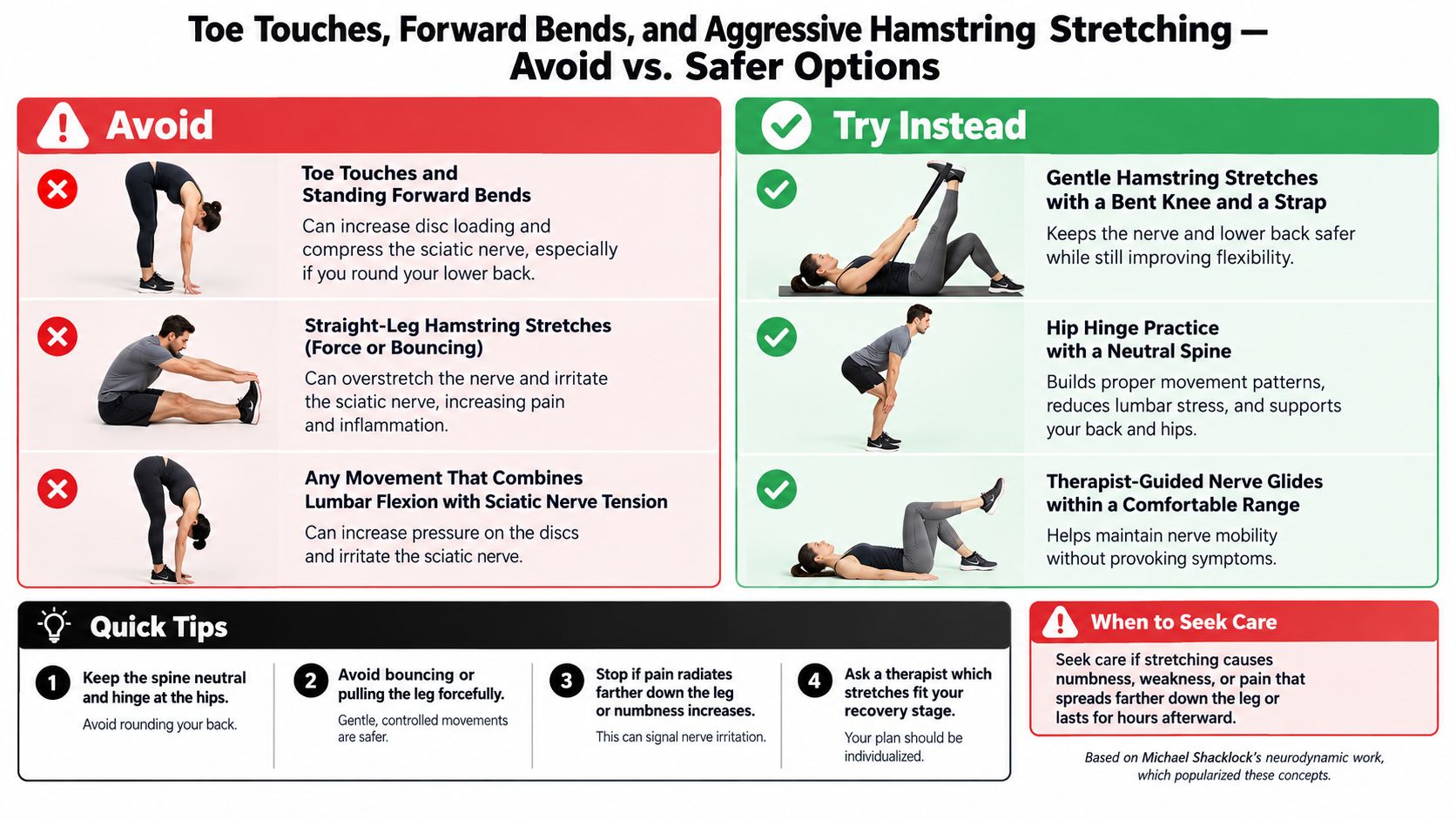
After a run, reaching farther toward your shoes may seem like the obvious response to a tight leg. But pulling harder isn't always the right treatment for that sensation. A stretch that produces tingling or pain down the leg needs a different response from ordinary muscle tightness.
Deep forward folds and forceful straight-leg stretching can combine lower-back bending with tension across sensitive nerve tissues. Harvard Health's sciatica stretching guidance advises avoiding stretches that cause discomfort or sharp pain, along with heavy lifting that involves bending or twisting.
Swap Forceful Stretching for a Supported, Comfortable Range
If stretching is comfortable, try a supported standing position with a soft knee and a small hip hinge. Keep your lower back from rounding. Don't bounce, pull your foot toward you, or chase a stronger sensation.
- Safer swap: Use a gentle supported stretch, or skip stretching and take a short, comfortable walk. A therapist can determine whether nerve-mobilization exercises fit your presentation.
- Stop signal: End the stretch if pain travels farther down the leg or tingling increases.
- Evaluation signal: Arrange assessment if numbness persists afterward, symptoms keep returning with gentle movement, or weakness develops.
MedAmerica's guidance on stretching your legs after a run can help you review your routine. With sciatica, however, your symptom response matters more than reaching a particular position.
2. Full Sit-Ups and Loaded Crunches
A stronger core doesn't require pushing through radiating pain. If you're holding a weight against your chest and rounding up from the floor, increasing the load may make an already uncomfortable movement harder to tolerate.
Full sit-ups and loaded crunches involve repeated trunk bending. During an irritable flare, that combination of movement and resistance may aggravate leg symptoms. The practical concern is what happens in your leg, not whether your abdominal muscles feel challenged.

Abdominal fatigue is a reason to pace a set. Increasing radiating pain is a reason to change the exercise.
Use Low-Load Bracing Instead
A practical starting alternative is gentle abdominal bracing in a comfortable position, without repeatedly curling your trunk. For example, lie with your knees bent and feet supported, lightly tighten your abdomen, and keep breathing. Don't force your back flat if that increases symptoms.
This isn't a prescription for everyone. If lying down or bracing aggravates your leg, stop and ask a therapist to select another position. MedAmerica's core-strengthening exercise guidance provides options to discuss rather than a routine you must complete.
Stop the exercise if leg pain, tingling, or numbness appears or increases. Get evaluated if those symptoms remain worse afterward, recur with low-load alternatives, or include weakness. Return to harder core work gradually, rather than testing a weighted crunch each day to see whether you can tolerate it yet.
3. Heavy Conventional Deadlifts With a Rounded Back
A deadlift can start under control and become a different movement when fatigue sets in. If the bar drifts away and your back rounds as you try to finish, end the set rather than forcing another repetition. During a sciatica flare, the aim is to avoid loaded bending that brings on leg symptoms.
Heavy deadlifts aren't permanently forbidden. WebMD's sciatica exercise guidance advises avoiding heavy lifting and twisting during roughly the first six weeks of recovery. Treat that as general guidance, not a personal return-to-lifting date.
Try an unloaded hip hinge with your hands supported on a stable counter. Keep the range comfortable and move slowly. This reduces the load while letting you practise the pattern. If even this hinge increases leg symptoms, stop and choose walking only if it feels comfortable. A therapist can assess your movement and help determine whether to modify it.
Use the video as a movement reference, not as evidence that a particular lift is safe for your symptoms.
When you return to resistance, start light and stop before fatigue changes your position. Ask a therapist to review your hinge if you're unsure when to reload it.
Stop lifting if pain travels farther down your leg or numbness appears or increases. If symptoms remain worse after you unload, get assessed before trying again. Progressive weakness, or sudden severe pain or numbness after significant trauma, calls for urgent medical evaluation, not another technique adjustment.
4. Weighted Russian Twists and Loaded Trunk Rotation
Holding a dumbbell while leaning back and turning side to side can feel like efficient core training. If each turn produces burning in your buttock or tingling toward your foot, though, the exercise isn't serving your current needs.
Russian twists combine a flexed trunk position with repeated rotation and resistance. During a sensitive flare, adding weight and turning farther can make the movement less tolerable. As noted earlier, guidance cautions against sharp spinal rotation and loaded bending or twisting when these movements provoke symptoms.
Practical rule: Train within a position you can tolerate before adding a movement that repeatedly sends symptoms down your leg.
Try Resisting Rotation Instead of Repeating It
A light anti-rotation exercise is a possible alternative. For example, stand beside a securely anchored resistance band, hold it near your chest, and resist being pulled sideways without twisting. Start with minimal resistance and a comfortable stance.
The trade-off is straightforward: you're still asking your trunk muscles to work, but you're removing repeated loaded rotation. That doesn't make the band exercise automatically safe. If it increases leg symptoms, put the band down and choose comfortable light activity instead.
Stop if the exercise creates radiating pain, stronger tingling, or increasing numbness. Arrange an evaluation if those symptoms persist after stopping or return even with light resistance. New or progressive weakness needs prompt medical attention.
When returning to rotational training, begin with small, slow, unweighted movements if your clinician considers them appropriate. Don't use a symptom-free moment as a reason to jump straight back to a heavy dumbbell.
5. High-Impact Plyometrics and Jumping
When a jump class starts, box jumps, burpees, and jump squats can be hard to modify on the fly. If each landing sends a jolt down your leg, step out of the sequence rather than trying to keep pace.
Running, jumping, and other mechanically demanding drills may aggravate sciatica for some people. Burpees add quick transitions between positions. Speed, impact, and fatigue leave less room to adjust when symptoms begin.
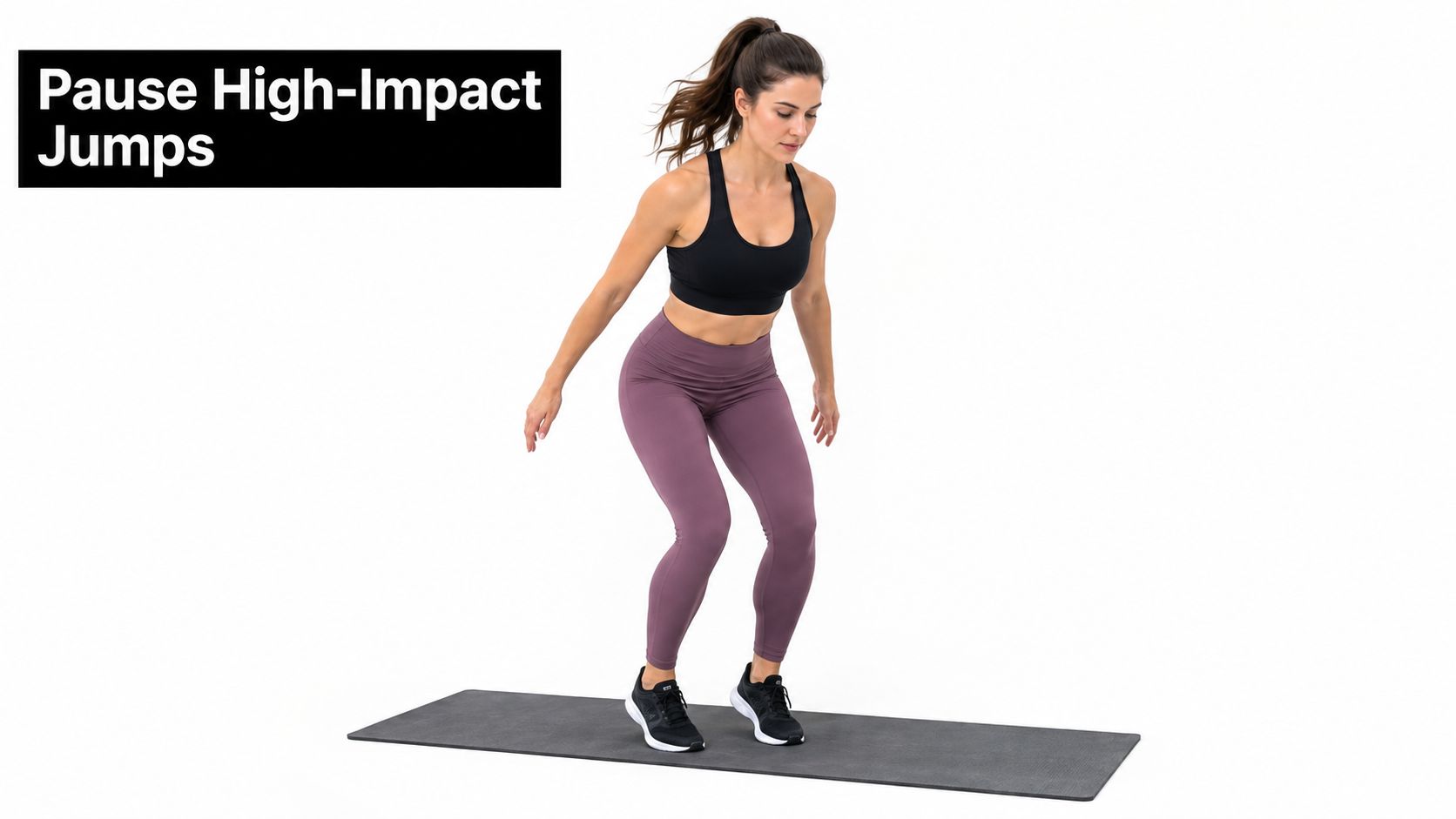
Before class, tell the instructor you're skipping jumps. Try comfortable walking intervals in place of the jump station, or aquatic exercise if available and tolerable. These swaps reduce repeated landings, though they still need to feel manageable for your symptoms.
Use this decision rule: Keep the activity only while leg symptoms stay stable. Stop if pain travels farther down the leg, numbness increases, or weakness appears.
If symptoms remain worse after the workout or flare repeatedly despite removing impact, arrange an evaluation. Seek urgent care for progressive weakness. Once symptoms settle, ask your therapist about returning to impact, starting with controlled, low-demand drills before adding speed or height.
During a flare, aim to stay active without repeatedly provoking symptoms. A quieter workout is often the practical choice.
6. Bent-Over Barbell Rows With a Rounded Back
Your upper back may feel ready for another set while your lower back is struggling to hold the bent-over position. That difference matters. A row can become provocative because of the position you maintain, not just the pulling movement.
Bent-over rows with a rounded lower back combine resistance with sustained trunk bending. As noted earlier, mechanically demanding drills involving loaded spinal flexion can aggravate nerve symptoms in some patients. Reducing the weight may help, but changing the setup can be more useful.
Support the Trunk While Training the Upper Back
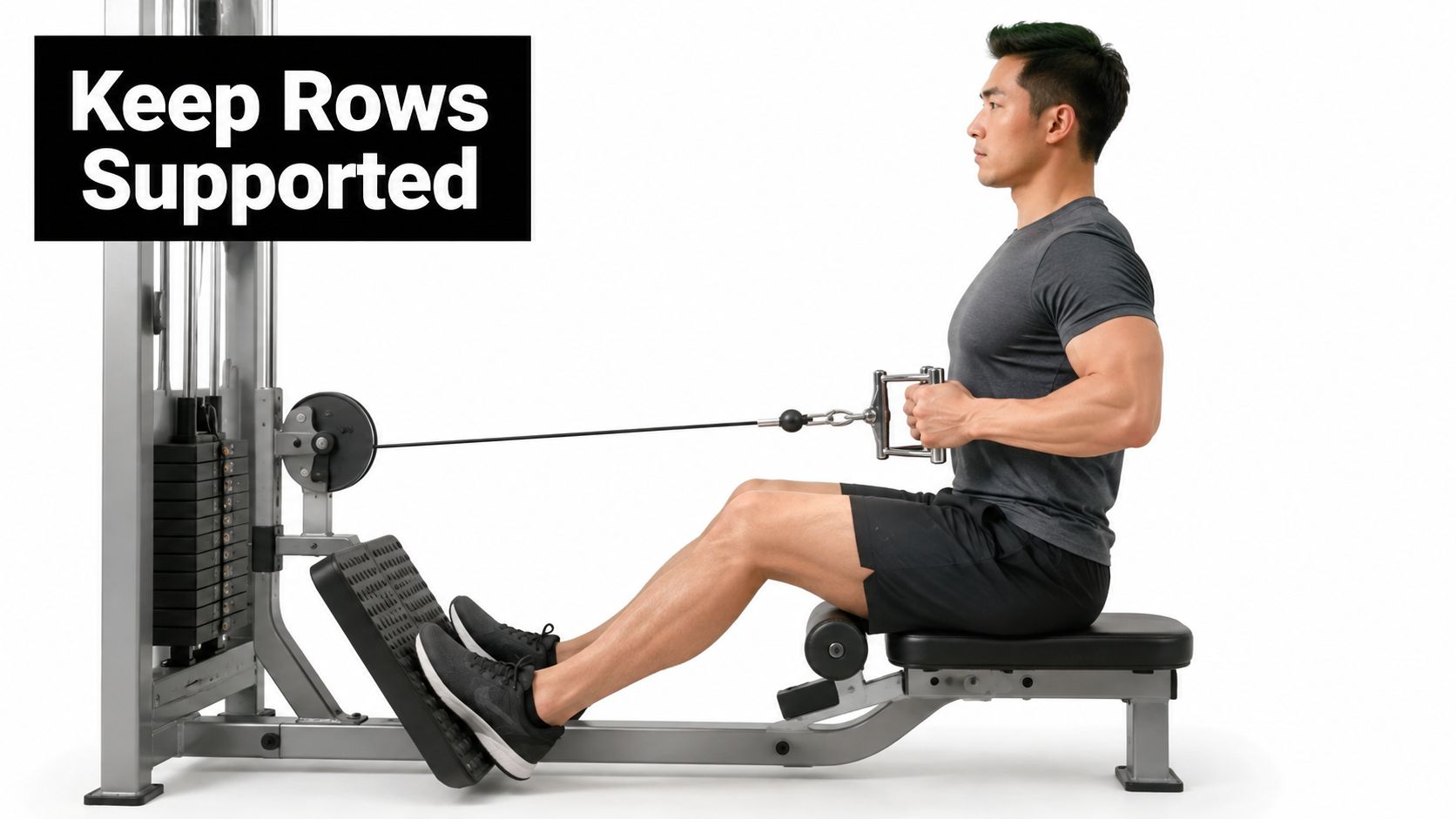
Try a lightly loaded chest-supported row on a bench, provided that position is comfortable. Another option is a light seated cable row without reaching forward into a deep slump. Neither setup guarantees comfort, so check your leg symptoms before and during the exercise.
Removing the unsupported hinge is a useful modification. It's not permission to pull a heavier weight.
Keep the movement controlled and avoid rocking your trunk to finish a repetition. If the seated position itself aggravates symptoms, don't assume the cable machine is the safer choice. Stop and select another activity with your therapist.
End the set when your back starts rounding, or sooner if leg pain or tingling increases. Book an assessment if a supported, lightly loaded version still reproduces symptoms or numbness remains afterward.
Increasing weakness requires prompt medical evaluation. Don't mistake losing leg strength for ordinary workout fatigue, especially when it accompanies worsening radiating symptoms.
7. Prolonged Sitting in Deep Lumbar Flexion
After a workout, you drive home and settle at your desk, staying hunched as leg symptoms build. The position may matter less than the time spent in it. Prolonged sitting or forward bending can aggravate symptoms for some people, so change positions before discomfort keeps increasing. There is no single posture you need to hold all day.
On a stationary bike, reduce the forward reach and ask a therapist to check your setup. At work, use a comfortable, supported seat and take short walks when tolerated. A lumbar roll is worth testing only if it feels helpful. For more ideas, see these exercises for people who sit at a computer all day.
Use symptoms to guide the adjustment. If leg pain starts spreading or numbness increases, stand or change position. If standing also worsens symptoms, choose a comfortable alternative rather than replacing one prolonged posture with another.
During seated exercise, avoid staying rounded between efforts. At your desk, take a movement break before you find yourself pushing through worsening leg symptoms. In the car, adjust the seat and add support if comfortable, without forcing an exaggerated upright position.
If symptoms remain worse after sitting despite changing positions, arrange an evaluation. New or increasing weakness also needs assessment. A clinician can help identify which positions and activities are suitable for you.
7 Sciatic Nerve Exercises to Avoid: Comparison Guide
| Movement to Avoid or Modify | Form or Loading Demand | Resource Requirements | Potential Effect on Sciatica | Safer Option or Best Use |
|---|---|---|---|---|
| Toe touches, forward bends, aggressive hamstring stretches | Often combine a rounded lower back with straight-leg nerve tension | No equipment; commonly done in stretching routines | May aggravate radiating pain, tingling, or numbness, especially when forceful or bounced | Try gentle bent-knee hamstring stretches or hip hinges with a neutral spine |
| Full sit-ups and loaded crunches | Repeated lumbar flexion, sometimes with added weight or twisting | Mat; weights or medicine ball for loaded versions | May increase disc stress and provoke leg symptoms | Consider controlled dead bugs, bird dogs, or modified bridges as tolerated |
| Heavy conventional deadlifts with a rounded back | High load; requires controlled hip hinge and neutral spine | Barbell and weights; coaching may help | Poor form, jerking, or fatigue may aggravate disc or nerve symptoms | Rebuild with hip-hinge drills or light, controlled variations |
| Weighted Russian twists and loaded trunk rotation | Combines trunk rotation and flexion under load | Dumbbell, plate, or medicine ball | May aggravate disc or nerve symptoms; added weight increases loading | Try anti-rotation Pallof presses, supported side planks, or controlled bird dogs |
| High-impact jumps and plyometrics | Explosive movements and repeated hard landings | Space or a box; often used in HIIT or sports training | Impact and fatigue may worsen symptoms or compromise control | Use step-ups, controlled squats, or low-impact cycling while recovering |
| Bent-over barbell rows with a rounded back | Sustained hinged posture while lifting; form may deteriorate with fatigue | Barbell and weights | Loaded spinal flexion may provoke back or leg symptoms | Choose chest-supported or seated rows with an upright trunk |
| Prolonged sitting in deep lumbar flexion | Sustained slumped posture rather than repeated movement | Chair, car seat, or cycling setup | May gradually aggravate symptoms during or after prolonged sitting | Change position regularly, use lumbar support, and adjust seating to maintain a comfortable posture |
Choosing Safer Movement Until Symptoms Settle
The most useful approach to sciatic nerve exercises to avoid is a decision rule, not a rigid blacklist. Temporarily remove or modify movements that increase radiating pain, tingling, numbness, or weakness. Keep the activities that remain tolerable during the session and don't leave you worse afterward.
A clinical review of sciatica diagnosis and management describes the shift away from bed rest toward active care and individualized exercise. There isn't a single exercise type that's best for everyone. Comfortable walking, aquatic exercise, and clinician-selected strengthening or nerve-mobilization work may fit different presentations.
Let Symptoms Guide the Next Step
Before exercising, notice where you feel symptoms and whether you already have numbness or weakness. During the activity, watch for increasing intensity or pain spreading farther down the leg. Afterward, check whether you've returned to your usual baseline or remain worse.
- Modify and monitor: Stop the provoking movement and choose a tolerable, lower-demand alternative.
- Book an evaluation: Seek assessment for persistent or recurring symptoms, worsening nighttime pain, or symptoms that limit sleep and everyday activity.
- Seek urgent medical care: Don't wait for a routine therapy visit if you develop bowel or bladder changes, saddle-area numbness, or severe or progressive weakness.
Self-management also has limits after an auto accident, work injury, or surgery. Have a licensed clinician assess your symptoms before progressing a provocative exercise routine. A calendar date or a temporary reduction in pain isn't enough to determine readiness for heavy lifting.
MedAmerica Rehab Center's multidisciplinary team in Deerfield Beach can assess your movement and develop an individualized plan that combines hands-on therapy with targeted, progressive exercise. The aim is to help you rebuild tolerable activity, not to leave you avoiding movement indefinitely.
MedAmerica Rehab Center offers individualized physical therapy and multidisciplinary rehabilitation for sciatica in Deerfield Beach. Visit MedAmerica Rehab Center to request an evaluation and bring a list of the exercises, sitting positions, and daily tasks that worsen your leg symptoms.
MedAmerica Rehab · Deerfield Beach
Talk to a clinician about your pain
Physical therapy, chiropractic, acupuncture and shockwave therapy under one roof, since 1995. Same-day appointments are available.
Mon–Thu 8:00 AM – 6:30 PM · Fri 8:00 AM – 3:00 PM