

Fall Prevention Program for Older Adults That Works
More than 1 in 4 adults aged 65 and older falls each year, according to the CDC's older-adult falls data. In 2024, falls caused over 43,000 deaths, about 4.5 million emergency-department visits, and 1.4 million hospitalizations among older adults. Those figures make one point clear: a fall prevention program for older adults can't be reduced to a handout saying “be careful.” It must identify why a person is unstable, challenge the right physical systems, change the home environment, and remain accessible long enough to become part of daily life.
A well-designed program is practical and progressive. A therapist measures mobility, balance, leg strength, gait, vision-related concerns, footwear, medications, and home hazards. Then the team builds a plan that fits the person's current ability, not an imagined average patient. The evidence is strong, but access remains uneven, especially for homebound, rural, racially and ethnically diverse, and disabled older adults, as described in the 2025 National Falls Prevention Action Plan.
Why Falls Are a Serious Concern for Older Adults
A fall rarely ends when the person stands up. It may cause a hip fracture, head injury, wrist injury, or a period of hospitalization that interrupts normal routines. Even without a major injury, many older adults become afraid to walk, bathe, use stairs, or leave home. That avoidance reduces activity, weakens the legs, and makes the next loss of balance more difficult to recover from.
The CDC reports that falls are the leading cause of injury death for adults aged 65 and older. Its 2024 figures also include 3.1 million treated-and-released emergency visits and an estimated $80 billion in annual medical spending, with Medicare covering roughly two-thirds of that burden. These numbers explain why prevention belongs in routine geriatric care, not only after an emergency.
A fall is often a chain of modifiable risks
Many falls have recognizable contributors. Balance reactions may be slow. The quadriceps, gluteal muscles, or hip stabilizers may not generate enough force. Vision changes can make obstacles, steps, or changes in floor height harder to detect. Medication side effects may cause dizziness, drowsiness, or a sudden drop in blood pressure. A loose rug, poor lighting, or an unsafe bathroom transfer can turn a manageable mobility limitation into an injury.
The clinical task is to separate those contributors instead of treating “fall risk” as one vague diagnosis. A therapist may find that one patient needs reactive balance training, another needs progressive leg strengthening, and a third needs medication review and bathroom modifications before exercise can be performed safely.
Practical rule: Prevention works best when each intervention answers a specific question, such as “Can this person recover from a sideways step?” or “Can they rise from a low chair without using their arms?”
A complete program therefore includes assessment, balance and gait work, strength training, environmental changes, education, and follow-up. It also addresses confidence. Fear can be protective when it prompts reasonable caution, but excessive fear can lead to inactivity and physical decline. The aim isn't to promise that falls will never happen. The aim is to improve the person's capacity to remain upright, respond when balance is disturbed, and move safely through the environments they use.
Screening and Assessment at the First Visit
The first appointment shouldn't begin with random exercises. It begins with a conversation. The therapist asks about recent falls, near-falls, dizziness, pain, numbness, medical conditions, assistive devices, daily activities, and fear of falling. A family member can add useful details, especially if the patient minimizes stumbles or has difficulty recalling medication changes.
Medication review is part of the risk picture, but a therapist won't independently stop or change a prescription. Instead, the therapist documents concerns and coordinates with the prescribing clinician or pharmacist. The intake should also include the person's goals, such as walking to the mailbox, using the shower independently, or returning to a community activity.
What the physical examination measures
The Timed Up and Go examines functional mobility. The patient rises from a chair, walks, turns, returns, and sits. The clinician observes how the person initiates movement, turns, manages the transition, and uses an assistive device. The result is interpreted alongside the quality of movement and the patient's medical history, rather than treated as a diagnosis by itself.
For more detailed balance testing, a therapist may select the Berg Balance Scale or Mini-BESTest. These tools examine tasks such as changing position, maintaining a narrow stance, turning, and responding to movement demands. The 30-Second Sit-to-Stand helps show how the lower extremities manage repeated transfers. A gait observation adds information about step symmetry, foot clearance, cadence, turning, and whether the patient looks down or reaches for support.
Vision and footwear deserve direct attention. Poor peripheral awareness, difficulty seeing contrast, or unsafe shoes may not appear during a seated strength test. Patients and families can also review this guide by Style Site Optical when they want a clearer explanation of how peripheral vision concerns may affect everyday navigation.
Turning results into a treatment plan
Assessment results determine starting position, supervision, equipment, rest periods, and progression. Someone who loses balance with head turns shouldn't begin with an unsupported obstacle course. Someone who can't rise safely from a standard chair may need a higher surface, arm support, and focused strengthening first.
Families can review what a clinical fall risk assessment for elderly patients should address before scheduling care. The assessment isn't paperwork that delays treatment. It's what keeps treatment specific, measurable, and safe.
Balance and Gait Training That Actually Challenges the Body
Balance training is the central skill practice in an effective program because standing still in a comfortable position doesn't prepare someone for every real-world disturbance. The evidence supports this emphasis. A 2017 systematic review and meta-analysis found that exercise reduced fall rates by 21% overall, with a pooled rate ratio of 0.79 across 69 comparisons. The review also found greater benefit in programs that challenged balance and provided more than 3 hours per week of exercise. A separate high-certainty evidence summary reported a 23% reduction in falls, with a pooled rate ratio of 0.77 from 64 studies across 59 studies and 12,981 participants. See the British Journal of Sports Medicine review and the USPSTF evidence summary.
A clinic session might start with feet together while the patient keeps one hand near a stable support. The therapist can then narrow the base of support, progress toward tandem stance, and introduce brief single-leg work when appropriate. The patient may practice on a compliant surface, but only when the therapist has established enough control to make that challenge useful rather than reckless.
Progression is the treatment
The therapist changes one demand at a time:
- Less hand support: Move from two hands to one hand, then fingertip contact, when control improves.
- Narrower stance: Progress from a comfortable base to semi-tandem and tandem positions.
- Reactive practice: Use carefully controlled nudges or reaching tasks so the patient rehearses recovery steps.
- Gait variation: Work on step length, cadence, turning, stopping, and changing direction.
- Dual-task walking: Carry a cup, respond to a simple question, or turn the head while walking when basic gait is secure.
The patient should feel challenged, but the therapist should control the environment and provide a safe recovery strategy. Gentle seated movement may help someone begin activity, but it doesn't provide the same postural demand as standing, stepping, turning, or reacting to a perturbation.
For a closer explanation of how therapists train walking mechanics, see what gait training in physical therapy involves. The right exercise isn't the hardest exercise. It's the task that exposes a manageable limitation and gives the patient enough practice to improve it.
Strength and Flexibility Exercises That Build Real Stability
Balance reactions depend on strength. A patient may understand where to place the foot but still fail to recover if the hips, knees, or ankles can't produce force quickly enough. Strength work supports sit-to-stand transfers, stair negotiation, foot clearance, and the lateral control needed when the body moves outside its base of support.
A therapist may begin with bodyweight movements and select resistance according to the patient's performance and perceived effort. Later, the plan can use ankle weights, dumbbells, or resistance bands. The posterior chain, quadriceps, and hip abductors receive particular attention because they contribute to upright posture, rising from a chair, and controlling side-to-side movement.
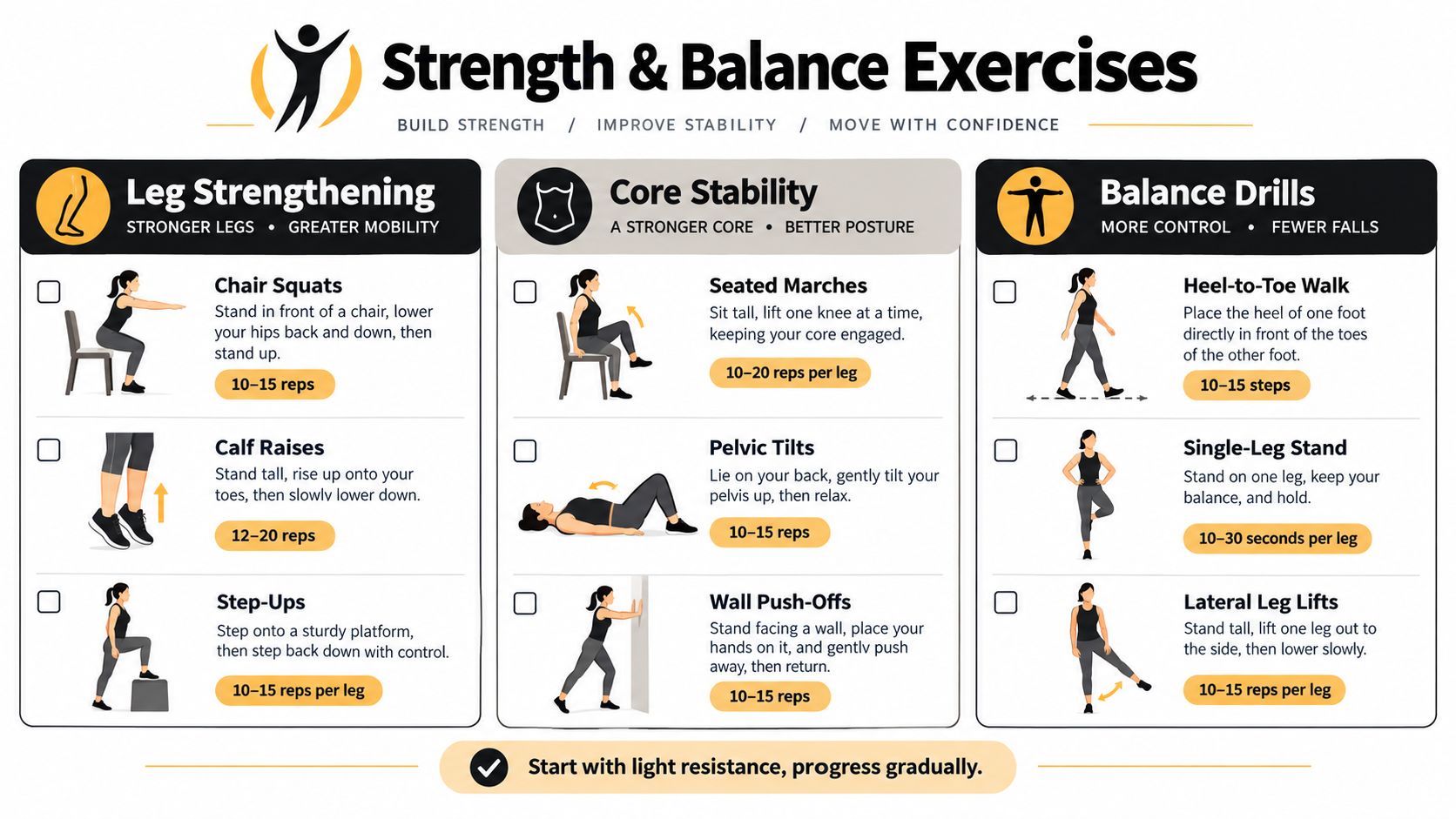
A representative exercise sequence
A session may include seated knee extensions, sit-to-stand from a graded chair height, heel raises, and standing hip abduction. The therapist watches alignment, breathing, speed, and control instead of counting repetitions without checking form. A patient who leans heavily to one side during a sit-to-stand needs a different adjustment than one whose legs fatigue.
The plan can also include flexibility for the ankle dorsiflexors, hip flexors, and hamstrings. Restricted motion in these areas can change step geometry and make it harder to clear the foot or place it accurately. Flexibility work supports movement quality, but it shouldn't replace loaded strengthening and balance challenge.
Dose and home carryover
The evidence favors programs combining balance, strength, and functional training, rather than passive advice or stretching alone. A commonly used clinical starting point is two to three sets of ten to fifteen repetitions, two to three times weekly, adjusted to the person's condition and tolerance. Because those exercise details are a treatment framework, not a universal prescription, the therapist modifies them for pain, fatigue, osteoporosis, neurologic conditions, and cardiovascular limitations.
Load can increase when the last set feels controlled and only moderately difficult. The home program should mirror clinic movements with a stable chair, a resistance band, or bodyweight. Patients should never perform standing exercises near clutter, on an unstable surface, or without the support and supervision recommended by their clinician.
Home Safety Modifications and Patient Education
A strong exercise plan can still fail if the patient repeatedly encounters preventable hazards at home. The therapist or occupational therapy professional reviews lighting, floor surfaces, rugs, stairs, bathroom transfers, bed height, and the route between the bedroom and bathroom. The review can happen in person or through a structured video walk-through.

Fix the highest-risk details first
Start with changes the household can complete promptly:
- Clear walking paths: Remove clutter, cords, pet toys, and objects left beside the bed.
- Improve visibility: Add reliable lighting along stairs, hallways, and nighttime routes.
- Secure the bathroom: Consider properly installed grab bars and a safer shower setup.
- Review floors: Remove loose throw rugs or secure surfaces that shift underfoot.
- Replace unsafe footwear: Choose shoes with a firm heel counter and a stable, nonslip sole.
Families can use this safe home modifications guide when planning broader aging-in-place changes. A grab bar isn't a symbol of decline. It's an engineering solution that reduces the force and instability involved in a transfer.
Medication side effects, hydration, and vision follow-up also belong in the education plan. The therapist can explain what symptoms should be reported, while the prescribing clinician manages medication decisions. If the patient's risk profile warrants it, the care team may discuss hip protectors as one part of an injury-reduction strategy.
A patient should also learn what to do after a fall. The backward-chaining approach may include rolling to the side, pushing to hands and knees, crawling to a stable surface, and standing only when safe. This sequence must be practiced under professional supervision and adapted for pain, weakness, or injury. More practical home guidance is available in how to prevent falls at home.
Use the following video as a supervised education resource, not as a substitute for an individualized examination.
Outcomes and Benefits You Can Realistically Expect
Exercise-based programs produce their strongest value through consistent, targeted practice. The high-certainty evidence summarized by the USPSTF found a 23% reduction in fall rates, with a rate ratio of 0.77 and a 95% confidence interval of 0.71 to 0.83, based on 12,981 participants across 59 studies. The same evidence indicates that balance challenge and greater weekly exercise volume are associated with stronger results, while no single universal protocol is clearly superior.
Multicomponent exercise can also improve mobility, balance, and lower-extremity strength. Evidence summarized by Johns Hopkins Medicine reports a reduction in injurious falls, with an injurious-fall incidence rate ratio of 0.84 and a 95% confidence interval of 0.74 to 0.95. That matters because the goal isn't only to reduce the number of falls. Better strength and balance may help a person respond more effectively when a slip or trip still occurs.
What progress looks like clinically
A useful outcome review includes more than fall counts. The therapist may reassess sit-to-stand performance, gait quality, balance-test scores, turning, confidence, and the patient's ability to complete meaningful tasks. A patient might report taking a short walk again, carrying a light object while moving through the kitchen, or using the bathroom at night with less hesitation.
| Outcome measure | Typical change |
|---|---|
| Falls | A meaningful reduction is the target, but the program doesn't eliminate every fall |
| Injurious falls | Reduction is a realistic goal when exercise and environmental changes are combined |
| Mobility | Smoother transfers, safer turns, and more controlled walking |
| Strength | Better ability to rise, climb steps, and recover from an unexpected movement |
| Confidence | More willingness to move, practice, and resume daily activities |
The exact result varies with frailty, neurologic disease, vestibular loss, pain, vision, medication burden, and adherence. Adults aged 85 and older and people with complex functional limitations remain important groups for more individualized research, as noted by the USPSTF review in JAMA. A therapist should therefore avoid promising a fixed outcome or prescribing the same routine to every participant.
Enrollment, Insurance, and How MedAmerica Delivers the Program Locally
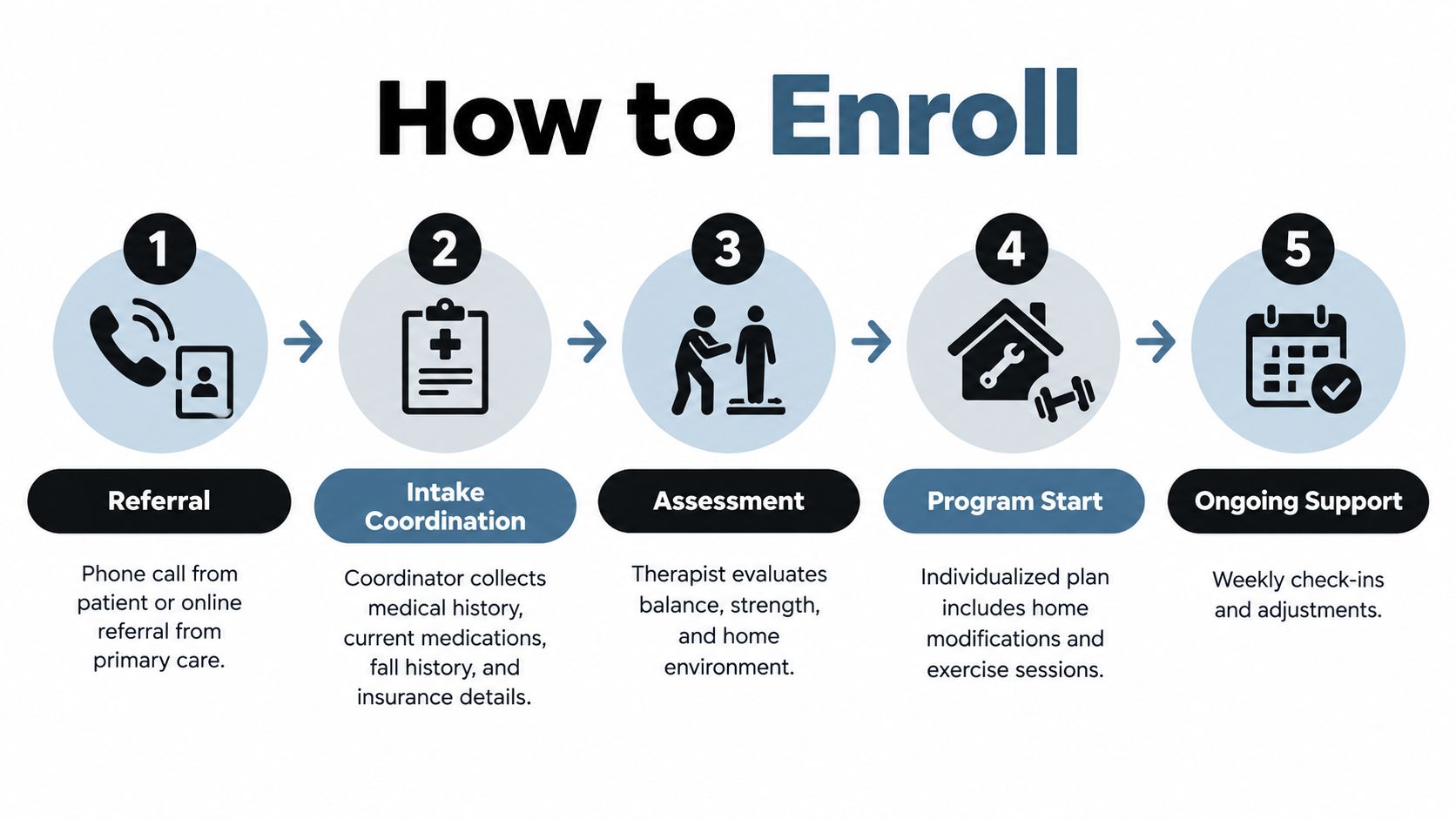
Access starts with a phone call, an online referral, or an order from a primary care clinician or specialist. Before the first appointment, an intake coordinator may request the medical history, current medication list, recent imaging when relevant, and a record of falls or near-falls. Bringing an assistive device, comfortable shoes, and a family member can make the evaluation more informative.
Coverage depends on the patient's plan and the clinical circumstances. Medicare Part B may cover medically necessary physical therapy when the applicable referral and plan requirements are met. Many Medicare Advantage plans and supplemental policies may also provide benefits, but copays, coinsurance, visit limits, authorization rules, and deductibles vary. Confirming coverage before the evaluation prevents avoidable surprises.
What happens at the first visit
A typical first visit includes paperwork, vital signs, a detailed history, movement observation, balance and strength testing, goal-setting, and an initial home exercise plan. The therapist explains which findings create risk and why each recommended exercise or modification belongs in the plan. The family should leave knowing what to practice, what to avoid, and how progress will be measured.
For patients in Deerfield Beach who need coordinated care, MedAmerica Rehab Center's model brings physical therapists, occupational therapists, and physicians into one clinical setting. Clinic-based sessions may be scheduled two to three times per week, with optional home visits for patients who can't travel, depending on clinical needs and availability.
The practical enrollment sequence is straightforward:
- Request a referral: Contact the clinic or ask a primary care or specialty provider to send one.
- Complete intake: Provide medical history, medications, fall details, insurance information, and goals.
- Attend assessment: Let the therapist evaluate balance, strength, gait, mobility, and relevant home concerns.
- Begin the plan: Follow the individualized exercise and safety program at the clinic and home.
- Review progress: Report new falls, dizziness, pain, or difficulty completing exercises so the team can adjust care.
The larger challenge is delivery. Proven interventions can't help someone who lacks transportation, can't access a class, or has no workable billing pathway. A local program closes that gap by connecting assessment, supervised progression, home practice, family education, and follow-up in a format the patient can realistically attend.
MedAmerica Rehab Center provides individualized physical therapy, balance and gait training, home-safety guidance, and fall-prevention care for older adults in Deerfield Beach and nearby communities. Visit MedAmerica Rehab Center to request an evaluation, discuss referral and insurance requirements, and build a safer mobility plan with a licensed care team.
MedAmerica Rehab · Deerfield Beach
Talk to a clinician about your pain
Physical therapy, chiropractic, acupuncture and shockwave therapy under one roof, since 1995. Same-day appointments are available.
Mon–Thu 8:00 AM – 6:30 PM · Fri 8:00 AM – 3:00 PM