

Delayed Neck Pain After Car Accident: What to Watch For
You exchanged information at the scene, declined an ambulance because you felt fine, drove home, and went to bed. Then you woke up and couldn't turn your head far enough to check your blind spot. That gap between the crash and the pain is what makes delayed neck pain after a car accident so unsettling, because it leaves you guessing whether something serious was missed or whether you're sore.
Both possibilities exist, and they aren't distinguished by how late the pain arrived. They're distinguished by what the symptoms are and which direction they're moving. A stiff neck that loosens a little each morning is a different situation from arm numbness that spreads further down your hand overnight, even if both started 14 hours after impact.
This is a guide to telling those situations apart. You'll get the timing pattern, a symptom list sorted by urgency, a simple log you can keep on your phone for three days, and an honest account of what a normal scan can and can't tell you about getting better.
Why Neck Pain Can Start Hours or Days Later
Say you're rear-ended at a light. Your head snaps back and forward in a fraction of a second, your heart pounds, and you spend the next hour dealing with a tow truck and an insurance call. You feel wired, not hurt. By evening your neck aches, and by morning turning toward the passenger seat is a two-part maneuver involving your whole torso.

That sequence is common enough to be expected. According to the American Academy of Physical Medicine and Rehabilitation's cervical whiplash overview, an estimated two-thirds of people involved in motor-vehicle collisions report neck pain or related symptoms immediately or within several hours, while approximately one-third develop symptoms later, sometimes up to 48 hours after the crash.
What's happening in your neck during the delay
The rapid push and pull of acceleration and deceleration loads the muscles, ligaments and small joint structures of the neck. Mechanical strain happens in that instant, but the experience of pain builds afterward: inflammatory signaling ramps up, muscles tighten protectively around the area, and the nervous system becomes more sensitive to movement. Adrenaline at the scene masks the early part of that process. Once it fades and you sit still for a few hours, stiffness and guarding take over.
Clinical timing observations give you a rough anchor. The same AAPM&R clinical summary reports average delays of about 11 hours for neck-pain onset among patients who eventually recovered within two years, compared with approximately 8 hours among patients who didn't recover in that period, with individual onset ranging from minutes to several days.
Notice what those numbers don't say. The group with the shorter average delay did worse, which tells you onset time isn't a severity scale. If you're building a timeline for an insurer or a lawyer, Shea Culgin Law's explanation of why whiplash pain shows up later is useful context for why a same-day "I'm fine" statement doesn't cancel out next-day symptoms.
A late start doesn't prove the pain is unrelated to the crash, and it doesn't prove the injury is minor. Timing tells you when to pay attention, not how bad things are.
Warning Signs That Need Prompt Medical Care
Sort your symptoms by what they are, not by when they showed up. The table below is the fastest way to decide whether tonight is a monitoring night or a getting-seen night.
| Symptom | What It May Indicate | Action |
|---|---|---|
| Stiffness, mild soreness or reduced neck motion that improves daily | Routine delayed soreness after whiplash-type strain | Track for several days and book a prompt assessment if it doesn't improve |
| Severe or unusual headache, new or unlike earlier headaches | Needs review to exclude serious causes | Same-day medical evaluation |
| Dizziness, blurred vision or balance problems | Can accompany neck injury and needs assessment | Same-day medical evaluation |
| Numbness, tingling or arm weakness that spreads or progresses | Possible nerve involvement | Prompt medical assessment |
| Confusion, fainting, difficulty walking or loss of bladder or bowel control | Serious warning signs beyond routine neck pain | Emergency care now |
Routine soreness you can watch
Stiffness that's worst in the morning and eases as you move, soreness that reproduces with certain positions, and a neck that turns a little further each day all fit the ordinary pattern. So does a dull headache at the base of the skull that responds to rest and gentle movement. The key word is improving. You're not looking for zero pain by tomorrow, you're looking for a downward slope.
Same-day symptoms
A headache that feels unlike any you've had, dizziness that makes you reach for a wall, blurred vision, or tingling that moves further down your arm than it did this morning all deserve review today. A clinical evidence synthesis on whiplash-associated disorder identifies weakness, numbness, loss of coordination, severe headache, confusion, fainting and rapidly worsening symptoms as features requiring evaluation beyond routine whiplash management. Those symptoms change the assessment, because they point toward structures and systems that a stretching program won't address.
Emergency symptoms, no waiting
Sudden weakness, confusion, fainting, trouble walking, or loss of bladder or bowel control means emergency care now, not a clinic appointment tomorrow. Don't test your neck with forceful stretching or let anyone manipulate it before a serious injury has been excluded.
Pain that simply won't settle
Neck pain that holds steady or climbs across several days needs a prompt visit rather than a spot on next month's calendar. Persistence is information. If you're unsure which category a symptom falls into, Nares Law Group's guide to spotting symptoms hours after a collision walks through the delayed-symptom pattern in plain terms, and our own overview of hidden injury symptoms to watch for after a car accident covers the complaints people most often dismiss.
The decision rule: any red flag appears, stop watching and get seen. Only routine symptoms present, start the log below.
What to Record in the First 72 Hours
Memory flattens trends. You'll remember that today hurts and forget that Tuesday hurt less, which is exactly the comparison a clinician needs. A 2025 population study of delayed post-collision symptoms notes that discomfort may be delayed for up to 12 to 15 hours and can include neck, back and arm symptoms along with headache, dizziness and balance problems, so a written record started early captures detail you'll otherwise lose.
Here's the checklist version to keep beside your phone notes.
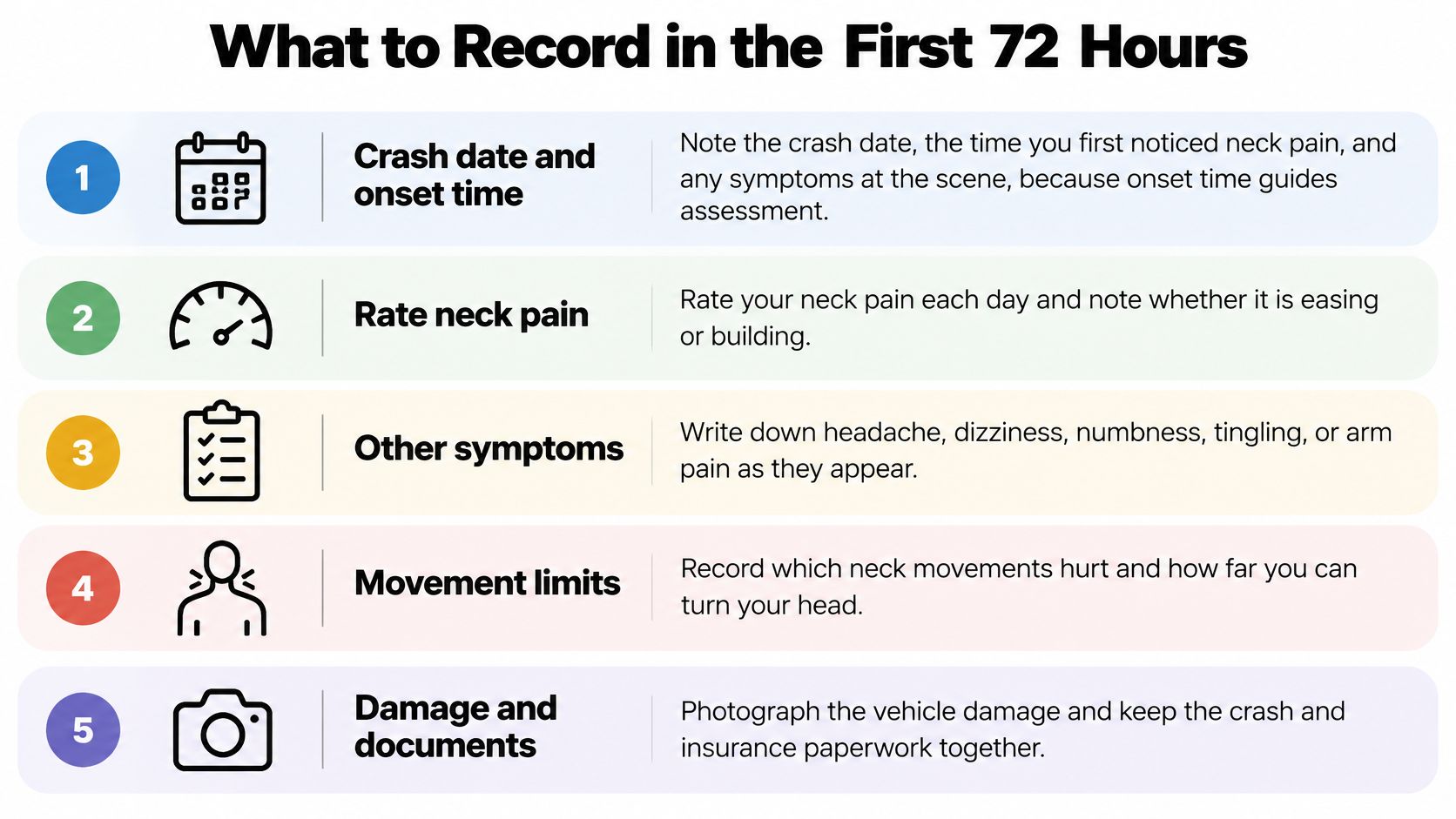
Work through these seven entries once in the morning and once at night. Two minutes is enough.
- Crash date and onset time. Write the date and rough time of the collision, what you felt at the scene, and the hour you first noticed neck pain. Onset time shapes the clinical picture, and "I felt fine for about 14 hours" is a useful sentence to hand a clinician.
- Pain score, 0 to 10. Same scale, twice daily, ideally at similar times. One number means little. Three days of numbers show a direction.
- Range of motion. Turn left and right, nod, tuck your chin. Use a fixed reference, such as how far you can turn before your shoulder starts moving, or whether you can see your side mirror without leaning.
- Head and thinking symptoms. Headache location and intensity, dizziness, trouble concentrating, and how you slept. These often travel with neck injury and get overlooked when the neck is the loudest complaint.
- Arm and hand checks. Numbness, tingling, grip strength, weakness, and whether the area is spreading. Compare hands. Squeezing a rolled towel with each hand gives you a crude but repeatable strength check.
- Daily function. Driving, lifting a grocery bag, working at a screen, reaching overhead, sleeping on your side. Function is what treatment aims to restore, so it belongs in the record.
- One word per day. Improving, stable, or worsening. This single label is the summary a clinician reads first.
This short walkthrough shows the kind of gentle movement and monitoring approach clinicians commonly discuss after a neck strain.
At 72 hours: steady improvement supports routine care and continued gentle activity. Rising scores, shrinking motion, or any new neurological sign means you book an evaluation now rather than adding another day to the log.
How Long Delayed Neck Pain Lasts
Many people improve. A meaningful minority don't, and knowing both halves of that picture keeps you from either panicking on day two or shrugging off month three.
The early drop-off is steep. In a 2026 controlled low-speed collision study, 58.3% of participants reported pain immediately after impact, and one week later pain prevalence had declined to 25.0%, with the cervical region remaining the most common location among those with persistent pain. Neck symptoms outlast other complaints, which is why your stiff neck may be the last thing to clear.
| Time point | Reported finding | Source |
|---|---|---|
| Immediately after impact | 58.3% reported pain | 2026 controlled low-speed collision study |
| One week later | 25.0% still reported pain, cervical region most common | 2026 controlled low-speed collision study |
| Six months | 21 of 66 assessed (31.8%) had persistent neuropathic pain | 2025 longitudinal study of 129 patients |
| One year or longer | About 50% still reported neck pain in the 2019 pooled analysis; more than 50% of people with whiplash-associated disorder symptomatic at 12 months or longer | 2019 systematic review and meta-analysis; 2025 review of whiplash-associated disorder |
When persistence becomes the pattern
Nerve-related pain is the version that tends to linger. A 2025 longitudinal study of 129 patients with acute whiplash-associated disorder found neuropathic-pain signs in 65% of participants initially, and among the 66 assessed at six months, 21 (31.8%) still had persistent neuropathic pain. Burning, shooting or electric discomfort behaves differently from muscular ache, and it needs a different plan.
Early measurements carry information about the long run, too. A 2024 longitudinal study of more than 200 people with whiplash, in which 177 completed MRI testing, found that brain connectivity and anxiety measured 1 to 3 days after injury helped predict chronic pain reported one year later.
None of that forecasts your individual outcome. What it supports is a habit: keep logging for weeks if symptoms persist, because the trend line is the evidence your clinician can act on.
What Scans Miss and What Predicts Recovery
A normal X-ray isn't a verdict on your pain, and it isn't a forecast of your recovery. Those are two separate questions, and imaging answers neither of them well.
The 2025 Australian clinical guideline technical report on prognosis strongly recommends assessing initial pain intensity, neck-related disability, number of painful body areas and total symptoms to estimate poor prognosis, and recommends against using X-ray or MRI solely to predict outcome in acute whiplash. Imaging can identify fractures or ligament disruption, which matters enormously when those are suspected. Predicting who still hurts in a year is a different job.

| Assessment | What It Shows | Main Limit |
|---|---|---|
| X-ray | Bone alignment and some fractures | Doesn't measure soft-tissue pain or predict recovery |
| MRI | Ligament disruption, disc or nerve changes when clinically indicated | A normal result doesn't rule out pain, and an abnormal result doesn't forecast disability |
| Neurological examination | Reflexes, strength and sensation | Needs repeating as symptoms change |
| Pain and disability scores | Pain intensity and neck-related function over time | Only informative when repeated over time |
Why a clean scan and real pain coexist
Pain after whiplash involves irritated soft tissue, protective muscle activity and a sensitized nervous system. None of those show up as a tidy structural finding. Meanwhile, plenty of people without any neck pain have disc changes on MRI, so an abnormal report doesn't automatically explain your symptoms or your future. If you're weighing which scan fits your situation, our comparison of when you need an MRI and when you need an X-ray explains the clinical reasoning behind each.
The numbers that actually inform prognosis
Early pain and disability scores outperform crash details. A systematic review and meta-analysis in the Journal of Orthopaedic and Sports Physical Therapy identified baseline pain greater than 5.5/10 and a Neck Disability Index above 14.5/50 among the strongest predictors of an unfavorable outcome, with a reported odds ratio of 5.61 for high pain intensity. That's why quantifying your pain at the first visit, then repeating it, is more useful than describing how hard the impact felt.
Longer-term risk data points the same direction. A 2019 systematic review and meta-analysis of six studies found a pooled relative risk of future neck pain of 2.3 (95% CI 1.8 to 3.1) for people who had sustained a collision-related neck injury compared with unexposed people, with an estimated attributable risk of 57% among the exposed group. In a population-based cohort of 919 Saskatchewan adults who initially reported no or only mild neck pain, a previous motor-vehicle neck injury carried an adjusted hazard-rate ratio of 2.14 (95% CI 1.12 to 4.10) for developing troublesome neck pain.
Two people, same crash, same day two
One rates pain 7/10, can't turn far enough to drive comfortably, and has stopped going to the gym. The other rates 3/10, drives normally, and notices stiffness only at the end of a workday. Same collision, same normal X-rays, very different next steps. The first person needs reassessment now and an active recovery plan. The second can keep moving and keep logging.
Fear of movement, low mood and passive coping also slow recovery, which is part of why an individualized plan beats waiting it out.
Group statistics describe populations, not you. Ask your clinician what your repeated pain and function scores show, and why follow-up examination is being proposed instead of another scan.
Evaluation and Rehabilitation Options Compared
The right option follows the findings, so the first step is always a full evaluation of pain, movement, neurological function and daily activity. Nothing in the list below should start before someone has checked your reflexes, strength, sensation and neck motion and asked what you've stopped doing.
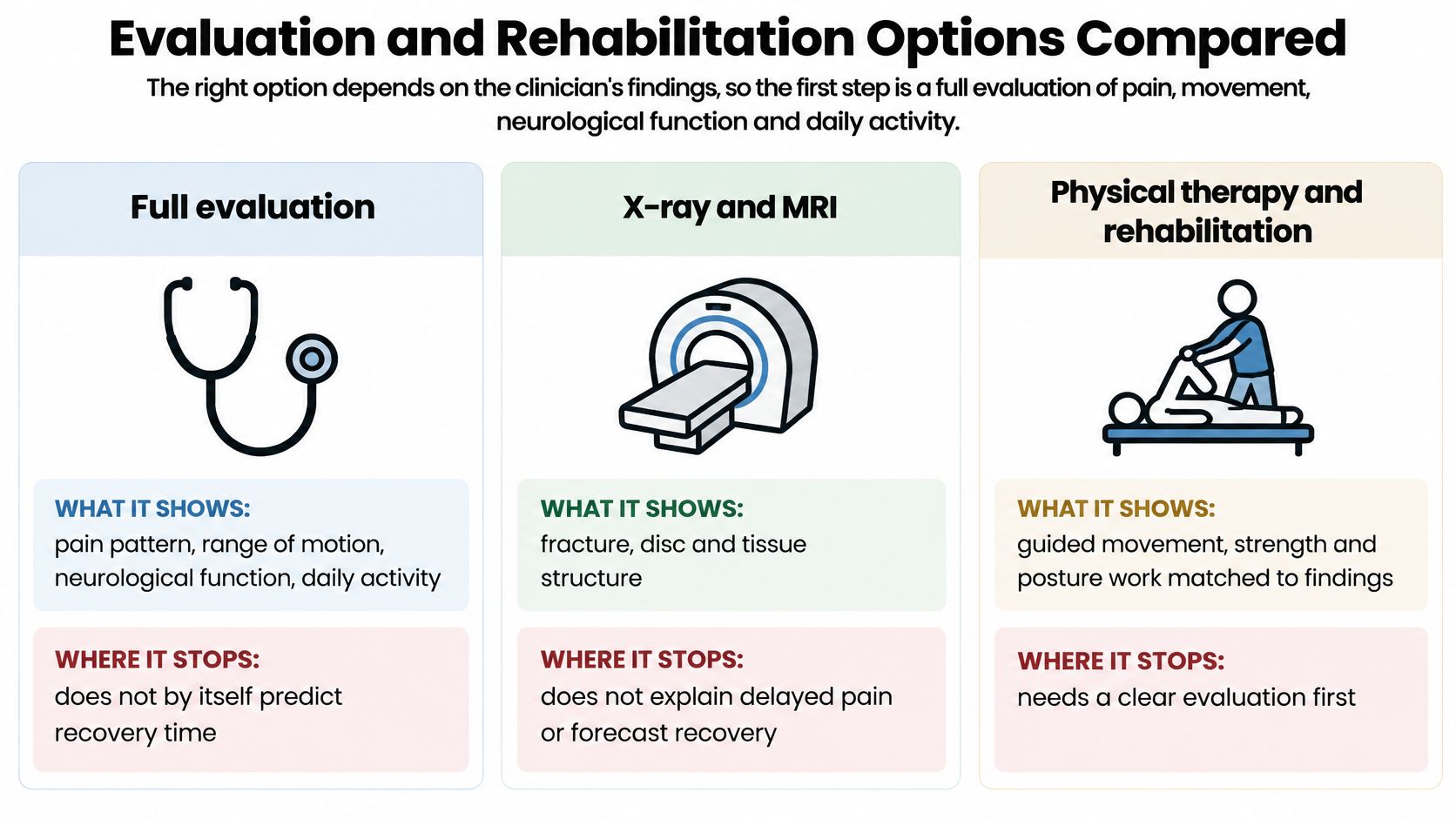
| Option | Typical Use | Questions to Ask |
|---|---|---|
| Physical therapy | Structured strengthening, mobility and graded activity | What are the goals, session frequency and progress measures? |
| Chiropractic care | Manual therapy and adjustments for neck pain | How long is the initial evaluation and what does the treatment plan include? |
| Acupuncture | Adjunct support for pain, headache and tension | How does it fit with the main plan, and what is the evidence for my symptoms? |
| Gentle self-directed movement | Staying active within comfort while symptoms settle | Which movements should I avoid while symptoms are worsening? |
| Medical review | Medication decisions and neurological assessment | Is imaging indicated, and what follow-up is planned? |
Structured rehabilitation
Physical therapy earns its place when pain has changed how you move and function. Expect deep neck flexor work, scapular strengthening, thoracic mobility drills and a graded return to the activities you logged as difficult, such as driving or overhead reaching. Our guide to physical therapy for whiplash injury describes how that progression is staged. Sessions here run 60 minutes for physical therapy follow-ups, which gives enough time to reassess and progress the program rather than repeat it.
Hands-on care and adjuncts
Manual therapy and adjustments suit people whose main limitation is joint stiffness and muscle guarding. Ask about the evaluation, not just the technique: our chiropractic initial evaluations are usually 30 minutes, and follow-up treatments are usually 15 to 20 minutes, so you know what you're booking. Acupuncture works as an add-on for pain, headache and tension rather than a replacement for active rehabilitation.
Gentle self-directed movement is the option many start with at home, and it's the one most easily overdone. Short, frequent, comfortable range-of-motion movements beat one aggressive stretching session. Skip heavy lifting, end-range forcing and sudden neck testing while symptoms are still climbing.
How to judge whether a plan is working
Evidence strength differs across these options, so the plan should carry explicit goals and a reassessment date. If pain scores, neck motion and daily function aren't moving in the right direction, the plan changes. If neurological signs appear or spread, the assessment changes first.
Book a Neck Evaluation This Week
Work through this order rather than deciding everything at once.
- Red flags first. Sudden weakness, confusion, fainting, difficulty walking or loss of bladder or bowel control means emergency care now. Severe headache, dizziness or spreading numbness means same-day evaluation.
- Persistent or worsening pain next. If your neck isn't improving across several days, book an evaluation this week instead of waiting for it to declare itself.
- Bring your log. Pain scores, range-of-motion notes, arm symptoms and the daily improving/stable/worsening labels give the clinician a trend rather than a snapshot.
- Ask for measurement. Request pain intensity and neck-related disability scoring, a neurological check, written goals and a follow-up date.
- Sort out coverage before the visit. We accept most major insurance plans, plus auto accident claims and workers' compensation claims, so have your claim number and insurer contact details ready when you call.
Describe what's bothering you when you reach out, and we'll call you back to confirm an appointment time. That's the whole first step, no guessing about which service you need.
You now have three things you didn't have this morning: a way to sort routine soreness from symptoms that need care, a record worth bringing to an appointment, and a clear route to being examined.
MedAmerica Rehab Center has provided physical therapy, chiropractic care and acupuncture in Deerfield Beach since 1995, including evaluation and rehabilitation for neck pain that surfaces a day or two after a collision. Bring your 72-hour log and we'll measure your pain, movement and neurological function, then build a plan with goals and a reassessment date. Visit MedAmerica Rehab Center to describe your symptoms and request an evaluation this week.
MedAmerica Rehab · Deerfield Beach
Talk to a clinician about your pain
Physical therapy, chiropractic, acupuncture and shockwave therapy under one roof, since 1995. Same-day appointments are available.
Mon–Thu 8:00 AM – 6:30 PM · Fri 8:00 AM – 3:00 PM