
Chronic Condition Management That Actually Works
Maria is 54, active, and tired of negotiating with her knee. She planned a beach walk this morning, but stiffness lingered after breakfast, the stairs felt uncertain, and one familiar twinge convinced her to cancel. By evening, she's wondering whether she should rest more, exercise harder, ask for a scan, or accept that her week will keep shrinking.
That dilemma captures the challenge of chronic condition management. Motivated people often aren't failing because they lack discipline. Their plans fail because the treatment burden is too high, the instructions don't match their current capacity, or the technology adds another obstacle between intention and action. A durable plan connects clinical guidance with simple, repeatable self-care, then adjusts when life disrupts it.
What Chronic Condition Management Really Means Day to Day
Daily management means making workable decisions around symptoms, function, and the activities that give life structure. It applies to arthritis, diabetes, fibromyalgia, persistent low back pain, post-surgical stiffness, neuropathy, and other conditions that continue for months or longer.
For Maria, the target is not a permanent fix for her knee. She needs to identify what provokes a flare, build enough strength and mobility for walking, choose an appropriate activity level each day, and recognize when pain warrants professional review. Better sleep, a longer walk, improved work tolerance, or less reliance on medication may matter more to her than an isolated clinical measurement. Those functional outcomes should guide the plan.
The clinic-plus-self-care loop
A durable plan assigns clear jobs to the clinic and the patient:
- The clinician assesses and adjusts. A rehab professional examines movement, strength, joint behavior, neurological signs, and barriers to progress. Treatment may include manual therapy, graded exercise, education, or referral when symptoms fall outside routine rehabilitation.
- The patient practices between visits. Daily movement, pacing, sleep routines, medication reporting, and brief symptom notes create the repetition that an occasional appointment cannot provide.
- Both sides review the response. A flare does not automatically mean the plan failed. It may indicate that the load rose too quickly, an exercise needs changing, recovery is inadequate, or another problem needs attention.
The practical difficulty is treatment burden. A plan can be clinically sound yet fail if it requires too many exercises, complicated tracking, or technology that the patient cannot use reliably. Low health confidence creates another barrier. Patients need clear reasons for each task, a starting dose they can manage, and feedback that connects practice with a meaningful activity.
Fatigue requires the same loop, with careful energy budgeting rather than repeated pushes followed by crashes. A broader daily strategy, such as Peak Performance's energy plan, can be considered alongside medical and rehabilitation guidance, not used as a substitute for either.
Practical rule: Ask, “What can I keep doing safely, and what support will help me do more?”
A plan earns its place by protecting routine and identity. Walking at the beach, completing a work shift, caring for family, or sleeping through the night gives treatment a measurable purpose. The clinic supplies assessment and course correction. Self-care supplies the repeated practice. Their feedback loop is what makes long-term progress more likely.
Why Chronic Conditions Are a Defining Health Issue in 2026
A patient can follow the plan, attend appointments, and still struggle to keep symptoms under control. A flare may disrupt work, exercise, sleep, or family responsibilities before the next clinical review. That gap between professional advice and daily life is why chronic condition management has become a defining healthcare task.
Noncommunicable diseases caused at least 43 million deaths in 2021, representing 75% of non-pandemic-related deaths worldwide, according to a review available through the National Library of Medicine. 18 million occurred prematurely before age 70, and 73% occurred in low- and middle-income countries. The burden reaches across medical care, rehabilitation, prevention, and the routines that help people remain active.
Cardiovascular diseases caused at least 19 million deaths, cancers caused 10 million, chronic respiratory diseases caused 4 million, and diabetes caused more than 2 million in 2021. Together, these four groups accounted for 80% of premature noncommunicable disease deaths in the same source.
The management problem behind the numbers
Acute care often follows a short course: identify the problem, provide treatment, and monitor recovery. Chronic conditions require a different operating model. Symptoms fluctuate, medication routines change, and work or caregiving can reduce the time available for exercise. A motivated patient may still stop using a plan if it feels too complicated, if progress is hard to recognize, or if digital tools create more work than support.
An earlier projection estimated that the worldwide cost of chronic disease would reach $47 trillion by 2030, as reported in a named global health projection. Evidence from the WHO era showed that 63% of global deaths in 2008 already came from major preventable diseases. More recently, more than one-third of people aged 16 and older reported a long-standing illness or health problem across 29 OECD countries in 2021, as summarized in this chronic-care review.
The practical response is a clinic-plus-self-care loop. Clinicians assess risk, adjust treatment, and address setbacks. Patients repeat manageable actions at home, observe how their body responds, and bring useful feedback to the next review. A plan that ignores treatment burden, low health confidence, or digital friction will often fail before its clinical value can be tested.
Rehabilitation matters because preserving movement can protect work participation, independence, and social connection. Passive treatment may calm symptoms temporarily, while durable gains require a realistic way to carry progress into the hours between appointments. A rehabilitation-friendly system teaches patients how to move, pace, monitor, and adapt, with clinical assessment available when the home plan no longer fits.
Evidence-Based Approaches Used in Modern Rehab
No single modality consistently solves a chronic problem. The useful question is what each tool does best, what limitation it carries, and how it fits into a larger plan.
Matching the tool to the job
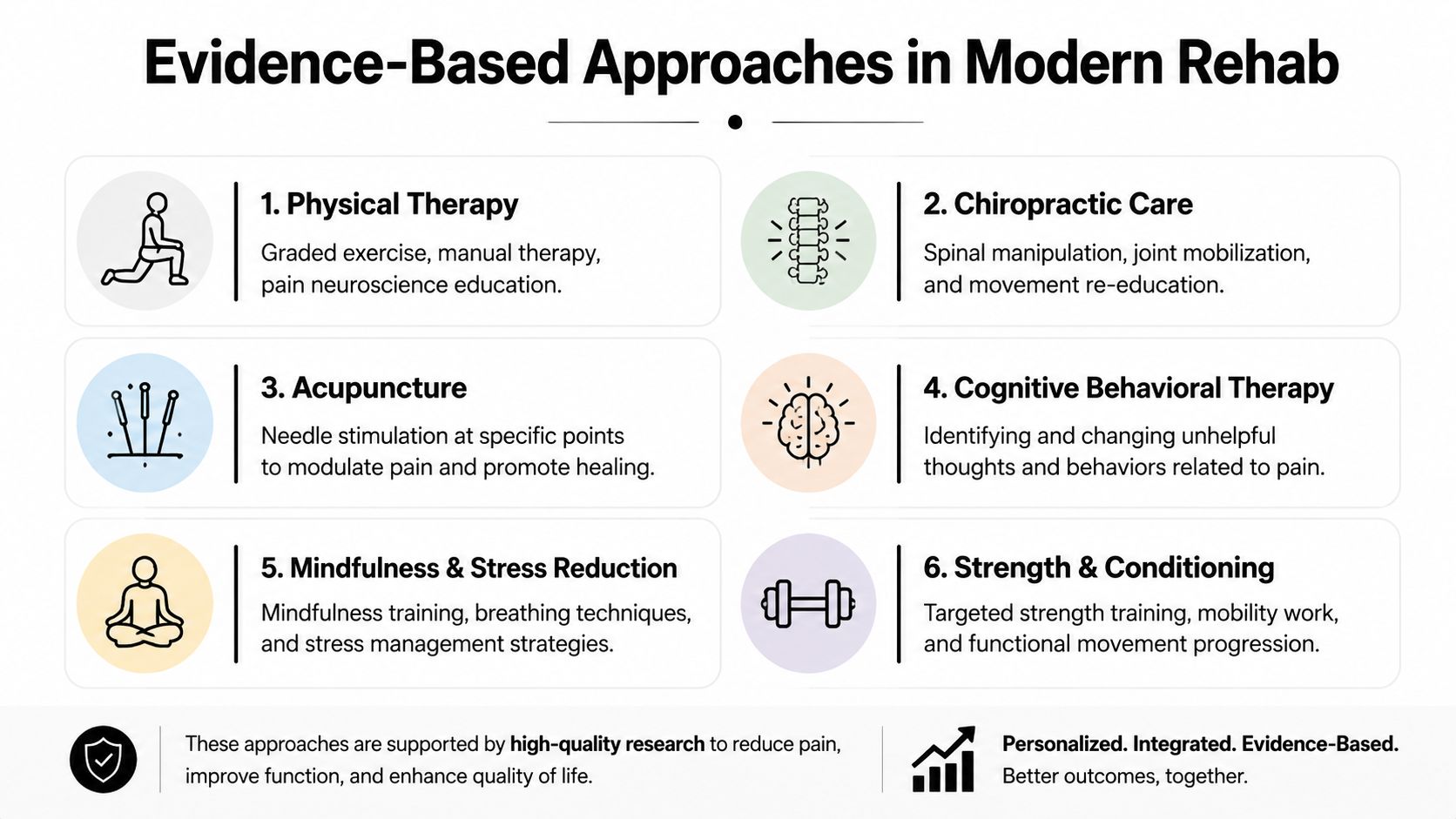
Physical therapy usually provides the assessment and progression structure. Graded exercise can rebuild tolerance, manual therapy can address mobility restrictions, and pain neuroscience education can reduce fear around movement. It works best when the patient leaves with a clear home dose, not when the session becomes the entire treatment. For patients who need help understanding pain and movement, pain neuroscience education resources can support the conversation.
Chiropractic care may help patients with mechanical spinal or joint pain through mobilization and related hands-on techniques. The practical trade-off is clear: it can be useful as an adjunct when paired with active rehabilitation, but repeated passive sessions without strengthening, mobility work, or functional practice don't build much independence.
Acupuncture can offer short-term symptom relief for some people with osteoarthritis, migraine, or chronic low back pain. That window may be valuable if it lets a patient walk, sleep, or complete exercise more comfortably. It shouldn't be presented as a replacement for diagnosis, progressive loading, or medical care.
Shockwave therapy uses acoustic pulses for selected stubborn conditions, including tendinopathy, plantar fasciitis, and calcific shoulder pain. Clinicians generally consider it when a well-designed conservative program has stalled. It isn't a universal pain treatment, and the diagnosis must justify its use.
Therapeutic exercise is usually the highest-yield long-term investment. Strength, mobility, balance, and aerobic work can be adjusted by frequency, intensity, duration, and recovery. Success means improved function, such as standing longer, climbing stairs with more confidence, or returning to a valued activity, rather than just completing exhausting workouts.
Medication coordination keeps rehabilitation safer and more coherent. A clinician can document questions about NSAIDs, neuropathic agents, and supplements for the prescribing physician, especially when side effects, duplicate products, or changing pain patterns complicate participation. Patients considering sleep-related support can also review options such as how to find your CPAP alternative, while keeping sleep treatment connected to their medical history.
What the evidence favors
A systematic review of Chronic Care Model interventions found that self-management support was the most common intervention and the one most consistently linked with statistically significant patient-level improvements, especially for diabetes and hypertension. The review also found narrower benefits from delivery-system redesign and changes in professional practice through decision support, as reported in the PubMed review.
That finding changes how a rehab clinic should combine modalities. Hands-on care can create an opening, but structured self-management turns that opening into capacity. The strongest plan is individualized, measurable, and stacked around the person's diagnosis and goals.
A Practical Self-Management Framework You Can Follow
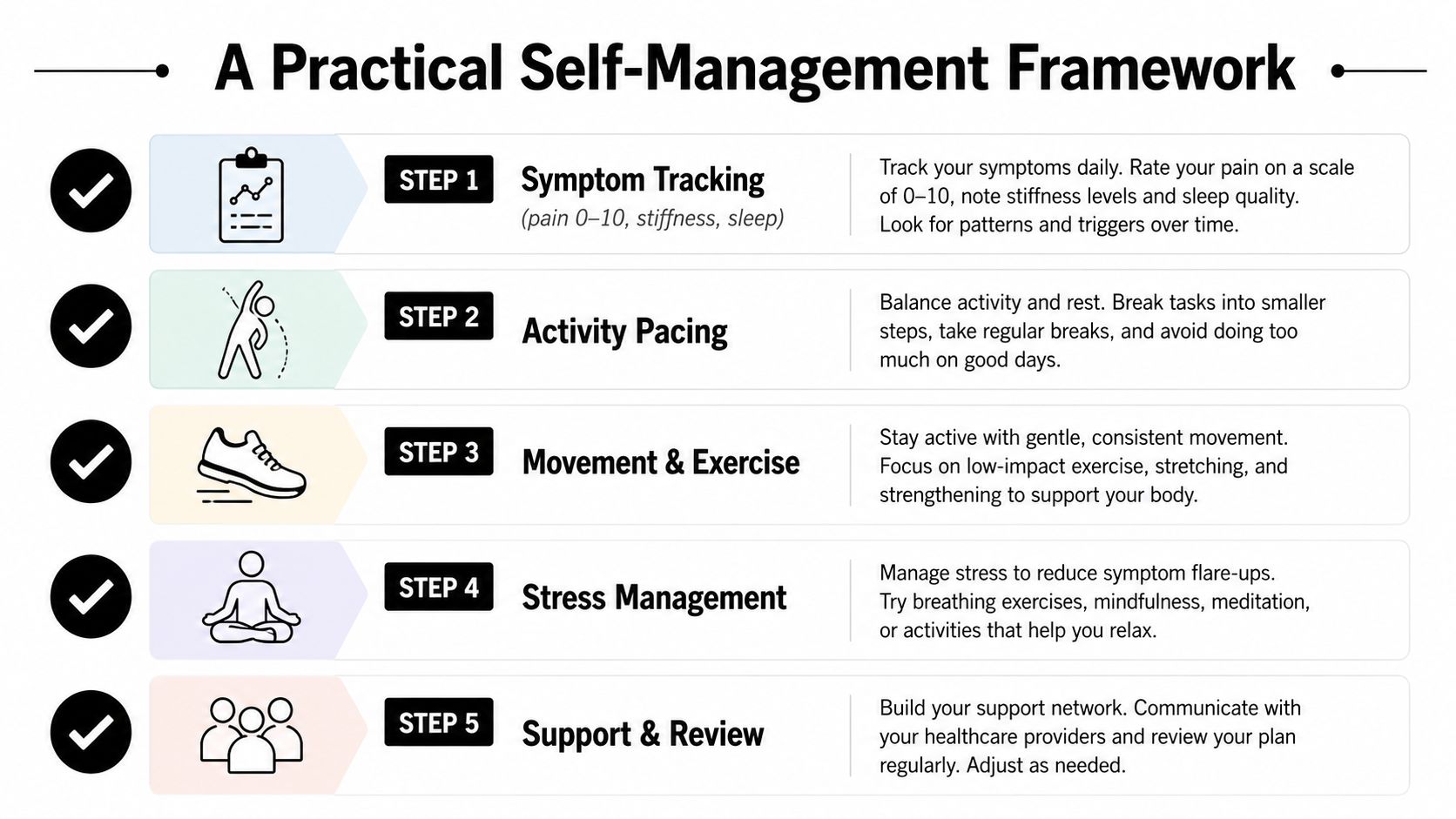
A home plan should be simple enough to survive a difficult week. Start with five steps, then review the pattern rather than reacting to one uncomfortable day.
Five steps that reduce guesswork
Track only useful signals. Record pain on a 0 to 10 scale, stiffness duration, and sleep quality in a notebook or basic phone note. The purpose isn't to create a perfect database. It's to show whether a new exercise, longer walk, or poor night of sleep changes your pattern.
Pace before the flare. Use the two-hour rule as a practical boundary. If an activity reliably causes a flare that lasts into the next two hours, reduce the load, divide the task, or add recovery. Increase activity gradually, never by more than 10% weekly, and stop before symptoms spike. This specific limit should be individualized with a clinician, particularly after surgery or during an active disease flare.
Dose exercise like treatment. Write down frequency, intensity, duration, and rest. Someone who can tolerate a short walk today shouldn't be prescribed the distance they hope to achieve later. Start with current capacity, then progress when the response remains stable.
Anchor the habit to something that already happens. Stretch after morning coffee. Perform balance work while waiting for the kettle. Take a planned walk after dinner. Existing routines provide a cue, so the exercise doesn't depend on remembering another isolated task.
Set escalation triggers. Contact the clinic for new numbness, pain above 6/10 for three days, missed workdays, or meaningful sleep loss. These aren't automatic diagnoses, but they are practical signals that the plan needs review.
A useful weekly review: Ask what improved, what became harder, which task was skipped, and what made it difficult. Change one variable at a time so you can identify the intervention that helped.
A clinician may recommend remote monitoring when it adds meaningful communication rather than another dashboard. Learn how remote therapeutic monitoring can fit into care, but keep the same standard: the tool should simplify decisions and prompt human follow-up.
Use the following video as a movement and self-care supplement, not as a diagnosis or individualized prescription.
Why Good Plans Still Fail and How to Stop That
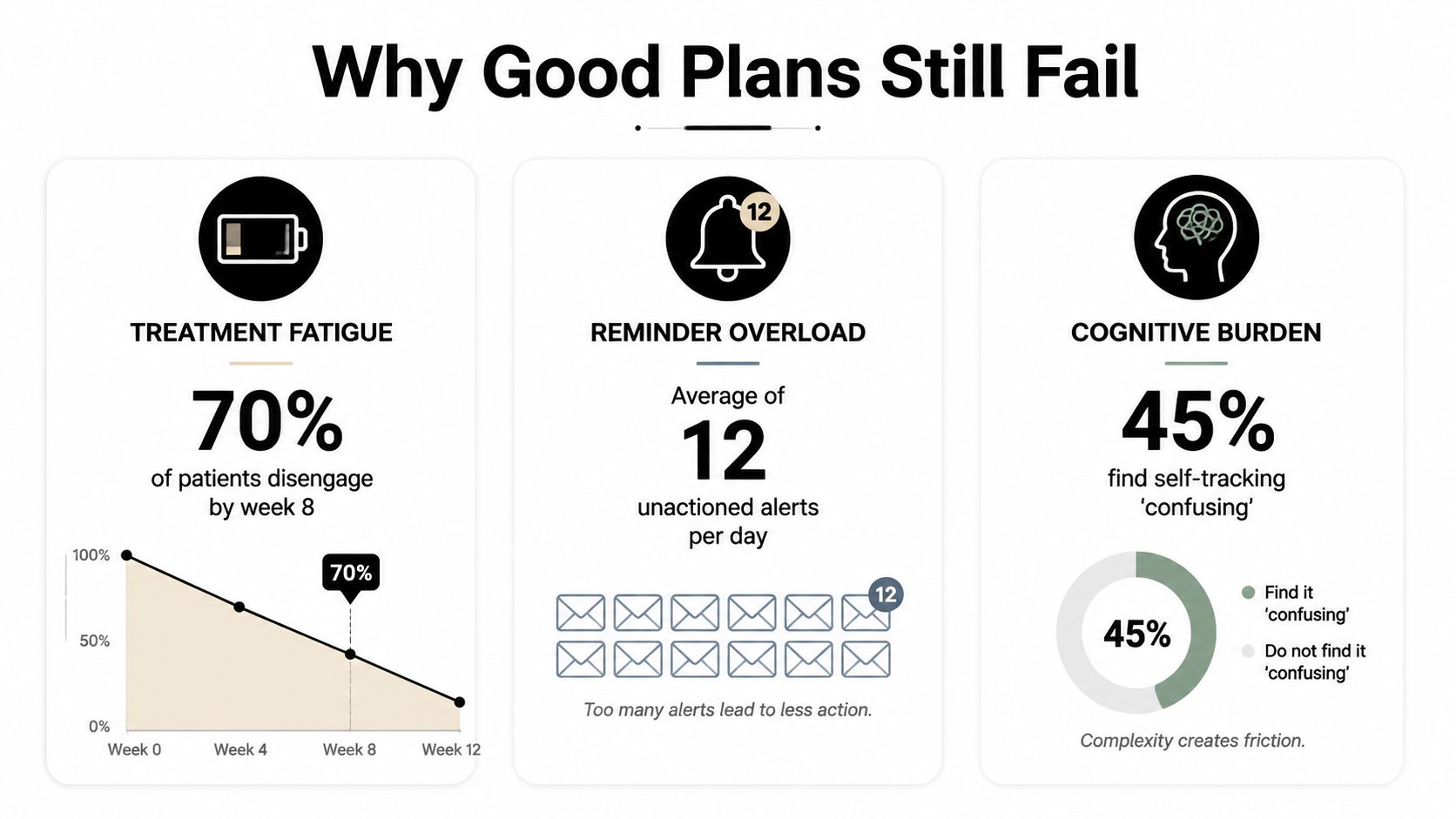
More reminders don't automatically create better self-care. A patient can be motivated, understand the diagnosis, and still abandon a plan because the plan asks too much, feels disconnected from daily life, or requires technology that doesn't work for them.
Three common breakdowns
Treatment burden accumulates across every diagnosis. A patient may have medication instructions, appointments, dietary changes, symptom logs, strengthening, stretching, walking, and sleep recommendations. Each task can sound reasonable alone, but the combined plan competes with work, transportation, caregiving, pain, and fatigue.
Low health confidence changes behavior even when motivation is present. Across OECD countries, only 59% of people living with chronic conditions said they were confident managing their own health, compared with 70% of people without chronic conditions, according to OECD data on effective chronic-condition care. If a patient expects exercise to worsen symptoms or doubts that small actions matter, a reminder won't resolve the underlying uncertainty.
Digital friction creates a separate access problem. A 2026 review of artificial intelligence in chronic disease self-management identified the digital divide, poor usability, interoperability problems, privacy concerns, and limited real-world evidence as persistent barriers. An app-only plan can exclude older adults, people with limited connectivity, and patients who need explanation rather than more notifications.
Design the plan around friction
Reduce the home program to two core behaviors at first. Pair each behavior with an existing routine, offer paper or basic-note alternatives, and schedule follow-ups that discuss barriers rather than merely reviewing compliance. If medication access, out-of-pocket spending, or pharmacy stock-outs interfere, document the system problem and coordinate with the relevant clinician instead of labeling the patient nonadherent.
A coordinated model can help when several providers are involved. Coordinated care providers can keep recommendations from competing with one another, but coordination only works when the patient understands who is responsible for each decision.
A plan that looks impressive in a clinic can be impossible at home. Good design removes work before it adds technology.
Research on self-management programs found improvements in social and role activity limitations, depression, physician communication, physical activity, emergency-room visits, and hospitalization over a six-month period. A similar low-cost program followed for two years reduced emergency and outpatient visits and health distress while improving self-efficacy, as described in the PubMed study. The lesson isn't that every patient needs an app. It's that support must strengthen confidence and make the next action achievable.
When Home Care Is Not Enough and You Need the Clinic
Home care works within a safe range. It shouldn't become a reason to ignore a changing neurological sign, progressive weakness, or unexplained systemic symptom. The handoff to a clinic is part of responsible chronic condition management, not evidence that self-care failed.
| Condition | Self-Care Sufficient | Clinic Escalation Triggers | Urgent Referral |
|---|---|---|---|
| Low back pain | Stable symptoms that respond to pacing and movement | Radiating symptoms, increasing weakness, or declining function | Bowel or bladder changes, severe progressive weakness, or other serious neurological signs |
| Osteoarthritis | Predictable pain with stable walking and daily function | Locking, instability, pain at rest, or a clear reduction in walking tolerance | Fever with a hot, painful joint or sudden severe deterioration |
| Fibromyalgia | Familiar flares that settle with pacing and recovery | A flare lasting more than two weeks or a meaningful loss of routine | New neurological symptoms or unexplained systemic symptoms |
| Neuropathy | Stable sensation with safe footwear and routine inspection | Progressive numbness, balance decline, or falls | Foot-ulcer risk, infected wounds, or rapidly worsening neurological change |
| Post-surgical recovery | Gradual progress within the surgeon's restrictions | Plateau or regression after six weeks | Fever, wound concerns, sudden severe pain, or acute loss of function |
What the first assessment should clarify
A multidisciplinary assessment should identify the dominant limitation, screen for conditions requiring medical referral, and translate findings into functional goals. For low back pain, that may mean distinguishing mechanical sensitivity from nerve involvement. For arthritis, it may mean separating strength loss, joint restriction, fear of loading, and a need for medical review.
Urgent referral is appropriate for unexplained weight loss, fever with joint pain, or a sudden severe headache, among other concerning findings. These symptoms need medical evaluation rather than routine rehabilitation.
Clinic-based care then acts as an escalation layer. Physical therapy, chiropractic care, acupuncture, shockwave therapy, and exercise can be coordinated when each has a defined role. The patient should leave knowing what to do at home, what to avoid temporarily, and which change requires a call.
How MedAmerica Rehab Center Fits Into Your Care Pathway
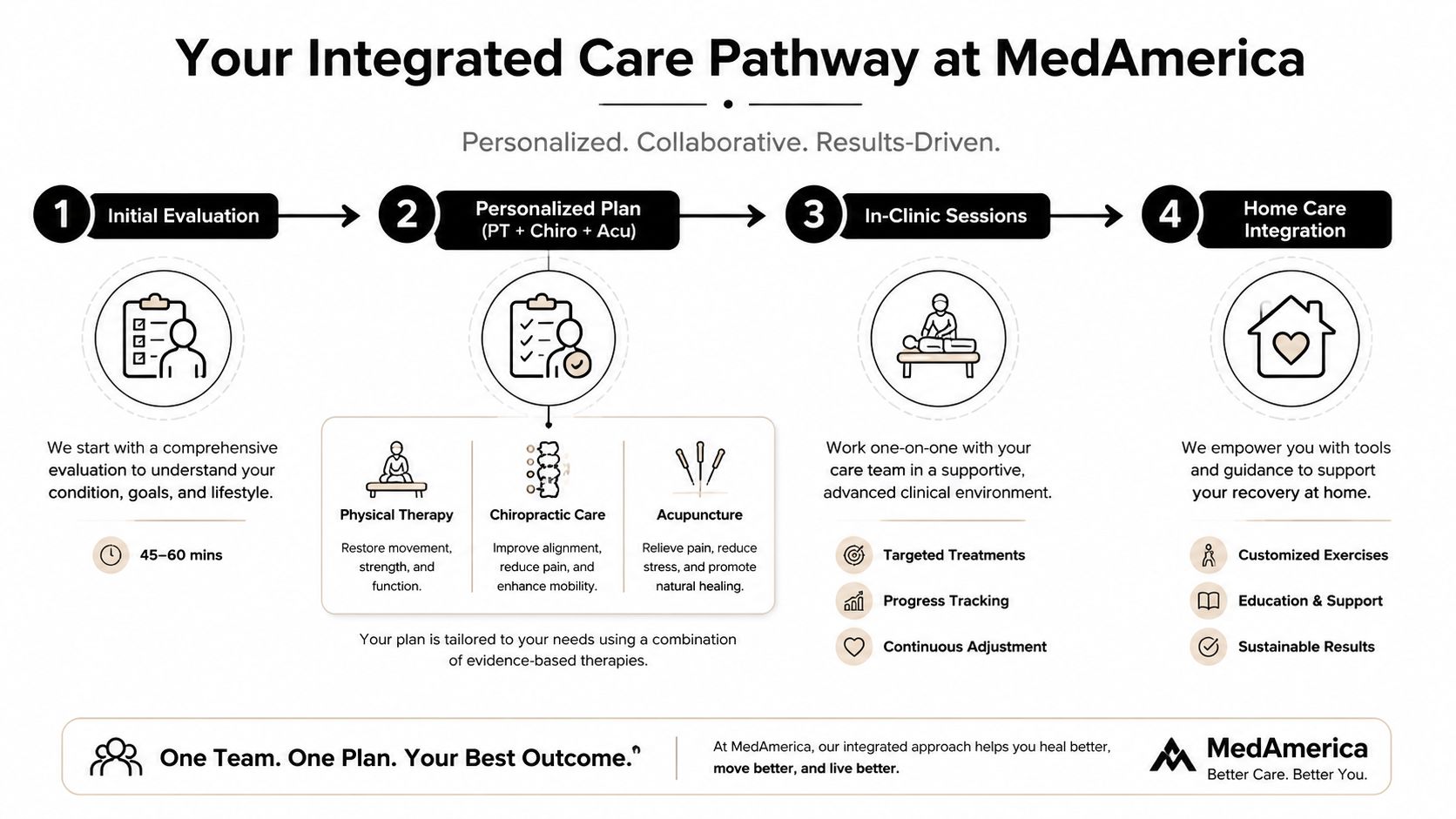
At MedAmerica Rehab Center in Deerfield Beach, the integrated model begins with the patient's goals and current limitations. The initial evaluation can organize physical therapy, chiropractic care, and acupuncture around the movement problem rather than treating each service as a disconnected appointment. Shockwave therapy and progressive exercise can be added when a stubborn tendinopathy or joint restriction needs a more specific approach.
Turning visits into a continuous loop
The pathway should keep moving in both directions:
- Evaluation informs the home plan. The clinician identifies the movement or symptom barrier and chooses an initial dose.
- Home response informs the next visit. The patient brings pain behavior, stiffness, sleep, activity tolerance, and obstacles back to the team.
- In-clinic treatment changes the available capacity. Manual techniques, education, exercise, and selected modalities help the patient practice a more useful movement pattern.
- Progress notes keep the plan aligned. The patient and prescribing physician can receive documented information when medication questions or broader medical decisions arise.
Practical access matters as much as clinical reasoning. Patients in Deerfield Beach and nearby South Florida communities can ask about appointment scheduling, parking, insurance documentation, and referral pathways before the first visit. Same-day availability and insurance-friendly processes may reduce logistical friction, while clear first-visit expectations help patients arrive prepared to discuss symptoms, medications, prior treatment, and goals.
The clinic doesn't replace home practice. It provides the assessment, feedback, and adjustment that keep home practice relevant. A patient recovering from surgery may need restrictions updated as healing progresses. Someone with arthritis may need the exercise dose changed after a flare. Someone with balance concerns may need a safer progression than a generic online routine can provide.
MedAmerica Rehab Center is one local option for coordinated physical therapy, chiropractic care, acupuncture, and shockwave services. The useful measure is whether the care pathway helps the patient move from supervised treatment toward confident, sustainable participation in daily life.
Building a Smarter Long-Term Plan for Your Health
Adult chronic care in 2026 should combine short clinical check-ins with longer periods of supported self-management. Patients need a clear endpoint based on function and confidence, not open-ended appointments with no shared definition of progress. Clinicians need patient-reported information that helps them adjust treatment instead of relying on a snapshot from one visit.
Use this week's actions to make the plan concrete:
- Schedule one reassessment checkpoint. Put a date on the calendar to review function, symptoms, sleep, and barriers.
- Audit medications and supplements. Write down what you take and send questions to the prescribing clinician, especially if side effects interfere with movement or sleep.
- Choose one movement upgrade. Add a manageable walk, strength exercise, mobility drill, or balance practice to an existing routine.
- Set one recovery target. Focus on sleep quality, stress recovery, or a consistent evening wind-down rather than trying to change every habit at once.
Chronic condition management is a skill set you build, not a service you consume. The clinic provides clinical judgment and accountability, while your daily choices provide the repetition that makes function durable.
MedAmerica Rehab Center offers coordinated physical therapy, chiropractic care, acupuncture, and shockwave therapy for chronic pain, mobility limitations, and recovery needs in Deerfield Beach. If your home plan keeps breaking down or symptoms are limiting work, sleep, walking, or daily activities, visit MedAmerica Rehab Center to arrange an evaluation and build a more workable care pathway.
MedAmerica Rehab · Deerfield Beach
Talk to a clinician about your pain
Physical therapy, chiropractic, acupuncture and shockwave therapy under one roof, since 1995. Same-day appointments are available.
Mon–Thu 8:00 AM – 6:30 PM · Fri 8:00 AM – 3:00 PM