

Physical Therapy for Sacroiliac Joint Pain: What Works
If your pelvis feels more level after treatment but sitting and walking still hurt, has the treatment worked? That question gets to the heart of physical therapy for sacroiliac joint pain: success should mean doing more of what matters to you, not just feeling different on the treatment table.
The sacroiliac joint, often shortened to SI joint, sits where the base of your spine meets your pelvis. Pain around this area deserves a careful assessment because nearby hip, back and nerve problems can feel similar. A useful rehabilitation plan starts by identifying the likely source, then measures progress through movement and daily function.
Physical Therapy Approaches for Sacroiliac Joint Pain at a Glance
Physical therapy isn't a guaranteed cure, but a well-matched plan can reduce pain and improve daily function. Treatment needs to address both what irritates the area and how you manage the demands of walking, lifting, sitting or exercise.
Think of the joint as a hinge and the surrounding muscles as a supporting brace. It's an imperfect analogy because the SI joint moves very little, but it explains why rehabilitation often focuses on control around the pelvis rather than trying to make the joint move more.
A menu rather than a fixed protocol
A therapist may combine the following approaches. The evidence signals describe their place in care, not a ranking that applies to every patient.
| Approach | What It Targets | Evidence Signal | Role in Plan |
|---|---|---|---|
| Patient education | Pain beliefs and daily load | Included in recommended first-line conservative care | Starting point for every plan |
| Pelvic-girdle stabilization exercise | Lumbopelvic motor control | Recommended within individualized rehabilitation | Core of the early phase |
| Stretching of restricted muscles | Tight hip and trunk muscles | Adding piriformis stretching to mobilization improved disability after 1 week, without extra pain benefit, in a 2025 randomized study indexed on PubMed | Supporting element |
| Manual mobilization or manipulation | Joint movement and pain | Can support pain relief and functional improvement, alone or alongside exercise | Used when clinically appropriate |
| Muscle energy technique | Restricted segments and muscle-assisted movement | Pain-relief signal is clearer than improvement in disability | Short-term relief |
| Balance and motor-control training | Weight transfer and single-leg stability | Combined training has stronger trial support than either component alone | Progression phase |
The distinction between pain relief and functional improvement matters. A treatment can make you more comfortable without yet making a work shift, grocery trip or walk easier. Both outcomes are useful, but they aren't interchangeable.
Why the combination matters
A person who struggles to roll in bed may need gentler movement practice before heavier strengthening. Someone who can exercise comfortably but flares after carrying groceries may need work on loading and weight transfer instead of more stretching.
Exercise is the central active component, while education helps you apply it outside appointments. Hands-on treatment may make movement more tolerable, and targeted stretching may address a restriction that interferes with the exercise.
Practical rule: Choose treatments by what they help you do, not by how dramatic they feel during the appointment.
The aim isn't to collect every technique in the table. It's to select the smallest useful combination, check your response and adjust the plan as your capacity changes.
How a Physical Therapist Confirms the Sacroiliac Joint Source
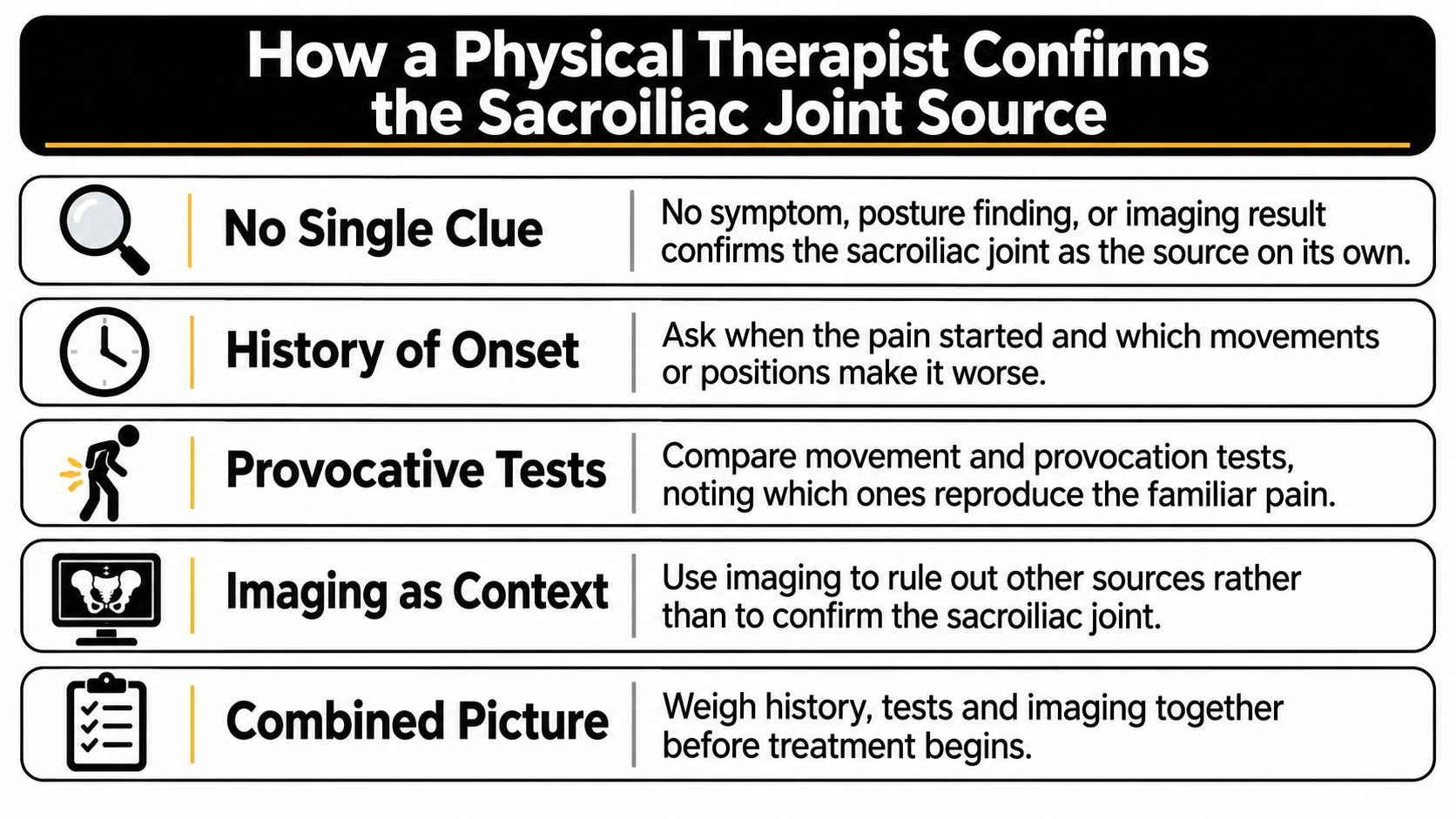
No single symptom, posture finding or imaging result confirms that the SI joint is causing your pain. A therapist builds a clinical picture from your history, an examination and tests that reproduce your familiar symptoms.
The assessment sequence
Your history comes first. Expect questions about when pain began, whether there was an injury, which tasks aggravate it, and whether symptoms travel into the leg. Previous surgery, pregnancy or postpartum status, and other medical conditions can also influence the examination.
The therapist then checks the lumbar spine, hips, movement patterns and neurologic function. This helps identify conditions that could resemble SI-joint pain or coexist with it.
A commonly recommended rule is at least three positive results among five provocation tests, Gaenslen, thigh thrust, distraction, compression and sacral thrust, according to the American Family Physician clinical review, which describes support from prospective and blinded validity studies.
A positive test means the maneuver reproduces the relevant familiar pain. It doesn't mean a joint has visibly slipped out of place, and an uncomfortable stretch alone isn't necessarily a positive result.
The assessment combines these clues rather than treating any one finding as decisive.
Turning findings into a plan
When the findings support SI-joint-related pain, first-line rehabilitation typically includes education, pelvic-girdle stabilization, stretching of restricted muscles and manual treatment when appropriate. Improving control around the lower back and pelvis can reduce excessive or uneven loading of sensitive structures.
Screening remains important even when the pelvic tests reproduce pain:
- Lumbar and hip assessment checks whether neighboring joints better explain the symptoms.
- Neurologic screening looks for changes in strength, sensation or reflexes.
- Medical history review identifies possible inflammatory disease, significant trauma or other reasons for referral.
Before your appointment, write down the positions, movements and tasks that reproduce the pain. Describing what happens when you rise from a chair or climb stairs is more useful than trying to diagnose your own pelvic alignment.
Telling Sacroiliac Joint Pain Apart from Hip, Nerve and Back Pain
The sacroiliac joint, hip and lumbar spine sit close enough that they can refer pain into the same patch of buttock and thigh, the way three neighboring houses can share one fence line. That overlap is why a single sore spot rarely names its own source. The patterns below narrow the possibilities, and an examination still has to confirm them.
| Condition | Typical Pain Location | Clue That Points There | Next Step |
|---|---|---|---|
| Sacroiliac joint dysfunction | Buttock or low back, often on one side | Familiar pain reproduced by pelvic loading tests | Physical therapy assessment and stabilization plan |
| Lumbar radiculopathy | Low back with pain radiating down the leg | Numbness, weakness or reflex changes | Neurologic examination, with imaging when clinically indicated |
| Hip disorder | Groin, front or outer hip | Pain with hip rotation or weight bearing | Hip examination and hip-focused care |
| Nonspecific low back pain | Low back without a single clear focus | Pain changes broadly with posture and movement | Movement-based therapy with reassessment |
Why an MRI doesn't settle the question
An MRI can reveal structural changes without proving those changes cause your symptoms. Scans still help investigate inflammation, injury or another suspected condition, so the useful question is which clinical problem the scan needs to answer.
A systematic review of conservative SI-joint pain trials highlighted how often investigators omitted thoracolumbar screening, which is one reason the examination has to reach beyond the sore spot. A feeling of improved symmetry right after manual treatment can be encouraging, yet it is a sensation rather than evidence that a joint has been corrected.
When the picture stays unclear, particularly before an invasive procedure, a physician may consider an image-guided anesthetic injection for diagnostic confirmation. Exercise-based care does not have to wait for that step.
Clues worth reporting
Leg pain that travels with weakness, numbness or altered reflexes points toward a nerve root rather than the joint itself. Our guide to physical therapy for sciatica explains how that pattern is usually evaluated, and the examination still decides which structure is involved.
Not every back-pain concern belongs in an SI-joint treatment pathway. For readers separately exploring breast-related back discomfort, Ideal Face & Body's resource to find breast reduction near Beverly Hills addresses that distinct question, not SI-joint diagnosis.
A useful outcome is better walking, sitting, sleep or work tolerance, not just less tenderness when someone presses the painful area.
Progress is judged the same way across all four rows of the table, by what you can do rather than how aligned the pelvis feels. If sitting through a meal, walking a block or rolling in bed gets easier across visits, the plan is working. If those tasks stay limited while the area only feels "put back," the diagnosis or the approach deserves a second look.
Red Flags That Need a Doctor Before Therapy
Some symptoms require medical evaluation before, or alongside, physical therapy. Don't assume new symptoms are another SI-joint flare, especially when they differ from your usual pattern.
Seek emergency assessment
Go to an emergency department for symptoms that could indicate serious nerve compression:
- Bladder or bowel changes: New difficulty controlling or emptying the bladder, or new loss of bowel control.
- Saddle-area numbness: New numbness around the groin, genitals or inner thighs.
- Progressive leg weakness: Rapidly worsening weakness, especially with bladder, bowel or sensory changes.
These symptoms shouldn't wait for the next rehabilitation appointment. Avoid testing them with exercises or waiting to see whether manual treatment helps.
Arrange prompt medical review
Other warning signs need timely evaluation, with urgency guided by severity and the combination of symptoms:
- Sudden severe pain: Pain that escalates quickly or makes normal movement unusually difficult.
- Fever or chills: Especially when accompanied by back pain or feeling generally unwell.
- Unexplained weight loss: Weight loss without an intentional change in diet or activity.
- Cancer history: New or changing back pain in someone previously treated for cancer.
- Significant trauma: Pain after a fall, vehicle collision or other substantial injury.
- Persistent night or resting pain: Pain that repeatedly disrupts sleep or doesn't ease with position changes.
Night pain isn't automatically a sign of dangerous disease, but its context matters. Morning stiffness and night pain can also occur with inflammatory conditions, which require a doctor's assessment rather than an exercise-only assumption.
For persistent pain without emergency signs, arrange a medical or rehabilitation assessment during the week rather than repeatedly treating yourself without a clear diagnosis. A physical therapist should screen for concerns and refer when needed; severe illness, major trauma or rapidly worsening symptoms warrant more urgent care.
Exercise Progression from Motor Control to Dynamic Balance
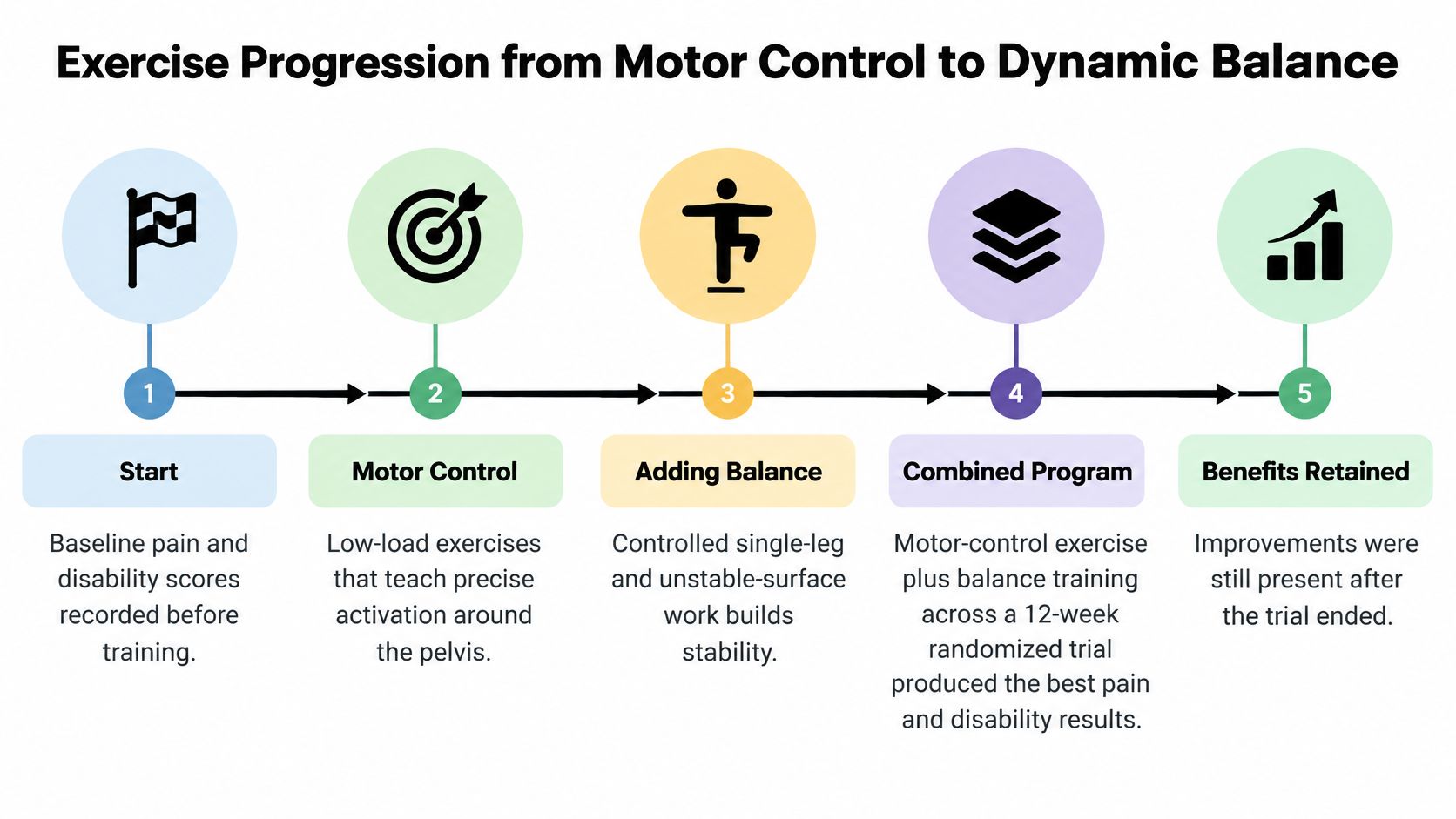
A randomized controlled trial of motor-control exercise and balance training found the strongest pain and disability results with the combined program after a 12-week intervention, with functional benefits still present at 24 weeks. That's a useful benchmark, not a promise that everyone needs the same schedule or exercises.
The practical implication is to move beyond isolated abdominal tightening. Your pelvis and trunk need to stay coordinated when you shift weight, step, turn and respond to an unexpected loss of balance.
Build control before adding complexity
The phases below illustrate clinical progression rather than reproduce a universal trial protocol.
| Phase | Goal | Example Work | Move On When |
|---|---|---|---|
| Early low-load control | Pelvic and trunk control at rest and during gentle movement | Pelvic stabilization drills and gluteal activation | Pain is settling and drills feel controlled |
| Middle weight transfer | Trunk and pelvic control during weight shifts | Supported single-leg stance, sit-to-stand and step work | Each leg stays stable without sharp pain or a sustained increase afterward |
| Late dynamic balance and gait | Control of side-to-side and rotational movement | Gait training, reactive balance and activity-specific loading | The relevant work or sport task is tolerated without a meaningful flare |
| Full program reference | Combine motor control and balance across the trial's intervention period | Individualized dosage based on symptom irritability | Reassess after the intervention and at later follow-up |
During a sit-to-stand, for example, the therapist may check whether you shift away from the painful side or twist to avoid loading it. During step work, the focus might be keeping the trunk controlled as the opposite foot leaves the ground.
This visual summarizes the progression from baseline assessment to combined training.
Adjust the dose, not just the exercise
Irritability means how easily symptoms start and how long they take to settle. A task that feels manageable during treatment may still be too demanding if it leaves you substantially worse afterward.
- Reduce demand by shortening the movement, using hand support or lowering resistance.
- Increase challenge by adding controlled weight transfer before speed or unpredictable movement.
- Check the aftermath by comparing later symptoms and everyday activity tolerance with your baseline.
If hip restriction interferes with the task, our guide to improving hip mobility explains related mobility work. Stretching should support the movement goal rather than become an automatic addition.
Progression cue: Move forward when the earlier task is controlled and repeatable. You don't always need to be completely pain-free.
Hands-On Relief, Recurring Pain and Three Recovery Scenarios
Joint mobilization, manipulation when appropriate, and muscle energy technique can be parts of SI-joint rehabilitation. Muscle energy technique uses a guided muscle contraction against resistance rather than having the therapist move you passively.
The image below shows the type of therapist-assisted positioning that may be used during hands-on assessment or care.

A 2025 critically appraised topic indexed on PubMed reviewed three studies and concluded that exercise therapy, manual therapy and combined care can reduce pain and improve function. That supports having options, but it doesn't establish that every technique is equally useful for every person.
What relief does and doesn't tell you
A 2025 systematic review and meta-analysis reported pooled pain reductions of 1.88 for muscle energy technique, 0.90 for mobilization and 1.13 for exercise, while only exercise significantly improved disability, by 5.37 points. Those pooled findings don't establish a universal protocol or predict an individual's response.
Before hands-on work, the therapist should explain the goal, the proposed trial of visits and the change that would justify continuing. Our explanation of hands-on physical therapy provides context for how manual care fits within rehabilitation.
The embedded video offers additional context, but it shouldn't be treated as a prescription for self-manipulation.
A warehouse worker whose pain returns after lifting
Consider a hypothetical worker who improves during rehabilitation but flares after a heavy lifting shift. The useful response isn't automatically more forceful treatment or abandoning exercise.
The therapist could temporarily reduce lifting demands, keep comfortable walking in the routine and restart exercises at a lower dose. Rehabilitation would then include practice with the actual work demand, such as lifting from different heights and turning while carrying a load.
The question becomes whether the worker can gradually tolerate the shift, not whether the pelvis feels corrected afterward.
A runner who feels better until the next run
A hypothetical runner gets brief relief after manual treatment, then develops the same symptoms on returning to running. Repeating the appointment without changing the running exposure may leave the main problem unaddressed.
The plan could shift toward controlled single-leg loading, balance and graded return to running. Hands-on care might remain a short supporting treatment if it helps the runner complete useful exercise.
The therapist should also review how symptoms change with distance, pace, terrain and recovery. Recurring pain calls for a dosage review, not an automatic conclusion that the joint has moved out of position.
A retired teacher who flares on longer walks
Consider a retired teacher who can manage short outings but becomes sore during longer walks. Pushing heavier strengthening alone may not address the mismatch between current endurance and the desired walking distance.
A practical plan might divide walking into manageable bouts, build duration gradually and set a milestone for reassessment. If walking tolerance doesn't improve, the clinician should revisit the diagnosis and check for other contributors.
Pregnancy and postpartum recovery also require attention to current capacity, delivery recovery and pelvic symptoms. The plan should account for those circumstances rather than apply a generic strengthening routine.
If symptoms follow an injection, report the timing and any new features to the treating clinician. Lake City Physical Therapy's resource on pelvic pain following sacroiliac injections provides related context, but worsening symptoms still need individualized medical advice.
Across these scenarios, temporary relief can create an opportunity to move. Progressive, tolerable activity is what the plan must ultimately help you regain.
Book Your First Physical Therapy Assessment
Book an assessment to clarify the likely pain source and set goals before committing to a program. Choose a concrete starting goal, such as getting through a grocery trip, sitting through dinner or returning to a modified workout.
At MedAmerica Rehab Center in Deerfield Beach, initial physical therapy evaluations typically last 60 to 75 minutes. The assessment can cover your history, relevant provocation tests, movement and pelvic control, followed by an individualized plan; ask to establish a reassessment date.
Arrive ready to describe the problem
Bring a list of aggravating positions and tasks, any available imaging reports and your current medications. Wear comfortable clothing, such as gym clothes and shoes, so you can move during the examination.
Our clinic is a Certified Outpatient Rehabilitation Facility, with licensed therapists providing hands-on care and targeted exercise. Sessions will likely be one to three times per week; confirm appointment length, recommended frequency and insurance coverage directly with us because your schedule and coverage aren't guaranteed by a general description.
Before agreeing to the plan, check that it answers these questions:
- Exercise progression: What will become more challenging as your capacity improves?
- Reassessment milestones: Which activities and measures will determine whether treatment is helping?
- Recurrence plan: What should you modify, and when should you contact the clinician if pain returns?
MedAmerica Rehab Center offers individualized physical therapy, hands-on care and targeted exercise for back pain and related mobility problems. Visit MedAmerica Rehab Center to arrange an assessment in Deerfield Beach and discuss a plan built around your symptoms, daily demands and functional goals.
MedAmerica Rehab · Deerfield Beach
Talk to a clinician about your pain
Physical therapy, chiropractic, acupuncture and shockwave therapy under one roof, since 1995. Same-day appointments are available.
Mon–Thu 8:00 AM – 6:30 PM · Fri 8:00 AM – 3:00 PM