

Chiropractor or Physical Therapist for Sciatica
Neither a chiropractor nor a physical therapist is universally better for sciatica. Screened patients should use an exercise-based plan, with manual therapy only inside that package.
Choosing a chiropractor or physical therapist for sciatica starts with a more useful question: What does your examination show you need, and is routine outpatient care safe? Pain relief matters, but so do walking capacity, leg strength, sensation, and the ability to get through an ordinary day.
A hands-on treatment that makes sitting easier can be useful. So can an exercise that helps you walk farther without aggravating your leg. Neither response, by itself, tells you which profession should manage the whole recovery.
Which Provider Fits Your Sciatica First
Neither professional title guarantees the better outcome. The useful distinction is between a plan that matches your findings and one that repeats the same treatment regardless of your response.
A 2025 systematic review and network meta-analysis included 50 randomized controlled trials involving 4,920 participants with chronic sciatica and found the largest short-term leg-pain reductions with spinal manipulative therapy and exercise combined with neural mobilization, with mean differences of approximately 61 points versus placebo on the study's pain scale, but rated the evidence very low certainty. No nonsurgical intervention had high-quality evidence confirming superiority.
That finding compares interventions, not professional job titles. It doesn't establish that a chiropractic office consistently produces better results than a physical therapy clinic, or the reverse.
Chiropractic care versus physical therapy for sciatica
| Decision point | Chiropractic care | Physical therapy |
|---|---|---|
| Main tools | Manipulation, mobilization, soft-tissue work, and a home plan | Exercise, gait and strength training, neural mobilization, education |
| What is measured | Pain response and joint motion after manual care | Gait, strength, range of motion, neural tension, exercise tolerance |
| Guideline place | Manual therapy only inside a package that includes exercise | Exercise programs are a primary recommendation for low-back pain with or without sciatica |
| Evidence snapshot | May help short-term leg pain; certainty is very low, and exercise should remain in the plan | Central to active care; no high-quality proof it always beats other nonsurgical care |
| Best starting fit | Screened mechanical pain that eases with hands-on care, with exercise added | Walking limits, assessed weakness, irritability with load, or a need to rebuild function |
| Poor fit | Confirmed radicular syndrome treated with manipulation alone | Passive visits that never progress strength or walking |
The what is measured row often changes the starting choice. If you're limping, avoiding stairs, or losing confidence in your leg, a physical therapist can organize care around gait, strength, neural tension, and progressive activity tolerance. New or worsening weakness needs medical triage rather than an automatic rehabilitation appointment.
The best starting fit row explains where chiropractic care can contribute. If screened, movement-related symptoms ease with mobilization or soft-tissue treatment, that relief can help you begin an active home program. It shouldn't become a reason to postpone exercise indefinitely.
Practical rule: Choose the clinician who can explain what's limited, how treatment addresses it, and how improvement will be measured.
If walking or exercise tolerance is the main limitation, physical therapy is a sensible lead. If hands-on care clearly improves comfortable movement, a chiropractor can lead with exercise included from the outset. Our broader comparison of physical therapy versus chiropractic care for back pain helps distinguish general back-pain care from a nerve-related leg problem.
What Sciatica Looks Like by Age and Course
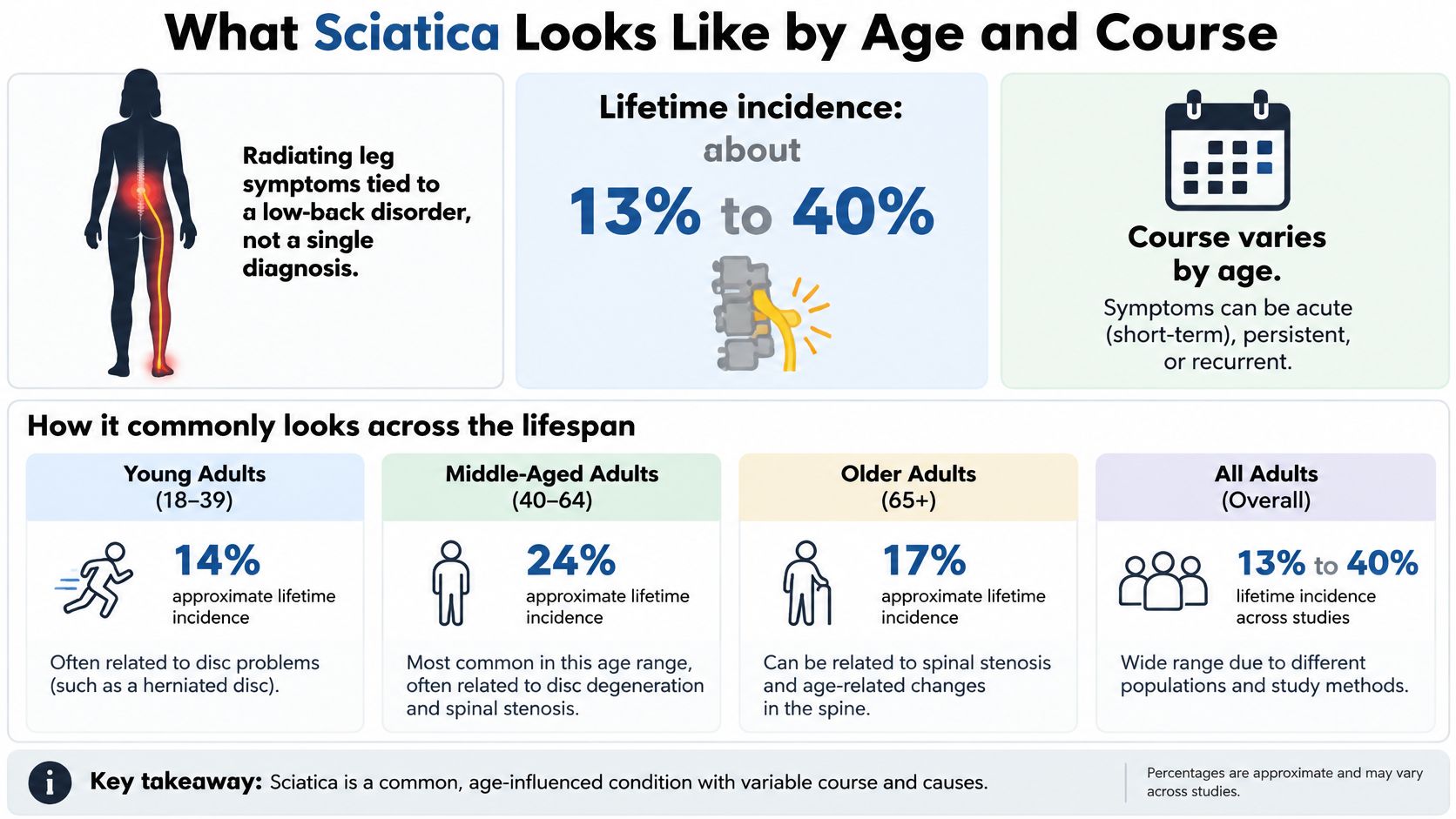
Sciatica isn't limited to older adults. The NICE evidence review reports a lifetime incidence of approximately 13% to 40% and an annual episode incidence of 1% to 5%; it also describes sciatica as rare before age 20, most common during the fifth decade of life, and less common thereafter.
Those figures describe how often sciatica occurs, not how often a particular treatment succeeds. They help explain why working-age adults seek care, but they can't tell you whether an adjustment, exercise program, or medical referral fits your symptoms.
A symptom pattern, not a complete diagnosis
Sciatica generally means radiating leg symptoms associated with a low-back disorder. The term doesn't identify the exact cause or tell the clinician how severely nerve function is affected.
The visual below summarizes the age pattern and the importance of assessing the course of symptoms.
Consider a hypothetical middle-aged driver whose leg pain flares after a long trip. During an examination, the clinician would check how sitting, standing, and movement affect symptoms, alongside strength and sensation. Pain after driving alone doesn't establish the cause or prove that manipulation is appropriate.
Now consider someone whose pain feels unchanged, but whose walking distance keeps shrinking. That person may describe the problem as stable because the pain score hasn't risen. Declining function still changes the assessment.
Describe the course before choosing a technique
Bring a description that covers more than where it hurts:
- Triggers: Explain whether sitting, walking, bending, or standing changes the leg symptoms.
- Function: Describe activities you've stopped or shortened.
- Nerve-related changes: Report numbness, altered sensation, or a leg that feels weaker.
- Direction of change: Say whether your overall ability is improving, unchanged, or deteriorating.
Questions about how long sciatica pain lasts are understandable, but duration alone doesn't determine the next step. A clinical examination comes before selecting exercise, manual treatment, spinal manipulation, or referral.
Common symptoms can still require prompt attention. Your age provides context; a changing neurological picture determines urgency.
Where Exercise and Manipulation Sit in Guidelines
Exercise leads the conservative-care package; manual therapy has a supporting role. That's different from saying every patient needs the same exercises or that hands-on treatment has no place.
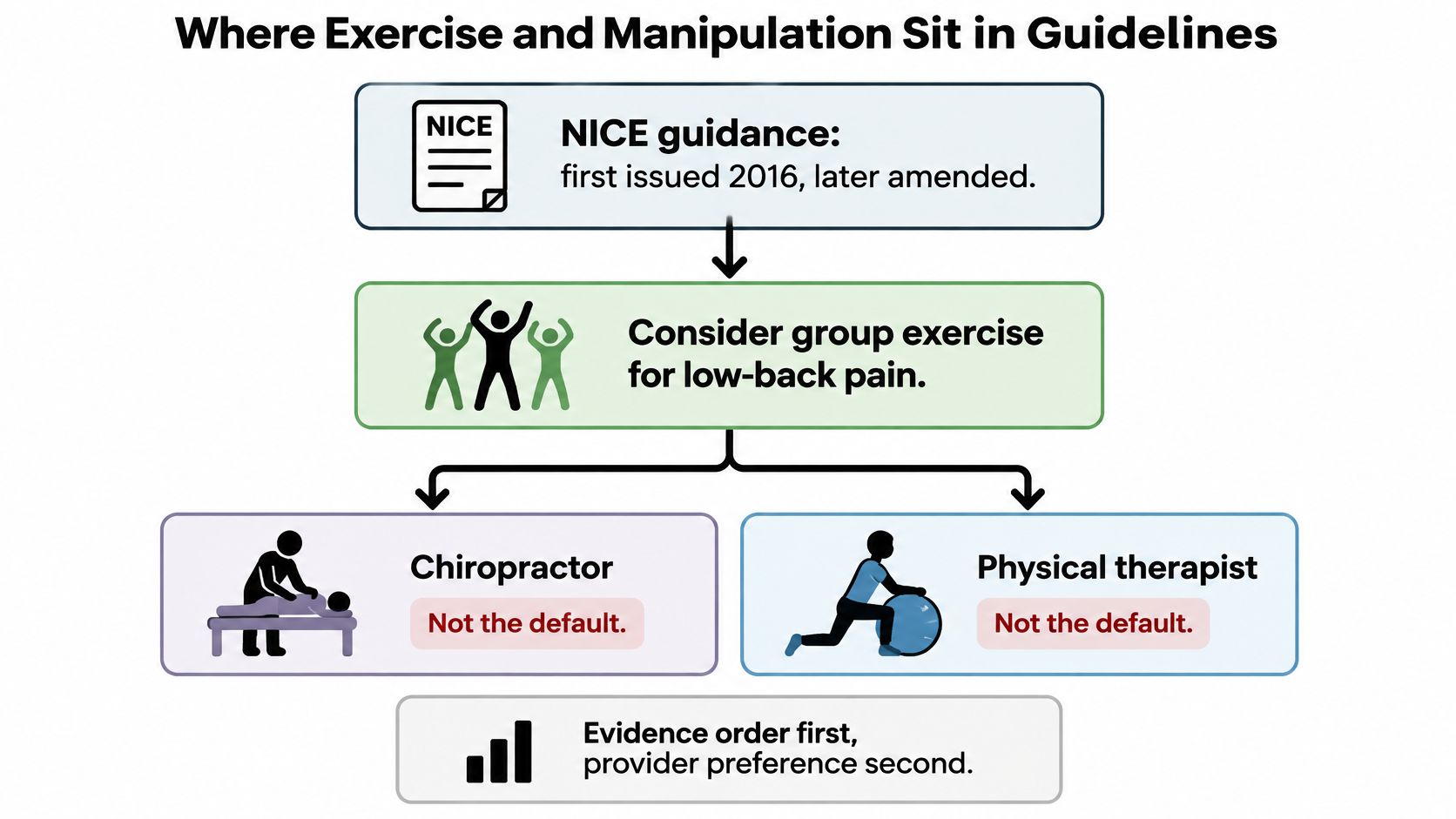
NICE guidance, first issued in 2016 and subsequently amended, recommends considering group exercise for low-back pain with or without sciatica, adapted to the person's needs, preferences, and capabilities. It permits manual therapy, including manipulation, mobilization, and soft-tissue techniques, only within an exercise-inclusive package.
Manual care is an adjunct to active rehabilitation, not a substitute for it.
This distinction prevents a common misunderstanding. An adjustment isn't automatically inappropriate because someone has leg pain, and exercise isn't automatically appropriate because it's active. The clinician still needs to select the method, starting dose, and progression according to the examination.
The hierarchy below puts treatment content ahead of provider preference.
What an active treatment package looks like
An exercise-based plan doesn't have to start with heavy lifting or strenuous stretching. For an irritable leg, the starting point may be comfortable movement, manageable walking, and a carefully selected exercise that doesn't provoke a sustained flare.
A useful package includes:
- Education: Clear instructions about activity, symptom monitoring, and when to seek help.
- Individualized movement: Exercises selected for your examination findings rather than a generic back-pain sheet.
- Progression: A way to increase walking, strength, or task tolerance as your response allows.
- Optional manual treatment: Hands-on care with a defined purpose, such as making a specific movement more comfortable.
- Reassessment: Repeat checks that show whether the approach is helping.
The exercise component should be usable at home. You should understand the movement, the intended response, and what to do if leg symptoms worsen afterward.
Judge the package, not the doorway
A physical therapist may use manual techniques. A chiropractor may prescribe therapeutic exercise and guide activity progression. The overlap means that the sign outside the clinic tells you less than the actual treatment plan.
Say mobilization makes it easier to stand upright. The next useful question is whether you can use that improvement to walk comfortably or practice an appropriate strengthening task. Repeating mobilization without testing that transfer leaves an important part of recovery unaddressed.
A coordinated plan can therefore make sense when the clinicians share findings and work toward the same functional goals. A manipulation-only plan doesn't provide the exercise-inclusive approach described in the guidance.
Red Flags That Change the Choice
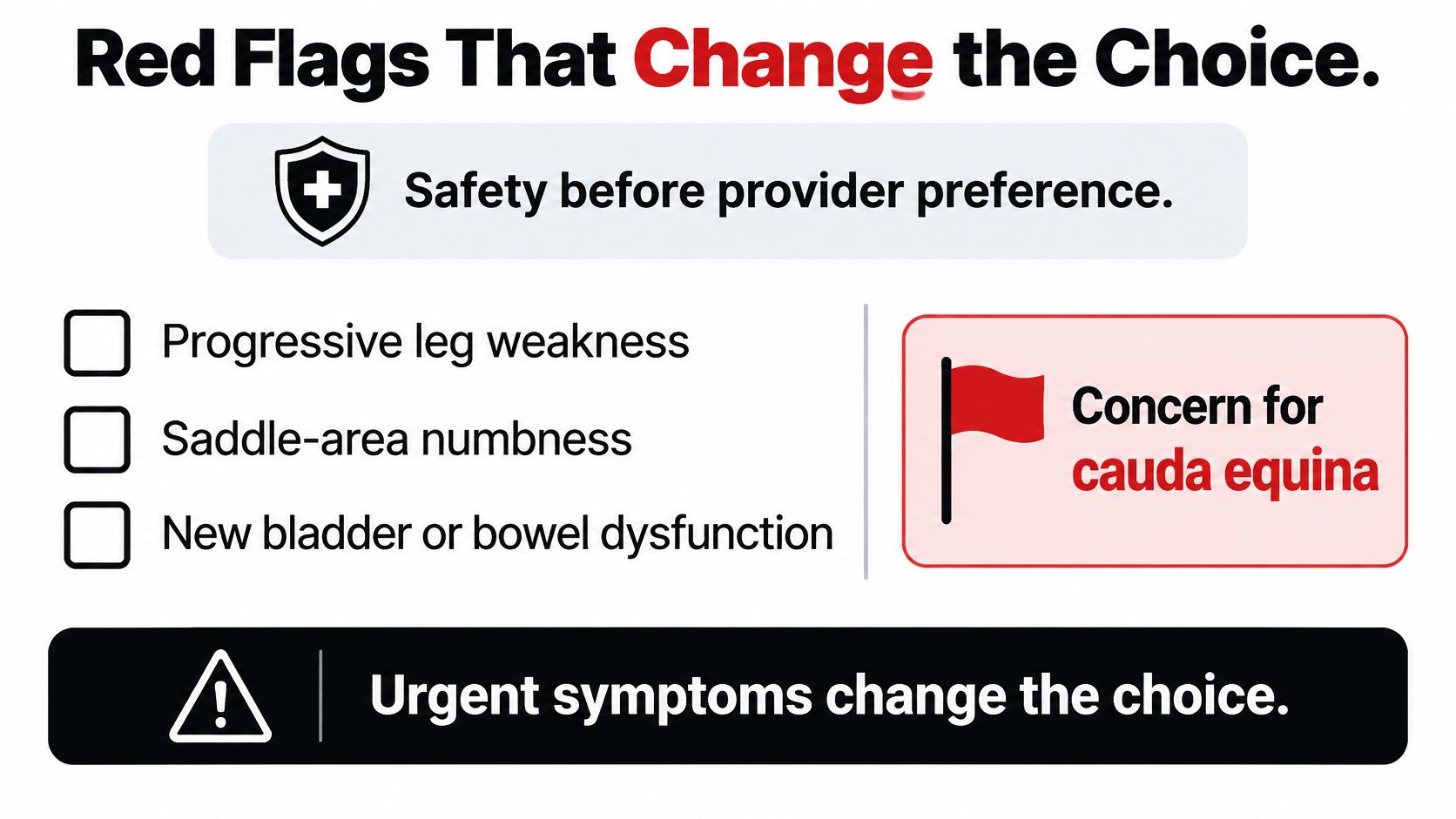
Progressive leg weakness, saddle-area numbness, and new bladder or bowel dysfunction require urgent medical evaluation. These symptoms can raise concern for serious nerve compression, including cauda equina syndrome, and shouldn't wait for a routine adjustment or exercise appointment.
Saddle-area numbness means altered feeling around the groin, inner thighs, buttocks, or the area that would contact a saddle. Don't dismiss it because back pain seems manageable.
Use this checklist to recognize symptoms that change the next step.
When medical assessment comes first
Recent significant trauma, rapidly declining function, or a history raising concern for cancer or infection also warrants medical assessment before routine treatment. Older adults should mention falls, relevant illnesses, and changes in their ability to walk or manage daily tasks.
Confirmed lumbosacral radicular syndrome, a nerve-root-related condition, deserves particular caution. A multidisciplinary physical therapy guideline found insufficient reliable evidence to recommend mobilization or manipulation routinely for this syndrome and noted a greater chance of adverse effects, including substantial pain increases and motor deficits, than in nonspecific low-back pain.
That isn't a blanket ban on every manual technique. It means the decision requires an examination, clinical expertise, and attention to the person's response, not an automatic recommendation to adjust the spine.
Establish a baseline before treatment
A safe outpatient plan should record:
- Leg-pain intensity: Include where symptoms travel, not just how much the back hurts.
- Disability and walking tolerance: The Oswestry Disability Index can complement a concrete walking goal.
- Strength and sensation: Document findings so later changes aren't judged from memory.
- Straight-leg-raise response: Use the clinician's examination to track nerve-related symptom sensitivity.
Joint-mobility work may have a role alongside exercise. An observational analysis summarized in the guideline associated meaningful physical-health improvement with mobility interventions, odds ratio 2.5, 95% confidence interval 1.5 to 4.4, and general exercise, odds ratio 1.5, 95% confidence interval 1.2 to 2.0. These associations don't prove that manipulation is safe for every nerve-root problem.
If you're wondering whether a disc could be involved, our explanation of possible herniated-disc symptoms provides background, not a substitute for examination.
The accompanying video offers another way to review the topic.
Seek emergency care now for new bladder or bowel dysfunction or saddle numbness, and urgent assessment for progressive weakness. Without urgent features, an outpatient route can be considered after screening.
Situations That Point to One Lead Clinician
The lead clinician should match the task that currently limits your recovery. Someone who can't tolerate a workday needs a different emphasis from someone whose screened stiffness improves with gentle mobilization.
These are starting points after assessment, not self-diagnoses or promises that a particular method will work.
Who should lead by sciatica situation
| Situation | Start here | Why this lead |
|---|---|---|
| Progressive weakness, saddle numbness, or new bladder or bowel change | Urgent medical evaluation | Possible serious nerve compression, not a routine clinic choice |
| Early irritable leg pain, no red flags, position-related | Either, with exercise included from the start | Manual care is optional inside an active plan |
| Relief after hands-on care that fades with walking or sitting | Physical therapist, manual care as an add-on | Function and load tolerance are the limit |
| Screened mechanical stiffness that eases with mobilization | Chiropractor plus an exercise plan started promptly | Manual care can facilitate movement if exercise isn't dropped |
| Chronic symptoms after a single-method plan | Coordinated chiropractic care and physical therapy | Reassess the missing component rather than repeat an unsuccessful approach |
| Strength loss or recovery after spine surgery | Medical assessment as needed, then physical therapy | Neurological tracking and progressive rehabilitation lead; postoperative restrictions apply |
| Auto or work injury limiting job tasks | A clinician who measures work function from the outset | The plan must track walking, strength, and duty tolerance |
The situation selects the lead; it doesn't necessarily exclude the other profession.
When temporary relief isn't enough
Consider a desk worker who feels better after hands-on treatment but develops the same leg symptoms when sitting through meetings. The next task isn't just to reproduce the post-treatment relief. It's to assess sitting tolerance, movement options, work breaks, and the person's capacity to manage the required activity.
Physical therapy can lead that progression while manual care remains available if it makes the active work tolerable. The important distinction is relief that enables practice, rather than relief followed by the same unmanageable day.
A person with screened stiffness and a clear response to mobilization may reasonably begin with a chiropractor. The active component should still be specific: comfortable walking, an appropriate strengthening movement, and instructions for monitoring symptoms.
When a stalled plan needs a fresh examination
Persistent symptoms after repeated adjustments don't automatically mean the person needs more forceful treatment. Likewise, an unsuccessful generic exercise sheet doesn't establish that exercise has failed.
A fresh examination may reveal that the exercise was too provocative, the starting load was inappropriate, the home instructions were unclear, or a medical review is needed. Coordination is useful when clinicians identify a missing element and agree on who will track it.
After spine surgery, rehabilitation must respect the surgeon's restrictions and the procedure performed. In auto-injury or workers' compensation care, the same practical discipline applies: record the actual work demands, including lifting, standing, driving, and walking, rather than relying only on a general pain score.
Choose a lead, not a silo: Someone should own the progression and reassessment, even when more than one clinician contributes.
Checkpoints That Show the Plan Is Working
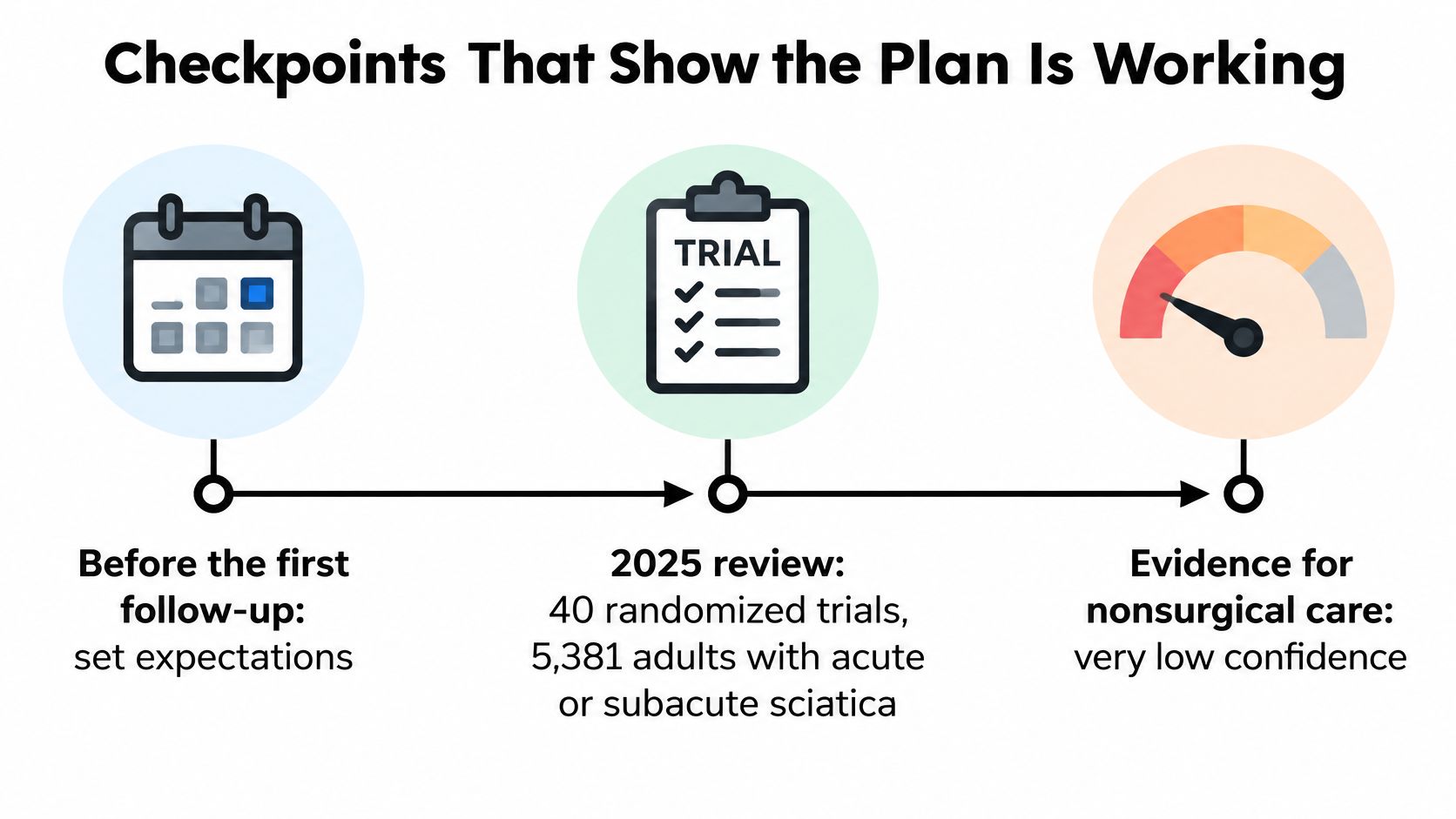
Uncertainty about treatment makes planned reassessment more important, not less. A 2025 review of 40 randomized trials involving 5,381 adults with acute or subacute sciatica rated confidence in nonsurgical-treatment evidence as very low because of bias and imprecision.
That review didn't establish a durable, universal winner between chiropractic care and physical therapy. Results changed with the intervention, follow-up period, and outcome measured, so a guaranteed recovery timetable would overstate what the evidence supports.
The timeline below emphasizes setting expectations before judging results.
At an early follow-up
Compare your current ability with the baseline, using the same activities and measures. Don't rely only on whether you felt relaxed or less sore when leaving the last appointment.
- Leg symptoms: Are they less intense, less frequent, or interfering with fewer activities?
- Walking: Can you cover more ground comfortably without sacrificing the rest of the day?
- Sleep and work: Are symptoms interrupting fewer necessary activities?
- Strength and sensation: Are examination findings stable or improving?
A meaningful early gain might be completing a usual household task with fewer stops. It doesn't have to mean the complete disappearance of pain.
When improvement is incomplete or absent
Less pain with declining strength isn't a reassuring result. Neither is a lower pain score achieved only by avoiding more and more activity.
If symptoms and function remain unchanged despite an exercise-inclusive plan, the clinician should reassess the working explanation, exercise selection, loading, and need for medical review. A change in lead clinician can be useful when the current approach isn't addressing the main limitation.
The plan should improve daily function while preserving or improving nerve status, not merely produce post-visit comfort.
NICE's assessment and management guidance reinforces urgent referral for progressive neurological deficits or suspected cauda equina syndrome. Those changes override any scheduled follow-up.
For an additional patient-facing overview of conservative options, the Arizona Valley Acupuncture sciatica guide can help you prepare questions about nonsurgical care. Treat it as background reading, not evidence that a particular treatment will suit your examination.
“Physical therapy” and “chiropractic care” can each describe a package of education, exercise, and manual techniques. Name the actual package when reviewing progress. Otherwise, it's difficult to distinguish an unsuitable method from an unsuitable dose, poor instructions, or a condition requiring a different level of care.
Book Screened Care in Deerfield Beach
If you're in Deerfield Beach or a nearby community and don't have urgent warning signs, start with an assessment rather than committing yourself to a long sequence of one technique. The useful outcome of that visit is a clear explanation of your findings, a lead clinician, and a practical next step.
At MedAmerica Rehab Center, we offer physical therapy and chiropractic care aimed at relieving pain, restoring mobility, and improving quality of life without surgery or unnecessary medication. Depending on the service and examination, a visit can include manual therapy, strengthening exercises, hot or cold packs, electrical stimulation, stretching, and an adjustment when appropriate.
Prepare for the evaluation
Our chiropractic initial evaluations are usually 30 minutes. Physical therapy initial evaluations typically last 60 to 75 minutes, allowing time for assessment and planning.
Bring a short written account of what's happening:
- Your leg symptoms: Note their location, intensity, and common triggers.
- Your walking limit: Describe a familiar route or task you can compare later.
- Strength or sensation changes: Explain what feels different and whether it's changing.
- Relevant history: Include injuries, surgery, current restrictions, and treatments already tried.
- Urgent symptoms: Disclose any bladder, bowel, or saddle-area changes immediately.
A concise note is more useful than trying to remember every symptom while you're uncomfortable. Bring any relevant postoperative instructions or existing reports, too, so the examination can account for them.
Leave with a usable next step
Before leaving, you should understand which clinician is leading, what activity to begin at home, and how your response will be reviewed. The plan should identify a functional target, such as sitting through a necessary task or walking a familiar route more comfortably.
Booking and clinical triage are separate jobs. Chimehill's overview of an AI receptionist for clinics provides context on administrative call handling, but a scheduling tool isn't a substitute for a clinician's assessment, and this isn't a statement that our clinic uses that service.
If weakness is progressing or bladder, bowel, or saddle symptoms are new, skip routine booking and seek urgent medical care. Otherwise, a screened first visit can replace guesswork with an active, measurable rehabilitation plan.
MedAmerica Rehab Center offers physical therapy and chiropractic care for sciatica, with treatment selected around your examination and functional needs. Visit MedAmerica Rehab Center to arrange an evaluation in Deerfield Beach and discuss a plan that combines appropriate hands-on care with active rehabilitation.
MedAmerica Rehab · Deerfield Beach
Talk to a clinician about your pain
Physical therapy, chiropractic, acupuncture and shockwave therapy under one roof, since 1995. Same-day appointments are available.
Mon–Thu 8:00 AM – 6:30 PM · Fri 8:00 AM – 3:00 PM