

Timed Up and Go Test: How to Run It and Read Results
A stopwatch clicks, your father pushes himself up out of the chair, walks to the strip of tape on the floor, turns, and sits back down. The therapist writes a number on the sheet. Fourteen seconds. Now the whole family wants to know whether that's bad.
That number comes from the Timed Up and Go (TUG) test, a mobility screen you'll meet in hospitals, skilled nursing facilities, outpatient clinics, and increasingly on phone apps. It takes under two minutes and needs nothing more than a chair and a stopwatch. It also gets quoted as if it were a verdict, which is where the confusion starts.
What the score can do is flag someone who deserves a closer look at strength, balance, medications, vision, and home hazards. What it can't do is predict a fall, name the cause of a slow walk, or tell you on its own whether a change between visits is real. Both limits are measurable, and knowing them changes how you read the next score you're handed.
What the Timed Up and Go Test Measures
Standing from a chair, walking a short distance, turning, and sitting again combines several everyday movements in one task. The Timed Up and Go (TUG) test puts a stopwatch on that sequence, giving a brief measure of functional mobility.
The person starts seated, stands, walks 3 meters (about 10 feet), turns, walks back, and sits down. A clinician records the time in seconds. The test was introduced in 1991 by Podsiadlo and Richardson as a practical modification of the older Get-Up-and-Go test, and was studied in frail older adults, as described in the original journal report. The report found the test reliable across different raters and repeated assessments by the same rater. It has since been used in rehabilitation, geriatric, neurological, and orthopedic settings.
One time combines four parts of movement: standing up, walking, turning, and sitting down. That makes the TUG useful as a quick overview, but the total does not show which part took the longest. The score also tracks closely with established measures of balance and daily function, so it can add context when considered alongside other assessments.
A lower time generally goes with better balance, faster walking, and greater independence. This relationship can seem counterintuitive: time and function move in opposite directions, so a shorter time corresponds to stronger performance. The number describes how long the sequence took, not why it took that long.
The TUG is a brief functional-mobility measure, not a laboratory gait analysis. It cannot isolate whether a person slowed while rising, walking, turning, or sitting, and it does not identify the cause. A cutoff can prompt a broader assessment, but it is not a verdict about someone's ability or future falls. A clinician can interpret the time alongside what they observe during the task and other information about the person.
How to Run the Timed Up and Go Test Step by Step
A result is only worth comparing to another result if both were produced the same way. That is the whole discipline of the test, and getting it right costs nothing.
The setup that makes results comparable
| Element | Standard setup | What to record |
|---|---|---|
| Chart | Armchair with armrests, seat about 46 cm (18 in) high | Chair type and whether armrests were used |
| Walkway | Straight path marked at 3 m (10 ft) with a turn point | Path length and surface |
| Footwear | The person's usual shoes | Shoe type, since footwear changes speed |
| Assistive device | Whatever the person uses daily, or none | Device type and whether it was used |
| Instructions | The same spoken words on every trial | Wording used and any demonstration |
| Timing | Starts on the word go, stops when seated | Time in seconds and number of trials |
The elements are simple, and every one of them changes the score if you let it drift. Here is the same procedure laid out as a process you can follow at the chair.
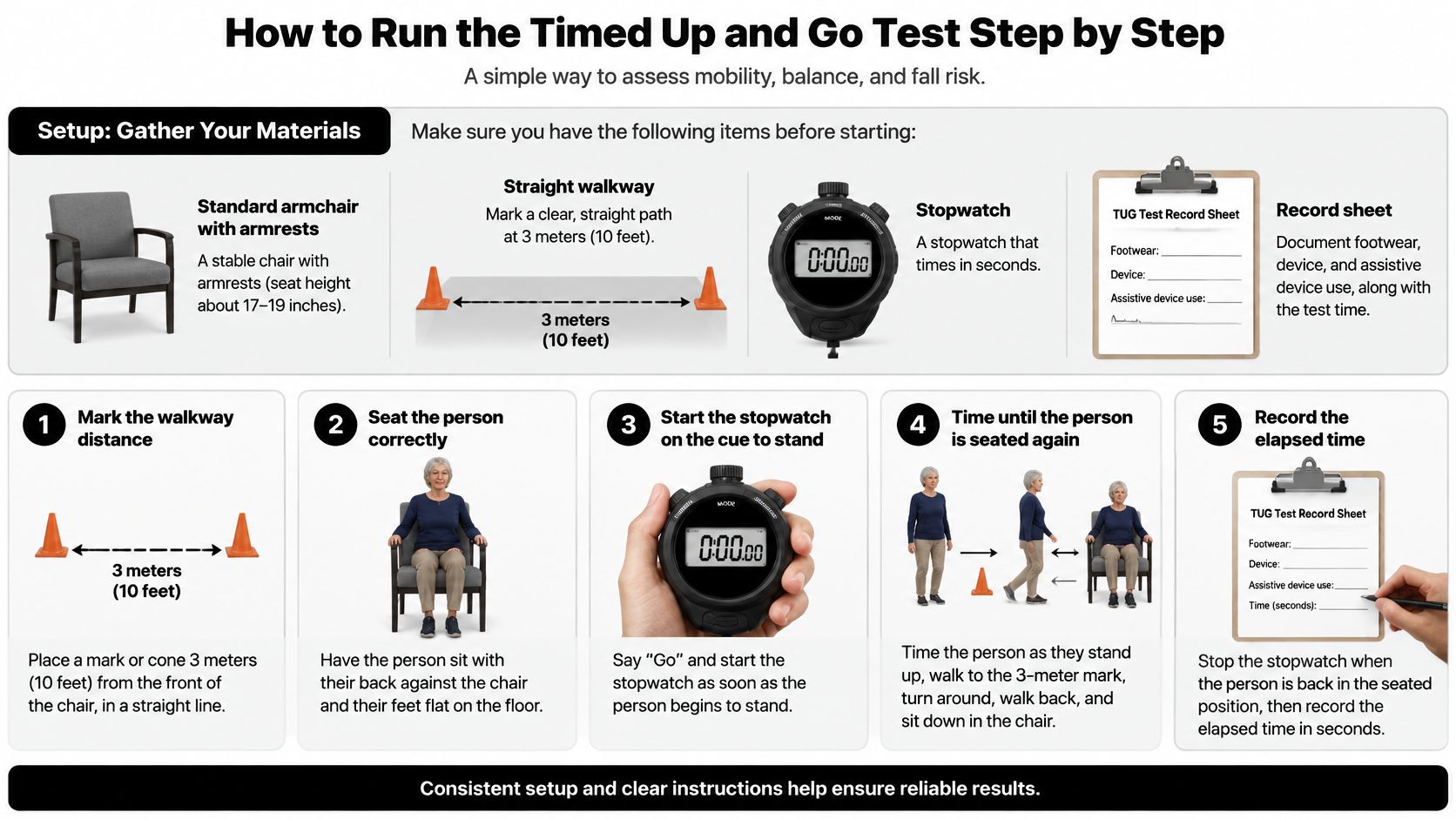
1. Seat the person the same way every time. Back against the backrest, feet flat, hands resting on the armrests. Someone perched on the front edge of the seat has already started the movement before the timer runs, which is the most common way a first score flatters a later one.
2. Write down the equipment before anyone moves. Chair type, footwear, and whether a cane or walker was within reach. A time recorded in slippers can't be compared with a time recorded in walking shoes.
3. Give the instruction once, in the same words. "When I say go, stand up, walk to the line at your normal pace, turn around, walk back, and sit down." Say it identically on every visit. Paraphrasing changes the pace people choose, and pace is most of the score.
4. Say go and start the timer on the same syllable. The start is where stopwatch error creeps in. Beginning half a second late turns a stable 13-second walker into a 12.5-second one on paper.
5. Watch the turn, don't just time it. The turn is where people shuffle, reach for a wall, or take four small steps where one pivot would do. Note which strategy they used, because that detail is what makes the number useful.
6. Stop the timer when the person is seated. Buttocks on the seat, not on the armrests, not when they lean back. Judgment at the end is the second source of noise, and it compounds with an early or late start.
7. Record the time and repeat only if your protocol calls for repeats. One practice trial followed by one or two timed trials is a common convention. Whatever you choose, keep it identical at reassessment.
A fast-walk version, where you ask the person to move as quickly as they safely can, is a separate protocol. Label it as such, because a fast-walk time can't be read against a comfortable-pace benchmark.
A clean run looks unhurried. The person rises smoothly, without shoving off the armrests unless that's their usual method, walks at a steady pace to the mark, turns without reaching for support, and lowers themselves into the chair instead of dropping. Nothing about that sequence is dramatic. It's supposed to look like getting up at home.
Score Cutoffs and Reference Thresholds Compared
A cutoff means nothing without the protocol that produced it. Use this table as a lookup, matching the threshold to the way the test was run.
| Threshold | Source or protocol | Walking condition | What it signals |
|---|---|---|---|
| 12 seconds or longer | CDC STEADI program | Standard 3 m walk at usual pace | Increased fall risk; start a broader assessment |
| 13.5 seconds | Cutoff most often quoted in patient handouts | Comfortable pace | A screening benchmark, not a diagnosis |
| 10 to 32.6 seconds | Systematic review of published cutoff values | Mixed protocols | Thresholds aren't interchangeable across studies |
| Fast-walk protocol | Separate version, person asked to walk quickly | Fast pace | Only comparable to other fast-walk results |
| Dual-task version | Walking while counting backward or carrying an object | Added mental or manual task | Times shift; compare only to the same dual-task setup |
Start with the number most clinicians reach for. The U.S. CDC STEADI program uses a threshold of 12 seconds or longer to identify increased fall risk in older adults, according to its TUG assessment form. The same form explains why that flag shouldn't be read as a diagnosis: performance is influenced by lower-extremity strength, balance, gait speed, pain, cognition, assistive-device use, and the test environment.
The 13.5-second figure gets quoted just as often, usually in handouts and family conversations. A systematic review of published cutoff values found thresholds ranging from 10 to 32.6 seconds across studies, which is a wide enough spread to make the point on its own. Different populations, different instructions, and different equipment produce different cutoffs, so borrowing one from a study of people who aren't like the person in your chair leads you somewhere unhelpful.
Why the spread? Pace instructions do most of the work: asking someone to walk quickly shaves seconds off, and counting backward while walking adds them back. Population matters too, since a stroke survivor and a healthy 70-year-old aren't being measured against the same baseline.
Say a 78-year-old walks at a comfortable pace and finishes in 14 seconds. That's above the CDC STEADI flag and above the handout figure, and it sits comfortably inside a published range that reaches into the thirties. None of those facts tell you why the walk took 14 seconds. What the number earns is a review: chair rise without armrests, gait observation, a medication list, vision, footwear, pain, and the path from bed to bathroom at night.
Practical rule: a score at or above a cutoff buys an assessment, not a label. Never let a single threshold end the conversation.
Why a Slow Score Does Not Predict a Fall
You know how a smoke alarm goes off when you burn toast? It's working exactly as designed. It tells you to check the kitchen. It doesn't tell you a fire is on the way.
A TUG threshold behaves the same way. At the widely used 13.5-second mark, a 2014 systematic review and meta-analysis of community-dwelling older adults found the test did a fair job of identifying some higher-risk people and a better job of clearing lower-risk ones. Pooled sensitivity was 0.31 (95% CI 0.13 to 0.57), meaning the threshold caught only about a third of the people at higher risk. Pooled specificity was 0.74 (95% CI 0.52 to 0.88), so roughly three in four lower-risk people were correctly left alone.
That imbalance is the part families never hear. A test with low sensitivity is a rule-in tool at best. A time under the cutoff is reassuring, not a guarantee, and a time over it is a prompt to investigate rather than an announcement that a fall is coming.

The same review found only a borderline statistical link between TUG time and falls, with an odds ratio of 1.01 (95% CI 1.00 to 1.02, p = 0.05). One extra second of walking time barely shifts the odds by itself. The authors' conclusion was direct: the TUG should not be used in isolation to identify fall risk among independently living older adults.
What to do with a slow result
Treat the number as the start of a checklist rather than the end of one. Each item below changes what a person's next six months look like, and none of them show up in a stopwatch reading.
- Leg strength: can they stand from a firm chair without pushing off the armrests?
- Balance and turning: do they steady themselves at the turn, or reach for a wall?
- Gait: is the walk symmetrical, or does one side lag?
- Medications: anything sedating, blood-pressure lowering, or recently changed?
- Vision and footwear: when were the glasses checked, and what's on their feet?
- Cognition: can they walk and talk at the same time without stopping?
- Home and history: rugs, stairs, night lighting, and how many near-falls in the past year?
Gait speed is one of the pieces worth adding, because a gait speed and fall risk measure captures walking on its own, without the chair and turn folded in. For a broader look at how these pieces fit together into a full review, Velma's guide to fall risk assessment covers the ground beyond the stopwatch.
Before anyone draws a conclusion, recheck the test under the same conditions. A second reading on the same chair, with the same instructions and the same shoes, tells you more than a comparison against a stranger's average.
Telling a Real Change From Normal Variation
A stopwatch shows whole seconds, while a busy appointment may leave time for only one trial. Together, those conditions can make a small difference look like progress when it may reflect ordinary variation.
The test can be repeatable when it is performed consistently. Among hospitalized patients recovering from stroke, reported inter-rater intraclass correlation coefficients were 0.97 and 0.99. Standard errors of measurement across studies were about 1.14, 1.34, and 2.83 seconds, according to a review of TUG measurement properties. For patients having or recovering from lumbar-spine surgery, ICC values were about 0.95 to 0.97, and studies reported minimum clinically important differences ranging from 0.9 to 3.4 seconds.
| Population | Reliability (ICC) | Measurement error (SEM) | Meaningful change |
|---|---|---|---|
| Stroke inpatients | 0.97 and 0.99 inter-rater | About 1.14 to 2.83 seconds across studies | About 18.7% for group change, about 26.5% for an individual |
| Lumbar-spine surgery patients | About 0.95 to 0.97 | Not calculated for this population | Minimum clinically important difference of 0.9 to 3.4 seconds across studies |
Working out your own change threshold
One estimate suggests that change needs to reach about 18.7% to represent a real difference at the group level, and about 26.5% for an individual. For tracking one person between visits, the individual threshold is the more relevant guide.
For a baseline of 14.0 seconds, a 26.5% change is about 3.7 seconds. The time would need to fall to roughly 10.3 seconds or lower to exceed that threshold. A result of 12.5 seconds remains within the range where measurement error could explain the difference. The person might have had a better day, worn lighter shoes, or started the timer a little sooner. A result near 10.3 seconds suggests a more substantial change and gives you a reason to discuss what may have contributed.
Two readings from the same person on the same chair beat one reading compared to a population average. A trend under identical conditions is the fairest comparison.
To make that comparison more useful, take two baseline trials to establish the person's ordinary range. Retest at a similar time of day, using the same chair, device, and footwear. Record the diagnosis and starting speed, since someone starting at 30 seconds has more room to improve than someone starting at 11. Consider the time alongside what happened during the test: turning stability, control when standing, breathlessness, pain, and any near-falls since the last visit.
If rising from the chair looks difficult, the 30-second chair stand test can assess that part separately by counting repetitions. That added detail can help distinguish difficulty with chair rises from the turning and walking components included in the TUG.
Testing at Home and Trusting a Phone Result
A phone can measure the test accurately and still give an incomplete picture. Both things are true at once, and holding them together is what makes home testing useful instead of misleading.
The accuracy part is real. A 2025 study of a pocket-worn smartphone app reported excellent concurrent validity for measuring five TUG repetitions compared with a lower-back sensor system, as published in this paper on smartphone-based TUG measurement. The catch sits in who was measured: participants were predominantly White and relatively fit, and their average single repetition took 9.7 seconds, a pace typical of independent adults rather than the people most likely to be screened. How confidently those results transfer to someone with substantial disability or a more diverse background is an open question.
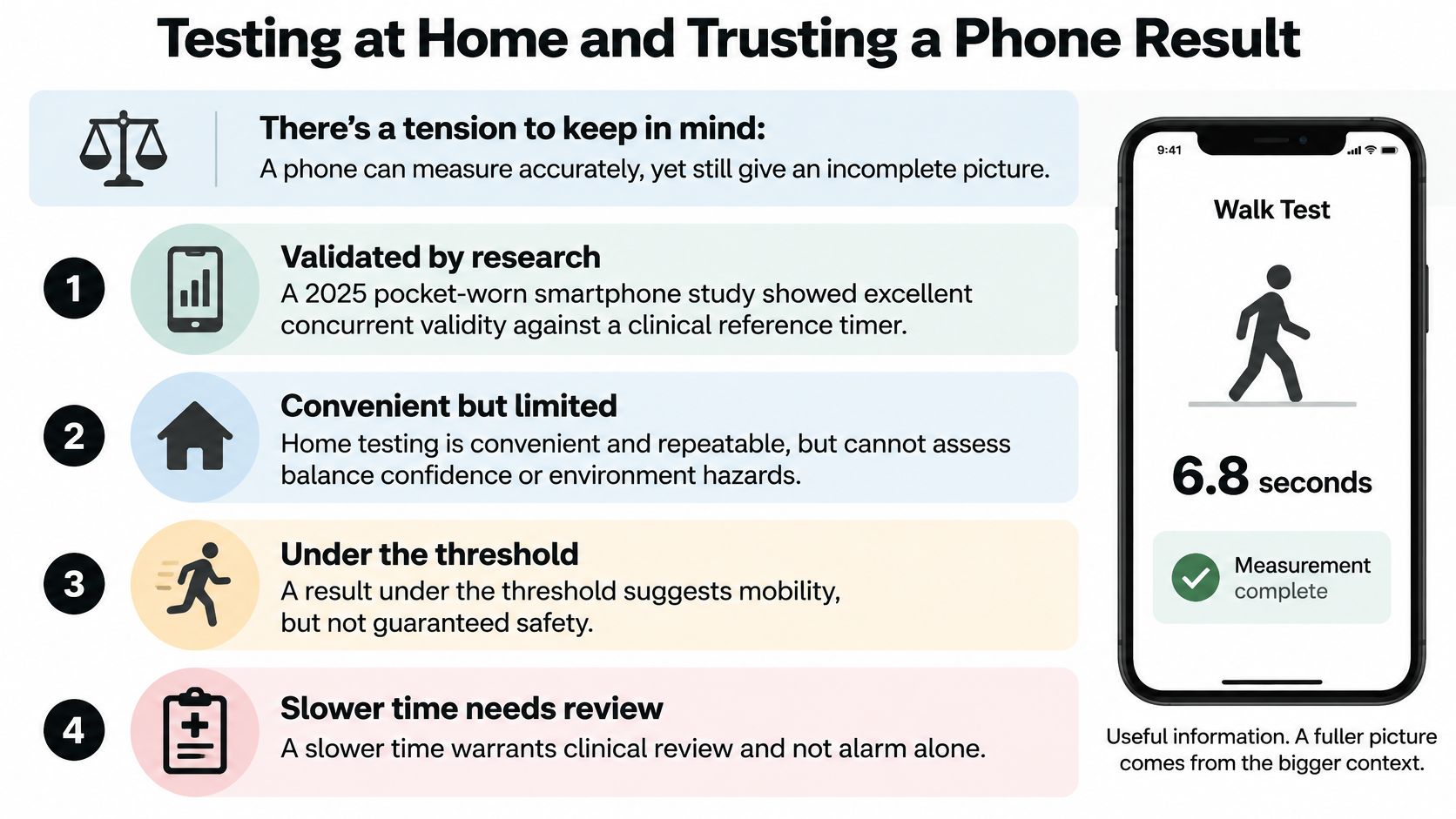
The incompleteness part comes from everything the sensor can't see. Phone or camera placement, chair height, walking surface, footwear, turning space, and fear of falling all move the number. So does repetition count: one pass and five passes are different tests. Instrumented TUG research also varies widely in equipment, sensor placement, protocols, and the parameters measured, which limits how well any single set of home reference values applies across clinical populations.
A home protocol worth repeating
- Don't test alone if you feel unsteady. Have someone in the room, close enough to step in.
- Use a sturdy chair with a back, on a clear stretch of floor, with space to turn at the far end.
- Mark the path and keep it marked. The same distance every time is what makes the comparison fair.
- Fix the phone position and write it down. Height, distance, and angle, so next month's test matches this one.
- Pick one repetition count and stay with it. One pass or five, the trend only works if the protocol doesn't change.
Track your own trend rather than matching a single raw score to a cutoff you found online. A slow week after a bad night's sleep is not the same signal as a slow month that keeps getting slower.
Home results support an in-person balance and gait evaluation. They don't replace it, because no phone can watch how you turn.
Confirm the Next Step With a Clinician
Reading the number well comes down to three actions, and none of them require a referral before you start.
Bring the record, not just the number. Write down the setup from the step-by-step procedure: chair type, walkway length, footwear, whether a cane or walker was used, the instruction you gave, and every trial time in seconds. Add any symptoms, dizziness, or near-falls from the same week. A clinician can work with a full page. A single figure scribbled on a referral slip forces guesswork.
Ask for the score to be read alongside something else. Balance, gait observation, leg strength, a medication review, vision, and fall history together say far more than a stopwatch alone. This is the difference between a screening result and an assessment, and it's the reason a slow time should never be delivered as a prediction.
Book an in-person evaluation. MedAmerica Rehab Center runs gait and balance evaluations that include the Timed Up and Go as one part of the picture rather than the whole of it. If you call, expect a callback to confirm a time, and you can also use the Schedule an Appointment page on the website. The first visit typically runs 60 to 75 minutes, and after that evaluation the team may be able to estimate how many sessions you'll need. Ask how they plan to repeat the test under identical conditions, so progress is measured against your own baseline instead of a number from a textbook.
A practical decision rule: if the time sits above a cutoff from the table, or has changed by more than about 26.5% for an individual, book the evaluation. If it's inside normal variation, repeat it under the same setup before drawing any conclusion. For a wider view of how mobility, cognition, and medication review fit together in one assessment, this practical guide to assessing frailty is a useful companion read, and our own fall risk assessment service page explains what a full review involves.
At MedAmerica Rehab Center in Deerfield Beach, the Timed Up and Go is one piece of a hands-on gait and balance evaluation, never a standalone verdict. Our physical therapists measure how you stand, walk, and turn, then build a plan around what's limiting you, whether that's strength, balance, pain, or confidence on uneven ground. Visit MedAmerica Rehab Center to schedule an appointment and get a baseline worth measuring against.
MedAmerica Rehab · Deerfield Beach
Talk to a clinician about your pain
Physical therapy, chiropractic, acupuncture and shockwave therapy under one roof, since 1995. Same-day appointments are available.
Mon–Thu 8:00 AM – 6:30 PM · Fri 8:00 AM – 3:00 PM