
Gait Speed and Fall Risk: What Your Walking Pace Reveals
Walking below 0.8 metres per second was associated with a 54% higher fall rate in an individual-participant-data meta-analysis published by the British Geriatrics Society. That doesn't mean a slower walker has a fixed probability of falling. It means an ordinary activity, walking at your usual pace, can reveal a reason to investigate mobility before an injury occurs.
The relationship between gait speed and fall risk is more useful when you think in bands and trends rather than passing and failing. Your walking speed helps determine what to assess next. How you turn, whether you've stumbled, and whether your pace is changing help determine what that number means for you.
Walking Speed Thresholds at a Glance
1.0 m/s, 0.8 m/s and 0.70 m/s are useful reference points, but they aren't interchangeable boundaries between safe and unsafe walking. Usual gait speed means the distance you walk, measured in metres, divided by the time taken in seconds. The instruction is to walk normally, not demonstrate your fastest possible pace.
The meta-analysis described above combined prospective evidence from community and clinical populations. It distinguished the risk of experiencing a fall from the fall rate, which also reflects repeated falls. Those measures answer different questions: whether someone falls at all, and how frequently falls occur.
Gait speed bands, fall-risk evidence and next steps
| Measured value | What the research shows | Suggested next step |
|---|---|---|
| 1.0 m/s or faster | Above the broader screening threshold, but not proof of safe turning or balance | Keep monitoring at routine check-ups |
| Below 1.0 m/s | A broader screen that identifies more potentially vulnerable adults than the stricter threshold | Ask for a broader fall-risk review |
| Below 0.8 m/s | Associated with greater fall risk and a higher fall rate | Arrange balance, strength and medication review |
| 0.70 m/s or slower | A warning band associated with substantially higher risk than faster walking | Book a balance or mobility evaluation soon |
| More than 13 seconds for 10 m | A timed-walk finding associated with recurrent falls | Arrange a full mobility evaluation |
Why broader screening catches more people
A stricter threshold concentrates attention on slower walkers. A broader threshold invites assessment before someone reaches that slower band. Neither approach identifies every person who will fall.
The distinction matters because screening is a decision about who needs a closer look, not a diagnosis of who will suffer an injury. Someone flagged by a broader screen may have treatable pain, reduced confidence or a balance problem worth addressing even if they never fall.
The table's actions are practical prompts, not universal treatment prescriptions. A medication review, for example, means discussing possible contributors with the prescribing clinician, not stopping a medicine yourself.
Practical rule: Use the speed band to choose the next assessment, not to assign yourself a personal probability of falling.
A result near a boundary also needs context. Don't interpret a slightly faster repeat as evidence that a concern has disappeared, particularly if the person hurried, changed walking aids or used a different testing setup. Record the conditions so future comparisons mean something.
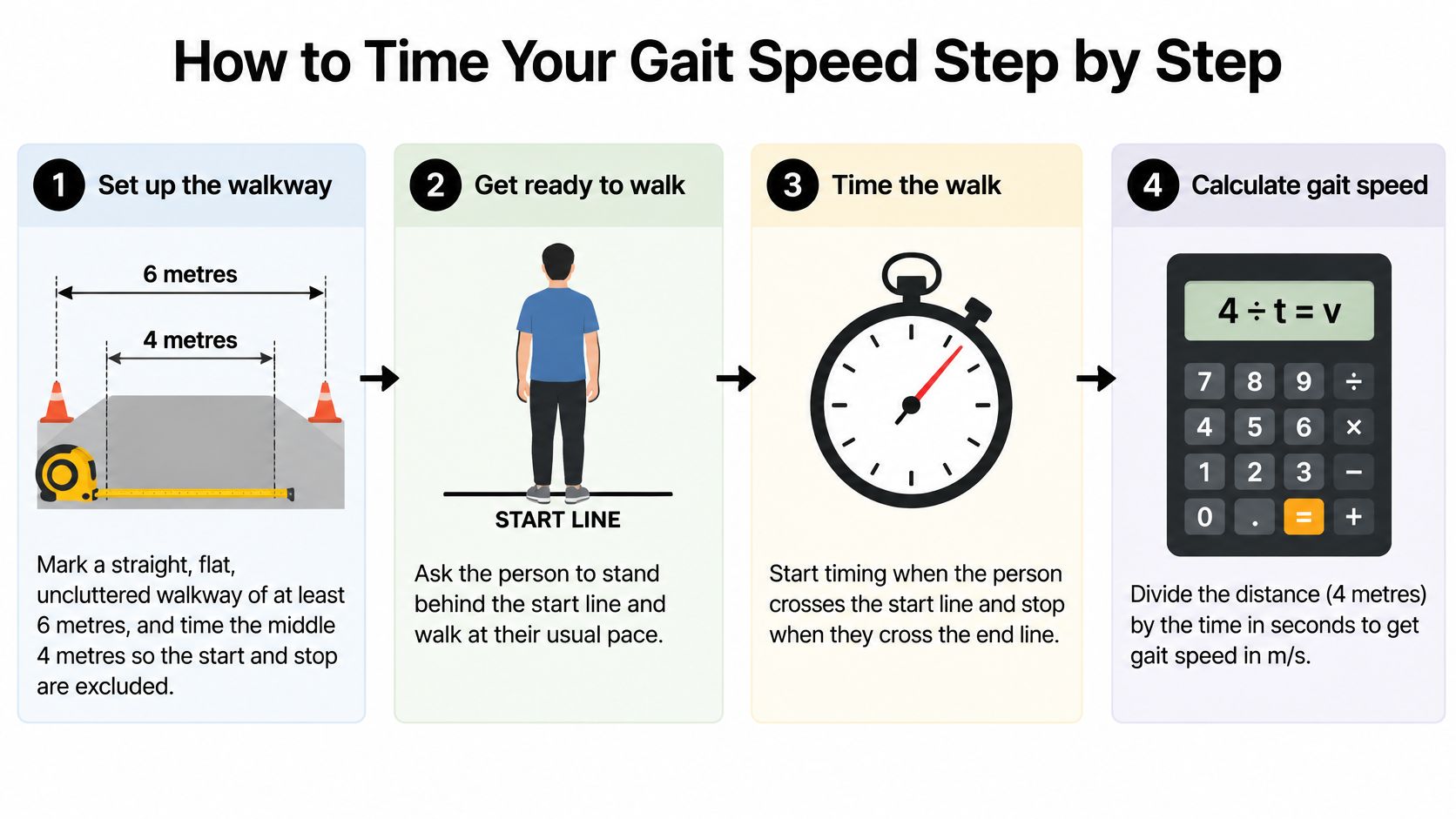
How to Time Your Gait Speed Step by Step
Use a measuring tape, floor markers and stopwatch, with another person handling the timing. If you're unsteady, have recently fallen or need hands-on help to walk, arrange supervised testing rather than trying to complete a home test.
An umbrella review of fall-risk assessment evidence describes a 4-metre walk with a 1.0 m/s threshold as a rapid screening approach and reports that taking more than 13 seconds to walk 10 metres predicts recurrent falls, with a likelihood ratio of approximately 2.0. That likelihood ratio isn't the same as saying your personal probability of falling doubles.
Use this visual as a reminder of the basic measurement sequence.
Set up a repeatable walk
Mark the course. For a home measurement, use a straight, flat, uncluttered walkway with room before and after the measured distance. Mark the timed portion clearly so acceleration and stopping aren't included.
Keep everyday conditions. Wear your usual walking shoes and use your prescribed cane or walker. Don't remove an aid to produce a supposedly better result.
Ask the person to begin before the timed line and walk at their usual comfortable pace. Avoid coaching them to speed up during the attempt.
Time between the markers. Start when the leading foot crosses the start marker and stop when it crosses the finish marker. Use the same timing convention when you repeat the test.
Divide the measured distance in metres by elapsed seconds. Repeat the walk, allow recovery if needed, and record both results rather than keeping only the faster attempt.
Observe the movement. Note hesitation, unequal steps, poor foot clearance, shuffling or reaching for support. Watch turning separately, because a straight walking segment doesn't test it adequately.
Calculate and document the result
As a hypothetical calculation, walking 4 metres in 5 seconds gives 0.80 m/s. Covering the same distance in 6 seconds gives approximately 0.67 m/s. These are arithmetic examples, not individual forecasts.
Record the date, course, timing method, footwear, walking aid and any pain or dizziness. If you average repeated speeds, keep the original measurements too.
A clinician may also compare ordinary walking with walking while performing a mental task, such as counting backwards. Don't add a distraction challenge at home when balance is uncertain. The purpose is to observe changes safely, not provoke a stumble.
For help interpreting movement quality alongside the stopwatch result, a physical therapy gait evaluation provides a more appropriate setting than repeated unsupervised testing.
How Gait Speed Predicts Falls in Older Adults
Fall risk doesn't suddenly switch on at a threshold. In a prospective study published in 2009, every 10 cm/s decrease in gait speed was associated with a 6.9% higher fall risk after adjustment for relevant participant characteristics; participants walking at 0.70 m/s or slower had approximately 1.5 times the fall risk of faster walkers.
The goal of assessment is confident, functional walking, not merely a faster test performance.
Think of each slowdown like adding another book to a shelf. The load builds gradually rather than appearing all at once when a particular book is added. Similarly, clinicians shouldn't ignore declining function because someone hasn't crossed a screening boundary.
A summary of several working systems
Walking requires leg strength, balance, coordination, reaction time and cardiovascular capacity to work together. A timed walk captures their combined effect without identifying which system is responsible for a slower result.
That distinction explains both its usefulness and its limits. A clinician can recognize a functional concern quickly, but must examine the person to understand whether pain, weakness, reduced endurance, impaired balance or another contributor deserves attention.
Medication use, vision, cognition, previous falls and the home environment also affect the interpretation. A slow pace isn't a verdict, and speed alone doesn't explain the circumstances in which someone might lose balance.
A slower result is a reason to investigate function, not a prediction that a fall is inevitable.
Read the direction of change
Serial measurements ask a different question from an isolated test: Is this person's usual mobility changing? A stable pace and a progressively declining pace shouldn't automatically lead to the same conversation, even when both remain within the same band.
Before concluding that function has deteriorated, check whether the testing conditions changed. Different footwear, a painful day, an unfamiliar walking aid or a different course can complicate comparison.
A confirmed downward trend supports looking for reversible contributors and considering targeted strengthening, gait training, balance assessment and home-safety changes. The useful outcome isn't just a faster stopwatch reading. It's a clearer explanation and a plan matched to the person's difficulties.
For a complementary visual discussion of walking and mobility, watch the following video.
When a Passing Pace Still Hides Fall Risk
Clearing a walking-speed threshold doesn't establish that you're safe from falls. It establishes only that you weren't below that threshold during that particular walking task.
A 2025 study of fall-risk stratification found that participants initially categorized as not at risk had nearly twice the rate of injurious falls when walking below 1.0 m/s (adjusted incidence-rate ratio 1.83); among participants already categorized as at risk, slow gait was associated with approximately 2.5 times the injurious-fall rate (adjusted incidence-rate ratio 2.45). These are group-level associations with injurious-fall rates, not personal injury probabilities.
The important implication is broader than the cutoff itself: an initial low-risk classification can leave meaningful vulnerability unrecognized. But this study doesn't establish that every faster walker is high risk. It supports interpreting the walking result alongside the person's actual experiences.
When everyday walking contradicts the test
Consider a retired teacher who walks briskly down a clear hallway but catches a foot on a loose rug and hesitates before kerbs. The hallway result doesn't cancel those concerns. It answers a narrower question about straight-line walking under controlled conditions.
Another person may move comfortably in a straight line but stumble when turning toward someone calling their name. Averaging speed across a short distance won't describe that balance recovery well.
Turning, distraction and confidence deserve their own questions. So do vision changes, medication effects and day-to-day inconsistency. An active older adult who doesn't identify as frail may still have a specific difficulty that warrants assessment.
A home checklist that adds useful context
Keep a brief record of the date, setting, activity and whether you needed support to recover. Describe what happened rather than assigning yourself a risk score.
- Falls or near-falls: Note a trip, slip or loss of balance, including episodes that didn't end on the ground.
- Unexpected support: Record grabbing a wall, furniture or another person to stay upright.
- Turning difficulty: Describe hesitation, unusually wide turns or multiple corrective steps.
- Changed steps: Look for shuffling, shorter steps, uneven movement or catching a toe.
- Distraction problems: Note difficulty while talking, carrying an object or navigating a busy space.
- Symptoms: Record dizziness on standing, pain during walking or a change after medication was started or adjusted.
- Reduced participation: Mention avoiding outings or familiar routes because you feel uncertain.
- Changing performance: Bring previous walking measurements and explain whether the setup stayed consistent.
A checklist item isn't a diagnosis. It is information that can change what a clinician tests, especially when the straight-line pace appears reassuring.
Don't dismiss a near-fall because you recovered. Describe how you recovered and what you needed to hold.
The practical response is a broader review, not practising the timed walk until the number improves. Guidance on improving balance in older adults can help frame that discussion, but exercises should match the difficulty identified. Someone who struggles with turns needs more than encouragement to walk faster.
Timed Walks Compared With Smartphone and Wearable Tracking
A stopwatch provides an interpretable starting point: a known distance, an elapsed time and a walking speed. Electronic walkways, smartphone applications and wearable sensors can add movement detail, but more measurements don't automatically produce a more useful clinical decision.
Gait measurement methods compared
| Method | What it captures | Main strength | Main limit |
|---|---|---|---|
| Stopwatch timed walk | Average speed over a short measured distance | Simple equipment and straightforward repeat testing | Doesn't quantify step-to-step variability or turning quality |
| Electronic walkway | Speed, step length and timing for individual steps | Detailed measurements in a controlled setting | Requires specialized equipment and access |
| Smartphone application | Speed and, with suitable software, gait characteristics | Potential for accessible monitoring | Needs validation across devices and walking environments |
| Wearable sensor | Movement signals used to estimate stride variability and support timing | Potential for observation during everyday activity | Requires validated processing and clinical interpretation |
What the extra detail means
Stride-to-stride variability describes how much walking changes from one stride to the next. Double-support time describes the part of walking when both feet are on the ground. These features can describe movement patterns that an average speed conceals, but their interpretation depends on the measurement system and the person being assessed.
A 2025 prospective smartphone-application study abstract in Age and Ageing reported that adding gait speed to frailty and comorbidity measures improved model AUC from 0.663 to 0.709, while mean speeds were 1.02, 1.18 and 1.29 m/s in high-risk, low-risk and healthy control groups, respectively. AUC describes how well a model separates groups across possible thresholds; it isn't an individual's chance of falling.
Those group averages shouldn't become new personal cutoffs. The finding supports combining gait information with clinical characteristics rather than treating an application as a standalone prediction system.
Slowing down isn't a treatment plan
Walking more slowly isn't always the safest strategy. Deliberately reducing pace doesn't identify or correct impaired strength, balance or confidence. Equally, deliberately speeding up to improve a score isn't an appropriate goal without understanding the problem.
Use a repeatable timed walk for clinical screening and comparison. Treat smartphone or wearable traces as supplementary information, especially when the device hasn't been validated for the person's walking environment, disability level or cane or walker use.
When to Book a Balance and Mobility Evaluation
Book an evaluation when your walking record or everyday experiences suggest a change that needs explanation. You don't need to wait for an injury, and you shouldn't postpone assessment merely because you can still complete a timed walk.
Useful reasons to arrange a review include:
- A slower screening result: Your usual pace falls into a band that calls for broader assessment, particularly the more concerning warning band.
- A fall or near-fall: You lose balance, catch yourself unexpectedly or need another person to prevent a fall.
- A consistent decline: Repeat measurements under comparable conditions show worsening mobility.
- New symptoms or medication changes: Dizziness, new walking difficulty or changes following treatment deserve discussion with the appropriate clinician.
- Restricted activity: Fear of falling is changing where you go or what you feel able to do.
Sudden new walking difficulty or dizziness shouldn't be treated solely as an exercise problem. Seek medical advice about the change rather than repeatedly testing yourself at home.
Bring a record that helps explain the problem
Prepare a short walking log with the dates, measured distances, elapsed times and walking aids used. Add observations about turns, foot clearance, hesitation and any need for support. Bring the shoes you usually walk in, rather than choosing a different pair just for testing.
A complete medication list is useful, including nonprescription products. Note recent vision changes and environmental concerns such as loose rugs, cluttered routes or difficulty negotiating the entrance to your home.
A fall-risk assessment for older adults can bring these observations together with movement, strength and balance testing. The appropriate review may involve more than one professional, particularly when medication effects, vision or medical symptoms need attention.
Ask for an explanation and a follow-up plan
At MedAmerica Rehab Center in Deerfield Beach, we provide balance and gait training and fall-prevention care for patients of all ages. We also treat gait and mobility issues associated with injury and rehabilitation, so the assessment can account for recovery needs rather than treating walking speed in isolation.
Ask what appears to limit your walking, which findings require medical follow-up, and what the proposed exercises are intended to improve. A useful plan connects the assessment to a specific task, such as turning without reaching for furniture or walking outdoors with greater control.
Before leaving, agree on how progress will be assessed and when to repeat the timed walk. Bring the same walking aid and use comparable conditions whenever possible. The purpose is to document meaningful functional change, not just produce a better number.
MedAmerica Rehab Center offers balance and gait training and fall-prevention care to address walking difficulties with an individualized rehabilitation plan. Visit MedAmerica Rehab Center to arrange an evaluation, and bring your walking measurements, medication list and notes about stumbles or difficult turns.
MedAmerica Rehab · Deerfield Beach
Talk to a clinician about your pain
Physical therapy, chiropractic, acupuncture and shockwave therapy under one roof, since 1995. Same-day appointments are available.
Mon–Thu 8:00 AM – 6:30 PM · Fri 8:00 AM – 3:00 PM