
Acupuncture for Knee Pain and Swelling: What to Expect
Acupuncture gives a small but real reduction in knee osteoarthritis pain and can improve stiffness, with a larger benefit compared with no treatment than compared with sham needles, and it hasn't been shown to reduce visible knee swelling. If your knee looks swollen, shouldn't you ask first whether pain relief and less swelling are the same thing?
They're not, and that distinction shapes a sensible plan. A needle treatment might make stairs feel easier while fluid in the joint stays unchanged. You need to know what's likely to change, what's uncertain, and which kind of swelling should send you to a doctor instead of to another session.
What the Evidence Says About Knee Pain and Swelling
Acupuncture for knee pain and swelling can modestly ease pain and stiffness in knee osteoarthritis, but it doesn't reliably shrink a visibly swollen joint. Treat pain relief as the plausible benefit and swelling as a sign that may need its own diagnosis.
The 2023 clinical practice guideline drew on 77 randomized controlled trials involving 9,422 people with knee osteoarthritis, 61.1% of whom were women. Compared with no treatment, acupuncture improved the overall WOMAC score, which combines pain, stiffness, and physical function, with moderate certainty for the total score. Certainty was lower for single parts, including very low certainty for WOMAC pain and low certainty for stiffness and function, although stiffness improved versus usual care with moderate-certainty evidence.
That wording matters. A result can favor acupuncture while the certainty rating warns you that better trials could change the estimate.
What the Evidence Shows for Each Knee Symptom
| Symptom | What the evidence shows | Practical role |
|---|---|---|
| Knee osteoarthritis pain | Small but statistically significant benefit against sham; larger benefit against no treatment | Adjunct to exercise, not a replacement |
| Stiffness | Improved compared with usual care, moderate certainty | Pair with mobility and strengthening work |
| Overall WOMAC score (pain, stiffness, function) | Improved compared with no treatment, moderate certainty for the total score | Use it to judge progress over several weeks |
| Visible knee swelling | Not consistently measured; no proven reduction | Assess the cause before adding sessions |
| Post-surgery or acute injury swelling | Not covered by the osteoarthritis evidence | Get medical clearance first |
Symptom relief means you hurt less or move more easily. Treating the cause means identifying and addressing why fluid built up. Acupuncture may do the first without proving the second. For broader background on living with osteoarthritis, see the joint health advice from Vitamin Planet.
A reasonable expectation is that pain and stiffness ease enough to exercise more comfortably. Swelling itself remains a diagnostic question first.
How Large the Pain and Function Benefits Are
Numbers only help if you know what acupuncture was compared against. The gap versus a waiting list looks much bigger than the gap versus sham needles, and both results tell you something different.
The Cochrane review of acupuncture for osteoarthritis pooled 16 randomized controlled trials involving 3,498 participants, and 12 trials studied knee osteoarthritis exclusively. Against sham acupuncture, short-term pain showed a standardized mean difference of -0.28, with a 95% confidence interval from -0.45 to -0.11. In plain terms, the average favored acupuncture, but the effect was modest.
Pain and Function Changes by Comparison Group
| Comparison | Pain change | Function change | Evidence base |
|---|---|---|---|
| Acupuncture vs waiting list | About 14.5 points on a 100-point pain scale (14.5% absolute) | Not stated as a single scale score | 4 trials, 884 participants |
| Acupuncture vs sham | About 0.9 points on a 20-point pain scale (4.59% absolute) | About 2.7 points on a 68-point scale (3.97% absolute) | 9 trials, 1,835 participants for pain; function reported on the 68-point scale |
| Pooled acupuncture vs sham | Standardized mean difference -0.28 (95% CI -0.45 to -0.11) | Included in the sham comparison above | 16 trials, 3,498 participants across the review |
Start with the waiting-list row. People receiving acupuncture improved about 14.5 points more on a 100-point pain scale than people who waited. That's a change many readers would notice, but the comparison includes attention, expectation, touch, time with a clinician, and just being in treatment.
The sham row is stricter. Sham procedures mimic needling without delivering the intended treatment, so they control for much of that context. There, acupuncture added roughly 0.9 points on a 20-point pain scale and about 2.7 points on a 68-point function scale. The review judged these sham-controlled gains below its predefined threshold for clinical relevance.
Practical rule: Quote the sham comparison when you want the conservative estimate, and the waiting-list comparison when you want the total experience of care versus doing nothing.
Neither number promises your personal result. Averages hide people who improve a lot, people who don't change, and people who stop because sessions aren't worth the time. If a provider quotes only the largest figure, ask which comparison produced it. That single question separates a realistic forecast from a sales pitch, and it sets up honest tracking of your own pain, walking, and stair use.
How Acupuncture May Ease Knee Pain
You can watch a typical session setup before reading about why it might change pain perception.
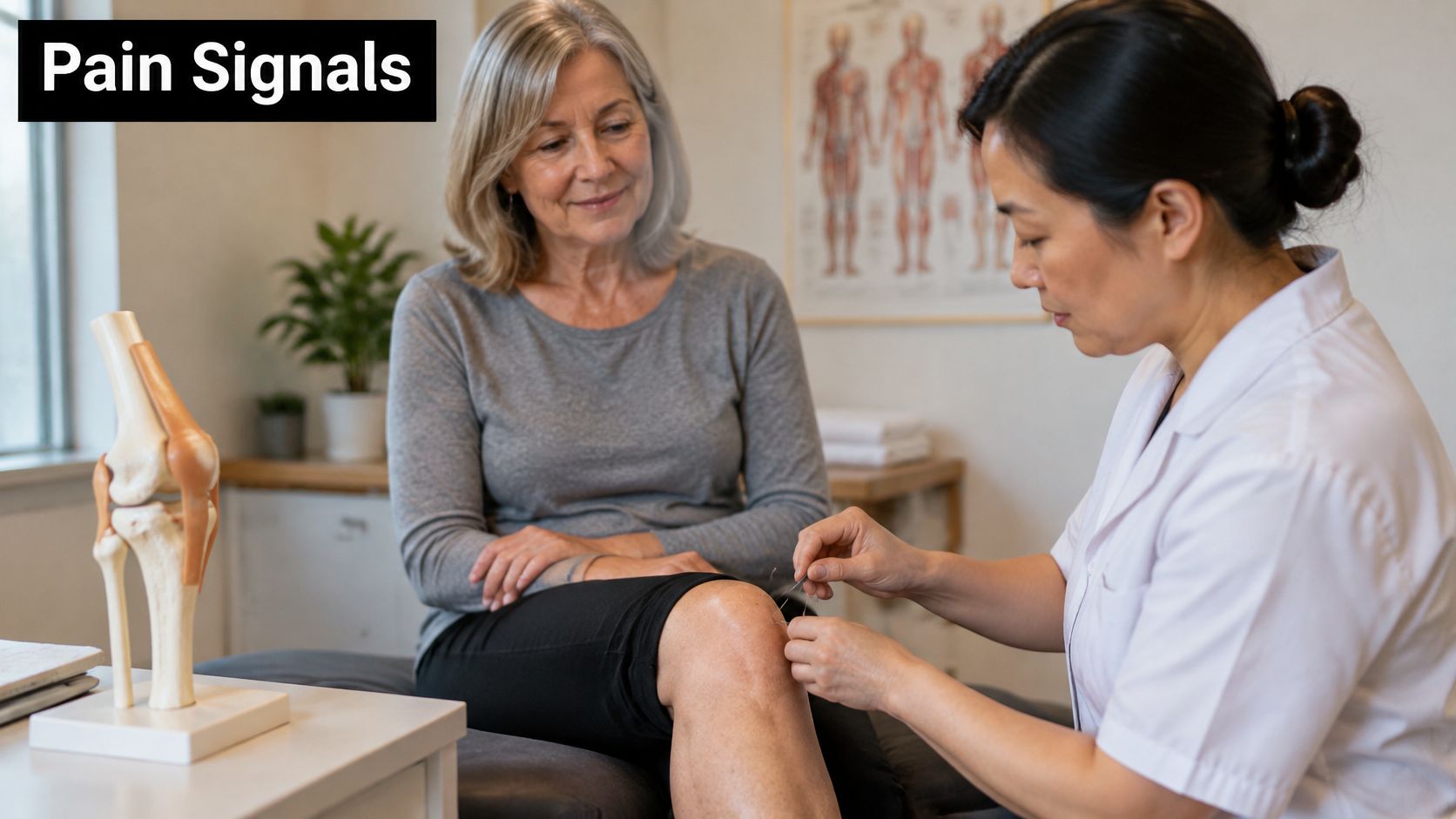
Think of pain signals traveling toward the brain like a loud radio station. Needle stimulation may work a bit like tuning in another station, making the pain signal harder to hear rather than repairing the structure that started it.
Proposed Ways Needles May Change Pain
- Gate control: Sensory input from a needle may compete with pain input in the spinal cord and brain, partly closing a gate that lets pain signals through.
- Natural pain-dampening chemicals: Stimulation may prompt release of endorphins and other neurochemicals involved in reducing pain sensitivity.
- Local circulation: Needling may alter blood flow in tissues around the joint, which could affect how irritated tissues feel during movement.
- Muscle guarding: Less pain can let tight quadriceps, hamstrings, and calf muscles relax, which may make bending and straightening feel smoother.
Each point is a proposed mechanism, not a settled explanation. Trials can measure whether pain scores move without proving which pathway caused the change. That uncertainty doesn't make relief imaginary, but it should stop anyone from claiming a precise repair process they haven't demonstrated.
Say your knee aches most when you rise from a chair. If treatment lowers pain sensitivity and guarding, you may stand with less hesitation and practice sit-to-stand repetitions more consistently. The exercise then builds strength. The needle didn't rebuild cartilage, yet it may have helped you do the work that supports the joint.
This short video gives another view of how clinicians explain treatment for painful conditions.
For a clinic overview of related uses, read about acupuncture for pain relief. The practical limit stays firm. Feeling less pain can improve movement, but it doesn't reverse osteoarthritis or remove its structural cause.
What a Typical Course of Acupuncture Looks Like
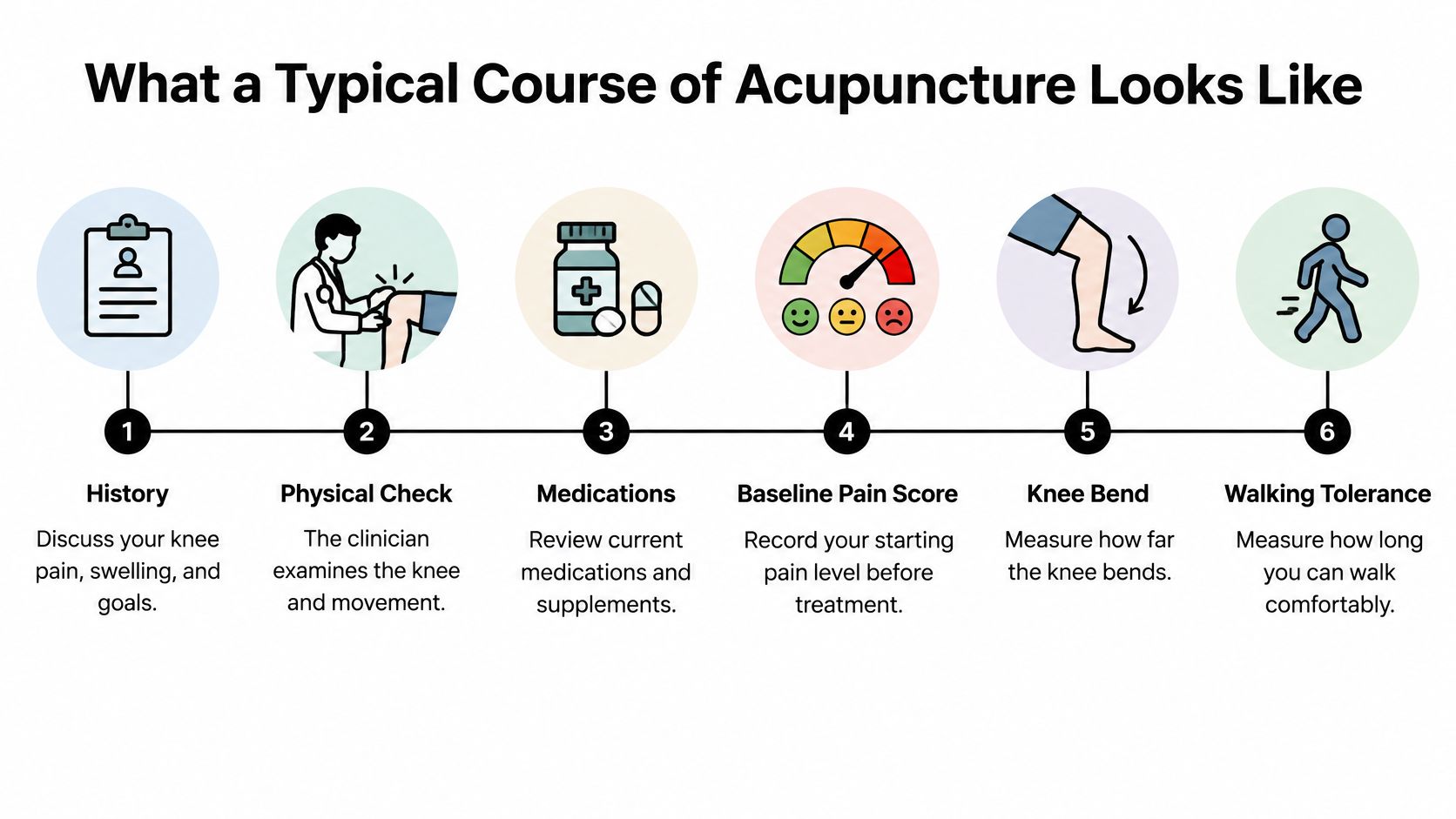
Your first visit should start with measurement, not needles. The clinician asks where it hurts, when swelling appears, what aggravates it, and whether the knee locks, gives way, or followed an injury. You'll also review diagnoses, prior injections or surgery, current medications, and supplements.
Next comes a physical check. Expect inspection of the knee, palpation around the joint, range-of-motion testing, strength checks, and observation of standing, walking, and possibly stairs. A useful baseline records pain, how far the knee bends, morning stiffness, and how long you can walk before stopping.
This visual summary shows the intake steps in order.
What Happens in a Session
The practitioner places thin, sterile, single-use needles around the knee and sometimes at points elsewhere on the limbs. You usually rest while they remain in place for around 20 to 30 minutes. Sensations can include a brief pinch, heaviness, warmth, or a dull ache, but sharp escalating pain should be reported right away.
Depending on the service, a visit can include manual therapy, strengthening exercises, hot or cold packs, electrical stimulation, stretching and/or an adjustment. Tell the clinician which elements are planned so you can separate the effect of needling from the effect of exercise or other care.
Typical 12-Week Course of Knee Acupuncture
| Phase | Typical frequency | What happens |
|---|---|---|
| Weeks 1-4 | One to two sessions per week | Baseline pain, stiffness and walking tolerance recorded; treatment starts |
| Weeks 5-8 | Weekly or every other week | Progress reviewed; strengthening and mobility work added |
| Weeks 9-12 | Weekly or less often | Reassessed against week 1 measures; continue, adjust or stop based on results |
Protocols vary, so treat the schedule as a planning example rather than a prescription. The decision point matters more than completing every visit. If nothing meaningful changes, continuing because a package was purchased isn't a clinical reason.
What to Track Between Visits
- Pain score: Rate pain from 0 to 10 at the same time each day, ideally during the same activity.
- Walking tolerance: Record distance or minutes before pain forces a stop.
- Morning stiffness: Note how many minutes pass before the knee loosens.
- Motion and stairs: Track knee bend if measured for you, plus whether you can climb stairs step over step or one step at a time.
Measure the task you care about. Walking to the mailbox without stopping tells you more than a vague sense that the knee feels different.
Mild soreness, a small bruise, or tiredness after treatment can be normal. Bleeding that doesn't stop, spreading redness, increasing warmth, fever, or sharply worse swelling isn't normal and needs prompt clinical advice.
Who Should Avoid Acupuncture or Adjust It
Is acupuncture automatically safe because needles are thin? No. It's usually well tolerated in qualified hands, but your medications, skin, immune status, and recent procedures can change the plan.
The NCCIH digest on mind and body approaches for chronic pain states that serious adverse events are rare when acupuncture is performed by a qualified practitioner using sterile needles, but reported complications include infection and punctured organs. A 2024 evidence review found no significant adverse-event difference between acupuncture and control groups, yet certainty varied from moderate to low and serious events were reported in some trials.
That combination supports screening rather than blanket reassurance. Ask who is qualified, whether needles are single-use, and how the clinic handles bleeding or infection concerns.
Higher-Risk Cases and the First Step for Each
| Case | Why it matters | What to do first |
|---|---|---|
| Taking anticoagulants or antiplatelet drugs | Bleeding and bruising risk | Medication review and physician sign-off |
| Diabetes or immune compromise | Higher infection risk | Skin and infection screening before needling |
| Recent injection or surgery at the knee | Infection and healing concerns | Written clearance from the treating physician or surgeon |
| Bleeding disorder or pregnancy | Bleeding and needling safety | Tell the practitioner before the first session |
Older adults may need extra attention to fragile skin, balance when getting off the table, and a long medication list. None of those automatically rules out treatment. They mean the clinician should inspect the skin, avoid broken or infected areas, review bleeding risk, and coordinate with the treating physician when needed.
Don't stop a prescribed blood thinner to make needling easier. Don't hide a recent injection because you want to start sooner. Those details affect needle location, timing, pressure after removal, and whether treatment should happen at all.
The same caution applies to expectations. Acupuncture should support participation in rehabilitation, not replace diagnosis or progressive strengthening. If pain drops but quadriceps strength, balance, and walking capacity don't improve, the plan is incomplete. A safer clinic will say that plainly before selling a long course.
Combining Acupuncture With Exercise and Other Care
Exercise remains the core treatment because strong muscles control load through the knee every time you stand, walk, or descend stairs. Aerobic activity, progressive strengthening, mobility work, and weight management when appropriate give you benefits that passive treatment alone can't maintain.
Use acupuncture as a bridge into that work in four steps.
- Start with pain control: Use early sessions to reduce pain and stiffness enough to exercise consistently.
- Build strength: Add physical therapy for quadriceps and hip strengthening, gait retraining, and graded loading.
- Restore movement: Layer in balance and mobility work as tolerance improves.
- Reassess: Compare pain, stiffness, walking, and stairs after 6 to 12 weeks using your baseline measures.
At MedAmerica Rehab Center, complementary options can serve different jobs. Physical therapy builds strength and retrains gait. Chiropractic care can provide manual therapy and joint adjustments where examination supports them. Shockwave therapy may be recommended by a provider for persistent soft-tissue pain, although it isn't a substitute for diagnosing joint swelling.
Our care aims to relieve pain, restore mobility and improve quality of life without surgery or unnecessary medication. That goal still requires active work from you between visits. Short, repeatable sessions beat occasional heroic workouts that flare the knee for days.
For structured home ideas, try these exercises to strengthen your knees and progress only as directed. If cycling, pool walking, or another low-impact option fits better than pavement walking, ThriveXDNA's guide to knee-friendly cardio offers useful context for choosing intensity.
Sequence matters: Calm pain enough to move, strengthen the muscles that protect the joint, then judge the plan by function rather than by how relaxing a session felt.
The best plan is built around your measurements and tolerance, not around loyalty to one treatment.
When Knee Swelling Needs Medical Care Now
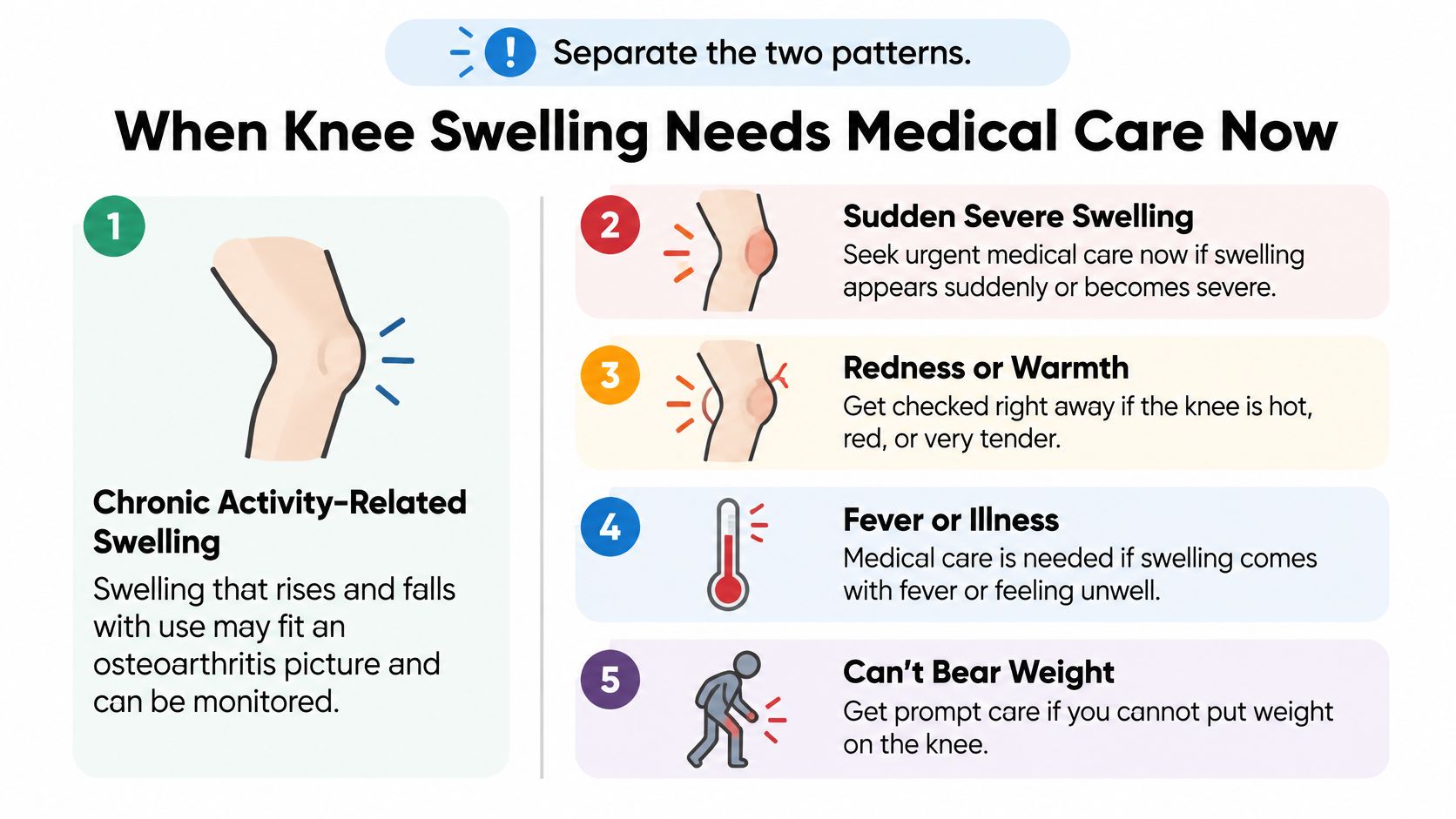
Separate two patterns before you book anything. Chronic, activity-related swelling that rises after a long walk and settles with rest may fit an osteoarthritis picture and can be monitored. New, severe, hot, or injury-related swelling belongs in medical assessment first.
This checklist highlights the distinction visually.
Red Flags That Need Prompt Medical Care
- Hot or markedly red knee: Especially with severe tenderness.
- Fever or chills: Swelling plus feeling ill needs urgent evaluation.
- Sudden severe swelling: Particularly after a twist, fall, or direct blow.
- Inability to bear weight: Or a knee that feels unstable.
- Locking: The knee gets stuck and won't fully bend or straighten.
- Calf swelling or pain: This needs same-day medical advice.
- Swelling after injury: Rapid swelling can signal internal damage.
The 2024 systematic review found clinically relevant pain improvement versus sham acupuncture, but rated the evidence very low certainty. For triage, visible swelling can indicate osteoarthritis, bursitis, crystal arthritis, infection, trauma, or an internal derangement. Those causes require different responses.
A doctor may examine the joint, test blood or joint fluid, order imaging, or refer you to orthopedics or rheumatology. That workup answers whether fluid is inflammatory, infected, bloody, or linked to a mechanical injury. Acupuncture can't answer those questions.
Use a simple decision rule during treatment. If swelling persists or worsens across several weeks, if circumference keeps increasing, or if pain rises after sessions instead of settling, see a physician before adding visits. For injury-specific next steps, review the guidance on knee injury swelling treatment.
Less pain shouldn't be mistaken for proof that inflammation resolved or tissue healed. Acupuncture is never a reason to delay evaluation when red flags are present.
Book a Knee Assessment Before Your First Session
Arrange an assessment before your first needling session so the clinician can identify the likely condition, screen risk factors, and set measurable goals. That order protects you from treating a label like swelling without knowing what's driving it.
What to Bring
- Medication list: Include blood thinners, antiplatelet drugs, diabetes medicines, and supplements.
- Procedure history: Bring dates and details for recent knee injections, surgery, or injuries.
- Two-week symptom record: Note pain, morning stiffness, swelling pattern, walking limits, and stair difficulty.
- Imaging reports: Bring X-ray, MRI, or ultrasound reports if you have them.
Ask three direct questions. Which condition are you treating? How many sessions are planned, and what happens at each phase? Which measures will show whether acupuncture for knee pain and swelling is working for you, and when will you stop or refer if it isn't?
At MedAmerica Rehab Center in Deerfield Beach, Dr. William Molesky practices as both chiropractor and acupuncturist. The wider team includes Arielle Leavitt (COO), Stanley Gusman (physical therapist), Heather Previll (doctor of physical therapy), Dorota Paspalis and Kristen Ebersberger (physical therapy assistants), and Krissy Carrera (office assistant). Self-pay costs $150 for the initial evaluation and $75 per visit for patients without insurance, and you can use medamericarehab.com for booking details.
Bring your questions and your baseline notes. If your knee is hot, suddenly swollen, locked, or impossible to load, see a physician first rather than booking acupuncture.
MedAmerica Rehab Center offers acupuncture alongside physical therapy, chiropractic care, and rehabilitation planning, so knee pain can be assessed and paired with strengthening rather than treated in isolation. If you want a measured plan with clear reassessment points, visit MedAmerica Rehab Center to arrange your knee assessment.
MedAmerica Rehab · Deerfield Beach
Talk to a clinician about your pain
Physical therapy, chiropractic, acupuncture and shockwave therapy under one roof, since 1995. Same-day appointments are available.
Mon–Thu 8:00 AM – 6:30 PM · Fri 8:00 AM – 3:00 PM