

Back Pain Relief After Surgery: Week by Week
About 15 in every 100 people still have clinically significant pain after spinal surgery. A 2023 systematic review of 16 studies involving 85,643 patients found a pooled prevalence of persistent postoperative pain of 14.97%, with a 95% confidence interval of 12.38% to 17.76%, in that systematic review of spinal surgery outcomes. The operation can relieve the pinch behind back or leg symptoms. It doesn't finish back pain relief after surgery by itself, and a useful week is judged by what you can do the next day, not by a pain score of zero.
What Pain After Back Surgery Usually Means
Say the incision burns when you roll in bed, two weeks after a lumbar decompression, while the walk to the mailbox is already easier. Both things can be true in the same afternoon. The nerve may be quieter, and the surgical site can still complain.
Stop reading every ache as a failed operation. Usual sources include residual nerve irritation, muscle and joint soreness from months of guarding, scar sensitivity when the incision is stretched, pain from a neighboring spinal level, and a pain system that was already wound up before surgery. If symptoms began as leg pain linked to an S1 bulge, the leg can keep buzzing after the pressure is off. That buzz describes a calming nerve. It isn't proof the surgery missed.
Selected disc-herniation surgery can still move pain and function faster than nonoperative care. In the Spine Patient Outcomes Research Trial observational cohort, 528 of 743 enrolled patients had surgery and 191 had nonoperative care. At 3 months, bodily-pain scores improved 40.9 points with surgery versus 26.0 with nonoperative care, physical function improved 40.7 versus 25.3, and Oswestry Disability Index scores improved 36.1 versus 20.9, in a 2016 review of lumbar disc-herniation treatment. Those people had persistent sciatica from a lumbar disc herniation. Choosing surgery wasn't the same as being assigned to it, so the gap isn't a promise for every back.
| Outcome | Surgery group | Nonoperative care |
|---|---|---|
| Persistent postoperative pain, pooled across 16 studies | 14.97% (95% CI 12.38-17.76%) | Not reported for nonoperative care |
| Bodily-pain improvement at 3 months (points) | 40.9 | 26.0 |
| Physical-function improvement at 3 months (points) | 40.7 | 25.3 |
| Oswestry Disability Index improvement at 3 months (points) | 36.1 | 20.9 |
Three clocks on the same back
Site soreness usually eases over days to a few weeks as the wound settles. Stiffness shows up when you sit too long or walk farther than yesterday. Pain that still limits life months later is a third clock, and it can keep running after an operation that did its mechanical job.
A good week is one where walking time and ordinary tasks creep forward. Getting out of bed, standing at the sink, and a short ride to the car tell you more than one morning number. Score the week on those tasks, then match the next phase to how you feel the day after, not to the date alone.
Warning Signs That Need a Clinician
Don't send an emergency to the couch, and don't send ordinary soreness to the emergency department.
Same-day care
Go the same day for new or worsening leg weakness, saddle numbness, or new trouble controlling bowel or bladder. Call the surgeon the same day for fever, wound drainage, or a wound that opens. Chest pain, a newly swollen calf, and night pain that is clearly escalating, rather than the stiff first minutes after you get up, belong in same-day care too. These aren't "try a lighter walk" problems.
A call, not a harder session
Phone the clinic promptly if leg pain keeps spreading, if new numbness appears while strength is still intact, or if daily function slides after an early good month. Adding load won't sort those patterns, and extra days in bed won't either.
Incision tenderness, muscle ache after a longer walk, and stiffness after sitting can be watched when each settles by the next day and walking holds steady from week to week.
| Symptom | Often means | Action |
|---|---|---|
| Incision soreness that eases over days | Normal early healing | Continue the cleared walking plan |
| Stiffness after sitting that loosens with a short walk | Deconditioning and guarded posture | Break up sitting and keep graded walks |
| Leg pain that stays up more than about 24 hours after a new exercise | Load advanced too fast | Drop back one step and tell the therapist |
| New weakness, saddle numbness, or bowel or bladder change | Possible nerve emergency | Same-day surgical or emergency care |
| Fever, wound drainage, or a wound that opens | Possible infection or wound problem | Call the surgeon the same day |
| Pain still limiting life months later with a healed wound | Persistent pain, not automatic surgical failure | Rehab review of movement, nerves, and goals |
Recent follow-up research notes that roughly 30% of patients may continue to experience long-term pain and disability after elective lumbar-spine surgery. A sound operation and ongoing pain aren't opposites. The next step rests on the neurological exam, what you can no longer do, imaging when it's indicated, and whether symptoms are trending better. A rehab look at walking, deconditioning, guarded posture, and non-spinal contributors often comes before anyone discusses another procedure.
Bring a one-week log of walks, pain scores, and leg changes to every visit. That page is more useful than a single "it hurts" at the door.
A Week by Week Recovery Roadmap
Recovery has no reliable finish date. Use each phase below as a timing ceiling, not a deadline. A successful operation and lingering pain can coexist, so judge progress by how symptoms respond over about 24 hours, not by the calendar alone.
| Phase | Main goal | Activity to add | Usual limit |
|---|---|---|---|
| Weeks 2-4 | Build walking tolerance | Slightly longer walks if symptoms stay near baseline for about 24 hours | Avoid one long sitting block |
| Weeks 4-6 | Start supervised rehab when cleared | Low-load core and hip activation with a therapist | No heavy loading; match the operation |
| Weeks 6-12 | Build strength and endurance | Trunk, hip and pelvic strengthening, light aerobic work, one real-life task | Advance only if symptoms are stable for about 24 hours |
Before week 2 and after week 12
From discharge through day 14, focus on surgeon-cleared walking, log-roll transfers, wound care and following your written pain plan. Walks are often short and frequent, around 5 to 10 minutes several times a day. Follow your surgeon's limits on bending, lifting and twisting.
In weeks 2 to 4, add a little walking time only if pain and leg symptoms remain near baseline for about 24 hours afterward. Break up sitting, too. A long stretch on the couch can aggravate a back even when the morning walk felt fine.
Weeks 4 to 6 are a common time to begin supervised rehab after lumbar fusion or decompression, if your surgeon clears it and your healing and neurological status allow. Through week 12, build trunk, hip and pelvic strength alongside light aerobic activity and a practical task, such as carrying a light grocery bag or standing long enough to cook a simple meal. After 12 weeks, graded work or sport tasks may fit if symptoms remain steady. Preparing your home for early walks can help; planning your recovery at home covers practical arrangements such as chairs, meals and clear pathways.
Why the calendar loses
A systematic review of rehabilitation after lumbar surgery found short-term reductions in disability and pain with exercise therapy compared with usual care, with standardized mean differences of −0.41 and −0.36. Adding cognitive-behavioral training reduced disability further (SMD −0.31) and pain-related fear (SMD −0.64). Return-to-work results were inconclusive, with a pooled relative risk of 1.30 and a confidence interval of 0.99 to 1.69 that includes no difference, so a job date shouldn't be promised. The review rated the evidence as low quality, and rehabilitation protocols differed. Your operation's restrictions and nerve findings help determine how much activity is appropriate.
A worsening leg, new weakness, fever, wound drainage, bowel or bladder change, or rising night pain needs a clinician's attention, not another exercise.
Move to the next phase only when the 24-hour stability rule holds. If a new walk or exercise leaves you worse the next day, stay at your current level and contact your care team if symptoms persist or concern you.
Pain Control Steps That Limit Opioid Use
Medicines are a shared plan with the prescribing clinician. You don't rewrite them from a blog. The aim is enough relief to walk and sleep, with less opioid exposure as the pain changes shape.
- Write today's pain in two lines. Incision or muscle ache is one line. Leg or nerve pain is the other. They aren't treated as the same problem, and a single "7 out of 10" hides which one moved.
- Use the scheduled non-opioid base already approved. If your liver and your other medicines allow it, that often means acetaminophen on a clock, before you chase every spike.
- Ask whether a non-opioid for moderate to severe acute pain fits this operation. In January 2025, the U.S. FDA approved suzetrigine, the first in this oral class for adults. It widens the menu. It doesn't replace opioids for every person, and it isn't automatically available, covered, or appropriate after spine surgery in every country. Questions about how a new medicine sits with acetaminophen belong in a pain management after surgery conversation with the prescriber.
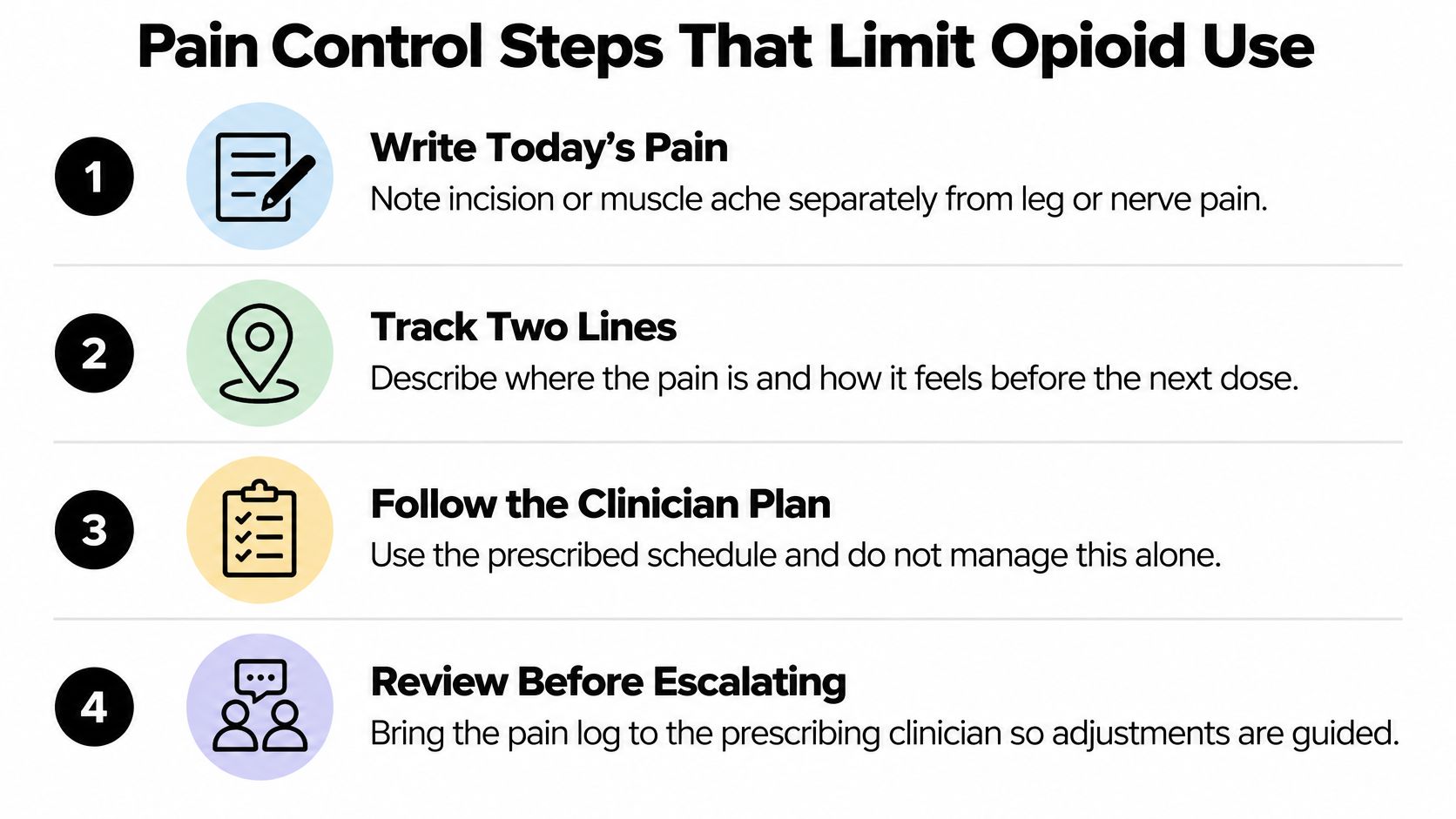
- Keep any opioid for breakthrough pain at the lowest dose that lets you walk and sleep. Reassess every few days. A refill on habit isn't a plan.
- Pair the dose with ice and a short walk. Ice the sore area for about 15 to 20 minutes, with a cloth between the pack and your skin. Then do the short walk already cleared for this phase. Medicine that isn't followed by movement tends to stall recovery.
- Head off the side effects that stop you moving. Start a constipation plan early, skip driving if you feel sedated, and call for heavy sleepiness or slow breathing. Opioids carry risks of sedation, respiratory depression, constipation, urinary retention, nausea, dependence, and substance-use disorder.
- Taper the opioid as surgical pain shifts toward stiffness. Don't stop other prescribed medicines on your own. Availability, contraindications, insurance, and prescribing rules differ by country, so every change goes through the surgeon or the clinician who wrote the prescription.
What the two lines are for
When the incision line fades and the leg line doesn't, the next adjustment isn't "more of the same pill." Nerve symptoms, wound pain, and movement stiffness pull the plan in different directions. Bring both lines to the visit so the dose can drop, stay, or change for a reason you can see.
How to Progress Walking and Strength
This sequence fits many people after lumbar decompression for a disc herniation. Fusion, stenosis, or spondylolisthesis can carry different limits, and those written limits win.
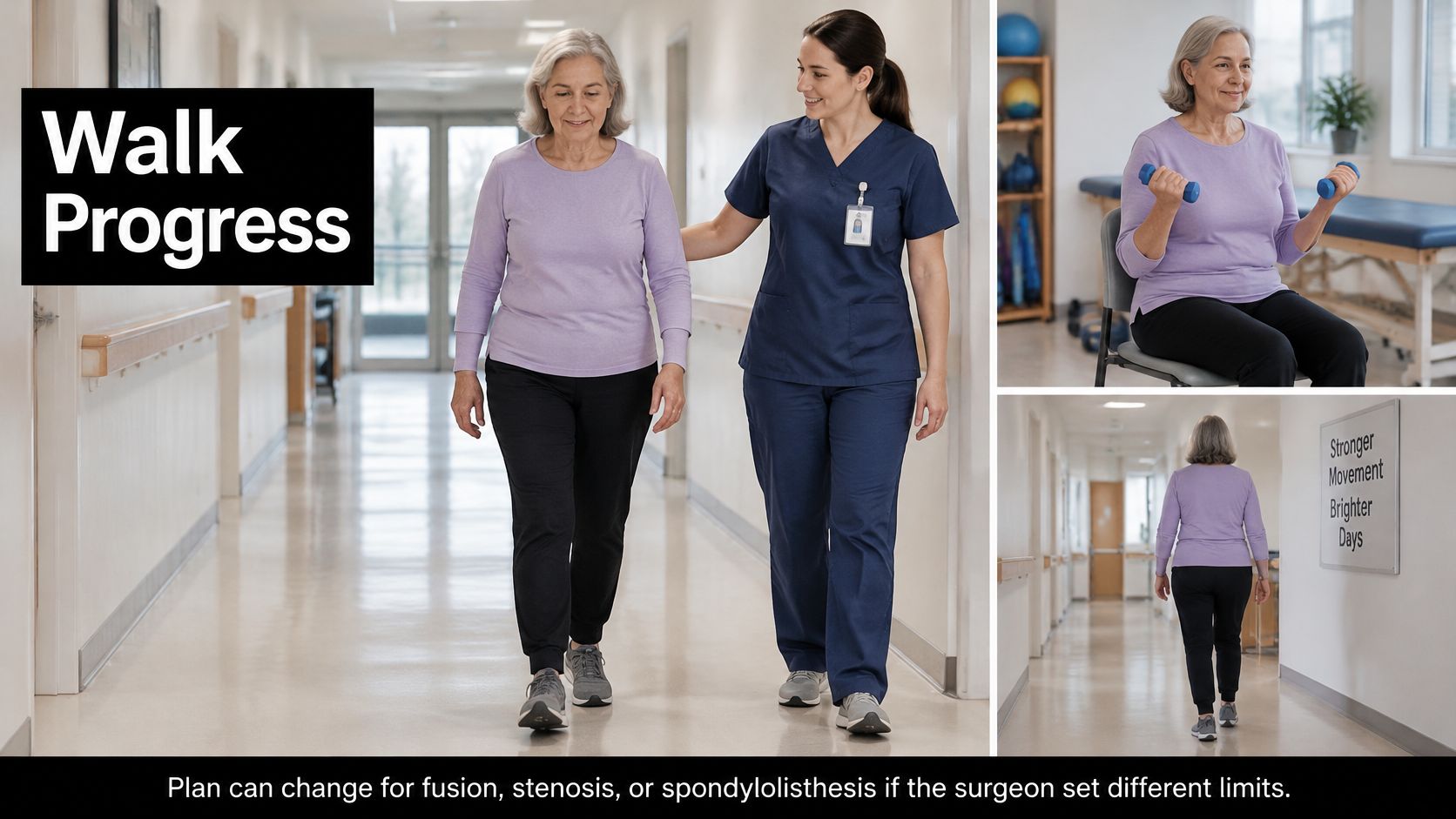
- Record a baseline before you add work. Note pain now, a function score such as the Oswestry Disability Index if your clinic uses one, how far you can walk, any numbness or weakness, and the lift or bend ban still in force. Without that snapshot, "better" is a mood.
- Practice neutral-spine transfers. Log-roll to your side, push up to sit, set your feet down, then stand. Use your hands on your thighs rather than a rounded reach to the floor. The point is to spare the healing tissues on the way to the walk, not to pass a flexibility test.
- Walk on level ground with the glutes lightly working. Start from the 5 to 10 minute bouts you already tolerate. Add about 5 minutes only after the previous bout stays comfortable for roughly a day. Gait training in physical therapy is the place to clean up a limp before you chase distance.
- Add low-load stabilization once you're cleared. Try gentle abdominal bracing while lying on your back, a bridge held 5 seconds for 8 to 10 reps, and side-lying hip abduction with a light band, 2 sets, every other day. Easy reps teach control. They aren't a workout you have to survive.
- Raise one variable at a time. Reps, then resistance, then endurance, then one work or sport task. Don't jump all four in the same week. A person who adds a band, a longer walk, and a grocery carry on Monday has no way to know which one stirred the leg on Tuesday.
- Recheck the next day, and stop if the leg argues. A small ache that settles is acceptable. Rising leg pain, new weakness, or pain that ruins sleep means you drop back one step.
A short demonstration of the log roll makes the transfer easier to copy before any strength work is added.
After lumbar decompression for disc herniation, supervised exercise beat unsupervised exercise in the short term, with a pain improvement of 1.14 points (250 participants) and a disability improvement of SMD −0.70 (175 participants), in a review of postoperative exercise. Against advice alone, supervised programs improved pain (SMD −0.91, five trials, n=341) and disability (SMD −0.80, four trials, n=261). Early ease isn't a reason to quit. In two trials involving 166 patients, supervised exercise wasn't better than no treatment for pain or disability at 3 or 6 months. Keep the plan long enough to matter, and don't paste decompression loading onto a fusion without your surgeon's limits.
Which Therapy Fits This Stage of Healing
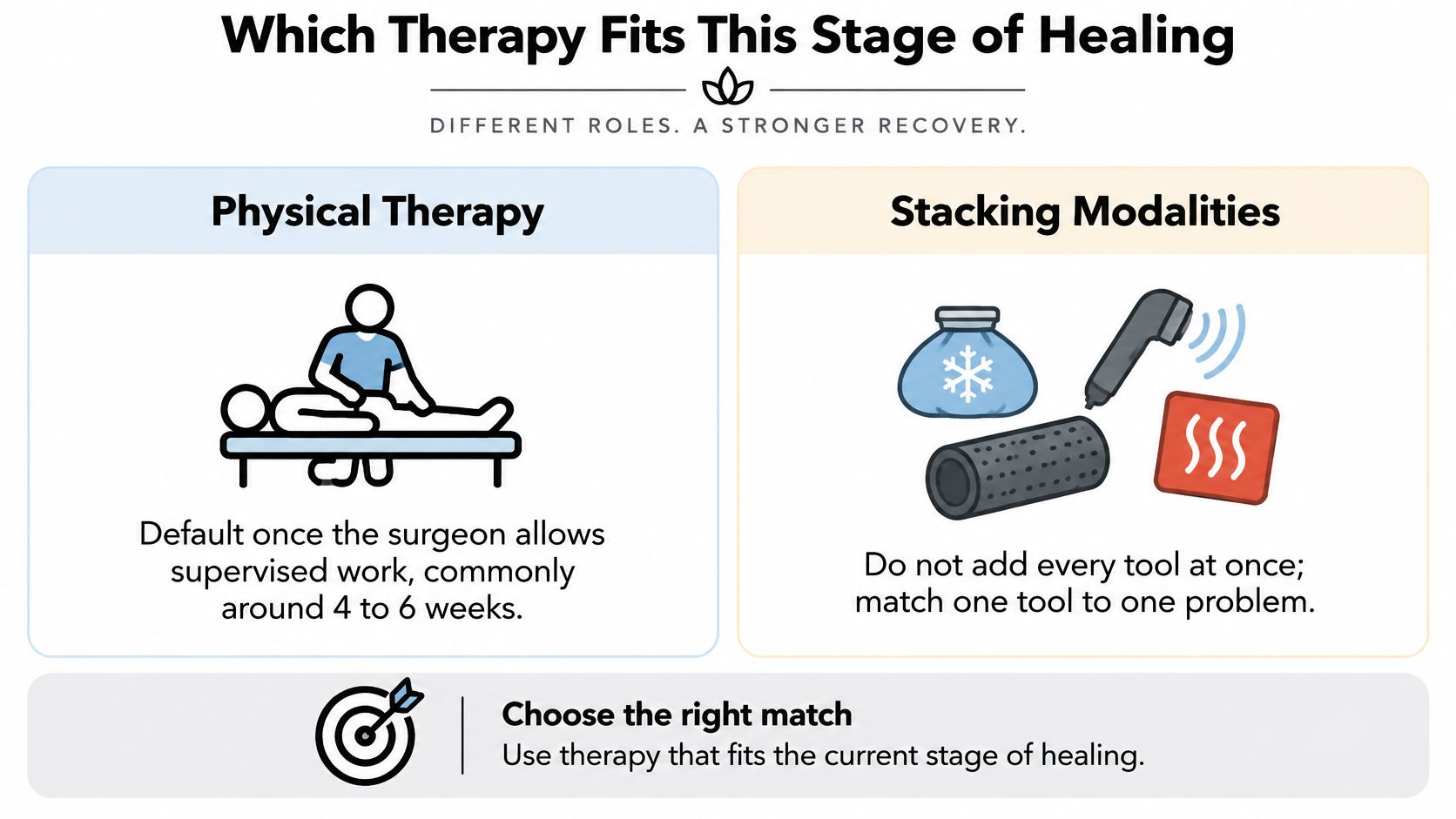
Match one tool to one problem. Stacking every modality in the same fortnight makes it impossible to tell what helped.
| Option | Best used for | Typical timing | Wait if |
|---|---|---|---|
| Physical therapy | Walking, strength, transfers, return to tasks | Often from 4-6 weeks when the surgeon clears supervised rehab | Wound is open, or new weakness or bowel or bladder change |
| Chiropractic | Stiffness and joint irritation after guarded posture | Only after explicit surgical clearance | Fresh fusion restrictions, or pain with a new neurologic sign |
| Acupuncture | Pain, muscle tension, headache, and poor sleep | Once the surgical team allows it, often alongside exercise | Fever, wound drainage, or pain that is rapidly worsening |
| Shockwave therapy | Stubborn soft-tissue pain and slow local healing | After the acute wound phase, as an add-on | Neurologic deficit or pain that needs surgical review |
Physical therapy is the default once supervised work is allowed, because the job is walking quality, hip and trunk strength, and a real task. Chiropractic can address stiffness from a guarded posture, and it isn't a way to force motion through a fresh fusion or an irritated nerve. Acupuncture fits when pain, muscle tension, or poor sleep is the main complaint and you want a low-drug add-on. Shockwave is a non-invasive option aimed at stubborn soft-tissue pain, not at a new neurologic deficit. If you want a plain comparison of hands-on care, exercise, and daily-task training, see how physical therapy, chiropractic, and occupational therapy differ.
Two people, two different first choices
Say you're six weeks after a decompression. You can walk the block, but you can't stand long enough to cook because your hips fatigue. That problem belongs in physical therapy first. Walking practice, hip strength, and a kitchen-height task will change the evening more than another passive modality.
Say the wound is calm, leg strength is intact, and a tight mid-back is what's limiting how you sit. Chiropractic can be added after the surgeon agrees. It still isn't the visit for escalating night pain, fever, or drainage. Those stay a surgical call.
Some people leave the hospital needing daily nursing support before outpatient therapy makes sense. Reading up on Medicare coverage for skilled nursing helps families separate that stay from later outpatient rehab.
Pick one primary goal for each block of care. Recheck it every couple of weeks by walking tolerance and leg symptoms, not by how many machines were used.
Book Post-Surgical Rehab at MedAmerica Rehab Center
When walking has stalled, leg symptoms linger, or the supervised window has arrived, a post-surgical visit at MedAmerica Rehab Center turns the roadmap into a session with a clock on it. Physical therapy and occupational therapy follow-ups are 60 minutes and can include manual therapy, strengthening, stretching, hot or cold packs, and electrical stimulation, chosen around your surgeon's limits. A first chiropractic evaluation is usually 30 minutes, later visits are usually 15 to 20 minutes, and an adjustment is included only when clearance is explicit.
Acupuncture and shockwave therapy are available as add-ons. Shockwave is a non-invasive treatment that helps reduce pain, improve healing, and restore function. Before you come, gather the surgeon's written restrictions, your current medication list, and gym-type clothes and shoes. You'll describe the surgery, what you can do now, and any leg, bowel, or bladder changes. We set one primary goal for that block of care and recheck it every couple of weeks by walking tolerance and leg symptoms. Bring the one-week log.
MedAmerica Rehab Center in Deerfield Beach helps people rebuild walking, strength, and daily tasks after back surgery with physical therapy, occupational therapy, and surgeon-cleared hands-on care. If your walks have plateaued or the supervised rehab window is here, bring your log and your written restrictions. Visit MedAmerica Rehab Center to book a post-surgical visit.
MedAmerica Rehab · Deerfield Beach
Talk to a clinician about your pain
Physical therapy, chiropractic, acupuncture and shockwave therapy under one roof, since 1995. Same-day appointments are available.
Mon–Thu 8:00 AM – 6:30 PM · Fri 8:00 AM – 3:00 PM