

Physical Therapy for Back Pain at Home: A Safe Plan
You cancelled the clinic visit again. The drive felt too long, the copay sat in the back of your mind, and the pain made even loading the car feel like a bad idea. You are still expected at work, the grocery list is unfinished, and the couch has become the only place that feels manageable. A home plan can fill that gap, but only if it is a monitored plan, not a random stretch sheet.
Why Home Physical Therapy Helps Back Pain
Low back pain is common enough that missing a visit is not a personal failure. The World Health Organization reported that approximately 619 million people, about 1 in 13 individuals worldwide, experienced low back pain in 2020. That was a 60% increase since 1990, and low back pain accounted for 8.1% of all years lived with disability globally that year. WHO identifies it as the leading cause of disability worldwide and estimates cases could reach 843 million by 2050, a projection driven largely by population growth and aging.
Those numbers explain why physical therapy for back pain at home matters. Travel, scheduling, cost, and limited clinic slots keep people from finishing a course of care. A home program lets you practice mobility, trunk strength, and self-management in the rooms where symptoms show up: the desk, the kitchen counter, the car seat.
What the home hours are for
Clinic time is short. The hours between visits decide whether a new movement sticks. A useful home plan has three jobs.
- Mobility: Short, tolerable ranges so sitting and bending do not lock you up by afternoon.
- Strength and control: Simple trunk and hip work you can repeat without a gym.
- Self-management: Pacing, position changes, and a clear rule for when to ease off.
Sleep setup belongs in that picture too. A supportive surface will not replace exercise, but a poor one can undo a careful day of movement. Indian River Furniture mattress advice is one practical place to compare how mattress choice affects overnight comfort.
Honest limit: Widespread pain does not mean every home routine fits every person.
Persistent, severe, or neurologically complicated symptoms need a professional evaluation before you start. The rest of this guide covers who should wait, how to build a first week, how to progress without guessing, and when a remote check or an in-person visit is the safer next move.
Screening Yourself Before You Start Exercising
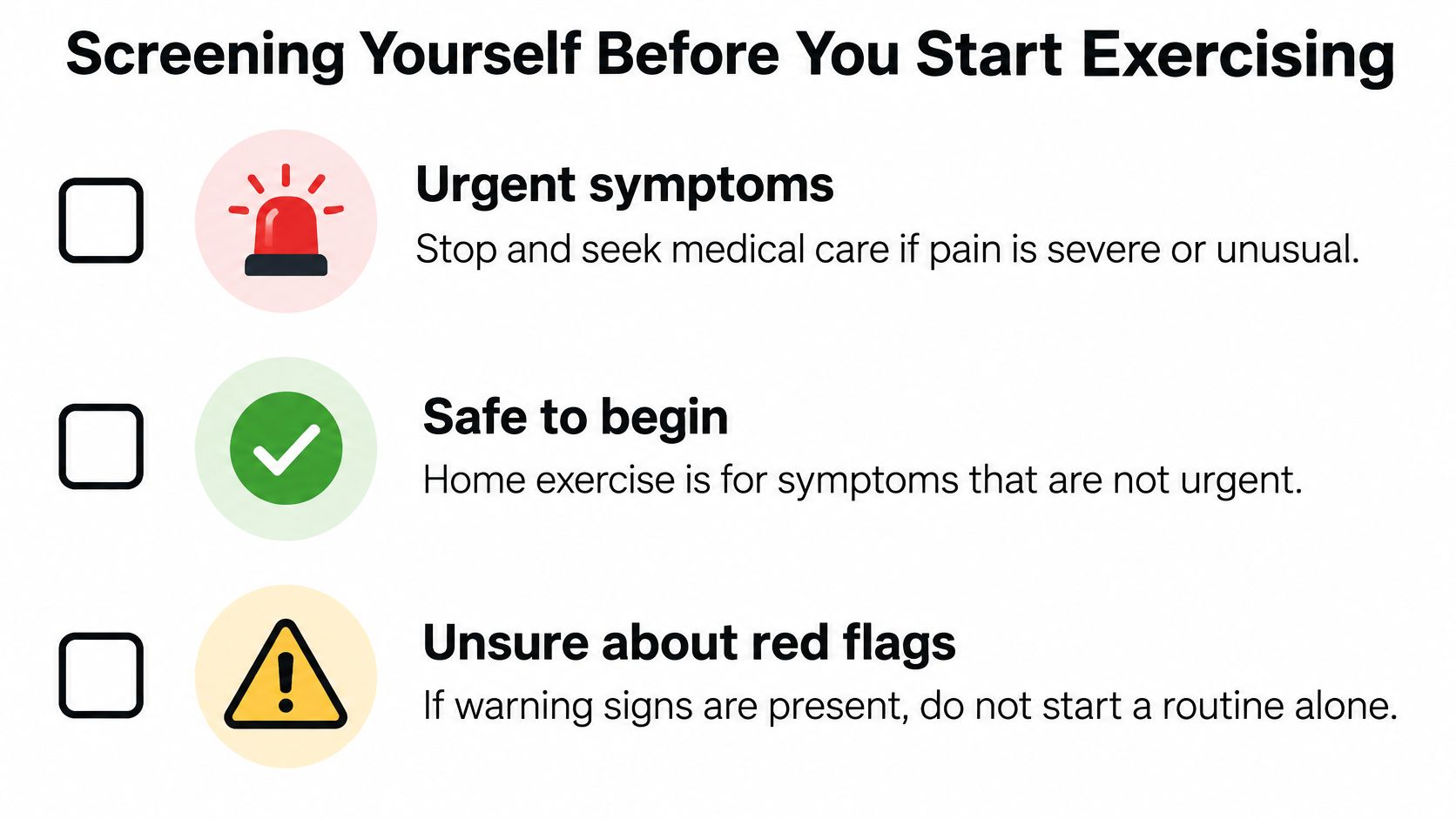
Before starting a home routine, check whether it matches your symptoms, abilities, and medical history. A 2025 meta-analysis found that, for chronic nonspecific low back pain, unsupervised home exercise was less effective than supervised in-person exercise for short-term pain and disability. The difference favored supervised care for pain reduction (Hedges' g = 1.11) and functional disability (Hedges' g = 0.69). Home exercise can help, but supervision matters when symptoms or health conditions make it difficult to choose or adjust movements safely.
Match the plan to the person
Write down what might affect your exercise choices and what you want to manage in daily life.
- Diagnosis: A nonspecific ache calls for a different approach than a recent fracture, possible infection, or structural problem your clinician has identified.
- Mobility and strength: Record what you can do now, such as standing from a low chair or walking to the mailbox. These tasks give you a baseline to compare as you progress.
- Age and comorbidities: WHO guidance recommends considering physical and mental capacity, other health conditions, reduced exercise tolerance, and the risk of adverse events before starting an unsupervised program.
- Functional goals: Make the target observable. Standing through dinner or driving for a set time gives you a clearer way to reassess than “less pain.”
If you are unsure whether a warning sign applies to you, get clinical advice before exercising alone. Sleep position can also help you notice patterns: symptoms that worsen after a long night in one posture are worth mentioning during assessment. For practical ideas about bedding habits, see a local guide to back-friendly sleep. You can also review options for back pain relief to understand where movement fits among other approaches.
Stop and get assessed first
Arrange a clinician visit before beginning a solo routine if you notice:
- Worsening leg symptoms: Pain, numbness, or tingling that spreads or intensifies.
- New weakness: A foot that drags, a knee that buckles, or new difficulty getting up from a chair.
- Lost daily function: You can no longer walk, sit, sleep, or work as you could last week.
- Severe or unusual pain: Symptoms feel different from your usual ache or do not settle with rest and a change of position.
If a warning sign might be present, have a qualified professional assess you before your first session. During a home program, reassess if symptoms worsen, weakness develops, or a daily task becomes harder. A therapist can help determine whether to adjust the movements, add supervision, or pause exercise for further evaluation.
Building Your First Week of Home Exercises
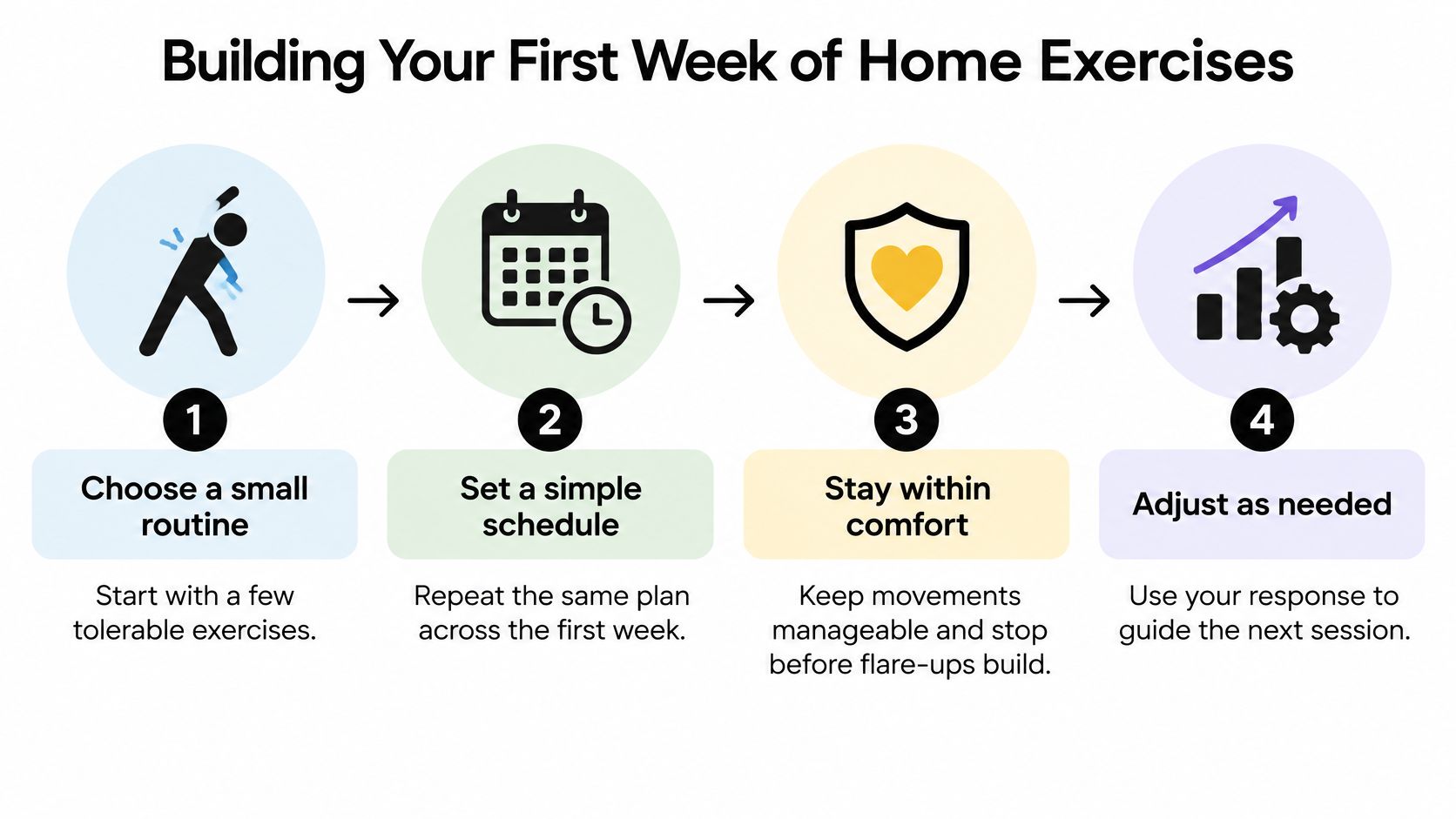
Once screening is clear, keep the first week small. A 2022 systematic review and meta-analysis of 33 studies involving 9,588 patients found that exercise performed exclusively at home reduced pain intensity for nonspecific low-back pain, with a large standardized effect size of -0.89 (95% CI -0.99 to -0.80). Functional limitation also improved (effect size -0.75, 95% CI -0.91 to -0.60). Programs that mixed home work with sessions elsewhere still helped. Supervised training produced the strongest pain improvements, and the researchers said the data were not enough to name one best duration or weekly frequency.
A short menu, not a long list
Pick three movements you can do on a firm surface with a clear stop rule. Examples that many people tolerate early:
- Pelvic tilt on your back. Knees bent, feet flat. Gently flatten the low back into the floor, hold a breath, release. Eight slow reps.
- Hands-and-knees rock. Shift your hips toward your heels only as far as the back stays comfortable, then return. Six to eight reps.
- Sit-to-stand from a firm chair. Use your hands if you need them. Five reps, rest, then five more if form stays steady.
A desk worker might do that pair of short sessions, morning and late afternoon, instead of one long workout after a stiff commute. A retiree might attach the same three moves to a ten-minute walk after breakfast. Neither person needs a gadget on day one. If you are curious about traction devices, read inversion table benefits and limitations before you buy one. They are optional tools with real trade-offs, not a substitute for a dose you can repeat.
Log the response, then get eyes on the form
After each session, write four lines: pain during the set, pain two hours later, what you could do afterward (walk, sit, chores), and whether leg symptoms changed. Have a clinician or other qualified professional watch your technique before you add reps or resistance. WHO guidance notes that home programs are generally more beneficial when they are personalized, followed by a practitioner, and built toward at least 20 hours of total program time. Week one is the start of that total, not the finish.
Add volume only after form looks right and the next-day log stays acceptable.
Progressing Safely and Managing Pain Flare-Ups
Early comfort is not a green light to jump levels. A Cochrane review of 35 studies involving 2,746 participants found exercise improved pain by an average of 15.2 points on a 0 to 100 scale at the earliest follow-up versus no treatment, usual care, or placebo (95% CI 12.2 to 18.3). Across 38 studies and 2,942 participants, disability improved by 6.8 points, which did not meet that review's prespecified minimal clinically important difference. Pain can move more than function, and gains often shrink over longer follow-up.
Change one variable at a time
Use a stepwise method. Confirm there are still no urgent symptoms. Keep the exercises tolerable. Repeat them while you watch both pain and function. Then raise one thing: repetitions, range, light resistance, or a harder daily task such as carrying a grocery bag from the car.
Do not raise intensity only because this morning's pain score dropped. Track walking tolerance, sitting time, sleep, work, and ordinary chores. If pain is down but you still cannot sit through a meeting, the plan is not ready for harder loads.
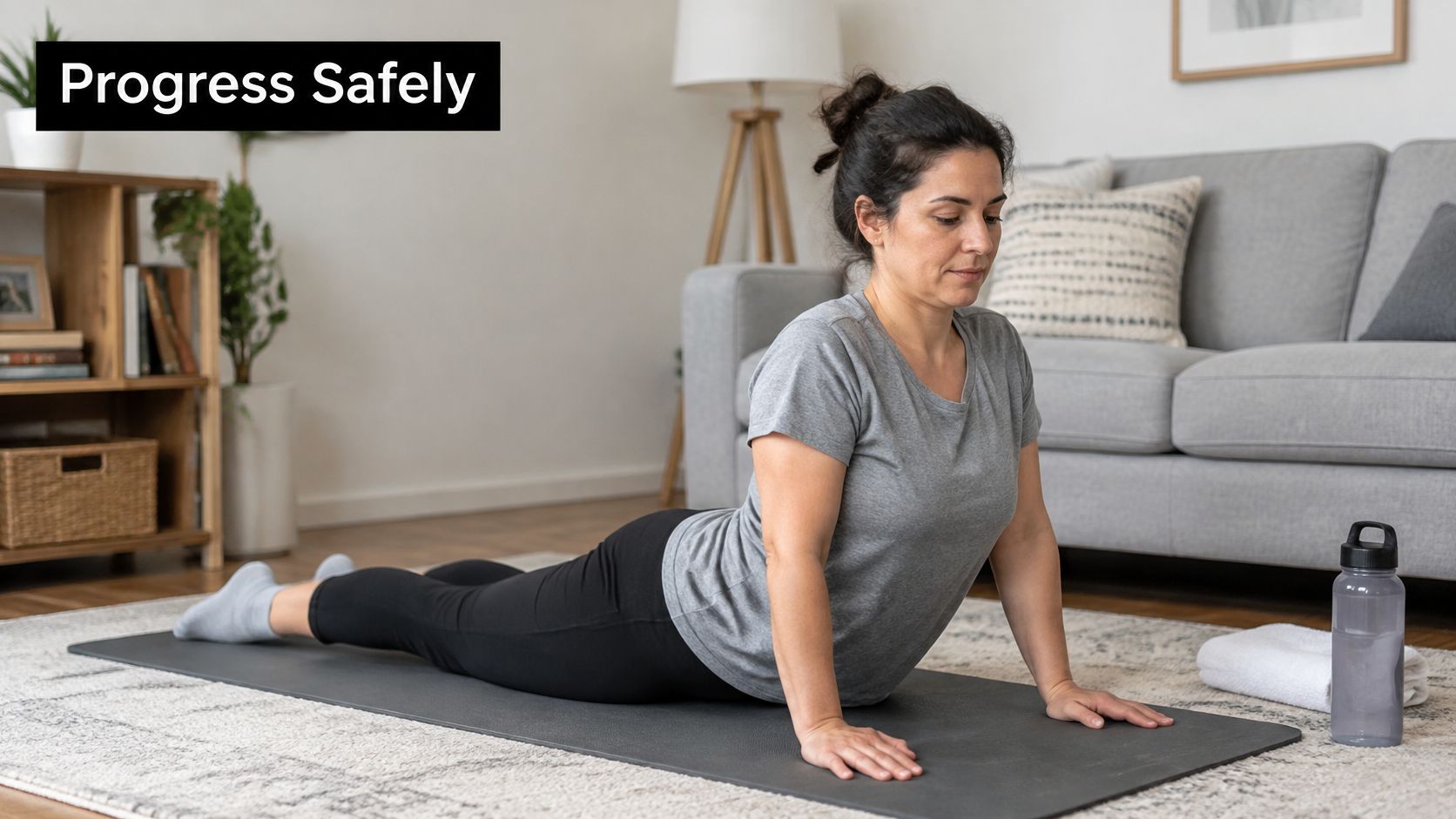
A floor extension, like the cobra position in the photo, is a range choice, not a requirement. Some backs like a little extension. Others prefer flexion or neutral positions. If the pose sends symptoms farther down a leg, stop that variation.
A short demo can show pacing in real time. Watch how little range is used before symptoms build, then compare that with your own log.
When a flare shows up
Step the dose back for a day or two instead of pushing through. Keep gentle movement you already tolerate, shorten sessions, and return to the last level that did not worsen leg symptoms. Seek care for progressively worsening leg pain, new weakness, or severe pain that will not ease. Periodic reassessment belongs in the plan because early improvements are not a permanent result.
Home Program or Clinic Visit How to Choose
If your back pain is stable and a clinician has already assessed it, home exercises may be reasonable. When symptoms are new, changing, or difficult to assess, a clinician's evaluation can help determine which movements are appropriate and how to monitor progress. Self-directed exercise, remote guidance, and in-person care each have different limits.
A home plan should include a reassessment date and clear reasons to seek help sooner. Track whether everyday tasks are improving, not just whether pain changes. If function stalls or symptoms worsen, contact a clinician rather than adding more exercises.
Side by side
| Care Pathway | Best Suited For | Key Watch-Out |
|---|---|---|
| Self-directed home exercise | Stable, nonspecific symptoms after a clinician has already cleared you | Form errors and fading adherence go unseen |
| Remote or video-guided therapy | People who can set up a camera, follow cues, and check in on schedule | Privacy, low digital comfort, language needs, and partial views of form |
| In-person clinic care | New or changing symptoms, hands-on needs, falls risk, or a plan that has stalled | Travel and scheduling can break consistency if there is no home piece |
A hybrid approach can combine an initial assessment, practice between visits, and a scheduled check-in. Remote care still needs an individualized program, and a camera cannot show every movement clearly. Choose in-person supervision when symptoms are changing, balance or falls are a concern, you need hands-on assessment, or progress has stalled. For people who cannot travel easily, private in-home physical therapy can bring assessment and treatment into the home.
Hands-on care can assess movement and help a therapist adjust the plan in real time. MedAmerica Rehab Center in Deerfield Beach, Florida, has offered care since 1995, including hands-on therapy, targeted exercise, and individualized plans for back and neck pain, sciatica, and fall prevention. Same-day appointments may be available when the schedule allows. At the first visit, expect a review of your history, movement testing, a starting dose, and written home exercises. Agree on when progress will be reviewed and which changes should prompt an earlier call.
Staying Consistent and Taking Your Next Step
A home plan can be well chosen and still fail if it fades from your week. In a randomized trial comparing motor-skill training with strength-and-flexibility exercise for chronic low-back pain, adherence was high just after treatment, at 83% in one group and 90% in the other. By six months, it was 70% versus 42%. The Cochrane review of motor control exercise also reports that adherence held in the booster group and dropped without boosters. Its findings on pain compared with minimal intervention varied in certainty. Track whether you can keep doing the plan and whether daily function improves, rather than aiming for a perfect routine.
Habits that survive month six
- Write the dose: Record the exercises, sets, and stop rule on paper or in your phone. Do not rely on memory.
- Keep the list short: Choose a manageable set of movements you can fit into an ordinary day.
- Book the booster: Set a check-in date so you can adjust the plan before missed sessions become a pattern.
- Keep a maintenance dose: Feeling better is a reason to review the plan, not automatically abandon it.
Log what you do, then compare it with walking, sitting, sleep, and work. If those activities remain limited after the agreed trial, arrange a reassessment instead of adding another downloaded routine. Worsening leg symptoms or weakness also call for clinical review. Reading about what a typical physical therapy session looks like can help you know what to expect when you book.
This week, keep the dose small, log each session, and choose a check-in date. If symptoms persist, worsen, or remain unchanged after the trial, ask a clinician to reassess the plan. A home program is a useful tool, but it cannot replace an evaluation when symptoms change or progress stalls.
MedAmerica Rehab · Deerfield Beach
Talk to a clinician about your pain
Physical therapy, chiropractic, acupuncture and shockwave therapy under one roof, since 1995. Same-day appointments are available.
Mon–Thu 8:00 AM – 6:30 PM · Fri 8:00 AM – 3:00 PM