
Rotator Cuff Tear Recovery Time Without Surgery
Meaningful recovery from a rotator cuff tear without surgery is usually measured over 3–12 months, not weeks, because pain and function can improve even when the tendon doesn't structurally reattach. Some people notice early changes within weeks, but the right timeline depends on symptoms, strength, the tear, and progress with rehabilitation.
You may be searching after a familiar moment: reaching for a seatbelt sends a sharp ache through your shoulder, sleeping on that side wakes you, or lifting a grocery bag suddenly feels harder than it should. It's natural to wonder whether a tear means surgery is inevitable. For many adults, a structured, monitored trial of nonsurgical care is a reasonable path, with progress judged by what the shoulder can do rather than by a promised date.
The question “How long does recovery take?” has more than one answer. Pain relief, a return to daily activities, and biological tendon healing are different outcomes. A shoulder can become more comfortable and useful while the tear remains visible on imaging, so a good rehabilitation plan tracks symptoms, movement, strength, sleep, and real-life tasks.
When Shoulder Pain Changes Your Daily Life
A shoulder problem often announces itself during ordinary tasks. You reach behind you for a seatbelt, lift a pan from a high shelf, or roll onto your sore side at night, and the pain interrupts a movement you used to take for granted. The ache may linger after the task is over, while weakness makes you question whether the tendon is damaged beyond repair.
That concern deserves a careful answer, not a blanket promise that surgery is either necessary or avoidable. A rotator cuff tear is a common orthopedic problem, and a monitored nonsurgical plan is a legitimate first option for many adults. The right choice depends on the type of tear, how the shoulder functions, the demands of work or recreation, and what matters most to the patient.
“Recovered” can mean different things
In day-to-day care, we separate recovery into three practical questions. Has pain settled enough to sleep and manage daily tasks? Can the person raise and rotate the arm with useful strength? Has the tendon itself structurally healed? Those outcomes don't necessarily happen together.
A patient may regain comfortable movement and return to many activities while imaging still shows a tear. That's why the rotator cuff tear recovery time without surgery can't be reduced to one deadline. The answer is usually measured in months, with progress checked along the way.
A useful measure of progress: Is the shoulder doing more, with less pain and better control, than it was several weeks ago?
A structured plan goes beyond resting the arm and applying ice. It starts with an assessment, adjusts painful or demanding activities, and adds movement and strengthening as the shoulder tolerates them. If weakness worsens, the arm can't be raised, or pain stays severe despite following the plan, the clinician reassesses rather than extending home treatment.
The central distinction is simple: symptom recovery isn't the same as tendon healing. Understanding what a tear involves makes the timeline easier to interpret.
What a Rotator Cuff Tear Actually Means
The rotator cuff is a group of four tendons that connect muscles around the shoulder to the upper arm bone. Together, they help stabilize the joint and control lifting and rotation. A tear can involve some tendon fibers, called a partial-thickness tear, or extend through the tendon, called a full-thickness tear.
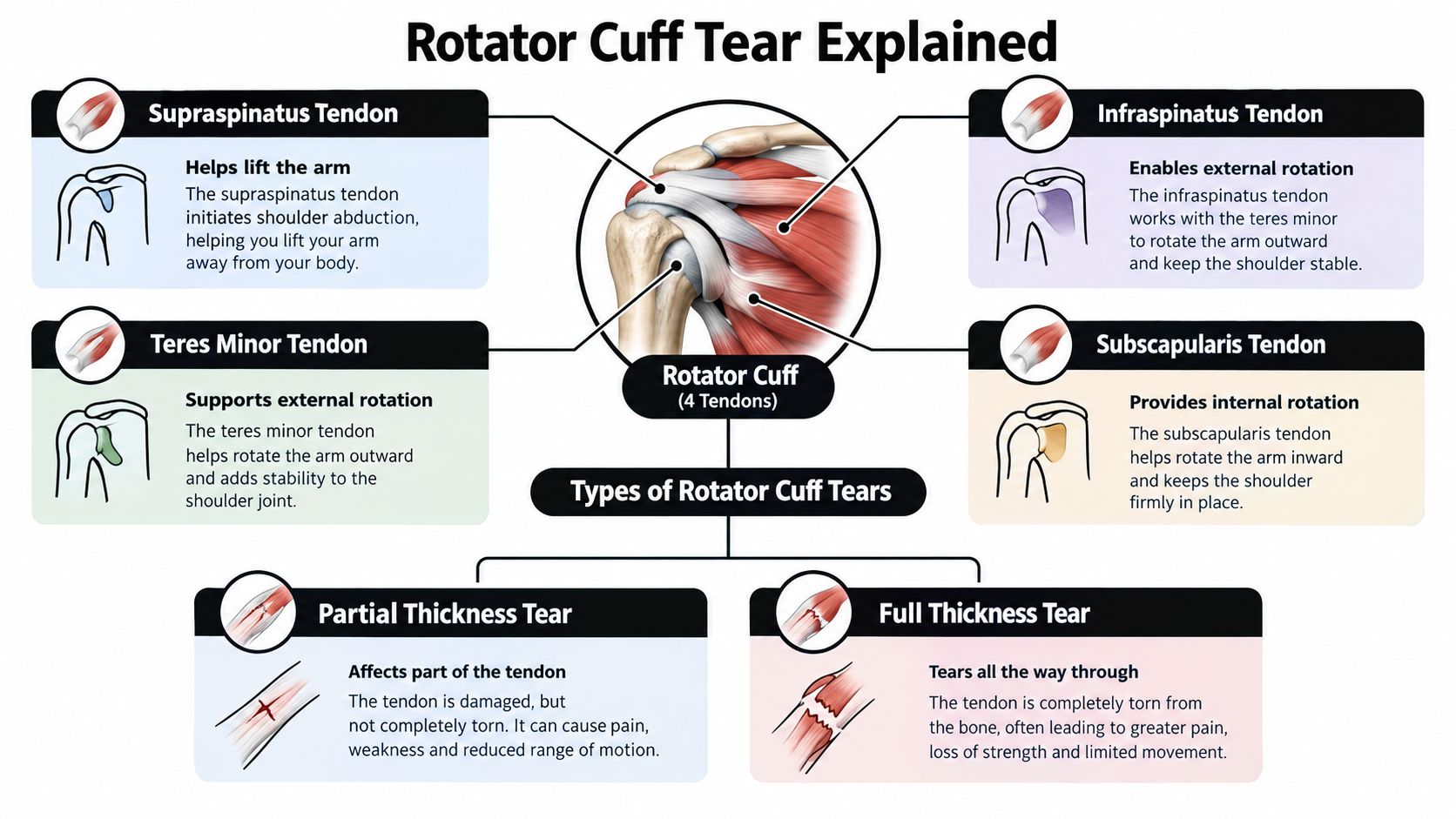
Two common ways tears develop
An acute tear can follow a distinct injury, such as a fall or sudden force on the arm. A degenerative tear develops gradually as the tendon changes over time, sometimes becoming symptomatic during routine activity. The history matters because sudden loss of strength after an injury calls for a different level of attention than a gradual ache that has built up over time.
Most rotator cuff tears don't structurally reattach without surgery. That doesn't mean the shoulder can't improve. AAOS guidance reports that approximately 80–85% of patients may obtain pain relief and improved function with nonsurgical management, which can include activity modification, medication when appropriate, and progressive strengthening, even though the tendon usually doesn't heal structurally without surgery (AAOS guidance on rotator cuff tears).
Think of a favorite jacket with a worn patch. The patch may not knit itself back into new fabric, but the jacket can still keep you warm and remain useful. In the same way, rehabilitation can improve how the shoulder moves and handles load without closing the tear.
Imaging is part of the picture, not the whole decision
An X-ray and an MRI answer different questions, and a scan alone doesn't determine whether surgery is the right choice. The clinician weighs the imaging alongside pain, strength, active movement, work or sport demands, and the patient's goals. For a plain-language overview of when each test may be used, see when an MRI or an X-ray may be needed.
A practical target is a shoulder that can tolerate gradually increasing activity with useful control. That's functional recovery, even if an image still shows a tendon defect.
The Four Phases of Non-Surgical Recovery
A staged plan gives the shoulder a way back to activity without asking it to do too much too soon. The phases below describe common rehabilitation windows, not fixed deadlines. A clinician adjusts the pace to pain, movement, strength, and response between visits.
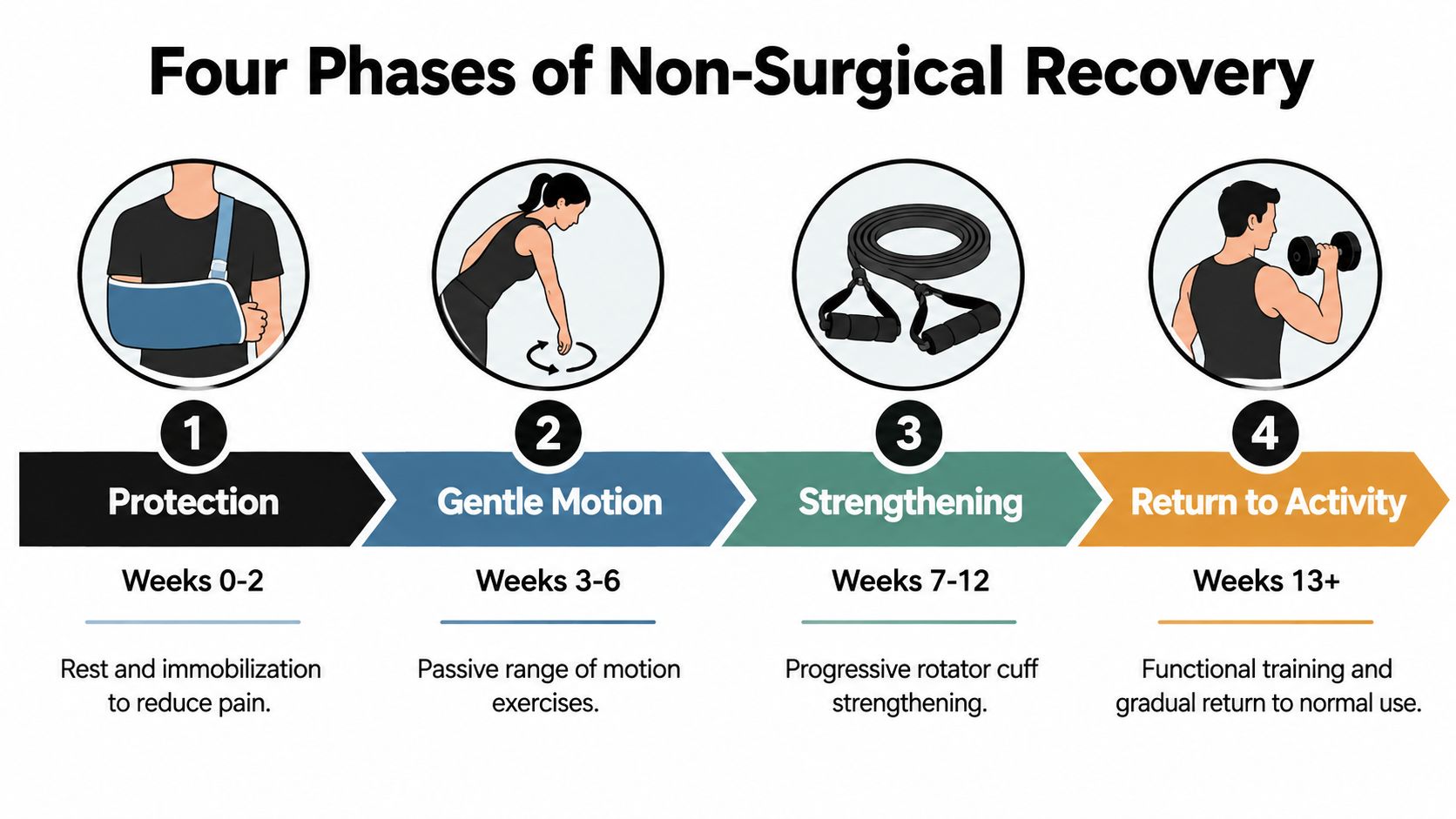
Phase 1, settle symptoms and protect movement
During weeks 0–2, the focus is relative rest, not complete shutdown. The patient reduces or modifies activities that repeatedly provoke sharp pain, keeps necessary daily movement within tolerance, and may use gentle pendulum motions if appropriate. The aim is to calm irritation while avoiding unnecessary guarding.
Phase 2, regain comfortable range
During weeks 2–6, guided mobility becomes more important. Depending on the examination, care may include passive or assisted stretching, manual therapy, and exercises for shoulder-blade control. The clinician watches for smoother movement and a better ability to reach without the shoulder hiking or the pain sharply increasing.
Phase 3, build strength gradually
During weeks 6–12, progressive strengthening can begin or advance as symptoms allow. Exercises may target the rotator cuff and the muscles that control the shoulder blade. The therapist adjusts resistance and range to build tolerance without provoking a lasting flare.
Phase 4, prepare for real demands
From around week 12 onward, rehabilitation shifts toward the activities the person needs to do, such as reaching overhead at work, lifting, or returning to sport. Load increases in steps. The clinician looks for controlled movement and adequate strength, not just the ability to complete an exercise once.
Across studies of full-thickness tears managed without surgery, approximately 90% of patients continuing conservative care reported success at 6 weeks, while meaningful functional recovery commonly continued over 6–12 months (review of nonoperative management of rotator cuff tears). That early result isn't a promise of full strength by that point. It's a reminder to define success in terms of symptoms and function, then keep building capacity.
The calendar doesn't decide when a person advances. A therapist considers pain-free or comfortable elevation, external-rotation strength, movement control, and whether sleep is improving. Modalities such as shockwave or acupuncture may be used as adjuncts when appropriate, but they don't replace progressive exercise and activity planning.
A guided visual can help explain how movement and loading are introduced:
Who Tends to Recover Well Without Surgery
A nonsurgical trial is most reassuring when the shoulder retains useful movement and strength, and the clinical findings support that approach. Tear size matters, but it isn't the only factor clinicians consider. Pain, muscle condition, strength, how the symptoms began, and what the patient needs the shoulder to do all contribute to the decision.
Findings that support a monitored trial
A 2024 observational study of full-thickness tears identified four factors associated with successful conservative treatment: preserved external rotation, negative impingement signs, minimal supraspinatus atrophy, and preserved intramuscular tendon. Patients with at least three of these factors had an 87% success rate (observational study of conservative treatment factors).
Those findings don't guarantee an individual result. They give the clinician a way to discuss whether an exercise-based trial is reasonable and what to monitor. Age alone doesn't settle the question. An older adult with useful strength and manageable symptoms may be a good candidate, while a younger person with a sudden traumatic loss of function may need an earlier specialist review.
Consider an active adult who works on their feet and has a medium supraspinatus tear on imaging but can still rotate the arm against resistance and raise it for everyday tasks. The scan is important, but so are the person's current function, symptom pattern, and goals. The plan can start with monitored rehabilitation while keeping reassessment in view.
A scan describes the tendon. The examination shows what the shoulder can do today.
Progressive weakness, significant muscle atrophy, or a sudden inability to raise the arm after an injury changes the discussion. Those signs may justify imaging review or a surgical consultation rather than continuing the same exercises indefinitely. The next step is to agree on checkpoints that show whether the plan is working.
Non-Surgical Treatments Offered at the Clinic
The core of nonsurgical care is a plan that matches the shoulder's current capacity. A review summarized in peer-reviewed literature reported pain relief and restored function in approximately 62%–74% of patients with imaging-confirmed symptomatic tears treated without surgery; satisfaction varied widely with tear type, expectations, follow-up, and treatment protocols (AAOS management guideline). These results support individualized care, not a guarantee that one treatment works for everyone.
Start with movement and progressive loading
Physical therapy typically assesses range of motion, strength, and how the shoulder responds to daily tasks. The therapist then selects exercises and adjusts them as tolerance changes. For an overview of a shoulder-focused approach, read about physical therapy for a shoulder injury.
Hands-on therapy may help address movement restrictions and make it easier to practice the right exercise. Chiropractic care may be considered for shoulder and nearby spinal mechanics when those areas affect comfortable movement. Neither substitutes for evaluating the tear or building shoulder capacity.
Use adjuncts selectively
Acupuncture may be used to help manage pain, while shockwave therapy may be considered as an adjunct for tendinopathy when clinically appropriate. These options aren't interchangeable with strengthening, and they aren't automatically needed together. A plan might pair targeted exercise and manual therapy with an adjunct, then keep the treatments that support progress and reconsider those that don't.
For someone looking for a patient-centered example of shoulder-focused rehabilitation, shoulder physical therapy for active women offers another perspective on matching care to activity needs.
MedAmerica Rehab Center provides physical therapy, chiropractic care, acupuncture, and shockwave therapy in Deerfield Beach, with licensed therapists and doctors coordinating individualized plans. Same-day appointments and insurance-friendly processes can make it easier to begin care without trying every service at once.
Even a well-chosen treatment plan needs scheduled check-ins. The clinician and patient should agree on what improvement looks like and what symptoms would prompt a change in direction.
Decision Checkpoints at 6 Weeks, 3 Months, 6 Months, and Beyond
Use checkpoints to judge the shoulder's trend, not to pass or fail a deadline. The examples below are practical guides for a monitored plan. A clinician may adjust them based on the examination, the tear, and the activities the patient wants to resume.
| Checkpoint | Expected progress | Reassess if |
|---|---|---|
| 6 weeks | Pain and sleep may be improving, with daily movement becoming easier. Full overhead elevation may still be limited. | Weakness is worsening, pain remains severe despite following the plan, or the arm can't be actively raised. |
| 3 months | Range of motion should be improving, and strengthening should be underway as tolerated. | Movement remains substantially restricted or exercise progress repeatedly causes a lasting flare. |
| 6 months | Many people are approaching a useful level for daily activities, while demanding work or sport may still need graded loading. | Function remains substantially limited or strength is declining rather than building. |
| 12 months | Persistent deficits can guide whether to continue the plan, adjust it, or seek further assessment. | Pain, weakness, or activity limits remain unacceptable to the patient despite a structured effort. |
A new traumatic event followed by sudden weakness or inability to lift the arm calls for prompt reassessment at any point. Persistent severe pain despite adherence also deserves review. The clinician may revisit the examination, the diagnosis, and whether further imaging or a specialist opinion would help.
Look for function, not a perfect scan
Track changes you can notice: how far the arm reaches, whether the shoulder can rotate against resistance, whether sleep is less interrupted, and whether work or household tasks are becoming easier. A shoulder that is improving functionally may still show a tear on MRI. That finding alone doesn't mean rehabilitation has failed.
Long-term monitoring matters because symptom relief and tendon structure don't always move together. AAOS evidence notes that tear size, muscle atrophy, and fatty infiltration may progress during 5–10 years of nonoperative management (AAOS clinical practice guideline for rotator cuff injuries). That's a reason to distinguish useful recovery from structural healing, especially when symptoms change or weakness develops.
Common Misconceptions About Healing Without Surgery
“A torn tendon must be repaired to get better”
A tear may remain visible even when pain and function improve. Nonsurgical care aims to help the shoulder move and tolerate activity, not to promise that the tendon will reattach. Whether that's enough depends on the person's symptoms, functional needs, and clinical findings.
“Rest and ice will fix it”
Relative rest can reduce aggravation, especially early on, but prolonged avoidance leaves the shoulder underused. Once movement is tolerable, a guided plan introduces mobility and progressive loading. The dose matters: too much too soon can provoke symptoms, while doing nothing doesn't rebuild control or strength.
“Pain means I'm damaging it, so I should stop”
Pain is useful information, but it doesn't automatically mean every movement is causing further injury. A clinician can help identify which motions need modifying and which exercises are appropriate. The aim is controlled activity that the shoulder can recover from, not forcing through sharp or worsening pain.
“If I'm not better in 6 weeks, conservative care has failed”
Early changes can be encouraging, but six weeks doesn't define the full recovery. Meaningful functional improvement often continues over months, with reassessment guiding the pace. If symptoms aren't moving in the right direction, the answer isn't to ignore them; it's to check the plan and the shoulder again.
Imaging studies also show why symptom progress and tendon change must be considered separately. In natural-history studies, approximately 49% of degenerative tears enlarged over a median of 2.8 years (review of natural history and enlargement of rotator cuff tears). That doesn't mean every tear will enlarge or that every person needs surgery. It does mean that feeling better shouldn't be confused with proof of structural healing.
The practical balance is to stay active within a clinician-guided plan, measure function, and speak up when weakness or pain worsens. An informed patient can take part in decisions without assuming either that surgery is inevitable or that nonsurgical care should continue forever.

What to Do This Week to Start Your Recovery
If shoulder pain is interfering with sleep, work, or basic tasks, arrange an evaluation rather than guessing at the tear or waiting for a fixed date. In Deerfield Beach and nearby communities, you can start by contacting a clinic that provides shoulder rehabilitation and ask how its team assesses movement, strength, and activity goals.
Bring any available imaging or reports, a short list of symptoms, examples of tasks that are difficult, and details of treatments you've already tried. At the first visit, the clinician can review your history, check range of motion and strength, and develop a plan with suitable home exercises. A door pulley exerciser may be one mobility tool to discuss, but whether it's appropriate depends on your examination and tolerance.
Ask how the team will measure progress and when it will reassess the plan. Same-day appointments and insurance-friendly processes may help make starting care more convenient, but the key is a plan that fits your shoulder rather than a promise of rapid healing. Some people notice early changes in pain or sleep within weeks; meaningful functional recovery commonly continues over the following months.
MedAmerica Rehab Center offers coordinated physical therapy, chiropractic care, acupuncture, and shockwave therapy for shoulder conditions in Deerfield Beach. If you're ready to discuss a monitored plan for your rotator cuff tear, visit MedAmerica Rehab Center to arrange an evaluation.
MedAmerica Rehab · Deerfield Beach
Talk to a clinician about your pain
Physical therapy, chiropractic, acupuncture and shockwave therapy under one roof, since 1995. Same-day appointments are available.
Mon–Thu 8:00 AM – 6:30 PM · Fri 8:00 AM – 3:00 PM