
Physical Therapy for Back and Neck Pain: A Complete Guide
Consistent, progressive exercise therapy improves chronic non-specific low back pain by about 15 points on a 0–100 pain scale. It improves functional limitation by about 6.8 points, although that change doesn't reach the usual threshold for a minimal clinically important difference.
You may already know the pattern. Your back or neck settles after a few days of rest, stretching, massage, or medication, then flares when you return to work, driving, lifting, running, or sleeping in the same position. The problem isn't that every stretch is useless. The problem is that a stretch rarely changes the strength, endurance, coordination, or movement strategy that keeps loading the painful area.
Effective physical therapy for back and neck pain is more deliberate. It starts with an assessment, identifies which movements aggravate or ease symptoms, and builds capacity gradually. Passive treatment can make movement easier, but lasting progress usually depends on learning to move and load your body with more control.
Understanding Why Back and Neck Pain Lingers
A patient may arrive saying, “My back pain came back because I stopped stretching.” Often, the story is more complicated. Stretching temporarily reduced muscle guarding, but the patient still bent, lifted, sat, or ran with the same strategy that had irritated the area. The relief was real, yet the cause remained.
Pain is a protective signal, especially after a sudden strain or overload. Persistent pain can become less predictable, involving sensitivity, fear of movement, reduced strength, stiff joints, altered breathing, poor endurance, or irritation of nearby nerves. That doesn't mean the pain is imaginary. It means the painful tissue isn't always the only thing a therapist needs to treat.
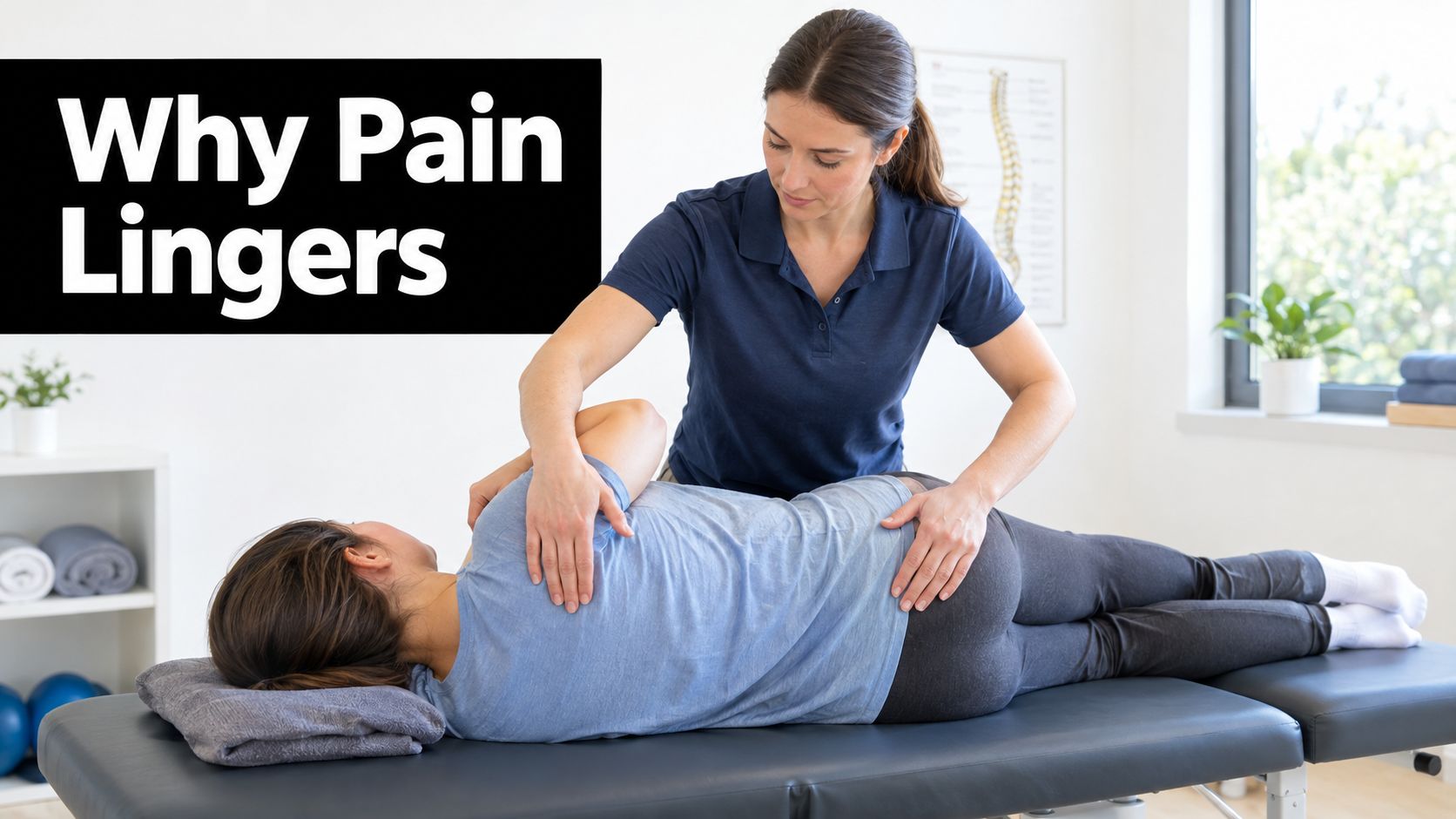
Why generic stretching misses the target
A tight hamstring may reflect how you use your hips and spine, not a simple shortage of flexibility. A stiff neck may involve the upper back, shoulder blade, or deep neck muscles rather than the spot that hurts. If a nerve is sensitive, forcing a stretch can increase symptoms instead of improving mobility.
An individualized assessment looks at:
- Movement direction: Whether bending, extending, rotating, or reaching changes symptoms.
- Load tolerance: How the back or neck responds to sitting, walking, lifting, or overhead work.
- Strength and endurance: Whether supporting muscles fatigue before the task is complete.
- Coordination: Whether the hips, trunk, shoulders, and neck share movement efficiently.
- Symptom behavior: Whether pain stays local or travels into an arm or leg.
Clinical rule: Temporary relief is useful information, but it isn't proof that the underlying problem has been corrected.
For active people, pain can also change how they train. Someone returning to running may need a graded plan that addresses cadence, hip control, trunk endurance, and recovery rather than just avoiding every run. A practical companion is this VitzAi.com back pain running guide, especially when deciding how to modify activity without abandoning movement altogether.
The Core Treatment, Progressive Exercise Therapy
Progressive exercise is the foundation of a defensible plan for persistent, non-specific low back pain. A Cochrane review pooled evidence from 2,746 participants across 35 studies and found moderate-certainty benefit compared with no treatment, usual care, or placebo. Pain improved by about 15 points on a 0–100 scale, while functional limitation improved by about 6.8 points. The functional change didn't reach the usual minimal clinically important difference threshold, so expectations should remain realistic. (Cochrane review of exercise therapy for chronic low back pain)
The practical interpretation matters. Exercise is not a magic reset, and a stronger feeling after one session isn't the same as restored capacity. For chronic pain, the most reliable target is a gradual reduction in symptoms and improved tolerance for daily tasks. Evidence is weaker for acute low back pain, where exercise appears no better than sham or placebo or no treatment in the short term. That makes assessment and timing important.
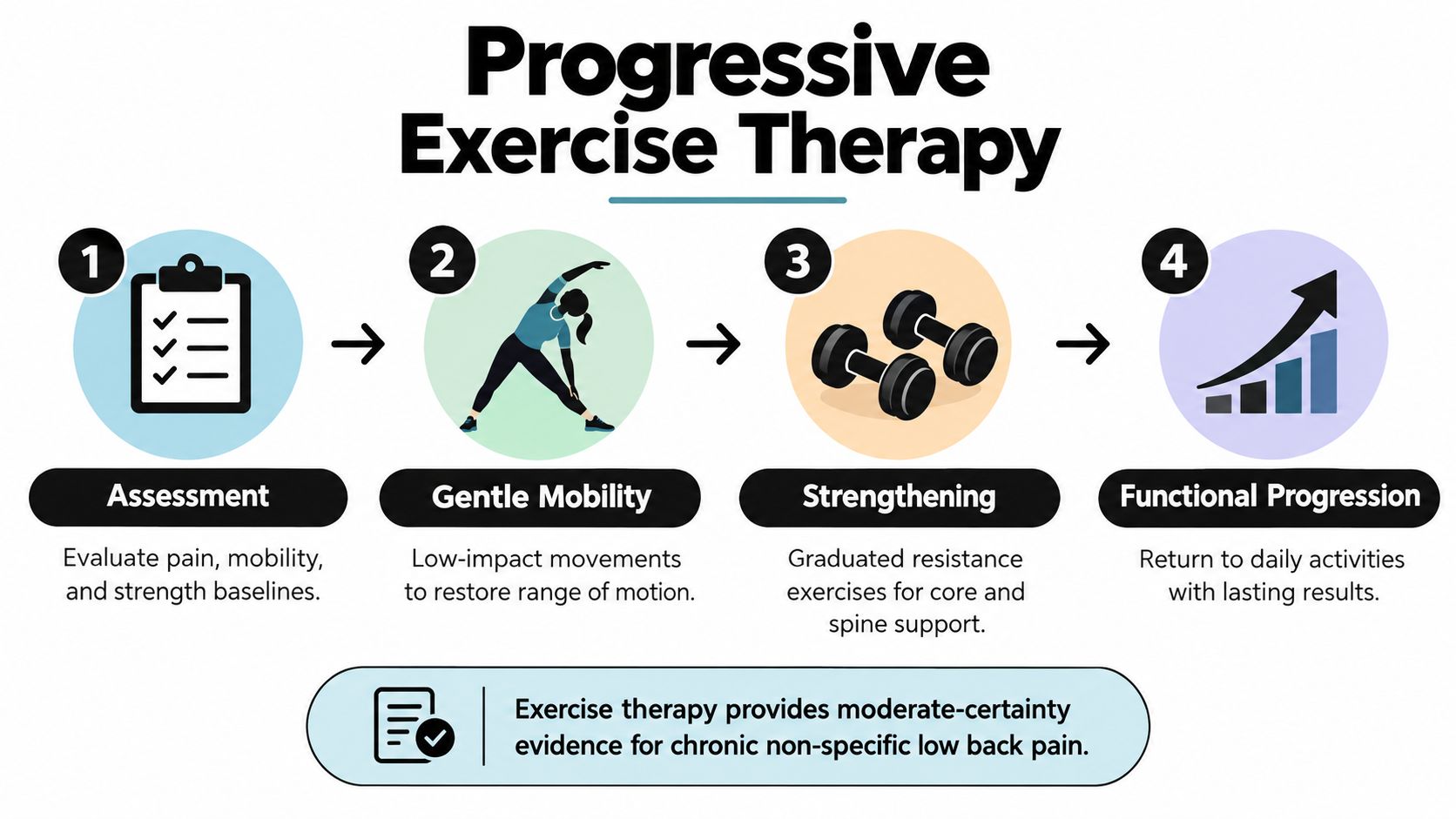
How therapists dose exercise
A good program changes as your response changes. Early sessions may use supported positions, breathing, gentle mobility, and low-load isometrics. Later work can include squats, hinges, carries, rows, cervical strengthening, trunk rotation, and task-specific lifting.
The therapist isn't choosing exercises because they're fashionable. Each movement should answer a clinical question:
- Mobility work: Can you access a useful range without provoking symptoms?
- Strength work: Can the hips, trunk, shoulder girdle, or neck produce force safely?
- Endurance work: Can you maintain control during a work shift, walk, drive, or training session?
- Functional progression: Can you return to the task that matters, not just complete an exercise in the clinic?
Home practice also needs a sensible dose. Gentle bedtime stretching benefits may help someone settle before sleep, but stretching shouldn't replace strengthening when weakness or poor endurance is part of the problem. A focused resource on core-strengthening exercises can complement a clinician-designed plan, provided the exercises match your symptoms and current ability.
The best protocol is rarely the hardest one. It's the one you can perform consistently, recover from, and progress without repeatedly triggering the same flare.
Manual Therapy vs Active Rehabilitation
Hands-on treatment and exercise aren't competing philosophies. They serve different purposes.
Manual therapy may reduce muscle guarding, improve a restricted joint's movement, or make a painful area easier to use. That short-term window can be valuable. A patient who couldn't rotate the neck comfortably may move better after treatment, which gives the therapist an opportunity to reinforce that range with active control.
The limitation is that passive improvement doesn't automatically transfer to lifting, walking, work, or sport. Someone can feel looser after manipulation or soft-tissue work and still return to the same overloaded movement pattern later that day. A clinic that relies on passive care alone may provide comfort without building capacity.
What the evidence supports
Guideline reviews for neck pain consistently support reassurance, advice to stay active, exercise therapy, and manual therapy combined with exercise. Strengthening for the upper quarter can have a moderate effect on pain, but no single exercise type has proved clearly superior. The practical message is active rehabilitation first, manual treatment as an adjunct. (Guideline synthesis for neck pain)
| Approach | Useful role | Main limitation |
|---|---|---|
| Manual therapy | Reduces guarding and helps a patient access movement | Effects may be temporary without active retraining |
| Mobility exercises | Restores comfortable range | Range alone doesn't build load tolerance |
| Strengthening | Improves force production and support | Requires gradual dosing and patient participation |
| Functional practice | Connects therapy to work, sport, and daily tasks | Can flare symptoms if progressed too quickly |
For a closer look at options such as joint mobilization, soft-tissue work, and assisted movement, review these manual physical therapy techniques. The right question isn't, “Should I choose massage or exercise?” It's, “What hands-on treatment will help me perform the active work that changes my movement?”
What to Expect at MedAmerica Rehab Center
A first visit should feel like an assessment, not a conveyor belt of identical treatments. You'll usually discuss when symptoms began, what makes them worse, what helps, your work and activity demands, previous injuries, and any medical concerns that could change the plan.
The therapist then watches you move. That may include walking, bending, reaching, rotating, getting up from a chair, lifting, or turning the neck. Strength, range of motion, balance, reflexes, and symptom response can all help determine whether the problem is primarily mechanical, nerve-related, load-related, or a combination.
A typical first-visit plan
Suppose sitting aggravates your low back, standing feels better, and lifting from the floor causes a sharp increase. A useful first visit might identify limited hip mobility, poor trunk endurance, and an overly rounded lifting strategy. Treatment could begin with education, a comfortable movement direction, hip and trunk exercises, and a modified lifting rehearsal.
The plan should include clear instructions:
- What to do at home: Exercises, walking or activity guidance, and the intended dose.
- What to modify: Positions or tasks that need temporary adjustment.
- What progress means: Easier dressing, longer walks, improved sleep, or safer lifting.
- When to contact the clinic: New weakness, spreading numbness, severe worsening, or other concerning symptoms.
MedAmerica Rehab Center offers physical therapy, chiropractic care, acupuncture, and shockwave therapy, with treatment selected around the patient's presentation and goals. That multidisciplinary model can be useful when exercise, education, hands-on care, and symptom management need to work together, but the plan should still explain how each treatment supports active recovery.
Advanced Modalities and Supportive Treatments
Modalities have a place, but they shouldn't distract from the work that restores capacity. Shockwave therapy, acupuncture, dry needling, heat, cold, or electrical stimulation may help selected patients manage pain or tolerate movement. Their value depends on the diagnosis, symptom duration, tissue involved, and response to treatment.
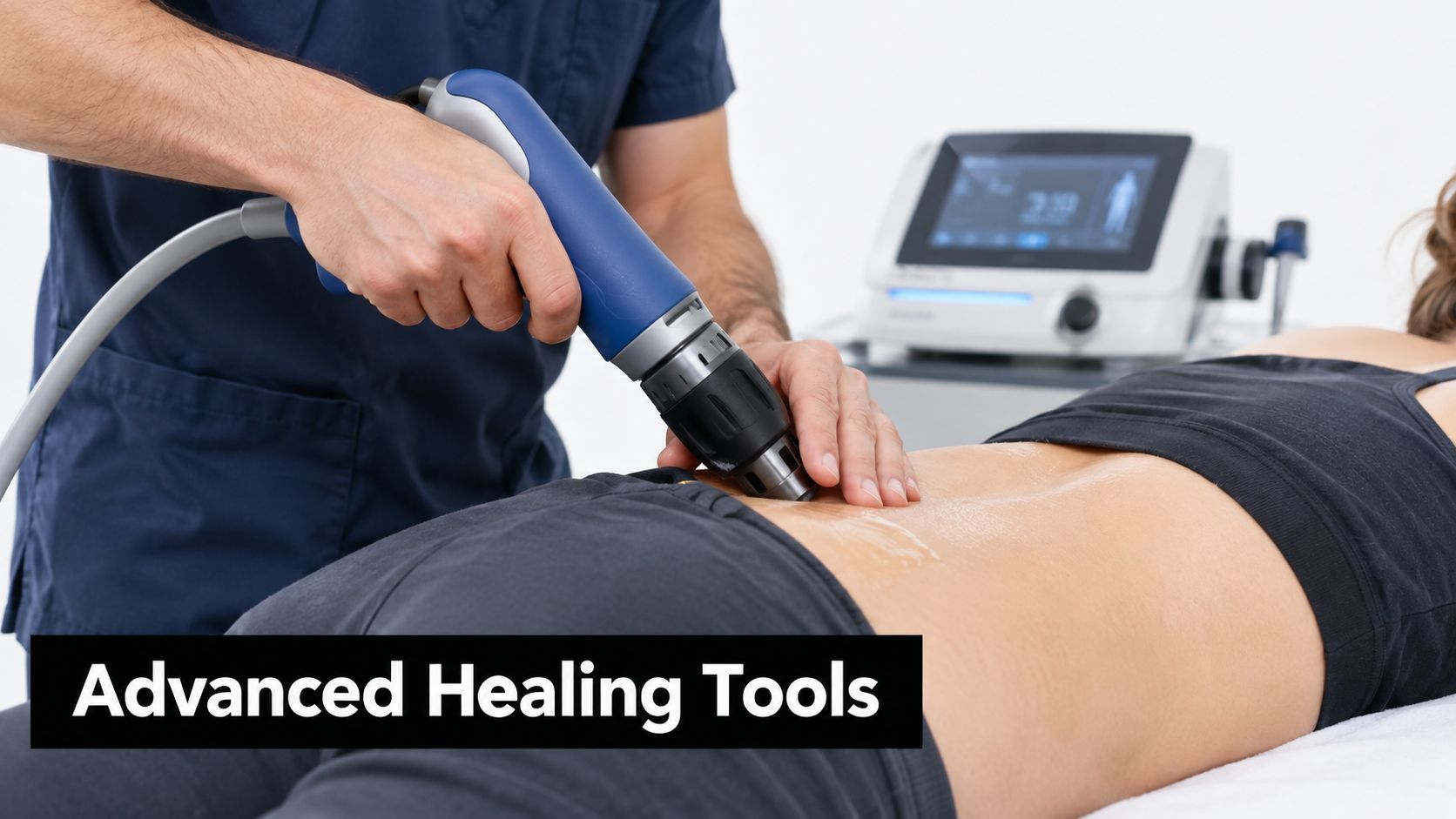
Shockwave therapy is sometimes considered for persistent soft-tissue problems when standard care hasn't produced enough improvement. It can be uncomfortable, and it isn't appropriate for every pain source. A therapist should explain what tissue is being targeted, what response is expected, and how the treatment connects to exercise.
Patients also ask about supplements and non-prescription options. If you're considering cannabidiol products, this practical guide on choosing CBD for back pain may help you identify questions about product quality and safety. It shouldn't replace medical advice, particularly if you take medication or have a complex condition.
The same principle applies to dry needling. It may reduce muscle tone or pain sensitivity for some people, but it doesn't correct a lifting strategy, restore neck endurance, or rebuild tolerance for work. Read about dry needling in physical therapy to understand how it can fit within a broader plan.
A modality is worthwhile when it helps you participate in rehabilitation. It becomes a distraction when every visit ends with passive treatment and no measurable progression.
Common Mistakes That Delay Recovery
Rest feels safe when movement hurts, but prolonged inactivity can leave the body less prepared for ordinary demands. The answer isn't to push through severe pain or ignore warning signs. It's to keep appropriate movement available and adjust the load instead of stopping everything.
Four patterns I see repeatedly
- Chasing the painful spot: Repeatedly stretching the tight area may calm symptoms without changing the movement pattern that keeps provoking it.
- Doing too much on good days: A sudden return to heavy lifting, long drives, or intense exercise can exceed current capacity and trigger another flare.
- Treating pain reduction as the only goal: Feeling better matters, but walking tolerance, strength, range, sleep, and confidence also show whether recovery is progressing.
- Switching plans too quickly: Exercise requires a fair trial and sensible progression. Changing routines every few days makes it difficult to know what helps.
Practical rule: Modify the task before abandoning all movement. A shorter walk, lighter load, supported position, or slower repetition can preserve progress.
Don't ignore symptoms that need medical assessment. New or worsening weakness, significant numbness, loss of coordination, unexplained systemic illness, or bowel and bladder changes require prompt professional attention rather than a home stretching experiment.
Taking the Next Step Toward Pain-Free Living
Start by choosing a clinician who will assess movement and explain the reasoning behind treatment. Ask whether the plan includes progressive exercise, how the home program will be adjusted, and what signs would indicate that you need medical evaluation or a different referral.
Bring useful information to the appointment:
- Symptom timeline: Note when the pain began and whether it followed an injury, workload change, or illness.
- Aggravating activities: Record what happens with sitting, walking, lifting, sleeping, driving, or exercise.
- Current strategies: List stretches, medications, treatments, and exercises you've already tried.
- Functional goals: Be specific, such as returning to gardening, turning your head while driving, carrying a child, or completing a work shift.
- Relevant history: Include surgeries, imaging, previous episodes, medical conditions, and medications.
Expect the first plan to evolve. A movement that is appropriate during a flare may not be enough once symptoms settle, while a demanding exercise may need to be delayed until basic control improves. Evidence for chronic low back pain supports progressive exercise, while the evidence is less convincing for exercise as a short-term treatment for acute low back pain, so the stage and pattern of pain matter. (Cochrane evidence on exercise therapy)
For persistent low back pain with fear of movement, ongoing disability, or poor response to standard exercise, ask whether psychologically informed physical therapy or a multidisciplinary pathway is appropriate. Recent guideline work has placed greater emphasis on matching treatment to these patient subgroups rather than giving everyone the same routine. (Guideline draft on acute and chronic low back pain)
You don't need to wait until pain disappears before rebuilding capacity. You need a plan that respects irritability, progresses carefully, and connects each exercise to the life you want to resume.
MedAmerica Rehab Center provides individualized physical therapy, chiropractic care, acupuncture, and shockwave therapy for back and neck pain in Deerfield Beach. Visit MedAmerica Rehab Center to arrange an evaluation and discuss a rehabilitation plan built around your symptoms, movement, and daily goals.
MedAmerica Rehab · Deerfield Beach
Talk to a clinician about your pain
Physical therapy, chiropractic, acupuncture and shockwave therapy under one roof, since 1995. Same-day appointments are available.
Mon–Thu 8:00 AM – 6:30 PM · Fri 8:00 AM – 3:00 PM