
Flexibility Training for Seniors: A Safe, Step-by-Step Plan
If you've noticed that turning to check your blind spot feels tighter, or that tying a shoe now takes a little planning, you're not imagining it. Most older adults don't lose flexibility all at once. They notice it in ordinary moments. Reaching for a seatbelt. Getting a foot up to put on a sock. Looking over a shoulder when backing out of a parking space.
That's usually when people start asking the wrong question. They ask, “What stretch should I do?” The better question is, “What's limiting me right now?” Sometimes it's stiffness. Sometimes it's weakness. Sometimes it's pain. And those three problems don't respond to the same plan.
That's how I approach flexibility training for seniors. Stretching matters, but it works best as an enabler. Better range of motion can make walking, strengthening, balance work, and daily tasks easier. It isn't a complete solution by itself, and it shouldn't be sold that way.
Why Flexibility Changes After 60
A common story goes like this. A person in their sixties or seventies reaches back for the seatbelt and realizes the shoulder doesn't glide the way it used to. Another bends to tie a shoe and feels the hips stop early. Nothing dramatic happened. There wasn't a fall or a new injury. The motion just got smaller and stiffer over time.
That pattern fits what we see with aging. Research in older adults found that shoulder and hip flexibility decreased by about 6 degrees per decade, with significant declines beginning after age 70 in one study of adults ages 55 to 86, as reported in this older-adult flexibility review. That doesn't mean decline is untouchable. The same review also described supervised flexibility training over 12 weeks that improved flexibility by 9.03% in one protocol and 22.96% in another, which is a useful reminder that older tissue still adapts.
What's changing in the body
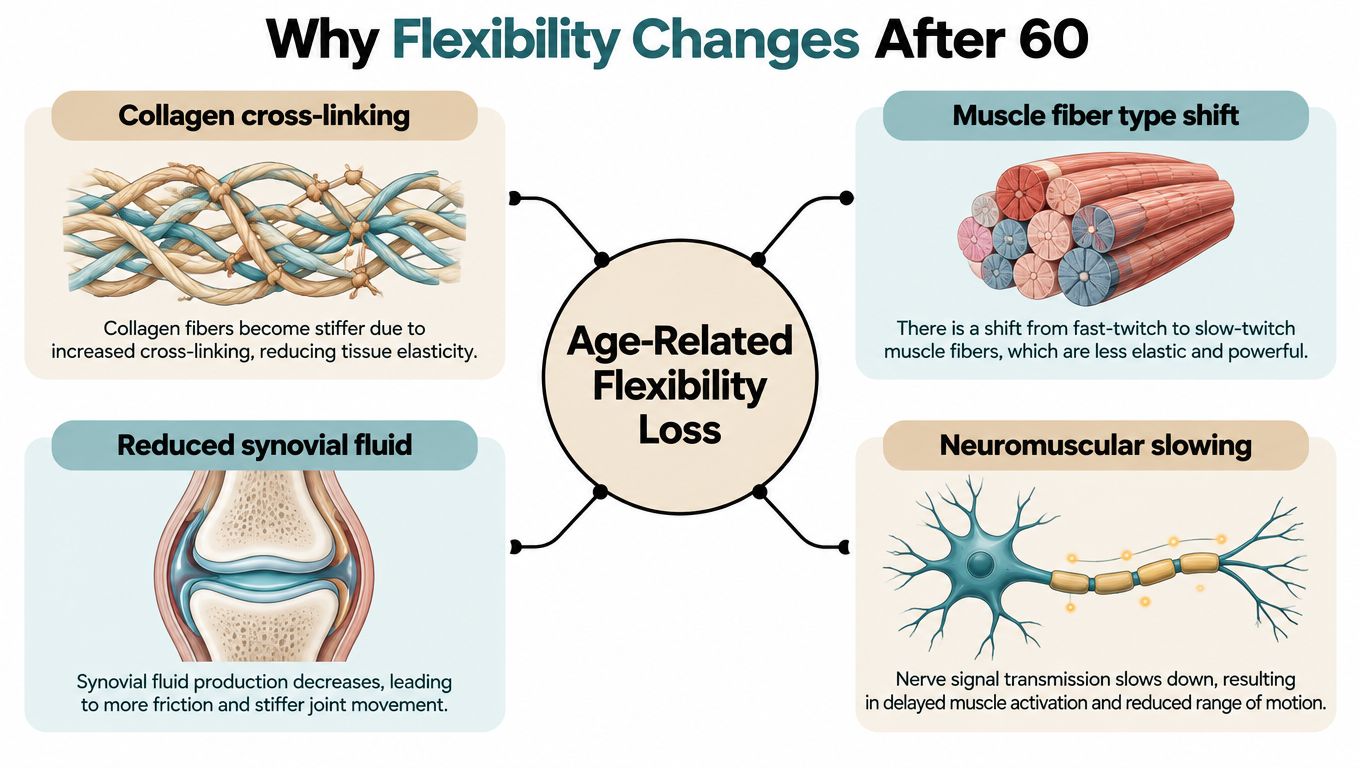
Part of the change is mechanical. Connective tissue gets stiffer with age. Collagen becomes more cross-linked and less forgiving. Joints often feel less smooth after long periods of sitting. Tissues don't spring back as easily as they did years earlier.
Another part is neurological. The brain and body stop trusting certain motions when they haven't been practiced. People move less at end range, then lose comfort there, then avoid it even more. That's one reason “I'm just stiff” can turn into “I don't turn that way anymore.”
What's normal and what isn't
Normal age-related stiffness usually builds gradually. It often improves after a bit of movement and feels symmetrical or at least familiar.
These signs deserve more caution:
- Sudden loss of motion that appeared over days instead of months
- Noticeable swelling after normal movement
- Night pain that wakes you or keeps returning
- Sharp pinching inside a joint rather than a broad muscle pull
Flexibility affects mobility, but it isn't the whole picture. A person can have looser hamstrings and still struggle to stand from a chair if the real limiter is leg strength.
That's the key frame for the rest of this guide. Better range helps, but your plan should still answer one triage question first. Is the main problem stiffness, weakness, or both?
What the Guidelines Actually Recommend
Many adults either underdo stretching or turn it into a heroic project they can't sustain. The middle ground works better. A major guideline for adults age 65 and older recommends flexibility activities at least 2 days per week for at least 10 minutes per day, with each static stretch held 10 to 30 seconds and repeated 3 to 4 times, according to the ACSM and AHA guideline for older adults. That same guideline explains that flexibility helps older adults maintain the joint range needed for daily life and regular physical activity.
That's the floor, not the ideal for everyone. In clinic, most older adults do better with short, repeatable sessions than with one long weekly session they dread.
What those recommendations look like in real life
If you translate the guideline into a weekly calendar, it looks less intimidating:
| Parameter | ACSM Position | Practical Application |
|---|---|---|
| Frequency | At least 2 days per week | Pick 2 fixed days to start, then add brief daily work if you tolerate it |
| Session length | At least 10 minutes per day | A short post-walk or post-exercise routine works well |
| Hold time | 10 to 30 seconds | Start near the lower end if you're guarded or painful |
| Repetitions | 3 to 4 times | Repeat the same stretch instead of constantly switching exercises |
| Purpose | Maintain range needed for daily life and activity | Use stretches that support dressing, walking, reaching, and turning |
Where many programs fall short
The guideline tells you how often and how long. It doesn't fix poor technique. The mistakes are predictable:
- Bouncing at end range instead of holding still
- Holding the breath while the neck and shoulders tense up
- Stretching into pain instead of mild tension
- Treating flexibility as a substitute for strength and balance work
Practical rule: If your routine fits the guideline on paper but leaves you sore, tense, and skipping the next session, the dose is wrong.
A practical program for older adults often works better when stretching is paired with the rest of training rather than isolated from it. Flexibility helps you access better positions. Strength helps you own those positions. Balance helps you use them safely.
Warming Up Before You Stretch
The fastest way to make stretching feel bad is to do it cold. Someone sits through breakfast, walks to a chair, reaches for a hamstring stretch, and immediately feels blocked. That's not stubborn tissue. That's a body that hasn't been prepared to move.
A brief warm-up changes the session. The point isn't to get tired. The point is to get the joints moving, raise tissue temperature a bit, and make end range feel less threatening.
A simple warm-up sequence that works
A practical older-adult protocol uses a short aerobic warm-up before static stretching, then places static holds after training or light exercise. Expert guidance also recommends at least 2 days per week, notes that daily stretching tends to produce better gains, and suggests holding each stretch 30 to 60 seconds for 2 to 4 repetitions per muscle group until slight discomfort, not pain, as outlined in this AAFP review of flexibility exercise and older-adult programming.
Use that structure with a simple sequence:
March in place or walk slowly
Keep it easy. Let the arms swing. The goal is circulation, not cardio.Heel-to-toe walking
This wakes up the ankles and feet and starts to organize balance.Shoulder rolls and scapular glides
Think smooth circles, then gentle shoulder blade squeeze and release.Seated trunk rotations or gentle cat-cow
Move through the middle back instead of forcing the lower back.Light dynamic motions
Controlled leg swings, straight-leg kicks, or arm swings through a comfortable range.
If you want examples that fit lower-body prep especially well, this guide to leg warm-up exercises for safer movement is a useful add-on before you settle into longer holds.
How to know you're ready to stretch
Don't overcomplicate it. Your body is ready when the first few reps stop feeling rusty. A shoulder that felt sticky at the start should turn a little easier. A hamstring that felt like a hard stop should feel more elastic.
Use these cues:
- Breathe out on effort. Don't brace through the warm-up.
- Keep the tempo controlled. No jerking, no flinging.
- Look for less resistance. If the target area feels exactly as blocked after moving, you may need a gentler setup or a different exercise.
Cold stretching is one of the most common reasons seniors decide flexibility work “doesn't help.” Usually the problem isn't stretching itself. It's the order.
A Four-Week Stretching Progression
Most seniors don't need a complicated routine. They need one they'll repeat. The best early progression starts with supported positions, then gradually asks for more control, a little more range, and better tolerance in standing and on the floor if floor work is safe for them.
This plan assumes your main limiter is ordinary stiffness, not sharp pain. Keep every stretch at a level of mild pull, never strain. Start with 20-second holds, build toward 30 seconds, and repeat 2 to 3 times per side. Exhale as you settle into the stretch.
Week-by-week structure
| Week | Primary Stretches | Hold Time | Key Modification | Progression Cue |
|---|---|---|---|---|
| Week 1 | Seated hamstring, seated figure-4, neck rotations, shoulder rolls | Start at 20 seconds | Use a firm chair and keep the range small | Less guarding and smoother breathing |
| Week 2 | Standing hip flexor stretch, standing calf stretch, repeat best Week 1 moves | Build toward 20 to 30 seconds | Hold a counter or wall for balance | Stand taller without leaning away |
| Week 3 | Wall chest stretch, thoracic extension over chair back, continue hip and calf work | 30 seconds if tolerated | Keep ribs down and avoid low-back arching | Better posture and easier overhead reach |
| Week 4 | Child's pose with chair support, supine spinal twist, continue selected standing work | 30 seconds | Skip floor work if getting down or up isn't safe | Deeper relaxation, not forced range |
How to run each week
Week 1 is about access. Use chair-assisted stretches because they reduce fear and let you focus on position. A seated hamstring stretch works best when the spine stays long instead of rounded. For the figure-4, don't crank on the knee. Lean forward from the hips only as far as the hip allows.
Week 2 introduces standing stretches because daily life happens upright. The calf and hip flexor are common culprits in short steps, forward posture, and stiff transitions. Keep a hand on a wall or kitchen counter. Balance support is not cheating. It lets the target area work without a wobble taking over.
If the stretch gets deeper only because you're twisting, shrugging, or holding your breath, that isn't progress. It's compensation.
Week 3 often helps the person who says, “My shoulders feel fine until I try to reach overhead.” Chest and upper-back mobility matter more than many people realize. A wall-based chest stretch and supported thoracic extension can make reaching less crowded without aggressively yanking on the shoulder itself.
Week 4 adds floor-supported options only if floor transfers are safe. If they aren't, stay with chair and wall versions. Plenty of older adults make excellent gains without ever lying on the floor.
Modifications that matter
For arthritis flares
Use shorter holds and smaller ranges. Aim for symptom-calming movement, not deep lengthening.After joint replacement
Follow the surgeon's or therapist's precautions first. Don't assume a standard hip or knee stretch is appropriate.With osteoporosis
Avoid forcing spinal flexion or twisting aggressively, especially under load.
If part of your goal is rotational movement for recreation, golf is a good example of where mobility has to support coordinated movement rather than exist on its own. This guide on how to improve your golf swing with mobility is a solid illustration of that idea.
Sample Weekly Plans You Can Follow
A routine works when it fits your day. The best plan is often attached to something you already do, after a walk, after morning coffee, or before dinner. If flexibility training for seniors feels like a separate project, it usually fades.
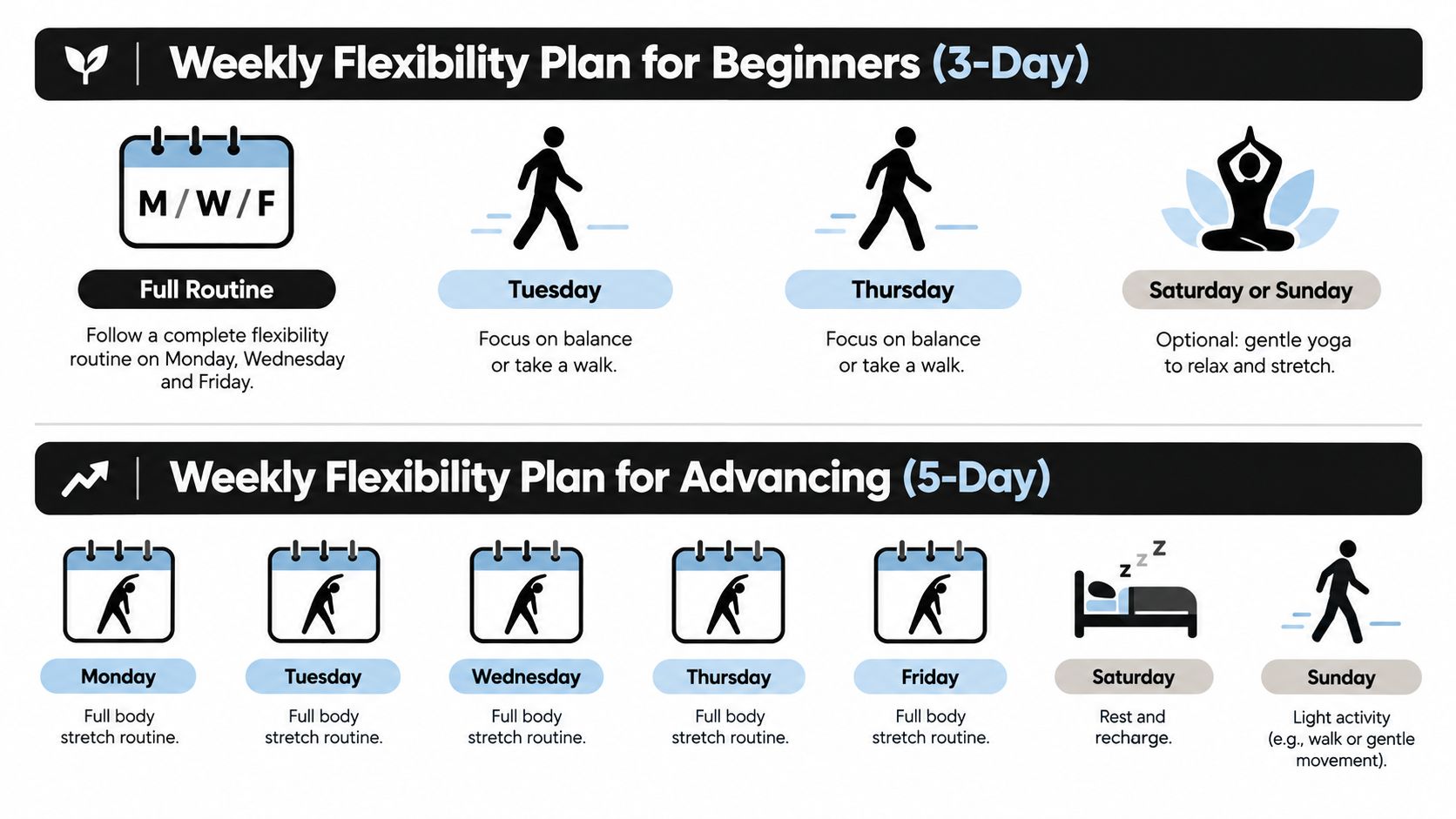
A realistic beginner plan
For a beginner, a 3-day plan is enough to build momentum.
Monday, Wednesday, Friday
Full stretch routine after a walk or after a short home exercise sessionTuesday and Thursday
Walking or simple balance practiceWeekend
Optional gentle mobility or rest, depending on how the body feels
A sample day might look like this:
Walk or warm-up
Use easy marching, walking, or heel-to-toe work.Main stretches
Pick four to six stretches, not twelve.Balance finisher
Tandem stance, supported single-leg stance, or weight shifts.
For a broader home menu, these mobility exercises for older adults pair well with a stretching routine and help fill in the movements that static holds miss.
For active seniors who already move well
A 5-day plan works better for the person who already walks, exercises, or plays a sport regularly.
Most weekdays
Brief daily mobility flowTwo days per week
Longer sessions with slower holds and more attention to specific problem areasOne or two easier days
Keep movement light and let tissues settle
Research in older adults shows that flexibility gains can appear after 3 to 4 weeks of regular practice, with larger gains when stretching is done daily, based on the same AAFP review of flexibility programming. That doesn't mean more is always better. It means consistency matters.
A sample minute-by-minute session
Minutes 1 to 5
Gentle warm-up and dynamic movementMinutes 6 to 14
Main stretches for hips, calves, chest, and shouldersMinutes 15 to 20
Balance or strength accessory work
Rest days still matter. If every session leaves you more guarded the next day, reduce the dose. Stretching should help you move into life, not recover from the stretching session itself.
Matching Stretches to Your Main Limiter
This is the decision point most articles skip. They hand everyone the same routine and call it “mobility.” That's not how older bodies work. A person limited by stiffness needs a different answer than a person limited by weakness. A person limited by pain needs an evaluation before they need more stretching.
Three triage questions
Ask yourself:
- Can you reach to the top of a shelf without hiking the shoulder or arching the back?
- Can you stand from a chair without pushing hard with your hands?
- Can you sit comfortably without constant shifting because one area feels jammed or irritated?
Those answers usually point in a useful direction.
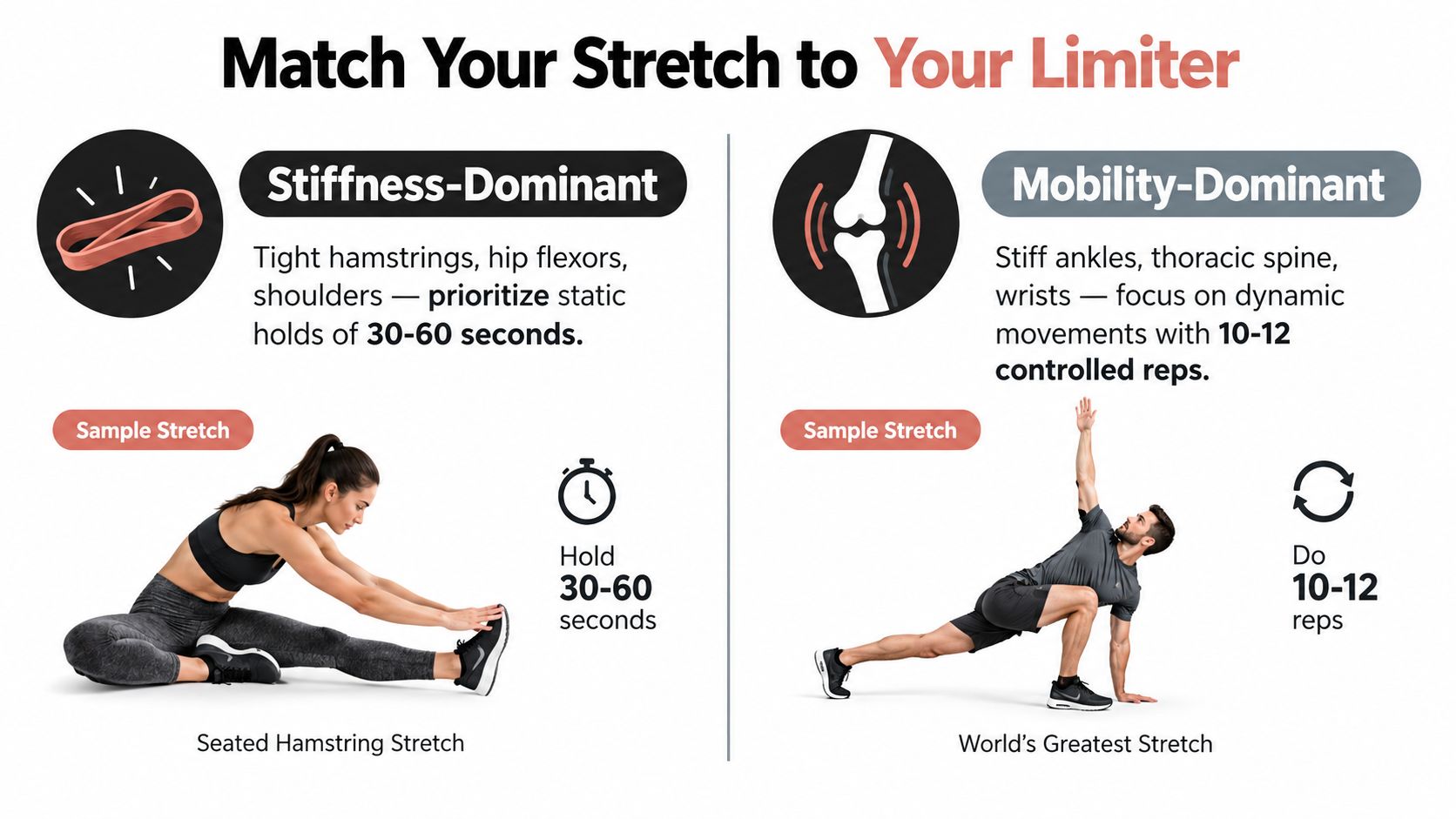
If stiffness is the main problem
Stiffness-dominant limits often show up as tight hamstrings, front-of-hip tightness, or shoulders that feel blocked at end range. In that case, static stretching usually belongs in the plan. A randomized home-based study of 90 older adults with leg tightness and or suspected sarcopenia supports a triage model that matches the intervention to whether the main limiter is stiffness, weakness, or both, rather than giving everyone the same routine, as described in this PubMed summary of older-adult home exercise triage.
Use longer holds, patient breathing, and a little support so you can relax into the position.
If weakness is the real limiter
If the hard part is climbing stairs, getting out of a chair, or controlling your body in standing, stretching alone won't solve much. A major review found that flexibility-specific programs often improved range of motion, but results for daily function were inconsistent, according to this review of flexibility training and functional outcomes in older adults.
That's why weakness-dominant problems usually need strengthening first, or at least strengthening alongside stretching. Resistance bands, sit-to-stands, step-ups, and supervised exercise often do more than chasing looser muscles.
A short demonstration can help you separate these categories in practice:
If you need simple movement ideas before full stretching feels appropriate, these range of motion exercises for home practice are a reasonable starting point.
If pain is leading the whole picture
Sharp joint pain, pinching, nerve symptoms, or pain that escalates with each session changes the plan completely. That person doesn't need a more aggressive hamstring stretch. They need the cause sorted out.
Treat ongoing stiffness with weakness or pain as a triage signal, not as proof you haven't found the right stretch yet.
Red Flags and When to See a Therapist
Stretching discomfort is usually broad, local, and predictable. You feel a pull in the muscle. It eases when you come out of the position. It doesn't hijack your walking or wake you up later.
Joint irritation and nerve irritation behave differently. They feel sharper, hotter, more electric, or more pinpointed. Those symptoms deserve respect.
Stop and get checked if you notice these signs
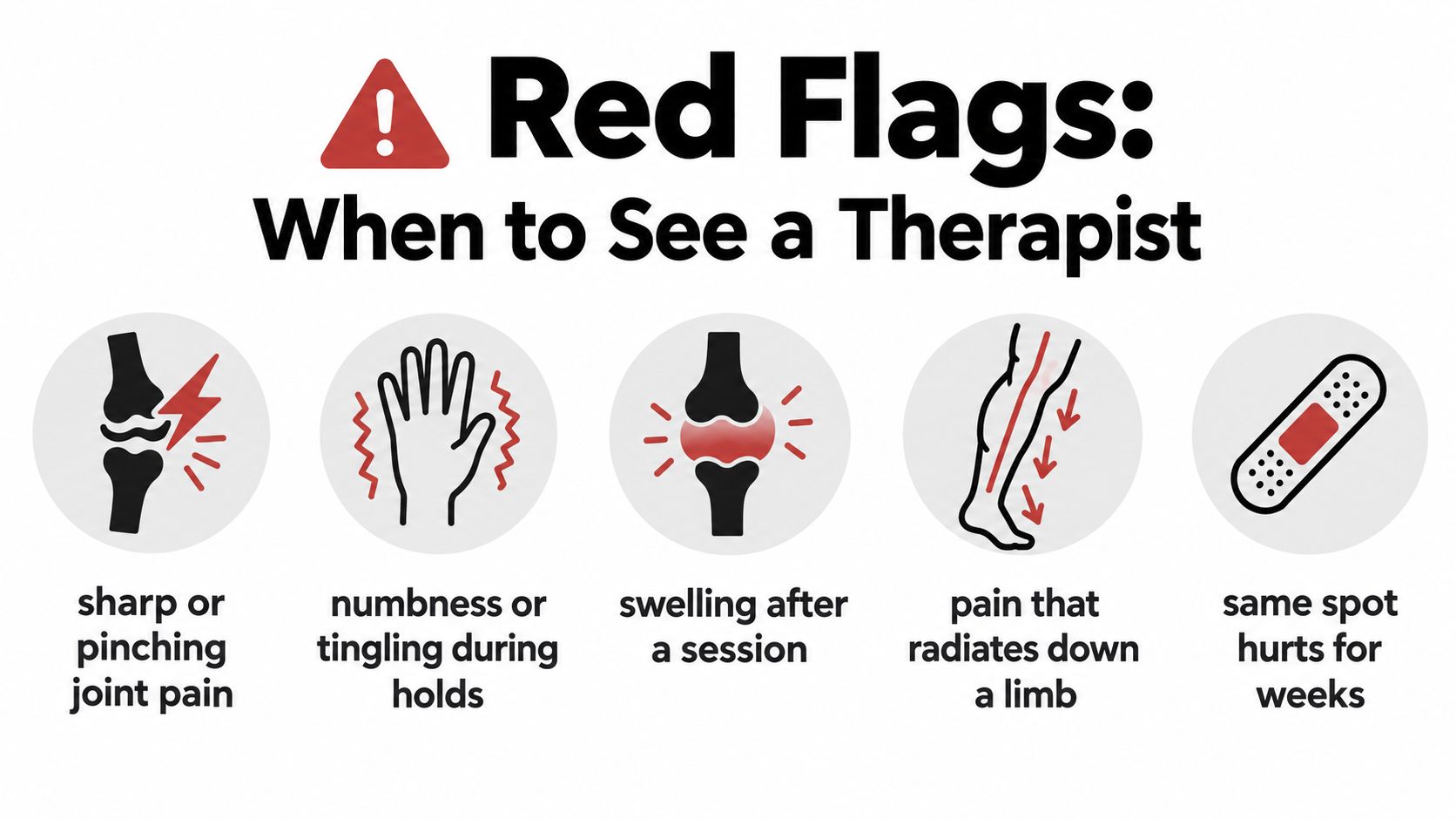
Use a simple stop rule if any of these show up:
- Sharp or pinching joint pain during the stretch
- Numbness or tingling during or after holds
- Swelling after a session
- Pain that wakes you at night
- Loss of motion that keeps getting worse instead of leveling off
A good practical cutoff is this. If symptoms don't settle within a day, or if they interfere with walking, rising from a chair, or sleeping, don't just keep repeating the same routine.
What a therapist looks at that a stretch chart doesn't
A proper assessment looks beyond tight muscles. It checks joint mobility, strength, balance, walking pattern, and how you move from one task to another. That matters because the painful shoulder may be moving poorly because the upper back is stiff, or the “tight hamstring” may be protecting an irritated back.
There's also a pain-specific angle worth keeping in mind. An exploratory systematic review published in 2025 found that isolated flexibility training reduced chronic pain symptoms in older adults across included studies, with signals for joint stiffness, movement discomfort, and osteoarthritis-related pain, but it also emphasized the limited number of high-quality trials and the shift toward individualized, multicomponent exercise rather than generic stretching advice, as summarized in this PubMed record on flexibility training and chronic pain in older adults.
When stretching isn't enough
If your routine helps you feel looser but the improvement disappears quickly, that often means the bigger issue hasn't been addressed yet. The same is true if your flexibility improves but daily function doesn't.
Some older adults need manual therapy, gait work, balance retraining, or progressive strengthening more than they need another printable stretch sheet. MedAmerica Rehab Center offers physical therapy, balance and gait training, and individualized exercise planning for problems like arthritis, post-surgical stiffness, and mobility loss. In the right situation, that targeted approach is more useful than adding another generic home routine.
If stiffness, pain, or balance issues are getting in the way of daily life, MedAmerica Rehab Center can help you sort out whether the limiter is flexibility, strength, joint restriction, or something else entirely. The team works with older adults on personalized plans that may include hands-on therapy, mobility work, balance training, and home exercises so your stretching routine supports the rest of your movement.
MedAmerica Rehab · Deerfield Beach
Talk to a clinician about your pain
Physical therapy, chiropractic, acupuncture and shockwave therapy under one roof, since 1995. Same-day appointments are available.
Mon–Thu 8:00 AM – 6:30 PM · Fri 8:00 AM – 3:00 PM