
Best Legs Warm Up Exercises for Mobility in 2026
You're standing at the edge of a workout, a long walk, or a day that already made your knees and hips feel older than they are. The temptation is to skip straight into movement, but stiff joints and sleepy glutes usually make that a bad trade. The better option is a short, structured warm-up that gets the legs ready without wasting energy.
Why Most Leg Warm Ups Fall Short
Most legs warm up exercises lists fail because they treat every body like an athlete mid-season. That leaves out the desk worker with tight hips, the older adult watching balance carefully, and the person coming back from knee or back pain. A generic “do some leg swings” plan can be fine for a healthy runner, but it's not enough guidance when the question is what to do with a stiff, sore, or unpredictable body.
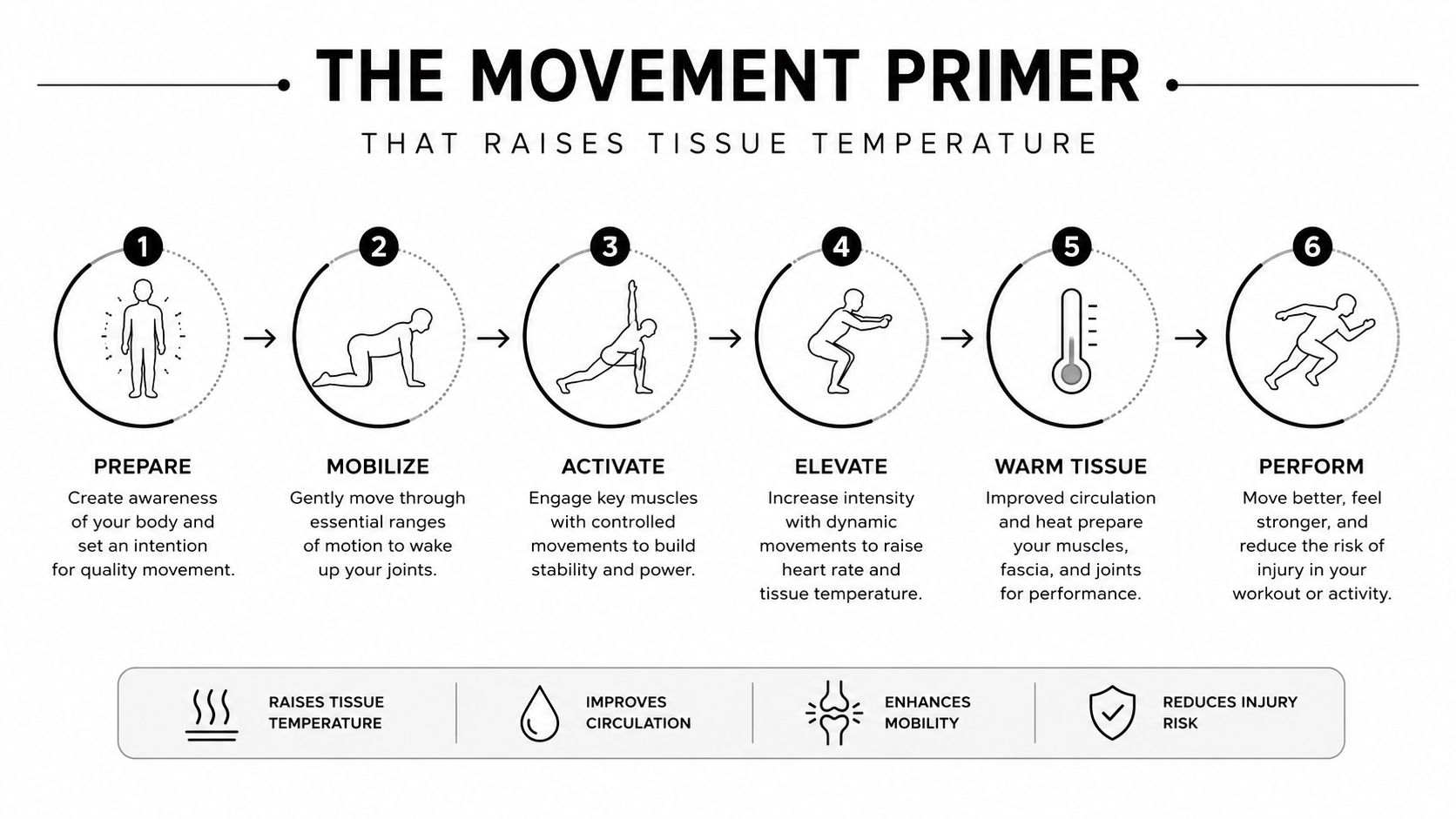
A better warm-up starts with a simple idea, prepare the system in layers. The clinic room teaches this every day. First raise tissue temperature, then switch on the stabilizers, then open the joints you need, then finish with movement that matches the day's task. That sequence keeps the warm-up short and useful, instead of random.
The structure that holds up best is an 8 to 12 minute flow. That lines up with practical guidance from Mayo Clinic, which recommends 5 to 10 minutes of gentle movement for low-intensity activity and 10 to 15 minutes of dynamic stretching and mobility for more vigorous exercise, with examples like leg swings, walking lunges, body-weight squats, and gentle calf stretches. Mayo Clinic's warm-up guidance is a good anchor for that pacing.
For athletes who want a sport-specific template, improve soccer performance drills can be a useful reference point, but the core lesson is broader. The warm-up should fit the body in front of you, not the most athletic body in the room.
Practical rule: if a warm-up feels like a mini workout, it's probably too much. If it feels like nothing happened, it's probably too little.
The Movement Primer That Raises Tissue Temperature
The first few minutes should feel almost too easy. That's the point. Light movement wakes up circulation, warms the tissues around the knees and hips, and makes the rest of the routine feel smoother, especially if you've been sitting for hours.
Pick low-impact movement first
Use 3 to 5 minutes of gentle cardio before any deeper mobility work. Treadmill walking at a mild incline, easy cycling, or marching in place all work. If you're on a treadmill, a small incline is enough, there's no need to climb a hill before breakfast. If you're marching, keep the steps smooth and rhythmic, with your breathing just starting to change.
The goal here is not conditioning. It's a rise in temperature and blood flow so the joints stop feeling glued together. After a day at a desk, even a short walk can change how the hips and ankles respond. If a bike is available, it's often one of the easiest ways to warm the legs without irritating the knees.
Use body signals, not the clock alone
A good movement primer ends when the body gives clear signs that it's ready. Look for a little warmth, slightly increased breathing, and less stiffness when you start to bend or step. Those cues matter more than trying to hit an exact pace.
The internal reference most readers need here is a basic range-of-motion checklist, and this ROM exercise guide fits well with that idea. The point is not to stretch harder. It's to move more freely before load shows up.
Clear transition sign: once the legs feel warmer and the first few bends are less stiff, move on. Don't stay in the primer long enough to tire yourself out.
Activation and Mobility Drills for the Hips, Glutes, and Ankles
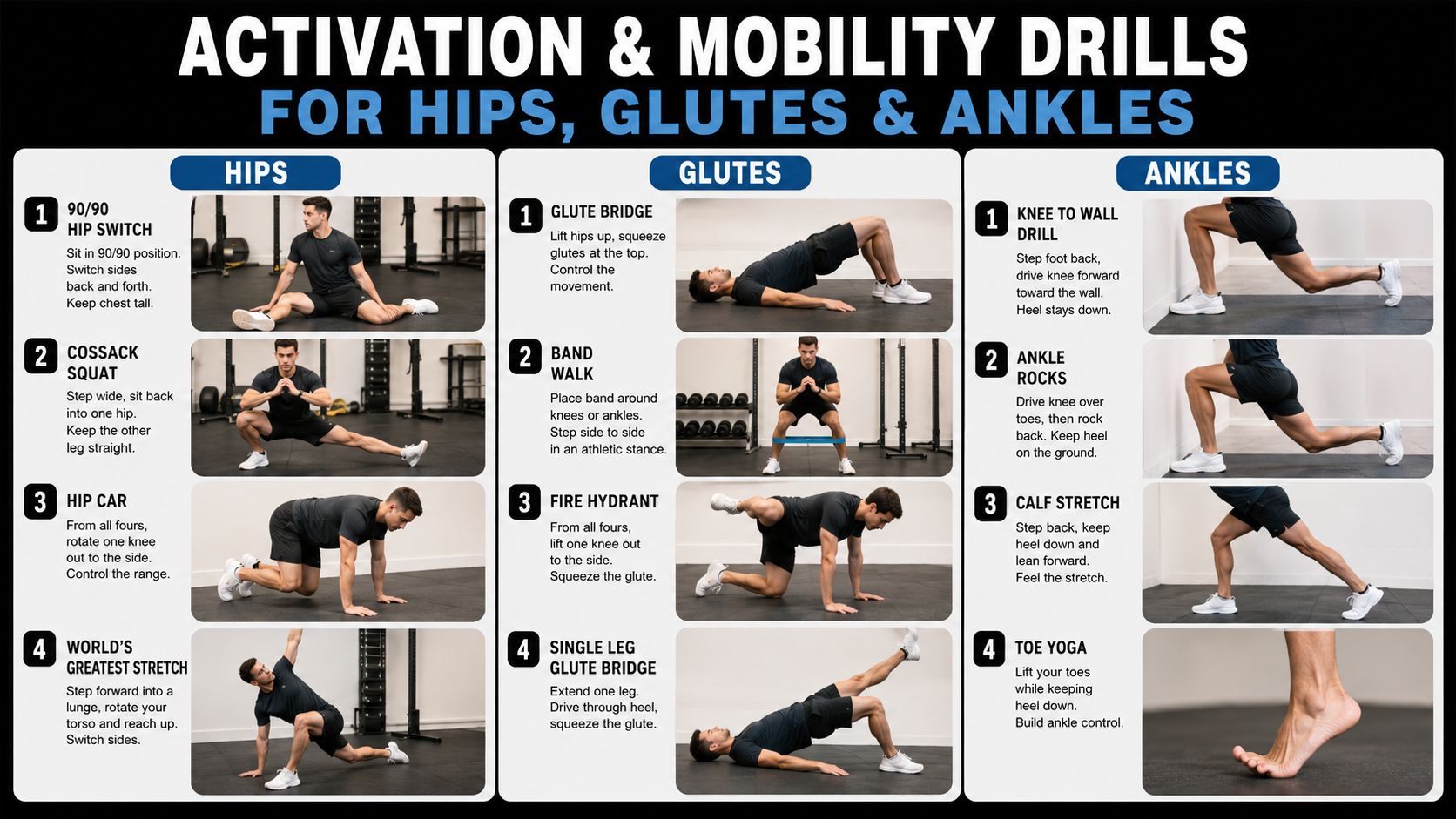
Once the tissues are warm, the warm-up gets more specific. Now you wake up the muscles that keep the knees tracking well, the hips sharing the work, and the ankles moving instead of leaking force. For readers looking for more lower-body mobility work, this hip mobility guide is a helpful companion.
Start with the glutes and hips
Do 2 sets of 10 glute bridges. Keep the ribs down, feet flat, and push through the heels without arching the lower back. The most common mistake is letting the low back do the work, which usually means the glutes are still asleep. If you feel it mostly in the back, shorten the range and squeeze the butt at the top instead of lifting higher.
Next, add banded lateral walks for short steps to each side. Stay low enough to feel the outer hips, but don't sink into a squat that changes your posture. The knees should stay aligned with the toes, not cave inward as fatigue shows up.
Open the joints without forcing them
For mobility, use deep squat holds only if they're comfortable. A supported version works better for many people, especially if balance is limited. Add ankle circles and controlled leg swings to keep the lower leg and hip moving in a way that previews walking, lifting, or sport. If a movement pinches or gives sharp discomfort, stop and shrink the range right away.
Breathing matters here. Exhale during the hardest part of each rep, especially in squat holds or bridge lifts. That keeps the trunk from bracing so hard that the hips never get to move. When in doubt, make the rep smaller and cleaner, not bigger and sloppier.
The Maximum Health calisthenics routine is a useful example of how bodyweight work can be sequenced well, but the clinic version keeps the same principle simple. Activate what stabilizes, then mobilize what tends to stiffen, then move on only when both feel smooth.
Clinical shortcut: if the knees are collapsing or the back is arching, the drill is too advanced for that moment. Reduce the range before you add more reps.
Matching Dynamic Drills to Your Activity
The final layer should match the day's actual demand. A runner doesn't need the same finish as someone preparing for squats, and a senior going for a neighborhood walk doesn't need court-sport lateral work. That's where many warm-ups go wrong, they copy drills instead of matching patterns.
For race-day planning, this guide to marathon race day success offers a useful reminder that warm-up choices should support the task ahead, not compete with it. The same logic applies to all lower-body prep.
| Activity | Recommended Drills | Primary Benefit |
|---|---|---|
| Running | High knees, butt kicks | Primes hip drive, cadence, and leg turnover |
| Lifting | Walking lunges, bodyweight squats | Prepares the squat and hinge patterns |
| Court or field sport | Lateral shuffles, quick direction changes | Wakes up side-to-side control and footwork |
| Daily walking | Heel-to-toe walks, easy marching | Supports balance and smooth gait |
Choose the drill that previews the task
If the workout is a run, use quick, light steps that teach the legs to cycle. If it's a lifting session, choose patterns that reinforce the positions you'll load. If it's a general movement day, keep the drills controlled and low-risk.
For a simple 5K-oriented sequence, this 5K warm-up resource lines up well with the same logic. The specific drill matters less than the pattern match.
If the drill looks nothing like the activity, it usually belongs in a different warm-up.
Common Mistakes That Undercut Even a Good Warm Up
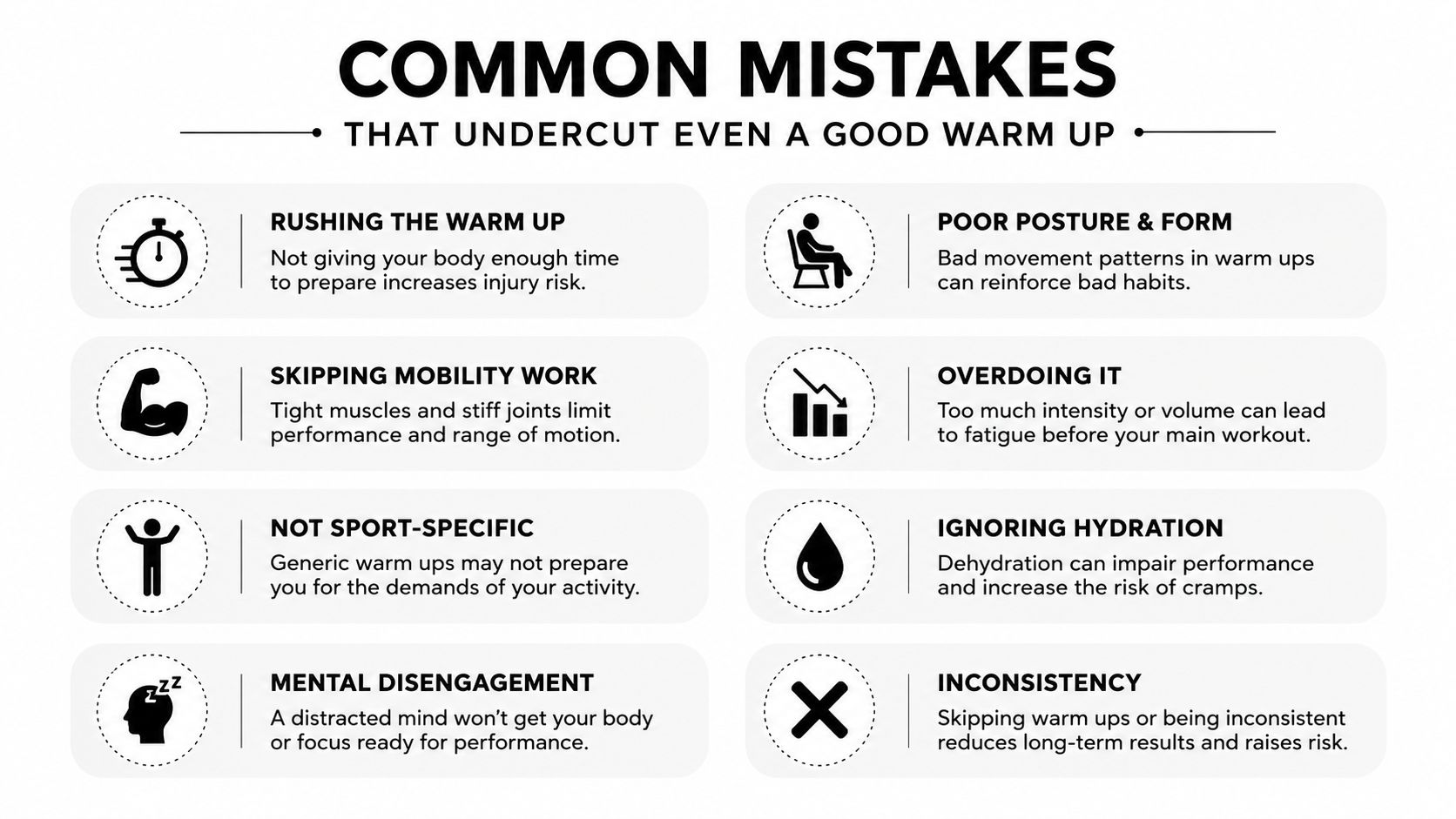
A warm-up can be well chosen and still fail if it's performed badly. The biggest problem I see is not exercise selection, it's order and intent. People start with long static holds, rush the mobility work, skip the final ramp-up sets, and then wonder why the first working set feels off.
Static stretching first is usually the wrong start
The 2023 systematic review in male youth soccer players found that switching from a standard warm-up to stretching-based warm-ups had no measurable effect on jump height, sprint speed, or ball-kicking speed, regardless of whether the stretching was static, dynamic, ballistic, or PNF. That review is useful because it reminds us that a stretch is not automatically a performance booster.
That doesn't make stretching useless. It means timing matters. If you want your legs to feel ready for movement, start with movement, then mobilize. Save long static holds for later unless a clinician has prescribed them for a specific reason.
Don't rush the ramp-up sets
A lot of lifters get the mobility part right and then fail at the transition into load. The expert warm-up sequence that works best is gradual, with lighter sets before the first main lift and lower reps as weight climbs. That progression prepares the nervous system for the working load instead of shocking it.
Pain is not a cue to push through
If a drill causes sharp pain, dizziness, or a lasting flare, it needs to change. That's especially true when the issue is not muscle tightness but joint irritation, balance loss, or post-surgical sensitivity. The warm-up should leave the body feeling better, not more guarded.
Don't use the same routine forever
A desk worker, a runner, and a senior with arthritis don't need identical prep every day. The best warm-up adapts to the body, the task, and the symptoms present that morning.
Modifications for Knee Pain, Arthritis, and Limited Mobility
The standard warm-up is not the safest warm-up for everyone. Adults with knee arthritis, hip stiffness, back pain, balance problems, or a recent injury often need lower-impact substitutions that still prepare the legs without flaring symptoms. The Arthritis Foundation's advice that some movements should be modified for joint limitations fits that reality, and it's why symptom-first planning beats copying a fitness routine.

Swap depth and balance demands before you swap effort
If deep squat holds bother the knees, use supported wall sits or a shallow sit-to-stand instead. If walking lunges feel unstable, use step-ups to a low box with a hand nearby for balance. If high knees aggravate the back or feel too bouncy, switch to low-resistance cycling or marching while holding the counter.
For people with poor balance, chair-supported marches are often a better start than free-standing drills. The goal is still warm-up, not challenge. As soon as you need to brace or compensate heavily, the drill is too advanced for that day.
Know the stop signs
Pain that feels sharp, shifting, or unstable needs attention. So does dizziness, swelling, or pain that lingers more than a day after the session. A warm-up should create a sense of easier movement within about 10 minutes. If it makes you feel worse, the body is telling you the plan needs to be changed, or evaluated.
For older adults, for people coming back from surgery, and for anyone with back or knee symptoms that keep repeating, safety comes before athletic-style intensity. Better modifications now usually mean more consistency later.
Quick Answers and When to See a Therapist
How long should a leg warm-up take? Usually 8 to 12 minutes is enough, with a little longer if you're about to train hard or feel especially stiff. Should you warm up on rest days? If the goal is to move better, yes, but keep it light and easy. What if warming up increases pain? Stop and switch to a gentler version, or get it checked.
How soon before exercise should you do it? Close enough that you stay warm, but not so long that you cool back down. If you notice persistent joint pain, swelling, instability, or a change in how you walk, it's time for an in-person evaluation rather than another internet routine.
If your legs feel stiff, uneven, or painful before exercise, a personalized plan can make a big difference. MedAmerica Rehab Center helps people sort out knee, hip, back, and balance issues with practical care that matches the body in front of them. If you're in Deerfield Beach and want a safer approach to movement, visit MedAmerica Rehab Center and book an appointment.
MedAmerica Rehab · Deerfield Beach
Talk to a clinician about your pain
Physical therapy, chiropractic, acupuncture and shockwave therapy under one roof, since 1995. Same-day appointments are available.
Mon–Thu 8:00 AM – 6:30 PM · Fri 8:00 AM – 3:00 PM