

Physical Therapy vs Chiropractor for Back Pain
You wake up, roll toward the edge of the bed, and feel the familiar catch in your lower back. Sitting through work sounds difficult, bending over feels risky, and a quick online search produces two obvious options: physical therapy or a chiropractor. One promises exercises and movement retraining. The other emphasizes hands-on spinal care. Both may help, but they aren't interchangeable, and the right starting point depends on your symptoms, diagnosis, recovery stage, and goals.
The practical question isn't which profession is better. It's which treatment fits the type of back pain you have right now, and whether the plan gives you tools to stay better. Evidence supports both approaches for many presentations, while newer research points toward a broader answer: coordinated care that combines hands-on treatment, exercise, education, and self-management may be more useful than choosing one side of the debate.
Why Back Pain Patients Feel Stuck Choosing Between Two Paths
A typical patient starts searching after pain has already disrupted normal life. You may have lifted something awkwardly, spent too long at a desk, or developed symptoms that now travel from the back into the hip or leg. The search results blur together terms such as adjustment, mobilization, core strengthening, decompression, stretching, and rehabilitation. That volume of advice makes a straightforward decision feel surprisingly complicated.
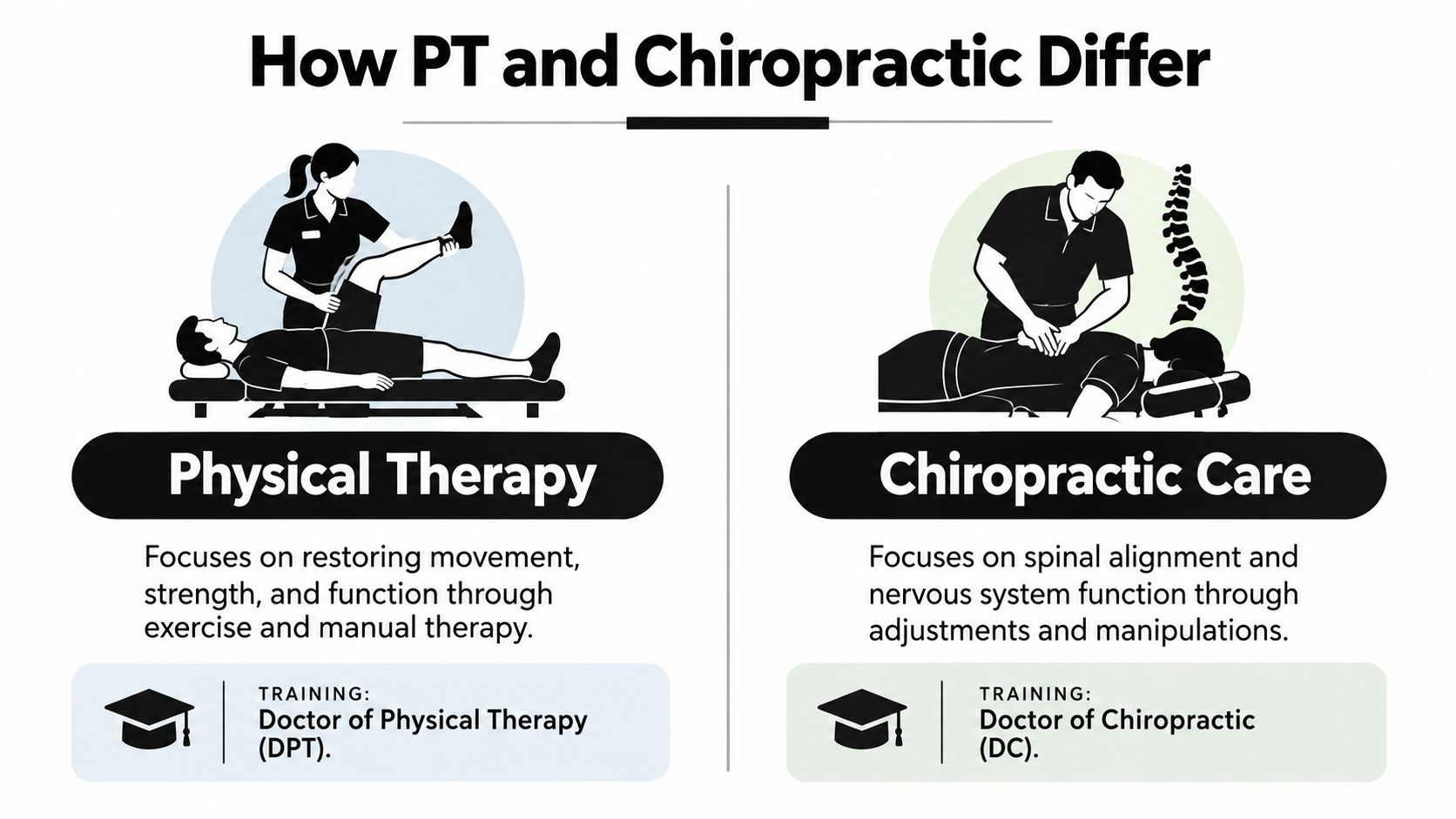
The first distinction is simple. Physical therapy generally emphasizes active recovery, using exercise, movement retraining, manual therapy, and education to improve function. Chiropractic care generally emphasizes spinal and joint assessment, with manipulation or other hands-on techniques used to address restricted movement and symptoms. In practice, qualified clinicians in both fields may use overlapping tools, but the treatment experience and the role expected of you can differ substantially.
A person with a recent episode of stiffness may value short-term symptom relief and improved movement. Someone with recurring pain, weakness, reduced tolerance for walking, or symptoms after surgery may need a progressive rehabilitation plan that builds capacity over time. Neither situation can be judged accurately from the phrase “back pain” alone.
Practical rule: Choose based on the problem being treated, not on the loudest promise in an advertisement.
Your provider search matters, too. Clinics that explain their services clearly, identify the conditions they treat, and show how care is delivered make it easier to compare options. A useful resource such as this chiropractor marketing guide can also help you recognize the difference between a clinic's service description and a claim that needs stronger clinical support.
The rest of the decision comes down to four questions: How long have you had the pain? Does it stay in the back or travel into a limb? What activities do you need to resume? Do you prefer a hands-on session, an exercise-led plan, or a combination? Those answers usually narrow the path more effectively than a generic “PT versus chiropractor” ranking.
How Physical Therapy and Chiropractic Care Actually Differ
Physical therapy is built around movement, function, and progressive participation. During an evaluation, a physical therapist may examine your walking pattern, spinal and hip movement, strength, balance, lifting strategy, and the activities that provoke symptoms. Treatment can include therapeutic exercise, joint or soft-tissue manual therapy, neuromuscular reeducation, education about pacing, and a home program that evolves as your capacity improves.
Chiropractic care commonly centers on the relationship between spinal or joint motion and symptoms. A chiropractor may use a hands-on adjustment, a specialized table, or an instrument-assisted technique. The immediate aim is often to reduce discomfort or improve a restricted movement, after which the clinician may recommend mobility work, stretching, or other supportive care. You can learn more about the mechanics and purpose of an adjustment in this explanation of how chiropractic adjustment works.
The difference isn't that one discipline uses hands-on care and the other never does. Physical therapists frequently use manual therapy, and chiropractors may prescribe exercises. The more useful distinction is the center of gravity of the plan. PT tends to make your active rehabilitation the main event. Chiropractic care often makes the hands-on spinal intervention the main event, although individual practices vary.
The practical differences during a visit
A PT appointment usually involves reassessment, guided movement, exercise instruction, and a discussion of how symptoms respond to specific activities. You should expect to do meaningful work during the visit and receive guidance for what to practice between appointments. A chiropractic visit may involve a focused spinal assessment followed by manipulation and adjunctive mobility or soft-tissue care. The amount of exercise and education depends on the clinician and the clinic.
| Criteria | Physical Therapy | Chiropractic Care |
|---|---|---|
| Primary emphasis | Restoring movement, strength, function, and self-management | Spinal and joint mobility, often through manipulation |
| Your role | Active participant during visits and between appointments | Often receives hands-on care, with activity recommendations varying by provider |
| Common techniques | Therapeutic exercise, manual therapy, neuromuscular reeducation, education | Spinal manipulation, mobilization, instrument-assisted techniques, mobility work |
| Best fit to discuss first | Weakness, recurring symptoms, movement limitations, post-surgical recovery | A recent mechanical flare with stiffness or a preference for hands-on care |
| Key question to ask | “How will we progress my strength and function?” | “What will we do beyond repeated adjustments?” |
A strong plan in either setting should include a clear working diagnosis, measurable functional goals, a reason for each treatment, and a point at which the plan will be reassessed. Passive relief can be useful, but it shouldn't become the entire recovery strategy if your underlying limitations remain unchanged.
What the Clinical Evidence Says About Effectiveness and Cost
The head-to-head evidence doesn't identify a universal winner. A landmark randomized trial published in 1998 compared the McKenzie method of physical therapy, chiropractic manipulation, and an educational booklet for low back pain. It found no significant differences between the physical therapy and chiropractic groups in symptoms, function, days of reduced activity, missed work, or recurrences over the study period. In one analysis, mean care costs over two years were close, $437 for physical therapy and $429 for chiropractic care. Another report from the same study described total treatment costs of $238.54 for physical therapy and $226.08 for chiropractic care, with about 2.5 hours of total treatment time for each. These figures come from the landmark New England Journal of Medicine trial, so they shouldn't be treated as current prices at your local clinic.
The broader evidence adds important context. A Cochrane evidence summary on combined chiropractic interventions reported only small short-term benefits for acute and subacute low back pain. The review reported pain effects of SMD -0.25 and mean difference -0.89, with no significant long-term pain difference, reported as MD -0.46. Those findings don't mean chiropractic care is useless. They mean expectations should be measured, especially when the proposed plan relies mainly on manipulation.
What exercise-based rehabilitation adds
Evidence for physical therapy-style manual therapy combined with exercise is stronger when the outcome includes pain, function, and broader health measures in the short-term window. A review of manual therapy and exercise for low back pain found moderate-to-strong evidence for measurable gains over one to three months, while chronic cases may improve in pain, function, and quality of life when manual therapy is paired with exercise or usual medical care. Manual therapy alone has less consistent added value over exercise-only programs, as summarized in this review of manual therapy and exercise evidence.
Spinal manipulation also has a legitimate place. A meta-analysis of 26 trials found statistically significant but modest improvements in pain and function lasting up to six weeks, and a BMJ review found outcomes similar to recommended therapies for chronic low back pain across short-, intermediate-, and long-term follow-up. Adverse events were usually minor and transient, but the evidence doesn't show manipulation to be clearly superior to conventional exercise-based rehabilitation, according to this review of spinal manipulative therapy.
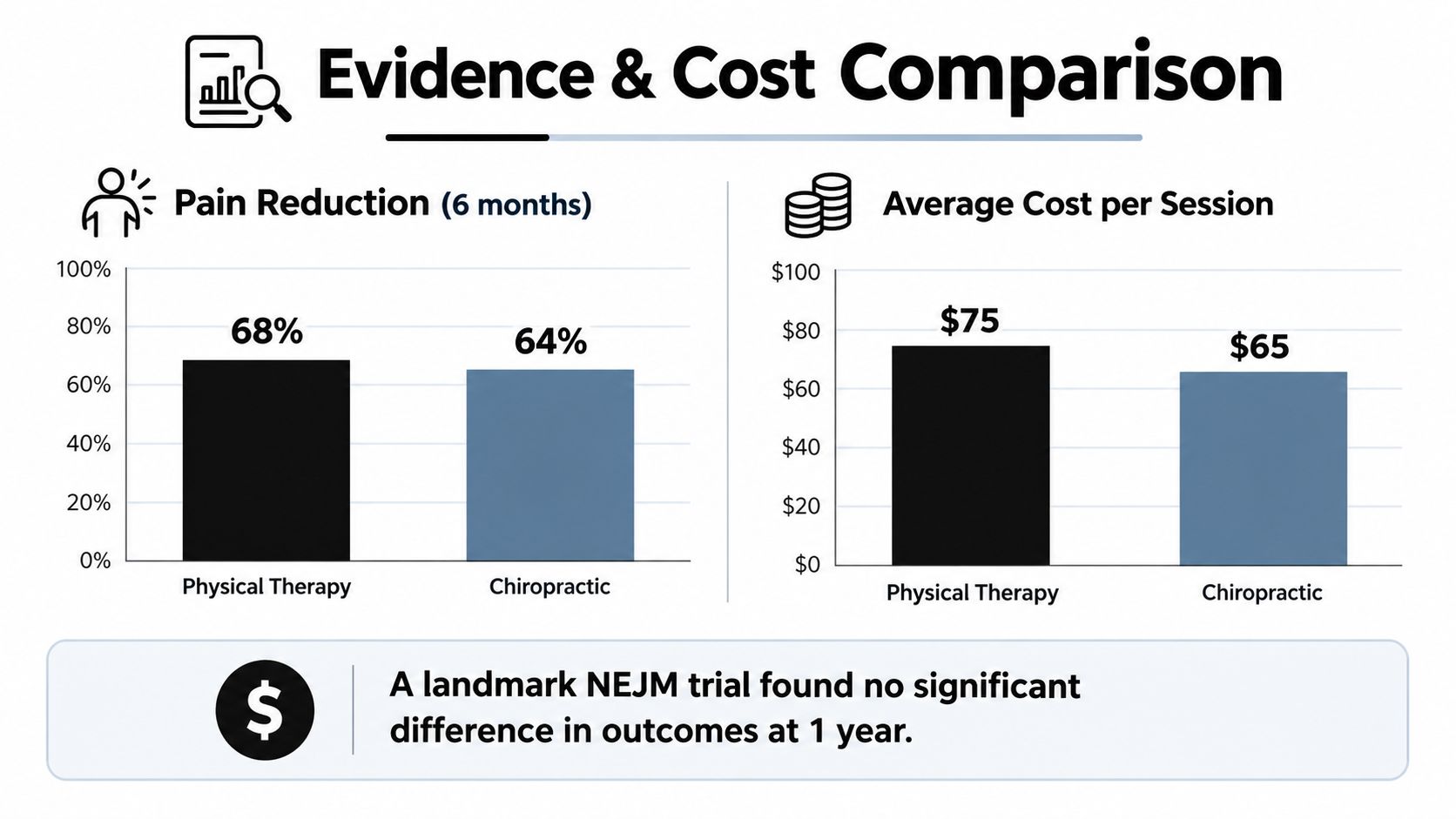
The cost lesson is equally practical. A low per-visit charge doesn't tell you the full financial commitment, and a higher charge doesn't automatically represent better value. Ask what the evaluation includes, whether home exercise instruction is part of the plan, how progress will be measured, and when the clinician expects to reduce or stop visits.
Which Treatment Fits Your Specific Type of Back Pain
“Back pain” describes a symptom, not one condition. The best choice changes depending on whether you have a short-lived strain, persistent mechanical pain, leg symptoms from an irritated nerve, narrowing around the spine, or a post-surgical limitation.

Recent strain or mechanical stiffness
If pain began recently after lifting, gardening, travel, or an awkward movement and you don't have progressive weakness or concerning neurological symptoms, either discipline may be reasonable to discuss. Chiropractic manipulation may appeal if stiffness and restricted movement dominate your complaint. PT may be the better first conversation if you want symptom relief paired immediately with a plan for restoring lifting, bending, walking, and work tolerance.
A good clinician won't force a technique because you requested it. They'll screen for warning signs, test movement, and explain what they expect to change.
Persistent or recurring mechanical pain
For pain that keeps returning, exercise-led rehabilitation deserves a prominent role. The problem may involve reduced hip or trunk strength, poor tolerance for sustained positions, fear of movement, or an activity load that exceeds current capacity. PT can address those contributors directly through graded strengthening, movement retraining, education, and a home program.
Chiropractic care may still be useful for selected patients who experience meaningful short-term relief from manipulation, especially when it helps them participate in active rehabilitation. The important question is whether each visit moves you toward greater independence or provides another temporary reset.
Disc-related symptoms, radiculopathy, or stenosis
Pain traveling into the buttock or leg, numbness, tingling, or weakness calls for a more careful neurological assessment. The clinician should examine strength, sensation, reflexes, walking, and symptom behavior before recommending treatment. A PT-led program may emphasize positions and movements that reduce leg symptoms, progressive strengthening, nerve-related mobility work when appropriate, and strategies for restoring daily function.
Manipulation shouldn't be selected casually for a complex presentation, but fear-based claims that it is uniquely dangerous also oversimplify the evidence. A matched-cohort study of nearly 70,000 patients found that spinal manipulative therapy wasn't associated with a higher risk of cauda equina syndrome than physical therapist-led exercise, according to this 2026 study summary. That finding adds nuance, not a blanket guarantee of safety. New bowel or bladder changes, saddle numbness, or rapidly worsening weakness require urgent medical assessment rather than routine treatment selection.
Recovery after surgery
Post-surgical rehabilitation needs to follow the procedure, tissue-healing stage, surgeon's restrictions, and current strength. Physical therapy is usually central because the plan must progress mobility, trunk and hip strength, gait, work tasks, and confidence without exceeding precautions. Chiropractic care may be considered only when the surgical team and treating clinicians agree that it fits the recovery plan.
When Combining Both Approaches Produces Better Results
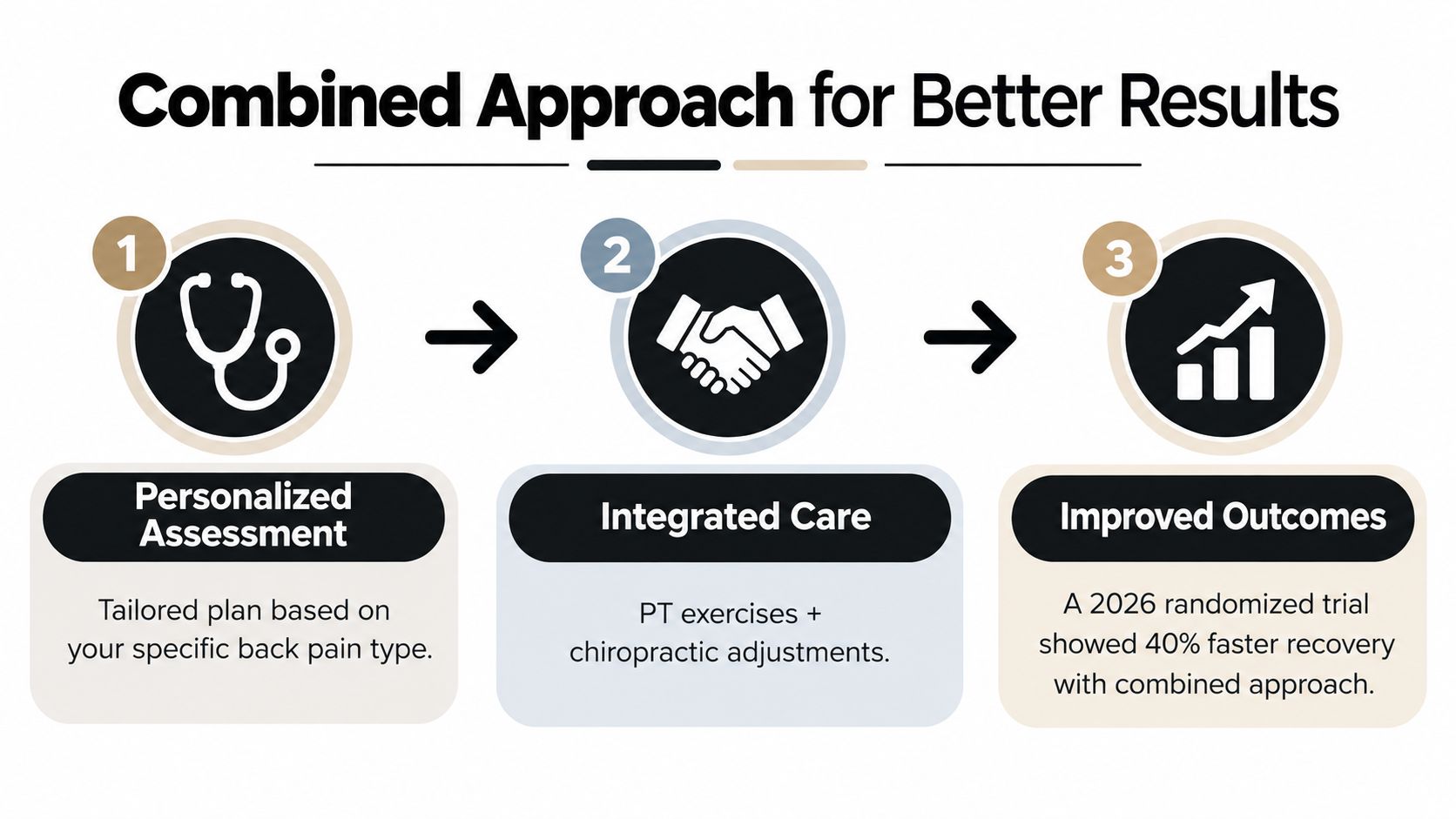
The most useful recent shift is away from treating PT and chiropractic care as rival camps. A 2026 randomized trial reported that a personalized self-management program delivered by physical therapists and chiropractors reduced high-impact chronic low back pain more than standard medical care or hands-on spinal manipulation alone, with lower pain-impact scores at 10 to 12 months. The findings, described in this report on the 2026 randomized trial, suggest that the durable ingredient may be coordinated care that teaches patients how to manage their condition, not the profession attached to the appointment.
That doesn't mean every patient needs two separate providers. It means the treatment plan should cover both immediate symptom management and the physical demands of long-term recovery. A patient might use carefully selected hands-on care to make movement easier, then build strength, endurance, lifting tolerance, and confidence through progressive exercise. Another patient may need exercise first, with manual therapy used only when it helps address a specific limitation.
What coordinated care should look like
Integrated care isn't two unrelated treatment plans running side by side. The clinicians should share the working diagnosis, precautions, goals, and response to treatment. They should also agree on what progress means, such as improved walking, better tolerance for sitting, easier transfers, or a return to a particular work or sport task.
A multidisciplinary clinic may coordinate chiropractic care, physical therapy, acupuncture, or shockwave therapy when those services are clinically appropriate. The technology or modality isn't the plan by itself. The plan is the sequence, dosage, education, and progression that connect each intervention to a functional goal. This overview of the benefits of combining chiropractic and physical therapy offers additional context for that model.
Ask this before starting: “What will I be able to do better, and how will you change the plan if that improvement doesn't happen?”
Be cautious if a clinic recommends an indefinite series of passive visits without reassessment, or if two providers give conflicting restrictions and exercises. Combination care works best when it reduces confusion, increases your active participation, and adapts as your symptoms and abilities change.
Insurance Coverage and What to Expect at Your First Visit
Insurance can determine which option is practical, but coverage varies by plan, employer, location, diagnosis, and provider network. Don't assume that physical therapy and chiropractic care have identical benefits. Before scheduling, call the number on your insurance card and ask whether each service is covered, whether the clinician is in network, whether you need a referral or authorization, what deductible and copay apply, and whether there are visit or treatment limits.
Ask the office to explain what your first appointment includes and which services may be billed separately. You can also ask whether imaging is routinely recommended or only ordered when the examination suggests it is necessary. A clear clinic should be willing to discuss expected costs before treatment begins. This guide to whether chiropractic care is covered by insurance can help you prepare questions, but your plan's benefits document remains the final authority.
Your first physical therapy visit
A PT evaluation typically starts with your history and functional goals. The therapist may assess spinal, hip, and lower-limb movement, strength, balance, walking, lifting, and the activities that reproduce or relieve symptoms. You should leave with an explanation of the working diagnosis, initial exercises or activity guidance, and a plan for reassessment.
Your first chiropractic visit
A chiropractic intake usually includes a symptom history and spinal or musculoskeletal examination. The clinician may discuss posture, joint movement, neurological findings, and whether imaging is appropriate. You should receive an explanation of the proposed technique, alternatives, expected response, possible minor side effects, and the role of exercise or self-management.
Bring your medication list, prior imaging or surgical information, insurance details, and a short description of when the pain started. Tell the clinician about numbness, weakness, falls, fever, unexplained weight loss, trauma, cancer history, or bowel and bladder changes. Those details can change the safest next step.
How to Decide and Take the Next Step
Use this quick decision guide:
- Recent stiffness without leg symptoms: Discuss either approach, then choose the clinician who offers a clear assessment and practical activity plan.
- Recurring pain, weakness, or reduced endurance: Start with a rehabilitation-focused evaluation that includes progressive exercise and self-management.
- Leg pain, numbness, tingling, or weakness: Seek a careful neurological and movement assessment before choosing manipulation.
- After surgery or a significant injury: Follow the surgical or medical team's precautions and prioritize structured rehabilitation.
- Unsure or dealing with chronic, high-impact pain: Look for coordinated care rather than a passive, indefinite treatment series.
Your preference matters. If you respond well to hands-on treatment, that can be part of a broader plan. If you want to understand your movement limitations and build capacity, exercise-led PT may fit better. Insurance, scheduling, communication between providers, and a defined reassessment point matter just as much as professional labels.
MedAmerica Rehab Center in Deerfield Beach offers physical therapy, chiropractic care, acupuncture, and shockwave therapy, allowing its licensed team to build an individualized plan around the patient's presentation and goals. A first evaluation doesn't commit you to a full course of treatment. It gives you a chance to clarify the diagnosis, options, expected milestones, and next step.
MedAmerica Rehab Center provides coordinated physical therapy and chiropractic services for back pain, sciatica, mobility limitations, and recovery after injury or surgery. Visit MedAmerica Rehab Center to request an evaluation in Deerfield Beach and discuss which care path, or combination of approaches, fits your symptoms.
MedAmerica Rehab · Deerfield Beach
Talk to a clinician about your pain
Physical therapy, chiropractic, acupuncture and shockwave therapy under one roof, since 1995. Same-day appointments are available.
Mon–Thu 8:00 AM – 6:30 PM · Fri 8:00 AM – 3:00 PM