
Post Surgical Rehab Centers: A Recovery Guide
You're home from the hospital, the paperwork is in a stack on the counter, and the incision looks fine, but your real question is simpler. What happens now? For many people after joint replacement, spine surgery, or another major procedure, the hard part starts after discharge, when daily life, pain, mobility limits, and follow-up appointments all collide.
Post Surgical Rehab Centers exist to make that next phase organized instead of improvised. They sit inside the broader post-acute and rehabilitation system, which is large and still growing, with one industry estimate putting the market at USD 5.9 billion in 2025 and projecting USD 10.8 billion by 2033 at a 12.90% CAGR from 2025 to 2033 (HTF Market Insights). That scale matters because recovery after surgery isn't a side service. It's a real care pathway with structure, staffing, and quality measures.
What a Post Surgical Rehab Center Does
A few days after knee replacement, many patients expect to go straight from hospital bed to full independence. In real life, the body usually needs a bridge. A post surgical rehab center provides that bridge by turning discharge into a managed plan, with therapy, monitoring, and day-to-day coaching instead of guesswork.
Recovery after surgery is a real care pathway with structure, staffing, and quality measures. It can happen in different settings, and the setting shapes what your days look like. Inpatient rehabilitation facilities fit people who need frequent therapy and close nursing support. Outpatient centers serve patients stable enough to live at home and return for scheduled visits. Some people use skilled nursing facilities when they need more medical oversight than home care can provide, and others recover with home-based therapy if travel is difficult or the surgeon expects a lighter level of treatment. For people who need therapy without leaving home, a private in-home physical therapy option can fill that role.
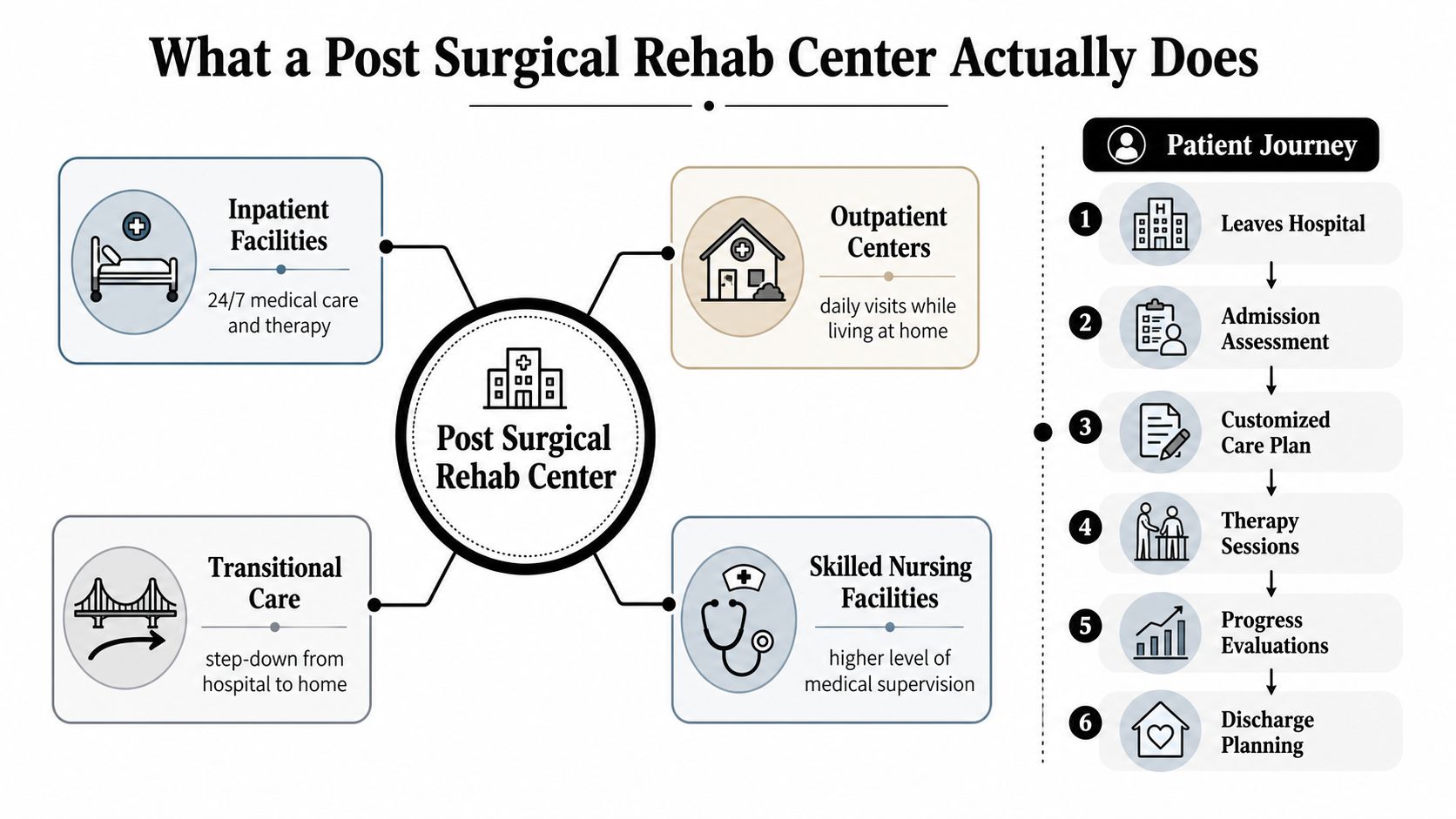
The team usually includes physical therapists, occupational therapists, and rehabilitation nurses. In some multidisciplinary clinics, care may also be coordinated with chiropractic care or acupuncture when those services fit the plan. The point is to restore motion, reduce pain, protect the surgical repair, and help you get back to normal tasks with fewer setbacks. Day to day, that can mean practicing safe transfers, learning how to manage swelling, building walking tolerance, and repeating movement patterns until they feel less awkward. That repetition is a lot like learning to use a brace on a weak joint, the support is there while strength and control catch up.
For a useful plain-language comparison of cardiac recovery pathways, the cardiac rehab guide from Pounds Health Insurance is a practical place to see how structured rehab is used after major surgery.
Practical rule: rehab is a planned stage of healing. The right setting depends on how much help you need, not just what surgery you had.
Inpatient, Outpatient, Skilled Nursing, or Home Based
The biggest decision after surgery is rarely the exercise list. It's the setting. The right choice depends on functional status, home support, transportation, wound care needs, and whether the surgeon expects close supervision.
| Choosing a Post-Acute Setting | Therapy Intensity | Nursing Oversight | Best Fit For |
|---|---|---|---|
| Inpatient rehabilitation facility | High, structured daily therapy | 24/7 rehab nursing | People recovering from complex surgery or needing close monitoring |
| Outpatient physical therapy | Scheduled visits while living at home | Limited, clinic-based | Stable patients who can travel and manage daily life safely |
| Skilled nursing facility | Lower therapy intensity than inpatient rehab | Higher medical supervision | Patients who need more nursing help and slower progression |
| Home-based therapy | Varies by plan | Minimal onsite oversight | People with limited mobility or homebound restrictions |
An inpatient rehabilitation facility usually makes sense when getting to therapy, bathing, transfers, or walking safely still feels hard enough that the patient needs hands-on support. CMS describes these facilities as delivering at least 3 hours of rehabilitation therapy per day, at least 5 days per week, with 24/7 rehabilitation nursing support, which is a very different model from an outpatient clinic (Texas Health). That intensity matters after complex orthopedic or spine procedures when frequent practice and monitoring both matter.
Outpatient therapy is often the better fit when someone is medically stable, has reliable transportation, and can manage the basics at home. It can work well for patients who don't need overnight care. If home recovery is the goal, resources that help you prepare your home for recovery are worth reviewing before the first visit.
Skilled nursing facilities sit in a different lane. They're for patients who need more nursing oversight than outpatient care offers, but don't necessarily need intensive rehab blocks. Home health is different again, since it's designed for people who can't safely leave home easily and need therapy in that environment.
If you want to compare home-based services with clinic care, this private in-home physical therapy resource shows how home visits fit into the recovery picture.
Short version: diagnosis matters, but function matters more. If you can't move safely, shower safely, or get transportation reliably, outpatient rehab may be the wrong first step even if the surgery itself was routine.
Core Services You Should Expect
Many people picture rehab as a few resistance bands and some stretches. That view misses how much a post surgical rehab center has to coordinate. A good center brings together movement training, pain control, and patient education so you leave with a plan you can follow at home.
For inpatient rehab, the CMS benchmark of at least 3 hours of therapy per day, 5 days a week helps show how structured the schedule can be. That standard is discussed in CMS materials on inpatient rehabilitation and gives you a reference point when a facility says it offers intensive care. Outpatient centers work differently because patients return home between visits, so each session has to be focused and efficient.
The movement side
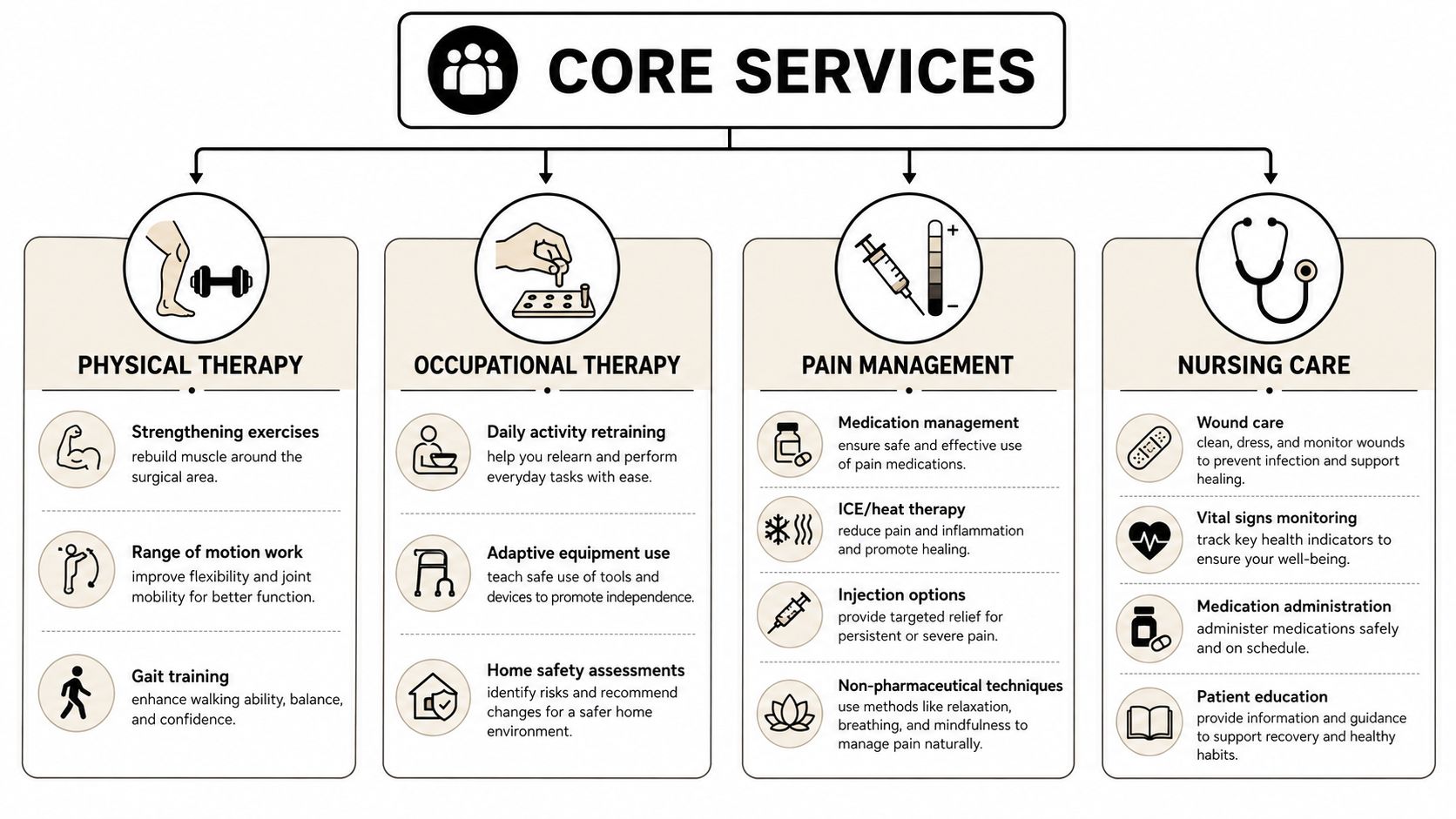
Physical therapy rebuilds strength, range of motion, balance, and walking mechanics. After surgery, that may mean simple but specific work, like learning how to put weight through a leg again, climb a step with control, or raise an arm without irritating healing tissue. Occupational therapy focuses on daily tasks, such as dressing, bathing, kitchen work, and using adaptive equipment safely.
The point is not to do random exercises. The point is to practice the exact movements that protect your surgery and let you function again.
The support side
Pain control is integrated into rehab rather than treated as a separate service. Centers may use ice, heat, medication coordination, and other non-drug strategies so you can tolerate therapy and keep moving. Nursing staff may also handle wound checks, vital signs, medication administration, and patient education when the setting calls for that level of oversight.
That support matters because a patient who is guarded, exhausted, or afraid to move cannot make much progress in therapy. Rehab day by day is often a mix of exertion and recovery, not just exercise time.
The hands-on details
Some multidisciplinary clinics also add manual therapy, joint mobilization, and other modalities when appropriate. If a program offers acupuncture or shockwave therapy, those services should fit the recovery plan rather than distract from it. The better question is always whether a service helps the patient move better and recover safely.
For a closer look at exercise-based recovery work, the Pilates for rehabilitation resource is useful because it shows how structured movement can be adapted for healing without turning therapy into a generic workout.
Typical Recovery Timelines After Common Surgeries
Timelines matter because people need to plan around work, driving, caregiving, and fatigue. They also need realistic expectations. Recovery after surgery is rarely linear, and the exact pace depends on age, health, and how well you were moving before the operation.
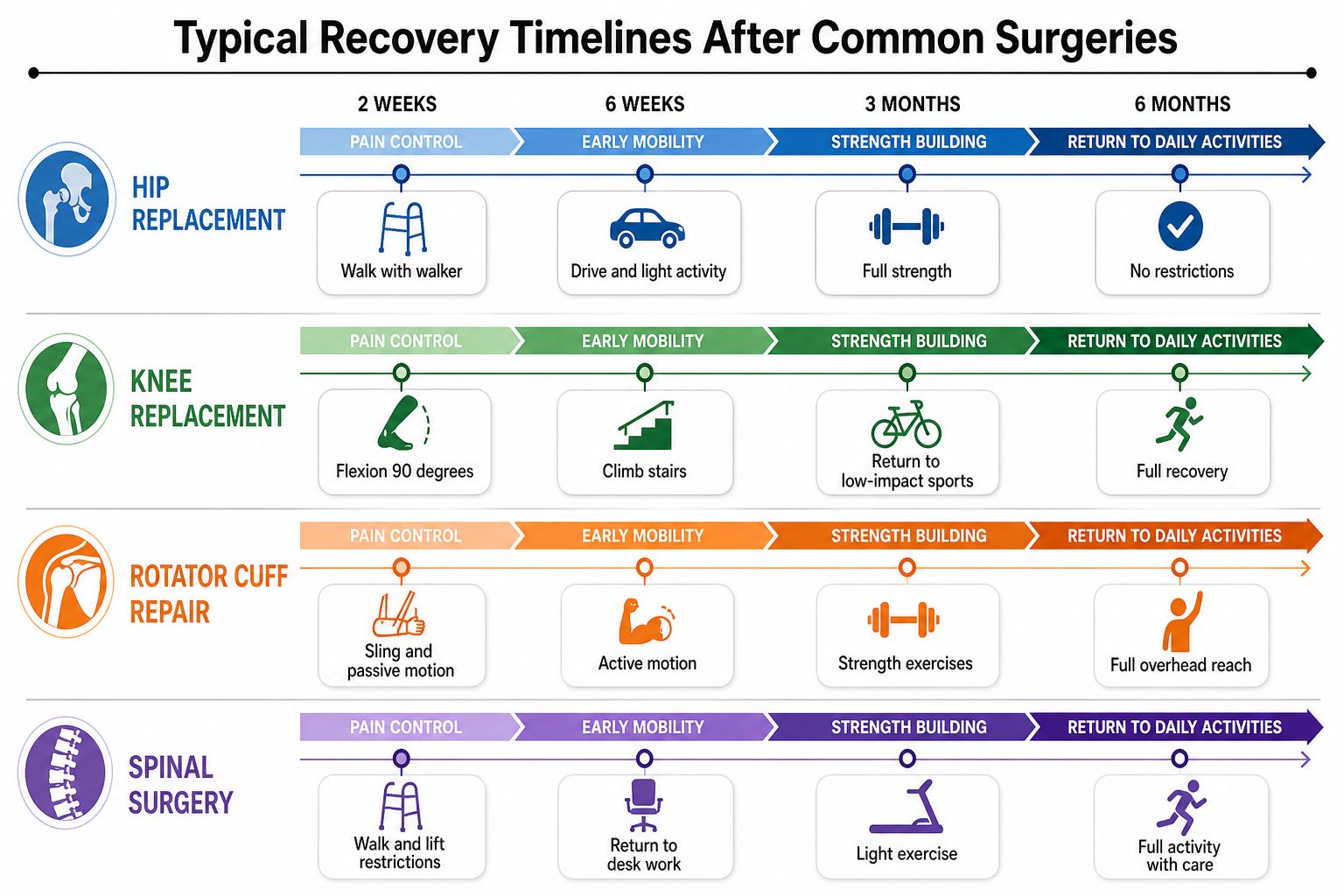
A practical way to think about the first 12 weeks after a common orthopedic surgery is in phases, not promises. Early on, the goal is usually pain control and safe movement. Later, the focus shifts to strength, endurance, and function. By that point, the question is less “Does it hurt?” and more “Can I do daily tasks without compensation?”
What the early phase usually looks like
After hip replacement, a patient may be walking with a walker early on, then driving and doing light activity later, then building toward stronger, steadier movement. After knee replacement, the early milestones often center on bend, gait, and stairs. Rotator cuff repair usually starts with protected shoulder motion before active strengthening. Spinal surgery often puts a premium on walking, lifting limits, and gradual return to sitting and desk work.
Why the same surgery can feel different
The procedure name alone doesn't tell the full story. A fit patient with strong home support may move through rehab faster than someone who went into surgery weak, deconditioned, or alone at home. Pain tolerance, sleep, and confidence with movement also affect the pace. That's why your surgeon and therapist should give you a plan based on function, not just the calendar.
A useful question at pre-op visits is simple, “What should I be able to do by week 2, week 6, and week 12?” That framing makes the plan easier to follow and easier to adjust if recovery stalls.
Questions to Ask Before You Choose a Center
The best phone call you can make is the one that sounds a little too detailed. Good rehab centers expect questions. Weak ones get vague when you ask who is guiding the plan.
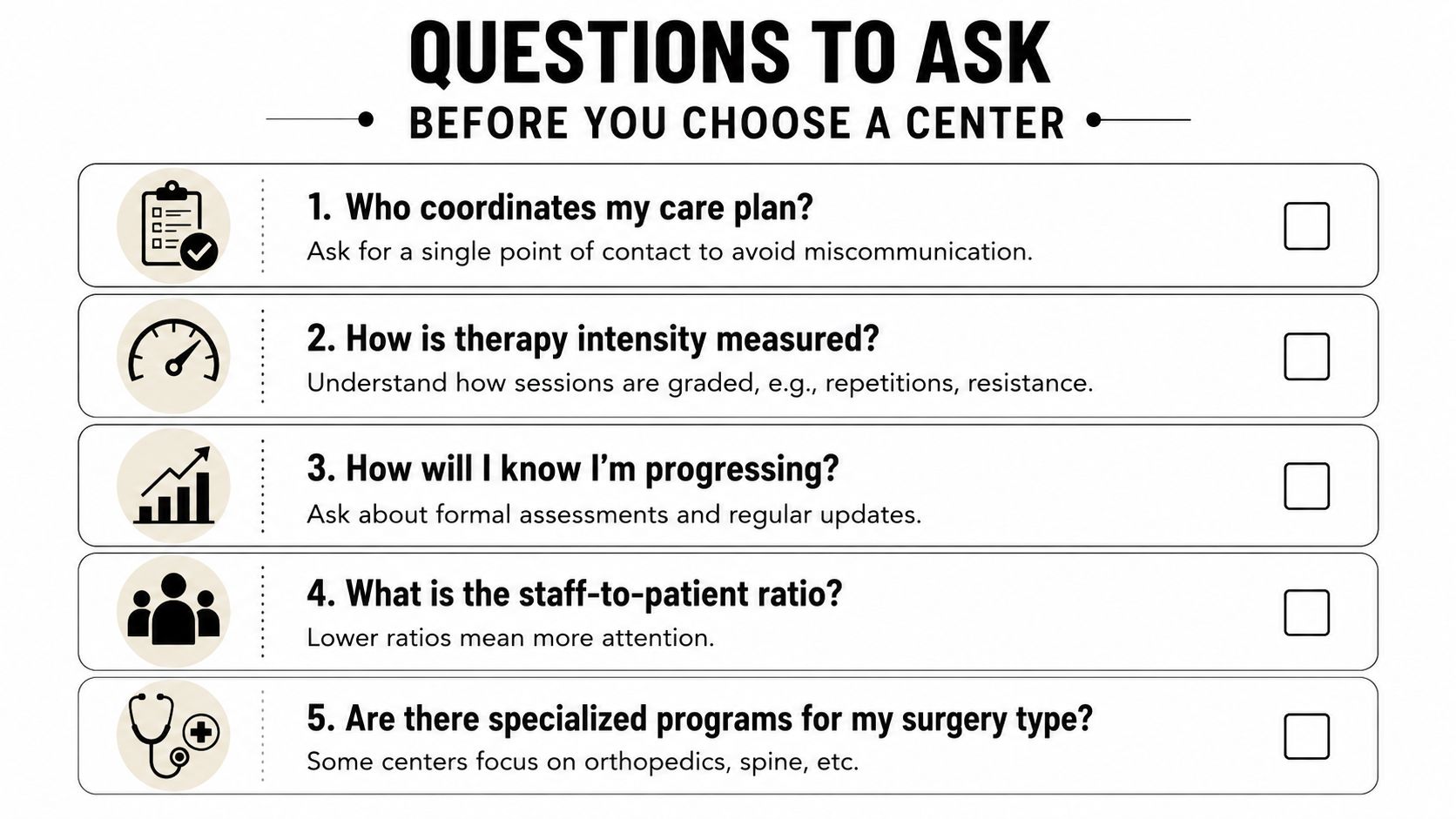
Ask about coordination and staffing
Start with, Who coordinates my care plan? You want one clear point of contact, because confusion between surgeon, therapist, and nursing staff creates delays. Then ask how many clinicians are involved in a typical week, and whether the same therapist follows you consistently. Consistency makes it easier to spot progress and catch problems early.
Ask about measurement and setbacks
Ask, How is therapy intensity measured? Good programs can explain how they decide when to progress exercises, when to back off, and how they track repetitions, resistance, walking distance, or tolerance. Then ask, How will I know I'm progressing? If they use formal assessments, outcome scores, or regular updates, that's a good sign they're looking beyond guesswork.
If a center can't explain how it handles flare-ups, missed sessions, or a setback after a hard day, keep asking until the answer is clear.
Ask about access and fit
You should also ask about insurance, workers' compensation, and appointment timing. Same-day or early-week openings can matter when the first week after surgery is already crowded with follow-ups. If the center has specialty programs for orthopedics or spine recovery, ask what that looks like in real terms, not marketing language.
How to Read Outcome and Quality Data
Two centers can list the same services and still produce very different recovery experiences. That is why public quality data deserves a close look. It does not replace a conversation with the staff, but it helps you see whether a facility consistently gets patients home safely and with fewer avoidable setbacks.
CMS publicly reports IRF measures such as discharge-to-community, Medicare spending per beneficiary, pressure-ulcer incidence, and 30-day readmission after discharge (CMS IRF quality reporting). In plain language, these measures show whether patients are leaving the facility for home, whether complications are appearing, and whether the handoff after discharge is holding together. If you want to see how one clinic presents these measures, review the photo outcome measure page.
A large cohort study in JAMA Network Open reported a national benchmark for successful community discharge after inpatient rehabilitation of 63.7% across 487,862 Medicare fee-for-service beneficiaries in 1,154 inpatient rehabilitation facilities. The range across facilities was wide, from 42.9% to 83.6%. That spread is the main lesson, because center quality is not the same just because the service list looks similar.
The same study found that 18.7% of facilities performed significantly better than the national mean, while 17.6% performed significantly worse (JAMA Network Open). That gap is a reminder to look for patterns, not slogans. A center that follows outcomes carefully is usually more open about where patients struggle and how it responds.
If you are comparing options, start with the discharge measure, then look at readmission, pressure-ulcer, and spending data together. One number can mislead. A pattern gives a clearer view of how the center works from admission through discharge.
What Your First Visit and First Month Will Feel Like
On day one, most outpatient patients spend time on paperwork, history review, and baseline testing before they do much exercise. The therapist will ask what surgery you had, what hurts, what movements are restricted, and what your home setup looks like. Then you'll usually get a first treatment session and a home program you can start right away.
At a local outpatient clinic like MedAmerica Rehab Center in Deerfield Beach, the first month is usually built around hands-on therapy, targeted exercises, and practical coaching that fits around daily life. Some patients come in after work, some schedule around caregiver duties, and some need a shorter, more comfortable start because they're still guarding the surgical area. A clinic setting can also mix modalities and supervised movement in a way that stays focused on function rather than just volume.
Weeks one through four often feel repetitive in a good way. You do the same basic motions with gradual progression, because healing tissue doesn't like surprises. Your therapist checks swelling, motion, walking quality, and pain response, then adjusts the plan without making recovery feel random.
The part patients appreciate most is clarity. You leave knowing what to do at home, what to avoid, and what should improve before the next visit. If the clinic also offers clear intake steps and insurance-friendly scheduling, the first month feels less like navigating a system and more like following a plan.
Putting Together Your Own Recovery Plan
The right rehab choice starts with one question, What level of help do I need? If you need close monitoring and daily therapy, inpatient care may fit. If you're stable at home and can travel, outpatient therapy may be enough. If you need more nursing oversight or can't safely leave home, the other settings deserve a closer look.
Before you commit, bring three things to the table, your surgeon's plan, your home situation, and the questions you want answered. Ask how progress is measured, how setbacks are handled, and what the first month should realistically look like. Then compare that answer with the public quality data, not just the brochure.
If you want an example of how a clinic can organize this kind of care, these exercise examples after surgery show the type of movement work that should be tied to a recovery plan, not handed out as a generic sheet.
The best center is the one whose plan fits your life, your mobility, and your support system. For many patients in Deerfield Beach, that means looking for a place that combines multidisciplinary care, transparent expectations, and a calm, patient-centered intake process.
If you're trying to decide what comes next after surgery, MedAmerica Rehab Center offers outpatient physical therapy, chiropractic care, acupuncture, and post-surgical rehabilitation in Deerfield Beach. Reach out to ask how your recovery plan could be coordinated around your surgery, your home routine, and your pace of healing.
MedAmerica Rehab · Deerfield Beach
Talk to a clinician about your pain
Physical therapy, chiropractic, acupuncture and shockwave therapy under one roof, since 1995. Same-day appointments are available.
Mon–Thu 8:00 AM – 6:30 PM · Fri 8:00 AM – 3:00 PM