
Pain Management After Surgery: Your Practical Recovery Guide
You've just left the surgery center in Deerfield Beach with a discharge sheet, a small prescription, and a house full of questions. The incision hurts, your body feels tight, and you're trying to figure out what is normal, what needs medication, and what you're supposed to do between now and the first rehab visit.
Pain management after surgery works better when you treat it like a daily workflow, not a single pill problem. A plan is often needed that combines medication timing, movement, sleep positioning, wound care, and clinic-based support so pain doesn't keep hijacking recovery.
What Post-Surgical Pain Actually Looks Like in the First Days
The first surprise after surgery is that pain usually isn't a sign something went wrong, it's part of the recovery process. Major reviews and surveys show that about 75% to 80% of surgical patients experience pain after surgery, and roughly 86% of those patients describe it as moderate, severe, or extreme. In a U.S. survey of 300 adults who had surgery, 86% reported postsurgical pain overall, 75% said it was moderate to extreme right away, and 74% still felt those same levels after discharge (PMC review).
Naming the pain helps you manage it
Not all pain feels the same. Incisional pain is the sharp, local soreness around the surgical site, especially when you change position, cough, or stand up. Inflammatory pain feels more diffuse, warm, and achy because the tissues are swollen and irritated, while muscle guarding is the protective tightness that makes you move oddly and stiffens the area around the operation.
That difference matters because each type responds to a slightly different strategy. Incisional pain often needs better dose timing and support when you move. Inflammatory pain usually improves with elevation, icing, and anti-inflammatory medicine if your surgeon approved it. Muscle guarding usually eases only when you start gentle movement, because the body stops bracing once it learns motion isn't dangerous.
Why the discharge sheet isn't the whole plan
Generic advice often stops at “take your medicine as directed.” That's not enough when the hardest part begins after the surgery center closes and you're home trying to get to the bathroom, sleep, and make the next follow-up visit. A pain management after surgery plan should tell you what to do when pain rises before a walk, when to pause and reassess, and when to call for help instead of waiting it out.
Practical rule: pain that stops you from breathing deeply, sleeping, or getting up safely needs a better plan, not just more patience.
The goal isn't to eliminate every twinge. It's to keep pain low enough that you can move, protect the incision, and stay on schedule with recovery tasks that change outcomes.
Building a Multimodal Medication Plan That Works
Single-drug recovery plans break down quickly when pain is moderate or severe. A layered approach, often called multimodal analgesia, works better because it uses more than one path at once. The American Pain Society guideline recommends a validated pain assessment tool so you can track response and adjust treatment, and it also advises pre-op education so patients know what to expect, including that people already using opioids usually need higher postoperative doses and may be harder to control (American Pain Society guideline00995-5/fulltext)).
Think in layers, not in rescue mode
The usual stack starts with nonopioids like acetaminophen and NSAIDs, then adds adjuvants when needed, then regional or neuraxial techniques for tougher cases, and only then short-course opioids if pain is still blocking function. That structure fits the clinical picture where postoperative pain is common and often under-treated, with clinical reviews noting that pain relief remains inadequate for many surgical patients (American Pain Society guideline).
A practical way to use this at home is to keep the non-opioid doses on a schedule instead of waiting for pain spikes. If your surgeon approved acetaminophen or an NSAID, use them before pain climbs to the point where you are shaking, guarding, or skipping your walk. The point is to stay ahead of the pain so movement does not feel like a crisis.
| When to Adjust Your Post-Surgical Medication Stack | |||
|---|---|---|---|
| Pain Level (0-10) and Function | First Line | Add Adjuvant | Consider Short-Course Opioid |
| Mild pain, moving and sleeping okay | Scheduled nonopioid plan if approved | Usually not needed | Usually not needed |
| Moderate pain, walking or therapy feels difficult | Nonopioid plan plus timing adjustments | Consider if pain is nerve-like, burning, or sleep is disrupted | Consider if function still drops despite the stack |
| Severe pain, cannot rest or mobilize safely | Recheck the plan and contact the surgical team | Add only if specifically prescribed | Short course may be appropriate for severe pain |
Reassess before you escalate
The common mistake is skipping structured reassessment. If you took a dose and still cannot stand up, the question is whether the problem is timing, underdosing, swelling, muscle guarding, or a mismatch between the procedure and the plan. That is why a validated pain score matters, because it keeps the conversation tied to function, not just discomfort.
A good home routine is simple. Wake up, score your pain, take the approved non-opioid medicine on time, move a little, and check whether the next activity is easier or harder. If a dose only masks pain for a short window, that is useful data, not a failure. A rehab clinician can use that pattern to decide whether you need a medication timing change, a different nonopioid, or a sooner check-in with the surgical team.
Medication planning also has to fit the rest of recovery. If your appetite is off, if sleep is poor, or if the medications upset your stomach, the rest of the day can fall apart fast. That is why home meals, hydration, and a simple inflammation-supportive menu matter too, and why some patients choose to browse inflammation-reducing diets while they sort out what they can tolerate.
When pain keeps blocking walking, dressing, or sleep, clinic-based care fills the gap between discharge instructions and outpatient rehab. If your program uses cold therapy, the practical details matter, and a guide like this one on how physical therapy cold packs are used at home and in clinic can help patients use them without turning every session into guesswork.
For patients who arrived with a harder pain history, the plan may need tighter coordination. Prior opioid use, nerve pain features, or a complex surgery all change the trade-offs, and the medication list should match that reality instead of assuming one standard pathway fits everyone.
At-Home Self-Care in the First 72 Hours
Cleveland Clinic states clearly, “most of your pain management will happen at home” (Cleveland Clinic). The first three days set the tone, because this is when your routine either supports healing or leaves every task feeling heavier than it should.
Build a recovery station before you're tired
Set up one place with your medications, water, phone charger, discharge papers, ice pack, and any wound supplies. You do not want to be searching the house at 2 a.m. trying to remember whether you already took a dose. If you're using ice, follow your surgeon's directions closely, because cold left on too long can injure skin and tissue, especially while numbness is still fading (Harvard Health).
For lower-body surgery, elevation often helps pain, swelling, and wound healing. If sleep is difficult, position the body so the surgical area is supported and the non-operated side is not twisting you into a guarded posture. For many people, a pillow between the knees or under the calf changes the whole night.
Take your medication before pain forces you to stop moving. If you wait until you are already flaring, the walk, the shower, and the trip to bed all get harder.
If you're trying to keep meals simple while your appetite and inflammation are shifting, it can help to browse inflammation-reducing diets for practical meal ideas that are easier to tolerate during recovery.
Watch the wound, not just the pain
Some soreness, tightness, and mild drainage can be part of normal healing, but increasing redness, heat, pus, or pain that suddenly worsens deserves a call to the surgeon. Your dressing changes should be calm, clean, and done on schedule, not rushed between missed doses and poor sleep.
If you're icing the area, cold pack guidance for physical therapy can help you think through timing and placement so the pack supports recovery instead of irritating the skin. The larger point is simple, movement and cooling should lower the daily burden, not create new problems.
Opioid Stewardship Without Needless Suffering
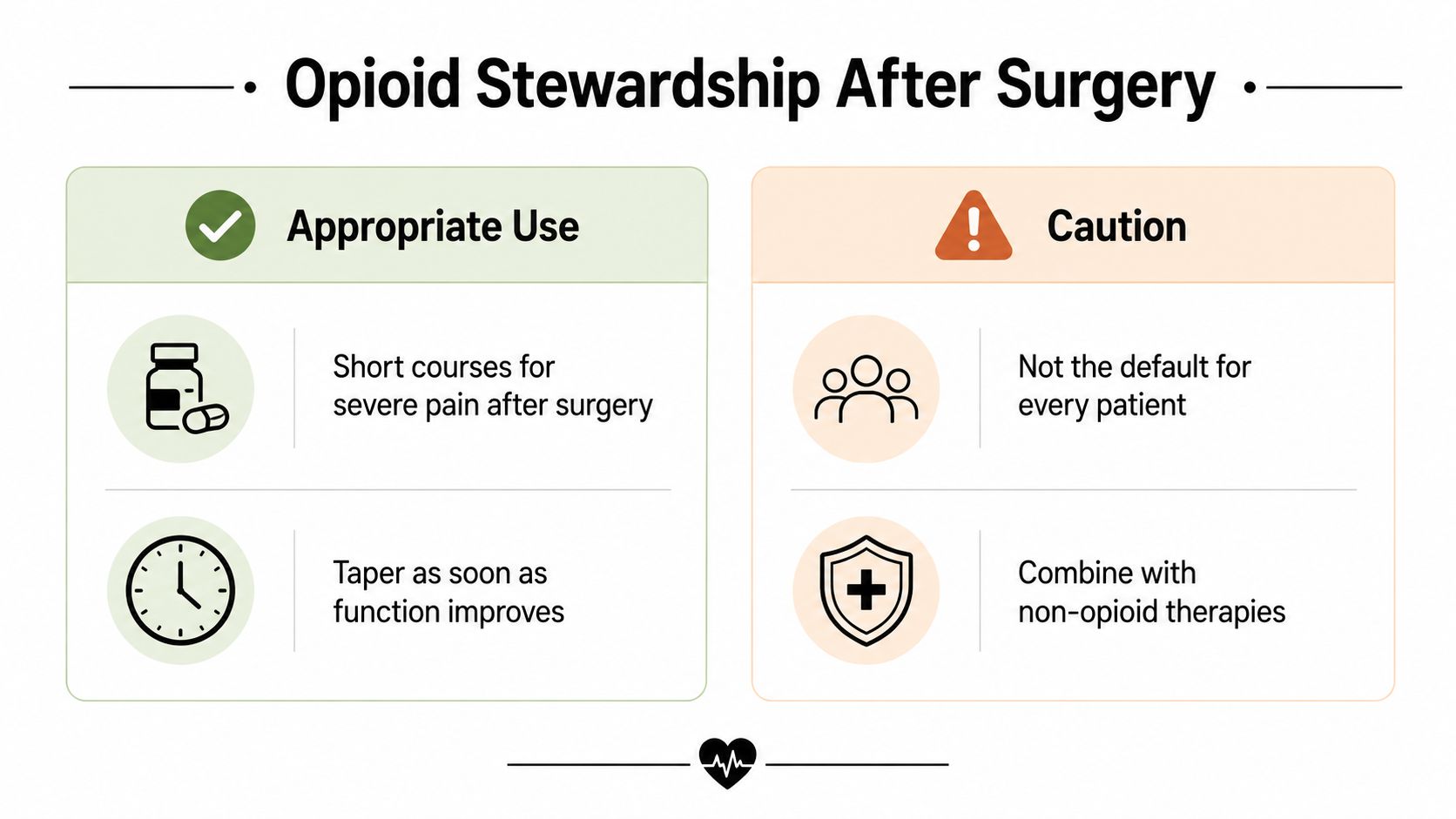
Opioids still have a place after surgery, especially when pain is severe and the first days are rough. But they should be used with purpose, not as the default for every patient. That's especially important because benchmark data show how much technique choice changes pain outcomes, with epidural analgesia associated with lower rates of moderate-to-severe pain and severe pain than patient-controlled analgesia or intramuscular approaches (acute postoperative pain review).
Use the smallest useful amount for the shortest useful time
That doesn't mean “avoid opioids at all costs.” It means use them when pain is still blocking sleep, breathing, or basic mobility, then taper as soon as function improves. Harvard's review makes the same point clearly, noting that non-opioid pain relievers often work well after surgery and that if an opioid is needed, it should be limited in duration and paired with other methods when possible (Harvard Health).
If you want a broader picture of why this matters, recent data on the opioid crisis is worth reading alongside your discharge instructions. The point isn't fear, it's context. Short-course use can be appropriate, but every extra day of unnecessary use raises the stakes.
Make safety part of the plan
Store opioids away from children, guests, and pets, and keep them in the original bottle if possible. Dispose of leftovers promptly through a take-back program or the method your pharmacist recommends. If your surgeon gives you a bowel regimen, follow it, because constipation can turn a manageable recovery into a miserable one.
A useful mindset is this, opioids are a tool for breakthrough pain, not proof that you're recovering correctly. If you still can't move without heavy sedation, the plan needs adjustment, not just another refill.
Progressive Rehab Exercises and Realistic Timelines
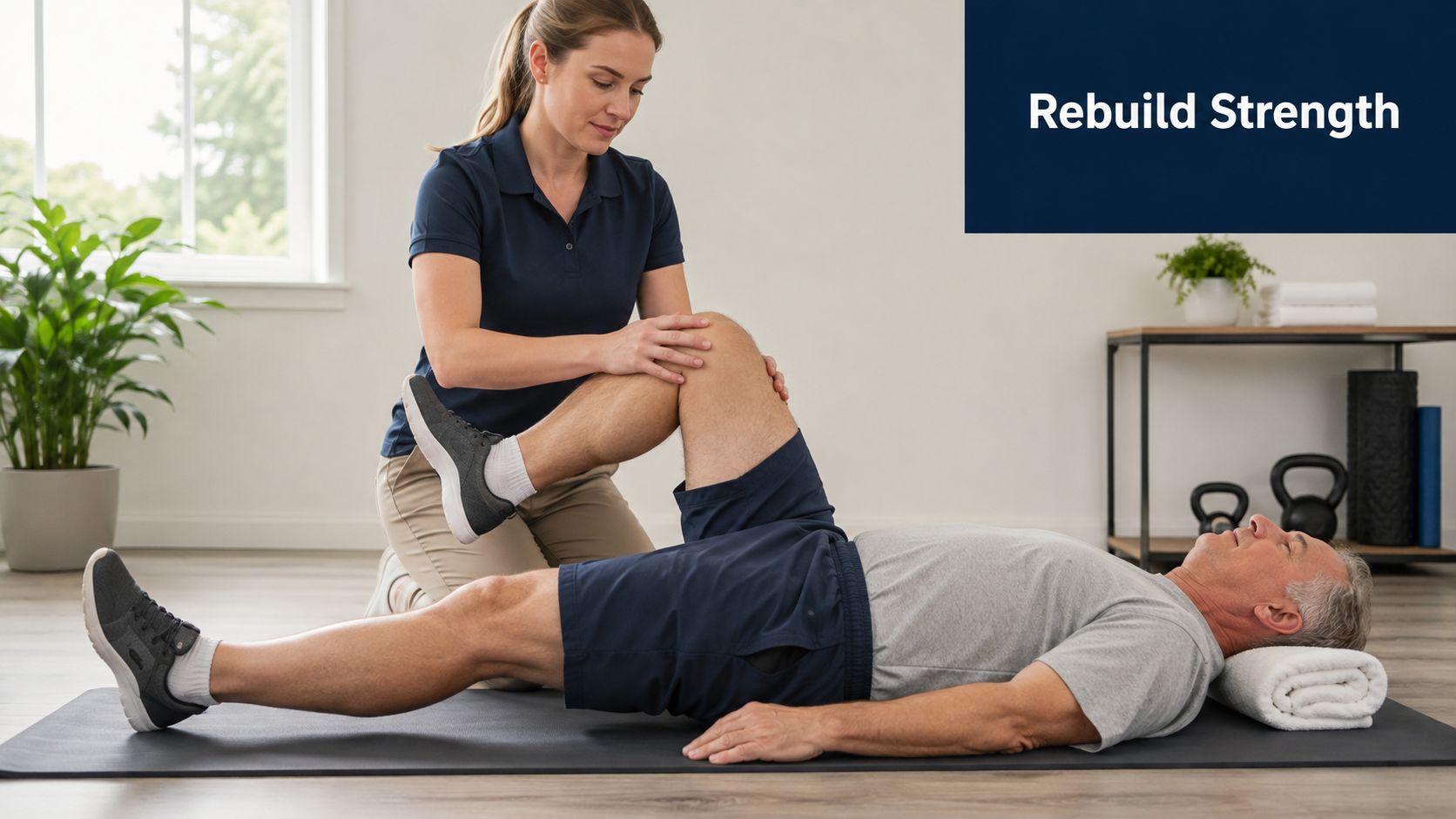
The first movement goal after surgery is not fitness, it's trust. Your body has to relearn that bending, walking, and reaching won't tear everything apart. Mild-to-moderate post-op pain can often be managed with physical therapy and exercise rather than escalating medication, which is why rehab should show up early in the recovery plan and not weeks later.
Week 1 is about gentle activation
In the first week, think short, frequent, and low-load. A chair-assisted ankle pump after knee or hip surgery helps the calf muscles wake up without straining the incision. After shoulder work, a strap-assisted pendulum or supported hand-walk on a table can keep the joint moving without forcing range.
The internal progression matters more than the exact exercise. If motion makes the pain surge for hours afterward, you did too much. If motion feels stiff at first and then eases, that's usually the right neighborhood.
Here's the internal guide many patients do well with after surgery:
- Knee or hip procedures: start with ankle pumps, heel slides, and short standing intervals.
- Shoulder procedures: use supported pendulums, table slides, and gentle scapular setting.
- General rule: stop short of sharp pain, but don't mistake normal stiffness for damage.
The article on exercise after operation is a helpful companion if you want to see how rehab movement is usually introduced after a procedure.
Weeks 2 to 8 should feel more active, not more fragile
By weeks 2 to 3, range-of-motion work and gait mechanics should start to matter more. That means walking with a better stride, getting up from a chair with less guarding, and practicing the motions that were awkward during week 1. By weeks 4 to 8, progressive strengthening usually becomes the focus, especially for orthopedic recovery where the tissues need load to rebuild confidence.
The rule is not “push through anything.” It's “nudge the system often enough that pain shrinks around movement instead of dominating it.” If the rehab work is timed well, medication becomes a support for activity, not a replacement for it.
Clinic-Based Modalities That Complement Your Surgery Recovery
A good post-surgical clinic visit should feel coordinated, not random. The first appointment usually starts with a movement assessment, a review of the surgeon's restrictions, and a conversation about what hurts most during real life tasks like walking, dressing, driving, or sleeping. At MedAmerica Rehab Center, that kind of plan can bring together physical therapy, chiropractic care, acupuncture, and shockwave therapy when they fit the phase of healing, and the team can coordinate around the surgical timeline.
Different tools belong at different points
Physical therapy often enters early, especially when the main problem is stiffness, weakness, or fear of movement. Chiropractic care may be used selectively when surrounding joints or the spine are compensating for the surgical side. Acupuncture can be helpful when pain is accompanied by nausea, tension, or medication side effects, while shockwave therapy is generally a later-stage option for tendon or soft-tissue recovery that needs a different kind of stimulus.
That sequence matters because not every modality solves the same problem. Early recovery is about safe movement, swelling control, and confidence. Later recovery is often about load tolerance, tissue quality, and getting back to work or sport without a pain flare.
The most useful physical therapy after surgery visits tend to start with a clear question, what movement is limited, and what change would matter most this week? The answer shapes the session better than a one-size-fits-all protocol ever could.
The best teams talk to the surgeon
A multidisciplinary team works best when it knows what procedure was done, what the restrictions are, and where the patient is getting stuck at home. A clinic that has worked with post-surgical patients since 1995 can keep the plan practical, because the challenge isn't just pain relief, it's moving from the hospital mindset to daily life without losing momentum.
The right team doesn't just treat pain. It helps you decide what to do on Tuesday morning when your knee is stiff, your shoulder is guarded, or your back is sore from sleeping wrong.
If you've had surgery and you're trying to decide which clinic tools fit your stage of recovery, that coordination is the difference between guessing and progressing.
Warning Signs, Smart Questions, and Your Recovery Checklist
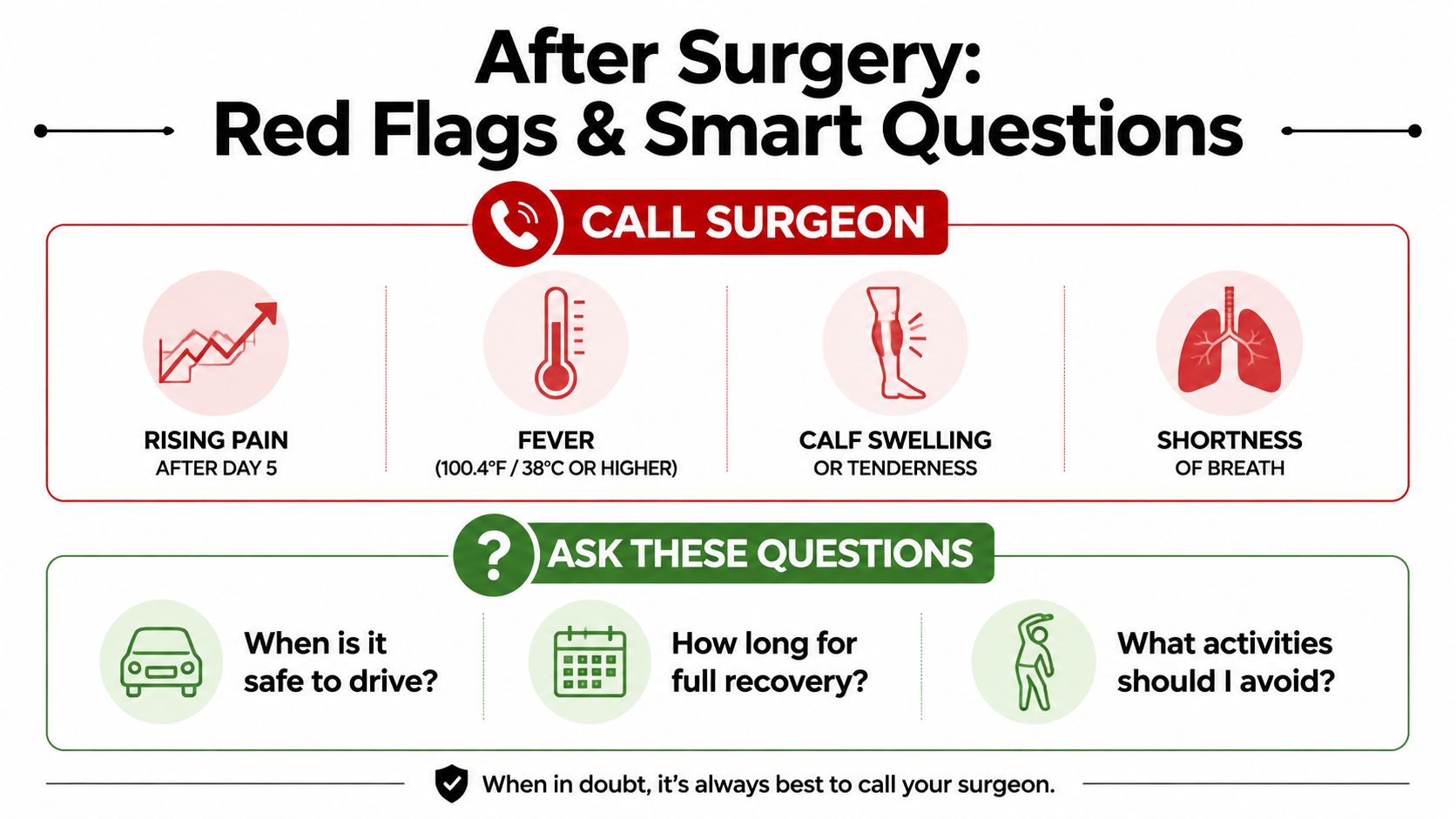
Pain should trend toward more manageable, not more alarming. If pain escalates after day 5, or you develop fever, calf swelling, shortness of breath, or new numbness, contact the surgeon right away. Those are not normal recovery frustrations, they're reasons to be checked.
For a quick way to judge whether a flare is mild or severe, the pain scale guide from Pain and Sleep can help you put a number on what you're feeling before you call the office or your therapist.
Three questions patients ask most often
How long does post-surgical pain usually last? It varies by procedure and by how active you are, but the key pattern is that pain should gradually become easier to manage as swelling drops and movement improves. If it's getting worse instead of better, that needs attention.
When is it safe to drive? Only when you can brake, turn, and move comfortably, and when your surgeon says you're allowed to drive. If you're still using opioid pain medicine or you can't rotate safely, it's too soon.
What if pain flares during physical therapy? Tell the therapist immediately. A flare usually means the load, range, or speed needs to be adjusted, not that rehab should be abandoned.
Print this or screenshot it: take medicine on time, move a little every day, ice or elevate if approved, check the wound, and call the surgeon if pain climbs instead of settles.
If you're in Deerfield Beach and you want a practical recovery plan that connects surgery, home care, and rehab, schedule a post-surgical consultation with MedAmerica Rehab Center. Their team can help you line up therapy, movement, and pain control so the next few weeks feel organized instead of overwhelming.
MedAmerica Rehab · Deerfield Beach
Talk to a clinician about your pain
Physical therapy, chiropractic, acupuncture and shockwave therapy under one roof, since 1995. Same-day appointments are available.
Mon–Thu 8:00 AM – 6:30 PM · Fri 8:00 AM – 3:00 PM