
Senior Fall Prevention Programs: Complete Safety Guide
Falls are not a rare event in later life. In the United States, over 14 million people age 65 and older, about 1 in 4, report falling each year, and about 37% of those falls lead to an injury that needs medical treatment or limits activity for at least one day, creating an estimated 9 million fall injuries annually (CDC fall data). For families, that changes the conversation from “Should we worry?” to “What kind of program changes the odds?”
The answer is a structured one. Senior fall prevention programs work best when they do more than tell people to “stay active.” The strongest programs combine screening, balance-challenging exercise, strength work, gait training, and home-safety changes, then progress those elements over time so the body keeps adapting. That's why clinicians treat fall prevention as a clinical process, not a motivational slogan.
The stakes are also financial, not just physical. Non-fatal older-adult falls cost an estimated $80 billion per year based on 2020 data, and that total is projected to exceed $101 billion by 2030, with Medicare paying 67% of those costs (CDC fall data). Global evidence shows the burden is widespread too, with a review of 104 studies estimating a 26.5% worldwide fall prevalence among older adults, and higher rates in Oceania and the Americas (CDC fall data).
The encouraging part is that well-designed programs do move the needle. Evidence reviews found that falls-prevention programs reduced the risk of falling by 11% and lowered the monthly rate of falling per person by 23%, while exercise interventions reduced falls across randomized trials by 15% (CMS evidence review).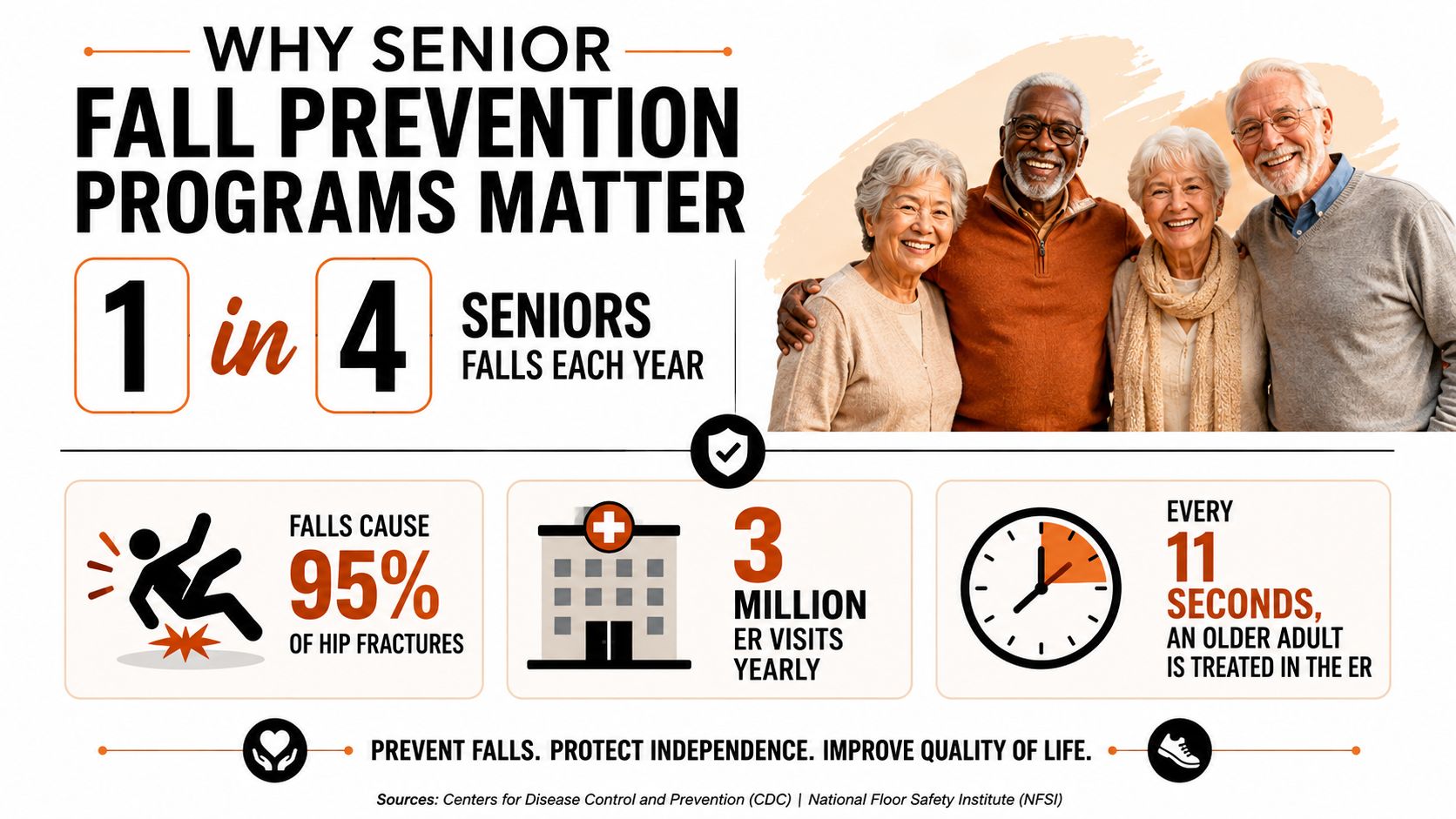
Practical rule: if a program doesn't assess risk and progress the work over time, it's usually offering activity, not prevention.
Why Senior Fall Prevention Programs Matter More Than Ever
Older-adult falls are not a minor nuisance, they are a growing clinical problem. The CDC reports that the age-adjusted fall death rate rose from 64.7 per 100,000 in 2018 to 78.4 per 100,000 in 2024. When the risk of a fatal outcome is climbing alongside the large number of non-fatal falls, prevention becomes a practical safety measure for families and care teams.
That is why generic advice falls short. Telling an older adult to “be careful” does not address weak hips, slowed stepping reactions, cluttered hallways, poor vision, medication side effects, or fear of moving. A real program looks at those pieces together and builds a plan that matches how the person walks, turns, stands, and lives.
What changes when a program is structured
The difference is in how the work is delivered. Evidence-based programs use repeated practice, a clear dose, and planned progression so the body is challenged enough to adapt without pushing the person past a safe limit. That matters in the clinic, because balance, stepping speed, and confidence change when training is specific and repeated over time.
The CMS evidence review found that falls-prevention programs lowered the risk of falling, and exercise-based interventions reduced falls in pooled randomized trials (CMS evidence review). In a CDC STEADI-related community program summary, participants experienced 46% fewer falls and 34% fewer fall injuries during one year of follow-up. Those are the kinds of results that come from multifaceted programs, not casual activity.
A good program also keeps people engaged in the tasks that matter most. Getting to the mailbox, rising from the toilet safely, turning in the kitchen, and crossing a hallway with less guarded movement are all real goals, and they require practice that carries over into daily life. Families usually want steadier mobility and less fear, and structured programs are built to produce exactly that.
For a broader look at how clinics organize the first visit, this fall risk assessment for elderly resource matches the way a therapy screen should start. The same careful intake also matters when memory or attention concerns affect safety, which is why a cognitive decline risk assessment can be relevant alongside mobility screening in some older adults.
How Fall Risk Screening Identifies Your Specific Weak Points
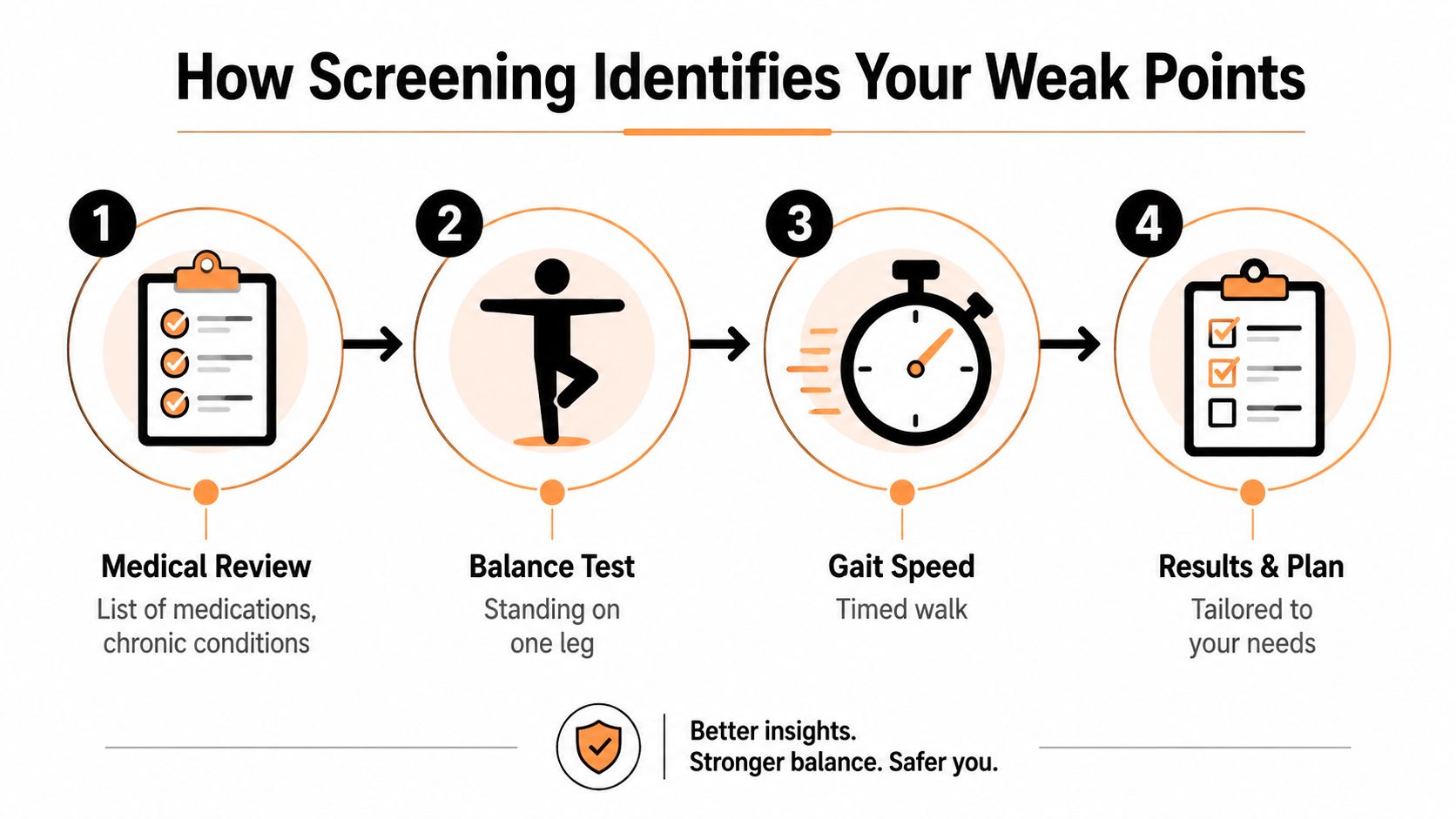
A quality fall prevention visit starts with questions, not exercises. The clinician needs to know what happened, what nearly happened, what feels unsteady, and what daily tasks have gotten harder. A person who sways when turning in the kitchen needs a different plan than someone who freezes when stepping off a curb.
What a clinic usually checks
The first pass is often mechanical. A therapist watches walking pattern, turning speed, sit-to-stand ability, and single-leg balance, then looks at foot placement, stride length, and whether the person uses compensations like grabbing furniture. Medication review, vision concerns, footwear, and home hazards all matter because falls rarely come from one isolated issue.
That's also why a screening should shape the plan, not just check a box. If the main problem is slower stepping response, the program should include drills that force quicker weight shifts. If the issue is poor stability during daily tasks, the plan needs functional practice that resembles those tasks, not only generic strengthening.
Practical rule: the assessment should tell you what to train, how hard to train it, and what to change at home.
For readers who want a broader intake framework, a helpful companion resource is this fall risk assessment for elderly guide, which aligns well with what a therapy clinic should review before building a program.
Clinicians also need to think beyond the legs. Vision, cognition, and attention influence whether someone notices obstacles, processes instructions, and responds to sudden changes in surface or direction. If there's concern about memory, judgment, or slowed processing, a resource such as cognitive decline risk assessment can be useful context for the broader safety picture.
The point of screening is not to label someone as frail. It's to identify the specific weak links that can be trained, corrected, or compensated for. That's the difference between a generic balance class and a clinically useful plan.
The Evidence-Based Components That Actually Reduce Falls
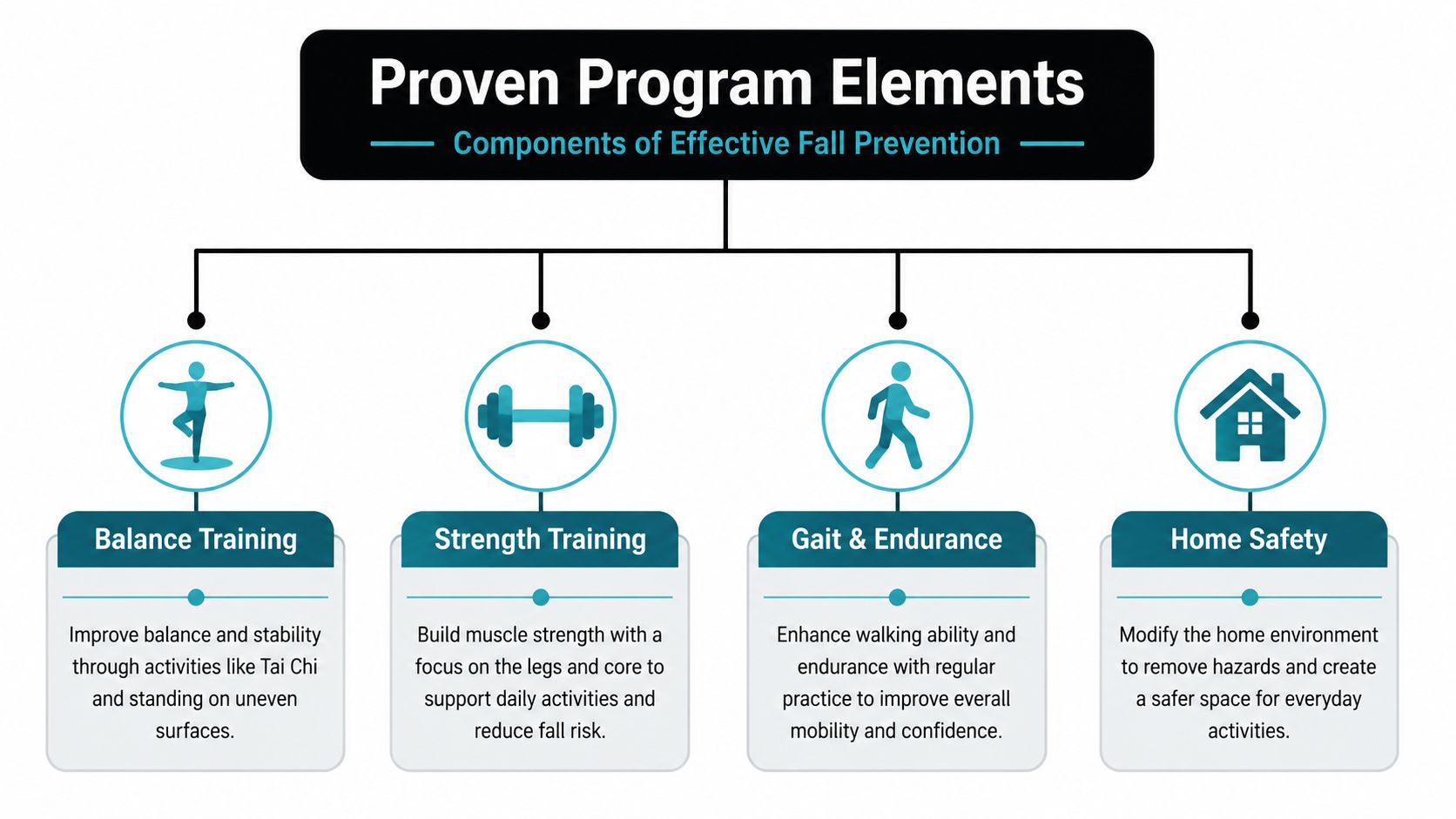
The strongest programs work because they combine the right ingredients in the right dose. The CDC's Falls Compendium organizes evidence-based interventions into 17 exercise interventions, 5 home-modification interventions, 12 clinical interventions, and 16 multifaceted interventions (CDC Falls Compendium). That classification matters because it shows prevention is broader than a single exercise sheet.
Exercise has to be challenging enough to matter
The World Guidelines for Falls Prevention recommend balance-challenging and functional exercise at least three times per week, with sessions individualized, progressed in intensity, and continued for at least 12 weeks (World Guidelines). In plain terms, balance work has to keep asking the nervous system to adapt. If the task never gets harder, the body has no reason to improve.
The right exercise dose is like resistance training for the balance system. Too easy, and nothing changes. Too hard, and people stop or get hurt.
Strength work belongs in the same conversation because weak legs make recovery from a stumble slower and less reliable. Gait practice matters because many falls happen during transitions, turns, or changes in surface, not just during standing still. Home-safety changes matter because a stronger body still has to deal with loose rugs, poor lighting, and crowded pathways.
A useful way to think about it is this. Balance training teaches control, strength training supports recovery, gait practice improves moving safely through space, and home modifications remove avoidable hazards. Programs that only do one of those pieces often leave the biggest risk factors untouched.
For a practical exercise example set, the fall prevention exercises for seniors resource is a good starting point, especially if you want to understand what a dose-appropriate routine looks like outside the clinic.
The biggest mistake is assuming all movement is equally helpful. A casual walk is good for general health, but it doesn't automatically challenge the systems that prevent a fall. Prevention works best when the exercises are specific, progressively harder, and closely matched to the person's deficits.
What a Typical Physical Therapy Session Looks Like
A good session feels focused, not intimidating. The therapist starts by checking how the person moved since the last visit, whether there were near-falls, and which tasks still feel unstable. From there, the plan usually moves into a warm-up, then balance and strength work, then a short cool-down with home instructions.
A realistic visit from start to finish
A person might begin with easy marching, ankle motion, or a few practice stands from a chair to wake up the legs and prepare the joints. Then the therapist may guide sit-to-stand progressions, tandem walking, and single-leg reaches, adjusting the hand support or stance width depending on how the person responds. If the patient leans too heavily or loses control, the therapist reduces the challenge and rebuilds it more gradually.
The pacing matters as much as the exercise list. Good therapists watch form in real time, not after the fact. They shorten a set when fatigue starts altering movement, and they increase difficulty only when the person can stay controlled.
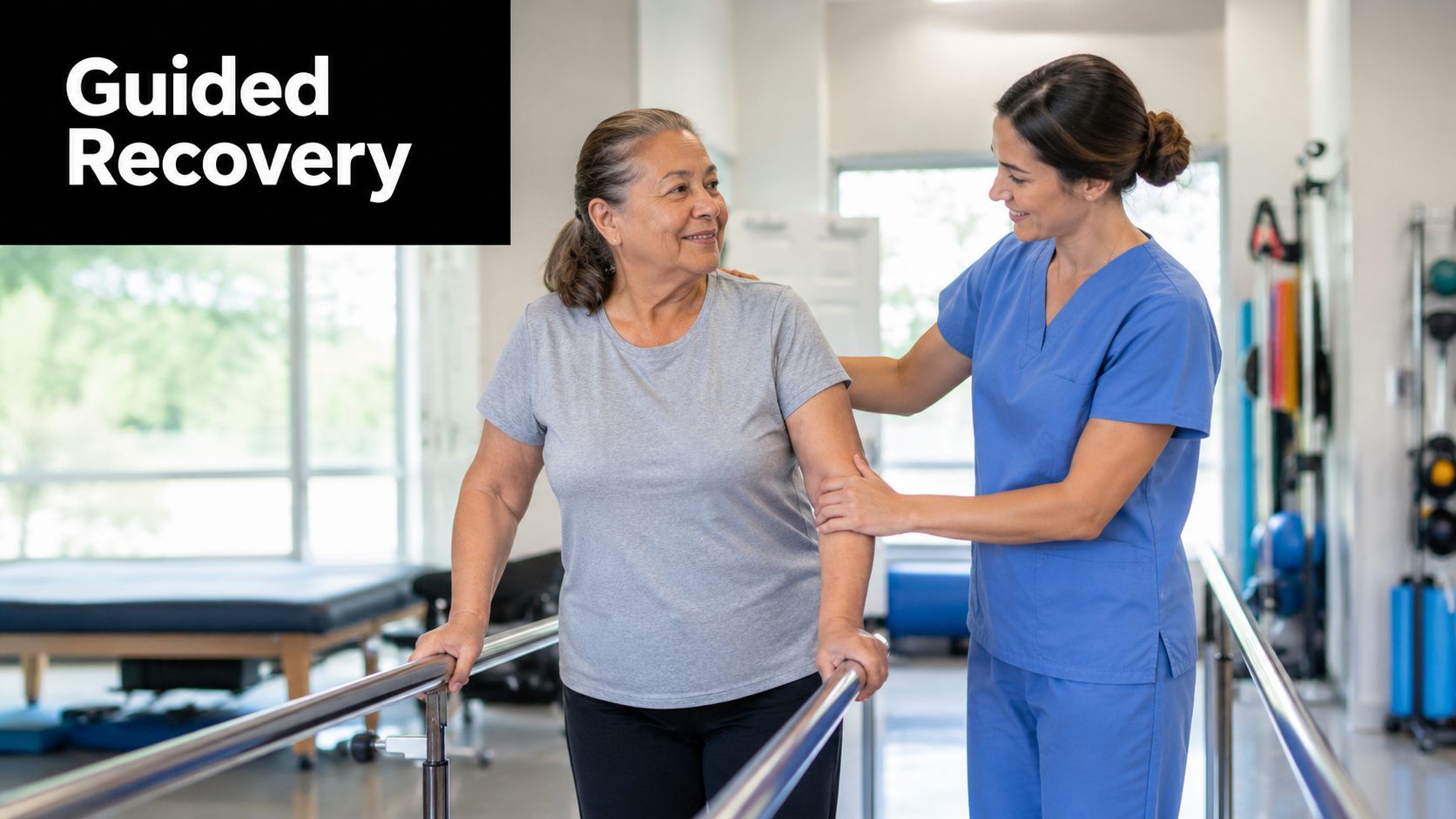
The environment should feel supportive and specific. Parallel bars, foam surfaces, step practice, and safe walking drills give the therapist a way to challenge balance without making the patient guess what to do. That hands-on feedback often matters more than the exact exercise name.
What people usually leave with
By the end, the patient should know two things clearly, what to do at home, and what level of challenge is expected next time. Home exercise is usually brief and practical, with a small number of movements that reinforce what was trained in the clinic. The best plans are repeatable, because consistency is what turns a visit into a change in function.
A family member often notices the difference before the patient does. Walking becomes a little less guarded, standing up takes less effort, and getting through a doorway or hallway feels less tense. Those are useful signs that the program is matching the right problem.
How to Choose the Right Fall Prevention Program Near You
A good fall prevention program should show clinical structure before the first exercise begins. Screening should come first, then an individualized plan, because the right dosage and progression depend on the person's balance limits, strength, gait, vision, and confidence. If a clinic gives everyone the same routine or cannot explain how it measures change, that is a warning sign.
Green flags and red flags
| Green Flags | Red Flags |
|---|---|
| Individualized screening first, then an individualized plan | Everyone gets the same routine without assessment |
| Licensed physical therapists involved in movement testing and progression | Staff can't explain who is supervising the program |
| Evidence-based curriculum with balance, strength, gait, and home-safety components | The program leans on vague wellness language |
| Clear progression and outcome tracking | No one can tell you how improvement is measured |
| Practical scheduling and insurance-friendly processes | Hidden friction around appointments or billing |
| Referral support and follow-through when multiple issues are present | Concerns about falls, vision, or medications are handled in isolation |
A strong program explains why each component is included and how it will be progressed. That matters because fall prevention works best when the exercises are matched to the person's actual deficits, then adjusted as tolerance improves. Older adults also need monitoring for fatigue, dizziness, and fear of falling, since those issues can change how well someone performs even a simple task.
When I help families sort through options, I look at who the program is really built for. Some services are set up for active seniors who need challenge and progression. Others are better for people with more complex mobility problems or several medical issues. A practical guide like how to choose a physical therapist can help narrow the questions before you call.
For volunteers and caregivers who support older adults in the community, even a separate resource such as screening for Meals on Wheels volunteers is a useful reminder that screening and safety checks matter in every setting, not only in clinics.
The question is whether the program can name the risk it is trying to reduce and show how it will check progress over time. If that answer stays vague, keep looking.
Overcoming Real Barriers to Enrollment and Consistency
The biggest barrier isn't always motivation. Sometimes it's transportation, cost, trust, or the feeling that a program wasn't built for the person being asked to join it. Qualitative research on medically underserved older adults found that people often recognized the value of fall prevention, but raised concerns around trust, autonomy, and cost for home-modification programs, and said LiFE-style programs would feel more acceptable with plain language, race-concordant images, and group support (Gerontologist study).
Access has to be designed in, not assumed
That means the best clinic plan can still fail if the patient can't get there. Evidence from underserved-community programs shows participation can improve when fall prevention is paired with transportation support, and implementation reviews note that outreach has only recently extended into rural underserved areas and nontraditional settings like faith-based organizations (Springer implementation review). Those are not small details. They're often the difference between enrollment and dropping off the schedule.
A practical clinic also makes room for questions people are reluctant to ask aloud. Is this covered by insurance? Can the exercise plan be simplified for home? Is there a way to fit visits around caregiving duties or a spouse's schedule? Those questions deserve straightforward answers.
If a program ignores the real-world messiness of life, it may be clinically sound and still fail in practice.
Culturally responsive outreach matters. Plain language, familiar faces, and community-based partnerships reduce the sense that prevention is reserved for people who already know the healthcare system well. When clinics partner with faith groups, senior centers, or local transportation options, they make it easier for older adults to stay with the plan long enough to benefit.
The other quiet barrier is vision. If someone is misjudging steps, bumping into furniture, or avoiding night walks because they can't see well, a vision testing in South Florida resource may be part of the larger solution. Falls rarely have one cause, so the fix usually can't be one-dimensional either.
Take the First Step Toward Safer Mobility at MedAmerica Rehab Center
The best fall prevention plans are specific, progressive, and realistic. They start with screening, then build balance, strength, and gait control around the person's actual limitations, while also addressing home safety and the barriers that keep people from following through. That's the model that gives older adults a better chance of staying mobile and independent.
MedAmerica Rehab Center in Deerfield Beach offers physical therapy, occupational therapy, balance and gait training, and fall-prevention programs in a family-owned, patient-centered setting. The clinic's licensed team uses individualized treatment planning, same-day appointments, and insurance-friendly processes to make care easier to start and easier to keep up with. For adults who want a practical, clinically guided path instead of generic advice, that combination is often the right starting point.
A good program should also feel clear from the first call. You should know what the intake looks like, what the therapist will assess, and how the plan will be adjusted as your confidence and mobility improve. If that's the kind of support you've been looking for, the next step is simple.
If you or someone you love is worried about balance, near-falls, or walking safely at home, visit MedAmerica Rehab Center to schedule a fall-risk screening and ask about a personalized prevention plan. Their team can help you turn fall prevention into a concrete, supervised process, not just another item on the to-do list.
MedAmerica Rehab · Deerfield Beach
Talk to a clinician about your pain
Physical therapy, chiropractic, acupuncture and shockwave therapy under one roof, since 1995. Same-day appointments are available.
Mon–Thu 8:00 AM – 6:30 PM · Fri 8:00 AM – 3:00 PM