

Physical Therapy After Surgery: A Deerfield Beach Guide
The ride home after surgery is often quieter than people expect. You're relieved the procedure is over, but now important questions start. How much should you move? What pain is normal? When do you start therapy? How do you avoid doing too little or too much?
That uncertainty is exactly why a clear rehab plan matters. Physical therapy after surgery isn't just a list of exercises. It's a progression. The right amount of movement at the right time helps protect healing tissue, reduce stiffness, restore confidence, and get you back to ordinary life in Deerfield Beach, whether that means walking the neighborhood, getting in and out of the car comfortably, or handling stairs without bracing for every step.
Post-surgical orthopedic rehab also tends to work very well when patients follow a structured plan. About 80 to 90% of patients report substantial improvements in mobility and pain reduction in post-surgical orthopedic rehabilitation, according to this review of physical therapy success rates. That doesn't mean recovery is effortless. It means the process is worth committing to.
Your Post-Surgery Journey Starts Now
The first few days at home can feel disorganized. Your sleep is off. Swelling changes through the day. You may be watching the clock for medication, trying to remember the surgeon's instructions, and wondering whether a small increase in soreness means progress or a problem.
That's where structure helps. A good rehab plan turns recovery from guesswork into a sequence of manageable steps. Instead of asking, “When will I feel normal again?” it's more useful to ask, “What does my body need this week?”
What recovery usually requires first
Most patients need the same core pieces early on:
- Protection of the surgical area: You need to respect weight-bearing rules, brace use, sling use, or motion restrictions.
- Swelling and pain control: Elevation, ice if recommended, position changes, and gentle movement usually matter more than pushing hard.
- Safe mobility: Walking, transfers, bed mobility, and bathroom safety are often the first real functional goals.
- A realistic daily routine: Recovery goes better when meals, medication timing, rest, and exercises aren't random.
If your discharge instructions feel thin, it helps to review practical support for discharge planning so your home setup, caregiver help, and follow-up appointments don't become last-minute stressors.
Recovery is smoother when the patient, surgeon, therapist, and family all understand the same plan.
What patients in Deerfield Beach often need to think about
Local lifestyle matters more than people realize. In Deerfield Beach, many patients want to return to walking outside, driving short distances, shopping independently, or keeping up with grandchildren and housework. Those aren't abstract rehab goals. They shape what therapy should focus on.
For one person, progress means getting safely from condo parking to the elevator. For another, it means carrying groceries without guarding the shoulder. For someone else, it means standing long enough to cook dinner without back or knee pain taking over.
A strong rehab plan meets you where you are. It doesn't treat every surgery the same, and it doesn't treat every patient the same either.
What to Expect From Your First Physical Therapy Visits
The first visit is rarely about pushing intensity. It's about learning what surgery you had, what precautions apply, how your symptoms behave, and what level of movement is safe today.
Bring your surgeon's referral if you have one, your post-op instructions, a medication list, and any brace, sling, or assistive device you were told to use. Wear clothing that gives easy access to the surgical area. If you had knee surgery, shorts help. If you had shoulder surgery, a loose shirt makes things easier.
The first conversation matters
Your therapist will usually ask questions that sound simple but are clinically important:
- How are you moving at home? Getting out of bed, using the bathroom, standing from a chair.
- What does the pain feel like? Aching, tightness, pulling, sharp pain, burning, or pressure all suggest different things.
- What makes symptoms worse? Walking, position changes, sleeping, reaching, stairs.
- What are your real goals? Not generic goals. Specific ones like driving, sleeping comfortably, or returning to work.
That discussion shapes the exam and keeps the plan practical.

What the therapist is checking
The physical assessment usually includes movement, but it's not a performance test. Your therapist is looking for baseline findings such as swelling, range of motion, guarded movement, incision awareness, muscle activation, balance, and how you transfer or walk.
Common parts of the exam include:
- Range of motion: How far the joint moves now, and whether the limit feels like stiffness, swelling, pain, or surgical restriction.
- Strength or muscle activation: Early on, this may be as simple as checking whether the quadriceps, glutes, or shoulder muscles are “waking up.”
- Gait and mobility: Are you limping, leaning, shuffling, holding your breath, or using the walker or cane incorrectly?
- Swelling and tissue response: The pattern of swelling can explain why a joint feels blocked or heavy.
If you want a clearer sense of the flow, this overview of what a typical physical therapy session looks like helps many patients feel more prepared before they arrive.
What the first sessions usually feel like
Early visits are often gentler than patients expect. You may work on breathing, position changes, swelling control, muscle-setting exercises, short walking practice, and very controlled mobility drills.
A few things are normal:
- Mild soreness after movement
- A stretching or pulling sensation around the surgical area
- Fatigue that shows up later in the day
A few things aren't goals:
- Sharp pain
- Forcing motion
- Leaving you flared up for the next day
Practical rule: You should feel guided and challenged, not ambushed by the session.
The best early therapy establishes trust. Your body needs input, but it also needs respect.
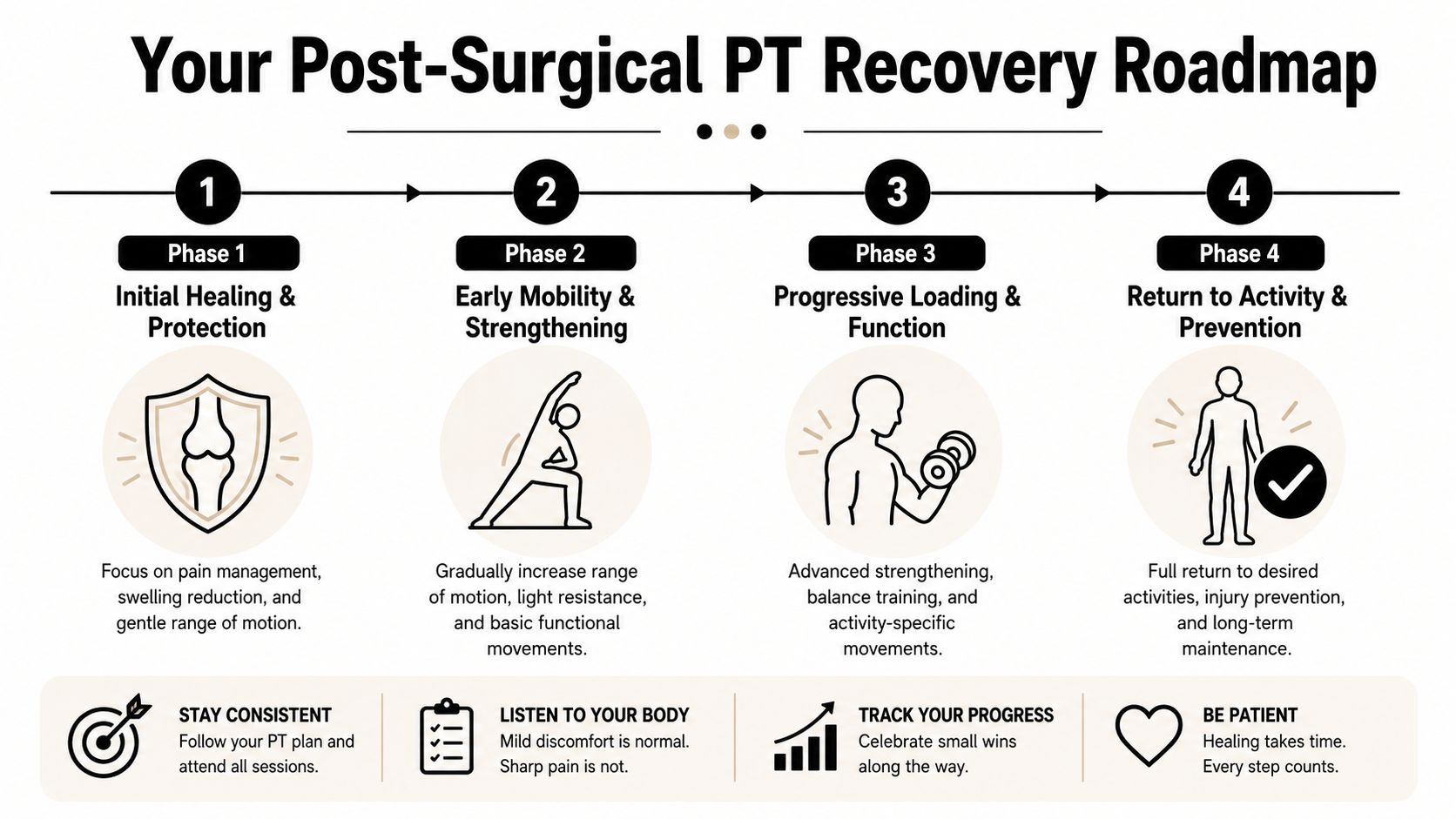
Your Recovery Roadmap The Four Phases of Post-Surgical PT
Recovery works better when you stop treating it like one long blur. Most post-op rehab follows four broad phases. The exact timing depends on the procedure, the surgeon's protocol, your baseline health, and how your tissue responds.
Phase 1 Initial healing and protection
This phase starts immediately after surgery. The priorities are pain control, swelling reduction, wound protection, safe transfers, and basic movement without stressing the repair.
Therapy here may include ankle pumps, breathing work, gentle assisted motion, muscle activation, walker training, and instruction on getting in and out of bed or chairs.
Research on structured early mobilization found that about 60% of surgery patients achieved full mobility independence by day 6 post-op when physical therapy began within the first 24 to 48 hours, according to this review of post-operative mobility gains. That's one reason early movement matters when the surgeon clears it.
Phase 2 Early mobility and motion recovery
Once the surgical area is protected and basic movement is safer, the focus shifts to restoring motion and reducing guarded patterns. Patients often notice that pain is no longer the only issue. Stiffness, swelling, and fear of movement become bigger obstacles.
In this phase, therapy often includes:
- Range-of-motion work: Gentle bending, straightening, reaching, or rotation within allowed limits.
- Basic muscle control: Reconnecting with muscles that have “shut down” after surgery.
- Simple functional drills: Sit-to-stand practice, short walking bouts, and step training if appropriate.
This is often where people get impatient. They feel a little better and want to jump ahead. That's when setbacks happen.
Moving early helps. Moving carelessly doesn't.
Phase 3 Strengthening and function
This phase starts when the tissue can tolerate more load and the joint is moving better. The work becomes more active. You're not just trying to move. You're trying to move well.
Exercises may include closed-chain strengthening, balance work, resistance bands, controlled step work, core stability, and task-specific training based on your surgery. A knee patient may work on stairs and standing tolerance. A shoulder patient may work on reaching mechanics. A spine patient may work on walking tolerance, posture, and trunk control.
A useful way to think about this phase is in terms of function:
| Focus | What it looks like in daily life |
|---|---|
| Better strength | Standing from a chair with less effort |
| Better balance | Safer walking on uneven ground |
| Better control | Less limping, shrugging, or compensating |
| Better endurance | Getting through errands without crashing later |
Phase 4 Return to activity and prevention
The final phase is where rehab becomes personal. The exercises should now match the life you want to return to. That might mean longer walks, lifting household items, getting back to recreational exercise, or preparing for work demands.
This phase often includes more dynamic loading, longer endurance tasks, and movement retraining so you don't return to old compensation patterns that overload another area.
Timeline examples without false precision
Patients often ask for a calendar date when they'll be “done.” That isn't how rehab works. Some surgeries, such as a total knee replacement, may progress steadily through walking, motion, strength, and stair goals. Others, like rotator cuff repair or ACL reconstruction, may feel slower because tissue healing rules limit how quickly loading can increase.
Instead of comparing yourself to someone else, track your own milestones:
- Are transfers easier than last week?
- Is swelling more manageable?
- Can you tolerate more walking or standing?
- Is your movement quality improving, not just your pain level?
That's how recovery should be measured in the clinic and at home.
Essential Home Exercises and Safety Cues
Your home program matters because clinic visits alone aren't enough. The point of home exercise isn't to exhaust you. It's to reinforce safe movement, keep swelling under control, maintain circulation, and prevent stiffness between appointments.
The exact exercises depend on the surgery, but a few foundational movements show up often in early rehab.
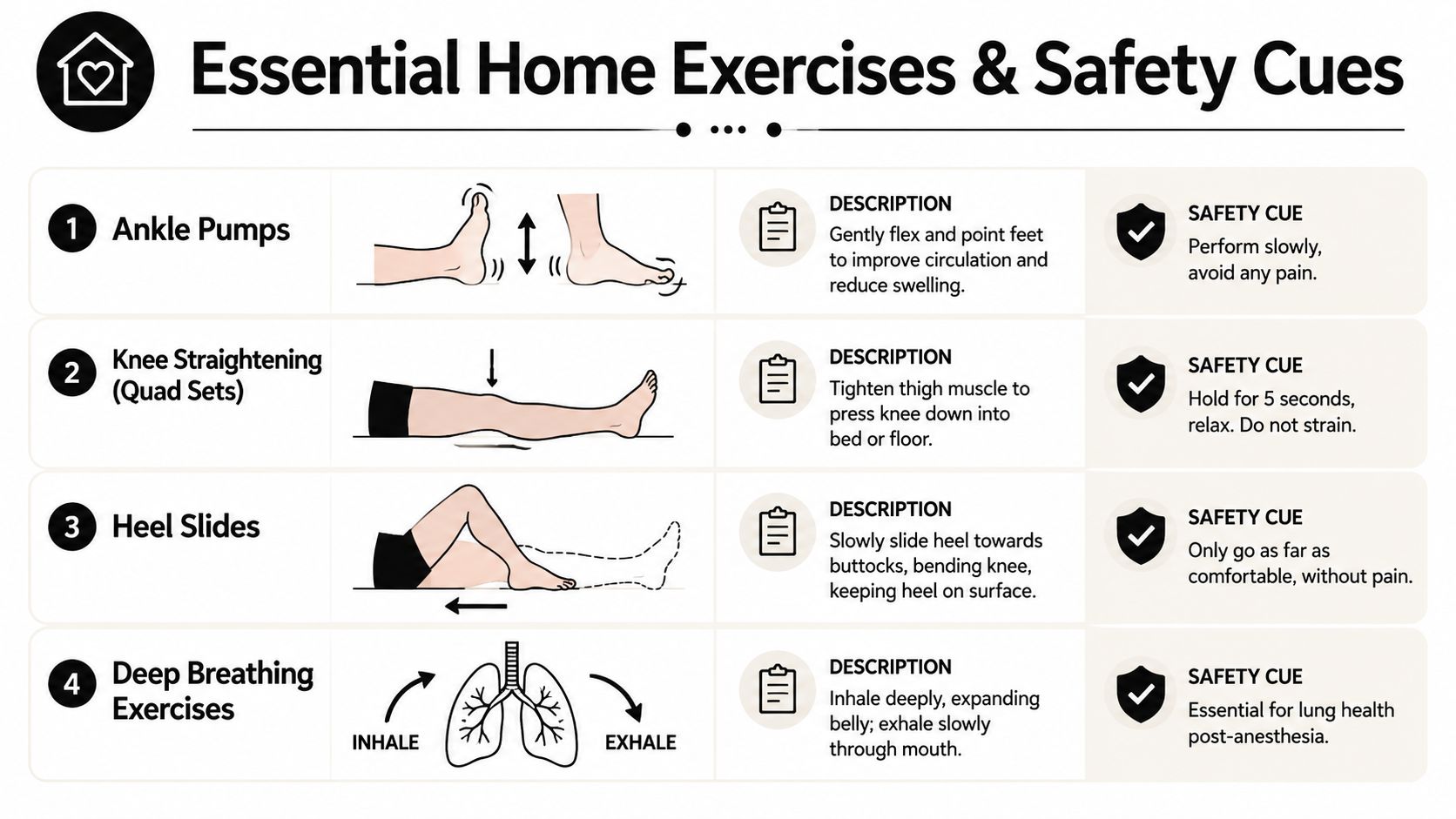
Four early exercises patients commonly use
- Ankle pumps: Point your feet down, then pull your toes up. Move slowly and keep the motion easy. This helps circulation and can help limit swelling.
- Quad sets: Tighten the front of the thigh and try to press the knee gently downward into the bed or floor. Hold briefly, then relax. This helps wake up the quadriceps after lower-body surgery.
- Heel slides: Slide the heel toward you to bend the knee, then slide it back out. Don't force the motion. The goal is controlled mobility, not a pain contest.
- Deep breathing: Inhale fully and let the ribs and belly expand, then exhale slowly. After anesthesia and reduced activity, breathing drills can help you avoid shallow breathing patterns.
This guide to exercises after surgery for faster healing is useful if you want examples of how home work is typically progressed.
A quick visual can make these cues easier to remember:
What the exercise should feel like
Early post-op exercise usually feels like effort, stretch, mild pulling, or muscle fatigue. It should not feel like a sudden stab, a tearing sensation, or a dramatic increase in joint pressure that lingers.
Use these cues:
- Slow is better than forceful: Fast reps usually create compensation.
- Breathe normally: If you're holding your breath, the effort is probably too high.
- Stop before form breaks down: Sloppy reps teach the wrong pattern.
- Respect the surgeon's restrictions: Some surgeries require temporary motion limits even if you feel capable of doing more.
Common mistakes at home
Patients usually run into trouble in one of two ways. They either underdo the plan because they're afraid to move, or they overdo it because they're having a “good day.”
Watch for these problems:
- Skipping exercises for several days, then trying to catch up
- Doing extra reps because the movement seems easy in the moment
- Using household furniture unsafely during exercise
- Pushing through sharp pain because you think pain always means progress
If symptoms spike later that day and stay elevated into the next day, the dose was probably too high.
A better way to approach home rehab
Think consistency, not heroics. A short, focused home session done correctly is more useful than an aggressive workout that leaves the joint irritated and swollen.
If you're unsure whether an exercise still fits your stage of recovery, bring that question to therapy. A home program should evolve. It shouldn't stay frozen at the same level for weeks when your body is ready for the next step.
Navigating Logistics Insurance and Scheduling in Deerfield Beach
You leave the surgeon's office with a packet of instructions, a new medication schedule, and a referral for physical therapy. Then the practical questions hit. Who takes your insurance, how soon should you start, who is driving, and what time of day can you get to treatment without turning the trip into another setback?
That part matters more than patients expect. A good post-op plan can lose momentum fast if visits are delayed by referral problems, authorization issues, or appointment times that do not fit your energy level and transportation options.
Questions worth asking your insurance company
Before the first therapy visit, call your insurance company and get clear answers on the basics. That usually saves time, billing confusion, and missed treatment days.
Ask:
- Is physical therapy covered for post-surgical care under my plan?
- Do I need a referral or prior authorization before I start?
- What will I owe per visit: copay, coinsurance, or deductible?
- Is there a visit cap or a review after a certain number of sessions?
- Is my clinic in network?
If you want a plain-language overview before calling, My Policy Quote's therapy guide can help you sort through the terms insurers usually use.
Scheduling for the real length of rehab
Post-surgical rehab is rarely a one-or-two-visit process. In shoulder surgery research, the average number of post-operative physical therapy sessions attended was 18, according to this study on in-patient PT and post-operative therapy use. Your number may be lower or higher depending on the procedure, your surgeon's protocol, and how steadily you progress. The practical point is simple. Put therapy on the calendar like an active part of treatment, not an optional add-on.
In Deerfield Beach, scheduling also has a local layer. Traffic on Federal Highway, seasonal congestion, and the challenge of getting in and out of the car after surgery can all affect attendance. I often tell patients to choose appointment times based on how they function, not on an ideal schedule they cannot maintain for six weeks.
How to make attendance easier
A few decisions make recovery more consistent:
- Book multiple visits ahead: Holding regular time slots reduces gaps in care.
- Match therapy times to your best window: Some patients move better mid-morning after medication and breakfast. Others do better earlier before fatigue sets in.
- Plan around transportation: If a family member is driving, build a schedule they can realistically keep.
- Ask front-desk questions early: Confirm referrals, authorizations, and billing expectations before they interrupt care.
- Choose convenience on purpose: Easy parking, a short drive, and flexible scheduling often improve follow-through more than patients realize.
If you are comparing clinics, this guide on how to choose a physical therapist can help you look at communication style, post-op experience, and day-to-day practicality.
MedAmerica Rehab Center is one local option for post-surgical rehabilitation in Deerfield Beach. The clinic can help patients work through intake, insurance questions, and scheduling availability when timing is tight. The goal is straightforward. Set up care in a way you can keep showing up for, especially during the first several weeks after surgery.
Expert Tips for a Faster and Smoother Recovery
A good recovery plan is more than exercises. Tissue healing is affected by sleep, hydration, nutrition, stress, medication effects, and how openly you respond to setbacks.
Patients often focus on the obvious part, the joint or incision. The less obvious part is that your whole system is trying to recover at once.
Habits that support healing
A few basics make a real difference:
- Eat regularly: Your body needs enough protein and overall nourishment to repair tissue.
- Hydrate consistently: Dehydration can make fatigue and muscle irritability worse.
- Protect your sleep: Healing is harder when pain, screen time, and irregular schedules keep you up.
- Use movement breaks: Short walks and position changes often help more than sitting too long in one posture.
Respect individual factors
Not every patient should follow the same frequency, intensity, or visit pattern. Older adults often need a more personalized schedule. Data shows that 35% of seniors over 65 require modified PT session schedules due to medication side effects, according to this discussion of preparing and recovering with physical therapy.
That matters in real practice. If a patient is dealing with dizziness, fatigue, balance changes, or fluctuating pain related to medication timing, forcing a standard plan can backfire.
Recovery goes faster when the program fits the patient, not when the patient is forced into a standard template.
Watch the mental side of rehab
Long recoveries can get discouraging. Progress isn't linear. One strong day can be followed by a sore day. That doesn't always mean something is wrong.
Use a steadier standard:
- Look for trends across the week
- Measure function, not just pain
- Report changes early instead of waiting until they become bigger problems
If you're planning a future surgery, ask about pre-surgical therapy. Building strength, learning assistive-device use, and setting realistic expectations before the procedure often makes the post-op phase smoother.
Red flags that deserve a call
Some symptoms need attention rather than patience.
Call your surgeon or therapist promptly if you notice: rapidly increasing swelling, new sharp pain, drainage or signs of infection around the incision, calf pain that feels unusual, shortness of breath, or a sudden loss of function.
Don't try to “push through” symptoms that feel dramatically different from your usual post-op soreness.
Most recoveries improve because patients stay consistent, communicate early, and let the rehab plan progress at the right pace. Fast recovery isn't about doing the most. It's about doing the right things often enough, with good timing and good judgment.
If you're recovering from surgery and want a clear, practical plan for your next steps, MedAmerica Rehab Center offers post-surgical physical therapy in Deerfield Beach with individualized treatment plans, guidance on what to expect, and help coordinating the logistics that often make recovery harder than it needs to be.
MedAmerica Rehab · Deerfield Beach
Talk to a clinician about your pain
Physical therapy, chiropractic, acupuncture and shockwave therapy under one roof, since 1995. Same-day appointments are available.
Mon–Thu 8:00 AM – 6:30 PM · Fri 8:00 AM – 3:00 PM